Global PLM Software in Process Manufacturing Market Snapshot
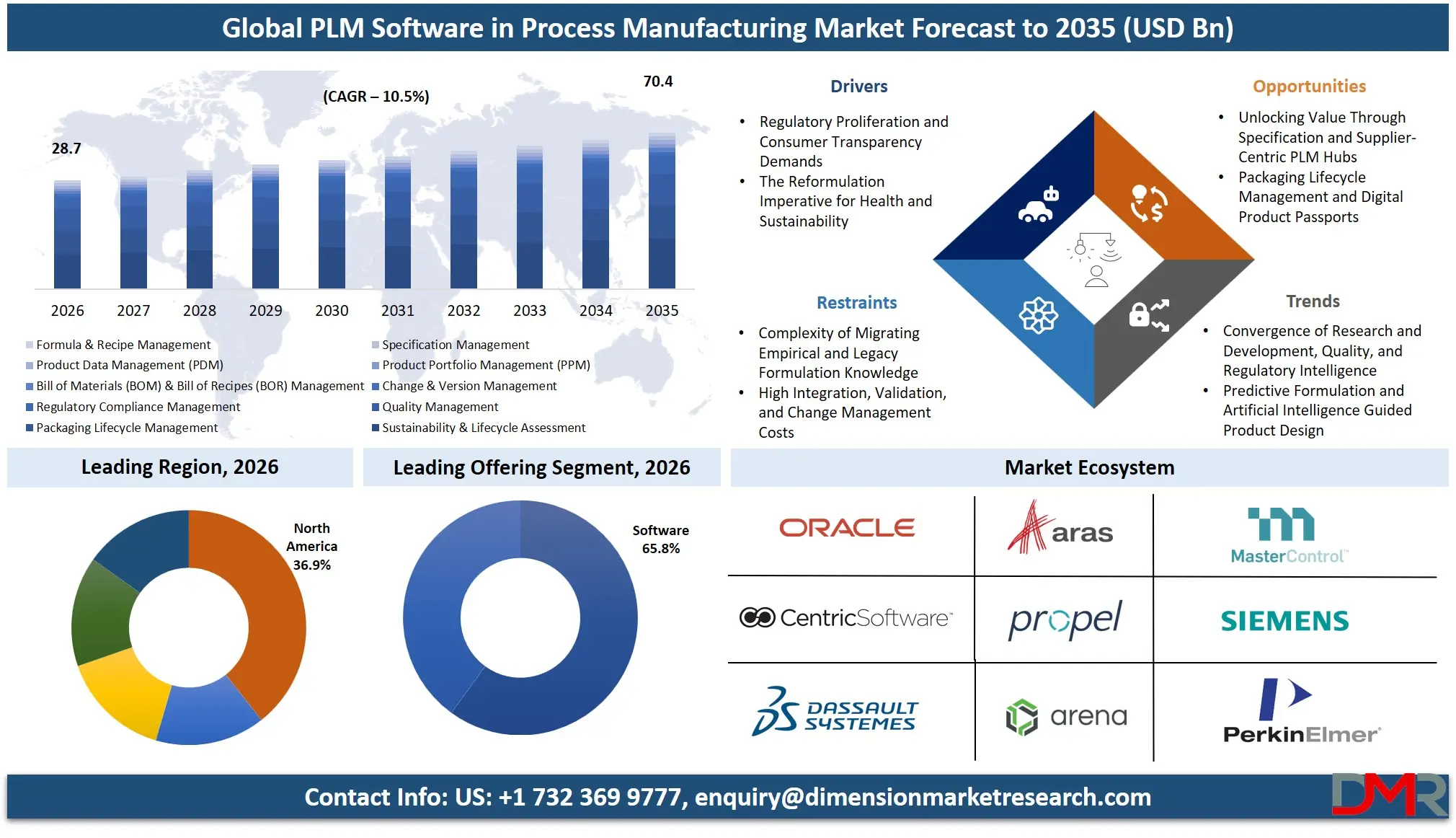
- Global PLM Software in Process Manufacturing Market Size in 2026: USD 28.7 Billion
- Global PLM Software in Process Manufacturing Market Size in 2035: USD 70.4 Billion
- Global CAGR from 2026 to 2035: 10.5%
- Software is the leading offering segment in 2026: 65.8%
- Cloud is the leading deployment mode segment in 2026: 62.5%
- New Product Development (NPD) is the leading application segment in 2026: 26.4%
- Pharmaceuticals is the leading process manufacturing industry segment in 2026: 28.4%
- North America is the leading region in 2026: 36.9%
What is the Global Supply Chain Consulting Service and its Market Size?
Product lifecycle management software in process manufacturing is a digital system for governing product information, formulations, recipes, specifications, ingredients, raw materials, packaging, quality records, regulatory requirements, and commercialization workflows throughout a product's lifecycle. Unlike discrete manufacturing, where the product definition is primarily organized around parts and assemblies, process manufacturing depends on formula driven transformation through blending, mixing, reacting, fermenting, distilling, refining, coating, or similar production methods. PLM software therefore connects research and development, regulatory affairs, quality, procurement, packaging, manufacturing, marketing, and supply chain teams around a controlled product record.
ℹ
To learn more about this report –
Download Your Free Sample Report Here
The Global PLM Software in Process Manufacturing Market is projected to valued at USD 28.7 billion in 2026 and is projected to reach USD 70.4 billion by 2035, expanding at a CAGR of 10.5%. The forecast is supported by growing demand for faster product innovation, formula optimization, specification management, regulatory intelligence, ingredient traceability, packaging compliance, quality by design, supplier collaboration, sustainability assessment, and cloud-based product development. Artificial intelligence, digital thread integration, automated compliance screening, and product level environmental intelligence are expected to expand the strategic role of PLM across food and beverages, chemicals, pharmaceuticals, biotechnology, cosmetics, home care, coatings, agrochemicals, lubricants, pulp and paper, textiles, and specialty materials.
Use Cases
- Formula and Recipe Development: Process manufacturers use PLM software to create, compare, approve, and reuse formulations while managing ingredient percentages, processing instructions, target properties, laboratory trials, yield, scale up parameters, and formula versions. A controlled formulation workspace helps research and development teams reduce duplication, preserve technical knowledge, and accelerate the transition from concept to commercial production.
- Specification and Supplier Management: PLM platforms centralize raw material, ingredient, intermediate, finished product, packaging, and supplier specifications. Automated workflows collect technical data sheets, certificates, safety documents, declarations, and test results from suppliers. This improves specification accuracy, qualification discipline, traceability, and collaboration across procurement, quality, regulatory, and product development teams.
- Reformulation and Compliance Assessment: Manufacturers use PLM to evaluate formulas against allergens, nutritional targets, restricted substances, market specific ingredient rules, claims, chemical inventories, and labeling requirements. When regulations, costs, or material availability change, teams can identify affected products, model substitute ingredients, assess compliance, and control revised formulations before release.
- Packaging Development and Commercialization: PLM connects product formulas with packaging components, artwork, labeling, claims, translations, technical specifications, sustainability attributes, and approval workflows. Brand, regulatory, quality, packaging engineering, and supplier teams can work from synchronized information, reducing artwork errors and improving launch readiness across countries and sales channels.
Key Takeaways
- Market Size: The Global PLM Software in Process Manufacturing Market is anticipated to be valued at USD 28.7 billion in 2026 and is forecast to reach USD 70.4 billion by 2035, expanding at a CAGR of 10.5%.
- Growth Outlook: Market expansion is supported by cloud modernization, digital thread initiatives for farm-to-fork traceability, clean-label reformulation programs, tightening chemical safety regulations, and the growing demand for enterprise-wide product data governance.
- Primary Growth Drivers: Escalating product portfolio complexity, compressed innovation cycles for brand extensions, globally dispersed supplier and co-manufacturer networks, regulatory traceability mandates, sustainable packaging requirements, and the integration of formulation, quality, and labeling data are accelerating PLM investment.
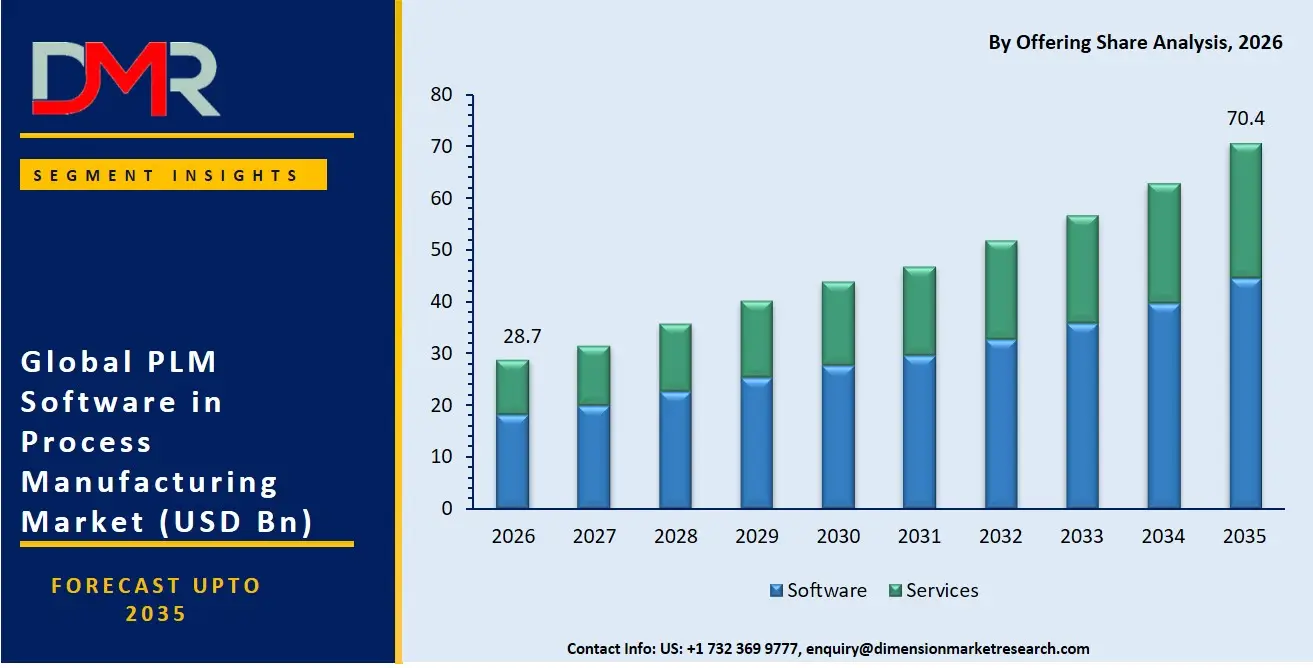
- By Offering Analysis: Software is projected to lead the offering segment with a 65.8% share in 2026, supported by demand for core formulation data management, specification control, labeling automation, and industry-specific capabilities. Services are expected to expand rapidly as enterprises require advisory, system integration, data cleansing, legacy migration, and managed support for value realization.
- By Deployment Mode Analysis: Cloud is expected to lead deployment with a 62.5% share in 2026. Hybrid cloud is projected to record strong growth as manufacturers blend scalable external collaboration with rigorous, on-premise-grade security for proprietary formulas and regulated intellectual property.
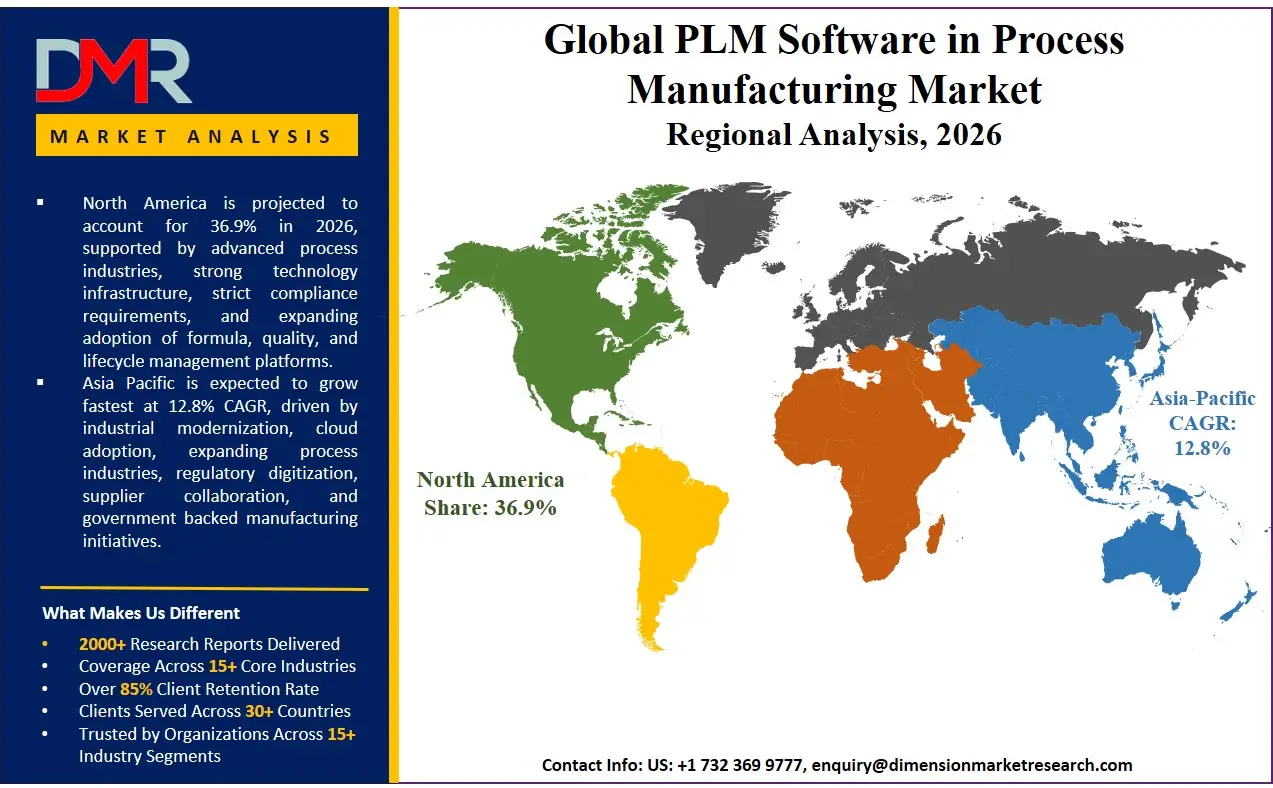
- Regional Leadership: North America is expected to account for 36.9% of global revenue in 2026, supported by mature pharmaceutical, biotechnology, and packaged food sectors and early adoption of AI-driven formulation and intelligent compliance platforms.
How AI/Gen AI is Transforming the PLM Software in Process Manufacturing Market?
Artificial intelligence is turning governed product data into practical formulation and compliance intelligence. Machine learning can classify ingredients and specifications, detect duplicates, identify missing supplier information, predict formula performance, estimate cost and environmental impact, and recommend viable substitutions. Generative artificial intelligence assistants can help formulators and regulatory teams search product histories, summarize safety and technical documents, extract structured data from supplier files, compare formulas, draft product documentation, and retrieve regulatory information through natural language.
The most valuable applications are embedded within controlled PLM workflows rather than separated from product records. Grounded assistants can evaluate nutritional, functional, cost, sustainability, and compliance constraints while preserving formula ownership, access rights, data lineage, and approval history. Emerging agentic capabilities may coordinate supplier onboarding, specification updates, regulatory screening, packaging reviews, and change impact analysis across PLM, enterprise resource planning, laboratory information management, quality management, manufacturing execution, and product information management systems.
Key Drivers in the Global PLM Software in Process Manufacturing Market
Regulatory Proliferation and Consumer Transparency Demands
Process industries face an unprecedented volume of evolving regulations governing ingredient safety, nutritional labeling, environmental impact, allergen disclosure, and provenance claims. From chemical substance registrations to front-of-pack labeling mandates and extended producer responsibility for packaging, the compliance burden is immense. Fragmented document-based or spreadsheet-driven processes cannot reliably manage the speed and complexity of these changes. PLM provides a centralized, rule-driven compliance engine that integrates regulatory intelligence into formula and packaging workflows, ensuring automated, proactive compliance. The imperative for accurate, auditable product records from concept to consumer makes modern PLM a foundational investment for brand integrity and market access.
The Reformulation Imperative for Health and Sustainability
Public health advocacy, evolving dietary guidelines, and corporate environmental, social, and governance commitments are driving an unprecedented wave of product reformulation across food and beverages, cosmetics, and home care. Manufacturers must systematically re-engineer products to reduce sugar, sodium, and saturated fats, remove allergens, replace materials of concern, or substitute petroleum-based ingredients with bio-based equivalents. PLM platforms are essential for managing this complexity at scale. They provide the digital environment to ideate, simulate, validate, and track reformulation projects, comparing organoleptic profiles, cost, compliance, and sustainability metrics against original benchmarks without compromising quality or brand identity.
Restraints in the Global PLM Software in Process Manufacturing Market
Complexity of Migrating Empirical and Legacy Formulation Knowledge
Enterprise PLM adoption in process manufacturing requires assimilating decades of unstructured product expertise handwritten lab notebooks, legacy spreadsheets with implicit knowledge, non-standardized raw material nomenclatures, and tacit formulation heuristics. Migrating this fragmented, often trade-secret data into a structured, governed PLM environment is a formidable scientific and cultural challenge. Large, multi-brand corporations must harmonize diverse naming conventions, units of measure, and testing methodologies acquired through legacy systems. The risk of losing critical organoleptic or processing nuance during digitization, coupled with high data-cleansing and standardization costs, can significantly impede implementation timelines and return on investment, particularly for small and medium-sized manufacturers with limited research and development information technology resources.
Growth Opportunities in the Global PLM Software in Process Manufacturing Market
Unlocking Value Through Specification and Supplier-Centric PLM Hubs
Beyond formula management, a significant greenfield opportunity exists in deploying PLM as a centralized specification management and supplier collaboration hub. Retailers and brand owners increasingly demand full transparency into raw material origins, certifications, and social compliance. By extending PLM to govern detailed raw material, packaging, and trading unit specifications and connecting it directly to supplier portals, manufacturers can streamline onboarding, digitize technical documentation exchange, and proactively mitigate upstream risks. This specification-centric approach enables real-time conformity checks, reduces reformulation lead times caused by material shortages, and builds a resilient, digitally integrated supply chain.
Packaging Lifecycle Management and Digital Product Passports
The global regulatory push toward sustainable packaging and digital product passports (DPPs) is creating a substantial opportunity for PLM expansion. Manufacturers must now manage packaging as an integral part of the product record, linking substrates, inks, adhesives, and structure to recyclability metrics, recycled content targets, and region-specific disposal labeling. PLM platforms that integrate packaging lifecycle management can centralize artwork, link packaging specifications to formulas, automate sustainability scorecards, and generate the datasets required for DPPs. This holistic product-plus-packaging governance is transforming PLM from a formulation-centric tool into a platform for cross-functional sustainability and circular economy compliance.
Trends in the Global PLM Software in Process Manufacturing Market
Convergence of R&D, Quality, and Regulatory Intelligence
Process manufacturers are breaking down silos between research and development, quality assurance, regulatory affairs, and supply chain, converging them onto a unified PLM backbone. This trend recognizes that formula fidelity, quality specifications, regulatory labeling, and supplier material data are fundamentally interdependent. Modern PLM architectures facilitate a seamless digital thread where a formulation change triggers automated quality and regulatory impact assessments, label updates, and supplier alerts. This convergence ensures that the product launched in the market consistently reflects the most current, approved, and compliant product definition.
Predictive Formulation and AI-Guided Product Design
PLM is evolving from a system of record for formulation science to an intelligent engine for predictive product design. Platforms are incorporating physics-informed machine learning models that can predict a recipe's shelf-life stability, rheological properties, or sensory profile based on ingredient inputs before any physical benchtop trial. This trend accelerates the "first-time-right" formulation, dramatically reducing physical prototyping costs, shortening development cycles, and empowering formulators to explore a wider innovation space. AI-guided design is becoming a powerful competitive differentiator in fast-moving consumer goods and specialty chemicals sectors.
Research Scope and Analysis
The Global PLM Software in Process Manufacturing Market is segmented by Offering, Deployment Mode, Organization Size, PLM Functionality, Application, and Process Manufacturing Industry. The analysis evaluates software and service demand, cloud and on-premises adoption, enterprise size, core lifecycle functions, operational applications, and industry-specific requirements.
ℹ
To learn more about this report –
Download Your Free Sample Report Here
By Offering Analysis
Software is projected to lead the offering segment with a 65.8% share in 2026. Demand is propelled by enterprise digitalization of formula authoring, specification data management, global compliance automation, supplier material tracking, and integrated label management processes.
ℹ
To learn more about this report –
Download Your Free Sample Report Here
Core PLM Platforms remain central as the system of record for the complete product definition. Industry Specific PLM Solutions address nuanced workflows in pharmaceuticals, food and beverage, and cosmetics. PLM Add-on Modules for sustainability scoring, AI-driven ideation, and artwork proofing are gaining adoption. Services are expected to record robust growth as deployments require strategic advisory, complex master data cleansing, multi-system integration, organizational change management, and ongoing application management support.
By Deployment Mode Analysis
Cloud is expected to dominate deployment with a 62.5% share in 2026 as process manufacturers seek elastic scalability, secure external collaboration with co-manufacturers and suppliers, rapid innovation environment deployment, and lower total cost of ownership. Hybrid Cloud is projected to register the fastest growth by enabling companies to safeguard highly proprietary master formulas and regulated registration dossiers in private or on-premises environments while leveraging the public cloud for ideation, supplier portals, and non-proprietary workflows. On-premises deployment remains critical for highly regulated pharmaceutical and defense-related chemical sectors demanding maximum data sovereignty and deterministic control over validated computing environments.
By Organization Size Analysis
Large Enterprises are expected to remain the dominant segment due to their expansive global product portfolios, complex brand hierarchies, multi-site production networks, and extensive regulatory submission requirements. These organizations mandate enterprise-grade control over recipe versioning, global specification harmonization, and integrated regulatory content management across hundreds of markets. Small and Medium Sized Enterprises are projected to grow faster as intuitive cloud-based PLM solutions, templated industry workflows, and subscription pricing lower adoption barriers. SMEs increasingly leverage PLM to formalize unstructured product development, strengthen customer audit readiness, and efficiently meet the digital collaboration mandates of large retail and brand clients.
By PLM Functionality Analysis
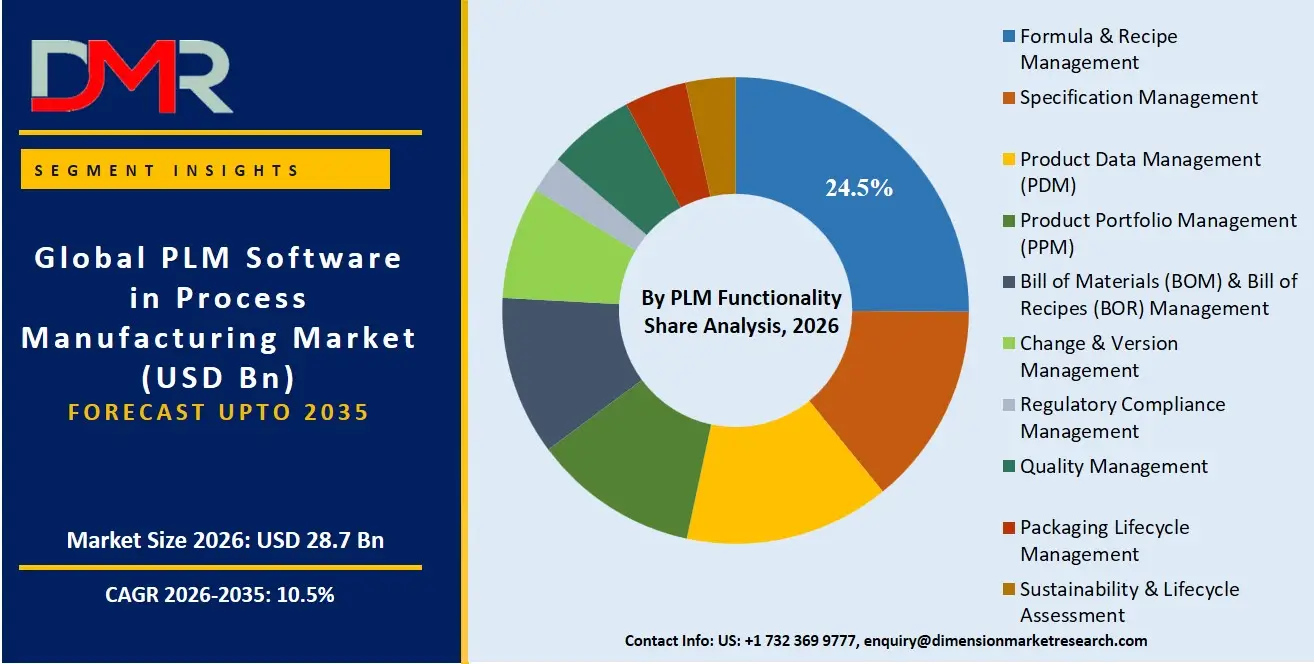
Formula & Recipe Management is expected to lead the functionality segment with 24.5% of market share in 2026, as it constitutes the scientific and intellectual property core for process manufacturers. Specification Management and Bill of Recipes (BOR) Management are fundamental for operationalizing formula data across the supply chain. Regulatory Compliance Management is projected to record the fastest growth due to global regulatory divergence and the need for automated content generation. Quality Management embeds quality attributes directly within the product record for proactive conformance. Sustainability & Lifecycle Assessment is rapidly gaining importance as manufacturers model product carbon footprints and packaging circularity during early-stage design. Packaging Lifecycle Management is emerging as a distinct discipline linking structural design to regulatory and sustainability data.
By Application Analysis
New Product Development (NPD) is projected to dominate the Global PLM Software in Process Manufacturing Market by application, accounting for 26.4% of revenue in 2026. Its leadership arises from the need to coordinate product ideas, formula design, technical specifications, laboratory trials, packaging, regulatory assessment, quality validation, costing, supplier inputs, and launch approvals through a controlled stage gate process. Food and beverage, chemical, pharmaceutical, cosmetic, personal care, and household product manufacturers increasingly use NPD platforms to shorten commercialization cycles while maintaining product safety, claims accuracy, traceability, and formulation consistency. Integrated workflows provide real time visibility across research and development, regulatory affairs, procurement, quality, packaging, and marketing teams. This cross functional coordination reduces rework, strengthens portfolio governance, and improves first time right product launch performance.
By Process Manufacturing Industry Analysis
Pharmaceuticals is projected to lead the industry segment with a 28.4% share in 2026. The industry's strict regulatory operating model, mandated quality by design principles, complex chemistry, manufacturing, and controls (CMC) documentation, and serialized traceability requirements make a governed PLM platform indispensable. Food & Beverages represents a major market characterized by high-velocity brand innovation, clean-label reformulation, and complex allergen management. Chemicals and Cosmetics & Personal Care are driven by stringent safety assessments and specialty ingredient portfolios. Biotechnology is projected to grow strongly as development pipelines diversify, requiring rigorous management of biological raw materials and complex manufacturing processes. Household & Home Care Products adoption is fueled by sustainable chemistry and packaging redesign initiatives.
The Global PLM Software in Process Manufacturing Market Report is segmented on the basis of the following:
By Offering
- Software
- Core PLM Platform
- Industry Specific PLM Solutions
- PLM Add on Modules
- Services
- Consulting and Advisory
- Implementation and Integration
- Training and Support
- Managed Services
By Deployment Mode
- Cloud
- Public Cloud
- Private Cloud
- Hybrid Cloud
- On premises
By Organization Size
- Large Enterprises
- Small and Medium Sized Enterprises (SMEs)
By PLM Functionality
- Formula & Recipe Management
- Specification Management
- Product Data Management (PDM)
- Product Portfolio Management (PPM)
- Bill of Materials (BOM) & Bill of Recipes (BOR) Management
- Change & Version Management
- Regulatory Compliance Management
- Quality Management
- Packaging Lifecycle Management
- Sustainability & Lifecycle Assessment
By Application
- New Product Development (NPD)
- Formula & Recipe Development
- Product Reformulation
- Packaging Development
- Regulatory & Compliance Management
- Supplier Collaboration
- Product Cost Management
- Quality & Traceability Management
- Product Commercialization
- End-of-Life (EOL) Management
By Process Manufacturing Industry
- Food & Beverages
- Chemicals
- Pharmaceuticals
- Biotechnology
- Cosmetics & Personal Care
- Household & Home Care Products
- Paints, Coatings & Inks
- Fertilizers & Agrochemicals
- Oil & Gas (Downstream & Lubricants)
- Pulp & Paper
- Textiles & Fibers
- Tobacco
- Others (Adhesives, Sealants, Rubber, Specialty Materials)
Regional Analysis
North America is the Leading Region in the Global PLM Software in Process Manufacturing Market
ℹ
To learn more about this report –
Download Your Free Sample Report Here
North America is expected to dominate the market, poised to account for 36.9% of global revenue in 2026. The region benefits from a massive, innovation-centric pharmaceutical, biotechnology, and branded food and beverage industrial base. Aggressive investment in digital R&D transformation, a stringent and well-defined regulatory landscape from bodies like the FDA and EPA, and a strong focus on clean-label and bio-based product development reinforce regional leadership. Early adoption of AI for predictive formulation, cloud-based R&D ecosystems, and integrated packaging lifecycle management further solidify North America's position at the forefront of process PLM innovation.
Asia Pacific is the Fastest Growing Region in the Global PLM Software in Process Manufacturing Market
Asia Pacific is expected to record the fastest growth, with a CAGR of 12.8% through 2035. Rapidly expanding pharmaceutical, food processing, specialty chemical, and personal care industries in China, India, South Korea, and ASEAN countries are the primary catalysts. A growing middle class demanding premium, safe, and sustainable products is pushing local manufacturers to formalize R&D processes. Harmonization with global regulatory standards for exports and government-led digitalization initiatives for manufacturing quality are accelerating cloud PLM adoption across both large conglomerates and agile, export-focused SME suppliers.
Europe PLM Software in Process Manufacturing Market
The Europe PLM Software in Process Manufacturing Market is projected to be estimated at USD 7.7 billion in 2026, growing at a CAGR of 9.8% from 2026 to 2035. Europe represents a profoundly influential market driven by the world's most forward-leaning sustainability and circular economy regulations. The EU's Chemicals Strategy for Sustainability, the Ecodesign for Sustainable Products Regulation (ESPR) mandating Digital Product Passports, and strict farm-to-fork transparency are compelling manufacturers to adopt PLM as a compliance and sustainability governance hub. Investment in managing complex packaging waste directives, carbon footprint labeling, and ingredient provenance is particularly strong.
Latin America PLM Software in Process Manufacturing Market
The Latin America market is expanding as large food and beverage, cosmetics, and agrochemical enterprises modernize innovation management. Brazil and Mexico are key adoption hubs, driven by strong local consumption and integration into global value chains. Multinationals are extending their corporate PLM standards to regional R&D centers, while local champions invest in specification and compliance systems to meet export market requirements. Cloud-based PLM offers an accessible pathway for mid-market companies seeking to leapfrog legacy infrastructure, although economic volatility and skills availability can moderate the pace of adoption.
Middle East and Africa PLM Software in Process Manufacturing Market
The Middle East and Africa market is developing alongside economic diversification programs that are building local food processing, halal pharmaceutical, and downstream petrochemical industries. The Gulf states, including Saudi Arabia and the UAE, are investing in world-class R&D and production hubs that require embedded regulatory and formula management. South Africa maintains a notable market in fast-moving consumer goods and beverages. Cloud-native and mobile-enabled PLM solutions are particularly relevant for managing specifications and supplier quality in regions with developing IT infrastructure, making compliance and traceability the primary purchasing drivers.
Major Countries Analysis
United States PLM Software in Process Manufacturing Market
ℹ
To learn more about this report –
Download Your Free Sample Report Here
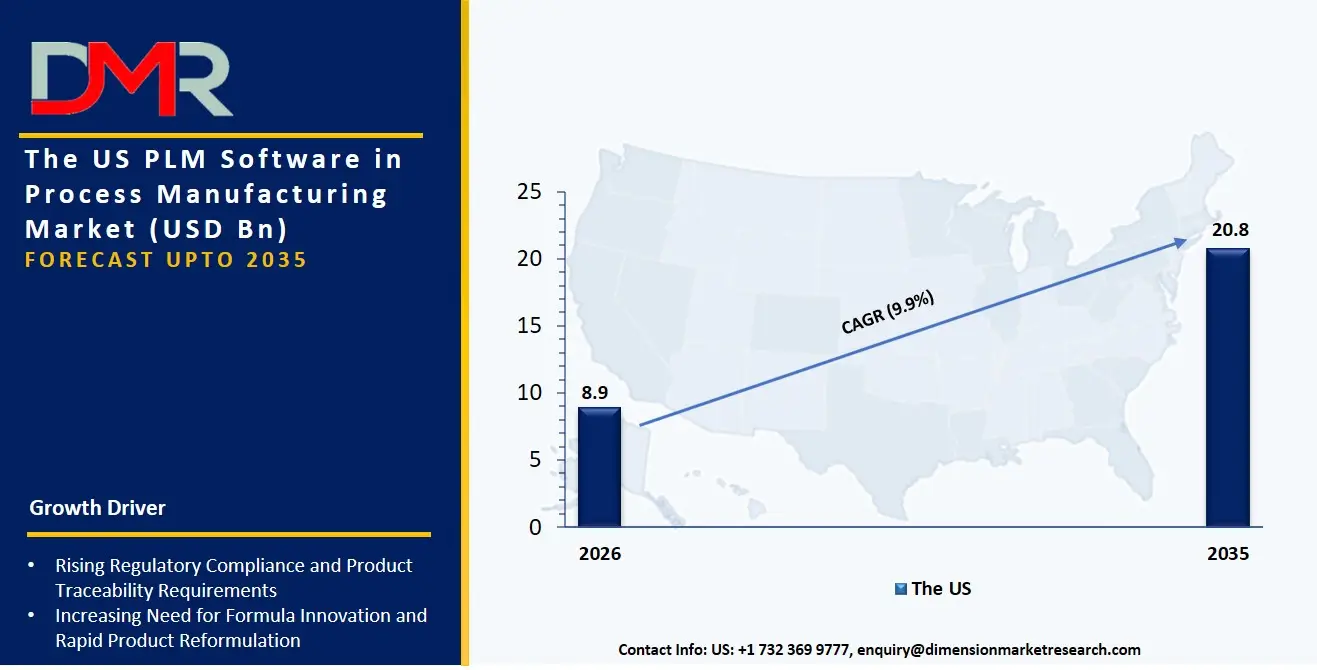
The United States PLM Software in Process Manufacturing Market is poised to be estimated at USD 8.9 billion in 2026 and is projected to reach USD 36.9 billion by 2035, expanding at a CAGR of 9.9% during the forecast period. The U.S. represents the single largest national market, driven by its colossal pharmaceutical, biotech, consumer packaged goods, and specialty chemical sectors. Manufacturers are leveraging PLM to accelerate generic drug development, manage complex biologics data, execute clean-label reformulations at scale, and automate the generation of FDA-compliant labeling. Investment is gravitating toward AI-driven product lifecycle intelligence, cloud-based collaborative R&D, and software solutions that unify formula science with rigorous regulatory information management.
Japan PLM Software in Process Manufacturing Market
The Japan PLM Software in Process Manufacturing Market is estimated at USD 1.9 billion in 2026 at a CAGR of 9.9%. Growth is supported by Japan's established chemicals, pharmaceuticals, biotechnology, food and beverages, cosmetics and personal care, advanced materials, coatings, and specialty manufacturing industries. Manufacturers are modernizing formula development, specification management, quality control, regulatory compliance, packaging workflows, and supplier collaboration to address workforce constraints, complex product portfolios, and international commercialization requirements. PLM platforms help companies govern recipes, formulations, raw material specifications, product changes, labeling data, and quality documentation. Increasing adoption of cloud platforms, artificial intelligence, laboratory integration, digital quality systems, and sustainability assessment will support continued market expansion.
Saudi Arabia PLM Software in Process Manufacturing Market
The Saudi Arabia PLM Software in Process Manufacturing Market is estimated at USD 450.0 million in 2026 at a CAGR of 9.6%. Growth is supported by national diversification initiatives that are expanding downstream petrochemicals, specialty chemicals, fertilizers, lubricants, pharmaceuticals, food processing, beverages, cosmetics, and consumer goods production. New manufacturing facilities require controlled formula and recipe data, specification management, quality assurance, regulatory compliance, supplier qualification, and technology transfer capabilities. PLM software enables manufacturers to connect product development with packaging, plant scale up, procurement, quality, and commercialization workflows. Opportunities are strong for vendors offering secure cloud deployment, localized implementation, data migration, regulatory intelligence, system integration, and workforce training.
Regulatory Landscape
The regulatory landscape makes controlled product information essential across process industries. Food and beverage companies manage ingredient permissions, allergens, nutrition, claims, traceability, and labeling. Chemical, coating, lubricant, textile, and specialty material manufacturers manage hazard classification, safety data sheets, substance restrictions, chemical inventories, and customer declarations. Pharmaceutical and biotechnology companies require documented development, quality, validation, electronic records, regulatory submissions, and controlled post approval changes. Cosmetics and personal care manufacturers manage ingredient restrictions, product safety, claims, notifications, and market specific labeling.
Packaging, environmental, and sustainability obligations increasingly cut across all sectors. Manufacturers need reliable information on packaging composition, recycled content, recyclability, restricted substances, product carbon footprints, and end of life routes. PLM supports compliance by connecting requirements with formulas, specifications, suppliers, tests, labels, packaging, approvals, and commercial products. The platform is most effective when regulatory content is current, responsibilities are defined, workflows are validated where required, and every decision retains a traceable human approval.
Investment and White Space Analysis
The strongest investment opportunities lie in cloud native formula centric PLM, embedded regulatory intelligence, artificial intelligence grounded in proprietary product data, specification exchange, supplier onboarding, packaging compliance, and product level sustainability analytics. White space remains in connecting PLM with laboratory information management, electronic laboratory notebooks, quality management, enterprise resource planning, manufacturing execution, regulatory databases, product information management, artwork, and environmental data without expensive custom integration.
Vendors can differentiate through industry templates, rapid migration from spreadsheets, configurable data models, multilingual regulatory coverage, validated cloud environments, low code workflows, cybersecurity, and measurable implementation outcomes. Midmarket manufacturers remain underserved, particularly in chemicals, coatings, adhesives, home care, agrochemicals, food ingredients, and regional consumer goods. Specialized capabilities for scale up, formula optimization, ingredient substitution, claims substantiation, safety documentation, and packaging lifecycle management can address needs that broad horizontal PLM platforms do not fully cover.
By Region
North America
Europe
- Germany
- The U.K.
- France
- Italy
- Russia
- Spain
- Benelux
- Nordic
- Rest of Europe
Asia-Pacific
- China
- Japan
- South Korea
- India
- ANZ
- ASEAN
- Rest of Asia-Pacific
Latin America
- Brazil
- Mexico
- Argentina
- Colombia
- Rest of Latin America
Middle East & Africa
- Saudi Arabia
- UAE
- South Africa
- Israel
- Egypt
- Rest of MEA
Competitive Landscape
The Global PLM Software in Process Manufacturing Market is moderately fragmented because competition spans broad enterprise PLM vendors, formula centric specialists, regulatory content providers, specification management platforms, quality software vendors, packaging workflow providers, and implementation partners. Large platform vendors compete on global scalability, enterprise integration, cloud architecture, workflow configuration, analytics, security, and lifecycle breadth. Industry specialists differentiate through formula and recipe management, ingredient intelligence, nutrition, chemical compliance, claims, supplier specifications, labeling, artwork, and rapid deployment.
Competitive advantage increasingly depends on the ability to connect research, regulatory, quality, procurement, packaging, manufacturing, and commercial data within a governed product record. Vendors are embedding artificial intelligence for formulation, regulatory research, document extraction, data cleansing, and product knowledge search. Open application programming interfaces, low code configuration, validated environments, sustainability data, and integrations with enterprise resource planning, laboratory information management, quality management, manufacturing execution, product information management, and regulatory databases are becoming central purchasing criteria.
Some of the prominent players in the Global PLM Software in Process Manufacturing Market are:
- Siemens Digital Industries Software
- Dassault Systèmes
- SAP
- Oracle
- PTC
- Aras
- Infor
- Centric Software
- TraceGains
- Selerant
- Specright
- beCPG
- Aptean
- MasterControl
- Veeva Systems
- Propel Software
- IFS
- Dotmatics
- PerkinElmer Informatics
- Xybion
- Honeywell
- Hexagon AB
- AVEVA
- Bentley Systems
- UL Solutions
- OpenBOM
- Omnify Software
- IBM
- Ideagen
- Other Key Players
Recent Developments
- In July 2026, Centric Software announced that Brenntag had deployed Centric PLM across its European Food and Nutrition operations. The implementation centralized formulas, compliance data, client briefs, technical documentation, and product development workflows while integrating compliance analysis into formulation activities.
- In April 2026, Trace One expanded Trace One Copilot with three purpose built assistants for regulatory affairs, product development, and supply chain work. The capabilities were embedded within Trace One Devex PLM and its regulatory compliance platform for food and beverage, cosmetics, and specialty chemical users.
- In October 2025, Trace One and Mondra announced the integration of product carbon footprint and lifecycle assessment insights into PLM workflows for food and beverage companies. The partnership was designed to bring environmental information into product development and supplier collaboration.
- In August 2025, Centric Software announced new food and beverage and grocery PLM capabilities, including embedded artificial intelligence, supplier collaboration improvements, mobile functionality, and a compliance engine for ingredient rules and formulation assessments across countries.
Report Details
| Report Characteristics |
| Market Size (2026) |
USD 28.7 Bn |
| Forecast Value (2035) |
USD 70.4 Bn |
| CAGR (2026–2035) |
10.5% |
| The US Market Size (2026) |
USD 8.9 Bn |
| Historical Data |
2021 – 2025 |
| Forecast Data |
2027 – 2035 |
| Base Year |
2025 |
| Estimate Year |
2026 |
| Segments Covered |
By Offering, By Deployment Mode, By Organization Size, By PLM Functionality, By Application, By Process Manufacturing Industry |
| Regional Coverage |
North America – The US and Canada; Europe – Germany, The UK, France, Russia, Spain, Italy, Benelux, Nordic, & Rest of Europe; Asia-Pacific – China, Japan, South Korea, India, ANZ, ASEAN, Rest of APAC; Latin America – Brazil, Mexico, Argentina, Colombia, Rest of Latin America; Middle East & Africa – Saudi Arabia, UAE, South Africa, Turkey, Egypt, Israel, & Rest of MEA |
Frequently Asked Questions
How big is the Global PLM Software in Process Manufacturing Market?
▾ The Global PLM Software in Process Manufacturing Market is valued at USD 28.7 billion in 2026 and is projected to reach USD 70.4 billion by 2035, reflecting strong worldwide demand for formula, specification, and compliance management solutions.
What is the CAGR of the Global PLM Software in Process Manufacturing Market from 2026 to 2035?
▾ The market is projected to expand at a compound annual growth rate of 10.5% between 2026 and 2035, supported by sustained investment in digital transformation for innovation management and regulatory compliance in process industries.
What factors are driving the growth of the Global PLM Software in Process Manufacturing Market?
▾ Growth is driven by escalating global regulatory complexity, health-driven product reformulation, clean-label and sustainability mandates, the need for end-to-end traceability, supplier transparency, and AI-augmented product development.
What are the major trends in the Global PLM Software in Process Manufacturing Market?
▾ Major trends include the convergence of R&D and quality on unified platforms, AI-powered predictive formulation, integrated packaging lifecycle management for sustainability, and the shift toward cloud and hybrid deployment models.
Which offering segment leads the Global PLM Software in Process Manufacturing Market?
▾ Software is projected to lead the offering segment with a 65.8% market share in 2026, supported by strong demand for core formulation, specification management, and embedded regulatory intelligence.
Which process manufacturing industry leads the market?
▾ Pharmaceuticals is projected to dominate the industry segment with a 28.4% share in 2026, driven by strict quality by design mandates, complex CMC documentation, and rigorous change control requirements.
Which region holds the largest share of the Global PLM Software in Process Manufacturing Market?
▾ North America is expected to lead the global market with a 36.9% share in 2026, supported by a massive base of pharmaceutical, biotechnology, and branded food companies and high innovation investment.
Which region is expected to grow the fastest in PLM Software in Process Manufacturing Market ?
▾ Asia Pacific is expected to record the fastest growth at a 12.8% CAGR through 2035, driven by industrial modernization, food safety reforms, and rapidly scaling life sciences and consumer goods sectors.
Who are the key players in the Global PLM Software in Process Manufacturing Market?
▾ Key market participants include Siemens, Dassault Systèmes, SAP, Oracle, PTC, Infor, Centric Software, Aptean, Trace One, and IFS, alongside specialists serving food, pharmaceutical, and chemical manufacturers globally.
How is the Global PLM Software in Process Manufacturing Market segmented?
▾ The market is segmented by offering, deployment mode, organization size, PLM functionality, application, and process manufacturing industry, with comprehensive regional analysis across all major geographies.