What is the Polyurethane Foam Market Size?
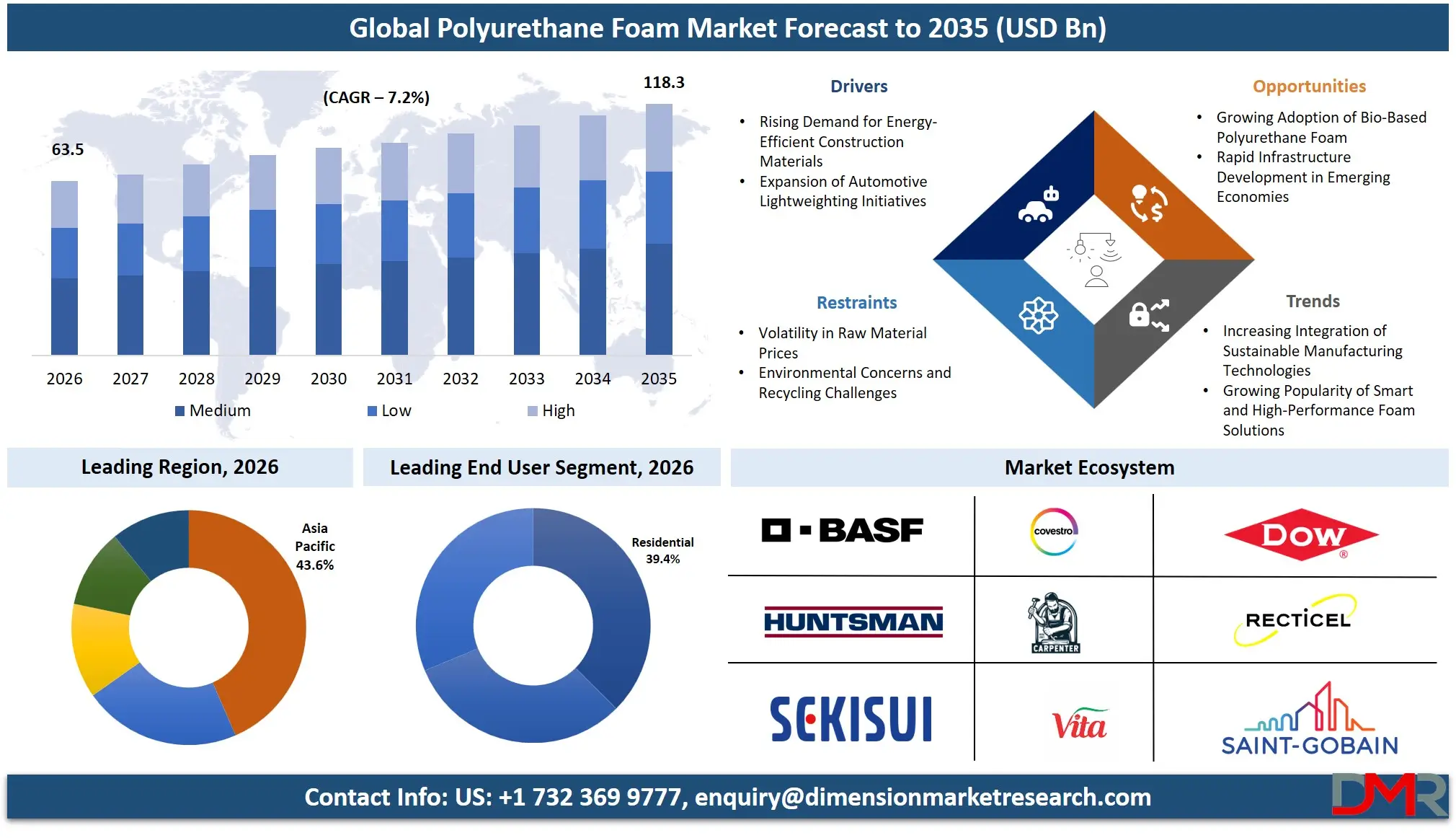
The Polyurethane Foam Market size is expected to be USD 63.5 billion in 2026 and increase at a compound annual growth rate of 7.2% to USD 118.3 billion in 2035 due to increased focus by the international community towards energy-efficient infrastructure development.
ℹ
To learn more about this report –
Download Your Free Sample Report Here
The Polyurethane Foam Market has experienced steady growth due to increased demand in various industry sectors like construction/building, automotive, furniture, mattresses/bedding, packing, and electronics. Increased demand for energy-efficient insulation material, light vehicle parts, and comfortable products have contributed to the market growth. The use of bio-polyurethane foam, sustainable production process, and use of recyclable raw materials has resulted in dynamic change within the industries.
ℹ
To learn more about this report –
Download Your Free Sample Report Here
The US Polyurethane Foam Market
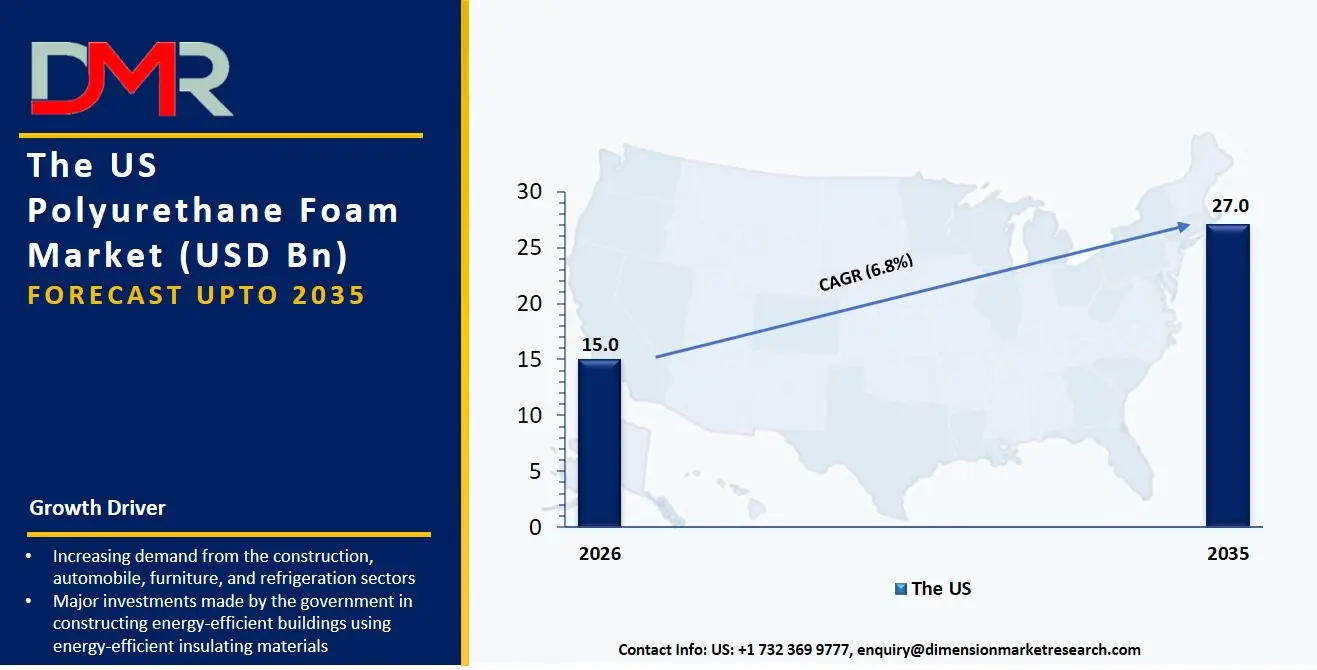
The US Polyurethane Foam Market size is estimated to be USD 15.0 billion in 2026 and is expected to increase at a CAGR of 6.8% over the forecast period.
Factors contributing towards the growth of the US Polyurethane Foam Market include the increasing demand from the construction, automobile, furniture, and refrigeration sectors. Major investments made by the government in constructing energy-efficient buildings using energy-efficient insulating materials are contributing significantly towards driving the adoption of rigid polyurethane foam products. Availability of advanced manufacturing facilities coupled with rising demand for lightweight vehicles is further fueling growth in the market. Regulations made by the government on sustainable constructions as well as low energy consumption by buildings have led to the development of eco-friendly polyurethane foam products.
ℹ
To learn more about this report –
Download Your Free Sample Report Here
Europe Polyurethane Foam Market
The Europe Polyurethane Foam Market size is estimated to be USD 12.1 billion in 2026 and is expected to increase at a CAGR of 6.7% over the forecast period.
In terms of regulations, sustainability norms, energy-efficiency initiatives, and circular economy strategies, the Europe Polyurethane Foam market will be highly impacted within the regional environmental context. The rising demand for rigid polyurethane foam insulation has been driven by building energy efficiency standards as well as building renovations in both residential and commercial applications. Additionally, automotive companies in Europe are using lightweight foam materials in order to increase fuel efficiency and electric vehicle efficiency. With rising investments in biopolyols and recycling polyurethane materials, more innovations can take place among manufacturers.
Japan Polyurethane Foam Market
The market size of Japan Polyurethane Foam will be USD 3.8 billion in 2026 and at a CAGR of 6.5% in the forecast period.
The Polyurethane Foam Market of Japan is growing at a steady pace owing to an increase in demand in electronic, automobile manufacturing, medical, and modern building industries. The use of high-performance materials and energy-efficient buildings in the country has boosted demand for rigid and microcellular foams. Fast-paced advancements in interior design of automobiles, insulation, and manufacture of smart appliances are acting as another driving force behind the growth of the market. With government backing sustainable industrial production practices and eco-friendly materials, there is rising interest in developing bio-based polyurethane technology.
Key Takeaways
- Market Size & Forecast: The Polyurethane Foam Market size is projected to reach USD 63.5 billion in 2026 and is anticipated to have a value of USD 118.3 billion in 2035.
- Growth Rate & Outlook: The Polyurethane Foam Market size is set to grow at a compound annual growth rate of 7.2% during the forecast period of 2026 to 2035.
- Primary Growth Drivers: Some of the major growth drivers in the market Increasing Demand for Efficient Building Material, and more.
- Key Market Trends: Some of the major trends in the market are Greater Integration of Sustainable Manufacturing Technologies, and more.
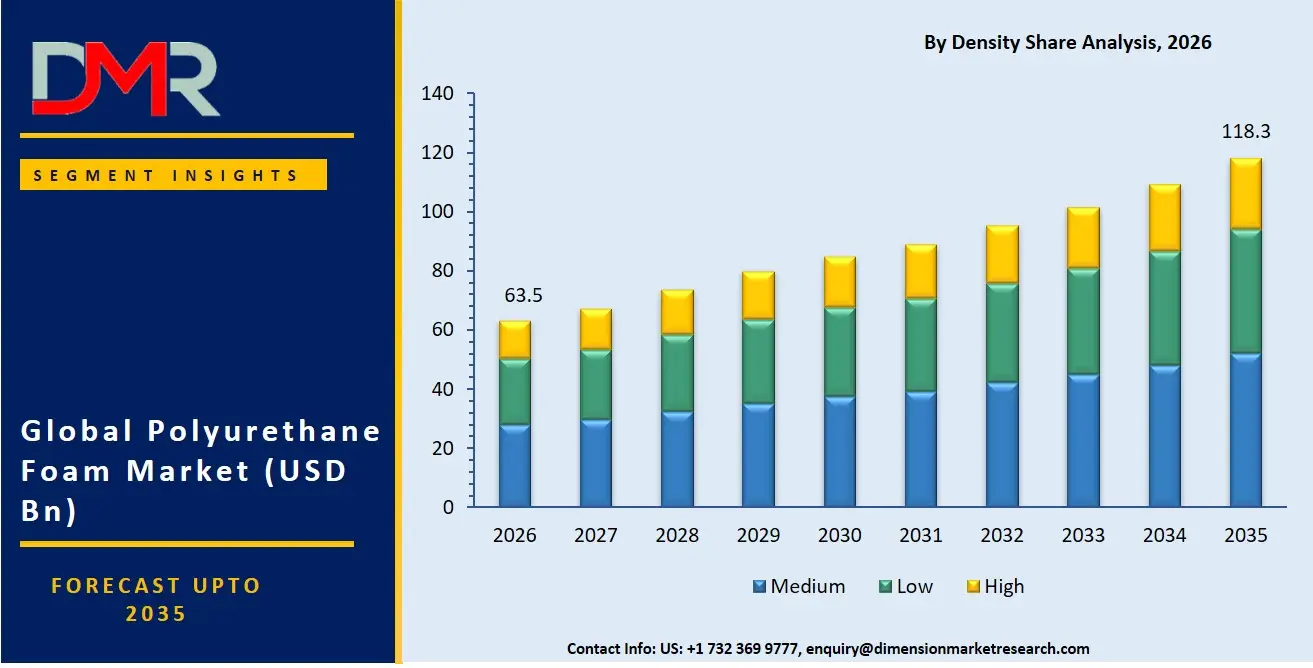
- By Density: Medium segment is anticipated to get the majority share of the Polyurethane Foam Market in 2026.
- By Application: Furniture & Bedding is expected to get the largest revenue share in 2026 in the Polyurethane Foam Market.
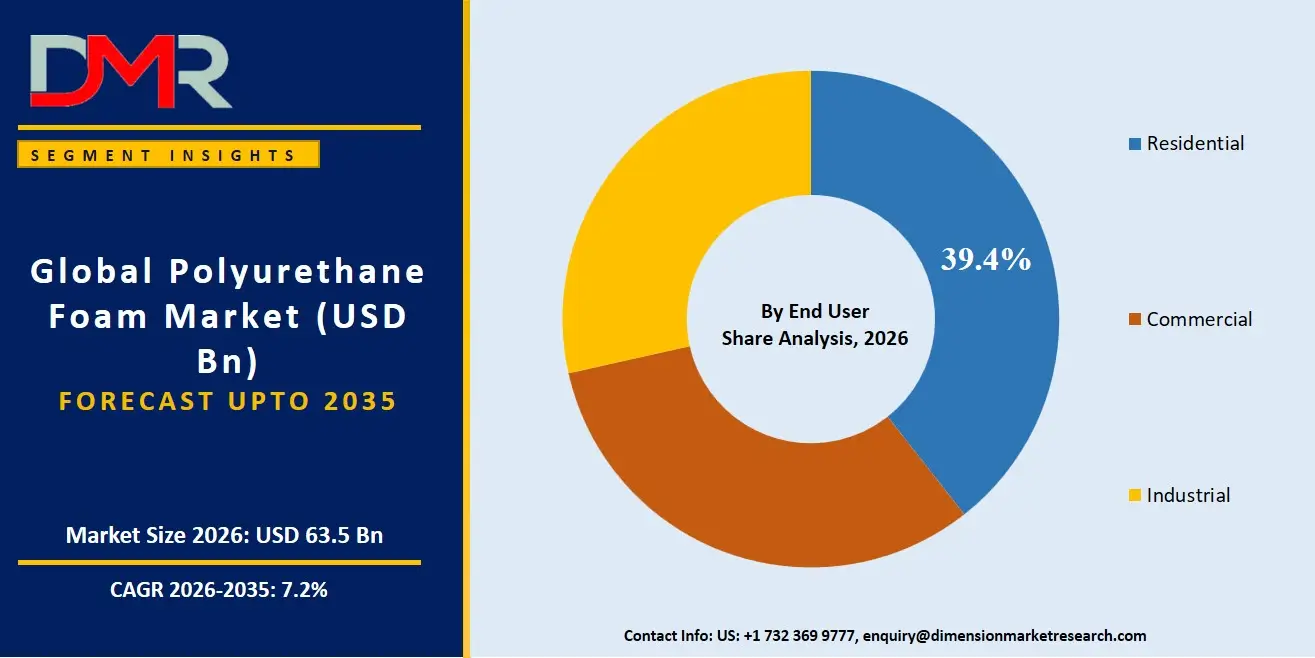
- By End User: Residential segment is expected to get the largest revenue share in 2026 in the Polyurethane Foam Market.
- Regional Leadership: Asia Pacific is set to lead the Polyurethane Foam Market with an estimated 43.6% share in 2026.
What is the Polyurethane Foam?
Polyurethane Foam is an extremely flexible polymer substance created by the reaction between polyols and isocyanates. This material comprises flexible, rigid, spray, and special-purpose foam forms that are utilized in various applications such as furniture, bedding, construction, automobiles, packaging, shoes, health care, and industry. The significance of polyurethane foam in the manufacturing and construction industry has increased greatly due to its excellent energy-saving and comfort-improving capabilities. Trends that include the development of bio-based polyurethane foam, recyclability, reduced emission manufacturing, and intelligent insulation systems are fueling innovations and transforming the consumption patterns globally.
Use Cases
- Applications of Thermal Insulation: The material finds uses in domestic as well as industrial construction where insulation of walls, ceilings, refrigerators and freezers needs to be undertaken. The high level of resistance to thermal conductance makes polyurethane foams very useful for saving energy, ensuring indoor stability of temperature and sustainability in infrastructure.
- Interior Parts of Vehicles: Polyurethane foams are widely used by automakers in producing interior components of automobiles because the materials prove very useful in offering seats which are comfortable to use, sound insulation and weight reduction in vehicles. As a result, they make valuable contributions in manufacturing both regular and electric cars.
- Furniture and Beddings Manufacturing: Flexible polyurethane foams offer good qualities in terms of resiliency, comfortability and pressure relieving. These qualities have made the materials very popular in production of beds, upholsteries, pillows and cushions. Increase in demand for high quality ergonomic furniture and high end beds will drive global market.
- Packaging Foam Materials: Polyurethane foams are widely used in packaging of fragile electronic goods in order to protect them from damage while handling or storage in certain temperatures.
How AI Is Transforming the Polyurethane Foam Market
AI has significantly impacted the polyurethane foam industry by enhancing manufacturing accuracy, quality checks, and optimizing the logistics of the whole process. AI can assist manufacturers in analyzing raw material use, formulating foam, and minimizing production wastage through predictive analytics techniques. Defects in density, consistency, and foam structure can be identified with the help of automated inspection procedures based on AI.
Moreover, AI technology is being used in research and development activities to speed up material development processes and test their performance with the help of virtual simulations. AI-based systems are being used by companies to forecast demand, manage inventories, and even customize products according to the customers' preferences. For instance, AI is aiding designers to create innovative and sustainable products for automotive and building applications.
Market Dynamic
Driving Factors in the Polyurethane Foam Market
Increasing Demand for Efficient Building Material
Increased focus by the international community towards energy-efficient infrastructure development is one of the most prominent factors that have been fueling the growth of the rigid polyurethane foam market. The insulation properties provided by rigid polyurethane foam make it a great choice for the construction industry when it comes to energy-efficient construction. With strict energy-efficiency building regulations being enforced by many governments, the use of rigid polyurethane foam will only see increased adoption in future years.
Restraints in the Polyurethane Foam Market
Fluctuations in Feed Stock Costs
The manufacture of polyurethane foams relies heavily on petrochemical feed stocks, and hence any volatility in the price of crude oil and feed stock supply will significantly impact the cost of production and profitability. Geopolitical concerns and economic instabilities also play a role in adding uncertainty to the pricing process. Small firms are likely to experience difficulties in sustaining competitive prices in case of an increase in raw material costs.
Opportunities in the Polyurethane Foam Market
Increasing Demand for Bio-Based Polyurethane Foam
The ever-growing emphasis on sustainability around the world has opened up new vistas of possibilities for manufacturers of bio-based polyurethane foams. Manufacturers have been making huge investments in renewable polyols made from plant sources such as soy and castor oils among others to decrease their dependency on petrochemicals. The consumer preference for eco-friendly products along with stringent regulations regarding sustainability are making it essential to develop carbon-efficient foams. Manufacturers should capitalize on the opportunities presented by industries such as furniture, automobiles, and construction which are looking for sustainable products.
Trends in the Polyurethane Foam Market
Greater Integration of Sustainable Manufacturing Technologies
The implementation of sustainable manufacturing technologies has been seen widely throughout the manufacturing industries because of its benefits to the environment and to operational efficiencies. In particular, there have been increased efforts in the development of materials that are made up of lower global warming potential blowing agents, recyclable formulas, bio-based sources, and low-emissions production systems. There have also been growing investments for circular economies focused on reclaiming polyurethane materials from scrap.
Research Scope and Analysis
The research scope of the Polyurethane Foam Market is based on the analysis of performance of the market through foam type, raw materials, density, application, end user, and sustainability segments. It includes the evaluation of demand patterns, innovations, competitive strategies, and regulatory factors that are driving industry growth in regions.
ℹ
To learn more about this report –
Download Your Free Sample Report Here
By Foam Type Analysis
Flexible Polyurethane Foam is expected to hold the largest market share of 41.8% by 2026 among all foam type segments due to its application in furniture pieces, beds, car seats, and cushions. Such product types benefit from the increasing demand for comfortable furniture and luxury mattresses within households and hotels. Moreover, flexibility, light weight, and economic benefits of the above mentioned products lead to their utilization within industrial production. As far as fastest growing product type is concerned, it would be Spray Polyurethane Foam due to the increasing demand for quality insulating products in residential houses and commercial properties. The necessity of energy efficiency and the construction of eco-friendly buildings and facilities increases demand for spray foam application in the roofing and walling areas. Also, producers are expected to introduce spray foam technology with minimal emissions and environmentally friendly materials.
By Raw Material Analysis
Polyols are anticipated to lead the raw material segment with a projected market share of 46.5% in 2026, considering that they act as a vital ingredient in producing flexible, rigid, and specialty polyurethane foams. The choice of polyether polyols is very popular among users because of their durability, hydrolytic stability, and economy in mass-production processes. With the growing trend in consuming comfort goods, insulating products, and automobiles interior parts, high consumption of polyols can be observed across the world. The bio-based polyols are likely to show highest growth rates in future, following the rising trend towards adopting sustainable raw materials in the manufacturing industry. This will further lead manufacturers to focus on utilizing renewable sources of polyols such as soybean oil, castor oil, etc.
By Density Analysis
Medium Density Polyurethane Foam is projected to have an almost 44.2% share of the market in 2026 because of the combination of various properties like durability, flexibility, comfort, and strength. Medium density foam has become a choice material in mattresses, upholstery furniture, car seats, and industrial applications because of their perfect combination of resilience and affordability. Rising consumer preference towards comfortable sleeping and seating products is driving the demand for Medium Density polyurethane foams in the market. On the other hand, the High Density foam is expected to grow at a fast pace owing to the rising demand for high quality insulation products and industrial applications. High density foams are known for their durability, thermal resistance, and load-bearing properties.
By Application Analysis
The Furniture & Bedding application segment will remain in the lead with a market share estimated to increase to 33.9% in 2026 due to increasing demand from around the world for mattresses, sofas, pillows, and upholstered furniture. Flexible polyurethane foam is among the major products used in the Furniture & Bedding application segment because of the attributes like comfort, durability, lightweight, and affordability that it offers. Urbanization, disposable income, and the desire of consumers for comfort are some of the factors driving the growth in demand for the products. The Building & Construction application segment will be the fastest-growing due to the focus of both the government and private entities on building energy-efficient buildings and using sustainable building materials.
By End User Analysis
The Residential category is expected to hold around 39.4% market share by 2026 owing to growing demand for polyurethane foam products used in beds, sofas, insulating and household appliances. Growing urban housing constructions, renovations, and consumer expenditure in purchasing household comfort products are contributing to considerable market growth. Flexible foams continue to gain high preference in furniture making in the residential category due to excellent cushioning and durability properties. The Commercial category is expected to be the fastest-growing category owing to the expansion of office buildings, hotels, healthcare, and retail establishments. Increased focus on energy-efficient buildings and innovative interior solutions has been boosting the requirement for polyurethane foam insulations, acoustic and furnishings products.
By Sustainability Type Analysis
Convention Polyurethane Foams are projected to command the largest market share of sustainability types at 67.8% in 2026 because of its vast applications in the industry, effective distribution network, and favorable cost economics. The conventional polyurethane foam material remains highly in demand in several industries such as construction, automobile, furniture, and packaging as a result of its superior quality and ease of manufacturing. However, Bio-Based Polyurethane Foams are projected to witness the highest CAGR during the same period as firms are embracing green approaches and techniques in dealing with environmental issues of sustainability. This is because the firms are making huge investments in renewable raw materials and eco-friendly technology to comply with environmental legislation and preferences.
The Polyurethane Foam Market Report is segmented on the basis of the following:
By Foam Type
- Flexible Polyurethane Foam
- Slabstock Foam
- Molded Foam
- Memory / Viscoelastic Foam
- High-Resilience Foam
- Rigid Polyurethane Foam
- Boardstock Foam
- Pour-in-Place Foam
- Structural Foam
- Spray Polyurethane Foam (SPF)
- Open-Cell SPF
- Closed-Cell SPF
- Integral Skin Foam
- Microcellular Foam
- Rebond / Reconstituted Foam
By Raw Material
- Polyols
- Polyether Polyols
- Polyester Polyols
- Bio-based Polyols
- Isocyanates
- MDI
- TDI
- Other Isocyanates
- Additives
- Blowing Agents
- Catalysts
- Flame Retardants
- Surfactants
- Fillers & Stabilizers
By Density
- Low Density
- Medium Density
- High Density
By Application
- Furniture & Bedding
- Mattresses
- Upholstered Furniture
- Cushions & Pillows
- Building & Construction
- Insulation
- Sealants & Gap Filling
- Roofing Applications
- Automotive
- Seating
- Interior Components
- Acoustic & Thermal Insulation
- Electronics & Appliances
- Refrigeration Insulation
- Appliance Components
- Packaging
- Protective Packaging
- Temperature-Controlled Packaging
- Footwear
- Healthcare
- Medical Support Surfaces
- Prosthetics & Orthotics
- Industrial Applications
- Filtration
- Pipe Insulation
- Floatation Products
- Aerospace & Defense
- Sports & Leisure
By End-User
- Residential
- Commercial
- Industrial
By Sustainability Type
- Conventional Polyurethane Foam
- Bio-based Polyurethane Foam
- Recycled Polyurethane Foam
Regional Analysis
Leading Region in the Polyurethane Foam Market
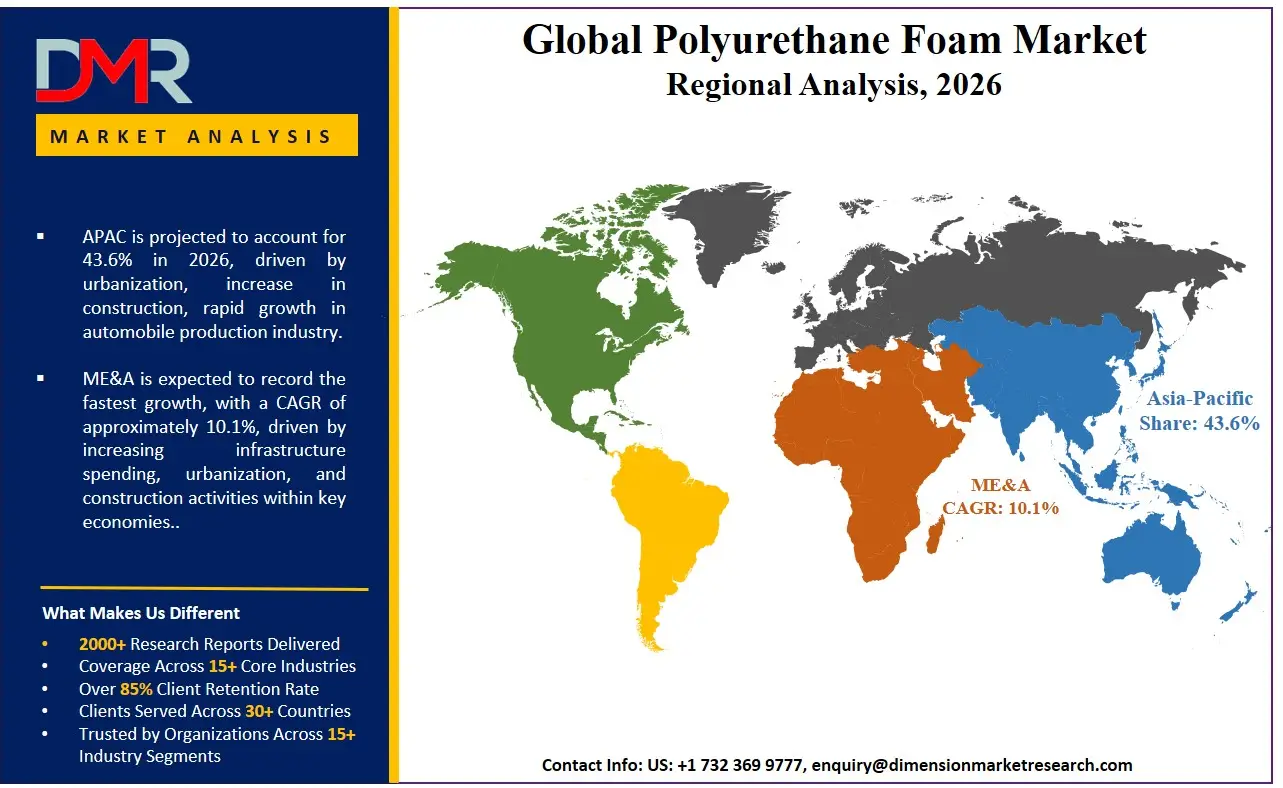
Asia-Pacific Region will dominate the global Polyurethane Foam Market with approximately 43.6% share by 2026. There are many factors responsible for this dominance, which includes urbanization, increase in construction, rapid growth in automobile production industry, along with growing demands of furniture and bedding applications in countries such as China, India, Japan, and South Korea. The rapid pace of industrialization and development of infrastructure are the reason behind increased demands for insulation material, packaging, and auto parts. Besides, governments' policies regarding energy efficiency of construction are also contributing towards capacity expansions in polyurethane foam.
ℹ
To learn more about this report –
Download Your Free Sample Report Here
Fastest Growing Region in the Polyurethane Foam Market
The ME&A region is expected to see the highest growth rate in the Polyurethane Foam Market owing to increasing infrastructure spending, urbanization, and construction activities within key economies. There are increased efforts by governments in smart cities, energy-saving structures, and diversifying industrial development programs, which have resulted in higher demand for high-quality insulation materials and building supplies. Furthermore, the growing logistics industry in cold chain management in the region has been driving the use of rigid polyurethane foams. Other drivers in the region include growing automotive assembly facilities, housing demand, and awareness about energy savings.
By Region
North America
Europe
- Germany
- The U.K.
- France
- Italy
- Russia
- Spain
- Benelux
- Nordic
- Rest of Europe
Asia-Pacific
- China
- Japan
- South Korea
- India
- ANZ
- ASEAN
- Rest of Asia-Pacific
Latin America
- Brazil
- Mexico
- Argentina
- Colombia
- Rest of Latin America
Middle East & Africa
- Saudi Arabia
- UAE
- South Africa
- Israel
- Egypt
- Rest of MEA
Competitive Landscape
Polyurethane Foam Industries are characterized by stiff competition caused by variables such as technological improvements, environmental strategies, and applications in other uses across many industries. More and more focus has been laid on product differentiation, application of manufacturing technologies, strategic alliances, and geographical expansion by competitors. The adoption of green polyurethane technology, recycled foam, and efficient production methods are some of the competitive strategies employed in this sector. The difficulty of establishing new facilities, costs incurred in adhering to regulations, and the procurement of raw materials characterize entry barriers into the industry.
Some of the prominent players in the global Polyurethane Foam are:
- BASF SE
- Dow Inc.
- Covestro AG
- Huntsman Corporation
- Wanhua Chemical Group Co., Ltd.
- Carpenter Co.
- Recticel NV/SA
- Sekisui Chemical Co., Ltd.
- Saint-Gobain
- Woodbridge Group
- Rogers Corporation
- INOAC Corporation
- Vita Group
- Trelleborg AB
- Armacell International S.A.
- Eurofoam Group
- Future Foam, Inc.
- FoamPartner Group
- UFP Technologies, Inc.
- Nitto Denko Corporation
- Other Key Players
Recent Developments
- In December 2025, The BASF group extended its line of spray polyurethane foam with the WALLTITE® RSB, an innovative closed-cell insulation material for sustainable construction. It was formulated using proprietary materials that consist of recycled and bio-based raw materials, which makes the insulation product high-performing and low-carbon-emission. The WALLTITE® RSB is a material that seeks to provide better insulation while fulfilling the sustainable construction objectives of customers.
- In December 2025, EUROPUR has revealed the introduction of CertiPUR™ for Bonded Foam, marking its initiative towards offering certification to mechanically recycled flexible polyurethane foam. This new system is the first-of-its-kind certification program that caters to the safety and health benefits of rebonded foam utilized in beds, furniture, and comfort applications. This program has been established with an aim to improve the sustainability of polyurethane foam through certification.
- In November 2025, SIBUR launched an innovative technology for producing high-quality polyurethane foam (PUF) to be used in pipeline insulation. It involves the use of cutting-edge shell-type thermal insulation materials meant to increase performance and protect pipelines effectively. The new technology has low thermal conductivity, high compressive strength, lower water absorption, and better durability, which is expected to reduce energy losses from pipelines and prolong their life span.
Report Details
| Report Characteristics |
| Market Size (2026) |
USD 63.5 Bn |
| Forecast Value (2035) |
USD 118.3 Bn |
| CAGR (2026–2035) |
7.2% |
| Historical Period |
2021 – 2025 |
| Forecast Period |
2027 – 2035 |
| Base Year |
2025 |
| Estimate Year |
2026 |
| Segments Covered |
By Foam Type, By Raw Material, By Density, By Application, By End-User, By Sustainability Type |
| Regional Coverage |
North America – The US and Canada; Europe – Germany, The UK, France, Russia, Spain, Italy, Benelux, Nordic, & Rest of Europe; Asia-Pacific – China, Japan, South Korea, India, ANZ, ASEAN, Rest of APAC; Latin America – Brazil, Mexico, Argentina, Colombia, Rest of Latin America; Middle East & Africa – Saudi Arabia, UAE, South Africa, Turkey, Egypt, Israel, & Rest of MEA |
Frequently Asked Questions
How big is the Polyurethane Foam Market?
▾ The Polyurethane Foam Market size is expected to reach USD 63.5 billion by 2026 and is projected to reach USD 118.3 billion by the end of 2035.
What is the CAGR of the Polyurethane Foam Market from 2026 to 2035?
▾ The market is growing at a CAGR of 7.2 percent over the forecasted period.
What factors are driving the growth of the Polyurethane Foam Market?
▾ Increasing Demand for Efficient Building Material, and more are the factors driving the growth of the Polyurethane Foam Market.
What are the major trends in the Polyurethane Foam Market?
▾ Greater Integration of Sustainable Manufacturing Technologies, and more are some of the major trends in the market.
Who are the key players in the Polyurethane Foam Market?
▾ Some of the key players in the Polyurethane Foam Market include BASF, DoW, Vita, and more
How is the Polyurethane Foam Market segmented?
▾ The Polyurethane Foam Market is segmented by foam type, raw material, density, application, end-user, sustainability type.
Which region held the largest share of the Polyurethane Foam Market in 2026?
▾ Asia Pacific is set to lead the Polyurethane Foam Market with an estimated 43.6% share in 2026.
Which region is expected to grow the fastest in the Polyurethane Foam Market?
▾ ME&A is the fastest-growing region in the Polyurethane Foam Market during the forecast period.