Market Overview
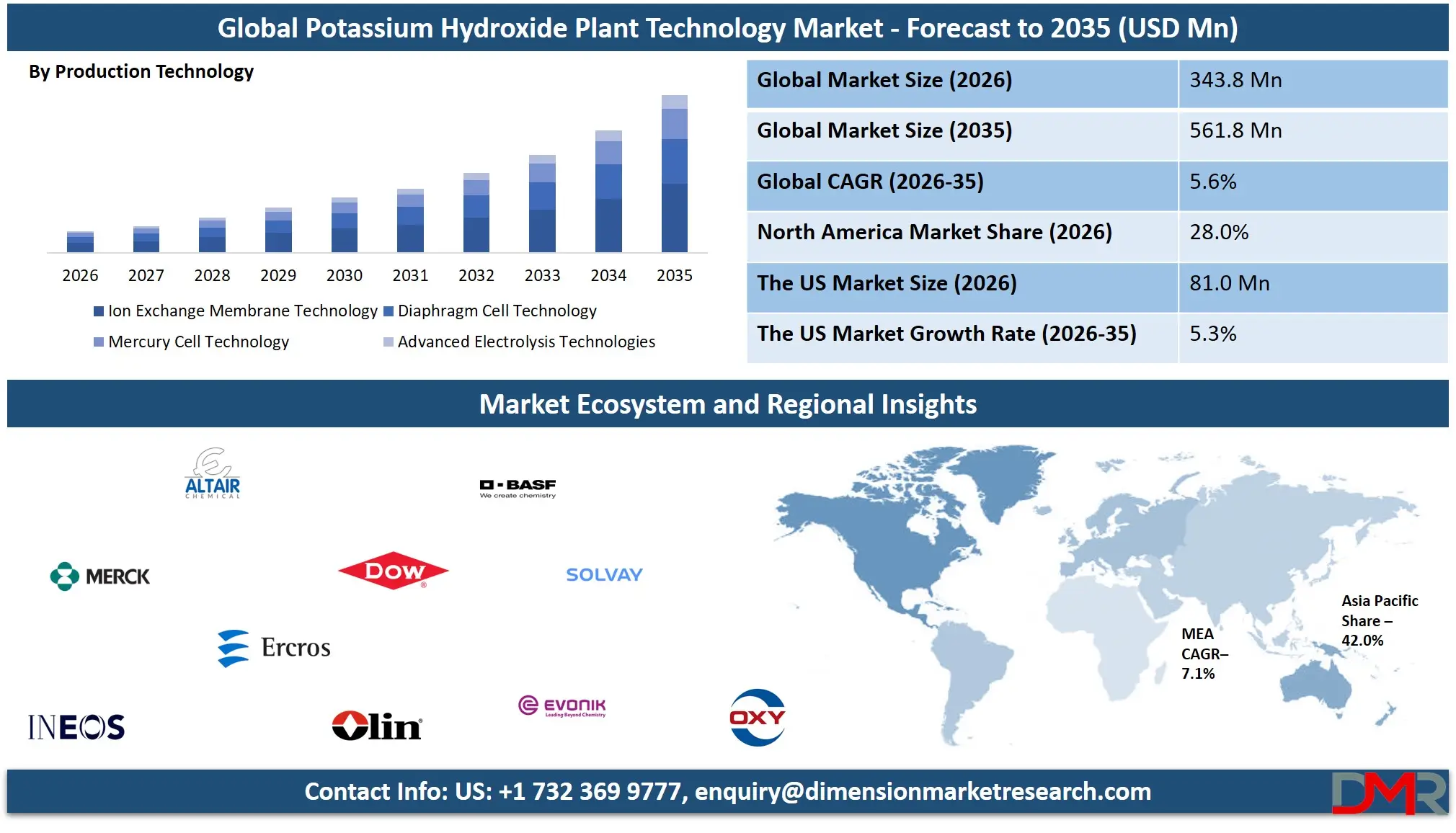
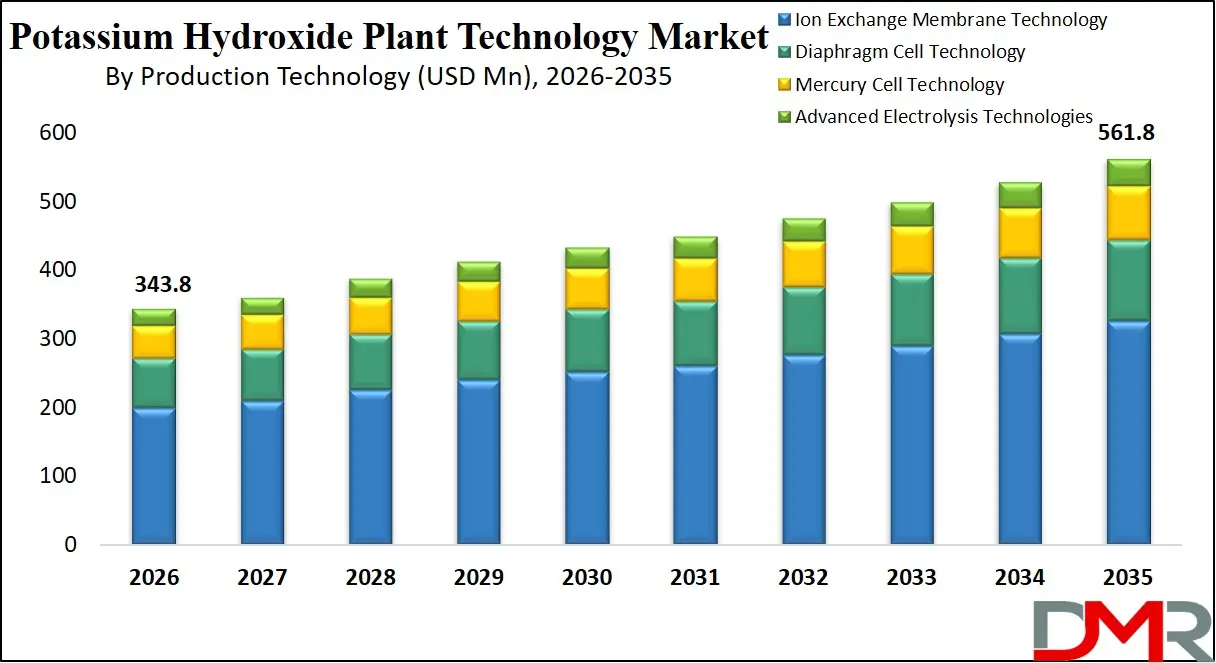
The Global Potassium Hydroxide Plant Technology Market size is projected to reach USD 343.8 million in 2026 and grow at a compound annual growth rate of 5.6% to reach a value of USD 561.8 million in 2035.
ℹ
To learn more about this report –
Download Your Free Sample Report Here
Potassium Hydroxide Plant Technology refers to the industrial processes, systems, and equipment used to manufacture potassium hydroxide (KOH) through electrolysis of potassium chloride solutions. It includes membrane cell, diaphragm cell, and mercury cell technologies, as well as advanced electrolysis methods such as zero-gap systems and oxygen-depolarized cathodes.
ℹ
To learn more about this report –
Download Your Free Sample Report Here
This technology is critical for producing high-purity KOH used in chemicals, fertilizers, batteries, pharmaceuticals, and food processing. The market plays a vital role in supporting industrial supply chains, with increasing emphasis on energy efficiency, environmental compliance, and integration with modern automation systems shaping its development.
The US Potassium Hydroxide Plant Technology Market
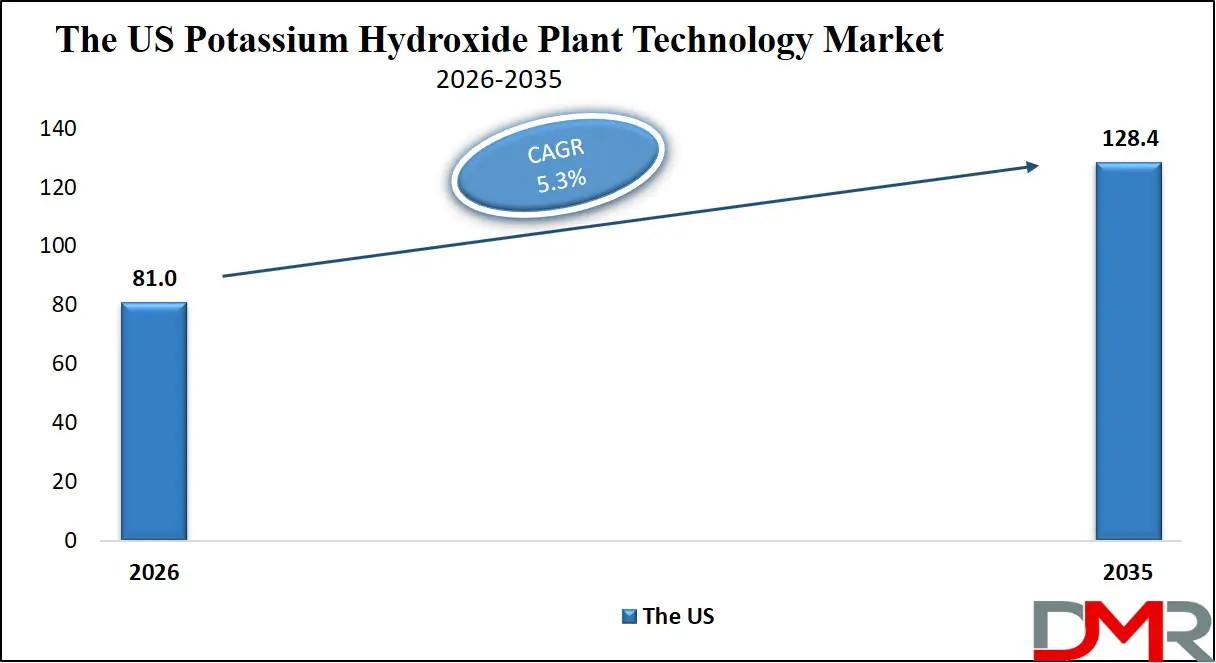
The US Potassium Hydroxide Plant Technology Market size is projected to reach USD 81.0 million in 2026 at a compound annual growth rate of 5.3% over its forecast period.
ℹ
To learn more about this report –
Download Your Free Sample Report Here
The US market is driven by strong demand from chemical manufacturing, energy storage, and semiconductor industries. Advanced membrane technologies dominate due to strict environmental regulations limiting mercury-based processes. Government incentives promoting clean energy and sustainable industrial practices are accelerating modernization of existing plants. Key players focus on capacity expansion and automation to enhance productivity. Additionally, rising demand for potassium-based fertilizers and battery-grade chemicals supports growth. Strategic investments in R&D and infrastructure upgrades are strengthening the country’s position as a technologically advanced market.
Europe Potassium Hydroxide Plant Technology Market
Europe Potassium Hydroxide Plant Technology Market size is projected to reach USD 68.8 million in 2026 at a compound annual growth rate of 5.4% over its forecast period.
Stringent environmental regulations and sustainability goals under regional policies such as the European Green Deal shape Europe’s market. The transition toward membrane cell technology is nearly complete, with a strong emphasis on reducing carbon emissions and energy consumption. Leading sectors include specialty chemicals, pharmaceuticals, and food processing. Innovation in green hydrogen integration and energy-efficient electrolysis is gaining traction. The region demonstrates a high pace of technological adoption, supported by government funding and collaborations focused on clean industrial transformation and circular economy initiatives.
Japan Potassium Hydroxide Plant Technology Market
Japan Potassium Hydroxide Plant Technology Market size is projected to reach USD 27.5 million in 2026 at a compound annual growth rate of 5.2% over its forecast period.
Japan’s market is characterized by advanced industrial infrastructure and a strong focus on high-purity chemical production. The electronics and semiconductor sectors drive demand for ultra-pure potassium hydroxide. Government initiatives supporting energy efficiency and industrial innovation are encouraging adoption of advanced electrolysis technologies. Urbanization and industrialization continue to sustain demand, while challenges include high operational costs and limited raw material availability. However, opportunities lie in technological advancements and export-oriented production, positioning Japan as a leader in precision chemical manufacturing.
Potassium Hydroxide Plant Technology Market: Key Takeaways & Influencing Factors
- Market Growth: The Potassium Hydroxide Plant Technology Market size is expected to grow by USD 200.8 million, at a CAGR of 5.6%, during the forecasted period of 2027 to 2035.
- By Production Technology: The ion exchange membrane technology segment is anticipated to get the majority share of the Potassium Hydroxide Plant Technology market in 2026.
- By Plant Integration: The integrated chlor-alkali plants segment is expected to get the largest revenue share in 2026 in the Potassium Hydroxide Plant Technology market.
- Regional Insight: Asia Pacific is expected to hold a 42.0% share of revenue in the global Potassium Hydroxide Plant Technology market in 2026.
- Use Cases: Some of the use cases of Potassium Hydroxide Plant Technology include chemical manufacturing, battery production, and more.
- U.S. Environmental Protection Agency reported in 2025 that over 95% of chlor-alkali plants in developed regions have transitioned to membrane cell technology.
- Eurostat stated in 2024 that the European chemical industry invested more than €30 million annually in sustainable process upgrades.
- International Energy Agency reported in 2025 that industrial electrification technologies could reduce energy intensity by up to 25% in chemical manufacturing.
- Japan Ministry of Economy, Trade and Industry noted in 2024 that specialty chemical exports, including high-purity alkalis, grew by approximately 8% year-on-year.
Potassium Hydroxide Plant Technology Market: Use Cases
- Chemical Manufacturing: Used extensively in producing soaps, detergents, and specialty chemicals. High-purity KOH enables efficient chemical reactions and consistent product quality across industrial processes.
- Agriculture Applications: Plays a key role in producing potassium-based fertilizers, improving soil fertility and crop yield. Its solubility and reactivity make it ideal for modern agricultural formulations.
- Battery Production: Essential in alkaline batteries and emerging energy storage systems. It supports conductivity and performance in next-generation battery technologies.
- Food & Pharmaceutical Processing: Utilized in food processing, pH regulation, and pharmaceutical formulations, ensuring compliance with safety and purity standards.
Market Dynamic
Driving Factors in the Potassium Hydroxide Plant Technology Market
Shift Toward Environmentally Sustainable Technologies
The increasing global emphasis on sustainability is a major driver for the adoption of advanced potassium hydroxide plant technologies. Regulatory bodies are phasing out mercury-based processes due to environmental hazards, encouraging industries to adopt membrane and advanced electrolysis technologies. These modern systems reduce emissions, energy consumption, and waste generation. Additionally, companies are aligning with ESG goals, which further accelerates investment in cleaner production technologies. This shift not only ensures compliance but also enhances brand reputation and operational efficiency in the long term.
Rising Demand from Energy Storage and Chemical Industries
Growing demand for potassium hydroxide in batteries, chemicals, and agriculture is significantly driving market growth. The expansion of renewable energy systems and electric vehicles has increased the need for efficient energy storage solutions, where KOH plays a crucial role. Similarly, the chemical industry relies heavily on KOH for various synthesis processes. Continuous industrialization and technological advancements are boosting production capacities, encouraging adoption of advanced plant technologies that offer higher output, reliability, and cost efficiency.
Restraints in the Potassium Hydroxide Plant Technology Market
High Capital Investment and Operational Costs
The installation of advanced potassium hydroxide production plants requires substantial capital investment, particularly for membrane-based and zero-gap electrolysis technologies. These systems involve high equipment costs, sophisticated infrastructure, and skilled labor requirements. Additionally, energy consumption remains a significant operational expense. Smaller manufacturers may find it challenging to adopt these technologies, limiting market penetration. This financial barrier can slow down the transition from outdated systems, especially in developing regions.
Regulatory and Technological Transition Challenges
Strict environmental regulations, while beneficial, create challenges for manufacturers transitioning from older technologies. Retrofitting existing plants or replacing outdated systems involves technical complexities and downtime, affecting productivity. Additionally, variations in regulatory standards across regions can create compliance difficulties for global players. Limited access to advanced technologies and expertise in certain regions further hampers adoption, slowing overall market growth despite increasing demand.
Opportunities in the Potassium Hydroxide Plant Technology Market
Integration with Renewable Energy Systems
The integration of potassium hydroxide production with renewable energy sources presents a significant growth opportunity. Electrolysis processes can be powered by solar or wind energy, reducing carbon footprint and operational costs. This aligns with global decarbonization goals and attracts investments in green chemical production. Companies adopting such integrated systems can gain a competitive advantage while meeting regulatory and sustainability requirements.
Expansion in Emerging Markets
Rapid industrialization in emerging economies offers substantial growth opportunities. Increasing demand for fertilizers, chemicals, and energy storage solutions is driving the need for efficient potassium hydroxide production. Governments in these regions are investing in industrial infrastructure and offering incentives to attract manufacturing investments. This creates a favorable environment for deploying advanced plant technologies and expanding market presence.
Trends in the Potassium Hydroxide Plant Technology Market
Adoption of Advanced Electrolysis Technologies
There is a growing trend toward adopting advanced electrolysis technologies such as zero-gap systems and oxygen depolarized cathodes. These technologies offer higher efficiency, lower energy consumption, and reduced environmental impact. Industries are increasingly investing in upgrading their production facilities to incorporate these innovations, enhancing productivity and sustainability.
Digitalization and Automation in Plant Operations
The integration of digital technologies and automation is transforming potassium hydroxide production. Smart monitoring systems, predictive maintenance, and AI-driven optimization are improving operational efficiency and reducing downtime. These advancements enable real-time data analysis, better resource management, and improved safety standards, making them a key trend shaping the market.
Impact of Artificial Intelligence in Potassium Hydroxide Plant Technology Market
Artificial intelligence is enhancing efficiency and productivity in potassium hydroxide plant operations by enabling predictive maintenance, process optimization, and real-time monitoring. AI-driven analytics help reduce energy consumption and improve yield by optimizing electrolysis parameters. Automation powered by AI minimizes human error and operational downtime. Additionally, AI supports quality control by ensuring consistent product purity. It also improves supply chain management through demand forecasting and inventory optimization, ultimately reducing costs and increasing overall operational efficiency across the market.
Impact of Iran War on Potassium Hydroxide Plant Technology Market
The Iran war has impacted the market by disrupting global supply chains and increasing energy prices, which directly affects electrolysis-based production costs. Export restrictions and geopolitical tensions have led to volatility in raw material availability. Companies are facing logistical challenges and higher transportation costs. Additionally, uncertainty in global markets has slowed investment decisions, while some regions are focusing on domestic production capabilities to reduce dependency on imports.
Research Scope and Analysis
By Production Technology Analysis
Ion exchange membrane technology is expected to dominate the market with an estimated 58% share in 2026 due to its superior efficiency, lower environmental impact, and compliance with strict regulations. This technology has largely replaced mercury-based systems in developed regions. Its ability to produce high-purity potassium hydroxide with reduced energy consumption makes it highly preferred. Meanwhile, advanced electrolysis technologies such as zero-gap systems are the fastest-growing segment, driven by increasing demand for energy-efficient and sustainable solutions. Continuous innovation and integration with renewable energy sources are expected to further accelerate growth in this segment.
By Plant Capacity Analysis
Large-scale plants (>200 TPD) are projected to hold approximately 52% market share in 2026, driven by economies of scale and higher production efficiency. These plants are widely adopted by major chemical manufacturers to meet bulk demand and reduce per-unit costs. Medium-scale plants are witnessing steady growth due to flexibility and moderate investment requirements.
However, small-scale plants are the fastest-growing segment, particularly in emerging markets, where localized production and lower initial investment make them attractive for new entrants and regional players.
By Product Grade Analysis
Industrial-grade potassium hydroxide is expected to dominate with a 55% share in 2026 due to its widespread use in chemicals, agriculture, and general industrial applications. Its cost-effectiveness and versatility contribute to its leading position. However, high-purity and electronic grade potassium hydroxide is the fastest-growing segment, driven by increasing demand from semiconductor and electronics industries. The need for ultra-pure chemicals in advanced manufacturing processes is significantly boosting this segment’s growth.
By Plant Integration Analysis
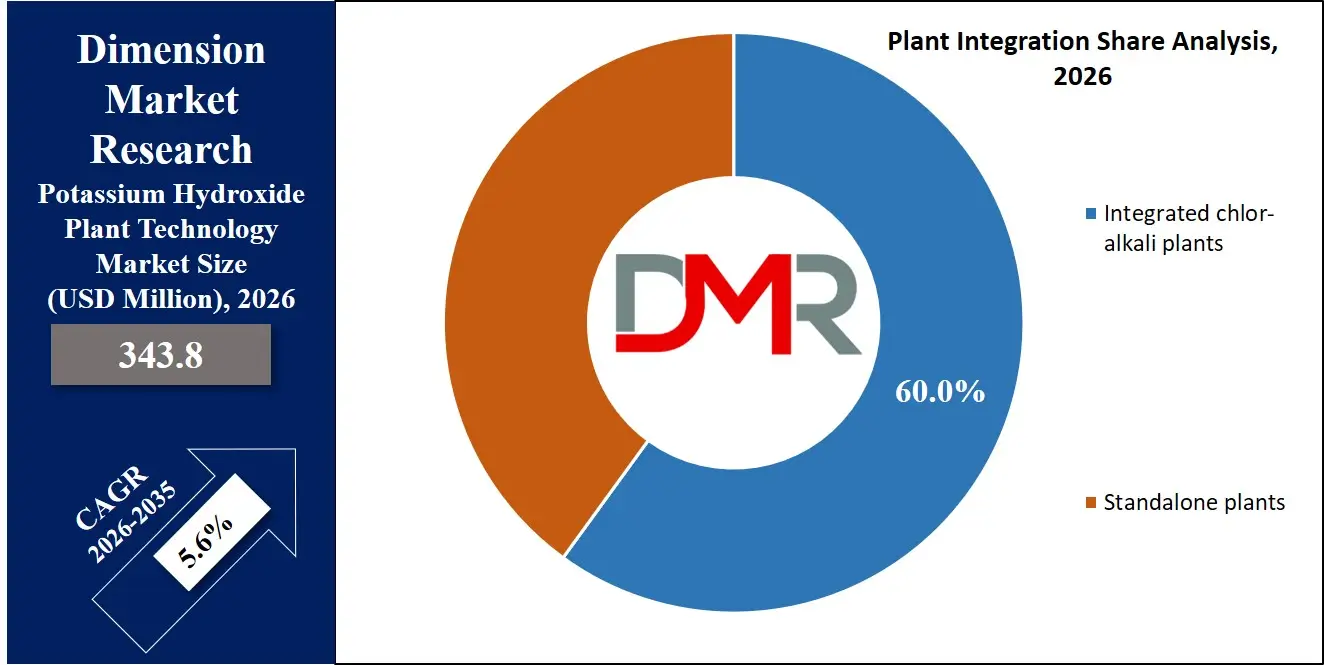
Integrated chlor-alkali plants are anticipated to lead with a 60% share in 2026 due to their operational efficiency and cost advantages. Integration allows for better resource utilization, reduced waste, and streamlined production processes.
ℹ
To learn more about this report –
Download Your Free Sample Report Here
Standalone plants, however, are gaining traction as the fastest-growing segment, especially in regions focusing on decentralized production and niche applications. Their flexibility and lower infrastructure requirements make them appealing for smaller-scale operations.
By End-Use Industry Analysis
The chemicals industry is expected to dominate with a 48% share in 2026 due to extensive use of potassium hydroxide in manufacturing processes. Its role in producing various chemical compounds ensures consistent demand. Meanwhile, the energy and batteries segment is the fastest-growing, driven by rising adoption of electric vehicles and renewable energy storage systems. Increasing investment in battery technologies is significantly contributing to the rapid expansion of this segment.
The Potassium Hydroxide Plant Technology Market Report is segmented on the basis of the following:
By Production Technology
- Ion Exchange Membrane Technology
- Cation Exchange Membrane (CEM)
- Anion Exchange Membrane (AEM)
- Hybrid Membrane Systems
- Diaphragm Cell Technology
- Asbestos Diaphragm
- Non-Asbestos Diaphragm
- Mercury Cell Technology
- Advanced Electrolysis Technologies
- Zero-gap Electrolysis
- Oxygen Depolarized Cathode (ODC)
By Plant Capacity
- Small Scale (<50 TPD)
- Medium Scale (50–200 TPD)
- Large Scale (>200 TPD)
By Product Grade
- Industrial Grade
- High Purity / Electronic Grade
- Food & Pharmaceutical Grade
By Plant Integration
- Standalone Plants
- Integrated Chlor-Alkali Plants
By End-Use Industry
- Chemicals
- Agriculture
- Energy & Batteries
- Food & Pharmaceuticals
- Electronics & Semiconductors
Regional Analysis
Leading Region in the Potassium Hydroxide Plant Technology Market
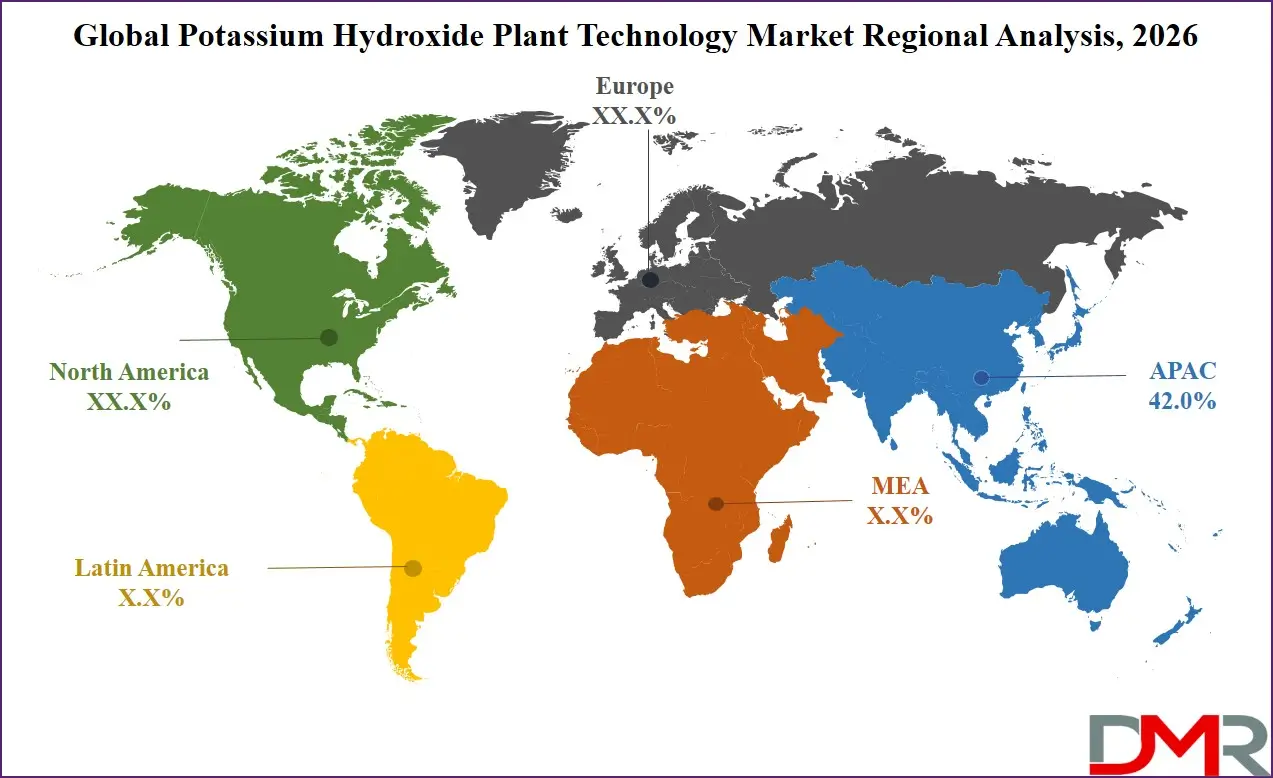
Asia-Pacific is expected to dominate the market with an estimated 42.0% share in 2026, driven by rapid industrialization, strong demand from chemical and agricultural sectors, and expanding manufacturing capabilities. Countries like China, India, and Japan are investing heavily in modernizing chemical production infrastructure. Government support, availability of raw materials, and cost-effective labor further strengthen the region’s position. Additionally, increasing adoption of advanced technologies and growing energy storage demand contribute to Asia-Pacific’s leadership in the market.
ℹ
To learn more about this report –
Download Your Free Sample Report Here
Fastest Growing Region in the Potassium Hydroxide Plant Technology Market
The Middle East & Africa region is emerging as the fastest-growing market due to increasing investments in chemical manufacturing and industrial diversification initiatives. Governments are focusing on reducing dependency on oil by expanding downstream chemical industries. Availability of low-cost energy resources supports electrolysis-based production. Additionally, infrastructure development and foreign investments are accelerating the adoption of advanced plant technologies, making this region a key growth hub.
By Region
North America
Europe
- Germany
- The U.K.
- France
- Italy
- Russia
- Spain
- Benelux
- Nordic
- Rest of Europe
Asia-Pacific
- China
- Japan
- South Korea
- India
- ANZ
- ASEAN
- Rest of Asia-Pacific
Latin America
- Brazil
- Mexico
- Argentina
- Colombia
- Rest of Latin America
Middle East & Africa
- Saudi Arabia
- UAE
- South Africa
- Israel
- Egypt
- Rest of MEA
Competitive Landscape
The Potassium Hydroxide Plant Technology Market is characterized by intense competition driven by technological innovation, efficiency improvements, and sustainability goals. Companies are focusing on upgrading existing plants with advanced electrolysis systems and investing in R&D to enhance performance and reduce energy consumption. High entry barriers due to capital requirements and regulatory compliance limit new entrants. Strategic collaborations, technology licensing, and capacity expansion are common approaches to strengthen market position and maintain competitive advantage.
Some of the prominent players in the global Potassium Hydroxide Plant Technology are:
- Olin Corporation
- Occidental Chemical Corporation (OxyChem)
- INEOS Group (INEOS KOH)
- Dow Inc.
- BASF SE
- Solvay S.A.
- Evonik Industries AG
- Merck KGaA
- American Elements
- Gujarat Alkalies and Chemicals Limited
- ERCO Worldwide
- UNID Co., Ltd.
- Vynova Group
- Ercros S.A.
- Altair Chimica S.p.A.
- Airedale Chemical Company Limited
- Hainan Huarong Chemical Co., Ltd.
- Inner Mongolia Ruida Taifeng Chemical Co., Ltd.
- Shandong Changyi Haineng Chemical Co., Ltd.
- Qinghai Huixin Chemical
- Other Key Players
Recent Developments
- In July 2025, Vynova Group announced its plans to discontinue its PVC production at its Beek facility in the Netherlands following a strategic review of operations. The site, located within the Chemelot industrial park, has significant production capacity and workforce. The decision reflects ongoing market pressures, including overcapacity, weak demand, and rising competition, aiming to improve long-term competitiveness and operational efficiency across its core business areas.
- In May 2025, Koh Young Technology Inc. has installed its 24,000th inspection system at a leading global EMS provider in Thailand, marking a major milestone. The deployment includes the Meister S solder paste inspection system, supporting high-precision manufacturing and defect detection. The EMS facility now operates multiple inspection systems, reflecting strong emphasis on quality control, with widespread installations across global sites to enhance production accuracy and efficiency.
- In April 2025, UNID Co., Ltd., a potassium-based chemical manufacturer from South Korea, has established a new potassium hydroxide plant in Yichang, Hubei, China. The first phase has an annual capacity of 90,000 tons, utilizing advanced production technology and supplying regional chemical industries. Future phases will expand output to include potassium hydroxide and potassium carbonate, positioning the facility among the world’s largest potassium product production bases with significant projected output value.
Report Details
| Report Characteristics |
| Market Size (2026) |
USD 343.8 Mn |
| Forecast Value (2035) |
USD 561.8 Mn |
| CAGR (2026–2035) |
5.6% |
| The US Market Size (2026) |
USD 81.0 Mn |
| Historical Data |
2021 – 2025 |
| Forecast Data |
2027 – 2035 |
| Base Year |
2025 |
| Estimate Year |
2026 |
| Report Coverage |
Market Revenue Estimation, Market Dynamics, Competitive Landscape, Growth Factors and etc. |
| Segments Covered |
By Production Technology (Ion Exchange Membrane Technology, Diaphragm Cell Technology, Mercury Cell Technology, Advanced Electrolysis Technologies), By Plant Capacity (Small Scale (<50 TPD), Medium Scale (50–200 TPD), Large Scale (>200 TPD)), By Product Grade (Industrial Grade, High Purity / Electronic Grade, Food & Pharmaceutical Grade), By Plant Integration (Standalone Plants, Integrated Chlor-Alkali Plants), By End-Use Industry (Chemicals, Agriculture, Energy & Batteries, Food & Pharmaceuticals, Electronics & Semiconductors) |
| Regional Coverage |
North America – The US and Canada; Europe – Germany, The UK, France, Russia, Spain, Italy, Benelux, Nordic, & Rest of Europe; Asia-Pacific – China, Japan, South Korea, India, ANZ, ASEAN, Rest of APAC; Latin America – Brazil, Mexico, Argentina, Colombia, Rest of Latin America; Middle East & Africa – Saudi Arabia, UAE, South Africa, Turkey, Egypt, Israel, & Rest of MEA |
| Prominent Players |
Olin Corporation, Occidental Chemical Corporation (OxyChem), INEOS Group (INEOS KOH), Dow Inc., BASF SE, Solvay S.A., Evonik Industries AG, Merck KGaA, American Elements, Gujarat Alkalies and Chemicals Limited, ERCO Worldwide, UNID Co., Ltd., Vynova Group, Ercros S.A., Altair Chimica S.p.A., Airedale Chemical Company Limited, Hainan Huarong Chemical Co., Ltd., Inner Mongolia Ruida Taifeng Chemical Co., Ltd., Shandong Changyi Haineng Chemical Co., Ltd., Qinghai Huixin Chemical, and Other Key Players |
| Purchase Options |
We have three licenses to opt for: Single User License (Limited to 1 user), Multi-User License (Up to 5 Users) and Corporate Use License (Unlimited User) along with free report customization equivalent to 0 analyst working days, 3 analysts working days and 5 analysts working days respectively. |
Frequently Asked Questions
How big is the Global Potassium Hydroxide Plant Technology Market?
▾ The Global Potassium Hydroxide Plant Technology Market size is expected to reach USD 250.3 million by 2026 and is projected to reach USD 564.1 million by the end of 2035.
Which region accounted for the largest Global Potassium Hydroxide Plant Technology Market?
▾ Asia Pacific is expected to have the largest market share in the Global Potassium Hydroxide Plant Technology Market, with a share of about 42.0% in 2026.
How big is the Potassium Hydroxide Plant Technology Market in the US?
▾ The US Potassium Hydroxide Plant Technology market is expected to reach USD 81.0 million by 2026.
Who are the key players in the Potassium Hydroxide Plant Technology Market?
▾ Some of the major key players in the Global Potassium Hydroxide Plant Technology Market include Olin, Dow, BASF, and others.
What is the growth rate in the Global Potassium Hydroxide Plant Technology Market?
▾ The market is growing at a CAGR of 5.6 percent over the forecasted period.