Power Plant Muffler Market Snapshot
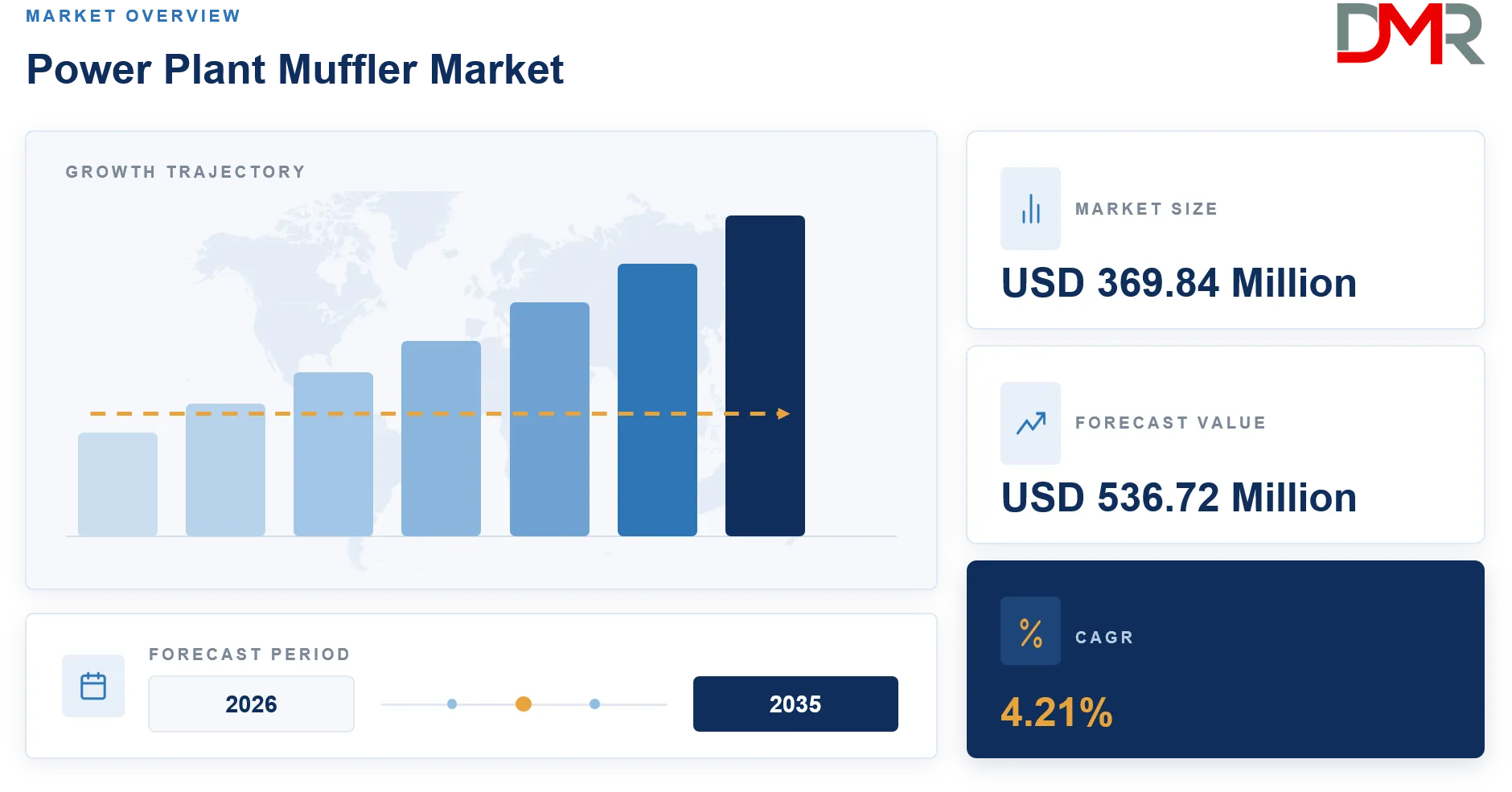
- Market Value: The Power Plant Muffler Market is valued at USD 369.84 million in 2026 and is projected to reach USD 536.72 million by 2035.
- CAGR: Power Plant Muffler Market is expected to grow at a CAGR of 4.21% from 2026 to 2035.
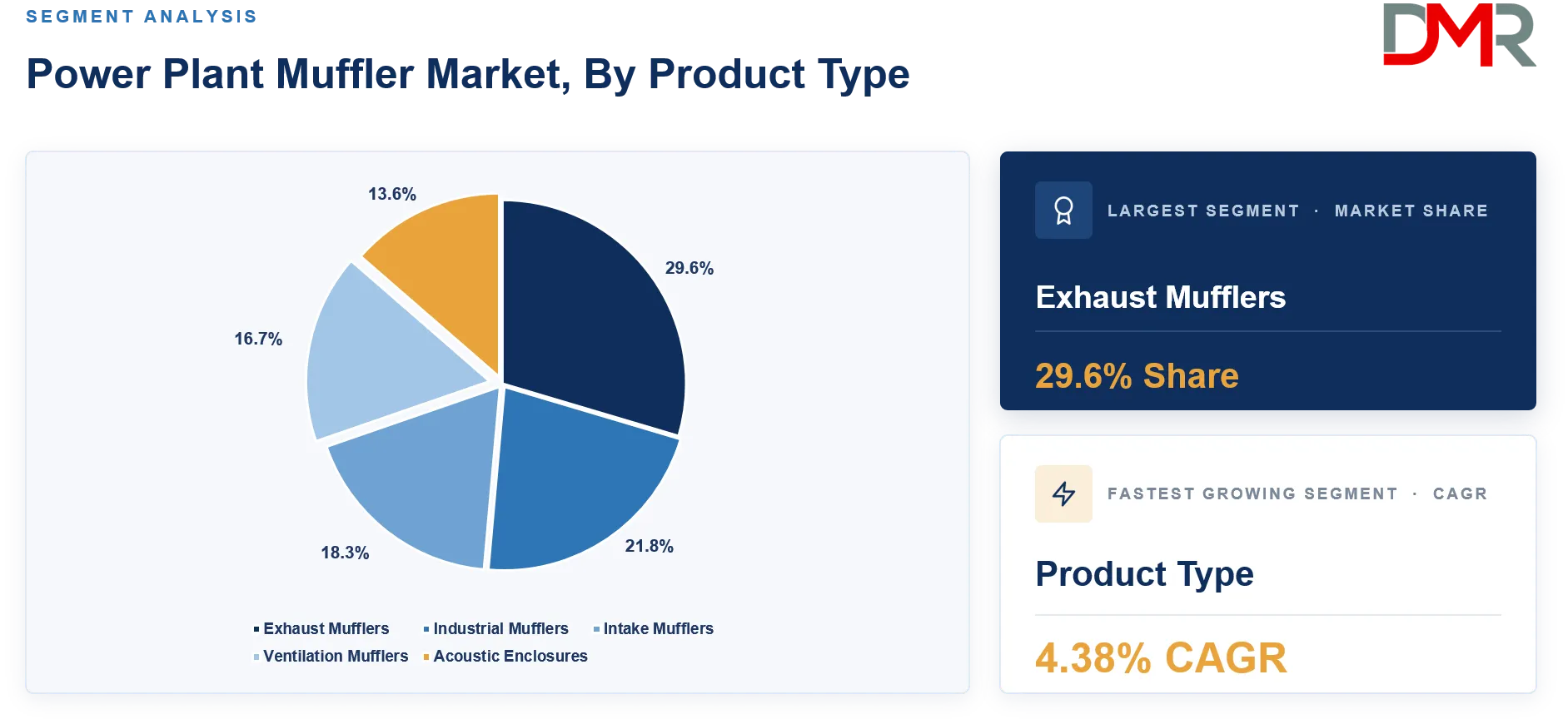
- By Product Type Analysis: Exhaust Mufflers segment dominated with a 29.6% share in 2026.
- By Muffler Type Segment Analysis: Combination Mufflers led the segment with a 38.6% share in 2026.
- By Power Plant Type Industry Segment Analysis: Gas Power Plants segment held a 32.9% share in 2026.
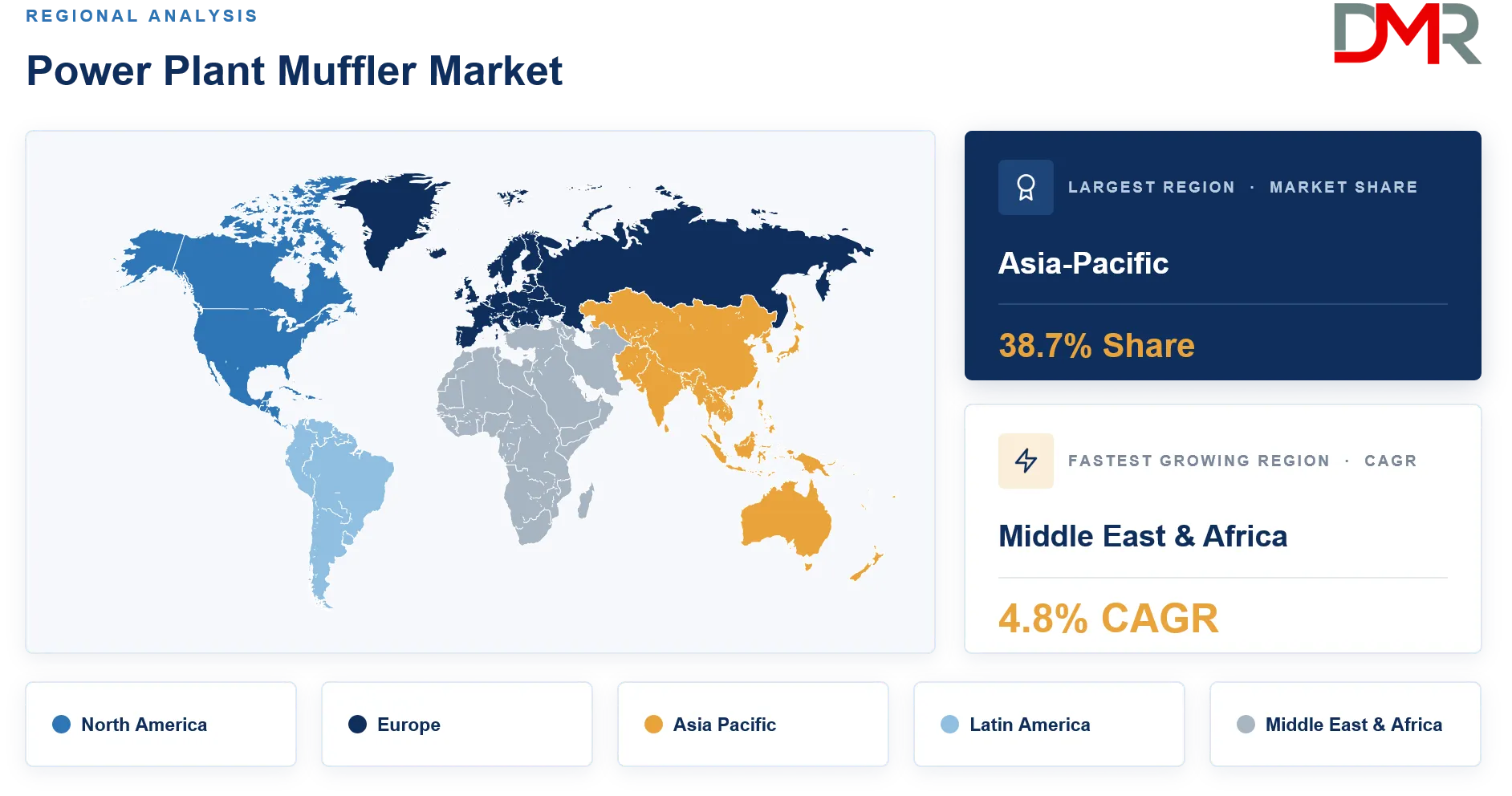
- Regional Analysis: Asia-Pacific led the Global Market with a 38.7% revenue share in 2026.
- Major Players: G+H Group, Caterpillar Inc., SAI - Société d'Acoustique Industrielle, MIRATECH Corporation, and others.
What is the Power Plant Muffler Market and its Market Size?
The Global Power Plant Muffler Market size is projected to be valued at USD 369.84 million in 2026 and is expected to reach USD 536.72 million by 2035, expanding at a CAGR of 4.21% during the forecast period. Power plant mufflers are engineered acoustic components installed in gas turbine exhausts, diesel engines, generator systems, ventilation lines, steam systems, and air intake assemblies to reduce industrial noise while maintaining acceptable exhaust flow and pressure conditions. Demand is increasingly linked with gas-fired generation, standby generation, combined cycle plants, industrial captive power, plant modernization, and noise-control retrofits.
ℹ
To learn more about this report –
Download Your Free Sample Report Here
The Power Plant Muffler Market includes reactive, absorptive, combination, and expansion chamber designs manufactured from carbon steel, stainless steel, aluminum, and alloy steel. Product selection varies according to frequency spectrum, exhaust temperature, gas velocity, permissible pressure drop, corrosion exposure, available installation space, and required acoustic performance. For power plant operators, muffler procurement is therefore not limited to reducing sound. Equipment must also protect turbine or engine efficiency, tolerate thermal cycling, support maintenance access, and meet project-specific environmental and occupational noise requirements.
Use Cases
- Gas Turbine Exhaust Noise Control: Power plants use large exhaust mufflers to attenuate broadband and low-frequency noise generated by gas turbines. These systems are engineered to handle high exhaust temperatures and large gas volumes while limiting pressure loss that could reduce turbine efficiency.
- Diesel Generator Silencing: Utility plants, captive power facilities, data centers, and industrial sites install exhaust mufflers on diesel generator systems to reduce combustion pulse noise. Reactive and combination designs are commonly selected where low-frequency attenuation and compact installation are required.
- Air Intake Noise Reduction: Intake mufflers control aerodynamic and compressor-related noise entering or leaving turbine air systems. These units must achieve acoustic attenuation while maintaining low airflow resistance because excessive pressure loss can affect turbine output and fuel efficiency.
- Steam and Vent Noise Management: Ventilation mufflers and related acoustic systems are applied to high-pressure steam, blowdown, relief, and process gas discharge points. Their design addresses high velocity flow noise while protecting plant personnel and surrounding communities from short-duration but intense acoustic events.
- Power Plant Retrofit Programs: Older generating stations increasingly require replacement silencers when acoustic packing deteriorates, internal baffles fail, corrosion develops, or local noise conditions change. Retrofit projects create aftermarket demand for engineered replacements compatible with existing ducts, stacks, turbines, and structural supports.
How AI/Gen AI is Transforming the Power Plant Muffler Market?
Artificial intelligence is beginning to influence power plant muffler engineering through acoustic simulation, equipment monitoring, design optimization, and predictive maintenance. Sensor data collected from exhaust ducts, turbine systems, generators, and acoustic monitoring points can be evaluated to detect changes in sound patterns, vibration, temperature, and pressure. These changes may indicate damaged acoustic packing, internal baffle deterioration, abnormal gas flow, or structural fatigue. Data-led maintenance can help operators inspect silencers based on equipment condition rather than relying only on fixed maintenance intervals, improving asset availability and reducing the risk of unplanned acoustic performance failures.
Generative AI can also support engineering and commercial workflows by organizing specification documents, comparing vendor proposals, reviewing historical project requirements, and assisting engineering teams with configuration alternatives. In custom muffler projects, design decisions involve insertion loss targets, frequency bands, exhaust temperature, flow rate, backpressure, metallurgy, dimensions, and installation constraints. Digital tools can shorten the process of evaluating these variables. The strongest commercial use will remain engineering-assisted rather than fully automated, since final muffler designs must account for mechanical integrity, acoustic performance, thermal expansion, pressure losses, fabrication standards, and site-specific operating conditions.
Key Drivers in the Power Plant Muffler Market
Expansion of Gas-Fired and Flexible Power Generation
Growth in gas-fired, combined cycle, captive, and flexible generation capacity supports demand for engineered power plant exhaust mufflers. Gas turbines produce high-temperature exhaust and broad acoustic frequencies that require specialized attenuation systems rather than standard industrial mufflers. The 32.9% share held by gas power plants in 2026 reflects this relationship. Rising electricity requirements, grid-balancing needs, industrial power demand, and dispatchable generation investments create opportunities for gas turbine exhaust silencers, intake silencers, acoustic enclosures, and integrated exhaust systems.
Stricter Industrial Noise Management Requirements
Power producers must control occupational and environmental noise around turbines, generator buildings, stacks, ventilation equipment, and plant boundaries. This encourages the use of engineered mufflers during new plant construction and existing facility upgrades. Buyers increasingly specify required insertion loss, sound pressure limits, allowable pressure drop, operating temperature, material grade, and structural loading during procurement. The requirement to achieve acoustic performance without reducing engine or turbine efficiency strengthens demand for customized combination mufflers and technically validated exhaust systems.
Restraints in the Power Plant Muffler Market
High Cost of Custom-Engineered Muffler Systems
Large power plant mufflers are frequently project-specific products rather than standardized components. Engineering must account for flow rate, pressure, temperature, sound spectrum, corrosion conditions, structural loads, available space, transport limits, and equipment interfaces. Stainless steel and high-temperature alloy requirements can increase fabrication costs further. Complex testing, welding, acoustic materials, structural supports, duct modifications, and installation work can raise the total project cost, causing smaller plants and cost-sensitive operators to extend the service life of existing equipment instead of replacing it.
Pressure Drop and Performance Trade-Offs
Noise reduction cannot be optimized independently from plant performance. Mufflers introduce resistance into intake or exhaust flow paths, and excessive backpressure can affect engines and turbines. Increasing acoustic attenuation may require more baffles, absorptive material, chambers, or longer flow paths, which can increase system resistance and equipment dimensions. Suppliers therefore face a design trade-off between insertion loss, airflow, pressure drop, footprint, weight, durability, and cost. Poorly engineered systems can reduce operational efficiency and increase maintenance requirements, making technical qualification important in purchasing decisions.
Growth Opportunities in the Power Plant Muffler Market
Retrofit and Replacement of Aging Acoustic Systems
The installed base of gas turbines, diesel generators, industrial power plants, and combined cycle facilities creates a significant aftermarket opportunity. Acoustic packing can degrade under heat, moisture, vibration, chemical exposure, and repeated operating cycles. Internal components may also corrode or experience fatigue. Plants that expand capacity or experience new development near their boundaries can face tighter acoustic targets than those applied during original construction. Suppliers offering site surveys, acoustic modeling, replacement baffles, retrofit silencers, stack modifications, and turnkey installation can capture recurring revenue beyond new plant construction.
Integrated Noise and Emissions Control Packages
Power producers increasingly prefer suppliers that can address several exhaust-system requirements within one project scope. Mufflers can be integrated with catalytic emissions equipment, exhaust ducts, expansion joints, stacks, spark arrestors, filtration systems, acoustic enclosures, and supporting structures. This creates an opportunity for companies capable of supplying complete intake and exhaust packages. Integrated systems can reduce interface risk for engineering contractors and plant owners while simplifying procurement, installation, documentation, and commissioning. Such capabilities can also increase the value of each project compared with standalone muffler sales.
Trends in the Power Plant Muffler Market
Growing Adoption of Combination Mufflers
Combination Mufflers accounted for 38.6% of the market in 2026, reflecting demand for equipment capable of addressing multiple noise frequencies. These systems combine reactive chambers, which are effective for targeted low-frequency components, with absorptive elements that reduce broader-frequency noise. Gas turbines, reciprocating engines, and generator systems can produce complex acoustic signatures that are difficult to control with one attenuation principle. Combination technology allows suppliers to balance acoustic performance, dimensions, airflow, and pressure drop for demanding power generation applications.
Shift Toward Application-Specific Acoustic Engineering
Power plant operators are moving from catalog-based noise control toward systems engineered for specific turbine models, engine ratings, operating cycles, site layouts, and boundary noise targets. Suppliers increasingly differentiate through acoustic modeling, computational analysis, structural engineering, field measurement, performance verification, and retrofit expertise. Material selection is also becoming more application-driven as high exhaust temperatures, corrosive gases, thermal cycling, and outdoor exposure influence product life. This trend favors manufacturers with integrated acoustic, mechanical, fabrication, and field-service capabilities.
Research Scope and Analysis
The Global Power Plant Muffler Market assessment evaluates market size, share, growth, demand, technology trends, product development, regional opportunities, competitive conditions, application requirements, purchasing factors, and long-term industry prospects from 2026 to 2035.
ℹ
To learn more about this report –
Download Your Free Sample Report Here
By Product Type
Exhaust Mufflers dominated the product segment with a 29.6% share in 2026. Their leadership is supported by extensive application across gas turbines, diesel engines, stationary generators, reciprocating engines, and captive power systems. Exhaust systems represent one of the most important acoustic treatment points because combustion equipment can generate strong low-frequency pulsation and broadband noise. Exhaust mufflers must also withstand elevated gas temperatures, vibration, thermal expansion, and continuous flow. Replacement demand strengthens this segment because exhaust components operate in harsh environments where corrosion, packing deterioration, and internal structural wear can eventually reduce acoustic performance.
By Muffler Type
Combination Mufflers held a 38.6% share in 2026 and remained the leading muffler technology. Their market position is supported by the need to attenuate both tonal and broadband sound in power generation systems. Reactive sections use chambers and changes in flow geometry to reduce selected frequencies, while absorptive sections dissipate acoustic energy across a wider frequency range. This architecture is well suited to gas turbines and large reciprocating engines where acoustic signatures vary with load and operating conditions. Future opportunities are concentrated in high-performance exhaust systems, retrofit projects, space-constrained plants, and applications requiring high insertion loss with controlled pressure drop.
By Power Plant Type
Gas Power Plants accounted for 32.9% of revenue in 2026, making them the largest power plant type in the Power Plant Muffler Market. Gas turbines and gas engine plants require noise treatment across air intake, turbine casing, ventilation, exhaust ducting, and stack systems. Flexible gas-fired capacity also supports grids with large shares of variable renewable generation because these plants can respond to changing electricity supply and demand. For muffler suppliers, the segment offers opportunities across new installations, combined cycle facilities, cogeneration plants, peaking stations, industrial gas engines, turbine retrofits, and replacement exhaust systems.
The Global Power Plant Muffler Market Report is segmented on the basis of the following:
By Product Type
- Industrial Mufflers
- Exhaust Mufflers
- Intake Mufflers
- Ventilation Mufflers
- Acoustic Enclosures
By Muffler Type
- Reactive Mufflers
- Absorptive Mufflers
- Combination Mufflers
- Expansion Chamber Mufflers
By Material Type
- Carbon Steel
- Stainless Steel
- Aluminum
- Alloy Steel
By Power Plant Type
- Gas Power Plants
- Diesel Power Plants
- Coal Power Plants
- Nuclear Power Plants
- Biomass Power Plants
- Combined Cycle Plants
By Capacity
- Below 100 MW
- 100-500 MW
- 500-1000 MW
- Above 1000 MW
By Application
- Gas Turbine Exhaust
- Diesel Engine Exhaust
- Steam Turbine Systems
- Generator Exhaust Systems
- Air Intake Systems
By End User
- Utility Power Plants
- Industrial Power Plants
- Captive Power Plants
- Independent Power Producers
- Renewable Power Facilities
Regional Analysis
Asia-Pacific is the Leading Region in the Power Plant Muffler Market
Asia-Pacific accounted for 38.7% of Global Power Plant Muffler Market revenue in 2026. The region combines large installed power generation capacity with continuing electricity demand growth, industrial expansion, urban development, data center investment, and additions to gas, coal, nuclear, biomass, and captive generation infrastructure. China, India, Southeast Asia, Japan, South Korea, and Australia generate demand for exhaust silencers, generator mufflers, acoustic enclosures, and turbine intake systems. Increasing attention to industrial noise control and plant modernization further supports retrofit opportunities across the regional installed base.
Middle East & Africa is an Emerging Growth Region in the Power Plant Muffler Market
Middle East & Africa presents growing opportunities as utilities and industrial operators invest in gas-fired plants, captive generation, desalination-linked power systems, infrastructure projects, and flexible generation capacity. Gas turbines remain particularly important across Gulf markets, creating demand for high-temperature intake and exhaust acoustic systems. New generation projects, replacement of aging equipment, industrial expansion, and greater use of combined cycle technology provide opportunities for muffler suppliers capable of delivering engineered systems for extreme temperature, dust, corrosion, and continuous operating environments.
By Region
North America
Europe
- Germany
- France
- The UK
- Italy
- Spain
- Rest of Europe
Asia-Pacific
- China
- Japan
- India
- Australia
- South Korea
- Rest of APAC
Latin America
- Mexico
- Brazil
- Colombia
- Argentina
- Rest of LATAM
Middle East & Africa
- Saudi Arabia
- The UAE
- South Africa
- Rest of MEA
ℹ
To learn more about this report –
Download Your Free Sample Report Here
Major Countries Analysis
China Power Plant Muffler Market
The China Power Plant Muffler Market size is projected to be valued at USD 88.74 million in 2026 and is expected to reach USD 128.78 million by 2035, expanding at a CAGR of 4.21% during the forecast period.
China represents a major country opportunity due to its extensive power generation fleet, large industrial base, manufacturing capacity, and continued investment in electricity infrastructure. The market includes demand from thermal power plants, gas turbines, combined cycle facilities, industrial captive generation, biomass systems, and large generator installations. Industrial noise-control requirements are encouraging operators to consider acoustic performance during facility design and modernization. Domestic fabrication capacity creates strong price competition, while complex high-temperature turbine and retrofit projects create opportunities for suppliers with specialized acoustic engineering and system-integration expertise.
India Power Plant Muffler Market
The India Power Plant Muffler Market size is projected to be valued at USD 16.46 million in 2026 and is expected to reach USD 23.89 million by 2035, expanding at a CAGR of 4.21% during the forecast period.
India offers strong long-term demand potential as rising electricity consumption, industrialization, data center construction, manufacturing expansion, urban infrastructure, and captive power requirements increase the need for generation equipment. Diesel generators, gas engines, utility plants, industrial power facilities, and combined cycle systems create demand across exhaust, intake, ventilation, and acoustic enclosure applications. Noise-control requirements in industrial and populated areas strengthen the case for improved attenuation systems. Local manufacturing supports competitive equipment pricing, while international and specialized suppliers can target high-capacity turbines, premium silencers, complex retrofits, and integrated acoustic packages.
Competitive Landscape
The Global Power Plant Muffler Market has a fragmented competitive structure that includes global industrial equipment groups, engine and turbine ecosystem suppliers, specialist acoustic engineering companies, emissions-control businesses, and regional fabricators. Competition is based less on basic muffler manufacturing and more on insertion-loss performance, pressure-drop control, thermal durability, material expertise, customization, engineering documentation, delivery capability, and field support. Companies such as G+H Group, Dürr Universal, Donaldson Company, MIRATECH Corporation, SAI, IAC Acoustics, Caterpillar, Cummins, and Wärtsilä participate through different positions in the power-generation value chain.
Large engineered projects favor suppliers able to integrate silencers with exhaust stacks, filtration, emissions controls, ducts, expansion joints, enclosures, and structural systems. Regional manufacturers compete strongly in standardized generator exhaust products, while technically complex turbine and high-temperature applications create greater differentiation opportunities for specialist suppliers. Retrofit capability, acoustic modeling, installation support, lifecycle service, and relationships with turbine OEMs, engineering contractors, utilities, and independent power producers remain important competitive advantages.
Some of the prominent players in the Global Power Plant Muffler Industry are:
- G+H Group
- Caterpillar Inc.
- SAI - Société d'Acoustique Industrielle
- MIRATECH Corporation
- Universal Silencer
- Donaldson Company, Inc.
- Ergil Group
- Jeremias Abgastechnik GmbH
- Cummins Inc.
- STOPSON Italiana S.R.L.
- Catalyst Products International
- Nelson Global Products
- Wärtsilä Corporation
- IAC Acoustics
- DCL International Inc.
- Schiedel GmbH & Co. KG
- ECI - Exhaust & Emissions Control
- Nett Technologies Inc.
- Dürr Universal, Inc.
- Fischer Abgastechnik GmbH & Co. KG
- Others
Technology Analysis
Technology development in the Power Plant Muffler Market is focused on achieving higher acoustic attenuation while controlling exhaust backpressure, thermal stress, vibration, corrosion, and system weight. Combination mufflers are gaining importance because reactive chambers can target low-frequency pulsation while absorptive sections address broadband noise from gas turbines, diesel engines, generators, and air-handling systems. Manufacturers are using computational fluid dynamics, acoustic modeling, finite element analysis, and frequency-based simulation to optimize baffle geometry, flow paths, pressure drop, and structural integrity before fabrication.
Stainless steel and alloy steel are preferred for demanding exhaust environments where high temperatures and corrosive gases can shorten equipment life. Modular silencers, replaceable acoustic elements, integrated exhaust stacks, acoustic enclosures, and compact configurations are also improving retrofit flexibility. Sensor-based condition monitoring is emerging as another development, helping operators identify abnormal vibration, temperature, pressure, and acoustic behavior before deterioration causes performance or compliance issues.
Regulatory Landscape
The regulatory landscape for the Power Plant Muffler Market is shaped by occupational noise limits, environmental noise rules, power plant permitting conditions, equipment safety requirements, and community noise restrictions. In the United States, OSHA occupational noise requirements influence worker exposure management, while environmental and local authorities can impose project-specific limits around generating facilities. European projects operate within occupational noise and environmental frameworks that encourage engineering controls where machinery creates excessive sound exposure.
China, India, Japan, Australia, and other Asia-Pacific markets also apply industrial, workplace, or environmental noise requirements that influence power plant design and modernization. Compliance affects muffler specifications because operators must consider sound pressure, frequency, operating duration, plant boundaries, equipment location, and workforce exposure. This creates demand for verified insertion-loss performance, acoustic testing, engineered enclosures, exhaust silencers, intake systems, and retrofit solutions that reduce noise without creating excessive backpressure or compromising generating efficiency.
Recent Developments
- February 2026: MIRATECH Corporation completed its acquisition of Exhaust Control Industries (ECI), establishing an integrated APAC operating platform to strengthen power-plant silencer and emissions-control delivery across Australia and South Asia.
- February 2026: DCL International Inc. executed a second expansion of its Houston facility to approximately 60,000 sq ft, boosting capacity for catalytic silencers and exhaust systems serving gas-to-power and data-center generation projects.
- October 2025: MIRATECH Corporation signed definitive agreements to acquire Exhaust Control Industries (ECI), expanding its global muffler/silencer portfolio and regional engineering capacity for stationary-engine power applications.
| Report Characteristics |
| Market Size (2026) |
USD 369.84 Million |
| Forecast Value (2035) |
USD 536.72 Million |
| CAGR (2026-2035) |
4.21% |
| The US Market Size (2026) |
USD 72.35 Million |
| Historical Data |
2021 - 2025 |
| Forecast Data |
2026 - 2035 |
| Base Year |
2025 |
| Segments Covered |
By Product Type, By Muffler Type, By Material Type, By Power Plant Type, By Capacity, By Application and By End User |
| Regional Coverage |
North America - The US and Canada; Europe - Germany, France, The UK, Italy, Spain, Rest of Europe; Asia-Pacific - China, Japan, India, Australia, South Korea, Rest of APAC; Latin America - Mexico, Brazil, Colombia, Argentina, Rest of LATAM; Middle East & Africa - Saudi Arabia, The UAE, South Africa, Rest of MEA |
Frequently Asked Questions
What is the current size of the Power Plant Muffler Market?
▾ The Power Plant Muffler Market size is valued at around USD 369.84 million in 2026 and is forecast to reach USD 536.72 million by 2035.
What is the growth rate of the Power Plant Muffler Market during?
▾ The Power Plant Muffler Market is expected to grow at a CAGR of 4.21% during the forecast period 2026-2035.
Which region dominates the Global Power Plant Muffler Market?
▾ Asia-Pacific leads the Global Power Plant Muffler Market with a 38.7% revenue share in 2026, supported by expanding power generation capacity.
What factors are driving the growth of the Power Plant Muffler Market?
▾ Gas-fired power expansion, stricter industrial noise control, plant modernization, and rising generator installations are driving Power Plant Muffler Market growth.
What are the major challenges restraining the Power Plant Muffler Market?
▾ High custom-engineering costs, pressure-drop limitations, complex installation, and maintenance requirements restrain Power Plant Muffler Market growth.
Which segment holds the largest share of the Power Plant Muffler Market?
▾ Combination Mufflers hold a 38.6% share of the Power Plant Muffler Market in 2026, supported by effective broadband and low-frequency noise attenuation.
Who are the leading companies in the Power Plant Muffler Market?
▾ Leading companies in the Power Plant Muffler Market include G+H Group, Caterpillar Inc., SAI - Société d'Acoustique Industrielle, MIRATECH Corporation, Universal Silencer, Donaldson Company, Inc., Ergil Group, Jeremias Abgastechnik GmbH, Cummins Inc., STOPSON Italiana S.R.L., Catalyst Products International, Nelson Products, Wärtsilä Corporation, IAC Acoustics, DCL International Inc., Schiedel GmbH & Co. KG, ECI - Exhaust & Emissions Control, Nett Technologies Inc., Dürr Universal, Inc., and Fischer Abgastechnik GmbH & Co. KG.
How is AI influencing the Power Plant Muffler Market?
▾ AI is influencing the Power Plant Muffler Market through acoustic modeling, predictive maintenance, condition monitoring, design optimization, and performance analysis.
What are the future opportunities and trends in the Power Plant Muffler Market?
▾ Retrofit demand, integrated exhaust systems, smart monitoring, combination mufflers, and gas power expansion are creating opportunities in the Power Plant Muffler Market.