What is the Precision Fermentation Market Size?
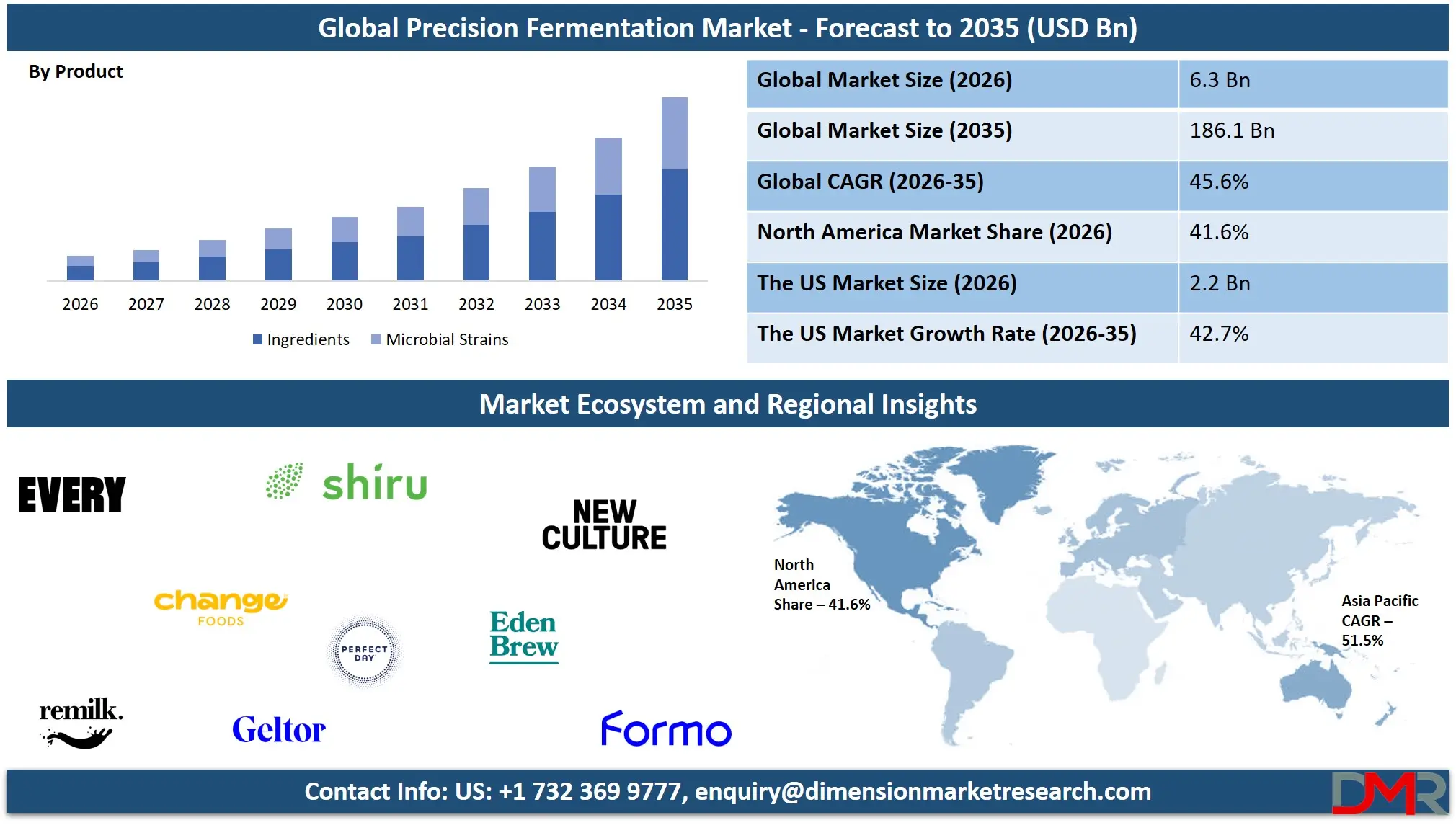
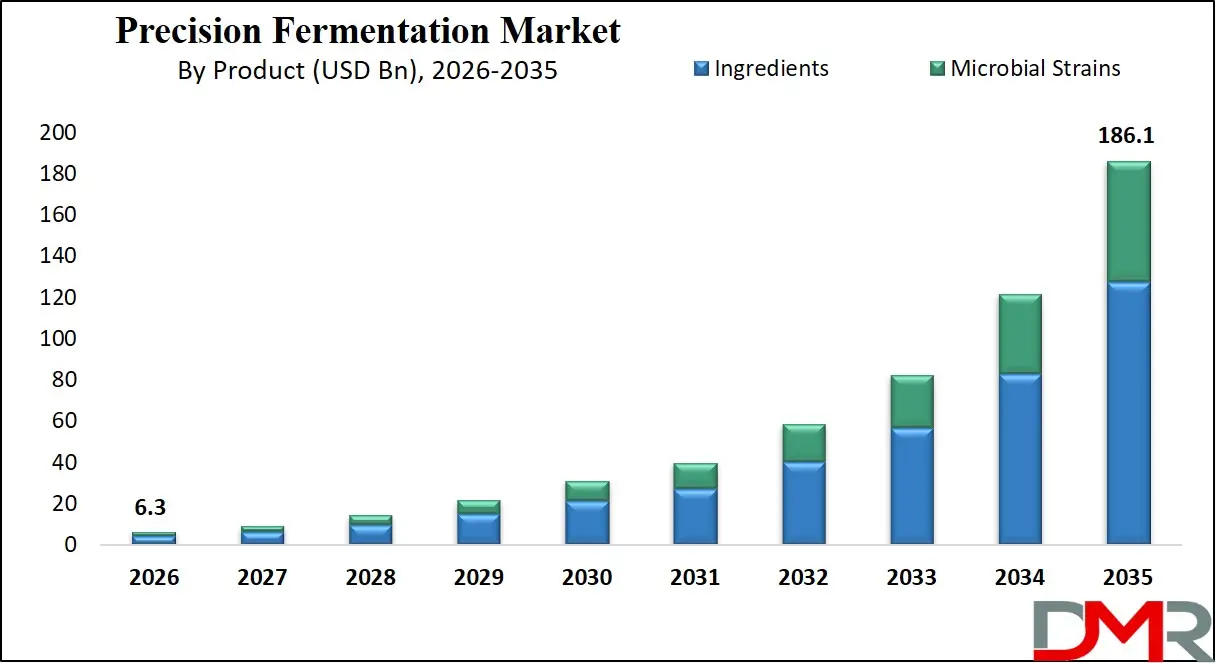
The Precision Fermentation Market size is expected to be USD 6.3 billion in 2026 and increase at a compound annual growth rate of 45.6% to USD 186.1 billion in 2035 due to the awareness of environment, together with increased consciousness regarding the welfare of animals.
ℹ
To learn more about this report –
Download Your Free Sample Report Here
The Precision Fermentation Market is witnessing considerable growth since there is a rising requirement for sustainable and scalable solutions in bio-manufacturing across sectors like food, pharmaceuticals, and chemicals. The Precision Fermentation Market is concerned with producing defined functional ingredients via precision fermentation using microorganisms as compared to traditional cultivation and chemical methods.
The rise in biotechnology investments along with the increasing preference of consumers for 'clean label' and 'animal-free' products is fuelling the market. The development in technologies, including synthetic biology, cost-saving measures, and regulatory advances, is also contributing towards the market growth.
ℹ
To learn more about this report –
Download Your Free Sample Report Here
The US Precision Fermentation Market
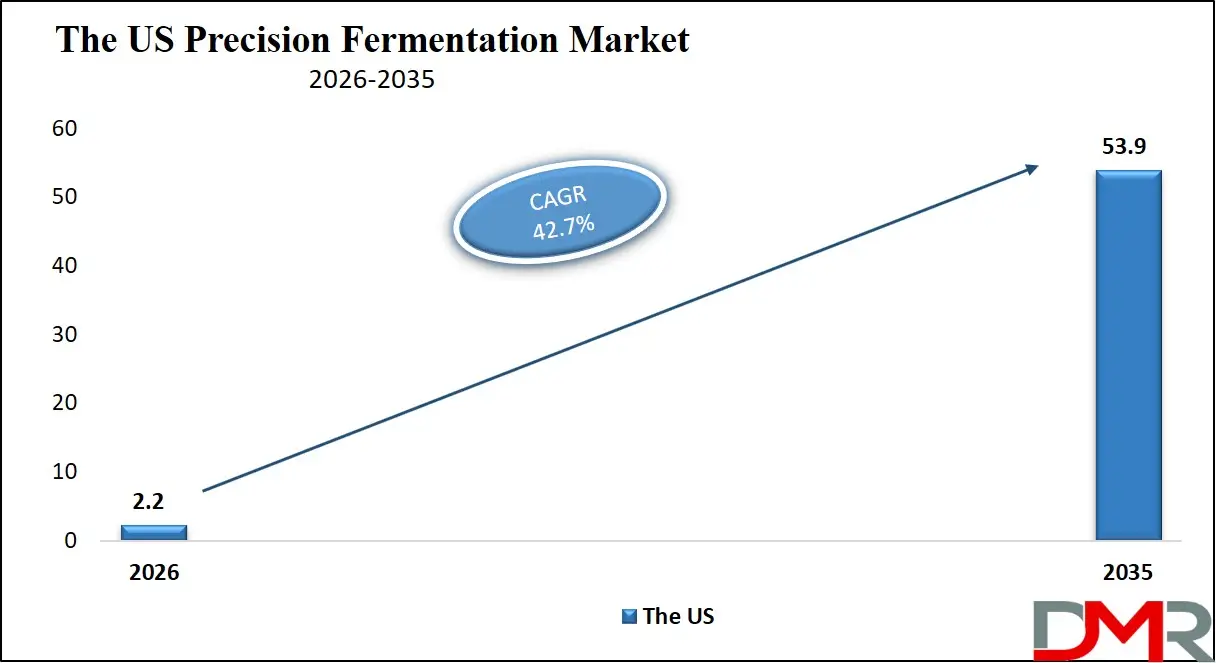
The US Precision Fermentation Market size is estimated to be USD 2.2 billion in 2026 and is expected to increase at a CAGR of 42.7% over the forecast period.
ℹ
To learn more about this report –
Download Your Free Sample Report Here
The market receives strong venture capital funding, state-of-the-art biotechnology facilities and regulatory framework. Encouraging public support towards alternative proteins ensures the uptake of such products. The use of biotechnology hubs and collaborations between start-ups and food processors ensures the sustainability of its market position.
Europe Precision Fermentation Market
The Europe Precision Fermentation Market size is estimated to be USD 1.5 llion in 2026 and at a CAGR of 43.1% over the forecast period.
The growth of Europe's market is affected by policies that are oriented towards sustainability like the European Green Deal and environmental legislation. There is an emphasis on clean label products and production that does not involve GMOs and is sustainable. Research funding is good especially for synthetic biology, and there is growing interest from consumers in plant-based protein products.
Japan Precision Fermentation Market
The market size of Japan's Precision Fermentation will be USD 252 million in 2026, with a CAGR of 44.0% in the forecast period.
Japan's markets continue to expand because of advancements in technology, the growth of cities, and governmental support for the development of new food technologies. Japan's commitment to ensuring food security and sustainability leads to increased investments in fermentation technologies. But there are issues such as cost, and there are possibilities in terms of functional foods and pharmaceuticals.
Key Takeaways
- Market Size & Forecast: The Precision Fermentation Market size is projected to reach USD 6.3 billion in 2026 and is anticipated to have a value of USD 186.1 billion in 2035.
- Growth Rate & Outlook: The Precision Fermentation Market size is set to grow at a compound annual growth rate of 45.6% during the forecast period of 2026 to 2035.
- Primary Growth Drivers: Some of the major growth drivers in the market include rising demand for sustainable and animal-free products, advancements in synthetic biology and bioprocessing, and more.
- Key Market Trends: Some of the major trends in the market are increasing adoption of hybrid fermentation models, shift toward clean-label and functional ingredients, and more.
- By Product: The ingredients segment is anticipated to get the majority share of the Precision Fermentation market in 2026.
- By Microogranism Type: The yeast segment is expected to get the largest revenue share in 2026 in the Precision Fermentation market.
- By Application: The alternative proteins segment is expected to get the largest revenue share in 2026 in the Precision Fermentation market.
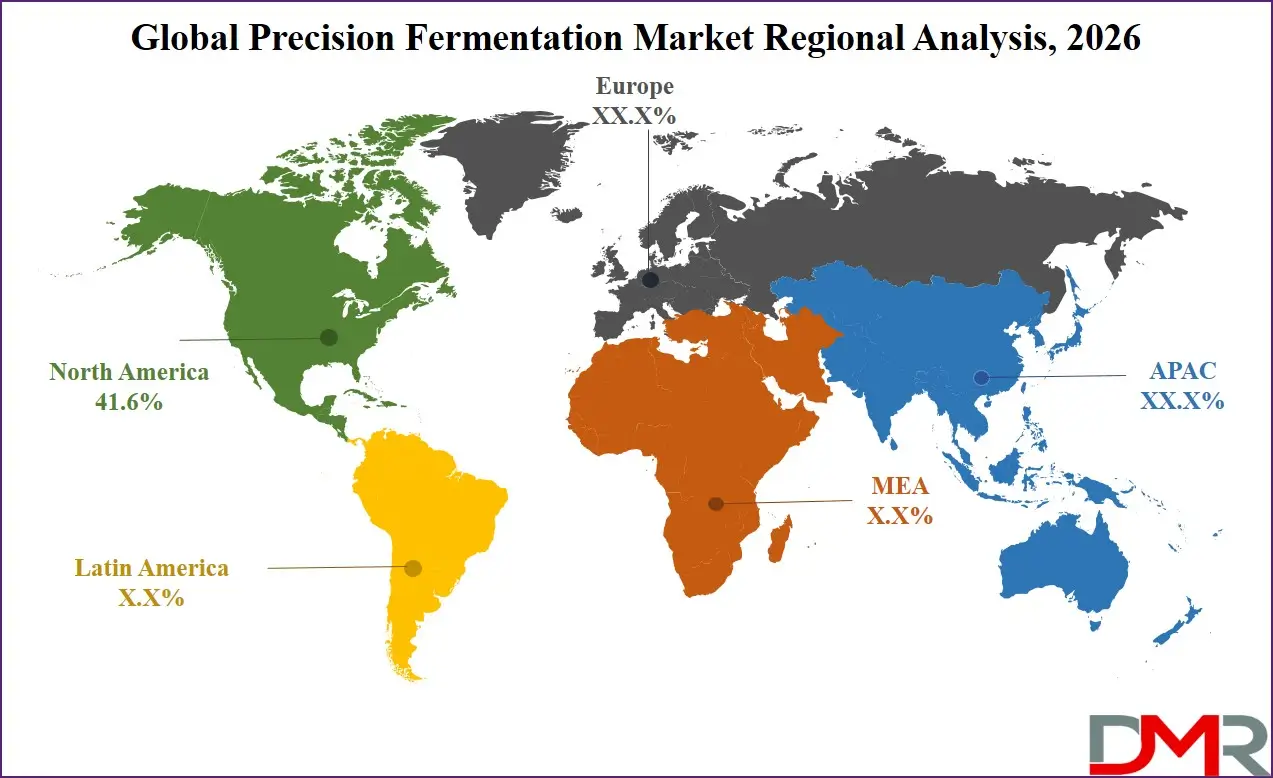
- Regional Leadership: North America is set to lead the Precision Fermentation market with an estimated 41.6% share in 2026.
What is the Precision Fermentation?
Precision fermentation is the term used for the use of genetically modified microorganisms such as yeast, bacteria, and fungi to produce particular substances as desired. This differs from conventional fermentation in the sense that the latter involves multiple end products while precision fermentation is very targeted and specific, allowing the production of high-purity products. Precision fermentation contributes greatly to creating sustainable substitutes to products from animals and fossil fuels. Some trends within this sector involve improved strain engineering, application of artificial intelligence in bioprocessing, and new applications in various fields.
Use Cases
- Alternative Protein Production: Enables manufacturing of animal-free dairy, egg, and meat proteins with identical functionality, supporting sustainable food systems and reducing environmental impact.
- Pharmaceutical Ingredients: Used to produce high-purity enzymes, antibodies, and therapeutic proteins, improving drug development efficiency and scalability.
- Functional Food Ingredients: Enhances nutritional profiles through production of vitamins, bioactives, and specialty compounds for fortified foods and beverages.
- Industrial Biotechnology: Supports production of bio-based chemicals, enzymes, and specialty materials, reducing reliance on fossil-based inputs.
How AI Is Transforming the Precision Fermentation Market
AI technology is making great advancements in precision fermentation technology using engineered strains of microorganisms as well as enhancing efficiencies in the process itself.
Predictive analytics in AI is achieved through gene analysis, and therefore there is no need for experimentation when making improvements.
Real-time analytics from AI helps in fermenting processes through better process control. Supply chain management and demand forecasting are better managed, leading to better scaling up of processes.
Market Dynamic
Driving Factors in the Precision Fermentation Market
Rising Demand for Sustainable and Animal-Free Products
Awareness of environment, together with increased consciousness regarding the welfare of animals, is an important factor that helps create demand for sustainable options. Precision fermentation makes it possible to produce animal proteins without the use of livestock; therefore, it reduces greenhouse emissions and conserves water and land use.
Advancements in Synthetic Biology and Bioprocessing
The advent of technologies in genetic engineering, strain improvement through artificial intelligence, and fermentation efficiency is propelling the industry forward. Technology adoption results in lower manufacturing costs, higher yields, and scalability. Precision fermentation is now commercially feasible due to continued research and development and automation in fermenters.
Restraints in the Precision Fermentation Market
High Production Costs and Infrastructure Requirements
Higher initial costs associated with the requirement of more sophisticated bioreactors, better environmental controls, and professional expertise are major drawbacks. Expansion of production and retaining efficiency without increased cost is difficult. Such limitations prevent smaller firms from participating actively in the market even when demand is high.
Regulatory and Approval Challenges
Bioengineering products have varying regulatory requirements depending on the region, thus delaying the approval process. The stringent safety and labeling standards, especially in Europe and Asia, pose challenges to accessing and expanding markets.
Opportunities in the Precision Fermentation Market
Expansion into Emerging Markets
The growth prospects of emerging economies lie in their growing urban population, rising incomes, and sustainability concerns associated with food production. Biotechnology innovations in these countries, facilitated by government programs, present business opportunities.
Integration with AI and Digital Biomanufacturing
The integration of artificial intelligence in fermentation processes enables predictive modeling, process optimization, and cost reduction. This technological synergy can significantly enhance production efficiency and open new avenues for innovation in ingredient development.
Trends in the Precision Fermentation Market
Increasing Adoption of Hybrid Fermentation Models
This new technology of hybrid fermentation involving both conventional and precision fermentation processes has emerged as another important industry trend. It enables companies to maintain an optimal balance between scalability and innovative technology adoption.
Shift Toward Clean-Label and Functional Ingredients
There is an increase in demand for clean-label products from consumers. The process of precision fermentation helps in manufacturing clean label and functional ingredients, offering increased nutrition content.
Research Scope and Analysis
By Product Analysis
The ingredients segment dominates the market due to its broad application across food, pharmaceutical, and industrial sectors, holding an estimated 68.4% share in 2026. Proteins, particularly whey and casein alternatives, drive this dominance due to high demand for dairy substitutes and functional food innovation. Increasing use of bioengineered enzymes, lipids, and specialty fats further strengthens this segment's position. Additionally, large-scale commercialization by food manufacturers and ingredient suppliers supports growth. Microbial strains are the fastest-growing segment, fueled by advancements in strain engineering, synthetic biology tools, and increasing demand for customized production organisms tailored for high yield and efficiency.
By Microorganism Type Analysis
Yeast is at the forefront in this classification since it is expected to generate 39.7% market share in 2026 as a result of its flexibility, scalability, and use in fermentation technology. In addition, it is highly appreciated due to its effectiveness in producing enzymes and proteins. It can undergo genetic modifications and thus is highly useful for precision fermentation. Bacteria are leading the way in terms of growth since they reproduce quickly, have high adaptability, and are suitable for producing bioactive chemicals.
By Ingredient Type Analysis
Protein ingredients are the most prevalent ingredients and account for up to 42.3% of market share in 2026 due to the rising demand for plant-based protein food ingredients as an alternative to animal meat or dairy products. The functional role of protein ingredients is equivalent to that of animal protein, making it useful for industrial manufacturing purposes. Furthermore, the increasing value attached to health and sustainability issues has driven up the demand for these products. The specialty molecule segment, which comprises peptides and antibodies, is expected to grow at the fastest pace because of its various uses in the pharmaceutical and biological industry.
By Application Analysis
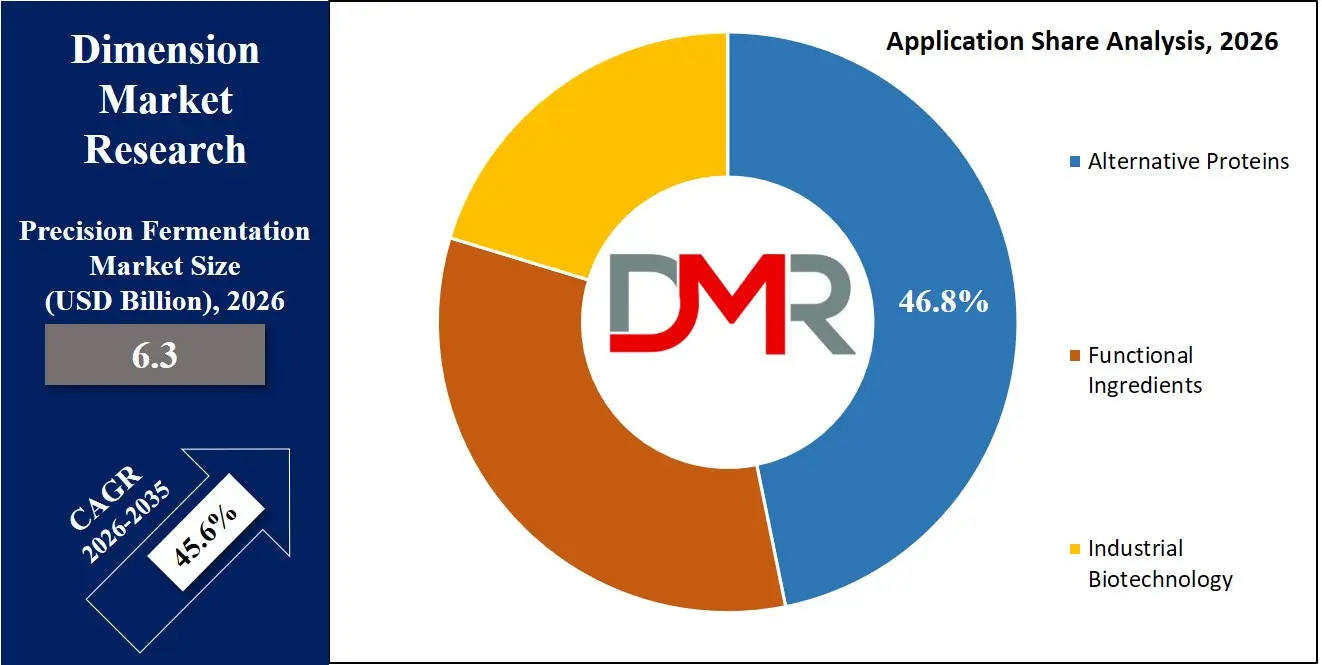
Alternative proteins dominate the market with a forecasted 46.8% share in 2026 because of high customer preference for plant-based or non-animal foods. The alternative proteins market receives significant impetus because of higher levels of awareness about the environmental impact and ethical food production.
ℹ
To learn more about this report –
Download Your Free Sample Report Here
The inclusion of ingredients obtained via precision fermentation by food producers in the mainstream food product range has increased the adoption of precision fermentation technology. Industrial biotechnology accounts for the highest growth rate because of growing demand for environmentally friendly bio-based chemicals and enzymes.
By End Use Industry Analysis
The most popular category is that of foods & beverages, accounting for nearly 51.2% of the global market share by 2026. This can be attributed to the rising preference of consumers for sustainable, clean label, and functional foods. The use of precision fermentation ingredients in dairy alternatives, bakery products, and functional foods is creating huge business opportunities in the industry. In addition, partnerships between biotech firms and food processing firms are making the commercialization faster than ever before. The fastest growing segments include the pharmaceuticals and healthcare categories owing to the developments in biologics and precision medicine.
By Technology Analysis
Precision fermentation takes the lead with an expected market share of 47.5% by 2026, mainly because of its efficient and effective capability to produce target high-value compounds. The use of precision fermentation for the production of protein/enzyme/bioactive production contributes significantly to its importance within the industry. Owing to constant developments in genetic modification/fermentation technology, precision fermentation is expected to hold on to its leadership position. Hybrid fermentation is the most rapidly growing product category because of its economic feasibility.
The Precision Fermentation Market Report is segmented on the basis of the following:
By Product
- Ingredients
- Proteins (Whey, Casein, Egg, Collagen, Heme)
- Enzymes
- Lipids & Specialty Fats
- Flavors & Aromas
- Vitamins & Bioactives
- Microbial Strains
By Microorganism Type
- Yeast
- Bacteria
- Fungi
- Algae
By Ingredient Type
- Protein-based Ingredients
- Enzymes
- Structural Molecules (Collagen, Gelatin)
- Flavor & Functional Compounds
- Specialty Molecules (Peptides, Antibodies)
By Application
- Alternative Proteins
- Dairy Alternatives
- Egg Alternatives
- Meat & Seafood Alternatives
- Functional Ingredients
- Industrial Biotechnology
By End-Use Industry
- Food & Beverages
- Dairy & Alternatives
- Meat Alternatives
- Bakery & Confectionery
- Functional Foods
- Pharmaceuticals & Healthcare
- Personal Care & Cosmetics
By Technology
- Precision Fermentation
- Biomass Fermentation
- Hybrid Fermentation
Regional Analysis
Leading Region in the Precision Fermentation Market
The North American region dominates the global market with its forecasted market share of 41.6%, which is due to considerable investments in biotechnology, well-developed research facilities, and supportive regulations. The dominant position of the North American market is caused by its availability of well-developed biotech hubs, venture capital funding, and an innovative environment centered around alternative protein-based technologies and biomanufacturing. At the same time, the high degree of consumer awareness and support from governmental authorities, together with growing demand for sustainability and clean-label products, add to the region's leadership.
ℹ
To learn more about this report –
Download Your Free Sample Report Here
Fastest Growing Region in the Precision Fermentation Market
The Asia-Pacific region is the leading market owing to its quick urbanization, higher population, and increasing demand for sustainable food sources. Rising population of middle classes, changing consumer preferences, and growing awareness about health are boosting the demand for novel protein sources and functional ingredients. Biotechnological innovations backed by government support and research and industrial development are some of the primary factors driving the growth of the market. Countries in this region are aggressively focusing on food security and sustainability through technological advances.
By Region
North America
Europe
- Germany
- The U.K.
- France
- Italy
- Russia
- Spain
- Benelux
- Nordic
- Rest of Europe
Asia-Pacific
- China
- Japan
- South Korea
- India
- ANZ
- ASEAN
- Rest of Asia-Pacific
Latin America
- Brazil
- Mexico
- Argentina
- Colombia
- Rest of Latin America
Middle East & Africa
- Saudi Arabia
- UAE
- South Africa
- Israel
- Egypt
- Rest of MEA
Competitive Landscape
There is intense competition in the Precision Fermentation Market due to innovation, intellectual property, and technology. The strategic alliances and research are necessary for companies to be able to compete in the industry. There are also high entry barriers in the market because of the capital required and the technical skills needed.
Some of the prominent players in the global Precision Fermentation are:
- Perfect Day
- Geltor
- The EVERY Company
- Impossible Foods
- ImaginDairy
- Shiru
- Formo
- Eden Brew
- Change Foods
- New Culture
- Remilk
- Onego Bio
- Motif FoodWorks
- Helaina
- MycoTechnology
- Mycorena
- Nourish Ingredients
- Melt&Marble
- Fybraworks Foods
- De Novo Foodlabs
- Other Key Players
Recent Developments
- In April 2026, Praj Industries announced the launch of an Advanced Precision Fermentation Lab at Praj Matrix to advance next-generation biomanufacturing. The facility will focus on AI-enabled precision fermentation and scalable bioprocesses to improve efficiency and reliability. Supporting sectors such as pharmaceuticals, food, cosmetics, and biofuels, the initiative strengthens collaboration and enhances capabilities alongside Praj HiPurity Systems.
- In April 2026, AuX Labs raised USD 4 million to accelerate commercialization of precision fermentation-derived dairy proteins for cheese alternatives. Backed by NYA Ventures and Nàdarra Ventures, the funding supports scaling products designed to match traditional cheese in melt, stretch, and taste. The platform targets the large global cheese market by addressing performance gaps in existing alternatives and enabling adoption in everyday food applications.
- In December 2025, Onego Bio announced an expert series titled "The Power of Trichoderma reesei," highlighting the organism behind its Bioalbumen® protein platform. The initiative explores its scientific and industrial advantages in precision fermentation. The first session will examine its role as a scalable microbial workhorse, with insights into performance and applications in protein manufacturing, followed by a detailed white paper.
Report Details
| Report Characteristics |
| Market Size (2026) |
USD 6.3 Bn |
| Forecast Value (2035) |
USD 186.1 Bn |
| CAGR (2026-2035) |
45.6% |
| Historical Period |
2021 – 2025 |
| Forecast Period |
2027 – 2035 |
| Base Year |
2025 |
| Estimate Year |
2026 |
| Segments Covered |
By Product (Ingredients, Microbial Strains),
By Microorganism Type (Yeast, Bacteria, Fungi, Algae),
By Ingredient Type (Protein-based Ingredients, Enzymes, Structural Molecules (Collagen, Gelatin), Flavor & Functional Compounds, Specialty Molecules (Peptides, Antibodies)),
By Application (Alternative Proteins, Functional Ingredients, Industrial Biotechnology),
By End-Use Industry (Food & Beverages, Pharmaceuticals & Healthcare, Personal Care & Cosmetics),
By Technology (Precision Fermentation, Biomass Fermentation, Hybrid Fermentation) |
| Regional Coverage |
North America – The US and Canada;
Europe – Germany, The UK, France, Russia, Spain, Italy, Benelux, Nordic, & Rest of Europe;
Asia-Pacific – China, Japan, South Korea, India, ANZ, ASEAN, Rest of APAC;
Latin America – Brazil, Mexico, Argentina, Colombia, Rest of Latin America;
Middle East & Africa – Saudi Arabia, UAE, South Africa, Turkey, Egypt, Israel, & Rest of MEA |
Frequently Asked Questions
How big is the Precision Fermentation Market?
▾ The Precision Fermentation Market size is expected to reach USD 6.3 billion by 2026 and is projected to reach USD 186.1 billion by the end of 2035.
What is the CAGR of the Precision Fermentation Market from 2026 to 2035?
▾ The market is growing at a CAGR of 45.6 percent over the forecasted period.
What factors are driving the growth of the Precision Fermentation Market?
▾ Rising demand for sustainable and animal-free products, advancements in synthetic biology and bioprocessing, and other factors are driving the growth of the Precision Fermentation Market.
What are the major trends in the Precision Fermentation Market?
▾ Increasing adoption of hybrid fermentation models, shift toward clean-label and functional ingredients, and more are some of the major trends in the market.
Who are the key players in the Precision Fermentation Market?
▾ Some of the key players in the Precision Fermentation Market include Perfect Day, Formo, Shiru, and more.
How is the Precision Fermentation Market segmented?
▾ The Precision Fermentation Market is segmented by product, microorganism type, ingredient type, application, end-use industry, technology.
Which region held the largest share of the Precision Fermentation Market in 2026?
▾ North America is set to lead the Precision Fermentation market with an estimated 41.6% share in 2026.
Which region is expected to grow the fastest in the Precision Fermentation Market?
▾ Asia-Pacific is the fastest-growing region in the Precision Fermentation market during the forecast period.