What is the Privacy-Enhancing Technologies Market Size?
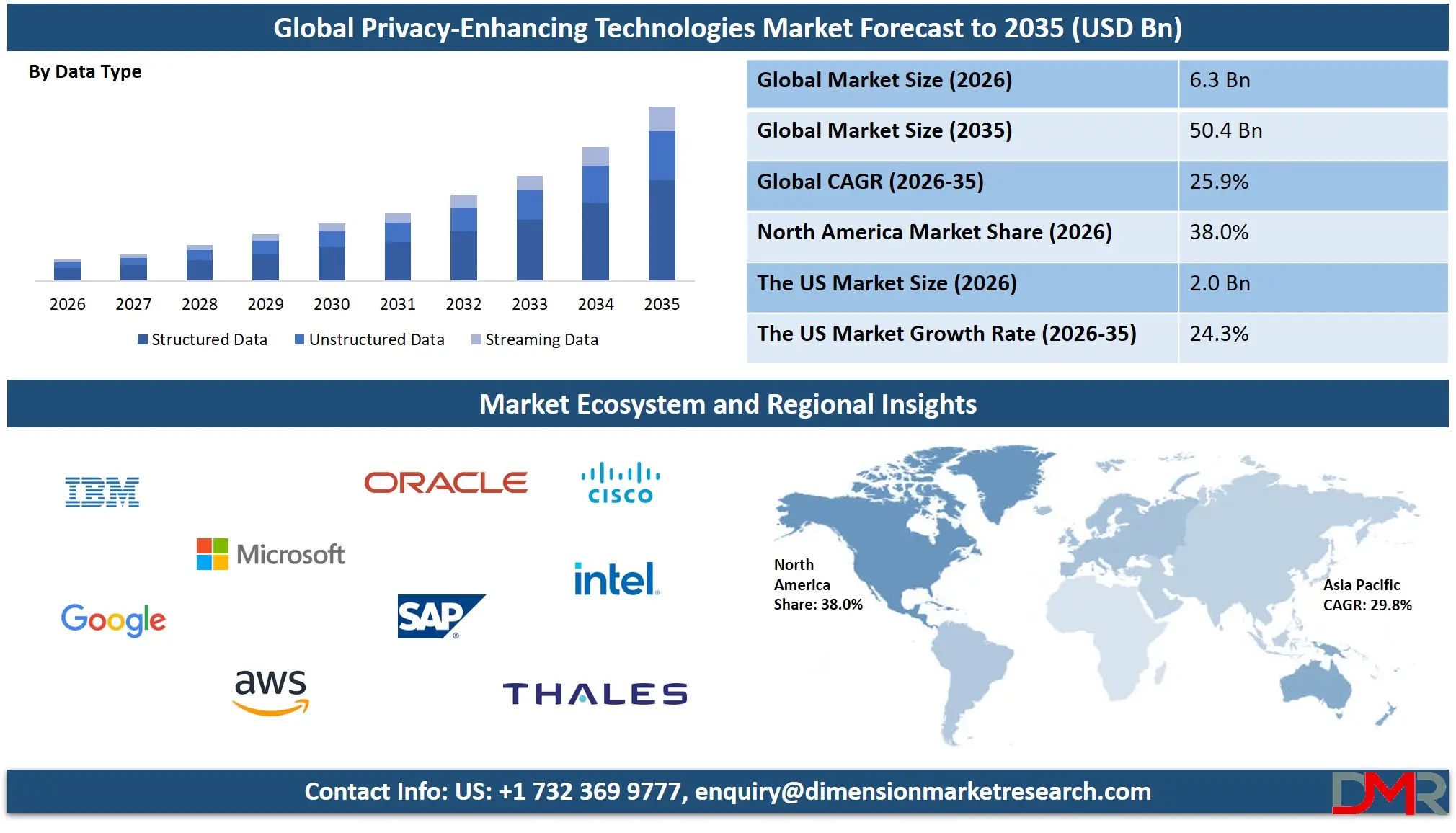
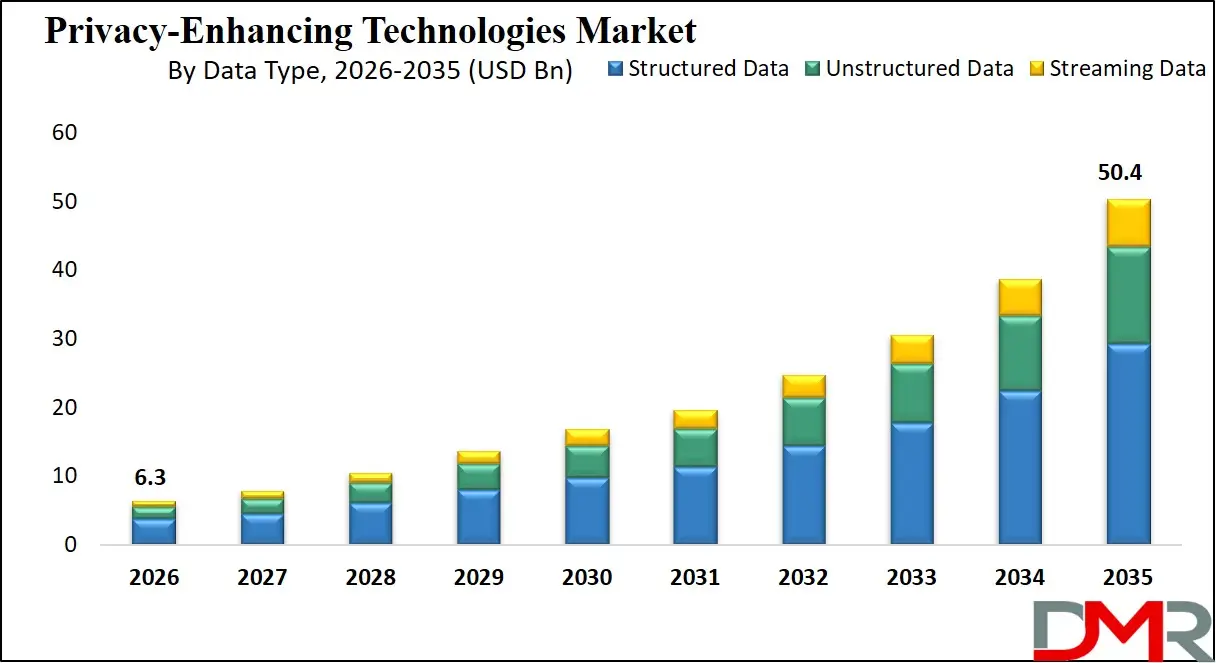
The Global Privacy-Enhancing Technologies Market is projected to reach USD 6.3 billion in 2026 and grow at a compound annual growth rate of 25.9%, reaching USD 50.4 billion by 2035.
ℹ
To learn more about this report –
Download Your Free Sample Report Here
The Privacy-Enhancing Technologies (PET) market is expanding rapidly as organizations aim to secure sensitive data while enabling safe analytics and sharing across digital systems. According to the International Data Corporation, global data volume is expected to reach 175 zettabytes by 2025, intensifying privacy risks.
Regulatory pressure from bodies like the European Commission is accelerating the adoption of privacy-first frameworks. Rising cyber threats reported by the Cybersecurity and Infrastructure Security Agency further drive demand. Growth in AI and cloud is reinforcing adoption of secure computation technologies. Increasing awareness and compliance needs continue to support market expansion. The market is set for strong future growth with encrypted analytics and federated learning.
ℹ
To learn more about this report –
Download Your Free Sample Report Here
US Privacy-Enhancing Technologies Market
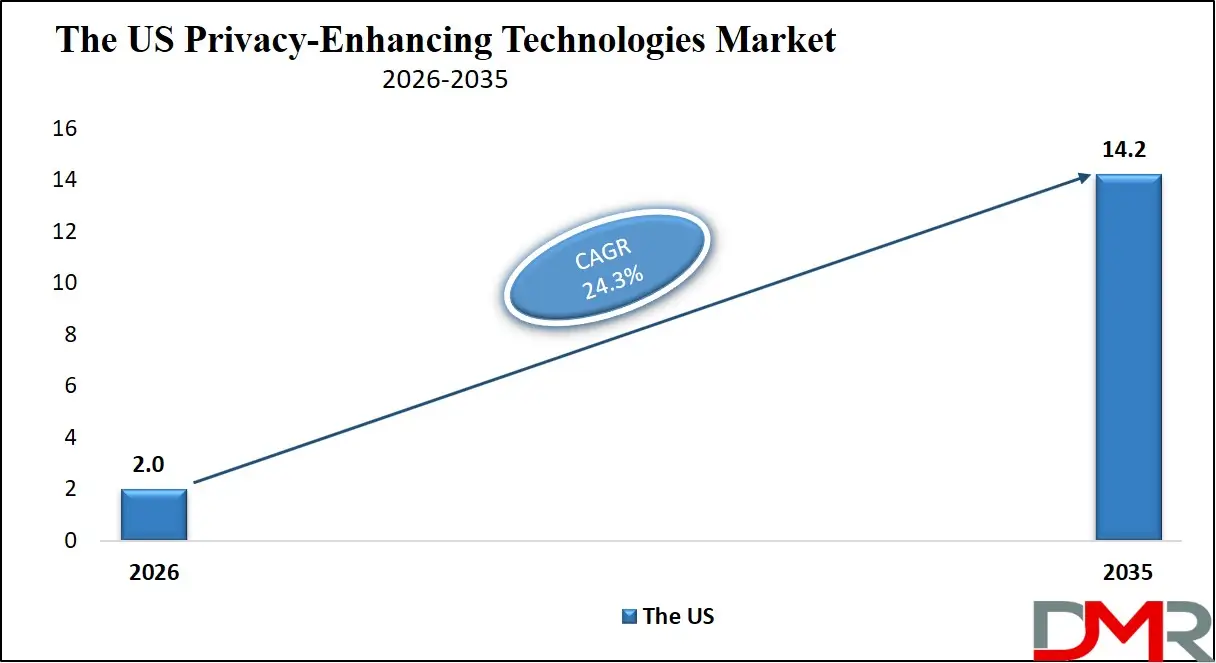
The US Privacy-Enhancing Technologies Market is projected to reach USD 2.0 billion in 2026 and grow at a compound annual growth rate of 24.3%, reaching USD 14.2 billion by 2035.
ℹ
To learn more about this report –
Download Your Free Sample Report Here
The United States Privacy-Enhancing Technologies market leads globally due to strong regulations and advanced digital infrastructure. Frameworks from the National Institute of Standards and Technology are accelerating adoption across industries. Rising cyber threats reported by the Cybersecurity and Infrastructure Security Agency are further driving demand. Growth in AI and cloud computing is increasing the need for secure data processing. The market is expected to grow steadily with continued regulatory support and technological innovation.
Europe Privacy-Enhancing Technologies Market
Europe Privacy-Enhancing Technologies Market is anticipated to reach USD 1.5 Bn in 2026, expanding with a CAGR of 24.7%. The growth is driven by stringent data protection regulations and strong enforcement of privacy frameworks across industries. Increasing adoption of cloud services, AI, and secure data sharing platforms is further accelerating demand for PET solutions. Rising focus on compliance and cross-border data governance is also strengthening market expansion across the region.
Japan Privacy-Enhancing Technologies Market
Japan Privacy-Enhancing Technologies Market is anticipated to reach USD 441 Mn in 2026, expanding with a CAGR of 23.8%. Growth is driven by increasing digital transformation across enterprises and rising focus on data security and privacy compliance. Adoption of cloud computing, AI-driven analytics, and secure data sharing frameworks is further boosting demand for PET solutions. Strong government emphasis on cybersecurity and information protection is also supporting steady market expansion in the country.
Key Takeaways
- Market Size: The Privacy-Enhancing Technologies market is projected to reach USD 6.3 billion in 2026, driven by rising enterprise adoption of privacy-first data solutions.
- Growth Rate and Outlook: The market is expected to grow at a CAGR of 25.9% from 2026 to 2035, indicating strong long-term expansion across digital ecosystems.
- Primary Growth Drivers: Growth is fueled by stricter data privacy regulations, increasing cyber threats, and rapid expansion of AI, cloud computing, and big data applications.
- By Component Analysis: Software dominates the segment with a 61% share in 2026, driven by demand for encryption, anonymization, and privacy analytics platforms.
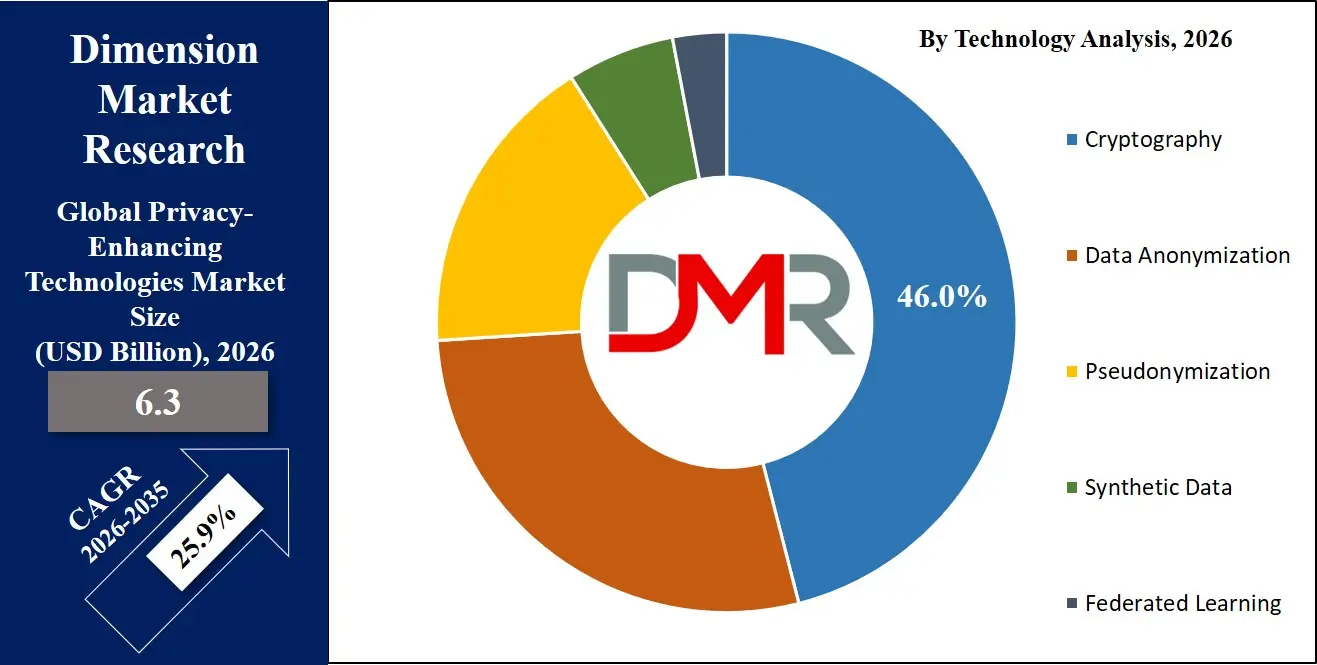
- By Technology Analysis: Cryptography leads with a 46% share in 2026, supported by widespread use of secure computation and encryption-based privacy solutions.
- By Deployment Analysis: Cloud deployment dominates with a 54% share in 2026, driven by scalability, flexibility, and integration with modern digital infrastructures.
- Regional Leadership: North America leads the market with a 38% share in 2026, supported by advanced digital infrastructure, strong regulatory frameworks, and early technology adoption.
What are Privacy-Enhancing Technologies?
Privacy-Enhancing Technologies (PETs) are techniques that allow data to be used and analyzed without exposing sensitive information. They include encryption, anonymization, and secure computation to protect privacy. These technologies are widely used in finance, healthcare, and government sectors. The National Institute of Standards and Technology promotes PETs as part of privacy-by-design systems. The European Union Agency for Cybersecurity highlights their role in secure data sharing. The Organisation for Economic Co-operation and Development supports their use for trusted data flows. PETs are becoming essential as digital data usage continues to grow.
Use Cases
- Financial Fraud Detection: Privacy-Enhancing Technologies enable banks to analyze transaction patterns without exposing customer-level sensitive data. Secure computation and encryption help detect anomalies while maintaining compliance with strict financial regulations. This improves fraud prevention accuracy while preserving user confidentiality.
- Healthcare Data Collaboration: PETs allow hospitals and research institutions to share medical insights without revealing patient identities. Techniques like anonymization and federated learning support secure cross-institutional research. This accelerates drug discovery and diagnostics while ensuring patient privacy protection.
- Secure Cloud Data Processing: Organizations use PETs to process and analyze data in cloud environments without exposing raw datasets to service providers. Encryption and confidential computing ensure data remains protected during computation. This supports scalable cloud adoption without compromising security.
- Government Data Sharing: Public sector agencies apply PETs to securely share citizen data across departments for analytics and policymaking. Privacy-preserving techniques reduce risks of data leakage and unauthorized access. This enables efficient governance while maintaining strict data protection standards.
How AI is Transforming the Privacy-Enhancing Technologies Market?
AI is transforming the Privacy-Enhancing Technologies market by enabling automated data protection through advanced encryption, anomaly detection, and privacy risk assessment. It strengthens PET solutions by powering techniques like federated learning and secure multi-party computation for distributed data processing without exposing raw data.
AI also improves real-time threat detection and adaptive privacy controls across cloud and enterprise systems. As AI adoption grows, it is accelerating demand for scalable, intelligent privacy frameworks across industries.
Market Dynamics
Key Drivers in the Global Privacy-Enhancing Technologies Market
Rising Data Privacy Regulations
Global governments are enforcing stricter data protection laws that require organizations to secure and control personal data usage. Regulations such as GDPR-inspired frameworks and national privacy acts are pushing enterprises toward privacy-by-design systems. This is increasing demand for PET solutions like encryption, anonymization, and secure computation. Organizations are adopting these technologies to avoid penalties and maintain compliance. As regulatory scope expands across industries, PET adoption is becoming a mandatory enterprise requirement rather than an optional security measure.
Growth of Digital and AI Ecosystems
Rapid expansion of AI, cloud computing, and IoT is generating massive volumes of sensitive data across distributed environments. Traditional security methods are insufficient for handling data-in-use across complex digital workflows. PETs enable secure data processing without exposing raw information, making them essential for AI-driven analytics. Enterprises are increasingly integrating privacy-preserving models such as federated learning and encrypted computation. This technological shift is creating strong structural demand for advanced privacy infrastructure.
Restraints in the Global Privacy-Enhancing Technologies Market
High Implementation Complexity
Privacy-Enhancing Technologies often require advanced cryptographic expertise and complex system integration, making deployment challenging for enterprises. Many organizations face difficulties in aligning PET solutions with legacy IT infrastructure. The computational overhead of encryption-based techniques can also reduce processing efficiency. Additionally, lack of standardized frameworks increases implementation uncertainty across industries. These factors collectively slow down large-scale adoption, especially among small and medium enterprises with limited technical capabilities.
High Cost of Deployment
PET solutions involve significant investment in infrastructure, skilled workforce, and advanced security systems. Techniques such as homomorphic encryption and secure multi-party computation require high computational resources, increasing operational costs. Organizations must also invest in continuous monitoring and system upgrades to maintain effectiveness. For many enterprises, especially cost-sensitive sectors, return on investment remains uncertain in the short term. This cost barrier restricts rapid scalability despite strong demand.
Growth Opportunities in the Global Privacy-Enhancing Technologies Market
Expansion of Data-Driven Business Models
Enterprises are increasingly relying on data analytics, AI, and cloud ecosystems to drive decision-making and operational efficiency. This has significantly increased the need to process sensitive data without exposing it directly. Privacy-Enhancing Technologies enable secure computation and controlled data usage across distributed systems. Organizations are integrating PETs into core digital infrastructure to maintain both performance and compliance. As digital transformation deepens across industries, demand for scalable privacy solutions is accelerating consistently.
Rising Cybersecurity and Data Breach Incidents
The growing frequency and sophistication of cyberattacks are pushing organizations to strengthen data protection mechanisms beyond traditional security tools. PETs provide an additional layer of protection by ensuring data remains encrypted or anonymized even during processing. This reduces exposure risks in case of breaches or unauthorized access. Enterprises are increasingly adopting PET-based frameworks to minimize financial and reputational damage. The rising threat landscape is therefore acting as a strong structural growth driver for the market.
Trends in the Global Privacy-Enhancing Technologies Market
Shift toward Privacy-by-Design Architecture
Organizations are increasingly embedding privacy controls directly into system architecture rather than adding them as external layers. This shift ensures compliance is maintained throughout the data lifecycle, from collection to processing. Privacy-Enhancing Technologies are becoming core components of enterprise IT frameworks. Enterprises are adopting built-in encryption, anonymization, and secure computation by default. This trend is reshaping how digital systems are designed globally.
Rise of Confidential Computing and Encrypted Analytics
There is a strong shift toward processing data in encrypted form without exposing raw inputs during computation. Confidential computing and homomorphic encryption are gaining traction across cloud and AI environments. This enables organizations to perform advanced analytics while maintaining strict data confidentiality. Cloud providers are increasingly integrating such capabilities into their infrastructure. This trend is accelerating enterprise trust in large-scale cloud adoption.
Research Scope and Analysis
By Component Analysis
Software is expected to dominate the Privacy-Enhancing Technologies market with a 61.0% share in 2026 due to strong demand for encryption, anonymization, and secure analytics solutions across cloud and AI systems. Its growth is driven by scalability, ease of deployment, and compliance needs. The services segment supports this ecosystem through consulting, integration, and managed services that help enterprises implement and manage PET solutions. These services ensure smooth adoption, regulatory alignment, and system optimization across industries.
By Data State Analysis
Data in Transit is expected to lead the data state segment with a 37.0% share in 2026, driven by the need to secure real-time data exchange across cloud networks, APIs, and digital platforms. Organizations focus on encrypting data while it moves to prevent interception and breaches. Data at rest involves protecting stored information in databases and cloud storage using encryption and access controls. It ensures long-term data security and compliance against unauthorized access.
By Data Type Analysis
Structured data is expected to dominate the data type segment with a 58.0% share in 2026 due to its heavy use in enterprise databases, financial systems, and compliance-driven operations, making it easier to apply encryption and privacy controls. It forms the core of most business-critical information. Unstructured data includes emails, documents, images, and media files, which are harder to secure due to their complex formats and require advanced AI-based privacy tools for processing and protection.
By Technology Analysis
Cryptography is expected to dominate the technology segment with a 46.0% share in 2026 due to its wide use in encryption, secure computation, and zero-knowledge proofs for protecting data across cloud and AI systems. It ensures strong confidentiality during storage, transfer, and processing. Data anonymization focuses on removing personal identifiers from datasets to enable safe analytics and research. It is mainly used where privacy compliance and data utility must be balanced.
ℹ
To learn more about this report –
Download Your Free Sample Report Here
By Deployment Analysis
Cloud deployment is expected to dominate with a 54.0% share in 2026 due to its scalability, flexibility, and ease of integrating PET solutions across AI and enterprise systems. It supports fast deployment and real-time data protection in distributed environments. On-premise deployment is used by highly regulated sectors needing full control over sensitive data within internal infrastructure, especially in government and finance.
By Enterprise Size Analysis
Large enterprises are expected to dominate with a 68.0% share in 2026 due to high data volumes, complex systems, and strict compliance needs, leading to strong adoption of advanced PET solutions. SMEs adopt these technologies more slowly due to cost and capability limits but are gradually increasing usage through affordable cloud-based privacy tools.
By Application Analysis
Data security is expected to lead the application segment with a 32.0% share in 2026 due to rising demand for protecting sensitive data across cloud and enterprise systems from breaches and unauthorized access. Compliance focuses on meeting regulatory requirements and ensuring legal adherence, driving PET adoption in regulated industries.
By End Use Analysis
BFSI is expected to lead the end-use segment with a 25.0% share in 2026 due to high volumes of sensitive financial data, strict regulations, and strong demand for fraud prevention and secure transactions. Healthcare focuses on protecting patient data while enabling secure sharing for diagnostics, research, and digital health services. Both sectors are major adopters, but BFSI leads due to higher risk exposure and compliance requirements.
The Global Privacy-Enhancing Technologies Market Report is segmented on the basis of the following:
By Component
- Software
- Encryption Software
- Anonymization Software
- Privacy Analytics Platforms
- Data Collaboration Platforms
- Services
- Consulting Services
- Integration Services
- Managed Services
- Hardware
- Trusted Execution Hardware
- Cryptographic Modules
By Data State
- Data in Transit
- Data at Rest
- Data in Use
- Data Sharing
By Data Type
- Structured Data
- Unstructured Data
- Streaming Data
By Technology
- Cryptography
- Data Anonymization
- Pseudonymization
- Synthetic Data
- Federated Learning
By Deployment
By Enterprise Size
By Application
- Data Security
- Compliance
- Risk Control
- Identity Security
- Privacy Analytics
- Secure Sharing
By End Use
- BFSI
- Healthcare
- Government
- IT and Telecom
- Retail
- Energy
- Manufacturing
Regional Analysis
Leading Region by Market Share
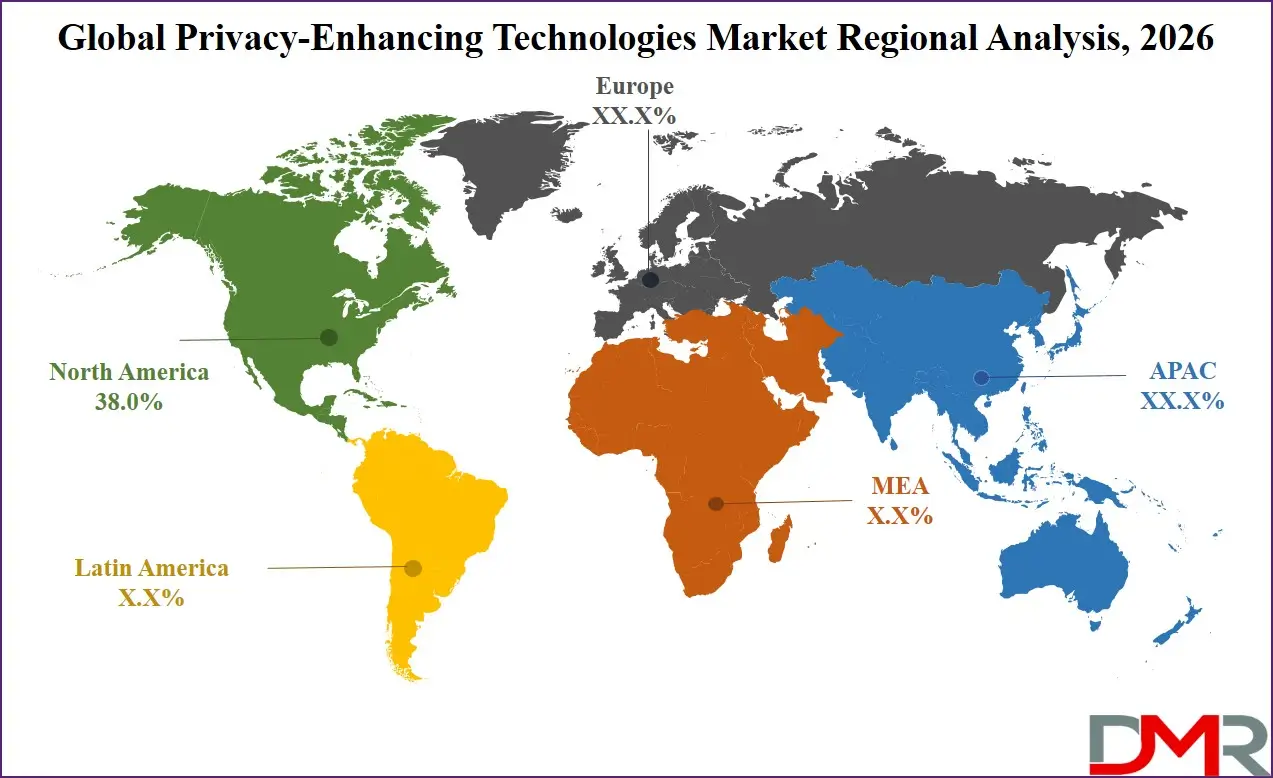
North America is expected to lead the Privacy-Enhancing Technologies market with a 38.0% share in 2026 due to strong regulatory frameworks and advanced digital infrastructure. High adoption of cloud, AI, and cybersecurity solutions across enterprises further drives demand. The presence of major technology providers and early adoption of privacy-first strategies strengthen its market dominance.
ℹ
To learn more about this report –
Download Your Free Sample Report Here
Fastest-Growing Regional Market
Asia Pacific is the fastest-growing regional market for Privacy-Enhancing Technologies, driven by rapid digital transformation and expanding cloud and AI adoption. Increasing data privacy regulations across countries and rising cyber threats are accelerating demand. Strong growth in tech-driven economies like China and India is further boosting market expansion.
By Region
North America
Europe
- Germany
- The U.K.
- France
- Italy
- Russia
- Spain
- Benelux
- Nordic
- Rest of Europe
Asia-Pacific
- China
- Japan
- South Korea
- India
- ANZ
- ASEAN
- Rest of Asia-Pacific
Latin America
- Brazil
- Mexico
- Argentina
- Colombia
- Rest of Latin America
Middle East & Africa
- Saudi Arabia
- UAE
- South Africa
- Israel
- Egypt
- Rest of MEA
Competitive Landscape
The Privacy-Enhancing Technologies market is highly competitive, driven by rapid innovation in encryption, secure computation, and anonymization solutions. Vendors are focusing on integrating advanced privacy features into cloud and AI ecosystems to gain an edge. Strategic partnerships, mergers, and continuous product enhancements are key strategies shaping competition. Increasing demand for regulatory-compliant solutions is intensifying market rivalry among global technology providers.
Some of the prominent players in the Global Privacy-Enhancing Technologies Market are:
- IBM Corporation
- Microsoft Corporation
- Google LLC
- Amazon Web Services
- Oracle Corporation
- SAP SE
- Cisco Systems
- Intel Corporation
- Thales Group
- Hewlett Packard Enterprise
- Accenture plc
- Infosys Limited
- Fortanix Inc.
- Duality Technologies
- Enveil Inc.
- Inpher Inc.
- Privitar Ltd.
- CryptoNumerics
- Anonos Inc.
- TripleBlind Inc.
- Other Key Players
Recent Developments
- July 2025: TripleBlind Inc. raised growth capital to scale its privacy-preserving data collaboration platform across healthcare and AI ecosystems.
- May 2025: Enveil Inc. secured Series C funding to expand its encrypted search and analytics platform for financial and government applications.
- April 2025: Google LLC completed the acquisition of Duality Technologies, strengthening its secure multi-party computation and PET capabilities.
Report Details
| Report Characteristics |
| Market Size (2026) |
USD 6.3 Bn |
| Forecast Value (2035) |
USD 50.4 Bn |
| CAGR (2026–2035) |
25.9% |
| Historical Data |
2021 – 2025 |
| Forecast Data |
2027 – 2035 |
| Base Year |
2025 |
| Estimate Year |
2026 |
| Segments Covered |
By Component (Software, Services, Hardware), By Data State (Data in Transit, Data at Rest, Data in Use, Data Sharing), By Data Type (Structured Data, Unstructured Data, Streaming Data), By Technology (Cryptography, Data Anonymization, Pseudonymization, Synthetic Data, Federated Learning), By Deployment (Cloud, On-Premise, Hybrid), By Enterprise Size (Large Enterprises, SMEs), By Application (Data Security, Compliance, Risk Control, Identity Security, Privacy Analytics, Secure Sharing), By End Use (BFSI, Healthcare, Government, IT and Telecom, Retail, Energy, Manufacturing) |
| Regional Coverage |
North America – The US and Canada; Europe – Germany, The UK, France, Russia, Spain, Italy, Benelux, Nordic, & Rest of Europe; Asia-Pacific – China, Japan, South Korea, India, ANZ, ASEAN, Rest of APAC; Latin America – Brazil, Mexico, Argentina, Colombia, Rest of Latin America; Middle East & Africa – Saudi Arabia, UAE, South Africa, Turkey, Egypt, Israel, & Rest of MEA |
Frequently Asked Questions
How big is the Privacy-Enhancing Technologies Market?
▾ The Privacy-Enhancing Technologies Market is anticipated to be valued at USD 6.3 billion in 2026 and is projected to reach USD 50.4 billion by 2035, reflecting strong enterprise adoption of privacy-first data frameworks.
What is the CAGR of the Privacy-Enhancing Technologies Market from 2026 to 2035?
▾ The market is expected to grow at a CAGR of 25.9% during the forecast period 2026 to 2035, driven by rising data privacy regulations and digital transformation.
What factors are driving the growth of the Privacy-Enhancing Technologies Market?
▾ Growth is driven by increasing data privacy regulations, rising cybersecurity threats, and rapid expansion of AI, cloud computing, and big data ecosystems. Enterprises are adopting PET solutions to ensure secure data sharing, regulatory compliance, and risk reduction.
What are the major trends in the Privacy-Enhancing Technologies Market?
▾ Key trends include adoption of privacy-by-design systems, rising use of federated learning and confidential computing, and increasing integration of PETs in cloud and AI infrastructures for secure data processing.
Which region held the largest share of the Privacy-Enhancing Technologies Market in 2026?
▾ North America held the largest share in 2026 with 38.0%, supported by strong regulatory frameworks, advanced digital infrastructure, and early adoption of privacy technologies.
Which region is expected to grow the fastest in the Privacy-Enhancing Technologies Market?
▾ Asia Pacific is expected to be the fastest-growing region due to rapid digital transformation, increasing cloud and AI adoption, and strengthening data protection regulations.
Who are the key players in the Privacy-Enhancing Technologies Market?
▾ Key players include IBM Corporation, Microsoft Corporation, Google LLC, Amazon Web Services, Oracle Corporation, SAP SE, Cisco Systems, Intel Corporation, Thales Group, Hewlett Packard Enterprise, Accenture plc, Infosys Limited, Fortanix Inc., Duality Technologies, Enveil Inc., Inpher Inc., Privitar Ltd., CryptoNumerics, Anonos Inc., and TripleBlind Inc.
How is the Privacy-Enhancing Technologies Market segmented?
▾ The market is segmented by Component, Data State, Data Type, Technology, Deployment, Enterprise Size, Application, and End Use, covering both infrastructure-level and application-level privacy solutions across industries.