What is the Privileged Access Management Market Size?
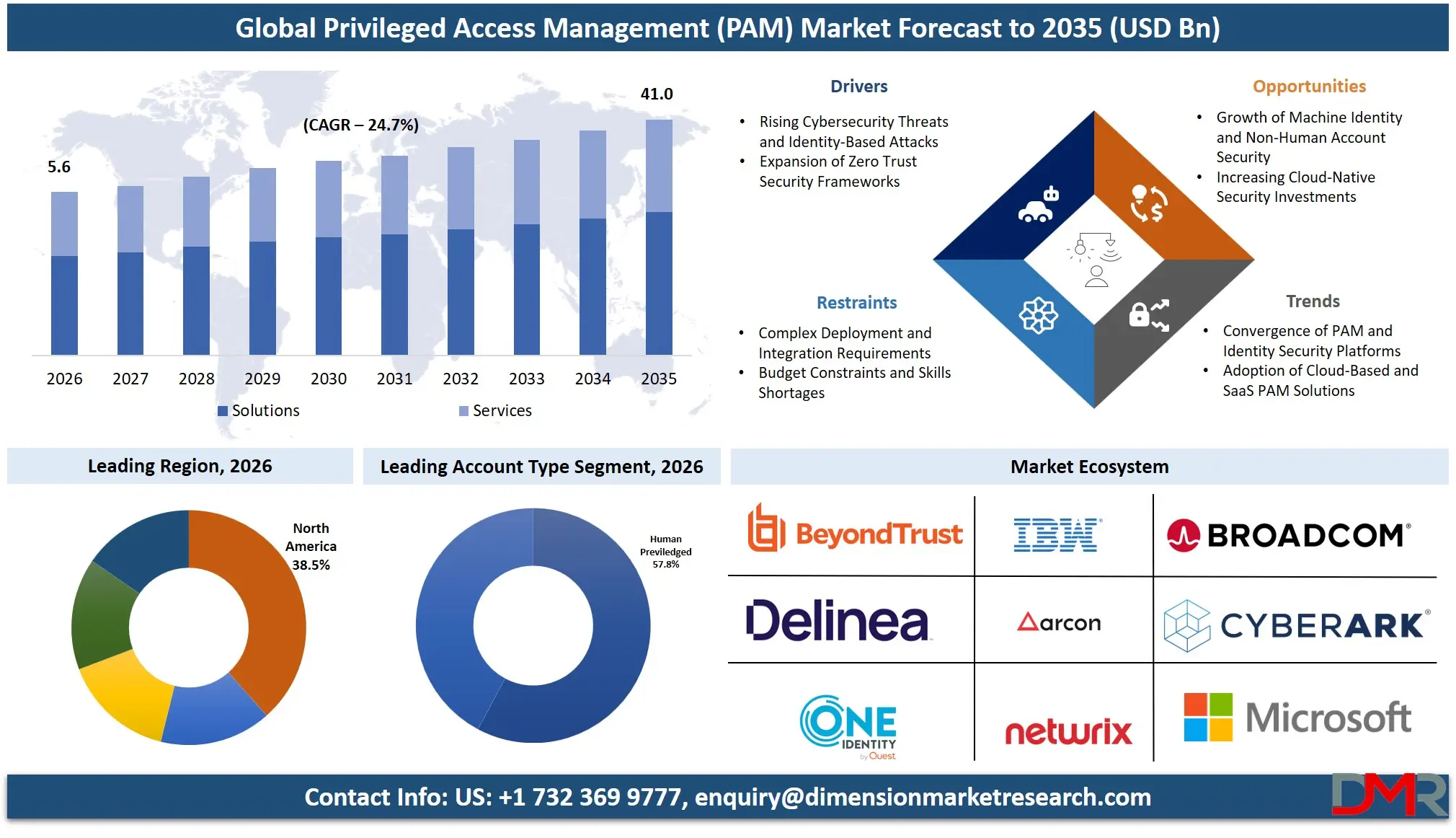
The Privileged Access Management (PAM) Market size is expected to be USD 5.6 billion in 2026 and increase at a compound annual growth rate of 24.7% to USD 41.0 billion in 2035 due to increase in the occurrence of ransomware attacks, credential theft, insider threats, and advanced cyber-attacks.
ℹ
To learn more about this report –
Download Your Free Sample Report Here
Privileged Access Management (PAM) is defined as the security products, protocols, and procedures that safeguard, monitor, govern, and report access to vital infrastructure, software, databases, cloud computing services, and sensitive information assets by privileged users and machine identities. The different components that make up PAM products include credential vaulting, session management for privileged accounts, implementation of least privilege, identity governance tools, and entitlement management in cloud services. It is an important aspect of modern enterprise cybersecurity strategy since it reduces risks related to insider threats, mitigates unauthorized access, and promotes regulatory compliance.
The US Privileged Access Management (PAM) Market
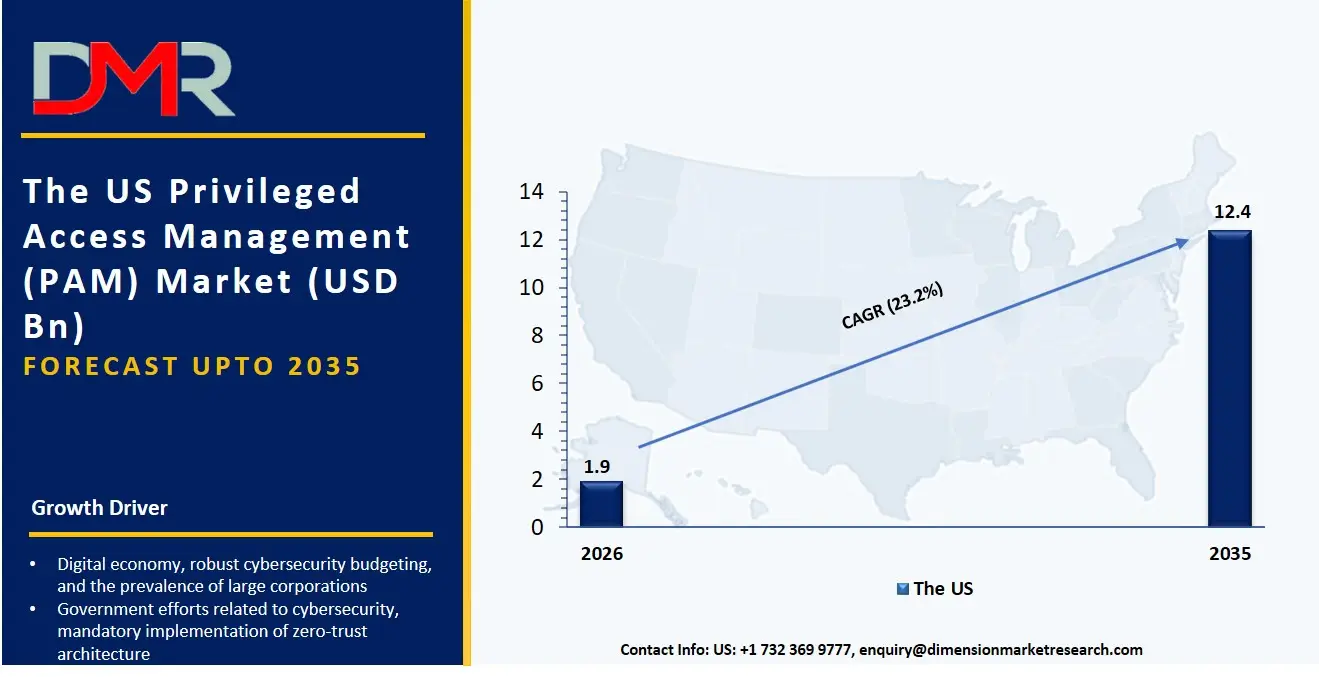
The US Privileged Access Management (PAM) Market size is estimated to be USD 1.9 billion in 2026 and is expected to increase at a CAGR of 23.2% over the forecast period.
ℹ
To learn more about this report –
Download Your Free Sample Report Here
US holds the dominant position within the PAM implementation market because of its digital economy, robust cybersecurity budgeting, and the prevalence of large corporations. Banks, health-care organizations, government bodies, as well as IT firms are making significant investments in PAM owing to rising cybersecurity concerns and regulatory policies. Government efforts related to cybersecurity, mandatory implementation of zero-trust architecture, and an increasing number of cloud computing projects drive market growth in the region. The region is home to some of the top cybersecurity players, sophisticated security infrastructures, and heightened awareness of identity attacks.
Europe Privileged Access Management (PAM) Market
The Europe Privileged Access Management (PAM) Market size is estimated to be USD 1.5 billion in 2026 and is expected to increase at a CAGR of 23.3% over the forecast period.
The market in Europe is seeing steady growth due to strict data protection rules, cybersecurity spending, and digitalization activities. Regulatory bodies through laws such as GDPR, NIS2, and cybersecurity policies prompt companies to deploy more advanced access controls and security measures concerning identities. Companies from financial institutions, manufacturing firms, healthcare organizations, and the public sector are among the leading users. The EU's digital infrastructure agenda through the European Green Deal is creating further opportunities for PAM implementation.
Japan Privileged Access Management (PAM) Market
The market size of Japan Privileged Access Management (PAM) will be USD 305 million in 2026 and at a CAGR of 23.7% in the forecast period.
There is growth in Japan's PAM market with organizations upgrading their existing infrastructure as well as enhancing protection against advanced cyber-attacks. Digital transformation efforts, along with investments in smart manufacturing and cybersecurity for operational technologies, have resulted in increased demand for PAM in the country. Efforts by the government to enhance cybersecurity, coupled with investments in securing operational technologies, are promoting the use of PAM within organizations. Among others, the manufacturing, finance, telecoms, and government sectors are witnessing high growth in adopting PAM.
Key Takeaways
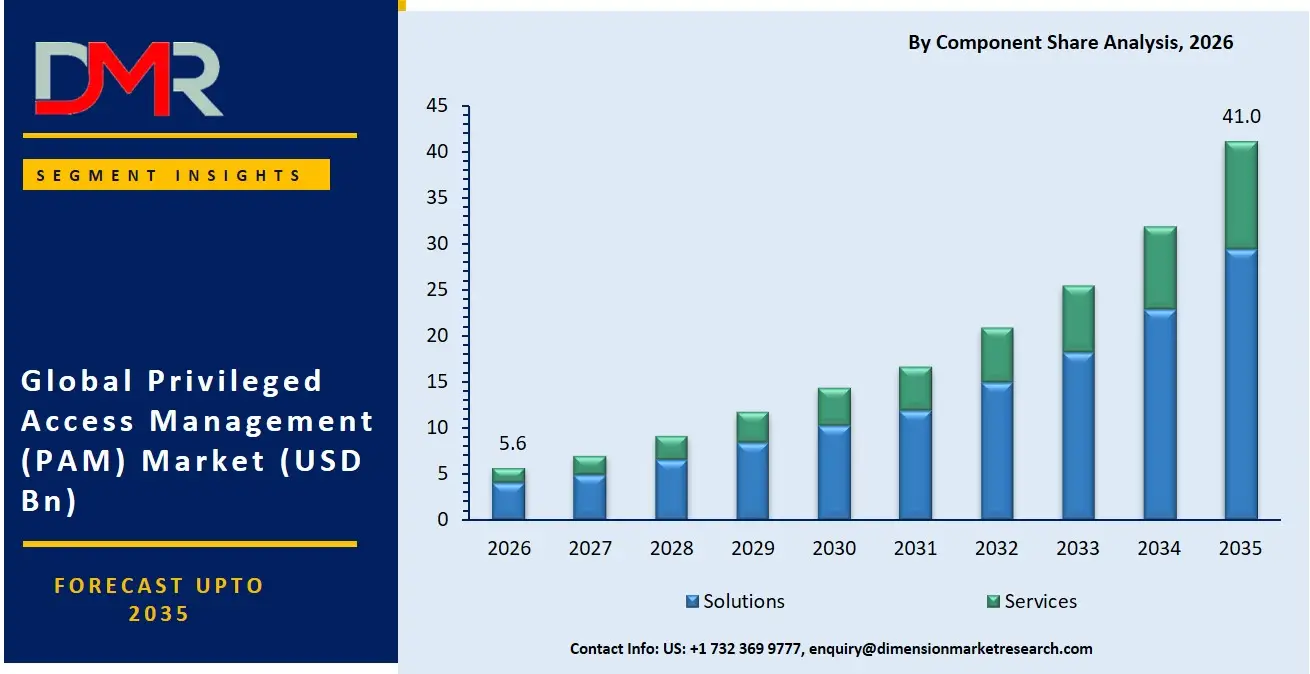
- Market Size & Forecast: The Privileged Access Management (PAM) Market size is projected to reach USD 5.6 billion in 2026 and is anticipated to have a value of USD 41.0 billion in 2035.
- Growth Rate & Outlook: The Privileged Access Management (PAM) Market size is set to grow at a compound annual growth rate of 24.7% during the forecast period of 2026 to 2035.
- Primary Growth Drivers: Some of the major growth drivers in the market Emerging Cybersecurity Challenges and Identity-Focused Attacks, and more.
- Key Market Trends: Some of the major trends in the market are PAM and Identity Security Platforms Convergence, and more.
- By Component: Solutions segment is anticipated to get the majority share of the Privileged Access Management (PAM) Market in 2026.
- By Deployment Mode: Cloud-based is expected to get the largest revenue share in 2026 in the Privileged Access Management (PAM) Market.
- By Organization Size: Large Enterprises segment is expected to get the largest revenue share in 2026 in the Privileged Access Management (PAM) Market.
- Regional Leadership: North America is set to lead the Privileged Access Management (PAM) Market with an estimated 39.2% share in 2026.
What is the Privileged Access Management (PAM)?
Privileged Access Management (PAM) refers to a set of cybersecurity policies and procedures aimed at controlling and managing the higher levels of access permissions that are accorded to individuals, software, machines, and automated processes within an organization's computing environment. The PAM framework involves techniques such as privilege credential vaulting, session monitoring, privilege elevation, access control, and entitlement management to reduce any security threats posed by privileged accounts.
Use Cases
- Transaction System Safeguarding: Financial institutions employ PAM to protect administrator accounts, privilege sessions, and protect transaction systems from any unauthorized attempts. The continuous monitoring and credential management capabilities help avoid any fraudulent activities while meeting regulatory compliance.
- Multi-Hybrid Cloud Protection: Organizations implement PAM to manage and control privilege accesses within a multi-cloud or hybrid cloud environment. The solutions allow organizations to have centralized control of entitlements, perform automated credential rotation, and follow the least privilege principle for cloud and DevOps administrators.
- Healthcare Information Protection: Healthcare organizations utilize PAM solutions to protect the security of electronic health records and clinical applications containing patient data. Privileged session and access management ensure compliance and avoid any internal breaches.
- Manufacturing Industry & Critical Infrastructure: Companies belonging to the manufacturing industries as well as utility companies utilize PAM to safeguard their OT environments. With the implementation of controlled privilege access policies, the organization avoids any potential cybersecurity risks.
How AI Is Transforming the Privileged Access Management (PAM) Market
The implementation of artificial intelligence into PAM systems brings about several advantages such as analyzing user behavior, anomaly detection, automation of risk assessments, and dynamic access controls. By analyzing user actions, privileged sessions, and access, AI algorithms can detect any anomalies and potential security breaches before any incidents happen.
Furthermore, AI technologies implemented into PAM systems can perform credential management, recommend privileges, optimize policies, and generate reports related to compliance requirements. All of the mentioned features bring numerous benefits such as increased efficiency, enhanced threat detection, improved response time, and improved overall identity security program.
Market Dynamic
Driving Factors in the Privileged Access Management (PAM) Market
Emerging Cybersecurity Challenges and Identity-Focused Attacks
With an increase in the occurrence of ransomware attacks, credential theft, insider threats, and advanced cyber-attacks, privileged accounts have emerged as a key target for the attackers. Organizations are becoming aware of the risks associated with privileged account security, especially the potential consequences in the event of credential compromise. PAM solutions offer organizations visibility, monitoring, credential management, and least privilege enforcement, thus constituting an integral part of cybersecurity strategies in today's world.
Restraints in the Privileged Access Management (PAM) Market
Integration Challenges Involved in Implementation
Integrating PAM solutions into various IT infrastructures can be quite challenging in terms of the amount of effort and time involved. The major challenge that most organizations experience when deploying PAM solutions is associated with the integration of the software into the current infrastructure including legacy systems, cloud, apps, and identity management systems. Small businesses without adequate cybersecurity capabilities may face more difficulties.
Opportunities in the Privileged Access Management (PAM) Market
Machine ID Growth and Non-Human Account Security
There is an increasing number of machine identities, service accounts, application programming interfaces, applications, containers, and robotic process automation tools, which makes this market area an attractive growth opportunity for PAM vendors. Companies need more advanced products in order to protect non-human privileged accounts, whose number exceeds human users' numbers. Those vendors who specialize in the management of machine identities will have an advantage here.
Trends in the Privileged Access Management (PAM) Market
PAM and Identity Security Platforms Convergence
Enterprises are heading towards identity security ecosystem solutions that incorporate PAM, identity governance, access management, and threat detection solutions. Software providers are consolidating what were once distinct security solutions into an integrated platform. The convergence offers greater visibility and makes management much easier.
Research Scope and Analysis
Privileged Access Management (PAM) Market analysis is focused on analyzing growth trends in terms of component, deployment mode, organization size, account type, industry vertical, and region. This analysis focuses on factors such as adoption trends, cybersecurity spending, cloud adoption trends, regulatory considerations, and identity security needs. Leading and upcoming market segments, market competition, technological advancements, AI adoption, and future prospects are evaluated for market expansion up to 2026.
ℹ
To learn more about this report –
Download Your Free Sample Report Here
By Component Analysis
Solutions will continue to be the dominant component, capturing around 71.4% market share by 2026. Businesses will focus on spending in areas like credential vaulting, session management for privileged users, privilege elevation, and cloud entitlement management as their security needs increase. More complex hybrid and multi-cloud environments are likely to drive demand for more sophisticated PAM software.
ℹ
To learn more about this report –
Download Your Free Sample Report Here
Secret management and CIEM software are gaining traction within the solutions sub-segment as businesses adopt cloud-native practices. On the other hand, the managed services segment is witnessing strong growth because businesses require skills that are hard to acquire in-house.
By Deployment Mode Analysis
The cloud-deployment model will dominate with 48.7% market share by 2026. Increasing demand for cloud-based PAM solutions can be attributed to features such as scalability, ease of deployment, accessibility, and lesser requirements for infrastructure. The rising popularity of cloud-based security projects and increased usage of SaaS solutions are key factors fueling growth in the segment. The hybrid deployment model is expected to exhibit strong growth, driven by the need to meet legacy infrastructure demands and incorporate cloud capabilities into business practices.
By Organization Size Analysis
Large companies are predicted to account for roughly 68.9% of the market share in 2026, owing to their significant IT infrastructure, larger budget for cybersecurity, and compliance issues. Such businesses deal with huge numbers of privileged users and intricate digital systems, requiring them to adopt PAM. The SME sector, on the other hand, is forecasted to be the fastest-growing market because cyberattacks have increasingly started to focus on small organizations. Cloud-based PAM products, security as a service, and growing cybersecurity awareness have made privileged access controls easy to implement for small firms.
By Account Type Analysis
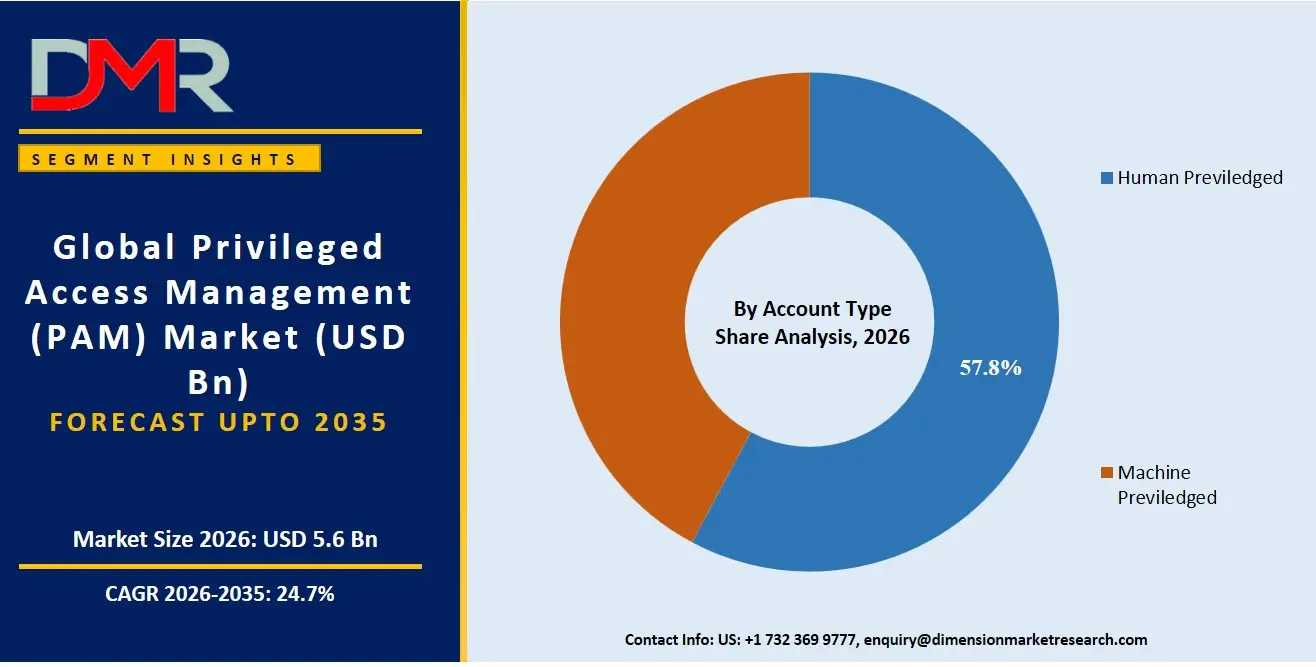
The market share of human privileged accounts is projected to remain the largest in 2026 at 57.8%, owing to organizations' focus on securing administrators, executives, and operators. Robust regulatory compliance measures and worries about insider threats will encourage continued expenditure on human account privilege management. Yet, machine privileged accounts will be the fastest-growing category of the market. Organizations have started using more services and tools that require automated account and identity management.
By Industry Vertical Analysis
The BFSI industry will be the major market leader, capturing 22.6% market share by 2026. Financial institutes have strict regulatory compliance norms, high-risk cyber attacks, and operational hazards associated with privileged account abuse. Hence, the financial institutes adopt PAM solutions at an early stage and extensively. The healthcare and life sciences industry will be one of the fast-growing vertical segments owing to the adoption of numerous digital health programs and enhanced patient data security needs.
The Privileged Access Management (PAM) Market Report is segmented on the basis of the following:
By Component
- Solutions
- Privileged Account & Session Management (PASM)
- Privileged Elevation & Delegation Management (PEDM)
- Secret Management & Credential Vaulting
- Cloud Infrastructure Entitlement Management (CIEM)
- Services
- Professional Services
- Managed Services
By Deployment Mode
- On-Premises
- Cloud-Based
- Hybrid
By Organization Size
- Large Enterprises
- Small & Medium-Sized Enterprises (SMEs)
By Account Type
- Human Privileged Accounts
- Machine Privileged Accounts
- Service Accounts
- Applications & Workloads
- Bots/RPA Accounts
By Industry Vertical
- Banking, Financial Services, and Insurance (BFSI)
- Government & Defense
- Healthcare & Life Sciences
- IT & Telecommunications
- Retail & E-commerce
- Manufacturing
- Energy & Utilities
- Other Industries
Regional Analysis
Leading Region in the Privileged Access Management (PAM) Market
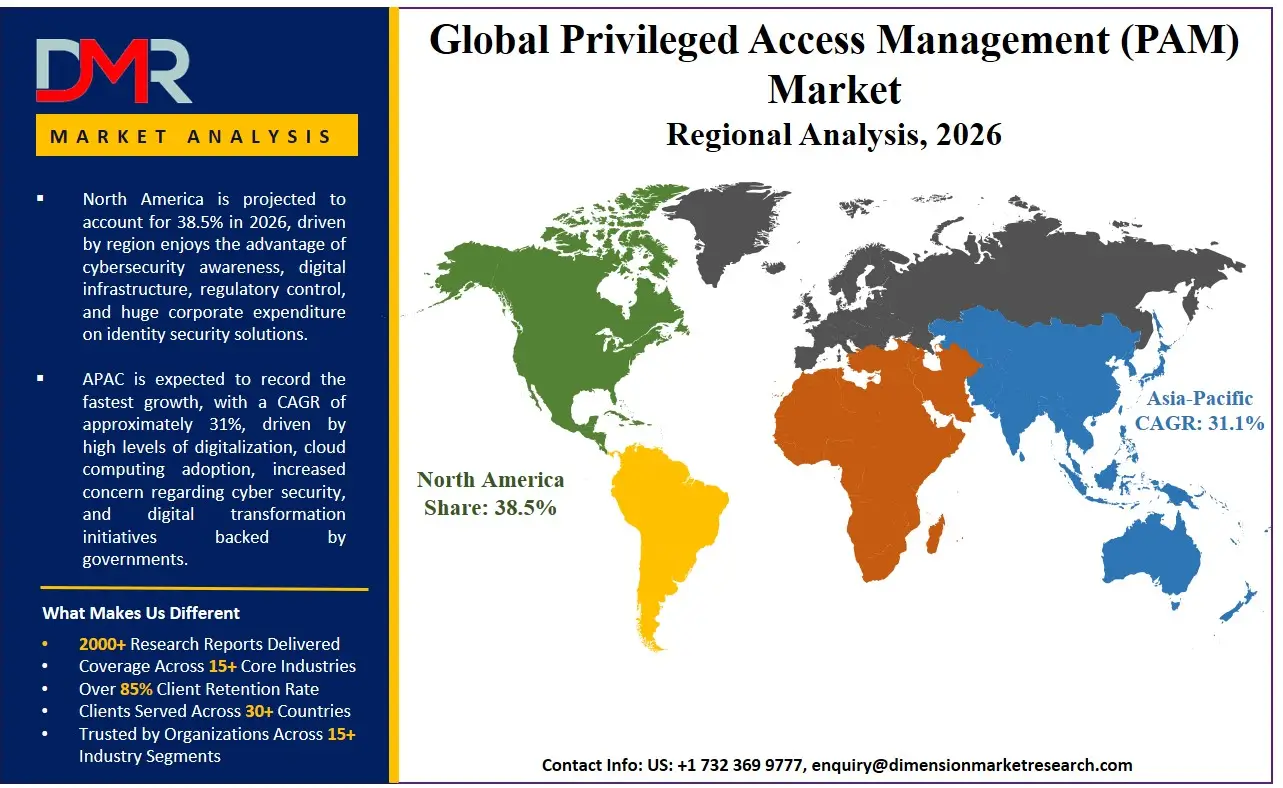
North America is predicted to retain its dominance with the projected market share of 38.5% in 2026. This region enjoys the advantage of cybersecurity awareness, digital infrastructure, regulatory control, and huge corporate expenditure on identity security solutions. Companies belonging to various industries, including financial services, healthcare, governments, and technology, have been focusing on PAM solutions for tackling complex cyberattacks and adhering to cybersecurity regulations. Federal initiatives in cybersecurity, prevalence of zero trust security approach, and the existence of mature cybersecurity environment keep aiding market dominance.
ℹ
To learn more about this report –
Download Your Free Sample Report Here
Fastest Growing Region in the Privileged Access Management (PAM) Market
The Asia Pacific region is expected to emerge as the most dynamic regional market in terms of growth driven by high levels of digitalization, cloud computing adoption, increased concern regarding cyber security, and digital transformation initiatives backed by governments. Governments of countries like Japan, India, South Korea, Singapore, and Australia are implementing stringent cyber security measures along with heavy investment in critical infrastructure. Enterprise technology adoption, increased data center investments, and cyber security threats are making enterprises invest in privileged access management systems.
By Region
North America
Europe
- Germany
- The U.K.
- France
- Italy
- Russia
- Spain
- Benelux
- Nordic
- Rest of Europe
Asia-Pacific
- China
- Japan
- South Korea
- India
- ANZ
- ASEAN
- Rest of Asia-Pacific
Latin America
- Brazil
- Mexico
- Argentina
- Colombia
- Rest of Latin America
Middle East & Africa
- Saudi Arabia
- UAE
- South Africa
- Israel
- Egypt
- Rest of MEA
Competitive Landscape
Competition within the PAM solution space is fierce, fueled by consistent innovation, integration of platforms, and new cybersecurity challenges. Companies invest heavily in increasing their products' functionality by means of cloud-native architectures, machine identity management, and AI-based security functions, among others. Technology integrations, strategic alliances, acquisitions, and research efforts are some of the ways through which companies try to build strong positions within this space. Technical expertise, customer base, compliance considerations, and integration ability are key factors that represent barriers to entry into this space.
Some of the prominent players in the global Privileged Access Management (PAM) are:
- CyberArk Software Ltd.
- BeyondTrust Corporation
- Delinea Inc.
- One Identity LLC
- IBM Corporation
- Microsoft Corporation
- Broadcom Inc. (Symantec)
- ManageEngine (Zoho Corporation)
- Netwrix Corporation
- ARCON TechSolutions Ltd.
- Ekran System Inc.
- Keeper Security Inc.
- WALLIX Group
- Senhasegura
- Hitachi Digital Services
- HashiCorp Inc.
- SailPoint Technologies Holdings, Inc.
- Saviynt Inc.
- Okta Inc.
- Ping Identity Corporation
- Other Key Players
Recent Developments
- In June 2026, The Securden team has launched the AI Agent Security and Governance Platform that is meant to help businesses gain visibility and management for their AI agents running on endpoints, clouds, SaaS applications, MCP servers, and connected tools. The new product can be helpful in dealing with the problems related to shadow AI, too many permissions, and lack of oversight since it allows discovering, securing, managing identities and permissions, and testing AI within one product.
- In October 2025, The collaboration between KeyData Cyber and CyberArk has received an extension in light of Privileged Access Management as a Service (PAMaaS). The subscription-based service is aimed at delivering enterprise-level PAM technology in the form of a managed solution that helps companies mitigate various risks related to privileged accounts. In particular, this managed solution will allow enterprises to enhance their cybersecurity, compliance, minimize operational complexity, and expedite the deployment process.
- In June 2025, CyberArk made an announcement on how the company's solution, known as the CyberArk Identity Security Platform, was being used by Panasonic Information Systems Co. Ltd. to manage privileged access among a large number of servers owned by Panasonic Group. This implementation will create a contemporary and automated privileged access management environment for improved security of identity and proper privilege management for user and machine identity alike. This implementation will assist Panasonic Information Systems with managing their IT systems in the Group's various functions such as manufacturing, distributing, and retailing.
Report Details
| Report Characteristics |
| Market Size (2026) |
USD 5.6 Bn |
| Forecast Value (2035) |
USD 41.0 Bn |
| CAGR (2026–2035) |
24.7% |
| Historical Period |
2021 – 2025 |
| Forecast Period |
2027 – 2035 |
| Base Year |
2025 |
| Estimate Year |
2026 |
| Segments Covered |
By Component, By Deployment Mode, By Organization Size, By Account Type, By Industry Vertical |
| Regional Coverage |
North America – The US and Canada; Europe – Germany, The UK, France, Russia, Spain, Italy, Benelux, Nordic, & Rest of Europe; Asia-Pacific – China, Japan, South Korea, India, ANZ, ASEAN, Rest of APAC; Latin America – Brazil, Mexico, Argentina, Colombia, Rest of Latin America; Middle East & Africa – Saudi Arabia, UAE, South Africa, Turkey, Egypt, Israel, & Rest of MEA |
Frequently Asked Questions
How big is the Privileged Access Management (PAM) Market?
▾ The Privileged Access Management (PAM) Market size is expected to reach USD 5.6 billion by 2026 and is projected to reach USD 41.0 billion by the end of 2035.
What is the CAGR of the Privileged Access Management (PAM) Market from 2026 to 2035?
▾ The market is growing at a CAGR of 24.7 percent over the forecasted period.
What factors are driving the growth of the Privileged Access Management (PAM) Market?
▾ Emerging Cybersecurity Challenges and Identity-Focused Attacks, and more are the factors driving the growth of the Privileged Access Management (PAM) Market.
What are the major trends in the Privileged Access Management (PAM) Market?
▾ PAM and Identity Security Platforms Convergence, and more are some of the major trends in the market.
Who are the key players in the Privileged Access Management (PAM) Market?
▾ Some of the key players in the Privileged Access Management (PAM) Market include CyberArk, IBM, Microsoft, and more
How is the Privileged Access Management (PAM) Market segmented?
▾ The Privileged Access Management (PAM) Market is segmented by component, deployment mode, organization size, account type, industry vertical.
Which region held the largest share of the Privileged Access Management (PAM) Market in 2026?
▾ North America is set to lead the Privileged Access Management (PAM) Market with an estimated 38.5% share in 2026.
Which region is expected to grow the fastest in the Privileged Access Management (PAM) Market?
▾ Asia Pacific is the fastest-growing region in the Privileged Access Management (PAM) Market during the forecast period.