Market Overview
The Global Probiotic Dietary Supplements Market covers commercially formulated live microorganism products sold in capsule, tablet, powder, liquid, chewable, and drop formats for direct human consumption. Probiotic-fortified food and beverage products, prescription-grade pharmaceutical probiotics, and veterinary applications fall outside Probiotic Dietary Supplements Market's scope. A 2025 survey found 84% of gut-health consumers reported greater interest in gut-health-supporting products than in prior years, confirming structural demand rather than a short-cycle trend.
ℹ
To learn more about this report –
Download Your Free Sample Report Here
The market connects to the broader dietary supplement industry at the point where clinical nutrition meets preventive consumer healthcare. Based on data from the 2024 CRN survey, 75% of Americans use dietary supplements, a category that includes probiotics, with usage holding steady year over year. Probiotic supplements serve populations from infants to geriatric users, with formulations targeting the gut, vaginal, oral, and skin microbiome ecosystems.
AI-driven recommendation engines are beginning to personalize probiotic selection based on lifestyle and dietary inputs. Brands combining clinical validation with digital personalization infrastructure now capture the highest-margin consumer cohort. Buyers shift from generic shelf browsing toward individualized regimens, compressing the time between product discovery and purchase.
Key Takeaways
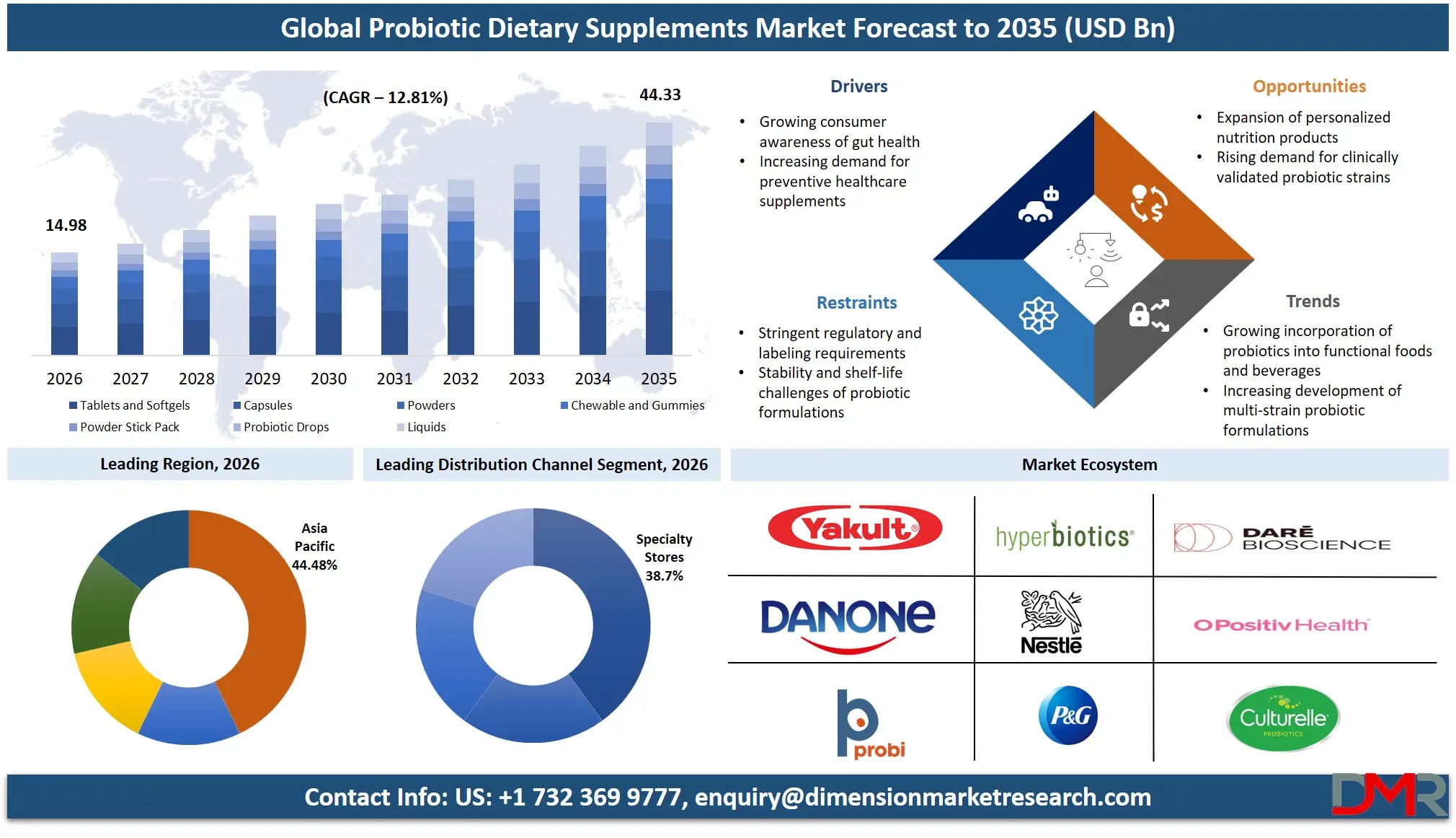
- The Probiotic Dietary Supplements market size is USD 13.28 billion in 2025, reached USD 14.98 billion in 2026, and is projected to hit USD 44.33 billion by 2035 at a CAGR of 12.81%.
- Gastrointestinal Health is the dominant application segment with a 61.73% revenue share in 2026.
- Asia Pacific leads all regions with a 44.48% revenue share in 2026.
- Tablets and Softgels hold the largest form share at 40.21% in 2026.
- Adults are the dominant end-user group with a 56.9% revenue share in 2026.
- Specialty Stores lead distribution with a 38.72% revenue share in 2026.
Market Size and Forecast
The Global Probiotic Dietary Supplements Market size is estimated at USD 14.98 Billion in 2026 from USD 13.28 Billion in 2025, and is projected to reach USD 44.33 Billion by 2035, exhibiting a CAGR of 12.81% during the forecast period.
Consumer adoption is broadening beyond traditional gut-health users into mental health, skin health, women's health, and pediatric segments. As reported by PMC10916572, 42.42% of ongoing probiotic clinical trials remain in Phase II, with only 18% reaching Phase IV. Each validated claim that clears Phase IV opens a new consumer sub-market and supports premium pricing, directly lifting revenue per unit sold within the forecast window.
Manufacturing technology advances are also compressing the gap between formulation capability and commercial scale. A 2025 microencapsulation study published by IJTECH reported probiotic microcapsule powder yields ranging from 16.77% to 21.65%, with encapsulated cells maintaining high viability. Brands that bring this encapsulation capability in-house will capture higher margins per unit as label-claim scrutiny from pharmacy buyers intensifies across North America and Europe.
Form Analysis
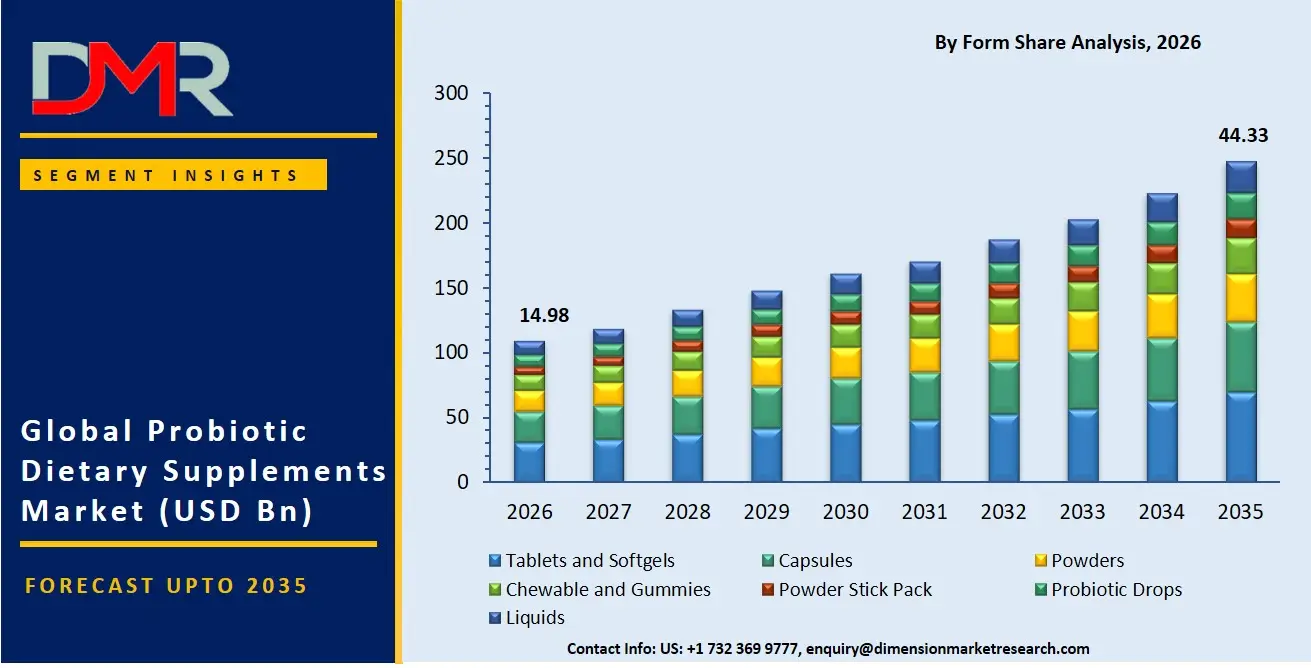
Tablets and Softgels led the Form segment with a 40.21% share in 2026.
ℹ
To learn more about this report –
Download Your Free Sample Report Here
Tablets and softgels command the largest share because they combine consumer familiarity with precise CFU dosing and compatibility with microencapsulation technologies that protect strain viability through digestion. Clinically minded buyers choose these formats when product documentation supports the purchase decision. Shelf stability further separates them from liquid and drop formats in pharmacy and specialty retail environments.
Capsules follow as the next significant format, favored by health-conscious buyers associating them with pharmaceutical-grade quality. Powders and Powder Stick Packs are gaining ground in sports and fitness, where consumers mix them into functional beverages. Chewables and Gummies are the fastest-growing format among children and older adults who have difficulty swallowing pills, pulling new end-user cohorts into the category. Probiotic Drops and Liquids serve infants almost exclusively, where format compliance is non-negotiable, and no consolidation toward a single format is expected across the forecast period.
Application Analysis
With a 61.73% share in 2026, Gastrointestinal Health outpaced all other Application categories.
A systematic review of 35 randomized controlled trials covering 3,406 adults with IBS found statistically significant global symptom reductions in 14 of 29 trials, with the strongest results from multi-strain products. The evidence base sustains both clinical recommendation and over-the-counter purchase behavior simultaneously. That dual-channel credibility is rare in the supplement category and explains why gut health maintains dominance even as newer applications attract investment.
Brain and Mental Health is attracting the most active brand investment outside the GI core. A 2026 randomized pilot trial reported significant improvements in depressive and anxiety scores in the probiotic group, giving the mental health application its first robust placebo-controlled data point. Separately, a 2025 RCT showed a 40% reduction in social withdrawal and lethargy symptoms in probiotic-treated children, validating pediatric immune and behavioral applications. Skin, Hair, and Nails is growing on beauty-from-within positioning, while Women's Health and Infant Formula remain earlier-stage but are advancing toward commercial scale.
End-User Analysis
Adults captured 56.9% of the End-User segment in 2026, ahead of all rival cohorts.
Adults hold this position because they represent the widest range of available formulations, the broadest set of targeted health concerns, and the highest accessibility to direct-to-consumer and e-commerce channels where subscription models are gaining traction. Self-directed health management among adults shortens the purchase cycle compared to pediatric or geriatric cohorts, where clinical guidance typically precedes purchase.
Infants and Children represent a clinically validated opportunity, supported by recent RCT evidence in pediatric behavioral and immune applications. The pediatric segment commands premium pricing and generates brand loyalty from parents who adopt products early in a child's development lifecycle. Geriatric users remain structurally underserved relative to the prevalence of digestive disorders in aging populations across North America and Europe.
Distribution Channel Analysis
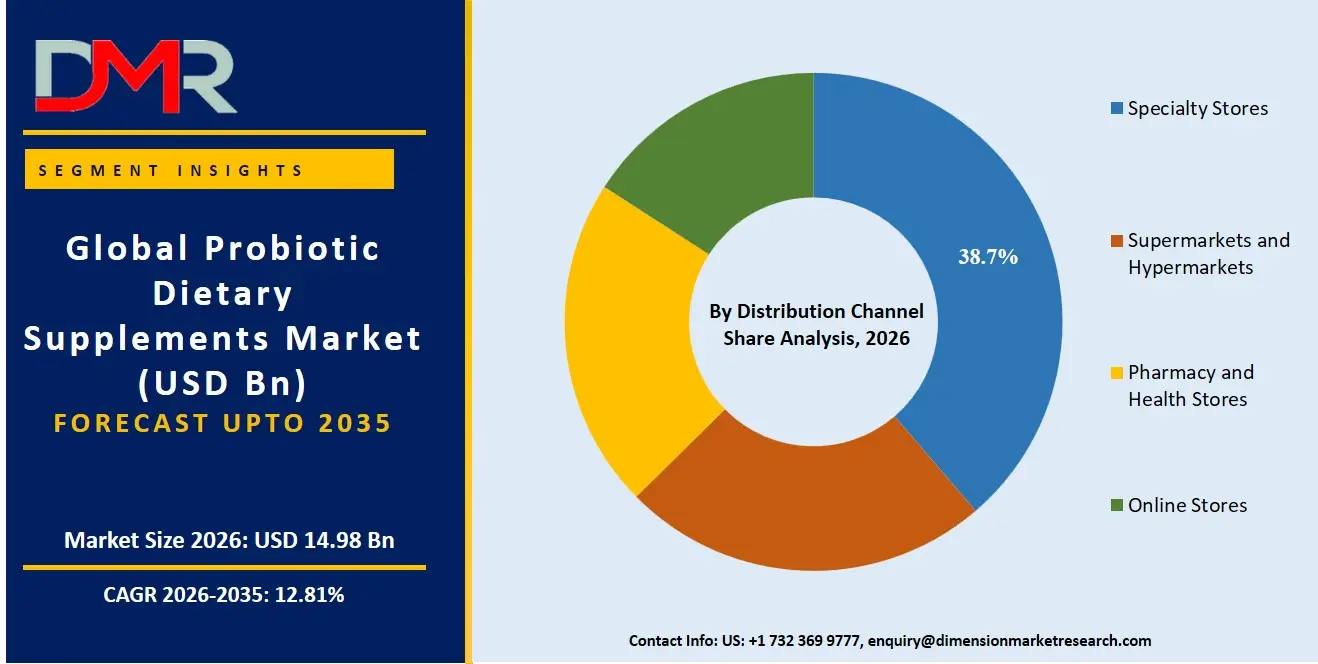
A 38.72% share made Specialty Stores the clear leader across Distribution Channel categories in 2026.
ℹ
To learn more about this report –
Download Your Free Sample Report Here
Specialty stores dominate because their staff expertise and curated assortments support higher average basket values among health-conscious buyers who prefer premium, multi-strain, and clinically validated products. Manufacturers selling through specialty channels capture higher margins per unit than in mass-market formats where private-label competition is most aggressive.
Pharmacy and Health Stores are the fastest-credibility-gaining channel as clinical recommendations increase. When a gastroenterologist mentions a probiotic strain, the consumer's first stop is typically a pharmacy, not a specialty store. Online Stores are the fastest-growing channel by volume, enabling subscription models and direct brand relationships that brick-and-mortar retail cannot replicate. Supermarkets and Hypermarkets drive volume in mainstream formats but face margin pressure from private-label switching, and their share will compress gradually over the forecast period.
Key Market Segments
By Form
- Tablets and Softgels
- Capsules
- Powders
- Chewable and Gummies
- Powder Stick Pack
- Probiotic Drops
- Liquids
By Application
- Gastrointestinal Health
- Sports Fitness
- Energy and Weight Management
- General Health
- Bone and Joint Health
- Immunity
- Cardiac Health
- Diabetes
- Anti-cancer
- Skin, Hair, and Nails
- Brain and Mental Health
- Nutritional Supplements
- Specialty Nutrients
- Infant Formula
By End-User
- Adults
- Infants
- Children
- Geriatric
- Men
- Women
By Distribution Channel
- Specialty Stores
- Supermarkets and Hypermarkets
- Pharmacy and Health Stores
- Online Stores
By Ingredients
By Target Microbiome Ecosystem
- Vaginal Microbiome
- Oral Microbiome
- Skin Microbiome
By Delivery Mechanism Technology
- Delayed-Release and Enteric Coated Encapsulation
- Standard Soluble Release
- Microencapsulated Beadlets
By Co-Ingredient Formulation
- Synbiotics (Probiotic and Prebiotic Fiber)
- Complex Hybrid Supplements (Probiotic and Multivitamins or Minerals)
- Single-Strain Isolates
Regional Analysis
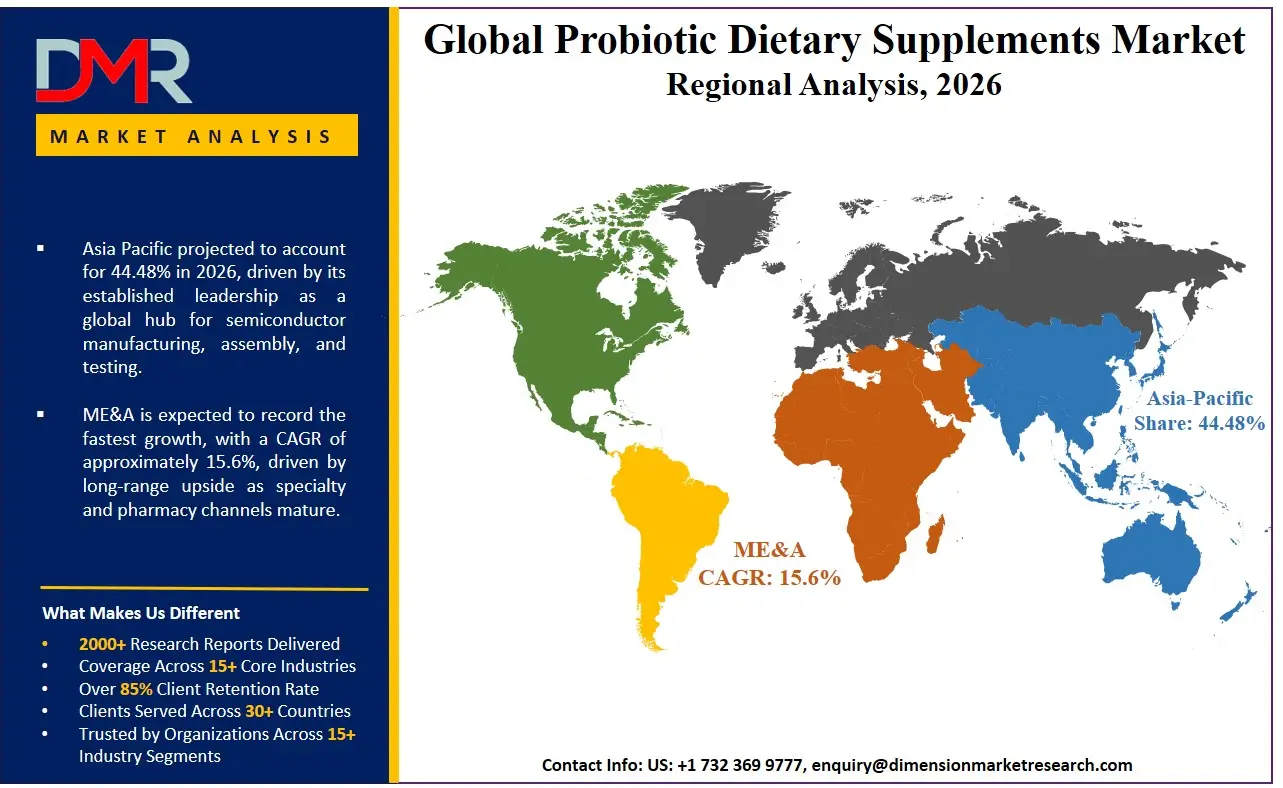
Asia Pacific held a dominant position with a 44.48% revenue share in 2026, equivalent to a market position valued at approximately USD 5.90 Billion of the USD 13.28 Billion global total.
ℹ
To learn more about this report –
Download Your Free Sample Report Here
Asia Pacific's lead is structural rather than cyclical. Fermented food cultures across China, Japan, South Korea, and India create pre-existing consumer comfort with live microorganism products that Western markets took decades longer to build. A rising middle class with growing disposable income is converting that cultural familiarity into branded supplement purchases, supported by modern retail and e-commerce infrastructure that puts specialty probiotic products within reach of second and third-tier city consumers.
North America holds the second-largest position, where clinical adoption and pharmacy channel strength sustain premium pricing across adult and women's health formulations. Europe is the most regulation-constrained region, with EFSA health claim restrictions limiting the speed at which new applications can be commercially marketed. That regulatory drag makes Europe a slower-growth market relative to its consumer wealth, though it rewards manufacturers with validated clinical dossiers. Latin America and the Middle East and Africa are early-stage markets where distribution infrastructure is the binding constraint. Both regions offer long-range upside as specialty and pharmacy channels mature, but neither will contribute meaningfully to global revenue share within the near term of the forecast period.
Key Regions and Countries
North America
Europe
- Germany
- France
- The UK
- Spain
- Italy
- Rest of Europe
Asia Pacific
- China
- Japan
- South Korea
- India
- Australia
- Rest of APAC
Latin America
- Brazil
- Mexico
- Rest of Latin America
Middle East and Africa
- GCC
- South Africa
- Rest of MEA
Market Dynamics
Clinical Evidence Elevates Probiotics Above the Supplement Norm
Probiotics crossed a credibility threshold that most supplement categories never reach. Clinicians now recommend strain-specific products for immunity and metabolic conditions backed by substantial trial data. As reported by the NIH Office of Dietary Supplements, a 2020 Cochrane Review of 82 randomized controlled trials covering 12,127 participants found probiotics reduced the risk of diarrhea lasting 48 or more hours by 36% and cut mean diarrhea duration by 21.3 hours versus placebo. Products supported by evidence at this scale move from health food store shelves into pharmacy recommendations and clinical discharge protocols.
NIH Office of Dietary Supplements data from a meta-analysis of 30 randomized controlled trials covering 1,624 participants further confirms the metabolic dimension. Probiotics taken for 3 to 12 weeks lowered total cholesterol by a mean of 7.8 mg/dL and LDL by 7.3 mg/dL versus placebo. PubMed data from a 2025 NHANES analysis spanning 2011 to 2023 identified probiotics among ten supplements showing a statistically significant upward trend in use among U.S. adults. Manufacturers who built distribution infrastructure during the post-pandemic demand peak are now better positioned than late entrants because shelf placement in specialty and pharmacy channels is increasingly competitive.
Label-Claim Gaps Undermine Category Credibility
Both the FDA and EFSA impose strict limits on permissible health claims for probiotic supplements. A brand cannot state that its product treats or prevents a medical condition without drug-level clinical evidence. Smaller manufacturers face disproportionate compliance costs and cannot match the regulatory affairs capacity of large supplement groups. Brands competing solely on price in commodity formats face margin pressure from private-label products in supermarket channels, with no claims-based differentiation available.
Viability across the supply chain compounds the credibility problem. As per research published in PMC8165489, a gastrointestinal-simulation study of 11 commercial probiotics found only 2 matched their label claims and only 6 retained viability above 6 log CFU/g after simulated digestion. The performance gap between label and delivery is a reputational liability for the whole category. Brands that close this gap through microencapsulation and cold-chain investment gain a tangible competitive advantage that commodity operators cannot replicate quickly.
Women's Health and Personalized Platforms Open High-Value Revenue Pools
Personalized probiotic formulations integrated with at-home microbiome testing represent the clearest near-term white space in Probiotic Dietary Supplements Market. Subscription-based regimens built on dynamic test-and-adjust models carry higher lifetime customer value than single-SKU retail products. Brands entering this channel now face few established competitors, and the switching costs created by data-driven personalization are structurally difficult for commodity brands to replicate.
Women's health is the second high-priority opportunity. In June 2026, Dare Bioscience announced the commercial launch of Flora Sync LF5 Vaginal Probiotic Capsules, its first revenue-generating probiotic product targeting women's microbiome health. That launch validates the segment commercially and signals to larger players that clinical-grade women's probiotic products have cleared the threshold from pipeline to active revenue generation. Capital will follow within the near term.
Market Trends
Evidence-Backed Positioning and AI Personalization Reshape Purchase Decisions
Gen Z consumers arrive at the probiotic category through social media gut-health narratives but convert on third-party-verified evidence. Multi-strain products carry a growing price premium over single-strain commodity formats. AI-driven recommendation engines are personalizing probiotic selection based on lifestyle and dietary inputs, shifting purchase decisions from generic shelf browsing toward individualized regimens. Brands that combine clinical validation with digital personalization infrastructure hold a two-to-three year window before the approach becomes standard across the category.
Market Competition Overview
The Global Probiotic Dietary Supplements Market is moderately fragmented. No single player commands dominant revenue share across all segments and regions simultaneously because the category's breadth across formats, applications, and end-users creates natural niches where focused operators compete effectively. Competitive advantage belongs to manufacturers who combine validated strain libraries with microencapsulation capability and multi-channel distribution reach. Those three assets together are difficult to replicate quickly and create defensible positioning.
Share is shifting toward brands that can substantiate clinical claims with third-party verification, as pharmacy-channel buyers demand more than marketing assertions. Brands entering women's health and personalized probiotic sub-segments are moving into higher-margin territory where consumer loyalty is stickier than in the general adult gut-health category. The fastest-moving competitive dynamic is the entry of clinically positioned brands into these sub-segments, where both pricing power and entry barriers are higher than in the mainstream GI supplement aisle.
Company Profiles
O Positiv Health has built its market position around multi-benefit probiotic formulations targeting women's health and whole-body microbiome support. In January 2025, the company launched URO Whole Body Probiotic, designed to support gut, skin, and oral microbiome health in a single product. The strategy targets the premium multi-application consumer rather than competing on single-benefit commodities, yielding higher average selling prices and reducing direct price comparison with mass-market brands. The risk is that multi-benefit claims require broader clinical substantiation to satisfy regulatory scrutiny across multiple health domains simultaneously.
Probi AB occupies a research-led position in the global probiotic supply chain, operating as both an ingredient supplier and a finished-product innovator. In May 2026, the company launched Rham271h, its first postbiotic ingredient, at Vitafoods Europe. Postbiotics do not face the same viability and cold-chain constraints as live bacteria, which widens Probi's addressable market and reduces supply chain risk. Brands that can source both probiotic and postbiotic ingredients from a single validated supplier gain a formulation advantage that is difficult for single-category competitors to match.
Key Players
- O Positiv Health
- Probi AB
- Dare Bioscience
- Nestle
- Hyperbiotics
- Yakult Honsha Co., Ltd.
- Danone S.A.
- Procter and Gamble Co.
- Culturelle
- Nature's Bounty Co.
- Pure Encapsulations
- BioGaia AB
- DuPont Nutrition and Biosciences
- Lallemand Inc.
- Garden of Life LLC
- Kerry Group Plc
- Others
Supply Chain and Value Chain Analysis
The value chain begins with strain development and fermentation at specialist biotechnology firms, moves through microencapsulation and blending at contract manufacturers, and reaches consumers through specialty, pharmacy, supermarket, and online channels. Maximum value is created at the strain development and encapsulation stages, where proprietary technology and clinical validation create pricing power that downstream distributors cannot replicate.
Cold-chain logistics between fermentation facility and retail shelf represent the biggest supply chain risk. Live bacterial strains require temperature-controlled handling at every stage, and failures at any point produce sub-label CFU counts that generate both regulatory exposure and consumer dissatisfaction. Manufacturers who internalize encapsulation capability reduce supply chain vulnerability and capture more margin per unit sold. Operators who outsource encapsulation accept both margin compression and a quality-control dependency that becomes a liability as label-claim scrutiny increases.
Regulatory Landscape
The FDA's Dietary Supplement Health and Education Act in the United States and EFSA's health claim authorization process in Europe are the two most consequential regulatory frameworks for Probiotic Dietary Supplements Market. Both restrict manufacturers from stating that a probiotic product treats, cures, or prevents any disease without drug-level clinical evidence. Brands must invest in structure-function claim language that educates consumers indirectly, which is slower and more expensive than direct therapeutic messaging.
A regulatory push for standardized quality testing is creating a secondary competitive dynamic. Third-party verification programs are gaining recognition among pharmacy buyers and clinical recommenders as a proxy for product quality. Brands that secure recognized third-party certification can access pharmacy and clinical channels that remain closed to unverified competitors. Regulatory pressure, while costly for individual manufacturers, is gradually raising the floor of product quality across the category and reducing the space for low-cost, low-quality entrants.
Investment and White Space Analysis
Investment is currently concentrated in women's health probiotic formulations and personalized microbiome subscription platforms, both of which command premium pricing and generate recurring revenue. Personalized probiotic platforms integrated with at-home microbiome testing represent the highest-potential white space because they convert a one-time supplement purchase into a data-driven subscription relationship with measurably higher lifetime customer value.
The geriatric end-user segment is the most structurally underserved given the prevalence of digestive disorders in aging populations across North America and Europe. Few brands have developed formulations with clinical specificity for this cohort, and pharmacy channel access is already established through existing chronic condition management products. Brands entering the geriatric or pediatric sub-segments with validated formulations face limited direct competition from established players today.
Recent Developments
- April 2026: IFF launched PureStrong, a canine-specific probiotic developed to support digestive health, extending its probiotic innovation portfolio into the pet health category.
Report Details
| Report Characteristics |
| Market Value (2025) |
USD 13.28 Billion |
| Market Value (2026) |
USD 14.98 Billion |
| Forecast Revenue (2035) |
USD 44.33 Billion |
| CAGR (2026 to 2035) |
12.81% |
| Base Year for Estimation |
2025 |
| Historic Period |
2020 to 2024 |
| Forecast Period |
2026 to 2035 |
| Report Coverage |
Revenue Forecast, Market Dynamics, Competitive Landscape, Recent Developments |
| Segments Covered |
By Form (Tablets and Softgels, Capsules, Powders, Chewable and Gummies, Powder Stick Pack, Probiotic Drops, Liquids), By Application (Gastrointestinal Health, Immunity, Brain and Mental Health, Skin, Hair and Nails, Infant Formula, and more), By End-User (Adults, Infants, Children, Geriatric, Men, Women), By Distribution Channel (Specialty Stores, Supermarkets and Hypermarkets, Pharmacy and Health Stores, Online Stores), By Ingredients (Bacteria, Yeast), By Target Microbiome Ecosystem (Vaginal Microbiome, Oral Microbiome, Skin Microbiome), By Delivery Mechanism Technology (Delayed-Release and Enteric Coated Encapsulation, Standard Soluble Release, Microencapsulated Beadlets), By Co-Ingredient Formulation (Synbiotics, Complex Hybrid Supplements, Single-Strain Isolates) |
| Regional Analysis |
North America (US and Canada), Europe (Germany, France, The UK, Spain, Italy, and Rest of Europe), Asia Pacific (China, Japan, South Korea, India, Australia, and Rest of APAC), Latin America (Brazil, Mexico, and Rest of Latin America), Middle East and Africa (GCC, South Africa, and Rest of MEA) |
| Competitive Landscape |
O Positiv Health, Probi AB, Dare Bioscience, Nestle, Hyperbiotics, Yakult Honsha Co. Ltd., Danone S.A., Procter and Gamble Co., Culturelle, Nature's Bounty Co., Pure Encapsulations, BioGaia AB, DuPont Nutrition and Biosciences, Lallemand Inc., Garden of Life LLC, Kerry Group Plc, Others |
| Customization Scope |
Customization for segments and region or country level will be provided. Additional customization can be done based on requirements. |
| Purchase Options |
Three license options: Single User License, Multi-User License (Up to 5 Users), Corporate Use License (Unlimited Users and Printable PDF) |
Frequently Asked Questions
What is the biggest investment opportunity in Probiotic Dietary Supplements Market?
▾ Personalized probiotic platforms integrated with at-home microbiome testing represent the highest-value entry point. Subscription-based models generate recurring revenue and create switching costs that standard retail probiotic brands cannot match. Women's health formulations targeting vaginal microbiome balance are the second most active area, with commercial launches validating the segment in 2026.
Who are the top companies in Probiotic Dietary Supplements Market?
▾ O Positiv Health and Probi AB are the most active companies in terms of recent product launches, with both bringing new formulations to market in 2025 and 2026 across multi-benefit and postbiotic categories. Other significant players include Dare Bioscience, Nestle, Yakult Honsha, Danone, Culturelle, and BioGaia AB. No single company commands a dominant share across all formats, applications, and geographies simultaneously.
Which segment is growing fastest in Probiotic Dietary Supplements Market and why?
▾ The Women's end-user segment and the Brain and Mental Health application are both outpacing the broader category. A 2026 randomized pilot trial reported significant improvements in depressive and anxiety scores in the probiotic group, giving the mental health application its first robust clinical data point. The commercial launch of vaginal probiotic products in 2026 confirms that women's health has cleared the threshold from pipeline to active revenue generation.
Which region is growing fastest in Probiotic Dietary Supplements Market and why?
▾ Asia Pacific holds a 44.48% revenue share and remains the fastest-expanding region. Rising middle-class incomes, cultural familiarity with fermented and functional foods, and rapid e-commerce channel growth are pulling branded probiotic supplement adoption higher across China, India, and Southeast Asia. No other region combines this scale of existing market share with this pace of new consumer entry.
What is the biggest challenge holding Probiotic Dietary Supplements Market back?
▾ Probiotic viability across the supply chain is the most operationally damaging constraint for manufacturers and the category's credibility. A gastrointestinal-simulation study found that only 2 of 11 commercial probiotics matched their label claims after simulated digestion, undermining consumer trust and inviting regulatory scrutiny. Brands that cannot close this gap through microencapsulation and cold-chain investment face intensifying pressure as third-party verification becomes a standard channel requirement.