Qatar Cold Chain Logistics Market Snapshot
- Qatar Cold Chain Logistics Market Size in 2026: USD 968.6 Million
- Qatar Cold Chain Logistics Market Size in 2035: USD 1,986.4 Million
- Qatar CAGR from 2026 to 2035: 8.3%
- Refrigerated/Cold Storage Warehousing is the leading service type segment in 2026: 48.9%
- Frozen is the leading temperature type segment in 2026: 43.6%
- Roadways is the leading mode of transport segment in 2026: 68.4%
- Dairy Products is the leading application segment in 2026: 27.9%
- Food and Beverage Industry is the leading end user segment in 2026: 74.8%
What is the Qatar Cold Chain Logistics Market and its Market Size?
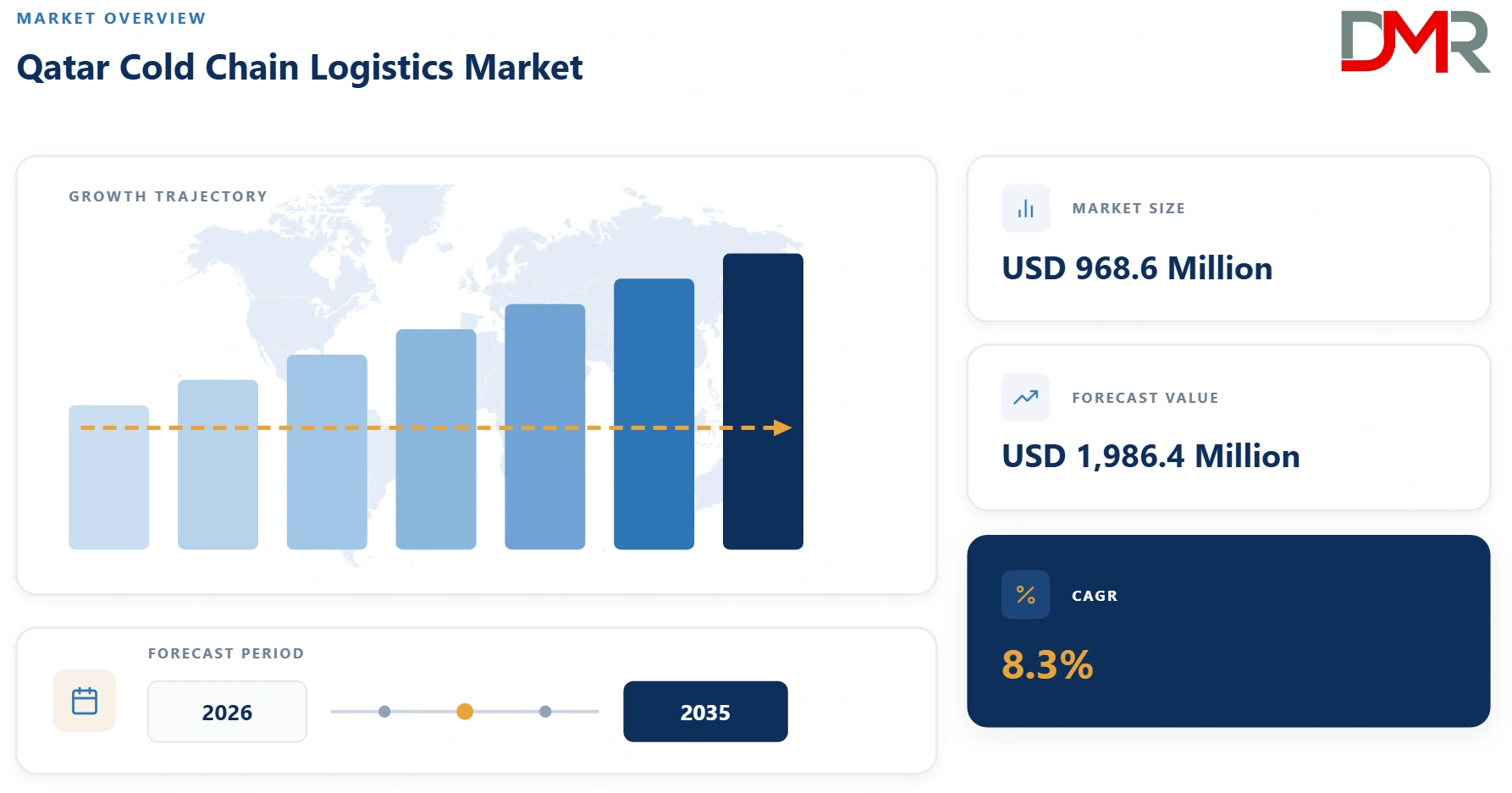
The Qatar Cold Chain Logistics Market is projected to be valued at USD 968.6 Million in 2026 and is projected to reach USD 1,986.4 Million by 2035, expanding at a CAGR of 8.3% during the forecast period.
ℹ
To learn more about this report –
Download Your Free Sample Report Here
Growth is being propelled by Qatar's extreme climate conditions that make robust cold chain infrastructure a food safety necessity, the country's post-blockade food security strategy that has driven substantial domestic cold storage and refrigerated transportation investment to support newly established dairy and poultry production capacity, and Qatar's position as a major logistics and re-export hub connecting to broader Gulf Cooperation Council markets through Hamad Port and Hamad International Airport. The maturing of climate-engineered cold storage and refrigerated transportation technology specifically suited to Qatar's demanding heat conditions, growing investment in cold chain infrastructure supporting Qatar's expanding healthcare sector and pharmaceutical distribution needs, and continued government investment in logistics infrastructure as part of Qatar National Vision 2030 economic diversification objectives are reshaping the market from a historically import-dependent logistics function into an increasingly sophisticated, domestically anchored cold chain network. Investment is accelerating as Qatari cold chain operators expand capacity to support both domestic food security production and the country's role as a regional logistics and trade hub.
Use Cases
- Cold Storage Infrastructure Supporting Post-Blockade Domestic Food Production: Qatari dairy and poultry companies rely on extensive cold storage warehousing networks to support the domestic production capacity established following the 2017 regional blockade, ensuring product quality is preserved from processing facilities through retail and foodservice distribution.
- Climate-Resilient Refrigerated Transportation Across Qatar's Domestic Distribution Network: Food distributors and retailers rely on specially engineered refrigerated trucking fleets capable of maintaining consistent temperature control despite sustained extreme ambient heat during transport across Qatar's compact but climate-demanding geography.
- Temperature-Controlled Pharmaceutical Distribution Supporting Healthcare Sector Growth: Pharmaceutical distributors and healthcare logistics providers use validated cold chain transportation and storage to support Qatar's expanding hospital and healthcare infrastructure, distributing vaccines, biologics, and temperature-sensitive medications across the country's healthcare network.
- Cold Chain Re-Export and Redistribution Through Hamad Port and Airport: International food and pharmaceutical importers and re-exporters leverage Qatar's advanced Hamad Port and Hamad International Airport cold storage infrastructure as a regional distribution and redistribution point serving broader Gulf Cooperation Council markets.
Key Takeaways
- Market Size: The Qatar Cold Chain Logistics Market is anticipated to be valued at USD 968.6 Million in 2026 and is forecast to reach USD 1,986.4 Million by 2035, expanding at a CAGR of 8.3%.
- Growth Outlook: Market expansion is sustained by Qatar's structural climate-driven cold chain requirements, the country's post-blockade food security strategy requiring corresponding cold storage investment, and Qatar's position as a growing regional logistics and re-export hub.
- Primary Growth Drivers: Extreme climate conditions necessitating robust cold chain infrastructure, post-blockade domestic food production capacity requiring supporting cold storage investment, growing pharmaceutical and healthcare cold chain demand, and Qatar's expanding role as a Gulf Cooperation Council logistics hub are accelerating market growth.
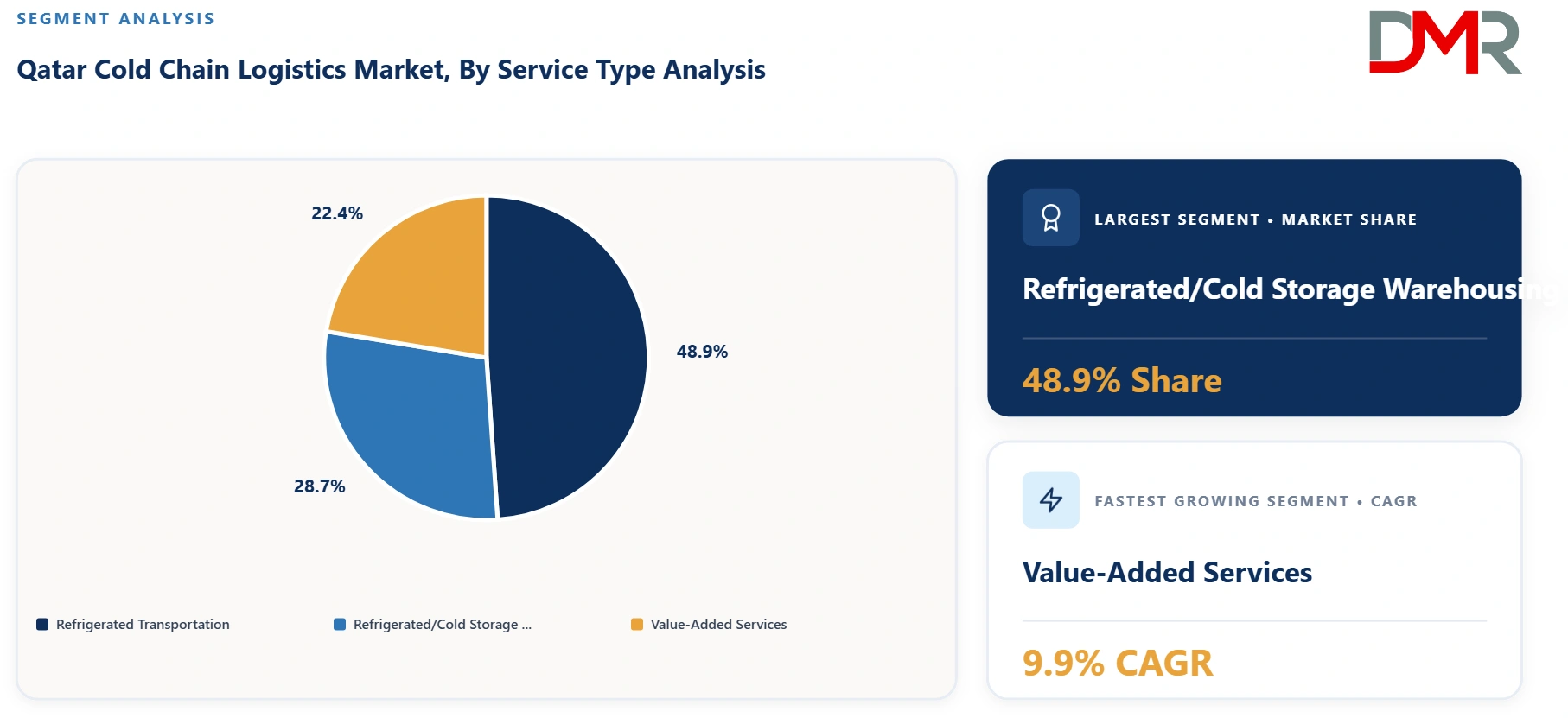
- By Service Type Analysis: Refrigerated/Cold Storage Warehousing is projected to lead the service type segment with a 48.9% share in 2026, reflecting substantial investment supporting both domestic food production and Qatar's regional logistics hub function. Value-Added Services is the fastest-growing service type segment at 9.9% CAGR, driven by rising demand for specialized handling and inventory management services.
- By Temperature Type Analysis: Frozen is expected to dominate with a 43.6% share in 2026, supported by substantial frozen food import and domestic distribution volumes. Deep-Frozen is the fastest-growing temperature type segment at 10.4% CAGR, driven by expanding pharmaceutical biologics distribution requiring ultra-low temperature handling.
- By Mode of Transport Analysis: Roadways is poised to lead with a 68.4% share in 2026, reflecting the central role of refrigerated trucking within Qatar's compact domestic distribution network. Airways is the fastest-growing mode of transport segment at 9.6% CAGR, driven by Hamad International Airport's growing role in time-critical pharmaceutical and premium food distribution.
- By Application Analysis: Dairy Products is expected to command a 27.9% share in 2026, underpinned by substantial post-blockade domestic dairy production and distribution requirements. Pharmaceuticals and Healthcare is the fastest-growing application segment at 10.8% CAGR, driven by expanding healthcare infrastructure and biologics distribution requirements.
- By End User Analysis: Food and Beverage Industry is projected to dominate with a 74.8% share in 2026, reflecting the sector's overwhelming share of overall cold chain volume. Pharmaceutical and Healthcare Industry is the fastest-growing end user segment at 10.2% CAGR, driven by sustained growth in Qatar's healthcare sector and temperature-sensitive drug distribution.
Key Drivers in the Qatar Cold Chain Logistics Market
Extreme Climate Conditions Necessitating Robust Cold Chain Infrastructure
Qatar's sustained extreme heat conditions create a structural, non-discretionary requirement for comprehensive cold chain infrastructure across virtually all temperature-sensitive food and pharmaceutical distribution. Ambient temperatures regularly reach levels that would compromise product safety and quality without reliable refrigerated transportation and storage, making cold chain investment an essential food safety requirement rather than a discretionary premium service consideration. This climate reality sustains structural demand for cold chain capacity investment across Qatar's food distribution system independent of shorter-term economic conditions.
Post-Blockade Food Security Strategy Requiring Corresponding Cold Storage Investment
Qatar's rapid development of domestic dairy and poultry production capacity following the 2017-2021 regional blockade has generated substantial corresponding demand for cold storage warehousing and refrigerated transportation infrastructure to support the distribution of this newly established domestic production. As Qatari food companies continue expanding and refining their domestic production capacity as part of the broader national food security strategy, sustained investment in supporting cold chain infrastructure is expected to continue, closely tracking the trajectory of the country's domestic food processing sector development.
Restraints in the Qatar Cold Chain Logistics Market
High Energy Costs Associated with Extreme Climate Cooling Requirements
The substantial energy consumption required to maintain reliable temperature control across refrigerated transportation and storage infrastructure under Qatar's sustained extreme heat conditions represents a significant restraint on the Cold Chain Logistics Market. Cooling equipment must operate considerably harder to maintain required temperatures than in more temperate climates, increasing operating costs for cold chain providers and potentially affecting overall food distribution economics, particularly given Qatar's need to import a substantial share of food products requiring extensive refrigerated handling throughout the supply chain.
Growth Opportunities in the Qatar Cold Chain Logistics Market
Energy-Efficient, Climate-Engineered Cold Storage Technology
Qatar's extreme climate conditions present a substantial opportunity for logistics providers and equipment manufacturers developing specifically engineered, energy-efficient cold storage and refrigerated transportation technology optimized for sustained extreme heat performance. Companies capable of demonstrating meaningfully lower energy consumption and more reliable temperature maintenance under Qatar's climate conditions can capture premium positioning and stronger long-term relationships with the country's food and pharmaceutical distribution companies.
Regional Cold Chain Hub Services Leveraging Hamad Port and Airport Infrastructure
Qatar's substantial investment in Hamad Port and Hamad International Airport infrastructure presents a significant opportunity for cold chain logistics providers to develop specialized regional distribution hub services connecting international food and pharmaceutical trade with broader Gulf Cooperation Council markets. Providers capable of leveraging Qatar's world-class logistics infrastructure to efficiently serve multiple regional markets from a single distribution point can capture premium, long-term contracts extending beyond Qatar's relatively small domestic market.
Trends in the Qatar Cold Chain Logistics Market
Growing Investment in Dedicated Cold Storage Zones Near Hamad Port
Qatar is increasingly developing dedicated cold storage and logistics zones near Hamad Port and other key transportation infrastructure, reflecting national priorities around logistics sector development and food security under Qatar National Vision 2030. These dedicated zones offer infrastructure and regulatory advantages specifically supporting cold chain investment, attracting concentrated development of modern, purpose-built cold storage facilities.
Rising Adoption of Solar-Assisted and Energy-Efficient Cooling Technology
Qatari cold chain logistics providers are increasingly exploring solar-assisted cooling and other energy-efficient refrigeration technologies to help manage the substantial energy costs associated with reliable temperature control under extreme heat conditions. This trend reflects both economic incentives to reduce cooling-related operating costs and growing alignment with Qatar National Vision 2030 sustainability objectives, positioning energy efficiency as an increasingly important competitive consideration among cold chain infrastructure providers.
Research Scope and Analysis
The Qatar Cold Chain Logistics Market is segmented by service type, temperature type, mode of transport, application, and end user, covering refrigerated transportation, cold storage warehousing, value-added services, chilled, frozen, deep-frozen temperature ranges, and food, pharmaceutical, and retail end users.
ℹ
To learn more about this report –
Download Your Free Sample Report Here
By Service Type Analysis
Refrigerated/Cold Storage Warehousing is projected to dominate the Qatar Cold Chain Logistics Market with 48.9% share in 2026, reflecting substantial investment supporting both post-blockade domestic food production distribution and Qatar's growing role as a regional logistics and re-export hub. Value-Added Services is expected to register the highest CAGR of 9.9% during 2026-2035, driven by rising demand for specialized handling, inventory management, and other services integrated alongside core transportation and storage offerings.
By Temperature Type Analysis
Frozen is anticipated to dominate the Qatar Cold Chain Logistics Market by temperature type, accounting for 43.6% share in 2026, supported by substantial frozen food import volumes given Qatar's continued reliance on food imports to supplement domestic production. Deep-Frozen is projected to register the highest CAGR of 10.4% between 2026 and 2035, driven by expanding pharmaceutical biologics distribution requiring ultra-low temperature handling and storage supporting the country's growing healthcare infrastructure.
By Mode of Transport Analysis
Roadways is projected to lead the Qatar Cold Chain Logistics Market with an estimated 68.4% share in 2026, reflecting the central role of refrigerated trucking within Qatar's compact domestic distribution network connecting Doha and other population centers. Airways is expected to register the fastest CAGR of 9.6% through 2035, driven by Hamad International Airport's growing role as a regional cargo hub supporting time-critical pharmaceutical and premium food distribution.
By Application Analysis
Dairy Products is projected to lead the Qatar Cold Chain Logistics Market with an estimated 27.9% share in 2026, underpinned by substantial post-blockade domestic dairy production requiring extensive cold storage and refrigerated transportation support. Pharmaceuticals and Healthcare is expected to register the fastest CAGR of 10.8% through 2035, driven by sustained expansion of Qatar's healthcare infrastructure and growing biologics and vaccine distribution requirements.
By End User Analysis
Food and Beverage Industry is projected to dominate the Qatar Cold Chain Logistics Market with 74.8% share in 2026, reflecting the sector's overwhelming share of total cold chain transportation and storage volume. Pharmaceutical and Healthcare Industry is expected to register the fastest CAGR of 10.2% through 2035, driven by sustained growth in temperature-sensitive drug, vaccine, and biologics distribution supporting Qatar's expanding healthcare sector.
The Qatar Cold Chain Logistics Market Report is segmented based on the following:
By Service Type
- Refrigerated Transportation
- Refrigerated/Cold Storage Warehousing
- Value-Added Services
By Temperature Type
- Chilled
- Frozen
- Deep-Frozen
By Mode of Transport
- Roadways
- Airways
- Waterways
- Railways
By Application
- Dairy Products
- Meat, Poultry and Seafood
- Fruits and Vegetables
- Bakery and Confectionery
- Pharmaceuticals and Healthcare
- Others
By End User
- Food and Beverage Industry
- Pharmaceutical and Healthcare Industry
- Retail and E-Commerce
- Others
Technology Analysis
Technology investment is increasingly shaping competitiveness in the Qatar Cold Chain Logistics Market as providers adopt climate-engineered refrigeration technology, IoT-based real-time temperature monitoring, and energy-efficient cooling systems specifically calibrated for reliable performance under sustained extreme heat conditions. Growing use of solar-assisted cooling technology, leveraging Qatar's abundant solar resources, is helping providers manage the substantial energy costs associated with reliable cold chain operation. Opportunities are expanding for providers investing in energy-efficient refrigeration systems engineered for extreme heat performance, digital traceability platforms supporting Hamad Port and Airport re-export trade documentation, and predictive maintenance analytics reducing equipment failure risk under demanding climate conditions. However, the high capital costs associated with climate-adapted equipment, combined with Qatar's relatively small domestic market limiting economies of scale for highly specialized infrastructure, present ongoing investment considerations for cold chain providers.
Investment and White Space Analysis
Investment opportunities in the Qatar Cold Chain Logistics Market are expanding alongside the country's structural climate-driven cold chain requirements, sustained post-blockade food security investment, and growing role as a Gulf Cooperation Council regional logistics hub. Significant white space exists in energy-efficient, climate-engineered cold storage and transportation technology, regional distribution hub services leveraging Hamad Port and Airport infrastructure, and specialized pharmaceutical and healthcare cold chain infrastructure. Providers with strong climate-adapted technical capability, established relationships with major Qatari food and healthcare companies, and regional logistics hub positioning are positioned to capture premium, longer-duration contracts. However, high energy costs associated with extreme climate cooling requirements, along with Qatar's relatively small domestic market scale, can constrain margins for providers lacking regional export or re-export business extensions.
Competitive Landscape
The Qatar Cold Chain Logistics Market is moderately consolidated and increasingly competitive, comprising national logistics companies affiliated with Qatar's major food processing champions, international cold chain and logistics companies with Qatari operations, and specialized pharmaceutical cold chain logistics providers. Competition centers on climate-engineered infrastructure reliability, energy efficiency, integration with Hamad Port and Airport regional logistics infrastructure, and specialized pharmaceutical validation and monitoring capability. National and international providers benefit from established relationships with Qatar's major food and healthcare companies and integrated regional distribution network capability, while specialized providers compete on category-specific expertise. Companies increasingly differentiate through climate-adapted technology investment, energy efficiency credentials, and regional logistics hub integration rather than storage capacity alone.
Some of the prominent players in the Qatar Cold Chain Logistics Market are:
- Gulf Warehousing Company Q.P.S.C. (GWC)
- Milaha
- Qatar Airways Cargo
- QTerminals
- Qatar Logistics W.L.L.
- Gulf United Cold Stores
- Al Jazeera Cold Stores
- Al Mana Cold Stores & Logistics
- Qatar National Import and Export Co.
- Agility Logistics Qatar
- DHL Global Forwarding Qatar
- DHL Supply Chain
- Kuehne+Nagel Qatar
- DSV Qatar
- DB Schenker Qatar
- CEVA Logistics
- A.P. Moller - Maersk
- Gulf Agency Company (GAC) Qatar
- Tristar Qatar
- Al-Futtaim Logistics
- Hellmann Worldwide Logistics Qatar
- Yusen Logistics Qatar
- FedEx Qatar
- UPS Qatar
- Aramex Qatar
- Nakilat Agency Company
- Al Madina Logistics
- Al Watania Logistics
- United Logistics Company W.L.L.
- Doha Qatar Logistics
- Qatar Distribution Company
- Baladna Food Industries
- Widam Food Company
- Ali Bin Ali Logistics
- Almuftah Group
- Qatar Cool
- Emirates Logistics
- APL Logistics
- XPO Logistics
- Al Khor Cold Storage
- Other Key Players
Recent Developments
- February 2026: Milaha confirmed launching specialized pharmaceutical logistics services featuring Ministry of Public Health-licensed temperature-controlled warehousing, real-time inventory monitoring, and GPS-tracked distribution vehicles for medicines, vaccines, cosmetics, and temperature-sensitive healthcare products.
- December 2025: Qatar adopted QS 10050:2025, introducing mandatory storage-temperature requirements for chilled meat, seafood, juices, eggs, baby food, and other sensitive foods, strengthening compliance across cold-chain storage and distribution.
- September 2025: Bin Yousef Cargo launched a new Ras Bufontas Free Zone warehouse providing temperature-controlled storage, smart racking, inventory management, fulfillment, and integrated air, road, and sea logistics services in Qatar.
Report Details
| Report Characteristics |
| Market Size (2026) |
USD 968.6 Mn |
| Forecast Value (2035) |
USD 1,986.4 Mn |
| CAGR (2026–2035) |
8.3% |
| Historical Data |
2021 – 2025 |
| Forecast Data |
2026 – 2035 |
| Base Year |
2025 |
| Segments Covered |
By Service Type, By Temperature Type, By Mode of Transport, By Application, By End User |
| Country Coverage |
Qatar |
Frequently Asked Questions
How big is the Qatar Cold Chain Logistics Market?
▾ The Qatar Cold Chain Logistics Market is valued at USD 968.6 Million in 2026 and is projected to reach USD 1,986.4 Million by 2035, reflecting the country's structural climate-driven cold chain requirements and post-blockade food security investment.
What is the CAGR of the Qatar Cold Chain Logistics Market from 2026 to 2035?
▾ The market is projected to expand at a compound annual growth rate (CAGR) of 8.3% between 2026 and 2035, supported by extreme climate conditions necessitating robust infrastructure, sustained food security investment, and Qatar's growing regional logistics hub role.
What factors are driving the growth of the Qatar Cold Chain Logistics Market?
▾ Growth is driven by extreme climate conditions necessitating robust cold chain infrastructure, post-blockade domestic food production capacity requiring supporting cold storage investment, growing pharmaceutical and healthcare cold chain demand, and Qatar's expanding role as a Gulf Cooperation Council logistics hub.
What are the major trends in the Qatar Cold Chain Logistics Market?
▾ Major trends include growing investment in dedicated cold storage zones near Hamad Port, rising adoption of solar-assisted and energy-efficient cooling technology, and continued expansion of regional distribution hub services.
Who are the key players in the Qatar Cold Chain Logistics Market?
▾ Key market participants include Milaha Logistics, Gulf Warehousing Company (GWC), Agility Logistics Qatar, Aramex Qatar, and DHL Supply Chain Qatar, among other national and international cold chain logistics providers.
How is the Qatar Cold Chain Logistics Market segmented?
▾ The market is segmented by service type, temperature type, mode of transport, application, and end user, with demand analysis concentrated around Doha, Hamad Port, and Hamad International Airport.