Qatar Food & Beverage Processing Market Snapshot
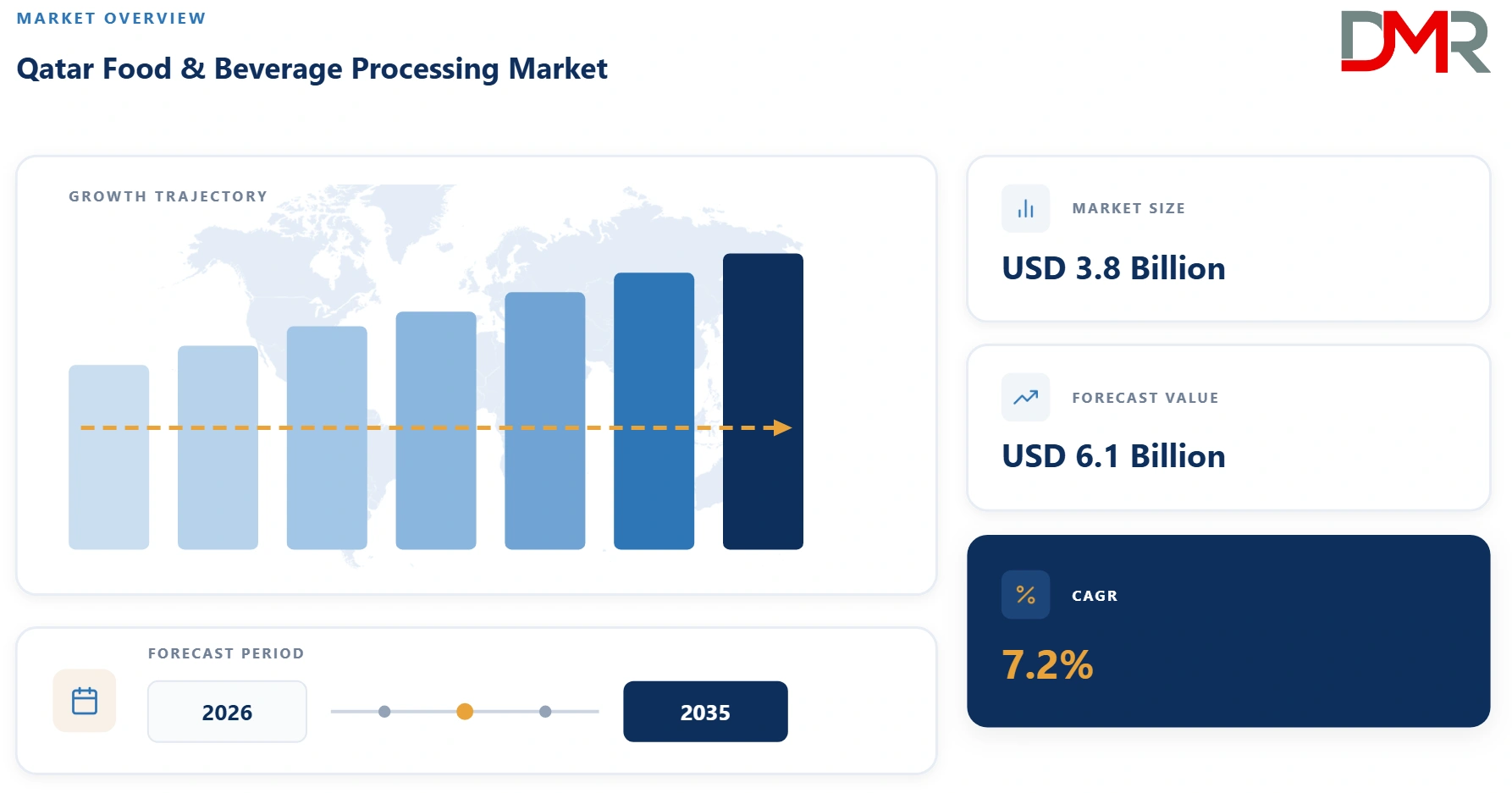
- Qatar Food & Beverage Processing Market Size in 2026: USD 3.2 Billion
- Qatar Food & Beverage Processing Market Size in 2035: USD 6.1 Billion
- Qatar CAGR from 2026 to 2035: 7.2%
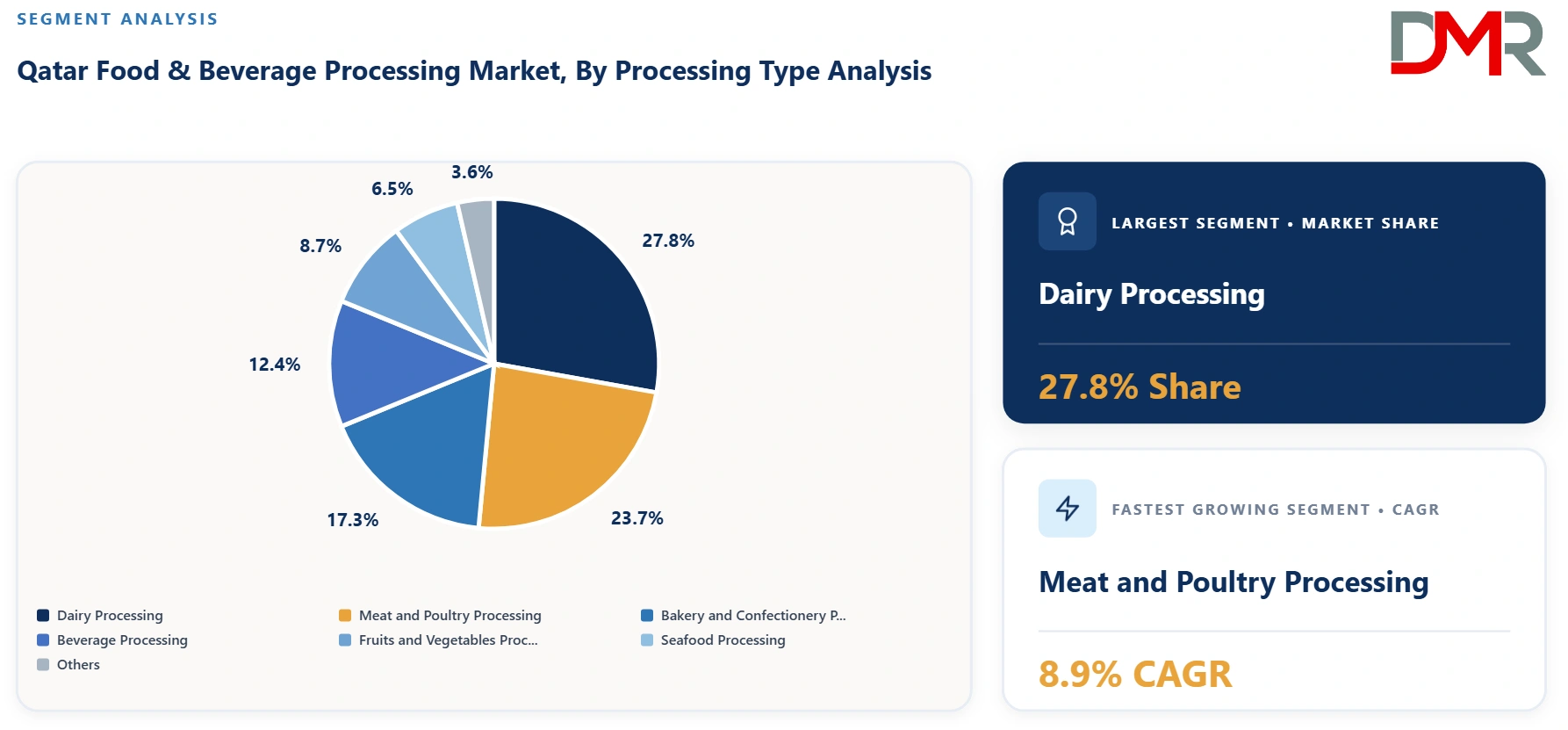
- Dairy Processing is the leading processing type segment in 2026: 27.8%
- Automatic is the leading technology segment in 2026: 58.6%
- Domestic Consumption is the leading application segment in 2026: 71.4%
- Large-Scale Food Processors is the leading end user segment in 2026: 64.8%
What is the Qatar Food & Beverage Processing Market and its Market Size?
The Qatar Food & Beverage Processing Market is projected to be valued at USD 3.2 Billion in 2026 and is projected to reach USD 6.1 Billion by 2035, expanding at a CAGR of 7.2% during the forecast period.
ℹ
To learn more about this report –
Download Your Free Sample Report Here
Growth is being propelled by Qatar's national food security strategy, decisively accelerated by the 2017-2021 regional blockade that exposed the risks of heavy food import dependency, sustained government and sovereign wealth investment in building domestic dairy, poultry, and broader food processing capacity, and Qatar's exceptionally high per-capita income supporting strong demand for both staple and premium processed food and beverage products. The maturing of vertically integrated dairy and poultry production capacity established in the years following the blockade, growing private sector investment in bakery, beverage, and value-added food processing capacity serving both domestic consumption and Qatar's substantial foodservice and hospitality sector, and continued government support for food processing investment as a strategic economic diversification priority under Qatar National Vision 2030 are reshaping the market from a historically import-dependent food supply pattern into an increasingly self-sufficient, technologically advanced domestic processing industry.
Use Cases
- Vertically Integrated Dairy Production for National Food Security: Qatari dairy companies, having rapidly established domestic dairy farming and processing capacity following the 2017 regional blockade, operate vertically integrated operations producing fresh milk, yogurt, and other dairy products to reduce reliance on imported dairy and support national self-sufficiency objectives.
- Poultry Processing Capacity Expansion Reducing Import Dependency: Qatari poultry companies invest in automated processing facilities to expand domestic chicken and poultry product production, directly addressing food security vulnerabilities exposed during the blockade period when poultry imports faced significant disruption.
- Premium Bakery and Beverage Processing for High-Income Consumer Market: Food and beverage processors develop premium bakery, confectionery, and beverage product lines specifically targeting Qatar's exceptionally high per-capita income consumer base and substantial hospitality and foodservice sector serving international visitors and residents.
- Foodservice and Hospitality Supply Chain Processing: Food processors develop specialized supply relationships with Qatar's extensive hotel, restaurant, and hospitality sector, supplying processed food products supporting both domestic consumption and Qatar's position as a regional business and tourism hub.
Key Takeaways
- Market Size: The Qatar Food & Beverage Processing Market is anticipated to be valued at USD 3.2 Billion in 2026 and is forecast to reach USD 6.1 Billion by 2035, expanding at a CAGR of 7.2%.
- Growth Outlook: Market expansion is sustained by Qatar's blockade-accelerated national food security strategy, sustained government and sovereign wealth investment in domestic processing capacity, and Qatar's exceptionally high per-capita income supporting strong processed food and beverage demand.
- Primary Growth Drivers: National food security priorities driving vertically integrated dairy and poultry processing investment, sustained high per-capita income supporting premium processed food demand, continued government support for food processing as an economic diversification priority, and Qatar's substantial hospitality and foodservice sector are accelerating market growth.
- By Processing Type Analysis: Dairy Processing is projected to lead the processing type segment with a 27.8% share in 2026, reflecting the scale of post-blockade domestic dairy production capacity investment. Meat and Poultry Processing is the fastest-growing processing type segment at 8.9% CAGR, driven by continued expansion of domestic poultry production capacity supporting food security objectives.
- By Technology Analysis: Automatic technology is expected to dominate with a 58.6% share in 2026, reflecting substantial investment in modern, large-scale processing facilities established as part of the national food security build-out. Automatic is also the fastest-growing technology segment at 9.4% CAGR, as new facility development consistently incorporates advanced automation.
- By Application Analysis: Domestic Consumption is poised to lead with a 71.4% share in 2026, reflecting the primary orientation of Qatar's food processing investment toward national self-sufficiency objectives. Export/Regional Trade is the fastest-growing application segment at 9.8% CAGR, driven by growing Qatari food company ambitions to serve broader Gulf Cooperation Council markets.
- By End User Analysis: Large-Scale Food Processors are projected to dominate with a 64.8% share in 2026, reflecting the scale of investment associated with national food security-driven production capacity expansion. Small and Medium-Sized Processors is the fastest-growing end user segment at 9.1% CAGR, driven by growing government support programs encouraging broader domestic food manufacturing sector development.
Key Drivers in the Qatar Food & Beverage Processing Market
National Food Security Strategy Accelerated by the 2017-2021 Regional Blockade
Qatar's experience during the 2017-2021 regional blockade, which severely disrupted established food import supply chains and exposed the risks of heavy dependency on food imports through neighboring countries, fundamentally reshaped national food policy priorities toward domestic production self-sufficiency. This blockade experience catalyzed rapid, large-scale investment in domestic dairy, poultry, and broader food processing capacity, with the government and sovereign wealth-backed entities providing substantial financial and regulatory support for this strategic capacity build-out. This national security-driven investment priority continues to shape Qatar's food processing sector development, distinguishing the market's growth drivers from those in markets where food processing investment is driven primarily by commercial demand considerations alone.
Exceptionally High Per-Capita Income Supporting Strong Processed Food Demand
Qatar's per-capita income, among the highest in the world, supports substantial consumer purchasing power for both staple and premium processed food and beverage products across the domestic market. This affluent consumer base, combined with Qatar's substantial expatriate population and extensive hospitality and foodservice sector serving international business and tourism visitors, creates a demand environment supporting continued food processing capacity investment and product portfolio premiumization beyond what population size alone would suggest.
Restraints in the Qatar Food & Beverage Processing Market
Small Domestic Market Scale Limiting Processing Facility Economies of Scale
Qatar's relatively small population represents a meaningful restraint on the Food & Beverage Processing Market, as domestic food processors face inherent limitations in achieving the production scale economies available to processors serving larger national markets. This scale constraint requires Qatari food processors to either accept higher per-unit production costs relative to larger-market competitors or pursue regional export strategies to achieve more competitive production scale, complicating the economics of certain processing capacity investments, particularly for categories with limited premium positioning potential.
Growth Opportunities in the Qatar Food & Beverage Processing Market
Regional Export Expansion Leveraging National Food Security Production Capacity
Qatar's substantial food processing capacity investment, originally driven by domestic food security objectives, presents an opportunity for Qatari food companies to develop export capability serving broader Gulf Cooperation Council markets, leveraging both established production infrastructure and Qatar's strategic logistics position. Companies capable of extending domestic food security-oriented production capacity into regional export markets can improve overall facility utilization and achieve more competitive production economics while diversifying revenue beyond the relatively small domestic Qatari market.
Premium Food and Beverage Product Innovation for Affluent Consumer and Hospitality Markets
Qatar's exceptionally high per-capita income and substantial hospitality sector serving international visitors present a significant opportunity for food processors to develop premium, differentiated food and beverage product lines specifically targeting this receptive and well-resourced consumer and institutional customer base. Companies investing in premium product innovation, potentially including collaboration with international culinary and hospitality brands present in Qatar's market, can capture strong margins within this affluent consumer environment.
Trends in the Qatar Food & Beverage Processing Market
Continued Vertical Integration Among Leading Qatari Food Processing Companies
Qatar's leading food processing companies, particularly within dairy and poultry categories, continue pursuing vertical integration spanning farming, processing, and distribution to strengthen supply chain control and resilience against potential future disruption. This vertical integration trend, initially driven by blockade-era food security concerns, continues as an enduring strategic priority among Qatar's leading food companies, reflecting lasting lessons learned from the blockade experience about the importance of supply chain resilience and self-sufficiency.
Growing Government Support for Small and Medium-Sized Food Processing Enterprise Development
Qatar is increasingly extending food security-related government support programs and financing incentives to smaller and medium-sized food processing enterprises, beyond the large national champions that received initial post-blockade investment priority. This trend reflects growing government recognition of the value in broadening domestic food processing capability across a more diverse base of companies, supporting continued sector development and potentially greater product category diversity within the domestic food processing industry.
Research Scope and Analysis
The Qatar Food & Beverage Processing Market is segmented by processing type, technology, application, and end user, covering dairy, meat and poultry, bakery, beverage, produce, and seafood processing, automatic and manual technology, and domestic consumption, export, and foodservice applications.
ℹ
To learn more about this report –
Download Your Free Sample Report Here
By Processing Type Analysis
Dairy Processing is projected to dominate the Qatar Food & Beverage Processing Market with 27.8% share in 2026, reflecting the substantial scale of post-blockade domestic dairy production capacity investment representing one of the most visible and successful examples of Qatar's national food security strategy. Meat and Poultry Processing is expected to register the highest CAGR of 8.9% during 2026-2035, driven by continued expansion of domestic poultry production capacity supporting broader food security objectives across additional protein categories.
By Technology Analysis
Automatic technology is anticipated to dominate the Qatar Food & Beverage Processing Market by technology, accounting for 58.6% share in 2026, supported by substantial investment in modern, large-scale processing facilities established as part of the national food security capacity build-out following the blockade period. Automatic technology is also projected to register the highest CAGR of 9.4% between 2026 and 2035, as new facility development and expansion projects consistently prioritize the latest automation technology available.
By Application Analysis
Domestic Consumption is projected to lead the Qatar Food & Beverage Processing Market with an estimated 71.4% share in 2026, reflecting the primary strategic orientation of Qatar's food processing investment toward national self-sufficiency and food security objectives rather than export-oriented production. Export/Regional Trade is expected to register the fastest CAGR of 9.8% through 2035, driven by growing Qatari food company ambitions to extend established domestic production capacity into broader Gulf Cooperation Council export markets.
By End User Analysis
Large-Scale Food Processors are projected to dominate the Qatar Food & Beverage Processing Market with 64.8% share in 2026, reflecting the substantial scale of investment associated with national food security-driven production capacity expansion led by major Qatari food companies. Small and Medium-Sized Processors are expected to register the fastest CAGR of 9.1% through 2035, driven by growing government support programs and financing incentives encouraging broader domestic food manufacturing sector development beyond large national champions.
The Qatar Food & Beverage Processing Market Report is segmented based on the following:
By Processing Type
- Dairy Processing
- Meat and Poultry Processing
- Bakery and Confectionery Processing
- Beverage Processing
- Fruits and Vegetables Processing
- Seafood Processing
- Others
By Technology
- Automatic
- Semi-Automatic
- Manual
By Application
- Domestic Consumption
- Export/Regional Trade
- Foodservice/HoReCa
By End User
- Large-Scale Food Processors
- Small and Medium-Sized Processors
- Government-Backed Food Security Entities
Technology Analysis
Technology development is central to the trajectory of the Qatar Food & Beverage Processing Market as companies invest in automated dairy and poultry processing equipment, climate-resilient facility design, and digital production monitoring technology supporting both efficiency and food safety documentation aligned with national quality standards. Growing use of precision agriculture and livestock management technology is supporting the productivity and sustainability of Qatar's rapidly established domestic dairy and poultry farming operations. Opportunities are expanding for companies developing water-efficient and climate-adapted processing and farming technology addressing Qatar's arid climate and water resource constraints, as well as automation solutions that help smaller Qatari food processing enterprises achieve competitive production efficiency despite limited domestic market scale. However, achieving cost-competitive production scale given Qatar's relatively small population remains a persistent economic and technical consideration shaping processing technology investment decisions.
Investment and White Space Analysis
Investment opportunities in the Qatar Food & Beverage Processing Market are expanding alongside the country's enduring national food security strategy, sustained high per-capita income supporting premium consumption, and growing government support for broader food processing sector development. Significant white space exists in regional export capacity development leveraging established domestic production infrastructure, premium food and beverage product innovation for Qatar's affluent consumer and hospitality markets, and continued vertical integration supporting supply chain resilience. Companies with strong vertical integration capability, established food security-aligned government relationships, and regional export market development capability are positioned to capture premium, longer-duration growth opportunities. However, Qatar's small domestic market scale limiting processing economies, along with the capital intensity of continued vertical integration investment, can constrain margins and growth pace for smaller processors lacking government-backed support or regional export capability.
Competitive Landscape
The Qatar Food & Beverage Processing Market is moderately consolidated and competitive, comprising several large, government-backed and sovereign wealth-affiliated national food processing champions alongside smaller domestic processors and multinational food companies with Qatari operations. Competition centers on vertical integration and food security alignment, government relationship strength, production scale efficiency despite the small domestic market, and premium product positioning capability for Qatar's affluent consumer base. Large, government-backed national champions benefit from substantial capital access, established food security policy alignment, and strong domestic brand recognition, while multinational companies compete through global product innovation capability and international brand recognition within Qatar's cosmopolitan consumer market. Companies increasingly differentiate through regional export capability, premium product innovation, and continued vertical integration rather than domestic market scale alone.
Some of the prominent players in the Qatar Food & Beverage Processing Market are:
- Baladna Q.P.S.C.
- Widam Food Company Q.P.S.C.
- Hassad Food Company
- Zad Holding Company
- Qatar Flour Mills Company
- Dandy Company Limited
- Gulf Food Production (Rawa)
- Qatar Food Factories Company (Qatar Pafki)
- Qatar Foods Industries
- Qatar Meat Production Company
- National Food Company (Al Arabia)
- National Food Company (NAFCO)
- Al Sada Food Industry
- Fresh Meat Factory
- Aalaf Qatar
- Arab Qatari Agricultural Production Company (QATFA)
- Agrico Agricultural Development
- Mahaseel for Marketing and Agricultural Services
- Al Arz Automatic Bakery
- Qbake
- Al Jazeera Food Industries
- Doha Food Industries
- Qatar National Food Industries
- Qatar Dairy Company
- Arabian Beverage Company
- Qatar Refreshments Company
- Ali Bin Ali Beverages
- Gulf Water Plant
- Rayyan Water
- Al Kawther Water Treatment Company
- Doha Dates
- RAW Middle East
- Al Waha Food Industries
- United Food Industries
- Al Mana Food Industries
- Nestlé
- PepsiCo
- Coca-Cola
- Mondelez International
- Unilever
- Other Key Players
Recent Developments
- March 2026: Qatar’s Minister of Municipality visited Baladna’s facilities, reviewing dairy and beverage production operations and the company’s role in domestic food security, local manufacturing, production efficiency, and strengthening Qatar’s integrated food-processing capabilities.
- March 2026: Widam Food signed an MoU with Hassad Food regarding a potential share-swap transaction or merger involving Aalaf Qatar, potentially consolidating activities across Qatar’s livestock, meat, feed, and food-processing value chain.
- March 2026: Qatar reported more than 138 national food-manufacturing factories operating efficiently, including 24 dairy, 20 water, 16 meat and fish, 15 bakery and pasta, and nine juice-production factories.
- October 2025: Qatar’s Minister of Commerce and Industry visited Rawa’s food-production factory, reviewing manufacturing lines, modern processing technologies, production procedures, quality systems, and food-safety standards supporting expansion of domestic manufacturing.
Report Details
| Report Characteristics |
| Market Size (2026) |
USD 3.2 Bn |
| Forecast Value (2035) |
USD 6.1 Bn |
| CAGR (2026–2035) |
7.2% |
| Historical Data |
2021 – 2025 |
| Forecast Data |
2026 – 2035 |
| Base Year |
2025 |
| Segments Covered |
By Processing Type, By Technology, By Application, By End User |
| Country Coverage |
Qatar |
Frequently Asked Questions
How big is the Qatar Food & Beverage Processing Market?
▾ The Qatar Food & Beverage Processing Market is poised to be valued at USD 3.2 Billion in 2026 and is projected to reach USD 6.1 Billion by 2035, reflecting Qatar's blockade-accelerated national food security strategy and sustained high per-capita income supporting processed food demand.
What is the CAGR of the Qatar Food & Beverage Processing Market from 2026 to 2035?
▾ The market is projected to expand at a compound annual growth rate (CAGR) of 7.2% between 2026 and 2035, supported by continued domestic food processing capacity investment, sustained high per-capita income, and growing regional export ambitions.
What factors are driving the growth of the Qatar Food & Beverage Processing Market?
▾ Growth is driven by national food security priorities driving vertically integrated dairy and poultry processing investment, sustained high per-capita income supporting premium processed food demand, continued government support for food processing as an economic diversification priority, and Qatar's substantial hospitality and foodservice sector.
What are the major trends in the Qatar Food & Beverage Processing Market?
▾ Major trends include continued vertical integration among leading Qatari food processing companies, growing government support for small and medium-sized food processing enterprise development, and increasing pursuit of regional export opportunities leveraging established domestic production capacity.
Who are the key players in the Qatar Food & Beverage Processing Market?
▾ Key market participants include Baladna Food Industries, Widam Food Company, Qatar National Import and Export Company (Mahaseel), Al Meera Consumer Goods Company, and Hassad Food, among other national and multinational food processing companies operating in Qatar.
How is the Qatar Food & Beverage Processing Market segmented?
▾ The market is segmented by processing type, technology, application, and end user, with demand analysis concentrated across Doha and Qatar's dedicated agricultural and industrial development zones.