Qatar Food Packaging Market Snapshot
- Qatar Food Packaging Market Size in 2026: USD 682.4 Million
- Qatar Food Packaging Market Size in 2035: USD 1,214.6 Million
- Qatar CAGR from 2026 to 2035: 6.6%
- Plastics is the leading material type segment in 2026: 41.6%
- Flexible Packaging is the leading packaging type segment in 2026: 45.2%
- Modified Atmosphere Packaging is the leading technology segment in 2026: 23.1%
- Dairy Products is the leading application segment in 2026: 26.4%
- Food and Beverage Manufacturers is the leading end user segment in 2026: 68.9%
What is the Qatar Food Packaging Market and its Market Size?
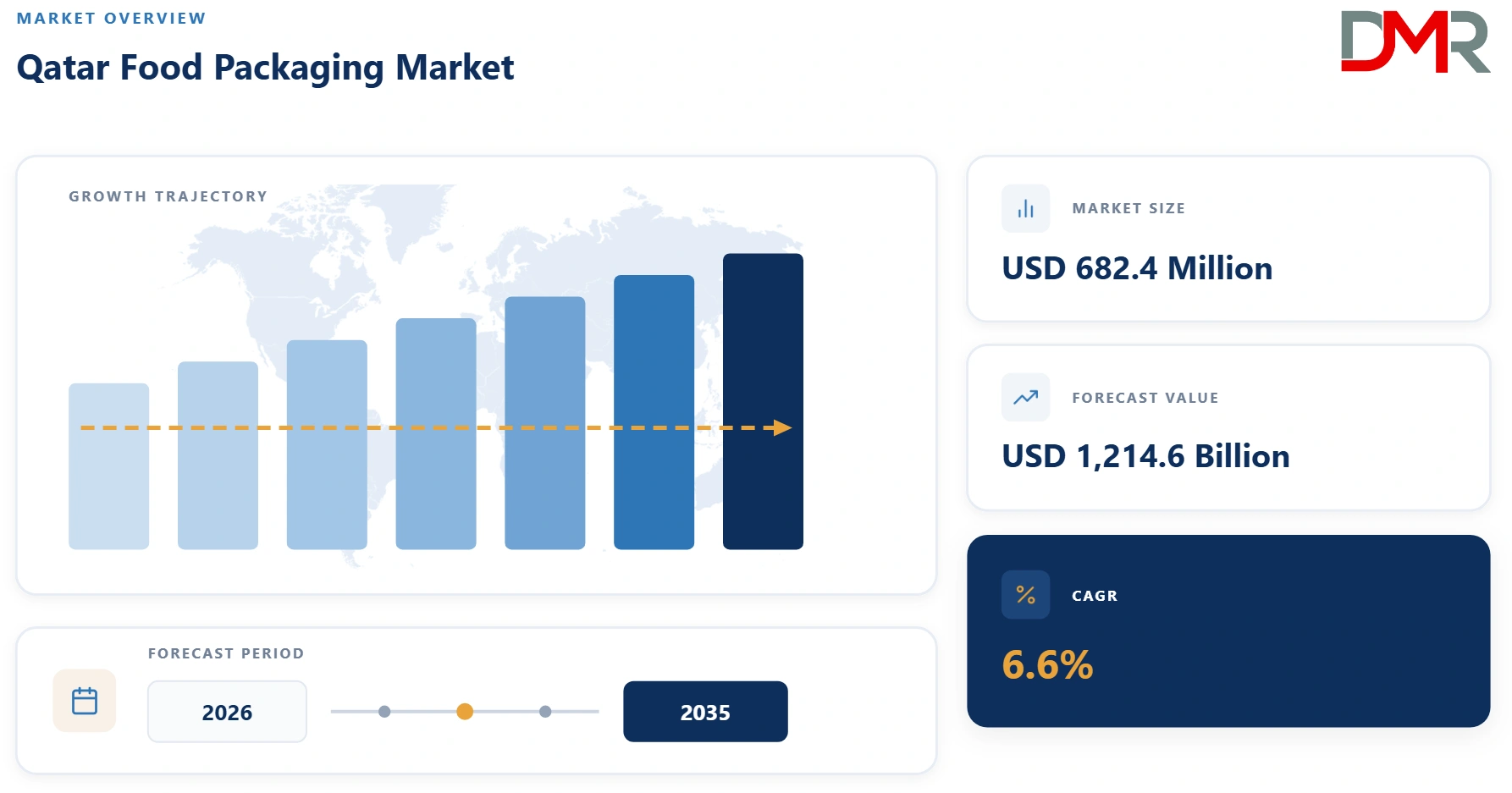
The Qatar Food Packaging Market is projected to be valued at USD 682.4 Million in 2026 and is further expected to reach USD 1,214.6 Million by 2035, expanding at a CAGR of 6.6% during the forecast period.
ℹ
To learn more about this report –
Download Your Free Sample Report Here
Growth is being propelled by Qatar's post-blockade national food security strategy that has driven substantial investment in domestic food manufacturing and processing capacity, sustained high per-capita income and premium food consumption patterns among Qatar's resident population, and the country's extreme climate conditions requiring robust protective packaging to preserve food quality and safety across distribution and retail environments. The maturing of climate-resilient barrier packaging technologies suited to Qatar's demanding heat conditions, growing food manufacturer investment in domestic packaging supply supporting Qatar National Vision 2030 self-sufficiency objectives, and continued expansion of Qatar's dairy, beverage, and bakery manufacturing capacity established in the years following the 2017-2021 regional blockade are reshaping the market from a historically import-dependent packaging supply pattern into an increasingly domestically anchored packaging industry. Investment is accelerating as Qatari packaging manufacturers and food companies continue building resilient domestic supply chains following the strategic lessons of the blockade period.
Use Cases
- Domestic Dairy Packaging Supporting Post-Blockade Food Security Strategy: Qatari dairy companies, which rapidly expanded domestic milk production capacity following the 2017 regional blockade to reduce import dependency, rely on substantial volumes of aseptic and modified atmosphere packaging to support ongoing domestic dairy production and self-sufficiency objectives.
- Climate-Resilient Packaging for Extended Shelf Life Under Extreme Heat: Qatari food and beverage manufacturers rely on specialized barrier packaging technologies engineered to maintain product quality despite sustained exposure to extreme ambient temperatures during storage, transportation, and retail display.
- Premium Packaging for Qatar's High-Income Consumer Market: Food and beverage brands serving Qatar's high per-capita income population invest in premium packaging design and materials reflecting strong consumer preference for high-quality, well-presented food products across both domestic and imported product categories.
- Flexible Packaging for Bakery and Snack Products: Qatari bakery and snack food manufacturers rely on flexible pouch and film packaging formats to provide cost-effective barrier protection for products distributed across Qatar's modern retail and foodservice channels.
Key Takeaways
- Market Size: The Qatar Food Packaging Market is anticipated to be valued at USD 682.4 Million in 2026 and is forecast to reach USD 1,214.6 Million by 2035, expanding at a CAGR of 6.6%.
- Growth Outlook: Market expansion is sustained by Qatar's post-blockade food security investment strategy, sustained high per-capita income and premium food consumption patterns, and continued expansion of domestic food manufacturing capacity requiring corresponding packaging supply growth.
- Primary Growth Drivers: National food security priorities driving domestic food manufacturing capacity expansion, sustained high per-capita income supporting premium packaging demand, extreme climate conditions requiring specialized protective packaging, and continued dairy and beverage production capacity growth are accelerating market growth.
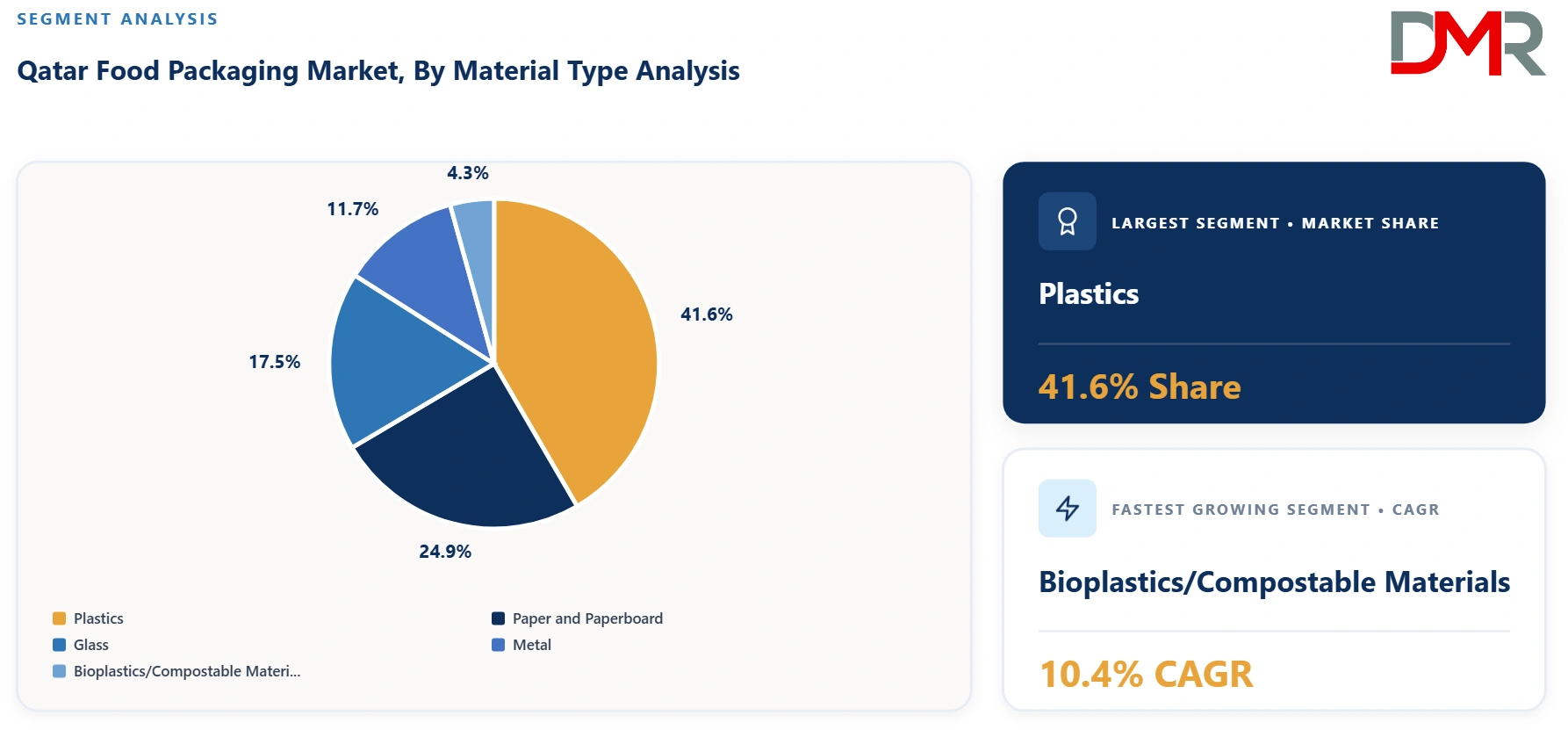
- By Material Type Analysis: Plastics is projected to lead the material type segment with a 41.6% share in 2026, reflecting continued cost-effectiveness and barrier performance for climate-resilient applications. Bioplastics/Compostable Materials is the fastest-growing material type segment at 10.4% CAGR, driven by growing sustainability awareness among Qatari food manufacturers and retailers.
- By Packaging Type Analysis: Flexible Packaging is expected to dominate with a 45.2% share in 2026, supported by widespread use across bakery, snack, and dairy categories. Rigid Packaging remains significant for beverage and dairy applications requiring robust barrier protection under extreme climate conditions.
- By Technology Analysis: Modified Atmosphere Packaging is poised to lead with a 23.1% share in 2026, reflecting its central role extending shelf life for meat, poultry, and prepared foods under demanding climate conditions. Active and Intelligent Packaging is the fastest-growing technology segment at 9.8% CAGR, driven by rising demand for freshness monitoring solutions.
- By Application Analysis: Dairy Products is expected to command a 26.4% share in 2026, underpinned by substantial post-blockade domestic dairy production capacity expansion. Ready-to-Eat and Frozen Foods is the fastest-growing application segment at 8.6% CAGR, fuelled by rising demand for convenience-oriented food formats among Qatar's affluent and time-constrained consumer base.
- By End User Analysis: Food and Beverage Manufacturers are projected to dominate with a 68.9% share in 2026, reflecting their position as the primary purchasers of packaging materials. Retailers and Grocery Chains is the fastest-growing end user segment at 7.9% CAGR, driven by expanding private label packaging initiatives.
Key Drivers in the Qatar Food Packaging Market
Post-Blockade National Food Security Strategy Driving Domestic Manufacturing Capacity
Qatar's experience during the 2017-2021 regional blockade, which severely disrupted established food import supply chains, catalyzed a sustained national strategy prioritizing domestic food production and manufacturing self-sufficiency. This strategic priority drove rapid expansion of domestic dairy, poultry, and other food processing capacity in the years following the blockade, with continued government and private sector investment sustaining this domestic manufacturing capacity expansion. Each unit of expanded domestic food production capacity generates corresponding packaging demand, making Qatar's food security strategy a particularly direct and durable driver of packaging market growth.
Sustained High Per-Capita Income and Premium Consumption Patterns
Qatar's exceptionally high per-capita income, among the highest globally, supports strong consumer purchasing power and demand for premium, well-packaged food and beverage products across both domestic and imported categories. This affluent consumer base creates sustained demand for higher-quality packaging materials and designs that support premium product positioning, distinguishing Qatar's packaging market from markets where cost minimization is the dominant packaging purchasing consideration.
Restraints in the Qatar Food Packaging Market
Small Domestic Market Scale Limiting Manufacturing Economies of Scale
Qatar's relatively small population and domestic market size, even accounting for strong per-capita consumption, represents a meaningful restraint on the Qatar Food Packaging Market, as domestic packaging manufacturers face inherent limitations in achieving the production scale economies available to packaging companies serving larger national markets. This scale constraint can affect the cost competitiveness of domestic Qatari packaging production relative to imported alternatives, requiring domestic manufacturers to pursue either premium positioning or regional export strategies to achieve viable production scale.
Growth Opportunities in the Qatar Food Packaging Market
Regional Export Positioning Leveraging Qatar's Logistics Infrastructure
Qatar's substantial investment in world-class port and logistics infrastructure, developed partly in response to blockade-era supply chain challenges, presents an opportunity for domestic packaging manufacturers to develop production capacity oriented toward serving broader Gulf Cooperation Council export markets rather than solely the relatively small domestic Qatari market. Manufacturers capable of leveraging Qatar's logistics infrastructure and manufacturing incentives to achieve regional export scale can overcome the domestic market size constraint while contributing to national economic diversification objectives.
Premium and Sustainable Packaging for Qatar's Affluent Consumer Market
Qatar's high per-capita income and growing sustainability awareness among its educated, affluent population present an opportunity for packaging companies to develop premium, sustainably positioned packaging solutions specifically targeting this receptive consumer market. Companies capable of combining premium presentation with credible sustainability credentials can capture strong margins within Qatar's relatively affluent and increasingly environmentally conscious consumer base.
Trends in the Qatar Food Packaging Market
Continued Domestic Packaging Manufacturing Investment Supporting Food Security Objectives
Qatar continues to attract domestic and international packaging manufacturing investment as an extension of its broader post-blockade food security strategy, recognizing packaging supply as a strategic component of overall food manufacturing self-sufficiency. This trend is supported by government incentives and industrial zone development specifically targeting food and packaging manufacturing investment aligned with Qatar National Vision 2030 objectives.
Growing Adoption of Sustainable Packaging Aligned with Qatar National Vision 2030
Qatari food and beverage manufacturers and retailers are increasingly adopting more sustainable packaging materials and formats, reflecting growing alignment with Qatar National Vision 2030 environmental sustainability objectives and rising consumer awareness. This trend reflects both government policy direction and the preferences of Qatar's educated, affluent, and increasingly environmentally conscious consumer population.
Research Scope and Analysis
The Qatar Food Packaging Market is segmented by material type, packaging type, technology, application, and end user, covering plastics, paper and paperboard, glass, metal, bioplastics, flexible and rigid packaging, modified atmosphere and active packaging technologies, and manufacturer, foodservice, and retail end users.
ℹ
To learn more about this report –
Download Your Free Sample Report Here
By Material Type Analysis
Plastics is projected to dominate the Qatar Food Packaging Market with 41.6% share in 2026, reflecting continued cost-effectiveness and barrier performance advantages particularly valuable under Qatar's demanding climate conditions. Bioplastics/Compostable Materials is expected to register the highest CAGR of 10.4% during 2026-2035, driven by growing sustainability awareness among Qatari food manufacturers and retailers aligned with Qatar National Vision 2030 environmental objectives.
By Packaging Type Analysis
Flexible Packaging is anticipated to dominate the Qatar Food Packaging Market by packaging type, accounting for 45.2% share in 2026, supported by widespread use across bakery, snack, and dairy product categories requiring lightweight, cost-effective barrier protection. Rigid Packaging remains a substantial segment given Qatar's significant post-blockade dairy and beverage production capacity requiring robust barrier protection suited to extreme climate distribution conditions.
By Technology Analysis
Modified Atmosphere Packaging is projected to lead the Qatar Food Packaging Market by technology, accounting for 23.1% share in 2026, reflecting its central role extending shelf life for meat, poultry, and prepared food products under Qatar's demanding climate distribution conditions. Active and Intelligent Packaging is expected to register the fastest CAGR of 9.8% between 2026 and 2035, driven by rising manufacturer interest in freshness monitoring and shelf-life extension technologies.
By Application Analysis
Dairy Products is expected to lead the Qatar Food Packaging Market by application, accounting for 26.4% share in 2026, underpinned by substantial post-blockade domestic dairy production capacity expansion supporting national food security objectives. Ready-to-Eat and Frozen Foods is projected to achieve the fastest CAGR of 8.6% during 2026-2035, driven by sustained consumer demand for convenience-oriented meal formats among Qatar's affluent and time-constrained population.
By End User Analysis
Food and Beverage Manufacturers are projected to dominate the Qatar Food Packaging Market with 68.9% share in 2026, reflecting their position as the primary purchasers of packaging materials supporting expanding domestic production. Retailers and Grocery Chains are expected to register the fastest CAGR of 7.9% through 2035, driven by expanding private label packaging initiatives across Qatar's modern grocery retail sector.
The Qatar Food Packaging Market Report is segmented based on the following:
By Material Type
- Plastics
- Paper and Paperboard
- Glass
- Metal
- Bioplastics/Compostable Materials
By Packaging Type
- Flexible Packaging
- Rigid Packaging
By Technology
- Modified Atmosphere Packaging
- Vacuum Packaging
- Aseptic Packaging
- Active and Intelligent Packaging
- Conventional Packaging
By Application
- Dairy Products
- Bakery and Confectionery
- Beverages
- Meat, Poultry and Seafood
- Snacks and Convenience Foods
- Ready-to-Eat and Frozen Foods
- Others
By End User
- Food and Beverage Manufacturers
- Foodservice Operators
- Retailers and Grocery Chains
Technology Analysis
Technology development is increasingly shaping competitiveness in the Qatar Food Packaging Market as manufacturers invest in advanced barrier coating technologies and climate-resilient material formulations specifically engineered to maintain product integrity under sustained extreme heat conditions. Growing use of intelligent packaging sensors capable of monitoring freshness and temperature exposure is helping manufacturers and retailers manage quality risk across Qatar's demanding climate. Opportunities are expanding for manufacturers investing in domestically produced barrier films reducing import dependency in alignment with national food security objectives, as well as premium sustainable packaging formats suited to Qatar's affluent consumer market. However, the country's relatively small domestic market scale can limit the economic viability of establishing highly specialized domestic production for certain advanced packaging technologies without a regional export strategy.
Investment and White Space Analysis
Investment opportunities in the Qatar Food Packaging Market are expanding alongside the country's post-blockade food security strategy, sustained high per-capita income supporting premium consumption, and growing alignment with Qatar National Vision 2030 sustainability objectives. Significant white space exists in domestic manufacturing capacity supporting national food security priorities, premium and sustainable packaging positioning for Qatar's affluent consumer market, and regional export capacity leveraging Qatar's world-class logistics infrastructure. Manufacturers with strong domestic production capacity, premium market positioning capability, and regional export market access are positioned to capture premium, longer-duration contracts. However, Qatar's relatively small domestic market scale, limiting manufacturing economies of scale, along with import dependency for certain advanced materials, can constrain margins and growth pace for smaller manufacturers lacking regional export capability.
Competitive Landscape
The Qatar Food Packaging Market is moderately fragmented and competitive, comprising large diversified global packaging companies with Qatari operations, regional Gulf packaging manufacturers serving Qatar from neighboring markets, and domestic Qatari packaging companies established or expanded as part of the post-blockade food security strategy. Competition centers on climate-resilient barrier performance, domestic manufacturing capacity aligned with national food security objectives, established relationships with major Qatari food and beverage manufacturers, and premium market positioning capability. Large diversified global packaging companies benefit from advanced material science capabilities, while domestic Qatari manufacturers compete on alignment with national food security priorities and government relationship advantages. Companies increasingly differentiate through climate-adapted material innovation and premium sustainable positioning rather than material cost alone.
Some of the prominent players in the Qatar Food Packaging Market are:
- Qatar Plastic Products Company (QPPC)
- Gulf Packaging Industries Limited (GPIL)
- Al Jazeera Packaging Company
- Qatar National Plastic Factory
- Doha Plastic Co. Ltd.
- Qatari German Company for Smart Packaging
- Al Mufeed Packaging & Packing Materials
- First Pack Factory LLC
- Liberty Packing Manufacturers
- Papercut Factory
- Ecoleaf Packaging & Printing
- Qatar Green Packaging Solutions
- SIG Combibloc Obeikan
- Tetra Pak
- Huhtamaki
- Mondi
- Amcor
- Berry Global
- Smurfit Westrock
- International Paper
- Stora Enso
- Pactiv Evergreen
- Novolex
- Detpak
- Eco-Products, Inc.
- BioPak
- Vegware
- Genpak
- Green Paper Products
- BioBag International
- delfortgroup
- UFlex
- Constantia Flexibles
- Coveris
- Sealed Air
- Sonoco Products Company
- ALPLA Group
- Crown Holdings
- Ardagh Group
- Greif
- Other Key Players
Recent Developments
- June 2026: Qatar’s Hamad Port Food Security Facilities and Warehouses Project reached 98% completion, integrating storage, processing, packaging, reloading, oil refining, and rice milling infrastructure to strengthen national food supply chains and packaging capacity further.
- December 2025: Qatar adopted QS 10050:2025, updating food shelf-life requirements, storage temperatures, and production-expiry date rules, creating stricter compliance obligations for packaged food producers, suppliers, retailers, and importers nationwide effectively.
- September 2025: Speedline showcased custom food packaging boxes, paper bags, paper cups, retail packaging, and printing solutions at Print Pack Sign Show 2025 in Doha, highlighting expanding local capabilities across Qatar’s packaging sector.
- November 2025: Qatar highlighted a high-value rigid packaging investment opportunity for food and consumer products, proposing an automated PE and PP packaging facility with 5,500-metric-ton annual capacity and $10 million investment.
Report Details
| Report Characteristics |
| Market Size (2026) |
USD 682.4 Mn |
| Forecast Value (2035) |
USD 1,214.6 Mn |
| CAGR (2026–2035) |
6.6% |
| Historical Data |
2021 – 2025 |
| Forecast Data |
2026 – 2035 |
| Base Year |
2025 |
| Segments Covered |
By Material Type, By Packaging Type, By Technology , By Application, By End User |
| Country Coverage |
Qatar |
Frequently Asked Questions
How big is the Qatar Food Packaging Market?
▾ The Qatar Food Packaging Market is projected to be valued at USD 682.4 Million in 2026 and is projected to reach USD 1,214.6 Million by 2035, reflecting Qatar's post-blockade food security investment strategy and sustained high per-capita premium food consumption.
What is the CAGR of the Qatar Food Packaging Market from 2026 to 2035?
▾ The market is projected to expand at a compound annual growth rate (CAGR) of 6.6% between 2026 and 2035, supported by continued domestic food manufacturing capacity expansion, sustained high per-capita income, and growing sustainability alignment with Qatar National Vision 2030.
What factors are driving the growth of the Qatar Food Packaging Market?
▾ Growth is driven by national food security priorities driving domestic food manufacturing capacity expansion, sustained high per-capita income supporting premium packaging demand, extreme climate conditions requiring specialized protective packaging, and continued dairy and beverage production capacity growth.
What are the major trends in the Qatar Food Packaging Market?
▾ Major trends include continued domestic packaging manufacturing investment supporting food security objectives, growing adoption of sustainable packaging aligned with Qatar National Vision 2030, and rising premium packaging positioning for Qatar's affluent consumer market.
Who are the key players in the Qatar Food Packaging Market?
▾ Key market participants include Qatar National Import and Export Company (Mahaseel Packaging), Baladna Packaging Operations, Qatar Industrial Manufacturing Company, Amcor, and Tetra Pak Qatar, among other domestic Qatari and international packaging manufacturers.
How is the Qatar Food Packaging Market segmented?
▾ The market is segmented by material type, packaging type, technology, application, and end user, with demand analysis concentrated across Doha and Qatar's dedicated industrial zones.