What is the Quantum Key Distribution (QKD) Market Size?
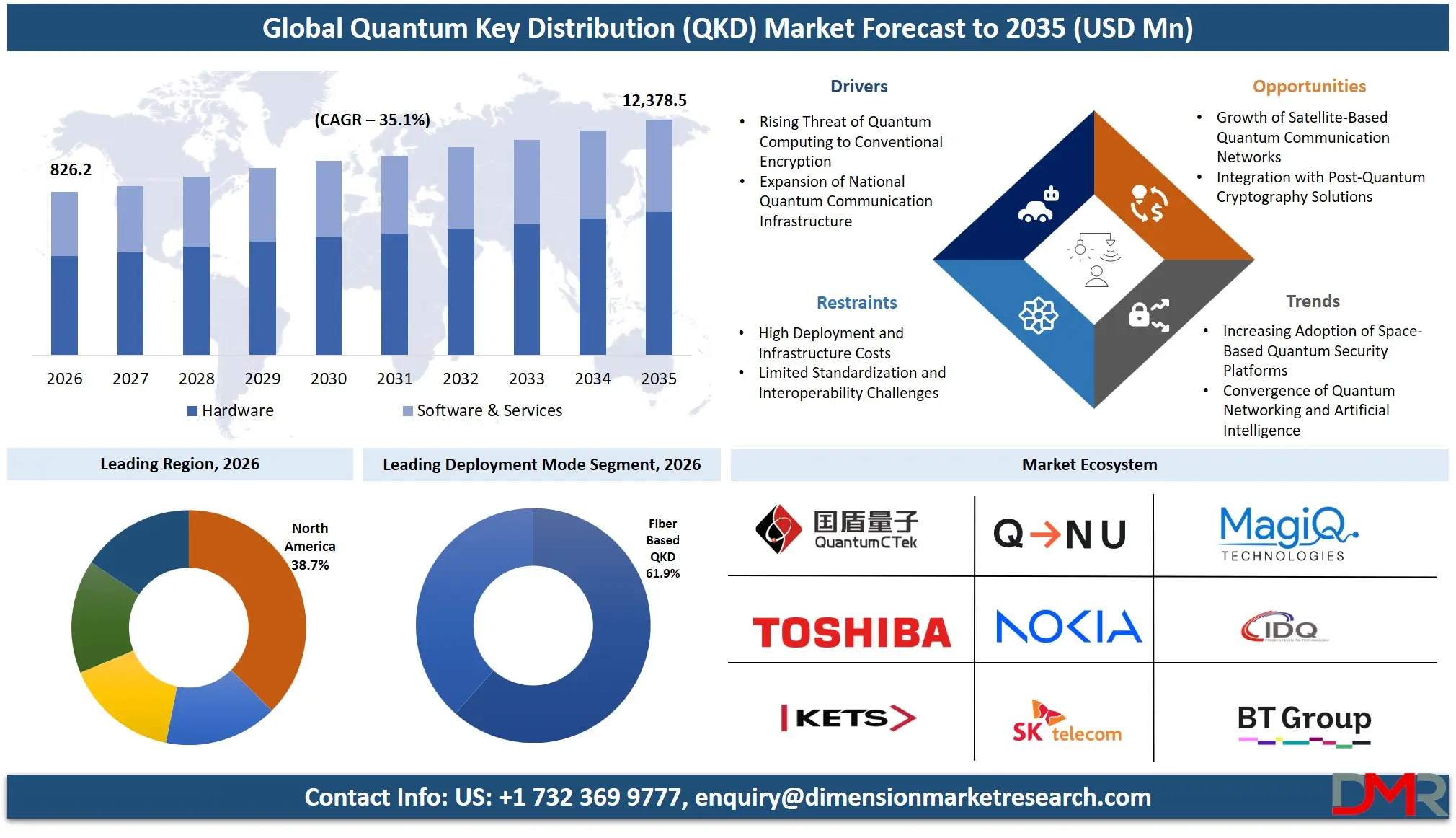
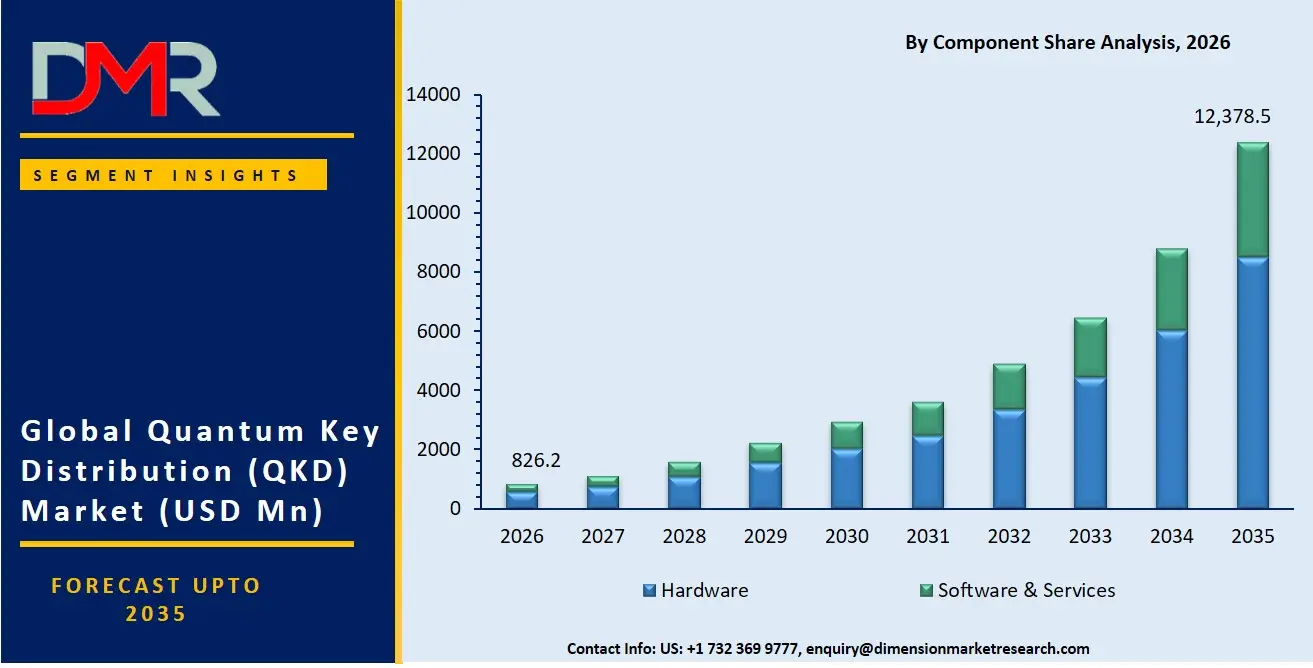
The Quantum Key Distribution (QKD) Market size is expected to be USD 826.2 million in 2026 and increase at a compound annual growth rate of 35.1% to USD 12,378.5 million in 2035 due to increasing number of advancements made in quantum computing technology.
ℹ
To learn more about this report –
Download Your Free Sample Report Here
The Quantum Key Distribution (QKD) Market is expanding very fast since there is a high need for cybersecurity solutions that will protect sensitive information from being compromised by quantum computers. The QKD market comprises hardware, software, and services involved in the use of quantum communication systems for exchanging encryption keys. Factors contributing to the growth of this market include increased adoption of quantum technology, development of quantum communication systems by governments around the world, and increasing needs in such industries as defense, telecommunication, BFSI, and data centers.
ℹ
To learn more about this report –
Download Your Free Sample Report Here
The US Quantum Key Distribution (QKD) Market
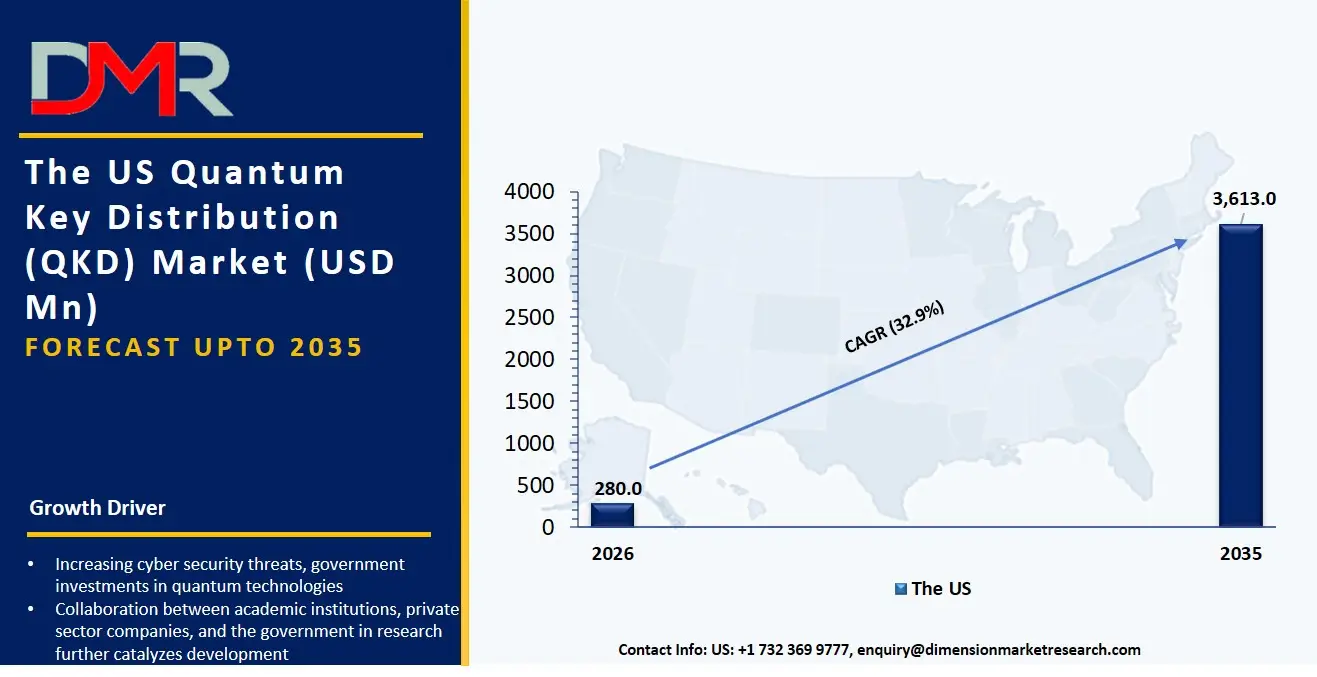
The US Quantum Key Distribution (QKD) Market size is estimated to be USD 280.0 million in 2026 and is expected to increase at a CAGR of 32.9% over the forecast period.
The US QKD industry is propelled by increasing cyber security threats, government investments in quantum technologies, and adoption of quantum-safe communication channels. There are increased efforts from the government, military, cloud providers, and banks to deploy quantum key distribution technologies for securing critical infrastructures. The collaboration between academic institutions, private sector companies, and the government in research further catalyzes development within the sector. Initiatives from the National Quantum Initiative and investment in quantum communication infrastructure help enhance leadership within the sector.
ℹ
To learn more about this report –
Download Your Free Sample Report Here
Europe Quantum Key Distribution (QKD) Market
The Europe Quantum Key Distribution (QKD) Market size is estimated to be USD 214.8 million in 2026 and is expected to increase at a CAGR of 33.2% over the forecast period.
Europe is among the most developed markets for QKD due to regulation, mandatory cybersecurity measures, and heavy investment in quantum communication technologies. Efforts in the form of EuroQCI and other similar programs are boosting QKD deployment. More and more telecom companies, governmental organizations, and banks are testing QKD pilot lines. The European Green Deal's focus on digital sovereignty and cross-border cooperation plays into the market's favor, while research institutions are further developing future QKD technologies.
Japan Quantum Key Distribution (QKD) Market
The market size of Japan Quantum Key Distribution (QKD) will be USD 33.0 million in 2026 and at a CAGR of 33.1% in the forecast period.
The QKD market in Japan has been facilitated by high-level investments in the development of sophisticated telecommunication systems, cybersecurity upgrades, and quantum technologies. Japanese government authorities are involved in developing quantum communication systems designed to enhance national security and cybersecurity. The highly developed electronics and photonic industries help to accelerate the development and adoption of QKD systems. Telecommunication companies and banks are beginning to conduct testing of quantum networks. High demand for data transfer security and growth in smart infrastructure contribute to creating growth prospects.
Key Takeaways
- Market Size & Forecast: The Quantum Key Distribution (QKD) Market size is projected to reach USD 826.2 million in 2026 and is anticipated to have a value of USD 12,378.5 million in 2035.
- Growth Rate & Outlook: The Quantum Key Distribution (QKD) Market size is set to grow at a compound annual growth rate of 35.1% during the forecast period of 2026 to 2035.
- Primary Growth Drivers: Some of the major growth drivers in the market Increasing Rising Peril from Quantum Computing to Existing Encryption Systems, and more.
- Key Market Trends: Some of the major trends in the market are Increased Adoption of Space-Based Quantum Security Systems, and more.
- By Component: Hardware segment is anticipated to get the majority share of the Quantum Key Distribution (QKD) Market in 2026.
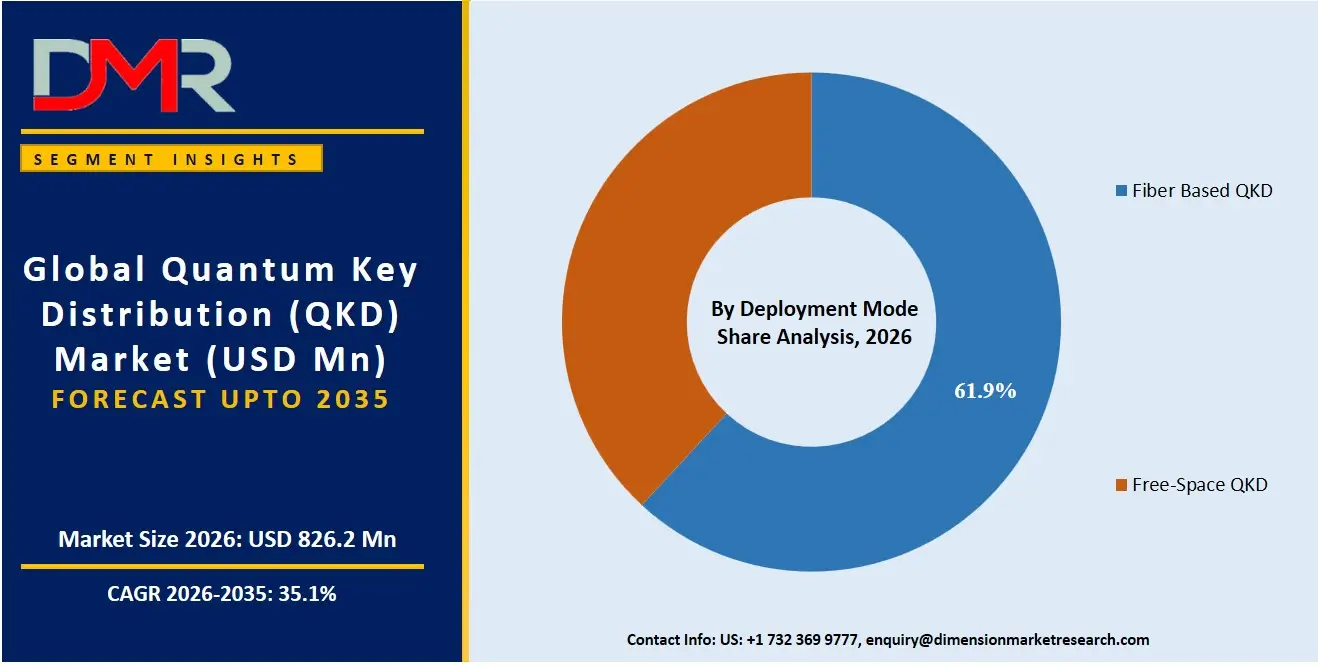
- By Deployment Mode: Fiber-based QKD is expected to get the largest revenue share in 2026 in the Quantum Key Distribution (QKD) Market.
- By End User: Government & Defense segment is expected to get the largest revenue share in 2026 in the Quantum Key Distribution (QKD) Market.
- Regional Leadership: North America is set to lead the Quantum Key Distribution (QKD) Market with an estimated 38.7% share in 2026.
What is the Quantum Key Distribution (QKD)?
Quantum Key Distribution (QKD) is an advanced communication technique that utilizes the principles of quantum mechanics in generating and transmitting encryption keys to two or more legitimate users. In contrast to conventional cryptography techniques, the QKD protocol is able to detect eavesdropping attempts, since it is impossible to measure the state of a photon without altering its properties. This technology allows for secure communication by using photon transmission via fiber optic cables or open space. At present, the development of QKD is receiving considerable attention due to improvements in quantum computers threatening existing encryption systems.
Use Cases
- Communications for Government & Defense: Quantum Key Distribution provides secure channels for communications in defense, intelligence, diplomacy, and other national security-related areas due to its interception detection capability, which is especially useful when protecting classified information against future cyber threats.
- Protection of Financial Data: QKD can be used by banks and financial organizations to safeguard their transactions and payment processing infrastructure as well as confidential data on clients from potential attacks in the future using quantum computing capabilities against classical cryptosystems.
- Cloud Computing & Data Center Security: As cloud infrastructures grow and become more widespread worldwide, QKD can be used by cloud service providers as well as operators of data centers to provide secure key distribution and thus protection of transmitted data integrity.
- Critical Infrastructure Network Security: Critical Infrastructure includes various areas, from energy utilities, transport, healthcare, telecommunications, to manufacturing industries. Operators of these infrastructures implement QKD-based technology to protect their operational technology and control systems.
How AI Is Transforming the Quantum Key Distribution (QKD) Market
AI has been making quantum communication more efficient, scalable, and reliable through the use of intelligent monitoring, error prediction, and optimization of QKD system operations. Through the use of artificial intelligence algorithms, it becomes possible to maximize key generation rates, detect any anomalies, and optimize the operations of the QKD system based on real-time operational data.
AI is helping in the field of cybersecurity through the detection of any anomalies in the operations of the network, enhancing the intelligence of the QKD system, and enabling an automated response to cybersecurity threats. In large-scale QKD infrastructure, AI is being used for resource allocation, network optimization, and reducing operating costs.
Market Dynamic
Driving Factors in the Quantum Key Distribution (QKD) Market
Rising Peril from Quantum Computing to Existing Encryption Systems
An increasing number of advancements made in quantum computing technology poses considerable dangers to existing encryption technologies that protect global communication systems from various cyber threats. More governments, defense establishments, banks, and infrastructures are now investing in quantum-resistant technologies to ensure their future preparedness in the field of cybersecurity. QKD represents a promising method of achieving information-theoretic security, thus ensuring a valuable opportunity for organizations willing to protect themselves from any possible quantum attack in the future.
Restraints in the Quantum Key Distribution (QKD) Market
High Installation and Infrastructure Cost
Deployment of QKD technology involves high-end technology components such as sources of photons, single photons detectors, optical transmission devices, and secure network infrastructure. The costs associated with the installation of specialized communication fibers or satellite communications are quite high, thus making it hard for smaller firms to embrace QKD. In addition, there is need for a considerable amount of resources to incorporate QKD into communication infrastructures.
Opportunities in the Quantum Key Distribution (QKD) Market
Integrating with Post-Quantum Cryptographic Solutions
Many firms have come to understand the benefits of integrating QKD technologies with post-quantum cryptographic technologies to create multi-layered cybersecurity systems. With hybrid cybersecurity solutions, one can build a more resilient system that is resistant to both classical computing attacks and quantum computing attacks. Integrating QKD into such solutions widens the market base for the technology and opens up lucrative business opportunities.
Trends in the Quantum Key Distribution (QKD) Market
Increased Adoption of Space-Based Quantum Security Systems
There are rising trends in adoption of quantum key distribution (QKD) systems that can be installed on board of satellites in order to offer quantum-based secure communication between any points around the globe. Many space agencies and telecoms around the world have been spending huge money on deployment of quantum satellites. It is expected that they will form the backbone of future quantum Internet.
Research Scope and Analysis
The analysis of the market for Quantum Key Distribution (QKD) focuses on various market segments such as component, technology, deployment type, and end user. Component is the dominant market segment owing to the importance of quantum communication devices in this field; meanwhile, software and services segments are experiencing fast growth. Currently, fiber-based QKD dominates the market in terms of deployment; however, satellite-based QKD is the fastest growing segment. The government & defense, as well as telecommunications, industries dominate in investments in quantum communications networks.
ℹ
To learn more about this report –
Download Your Free Sample Report Here
By Component Analysis
Hardware is expected to retain its position as the dominant component segment, representing around 68.4% of the total QKD market share in 2026. The reason behind this is the increased requirement of QKD transmitter devices, receivers, single-photon detectors, quantum random number generators, and other high-quality optical components that are essential to ensure secured quantum communication. Moreover, hardware installations in defense, telecoms, and government infrastructure continue to drive the revenues for the segment. On the other hand, the Software & Services segment is expected to witness the highest growth rate in the coming years owing to an increase in demand for network integration, security services, key management tools, and maintenance services.
By Technology Analysis
The discrete variable quantum key distribution (DV-QKD) system is anticipated to occupy the leading position in the technology segment with around 42.7% market share in 2026. The maturity of this technique, backed by significant research support and wide-ranging commercial deployment experience, makes this possible. Discrete variable quantum key distribution systems provide excellent security performance and find wide application in established optical fiber communication networks. The twin-field quantum key distribution system, on the other hand, is anticipated to be the fastest-growing technology segment because of its potential to extend the communication distance substantially.
By Deployment Type Analysis
Quantum Key Distribution using Fiber is expected to have about 61.9% of the global market share in 2026, thus leading among other deployment types. The established presence of fiber optic network, reliable technology, and adoption by metrocommunication network operators are behind the leadership position of this deployment type. Fiber-based quantum communications have continued being implemented by government organizations, telecom companies, and financial institutions to improve cybersecurity. However, Free Space Quantum Key Distribution, especially satellite-based quantum key distribution, is likely to grow faster owing to global investments in quantum communication technology and infrastructures.
By End User Analysis
The Government & Defense segment is projected to contribute about 36.8% to the world QKD market in 2026, continuing to hold its dominance as the leading user segment. Security needs of nations, defense modernizations, and encryption of secret communication networks are some of the factors that are contributing to the adoption rate. Quantum communication network installation projects backed by governments across the world are being undertaken to enhance their cyber resilience. The fastest growing user segment would be Telecommunications due to the rising use of quantum security in telecommunication networks.
The Quantum Key Distribution (QKD) Market Report is segmented on the basis of the following:
By Component
- Hardware
- QKD Transmitters
- QKD Receivers
- Single-Photon Detectors
- Quantum Random Number Generators (QRNGs)
- Optical Components
- Software & Services
By Technology
- Discrete Variable QKD (DV-QKD)
- Continuous Variable QKD (CV-QKD)
- Measurement-Device-Independent QKD (MDI-QKD)
- Twin-Field QKD (TF-QKD)
- Entanglement-Based QKD
By Deployment Type
- Fiber-Based QKD
- Free-Space QKD
- Terrestrial Free-Space QKD
- Satellite-Based QKD
By End User
- Government & Defense
- Telecommunications
- BFSI
- Data Centers & Cloud Providers
- Energy & Utilities
- Healthcare
- Research & Academic Institutions
Regional Analysis
Leading Region in the Quantum Key Distribution (QKD) Market
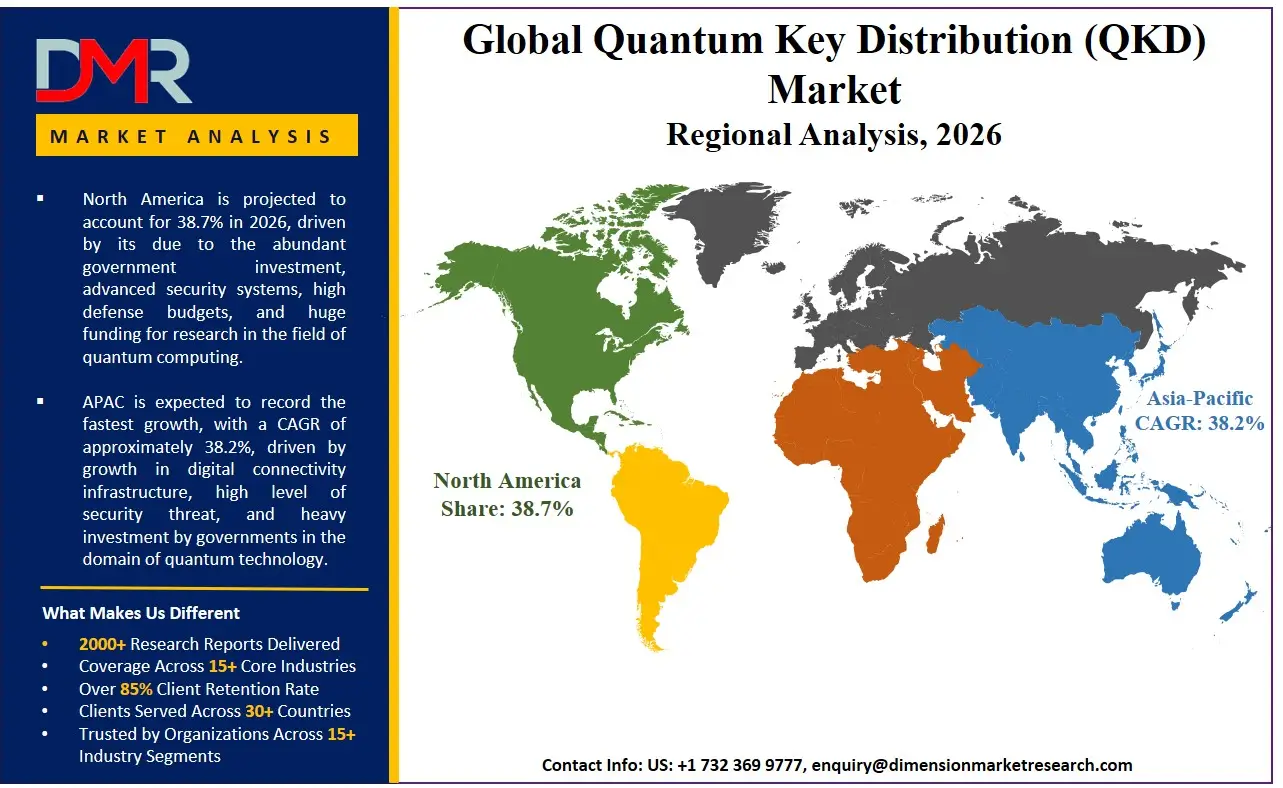
The North American region is set to lead the worldwide QKD market with its anticipated market share of 38.7% by 2026. This is due to the abundant government investment, advanced security systems, high defense budgets, and huge funding for research in the field of quantum computing. Several research organizations and companies continue to work toward innovations in quantum communication technologies. The increasing use by governments, defense organizations, financial organizations, and cloud computing providers will only add to the dominance of the North American market in this regard.
ℹ
To learn more about this report –
Download Your Free Sample Report Here
Fastest Growing Region in the Quantum Key Distribution (QKD) Market
Asia-Pacific is expected to experience the highest growth in terms of a regional market in the global QKD industry throughout the forecast period. The growth in digital connectivity infrastructure, high level of security threat, and heavy investment by governments in the domain of quantum technology have been instrumental in driving the growth in the market. Nations like China, Japan, South Korea, Singapore, and India have made significant progress in building their quantum communications network and QKD capabilities through satellite systems. The development in the telecommunication industry and the growing demand for cloud computing solutions in the region have added impetus to the growth.
By Region
North America
Europe
- Germany
- The U.K.
- France
- Italy
- Russia
- Spain
- Benelux
- Nordic
- Rest of Europe
Asia-Pacific
- China
- Japan
- South Korea
- India
- ANZ
- ASEAN
- Rest of Asia-Pacific
Latin America
- Brazil
- Mexico
- Argentina
- Colombia
- Rest of Latin America
Middle East & Africa
- Saudi Arabia
- UAE
- South Africa
- Israel
- Egypt
- Rest of MEA
Competitive Landscape
The QKD market is still very much driven by technology, marked by an abundance of IP capabilities, a host of research collaborations, and high entry barriers linked to the knowledge about quantum communications. The players in the market are actively working toward boosting the effectiveness of photon transmission, cutting down the costs of implementation, and exploring new commercial opportunities through effective collaboration with government agencies, telecommunication companies, and even military entities. Companies are increasingly making investments into satellite communication technologies, quantum networks, and hybrid quantum security systems.
Some of the prominent players in the global Quantum Key Distribution (QKD) are:
- ID Quantique
- Toshiba Corporation
- QuantumCTek Co., Ltd.
- MagiQ Technologies
- KETS Quantum Security
- QuNu Labs
- LuxQuanta
- ThinkQuantum
- SpeQtral
- Qubitekk
- Quantum Xchange
- SK Telecom
- BT Group
- Huawei Technologies
- Nokia
- Juniper Networks
- Cisco Systems
- Thales Group
- Leonardo S.p.A.
- Lockheed Martin
- Other Key Players
Recent Developments
- In May 2026, Pramatra Space Technologies raised an undisclosed pre-seed investment round through Seafund Ventures and other prominent angel investors like Rebalance and Magnivia Ventures. These funds would be used for the development and certification of its quantum technology product. Pramatra Space Technologies is working on its own Quantum Key Distribution platform based on the use of proprietary PIC technology for the production of entangled photons.
- In May 2026, The GlobalPlatform organization released Pavona, an open source secure silicon distribution with production-ready IP cores that have been certified according to international standards. It offers the first public post quantum cryptography (PQC) stack for embedded silicon and two taped-out Root of Trust designs based on TSMC's 3 nm technology. Pavona, which is designed to meet the requirements of FIPS 140-3 and Common Criteria, provides a way to develop chips by default with built-in security in an open standard environment.
- In March 2026, Toshiba Europe and Quantum Bridge Technologies (QBT) successfully demonstrated an international quantum-safe communication network by integrating Toshiba's Quantum Key Distribution (QKD) technology with QBT's Distributed Symmetric Key Establishment (DSKE) platform over existing fibre infrastructure. Presented at OFC 2026, the project enables secure interconnection of metropolitan QKD networks across continents. By combining information-theoretic security with DSKE's quantum-resistant key establishment method, the solution delivers provably secure long-distance communications without relying on public-key cryptography.
Report Details
| Report Characteristics |
| Market Size (2026) |
USD 826.2 Mn |
| Forecast Value (2035) |
USD 12,378.5 Mn |
| CAGR (2026–2035) |
35.1% |
| Historical Period |
2021 – 2025 |
| Forecast Period |
2027 – 2035 |
| Base Year |
2025 |
| Estimate Year |
2026 |
| Segments Covered |
By Component, By Technology, By Deployment Type, By End User |
| Regional Coverage |
North America – The US and Canada; Europe – Germany, The UK, France, Russia, Spain, Italy, Benelux, Nordic, & Rest of Europe; Asia-Pacific – China, Japan, South Korea, India, ANZ, ASEAN, Rest of APAC; Latin America – Brazil, Mexico, Argentina, Colombia, Rest of Latin America; Middle East & Africa – Saudi Arabia, UAE, South Africa, Turkey, Egypt, Israel, & Rest of MEA |
Frequently Asked Questions
How big is the Quantum Key Distribution (QKD) Market?
▾ The Quantum Key Distribution (QKD) Market size is expected to reach USD 826.2 million by 2026 and is projected to reach USD 12,378.5 million by the end of 2035.
What is the CAGR of the Quantum Key Distribution (QKD) Market from 2026 to 2035?
▾ The market is growing at a CAGR of 35.1 percent over the forecasted period.
What factors are driving the growth of the Quantum Key Distribution (QKD) Market?
▾ Rising Peril from Quantum Computing to Existing Encryption Systems, and more are the factors driving the growth of the Quantum Key Distribution (QKD) Market.
What are the major trends in the Quantum Key Distribution (QKD) Market?
▾ Increased Adoption of Space-Based Quantum Security Systems, and more are some of the major trends in the market.
Who are the key players in the Quantum Key Distribution (QKD) Market?
▾ Some of the key players in the Quantum Key Distribution (QKD) Market include Nokia, Toshibha, SK, and more
How is the Quantum Key Distribution (QKD) Market segmented?
▾ The Quantum Key Distribution (QKD) Market is segmented by component, technology, deployment type, end user.
Which region held the largest share of the Quantum Key Distribution (QKD) Market in 2026?
▾ North America is set to lead the Quantum Key Distribution (QKD) Market with an estimated 38.7% share in 2026.
Which region is expected to grow the fastest in the Quantum Key Distribution (QKD) Market?
▾ Asia Pacific is the fastest-growing region in the Quantum Key Distribution (QKD) Market during the forecast period.