What is the Global Real Estate Tokenization Market Size?
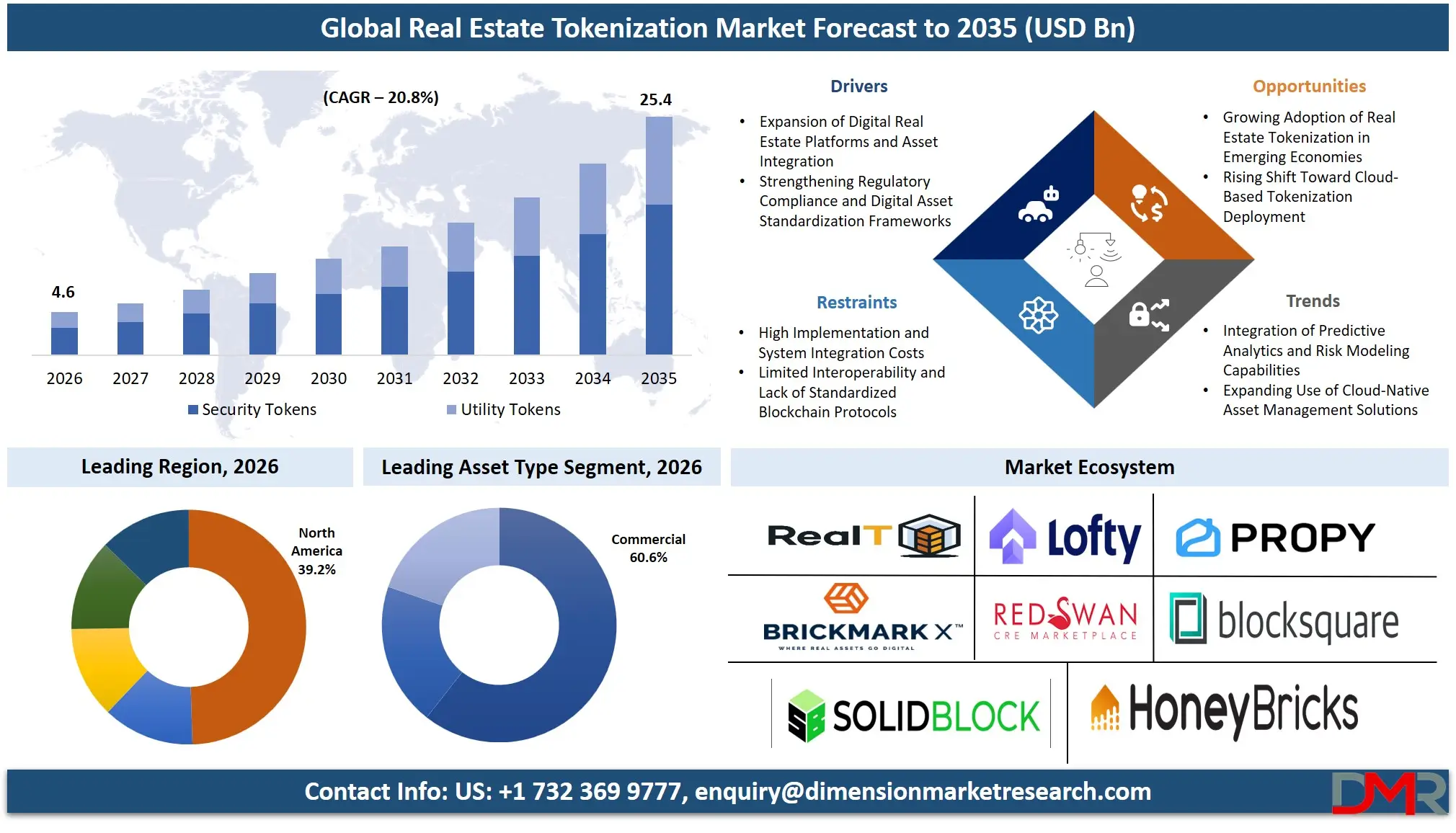
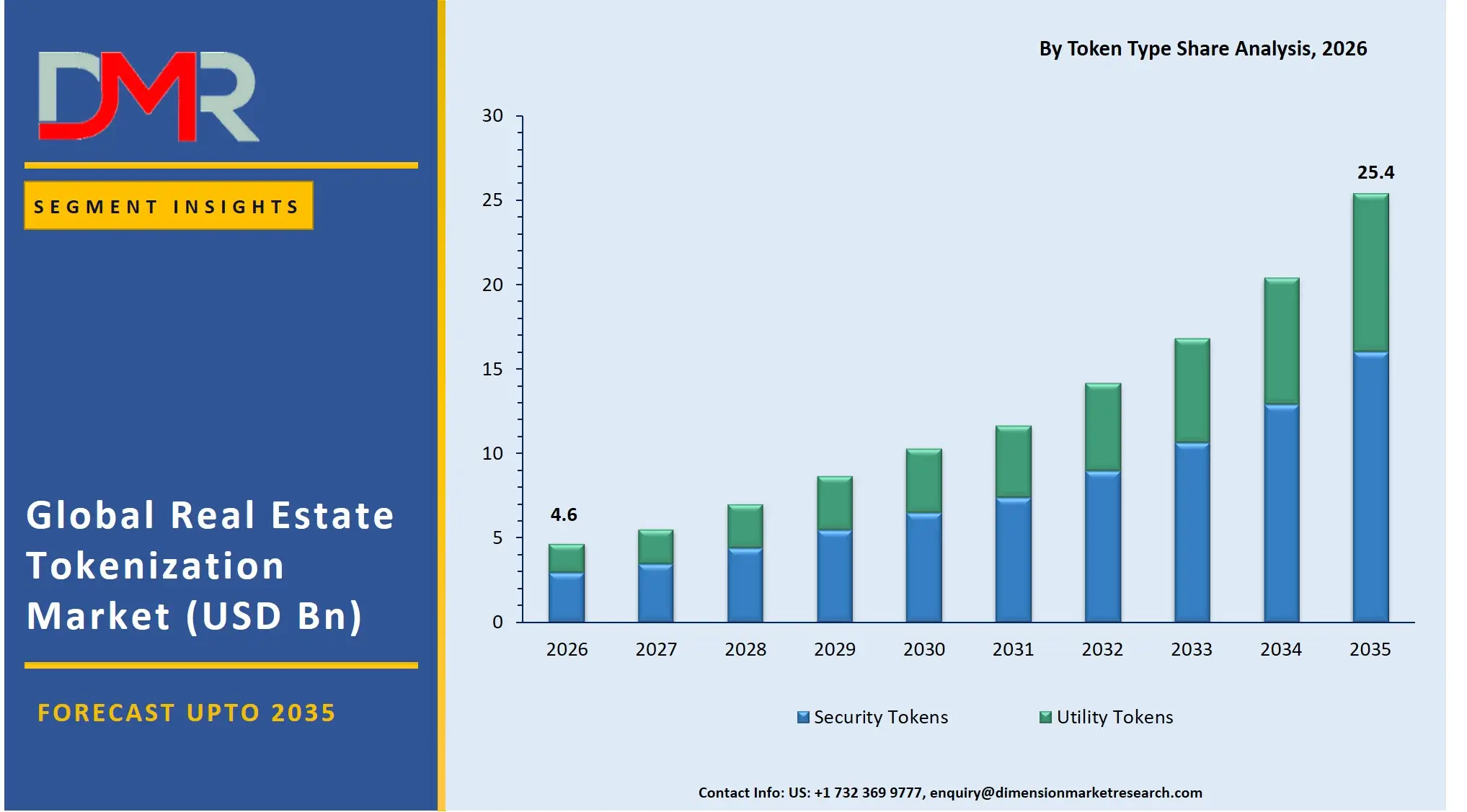
The Global Real Estate Tokenization Market size is estimated at USD 4.6 billion in 2026 and is projected to reach USD 25.4 billion by 2035, exhibiting a CAGR of 20.8% during the forecast period, driven by the rising use of blockchain-based fractional ownership in property investment, automated regulatory compliance through smart contracts, and connected decentralized finance (DeFi) frameworks.
ℹ
To learn more about this report –
Download Your Free Sample Report Here
The global real estate tokenization market is expanding because of increasing use of tamper-resistant blockchain ledgers in detecting and preventing unauthorized changes to ownership records; increasing compliance mandates, which reduce the risk of fraud during property transactions and speed up audit processes for real estate deployments; and more investment in automating asset lifecycle management.
Some other reasons for expansion in this market include new technologies for real-time valuation assurance, market risk prediction through analytics, automated dividend distribution handling, high-volume token issuance platforms, and improved data protection rules. The digital shift in financial and property technology companies has been helpful in speeding up product development and making asset management easier. This includes blockchain interoperability research. In addition, government plans focusing on preventing money laundering and the digital security economy have ensured steady research in title management and cloud-based tokenization modernization systems.
ℹ
To learn more about this report –
Download Your Free Sample Report Here
The US Real Estate Tokenization Market
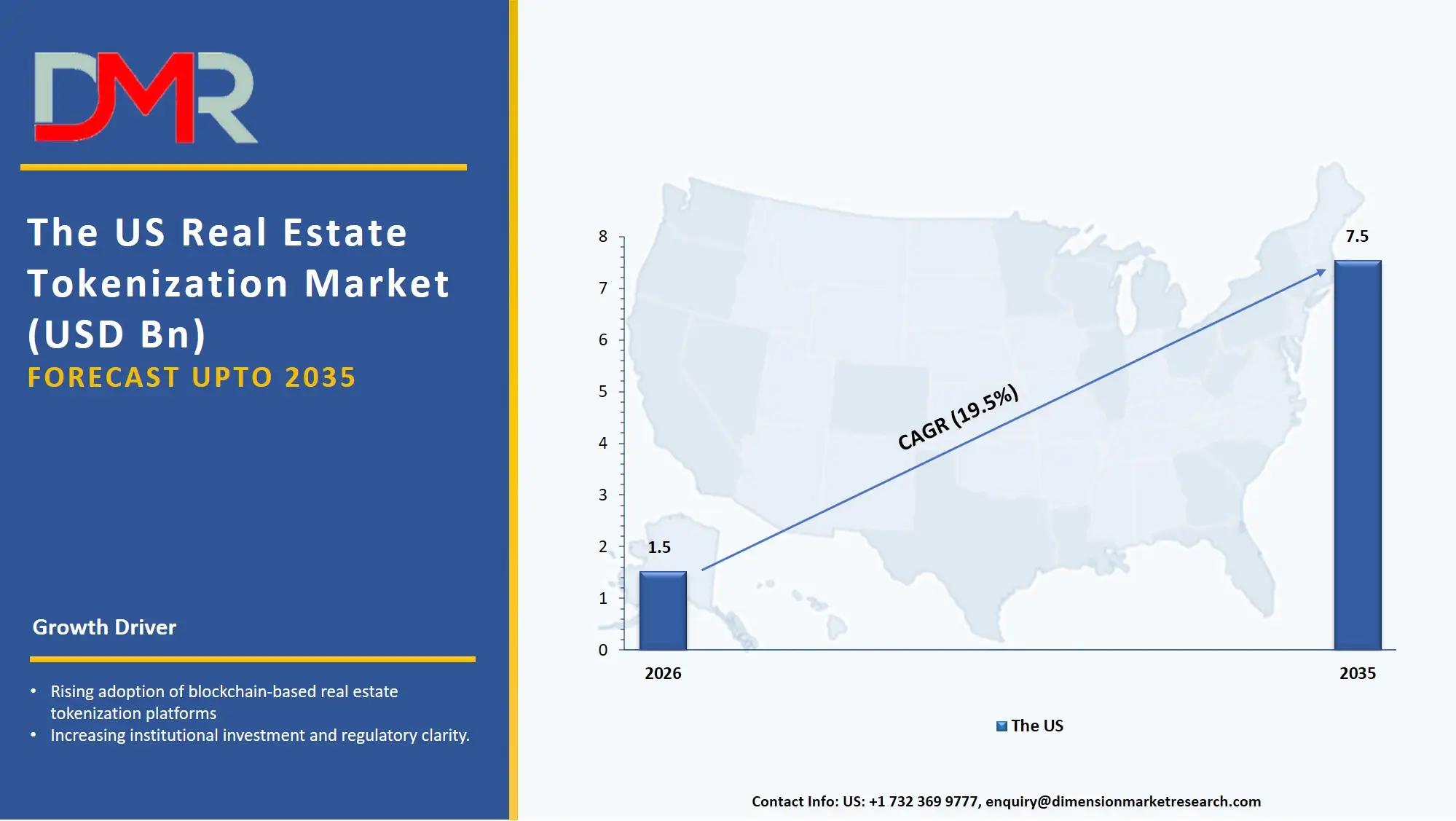
The US Real Estate Tokenization Market is estimated to grow to USD 1.5 billion in 2026 with a compound annual growth rate of 19.5% during the forecast period.
The US market is shaped by major federal and state-level programs promoting digital asset frameworks, digital identity affordability programs supported by FINRA and the SEC, and SEC-led modernization initiatives for tokenized securities. These programs encourage the use of tamper-proof title verification, real-time enterprise compliance data analysis, and predictive liquidity forecasting software. Automated compliance platforms are being rapidly adopted, and the US continues to invest in better data sharing between real estate research labs, certificate management systems, and reliable smart tools for tokenization platforms. Service providers are also influenced by laws like the Securities Act and national digital asset strategies to offer services that ensure transaction safety, rule-following, and smooth integration across public and private blockchains.
ℹ
To learn more about this report –
Download Your Free Sample Report Here
Europe Real Estate Tokenization Market
The European Real Estate Tokenization Market is estimated to be valued at USD 1.2 billion in 2026, witnessing growth at a CAGR of 19.8%, during the forecast period.
Europe's real estate tokenization market is well-established, shaped by EU-wide policies such as MiCA (Markets in Crypto-Assets Regulation), the DLT Pilot Regime, and national policies to support digital asset markets (e.g., Germany's electronic securities plans and France's blockchain strategies 2030). Countries are also making property processes more flexible to align enterprise and consumer asset protection needs and enable the sharing of threat intelligence across borders. The market grows due to new tools like tokenization platforms for real-time transaction validation and scoring systems for real estate projects. Use is made easier by teamwork between public and private groups and shared compliance rules. Manufacturers have access to technologies such as cloud key management and secure blockchain-based record-keeping, and Europe is at the forefront of the digitisation of safe and efficient asset tokenization operations.
Japan Real Estate Tokenization Market
The Japan Real Estate Tokenization Market is projected to be valued at USD 240.3 million in 2026, progressing at a CAGR of 21.0%, during the period spanning from 2026 to 2035.
Japan's real estate tokenization market is well developed, with high-quality digital certificate platforms, connected asset management systems, and a wide array of smart compliance risk analysis software tools. National focus on automation, security, and process integrity is delivered via predictive security models and smart asset protection management. Growth opportunities are helped by government measures under the Digital Agency's Security Roadmap by Japan's Ministry of Economy, Trade and Industry (METI), and continued investment in digital asset market modernization. Blockchain research, industrial transaction analysis for condition-specific asset development, and IoT device protection all need effective smart tokenization platforms to keep pace with data analysis. Higher costs for validating new automation systems and connecting them with legacy property registries are significant, but there are opportunities for the export of Japanese tokenization technologies to the Asian and Pacific markets.
Key Takeaways
- Market Size & Forecast: The Global Real Estate Tokenization Market is estimated to be valued at USD 4.6 billion in 2026 and is expected to grow to USD 25.4 billion by 2035.
- Growth Rate & Outlook: The market is expected to witness growth at a compound annual growth rate of 20.8% in the forecast period.
- Primary Growth Drivers: The availability of new blockchain processing technologies that use tamper-resistant ledgers, the need to speed up compliance results and improve success rates of digital identity integration, and more government investment in national digital asset market infrastructure are key growth drivers.
- Key Market Trends: The predictive profiling of individual asset risks, real-time title management handling, and the shift to cloud-based tokenization platforms and unified asset management platforms are key market trends.
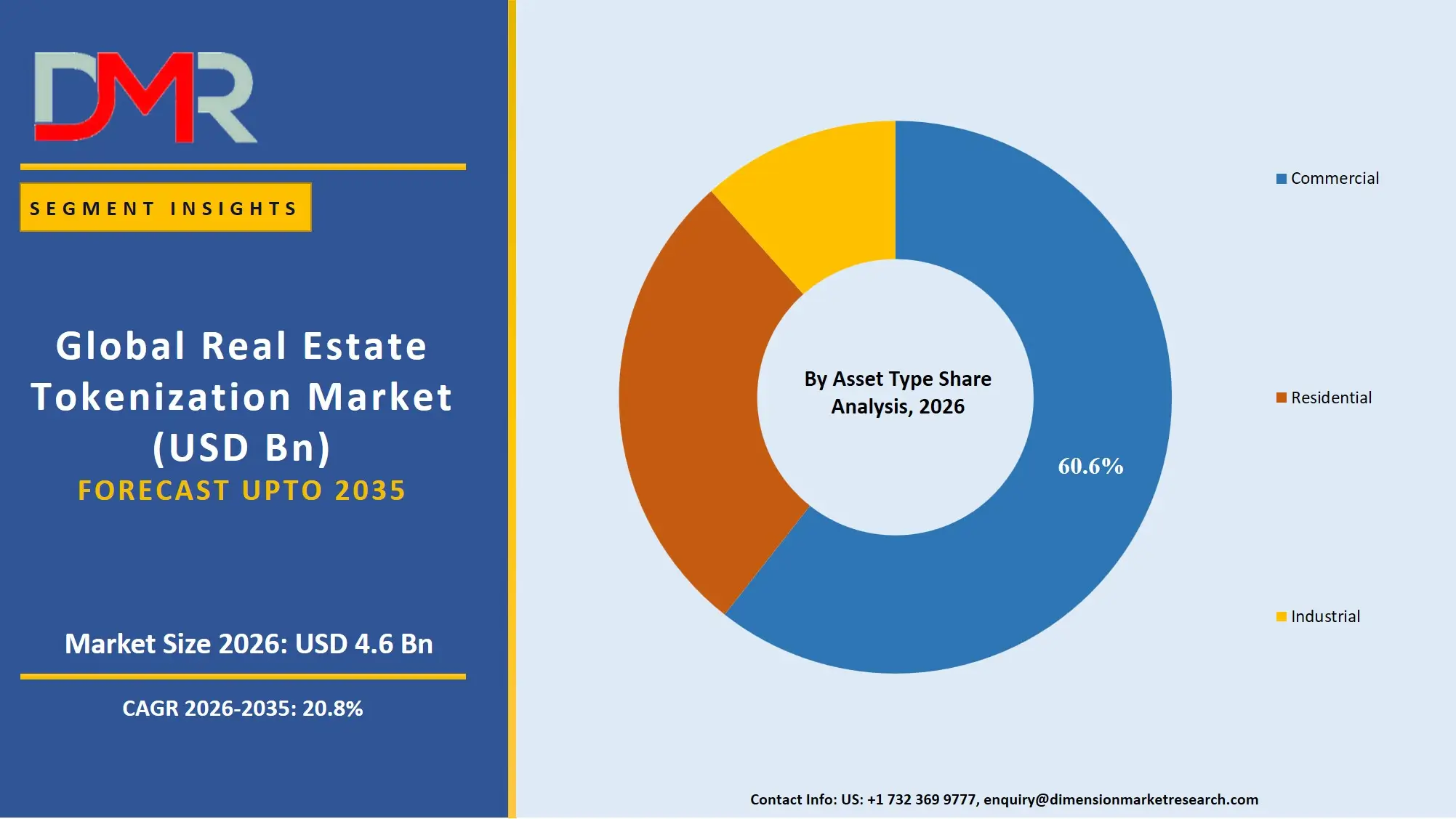
- By Asset Type: The commercial segment is expected to take the largest revenue share in 2026 in the global real estate tokenization market.
- By Token Type: The security tokens segment is expected to take the largest revenue share in 2026 in the real estate tokenization market.
- By End-User: The Investors segment is estimated to take the lead in 2026 with the largest share in the real estate tokenization market, owing to digital adoption and ease of fractional ownership integration.
- Regional Leadership: North America is estimated to take the lead in 2026 with 39.2% share in the real estate tokenization market, owing to significant investment in blockchain modernization and digital asset security technologies.
What is Real Estate Tokenization?
Real Estate Tokenization is the process of converting property ownership rights into digital tokens on a blockchain. These tamper-resistant tokens represent fractional ownership, enabling investors to buy, sell, and trade shares of real estate assets. Tokenization platforms use modern systems such as real-time valuation verification, asset management software, and remote compliance advisory to manage, verify, and track ownership events and results. To improve investment outcomes, manage liquidity variability and condition-specific asset programs, and expand service into personalized ownership coverage to support individual investor protection and promote the development of compliant security products.
Use Cases
- Market Stability for Real Estate Operations: Tokenization platforms can provide liquidity-balancing benefits through software (analytics, control systems) to reduce fraud risk and support settlement in seconds, compared to the months that it would take with only traditional property transfer.
- Long-Term Asset Management: Long-term data on ongoing market issues, including interest rate changes, property depreciation risks, or lease expirations, are studied to better understand market performance and to help plan long-term software-based care.
- Transaction Load Balancing: Asset processing is handled through tokenization clusters and smart load-balancing software in investment and e-commerce settings to support high-volume transaction capacity.
- Government & Critical Infrastructure Programs: Faster tokenization software development helps digital identity innovation and development of targeted asset programs; government programs through smart monitoring of national property data advance national digital asset strategies and help the adoption of operational standards.
How AI Is Transforming the Global Real Estate Tokenization Market?
Artificial intelligence (AI) is being used progressively more often in tokenization platforms to improve demand forecasting for property tokens, find anomaly patterns, and automatically spot unusual behavior in ownership data. It also allows faster compliance verification because it can handle investor onboarding requests on a large scale. Transaction logs and electronic audit trails are easier to study and help compliance teams find integration issues, reduce mistakes, and improve the overall accuracy of token issuance. This has resulted in operations being cost-effective, quicker, and more efficient than the old manual review method.
AI is also strengthening research and development by improving risk assessment and enabling more accurate capacity planning. It helps enterprises predict how many token transactions will be needed, find possible processing delays, and monitor the performance of tokenization networks more effectively. In addition, automation of routine compliance checks and performance tracking is reducing operational workload, lowering administrative costs, and improving overall efficiency. This is leading to better financial results and more stable operations across the digital asset production chain.
Market Dynamics
Key Drivers of the Global Real Estate Tokenization Market
Expansion of Digital Real Estate Platforms and Asset Integration
The market is growing with the rise of blockchain-based tools to monitor and process property ownership, better management of real estate records, and a closer connection of compliance and token issuance platforms. Tokenization platforms provide real-time data that allows monitoring of transaction workflow, helping to spot discrepancies early and checking compliance much faster. This has improved efficiency in operations and reduced human mistakes as well as administrative costs. At the same time, demand for automated asset management is being supported by increasing digitization of property transfer, fractional ownership, and security token issuance.
Strengthening Regulatory Compliance and Digital Asset Standardization Frameworks
There is an increasing emphasis on openness, data accuracy, and rule-following within the tokenization ecosystem. Rules and frameworks such as SEC regulations, MiCA, FATF Travel Rule, and GDPR are encouraging better asset handling practices and more structured compliance processes. These advances are supporting the need for systems that can offer steady monitoring of tokenized real estate assets and standardized reporting. At the same time, ongoing development of blockchain interoperability standards is strengthening the need for more effective management systems in both government and private market participants.
Restraints in the Global Real Estate Tokenization Market
High Implementation and System Integration Costs
The rollout of a tokenization platform remains costly, requiring significant investment in system integration, testing, and alignment with existing property workflows. In addition, following data privacy rules such as GDPR and other regional laws adds to setup complexity. These factors increase upfront costs and can limit adoption, especially among smaller enterprises and new companies entering the market.
Limited Interoperability and Lack of Standardized Blockchain Protocols
There is still fragmentation in the market in terms of blockchain formats and asset handling procedures. Although some areas have put in place organized asset management systems, many enterprises continue to work with both legacy registries and newer tokenization systems. Lack of standard interfaces limits the ability to share asset operations between different tokenization platforms and results in inefficiencies in system integration and deployment.
Growth Opportunities in the Global Real Estate Tokenization Market
Growing Adoption of Real Estate Tokenization in Emerging Economies
Newly developing economies such as Brazil, Indonesia, Nigeria, the UAE, and Vietnam are slowly building their digital payment and identity management systems. These regions have long-term growth possibilities, with more people adopting digital investment, and with more people becoming aware of blockchain programs and slowly digitizing asset infrastructure. These markets have few legacy property systems and can be used with new, technology-driven tokenization platforms that can grow over time.
Rising Shift Toward Cloud-Based Tokenization Deployment
The move to remote asset management, decentralized networks, and real-time compliance checks is driving the adoption of cloud-based tokenization systems. These systems allow centralized asset access, better coordination between applications and compliance teams, and faster transaction processing. Cloud-based deployment is increasingly becoming a trend among modern real estate tokenization providers as operational efficiency becomes one of the competitive factors.
Global Real Estate Tokenization Market Trends
Integration of Predictive Analytics and Risk Modeling Capabilities
Tokenization platforms are gradually adding data-driven technology to identify risk patterns and improve accuracy in asset management. These systems allow providers and enterprises to analyze transaction behavior better, simplify the management of property portfolios, and improve overall performance. This shift is slowly turning the industry more proactive and data-driven in asset optimization instead of being purely reactive in operations.
Expanding Use of Cloud-Native Asset Management Solutions
The use of blockchain-based tokenization systems is currently becoming a basic part of modern real estate operations. These systems allow real-time transaction monitoring, centralized asset administration, and better network coordination among market participants. Blockchain-based platforms are improving the efficiency and responsiveness of real estate operators across regions by removing reliance on traditional infrastructure and enabling scalable digital asset operations.
Research Scope and Analysis
The real estate tokenization market is witnessing strong growth driven by rising digital investment adoption, blockchain modernization initiatives, and increasing demand for fractional ownership solutions. The market is segmented based on asset type, token type, and end-user.
ℹ
To learn more about this report –
Download Your Free Sample Report Here
By Asset Type Analysis
Commercial real estate is expected to capture the majority market share within the asset type segment with approximately 60.6% in 2026 on account of its higher transaction values, demand for fractional ownership, and strong adoption across institutional investors and REITs. The extensive deployment of tokenization for office, retail, and logistics properties has established commercial real estate as a leading asset class in the field of property tokenization. Nonetheless, residential tokenization is predicted to be the fastest growing segment due to affordable housing demand, lower entry barriers for retail investors, and seamless integration with consumer investment apps. These systems are expected to become popular due to their capacity for remote ownership management, peer-to-peer trading, and multi-jurisdictional compliance. Furthermore, industrial real estate remains critical for high-value warehouse and logistics asset tokenization, requiring long-term lease management.
By Token Type Analysis
Security tokens are expected to capture the majority market share within the token type segment with approximately 85.4% in 2026 on account of regulatory clarity for securities, investor protection mechanisms, and seamless integration with traditional capital markets. The extensive adoption of security tokens by institutional investors and developers has established them as a leading token model in the field of real estate tokenization. Nonetheless, utility tokens are predicted to remain a minor but relevant segment due to demand for platform-based access, early-stage property crowdfunding, and ecosystem participation rights. These tokens are expected to continue serving niche use cases within tokenized real estate platforms. Furthermore, debt tokens remain an important structure within security tokens, supporting fixed-income real estate products and tokenized mortgage instruments.
By End-User Analysis
Investors are expected to capture the majority market share within the end-user segment with approximately 68.0% in 2026 on account of demand for portfolio diversification, lower minimum investment thresholds, and access to previously illiquid real estate markets. The extensive adoption of tokenization by retail and institutional investors has established investors as the leading end-user in the field of real estate tokenization. Nonetheless, developers are predicted to be the fastest growing segment due to faster capital raising, reduced debt dependence, and access to global investor bases. These end-users are expected to become popular adopters due to their capacity for pre-selling property shares, reducing holding costs, and accelerating project timelines. Furthermore, fund managers remain a significant segment for launching tokenized real estate funds and REIT alternatives.
The Global Real Estate Tokenization Market Report is segmented based on the following:
By Asset Type
- Residential
- Commercial
- Industrial
By Token Type
- Security Tokens
- Equity Tokens
- Debt Tokens
- Utility Tokens
By End-User
Regional Analysis
Leading Region in the Real Estate Tokenization Market
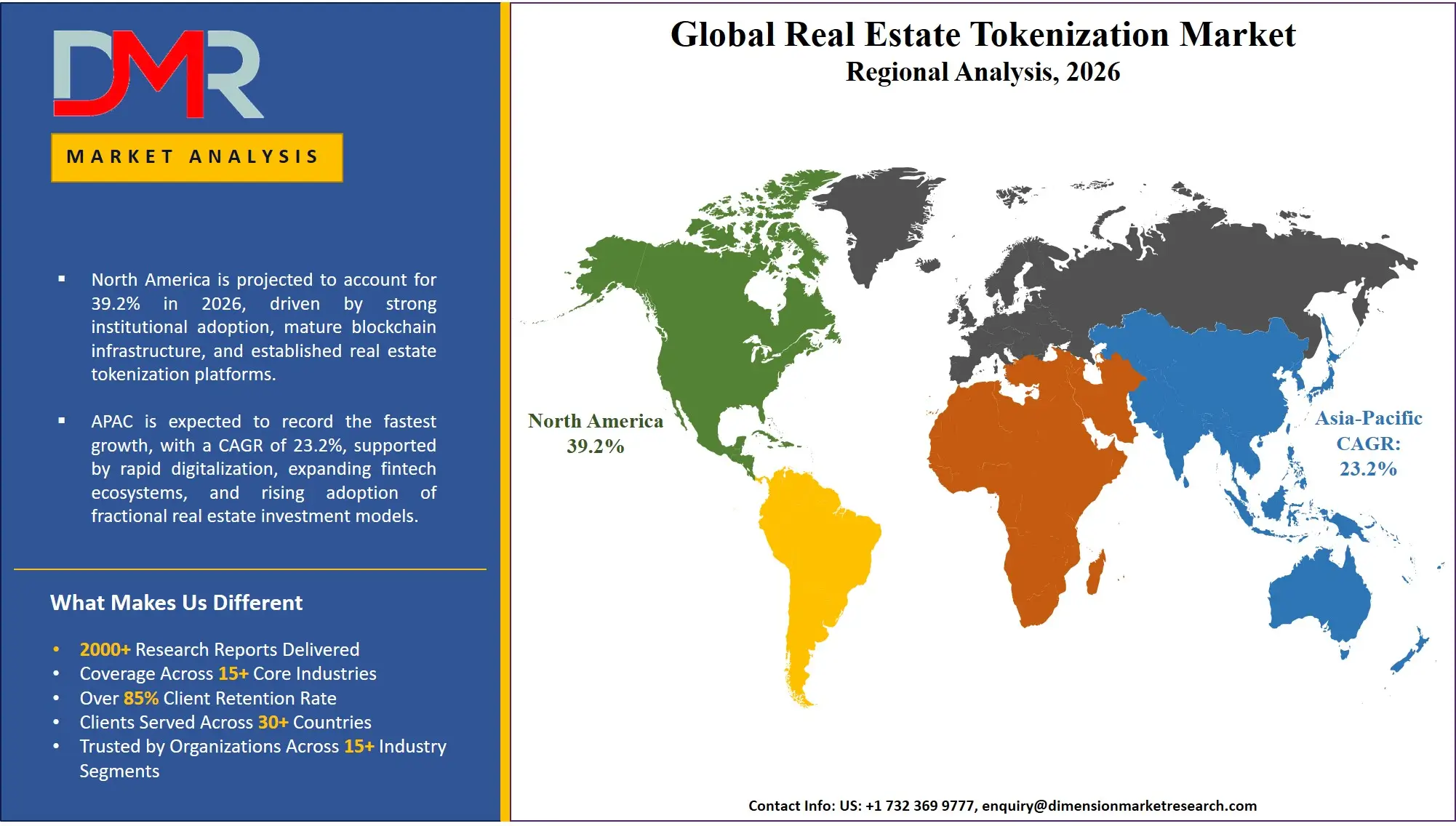
It is projected that North America will take the lead in the global real estate tokenization market (by value), covering a market share of about 39.2% in the year 2026. The region's dominance is driven by the world's most mature financial and security infrastructure, strong blockchain modernization spending funded by public and private sources, higher average tokenization platform transaction fees compared to other regions, a mature digital supply chain for advanced asset data sharing, and the presence of major tokenization platforms and blockchain providers. The widespread adoption of advanced asset processing and automation for property trading, digital certificates, and long-term portfolio management further strengthens North America's leading position. Additionally, ongoing investments in zero-trust monitoring and cross-border system interoperability under USMCA and federal blockchain initiatives further reinforce the region's technology leadership.
ℹ
To learn more about this report –
Download Your Free Sample Report Here
Fastest-Growing Region in the Real Estate Tokenization Market
Asia-Pacific is the fastest-growing region, supported by strong digital asset infrastructure goals in China, India, and Japan, increasing property tokenization awareness efforts, rising investments in local blockchain capabilities, and growing adoption of automated compliance analysis systems. The region benefits from well-established digital payment systems for e-commerce, increasing business activity, and alignment with national blockchain roadmaps. Countries across the region are actively setting up tokenization platforms to improve transaction security and strengthen digital identity infrastructure. Growing focus on cross-chain interoperability research and structured asset development further speeds up market expansion. Moreover, increasing government support and corporate net-zero trust commitments are expected to keep growth momentum high.
By Region
North America
Europe
- Germany
- The U.K.
- France
- Italy
- Russia
- Spain
- Benelux
- Nordic
- Rest of Europe
Asia-Pacific
- China
- Japan
- South Korea
- India
- ANZ
- ASEAN
- Rest of Asia-Pacific
Latin America
- Brazil
- Mexico
- Argentina
- Colombia
- Rest of Latin America
Middle East & Africa
- Saudi Arabia
- UAE
- South Africa
- Israel
- Egypt
- Rest of MEA
Competitive Landscape
The real estate tokenization market is highly competitive, with new ideas and strategic partnerships shaping the competitive environment. To gain an advantage, companies and vendors are focused on developing better digital asset platforms (such as blockchain-native tokenization engines, automated compliance verification systems, and mobile apps for asset management), smart analytics, and cloud-based transaction monitoring. There are high barriers to entering the market due to the large amount of investment needed for regulatory licensing, specialized blockchain market knowledge, and the need for mature software systems and rule-following.
Strategic approaches to increase market presence include partnerships with blockchain research groups and property registries, mergers between tokenization platforms and real estate software providers, and long-term support contracts with customers and government institutions. Additionally, research and development in cross-chain interoperability and flexible API designs are important for staying competitive and meeting the changing needs of the digital asset community.
Some of the prominent players in the Global Real Estate Tokenization Market are:
- RealToken LLC
- Lofty AI, Inc.
- Propy Inc.
- RedSwan CRE, LLC
- Blocksquare d.o.o.
- SolidBlock Ltd.
- HoneyBricks, Inc.
- SmartCrowd (Stake Properties Limited)
- Slice Platform Inc.
- BrickMark AG
- Securitize, Inc.
- tZERO Group, Inc.
- Tokeny Solutions S.A.
- Polymath Inc.
- DigiShares A/S
- STOKR S.A.
- INX Digital Company, Inc.
- Harbor Platform Inc.
- Zoniqx, Inc.
- Elevated Returns LLC
- Other Key Players
Recent Developments
- May 2026: Securitize, Inc. received regulatory approval enabling custody and atomic settlement of tokenized securities, allowing real-world asset trading and settlement directly onchain through its broker-dealer infrastructure.
- March 2026: RealToken LLC expanded its residential real estate tokenization portfolio, increasing fractional ownership offerings across U.S. rental properties and strengthening on-chain rental income distribution through automated smart contract systems.
- November 2025: Tokeny Solutions S.A. supported regulated digital asset issuance expansion in Europe through compliant tokenization infrastructure deployments, strengthening institutional-grade real-world asset tokenization frameworks.
Report Details
| Report Characteristics |
| Market Size (2026) |
USD 4.6 Bn |
| Forecast Value (2035) |
USD 25.4 Bn |
| CAGR (2026–2035) |
20.8% |
| The US Market Size (2026) |
USD 1.5 Bn |
| Historical Period |
2021 – 2025 |
| Forecast Period |
2027 – 2035 |
| Base Year |
2025 |
| Estimated Year |
2026 |
| Segments Covered |
By Asset Type, By Token Type, and By End-User |
| Regional Coverage |
North America – The US and Canada; Europe – Germany, The UK, France, Russia, Spain, Italy, Benelux, Nordic, & Rest of Europe; Asia-Pacific – China, Japan, South Korea, India, ANZ, ASEAN, Rest of APAC; Latin America – Brazil, Mexico, Argentina, Colombia, Rest of Latin America; Middle East & Africa – Saudi Arabia, UAE, South Africa, Turkey, Egypt, Israel, & Rest of MEA |
Frequently Asked Questions
How big is the Global Real Estate Tokenization Market?
▾ The Global Real Estate Tokenization Market size is estimated to have a value of USD 4.6 billion in 2026 and is expected to reach USD 25.4 billion by the end of 2035.
What is the CAGR of the Global Real Estate Tokenization Market from 2026 to 2035?
▾ The market is growing at a CAGR of 20.8% over the forecasted period.
What factors are driving the growth of the Global Real Estate Tokenization Market?
▾ The market is driven by advances in tamper-resistant blockchain processing, regulatory pressure to speed up compliance and reduce fraud, and increased government investment in national digital asset infrastructure.
What are the major trends in the Global Real Estate Tokenization Market?
▾ The key market trends include the adoption of predictive asset risk tracking and real-time ownership management analysis, along with a growing shift toward cloud-based tokenization platforms and blockchain-native asset management systems.
Which region held the largest share of the Global Real Estate Tokenization Market in 2026?
▾ North America is expected to account for the largest market share in 2026, with a share of about 39.2%.
Which region is expected to grow the fastest in the Global Real Estate Tokenization Market?
▾ Asia Pacific is the fastest-growing region in the market during the forecast period.
Who are the key players in the Global Real Estate Tokenization Market?
▾ Some of the major key players in the Global Real Estate Tokenization Market are Securitize, Inc., Tokeny Solutions S.A., RealToken LLC, Lofty AI, Inc., Polymath Inc., Harbor Platform Inc., and many others.
How is the Global Real Estate Tokenization Market segmented?
▾ The market is segmented by asset type, token type, and end-user.