Global Real-Time Transportation Visibility Platforms (RTTVPs) Market Snapshot
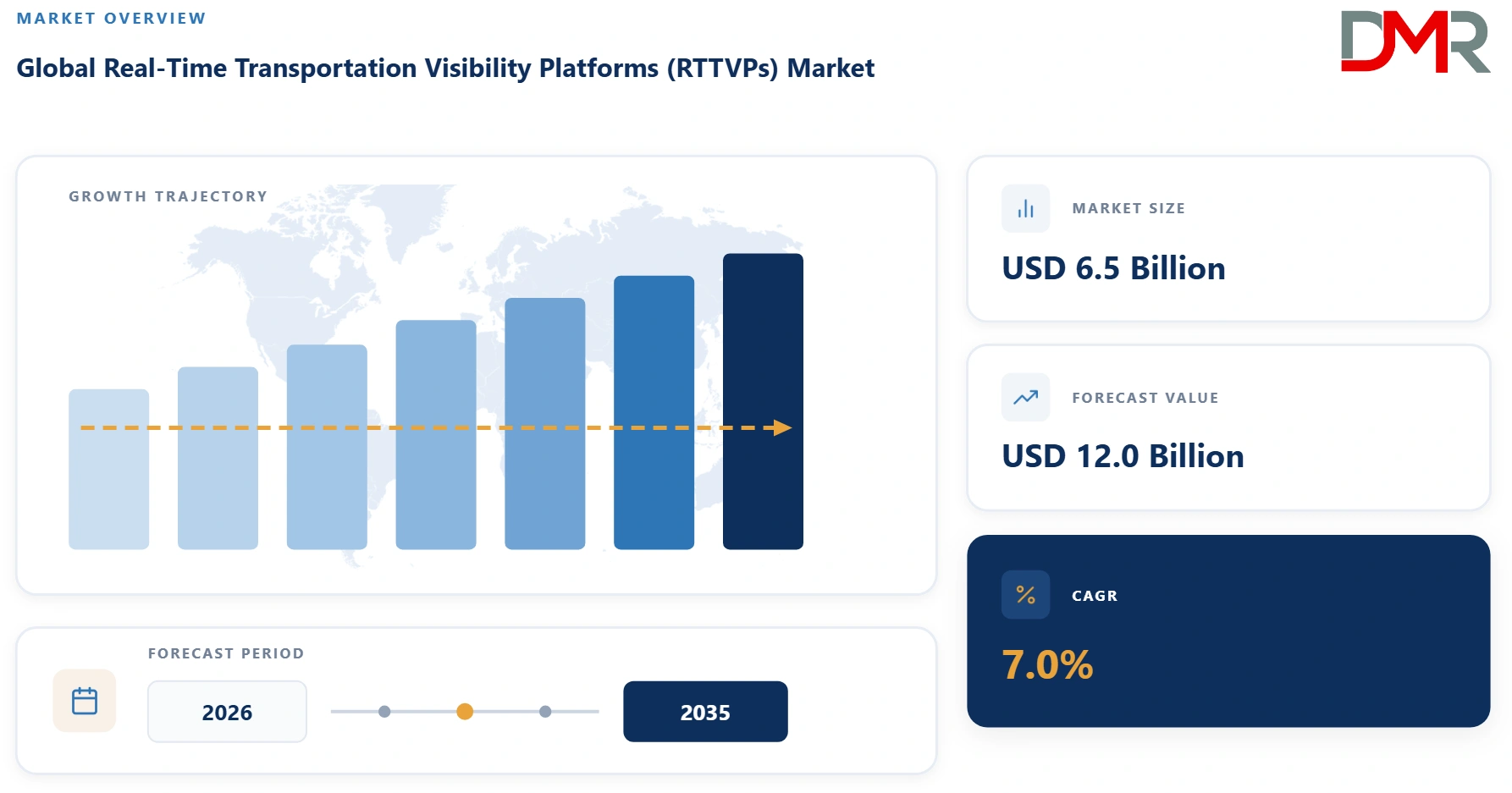
- Global RTTVPs Market Size, 2026: USD 6.5 billion
- Global RTTVPs Market Size, 2035: USD 12.0 billion
- Global CAGR, 2026–2035: 7.0%
- Leading Offering Segment, 2026 : Platform 72% share
- Leading Visibility Segment, 2026: Shipment Visibility 38% share
- Leading Transportation Mode, 2026: Road 46% share
- Fastest-Growing Segment: Inventory Visibility 11.8% CAGR
- Leading Region, 2026: North America 38% share
What is the Global Real-Time Transportation Visibility Platforms (RTTVPs) and its Market Size?
The global RTTVPs market is estimated at USD 6.5 billion in 2026 and is projected to reach approximately USD 12.0 billion by 2035, representing a 7.0% CAGR.
ℹ
To learn more about this report –
Download Your Free Sample Report Here
The growth outlook is supported by increasing supply-chain complexity, omnichannel fulfillment, e-commerce, transportation-cost pressure, carrier digitization, regulatory requirements for electronic freight information, and growing demand for predictive rather than purely retrospective logistics management. North America remains the largest market because of high enterprise software adoption and mature telematics/ELD infrastructure, while Asia-Pacific is expected to record the fastest growth as manufacturers, retailers, logistics providers, and governments accelerate logistics digitization.
Use Cases
- Shipment Tracking: Provides continuous location, milestone, ETA, and exception information across domestic and international freight movements.
- Predictive ETA Management: Uses historical and real-time data to anticipate delays and improve arrival-time accuracy.
- Exception Management: Automatically identifies transportation disruptions and prioritizes shipments requiring immediate intervention.
- Inventory-in-Transit Visibility: Connects shipment status with inventory positions to improve replenishment, working-capital, and planning decisions.
- Carrier Performance Management: Measures tracking compliance, dwell time, on-time performance, and transportation execution quality.
- Control-Tower Operations: Consolidates multimodal transportation data into a centralized environment for monitoring and coordinated decision-making.
Key Takeaways
- Market Size: The global market is estimated at USD 6.5 billion in 2026, reaching approximately USD 12.0 billion by 2035.
- Growth Rate: The market is expected to expand at approximately 7.0% CAGR during 2026–2035.
- Key Drivers: Supply-chain disruption, e-commerce, transportation-cost optimization, carrier digitization, IoT/telematics, and regulatory digitalization are major growth catalysts.
- Segment Dominance: Platform offerings, shipment visibility, and road transportation remain the largest categories.
- Fastest Growth: Inventory visibility is projected to grow fastest as enterprises connect transportation events with demand, replenishment, and working-capital decisions.
- Regional Leadership: North America leads in 2026 with an estimated 38% share, while Asia-Pacific is projected to grow fastest.
How AI, IoT, Cloud and Advanced Analytics are Transforming the RTTVPs Market
AI and machine learning are moving RTTVPs beyond location tracking into prediction, recommendation, and autonomous execution. Platforms ingest GPS, ELD, carrier API, weather, traffic, port, order, inventory, and historical transportation data to generate predictive ETAs, identify risks, classify exceptions, and recommend interventions. FourKites' Intelligent Control Tower, for example, combines real-time data, digital twins, and AI agents, while project44 has expanded its AI-agent capabilities into network operations, procurement, exception management, and disruption management.
Cloud computing and API-based connectivity reduce deployment friction and allow shippers to connect large carrier ecosystems without maintaining extensive local infrastructure. IoT, telematics, ELDs, smartphones, sensors, and connected vehicles improve the frequency and accuracy of transportation signals. In the United States, ELD infrastructure provides an important source of digital transportation data and supports more accurate tracking and compliance workflows.
The competitive landscape is therefore moving toward data-network scale, AI accuracy, interoperability, and automation rather than simple tracking functionality. Vendors increasingly compete on carrier connectivity, multimodal coverage, data quality, predictive accuracy, workflow automation, TMS integration, and the ability to convert visibility into measurable transportation savings.
Key Drivers in the Global Real-Time Transportation Visibility Platforms (RTTVPs) Market
Rising Supply-Chain Complexity and Demand for Predictive Visibility
Global supply chains increasingly involve multiple carriers, modes, countries, ports, distribution centers, suppliers, and handoffs. Disruptions caused by congestion, weather, geopolitical events, labor shortages, capacity volatility, and changing consumer demand make static transportation updates insufficient. Enterprises therefore increasingly require a continuous operational view that connects shipment milestones with orders, inventory, customer commitments, and transportation capacity.
Transportation Digitization and Connected-Carrier Ecosystems
The expansion of ELDs, GPS, telematics, APIs, mobile applications, digital freight marketplaces, carrier portals, and connected transportation systems is increasing the amount of machine-readable data available to visibility platforms. At the same time, governments are encouraging freight digitalization. The European Union's eFTI framework is designed to replace paper-based freight information with electronic data and will apply across road, rail, inland waterway, and air transport.
Restraints in the Global Real-Time Transportation Visibility Platforms (RTTVPs) Market
Data Quality, Fragmentation and Carrier Connectivity
The effectiveness of a visibility platform depends heavily on the quality, timeliness, completeness, and consistency of underlying transportation data. Carrier systems differ widely in API maturity, GPS quality, event definitions, update frequency, and integration standards. Smaller carriers may rely on mobile applications or manual processes rather than sophisticated APIs. Poor data can produce inaccurate ETAs, duplicate events, missing milestones, and false exceptions.
Growth Opportunities in the Global Real-Time Transportation Visibility Platforms (RTTVPs) Market
AI-Driven Autonomous Transportation Execution
The largest medium-term opportunity is the transformation of visibility software into AI-enabled execution platforms. Once a system understands shipment location, transportation constraints, customer priorities, inventory status, and disruption risk, it can automatically initiate corrective actions rather than simply alerting an operator.
Connecting Transportation Visibility with Inventory and Financial Decisions
RTTVPs are increasingly positioned as inputs into broader supply-chain planning. Transportation delays can change inventory availability, working-capital requirements, production schedules, customer service levels, and cash-flow timing. Connecting shipment events to inventory and planning therefore creates a larger economic value proposition than transportation monitoring alone.
Trends in the Global Real-Time Transportation Visibility Platforms (RTTVPs) Market
From Visibility Platforms to Decision-Intelligence Platforms
The market is rapidly moving beyond dashboards and alerts toward systems that interpret operational context, recommend actions, and increasingly execute workflows autonomously. Leading vendors are combining logistics data graphs, digital twins, predictive analytics, and AI agents.
Multimodal and End-to-End Visibility
Customers increasingly want one visibility layer covering road, ocean, air, rail, parcel, drayage, and intermodal movements. This is particularly important for international supply chains where visibility often disappears at modal handoffs.
Research Scope and Analysis
The RTTVPs market is segmented By Offering, By Visibility Type, By Transportation Mode, By Deployment, and By End-User Industry. Estimates reflect platform and associated service revenues directly attributable to real-time transportation visibility.
ℹ
To learn more about this report –
Download Your Free Sample Report Here
By Offering Analysis
Platform is estimated to dominate the RTTVPs market in 2026 with approximately 72% share, reflecting the recurring software revenue generated by cloud-based visibility platforms, analytics, control towers, APIs, and workflow capabilities. Enterprises increasingly prefer scalable platforms that can connect large carrier ecosystems and support multiple transportation modes from one interface. Services account for roughly 28%, including implementation and integration, consulting, and support and maintenance. Within services, implementation and integration represents the largest component because customers frequently require assistance connecting TMS, ERP, WMS, carrier, telematics, and legacy systems. The services segment is projected to grow at approximately 8.0% CAGR, slightly above the overall market, as mid-market adoption expands and complex enterprise deployments require integration expertise. Consulting represents the second-largest service category, while support and maintenance remains important for large multinational deployments. Platform vendors are increasingly embedding configuration, APIs, analytics, and workflow automation into subscription packages, but professional services remain critical where transportation networks are highly fragmented.
By Visibility Analysis
Shipment Visibility leads with an estimated 38% share in 2026, as shipment-level tracking remains the foundational RTTVP use case across shippers, carriers, freight forwarders, and retailers. It enables location monitoring, milestone tracking, ETA prediction, exception detection, and customer communications. Inventory Visibility is projected to be the fastest-growing category at approximately 11.8% CAGR, as enterprises increasingly connect transportation events to inventory-in-transit, replenishment, S&OP, and working-capital decisions. Fleet Visibility is the second-largest category at approximately 22% share, supported by telematics, ELDs, GPS, and carrier digitization. Order visibility represents approximately 18%, while yard and terminal visibility contributes roughly 10%. The market is increasingly converging these categories: shipment events are being connected to orders and inventory, while yard and terminal data is incorporated into end-to-end multimodal control towers. This convergence favors vendors with broad data networks rather than narrow point solutions.
By Transportation Mode Analysis
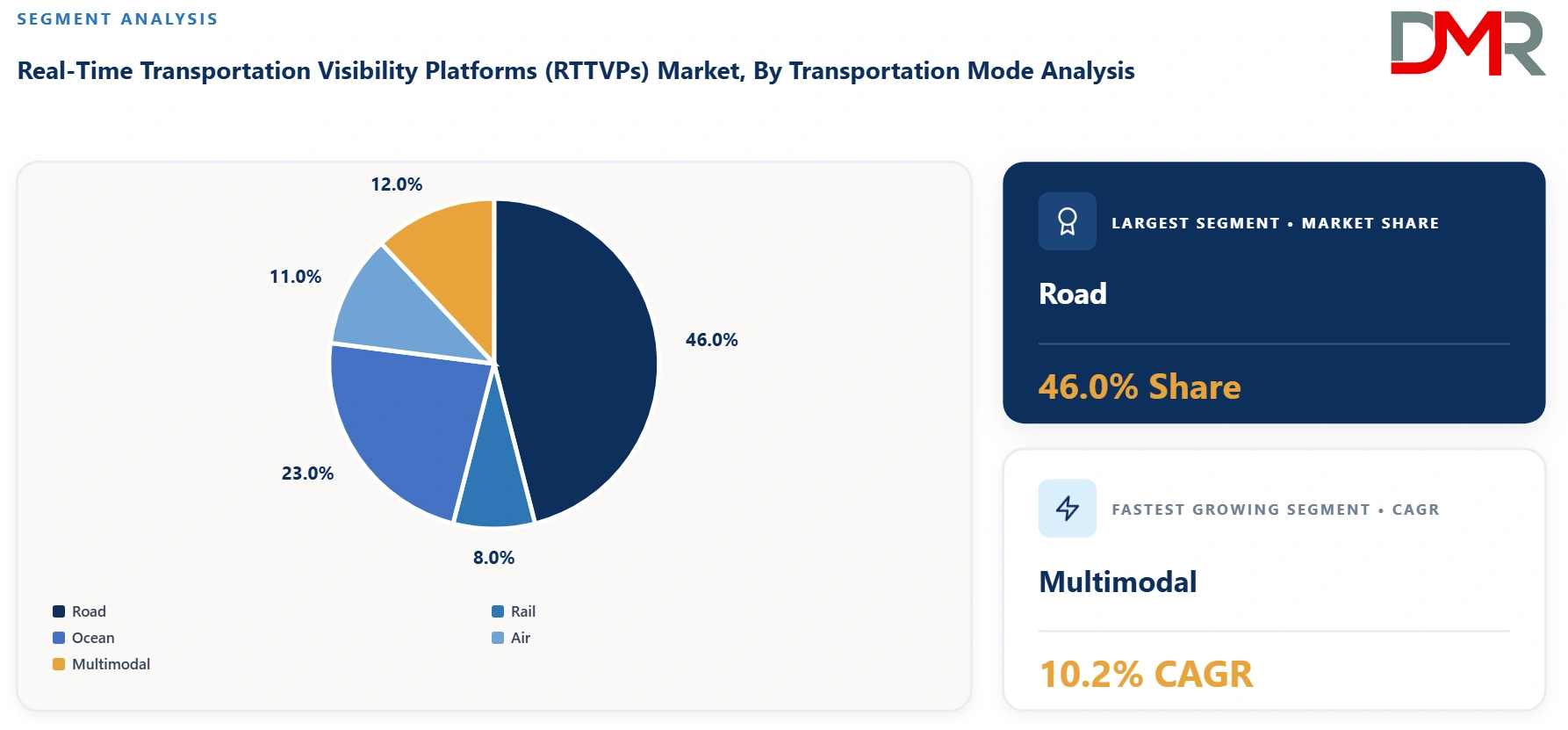
Road transportation represents the largest mode-specific category at approximately 46% share in 2026, reflecting the enormous volume of truck freight, mature GPS/ELD infrastructure, and high demand for real-time location and ETA data. Road visibility is especially important in retail, manufacturing, parcel, food and beverage, and third-party logistics. Multimodal transportation is expected to be the fastest-growing category at approximately 10.2% CAGR, driven by international supply chains requiring seamless visibility across ocean, port, rail, drayage, and final-mile road movements. Ocean represents approximately 23% of the market, air 11%, rail 8%, and multimodal 12%. Ocean visibility is receiving increasing investment because disruptions, port congestion, vessel rerouting, and container availability can create significant downstream inventory and production impacts. Leading platforms increasingly provide unified multimodal visibility rather than requiring customers to purchase separate tracking products for individual modes.
By Deployment Analysis
Cloud-based deployment accounts for approximately 78% share in 2026 and is expected to remain dominant throughout the forecast period. Cloud deployment supports rapid implementation, recurring subscription models, continuous software updates, elastic data processing, global carrier connectivity, and easier integration with other cloud enterprise systems. On-premises deployment holds approximately 22%, concentrated among organizations with stringent data-control requirements, legacy technology environments, or highly customized infrastructure. Cloud-based RTTVPs are expected to grow at approximately 8.1% CAGR, making deployment one of the more attractive areas of the market. Hybrid architecture will remain relevant even within cloud-led deployments because enterprises commonly retain certain ERP, TMS, WMS, security, and operational databases on private infrastructure. API-first architectures and integration platforms are consequently becoming increasingly important to enterprise buyers.
By End User Industry Analysis
Retail & E-Commerce is estimated to represent the largest end-user segment at approximately 24% share in 2026, supported by high shipment volumes, omnichannel fulfillment, delivery-time expectations, reverse logistics, and intense pressure to provide customers with accurate delivery information. Manufacturing follows at approximately 22%, where transportation delays can affect production schedules, inbound materials, finished-goods availability, and supplier performance. Logistics & Transportation contributes about 20%, while food and beverage represents 10%, automotive 9%, pharmaceuticals and healthcare 7%, chemicals 4%, consumer goods 3%, and other industries approximately 1%. Pharmaceuticals & Healthcare is expected to be among the fastest-growing verticals at roughly 9.5% CAGR, supported by temperature-sensitive logistics, regulatory traceability, high-value shipments, and increasingly sophisticated cold-chain requirements. Across industries, the market is moving toward embedding transportation visibility into broader supply-chain planning and execution rather than limiting it to logistics operations.
The Global Real-Time Transportation Visibility Platforms (RTTVPs) Market Report is segmented on the basis of the following:
By Offering
- Platform
- Services
- Implementation & Integration
- Consulting
- Support & Maintenance
By Visibility
- Shipment Visibility
- Fleet Visibility
- Order Visibility
- Inventory Visibility
- Yard & Terminal Visibility
By Transportation Mode
- Road
- Rail
- Ocean
- Air
- Multimodal
By Deployment
By End-User Industry
- Retail & E-Commerce
- Manufacturing
- Food & Beverage
- Automotive
- Pharmaceuticals & Healthcare
- Chemicals
- Consumer Goods
- Other Industries
Regional Analysis
North America is the Leading Region in the Global Real-Time Transportation Visibility Platforms (RTTVPs) Market
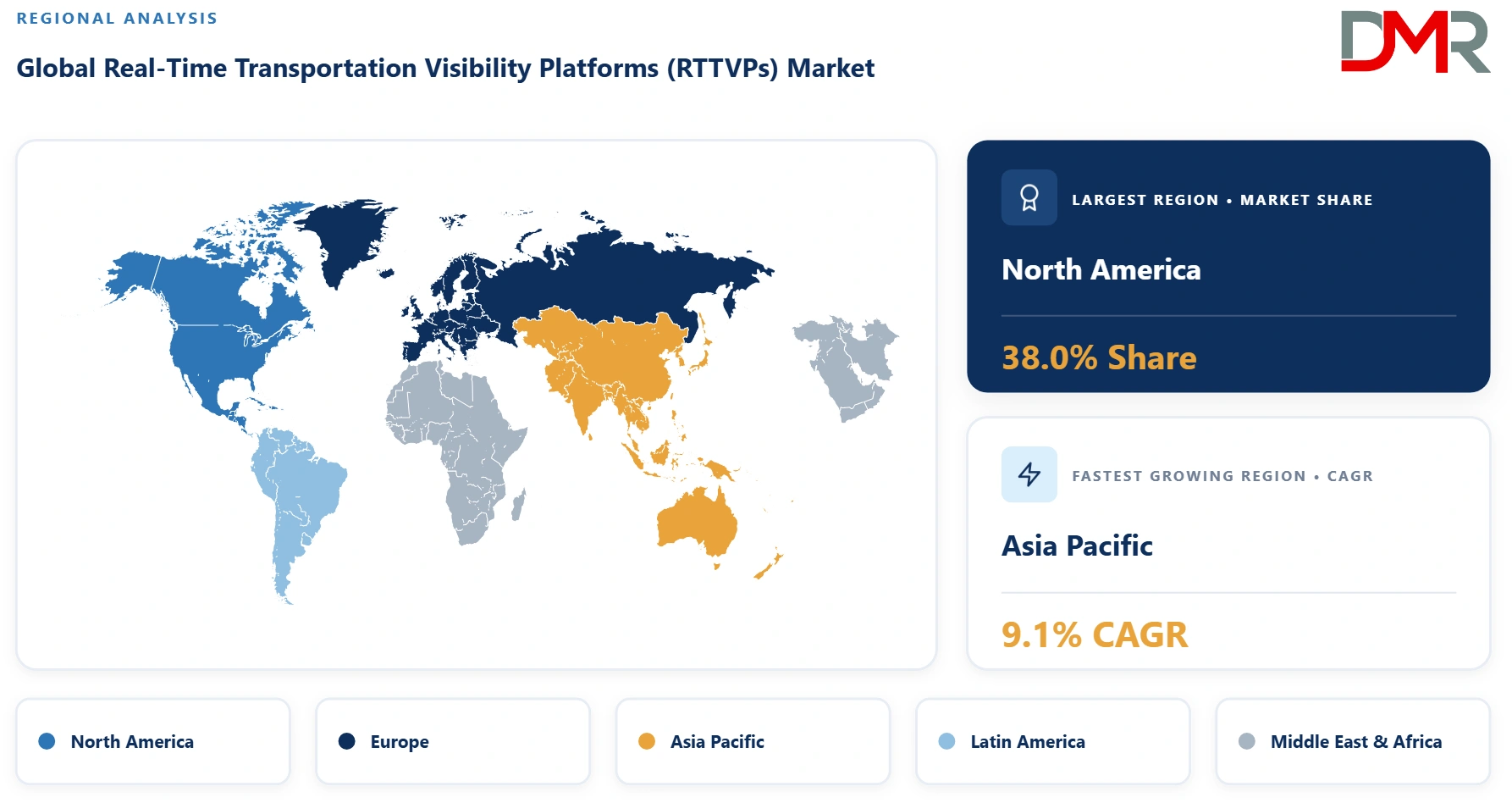
North America is expected to maintain its leading position in the global RTTVPs market, accounting for approximately 38% of global revenue in 2026, or about USD 2.47 billion. The region benefits from mature enterprise-software adoption, extensive trucking and 3PL networks, widespread telematics and ELD usage, large e-commerce volumes, and strong demand for transportation cost optimization. The United States is the principal market, with Canada providing additional demand across retail, manufacturing, energy, food, and logistics. The region also hosts several of the leading pure-play visibility providers and has a mature ecosystem of TMS, telematics, freight marketplaces, and logistics technology companies. The ELD framework creates a significant digital data foundation for road transportation.
ℹ
To learn more about this report –
Download Your Free Sample Report Here
Asia Pacific is the Fastest-Growing Region in the Global Real-Time Transportation Visibility Platforms (RTTVPs) Market
Asia-Pacific is projected to be the fastest-growing regional market, with an estimated 9.1% CAGR through 2035. Growth is supported by manufacturing concentration, cross-border trade, e-commerce, increasing logistics outsourcing, urbanization, and rapid adoption of cloud and mobile technologies. China, Japan, South Korea, India, Australia, and Southeast Asia represent the largest growth pools. Increasing supply-chain regionalization is also encouraging manufacturers to improve supplier, port, ocean, rail, and road visibility. Japan's response to logistics labor shortages and the country's broader logistics-DX initiatives reinforce demand for digital transportation optimization.
The Europe Real-Time Transportation Visibility Platforms (RTTVPs) Market
The European RTTVPs market is estimated at approximately USD 1.43 billion in 2026 and is projected to reach USD 2.39 billion by 2035, representing approximately 5.9% CAGR. Demand is supported by cross-border road freight, advanced manufacturing, automotive logistics, sustainability requirements, and increasingly digital freight documentation. The EU's eFTI Regulation is a significant structural driver because it establishes a framework for electronic freight information and requires authorities to accept electronic information through certified platforms when the regulation fully applies in July 2027.
Latin America Real-Time Transportation Visibility Platforms (RTTVPs) Market
Latin America is estimated at approximately USD 0.39 billion in 2026, reaching USD 0.73 billion by 2035, at approximately 7.2% CAGR. Brazil and Mexico are the principal markets. Growth is driven by e-commerce, cross-border manufacturing, automotive supply chains, logistics outsourcing, road freight digitization, and demand for theft prevention and shipment monitoring. Adoption remains below North American levels, creating substantial headroom as cloud platforms and mobile-based carrier connectivity become more affordable.
MEA Real-Time Transportation Visibility Platforms (RTTVPs) Market
The Middle East & Africa market is estimated at approximately USD 0.33 billion in 2026 and is projected to reach USD 0.65 billion by 2035, representing approximately 7.8% CAGR. Growth is concentrated in the Gulf states and selected African logistics hubs. Saudi Arabia and the UAE are investing heavily in logistics infrastructure, digital trade, ports, warehousing, and multimodal connectivity. Visibility platforms are increasingly relevant to large infrastructure projects, retail distribution, cross-border freight, e-commerce, and port-to-inland logistics.
Major Countries Analysis
United States Real-Time Transportation Visibility Platforms (RTTVPs) Market
The United States RTTVPs market is estimated at approximately USD 2.20 billion in 2026 and is projected to reach USD 3.95 billion by 2035, representing approximately 6.7% CAGR. Growth is supported by high enterprise adoption, extensive trucking networks, ELD/telematics infrastructure, e-commerce, 3PL activity, and strong investment in AI-based logistics software. The country is also the center of competition among major pure-play visibility platforms.
Japan Real-Time Transportation Visibility Platforms (RTTVPs) Market
Japan is estimated at approximately USD 0.31 billion in 2026, rising to about USD 0.53 billion by 2035, equivalent to approximately 6.1% CAGR. Labor shortages, the logistics “2024 problem,” parcel-delivery pressures, automation, robotics, digital logistics platforms, and government-backed logistics-DX initiatives are important demand drivers.
Saudi Arabia Real-Time Transportation Visibility Platforms (RTTVPs) Market
Saudi Arabia is estimated at approximately USD 0.09 billion in 2026, increasing to approximately USD 0.19 billion by 2035, or around 8.9% CAGR. Logistics diversification, Vision 2030-related infrastructure investment, port development, e-commerce, industrial localization, and digital transformation are expected to accelerate adoption of transportation visibility, control-tower, and predictive logistics technologies.
Regulatory Landscape
RTTVPs operate at the intersection of transportation regulation, data privacy, cybersecurity, electronic documentation, telematics, and industry-specific traceability requirements. In the United States, the FMCSA ELD framework creates requirements around electronic recording and management of commercial-driver hours-of-service data, strengthening the digital infrastructure surrounding road freight. In Europe, Regulation (EU) 2020/1056 and subsequent implementing/delegated acts establish the eFTI framework for electronic freight transport information. The EU expects the framework to apply fully from July 9, 2027, with certified platforms becoming an important component of digital freight information exchange. Data-protection laws, including GDPR in Europe and national privacy regimes elsewhere, also affect the collection and processing of location and driver-related information. Vendors increasingly need robust cybersecurity, access control, encryption, audit trails, data residency, and API governance.
Investment and White Space Analysis
The most attractive investment opportunities are concentrated in AI-enabled execution, multimodal visibility, emerging-market carrier connectivity, inventory-in-transit intelligence, and specialized vertical applications. Asia-Pacific offers significant white space because transportation digitization is expanding across fragmented carrier ecosystems. Latin America and MEA also present opportunities for mobile-first and low-integration visibility solutions. In mature markets, the highest-value opportunity is shifting from basic shipment tracking toward AI agents, transportation procurement, appointment scheduling, autonomous exception handling, inventory optimization, and transportation-finance integration. Pharmaceutical cold chains, high-value automotive logistics, ocean visibility, and cross-border trade documentation represent additional premium niches. The market is therefore attractive to software vendors, logistics technology companies, telematics providers, TMS vendors, systems integrators, and private-equity-backed platforms pursuing adjacent supply-chain software categories.
By Region
North America
Europe
- Germany
- France
- The U.K.
- Italy
- Spain
- Rest of Europe
Asia-Pacific
- China
- Japan
- India
- Australia
- South Korea
- Rest of APAC
Latin America
- Mexico
- Brazil
- Rest of LATAM
Middle East & Africa
- Saudi Arabia
- The UAE
- South Africa
- Rest of MEA
Competitive Landscape
The RTTVPs market is moderately consolidated at the enterprise-platform level but fragmented across adjacent tracking, telematics, TMS, freight-tech, and visibility niches. Leading pure-play providers compete with large logistics software companies and increasingly with TMS and control-tower vendors expanding into visibility. Key competitive differentiators include carrier-network breadth, data accuracy, multimodal coverage, predictive ETA performance, AI capabilities, integration depth, implementation speed, geographic reach, and measurable transportation savings. Vendors are increasingly pursuing partnerships, acquisitions, product expansion, and ecosystem integration to move from visibility into transportation execution. project44's 2026 restructuring into separate enterprise and logistics-service-provider businesses illustrates the market's movement toward specialized AI and infrastructure offerings.
Some of the prominent players in the Global Real-Time Transportation Visibility Platforms (RTTVPs) Market are:
- project44
- FourKites
- Shippeo
- Transporeon
- Descartes
- Overhaul
- GoComet
- Tive
- Samsara
- FarEye
- Roambee
- Wakeo
- Terminal49
- Vizion
- Portcast
- Trucker Tools
- Trimble
- HERE Technologies
- Uber Freight
- MacroPoint
- Sixfold
- Kuebix
- e2open
- Blue Yonder
- Manhattan Associates
- SAP
- Oracle
- Infor
- Kinaxis
- project44 Movement
- FourKites Intelligent Control Tower
- Shippeo Visibility Platform
- Transporeon Visibility Hub
- Descartes MacroPoint
- Locus
- Fleet Complete
- Geotab
- Verizon Connect
- KeepTruckin (Motive)
- Fleetio
- Other Key Players
Recent Developments
- July 2026: Launched a conversational AI analyst designed to convert real-time supply-chain data into faster operational decisions.
- July 2026: Created two businesses, project44 for enterprise shippers and LSP44 for logistics service providers, with the latter focused on AI-agent and API infrastructure.
- June 2026: Made its Real-Time Multi-Modal Visibility solution available as an SAP Endorsed App, extending live carrier signals and predictive ETAs into SAP Business Network for Logistics.
- May 2026: Reported 34% year-over-year new-ARR growth and highlighted expanding AI-agent adoption across freight procurement, exception management, disruption management, network operations, and carrier onboarding.
- May 2026: Launched Booking Connect for Ocean, an agentic platform designed to automate carrier selection, contract management, documentation, booking, and exception handling for ocean freight.
- May 2026: Introduced Inventory Twin enhancements designed to connect real-time transportation execution intelligence with inventory planning and S&OP processes.
- April 2026: Acquired LunaPath.ai to accelerate AI-agent orchestration and integrate logistics automation capabilities with its real-time supply-chain decision-intelligence platform.
- April 2026: Launched its Network Operations Agent, using AI-driven workflows to resolve equipment identification, missing milestone, carrier connectivity, and data-quality issues across its logistics network.
Report Details
| Report Characteristics |
| Market Size (2026) |
USD 6.5 Bn |
| Forecast Value (2035) |
USD 12.0 Bn |
| CAGR (2026–2035) |
7.0% |
| The US Market Size (2026) |
USD 2.20 Bn |
| Historical Data |
2021 – 2025 |
| Forecast Data |
2026 – 2035 |
| Base Year |
2025 |
| Segments Covered |
By Offering, By Visibility, By Transportation Mode, By Deployment, By End-User Industry |
| Regional Coverage |
North America – The US and Canada; Europe – Germany, France, The UK, Italy, Spain, Rest of Europe; Asia-Pacific – China, Japan, India, Australia, South Korea, Rest of APAC; Latin America – Mexico, Brazil, Colombia, Argentina, Rest of LATAM; Middle East & Africa – Saudi Arabia, The UAE, South Africa, Rest of MEA |
Frequently Asked Questions
What is the market size of the Real-Time Transportation Visibility Platforms (RTTVPs) Market in 2026?
▾ The Real-Time Transportation Visibility Platforms (RTTVPs) Market is estimated at approximately USD 6.5 billion in 2026.
What will be the size of the Real-Time Transportation Visibility Platforms (RTTVPs) Market by 2035?
▾ The Real-Time Transportation Visibility Platforms (RTTVPs) Market is projected to reach approximately USD 12.0 billion by 2035.
What is the CAGR of the Real-Time Transportation Visibility Platforms (RTTVPs) Market from 2026 to 2035?
▾ The Real-Time Transportation Visibility Platforms (RTTVPs) Market is expected to grow at approximately 7.0% CAGR from 2026 to 2035.
What are the key drivers of the Real-Time Transportation Visibility Platforms (RTTVPs) Market?
▾ The Real-Time Transportation Visibility Platforms (RTTVPs) Market is driven by supply-chain complexity, e-commerce growth, carrier digitization, IoT adoption, and demand for predictive transportation intelligence.
Which segment dominates the Real-Time Transportation Visibility Platforms (RTTVPs) Market?
▾ In the Real-Time Transportation Visibility Platforms (RTTVPs) Market, the Platform segment leads with approximately 72% share in 2026, supported by widespread cloud-based enterprise adoption.
Which is the fastest-growing segment in the Real-Time Transportation Visibility Platforms (RTTVPs) Market?
▾ Inventory Visibility is projected to be the fastest-growing segment in the Real-Time Transportation Visibility Platforms (RTTVPs) Market, with an estimated 11.8% CAGR.
Which region leads the Real-Time Transportation Visibility Platforms (RTTVPs) Market?
▾ North America leads the Real-Time Transportation Visibility Platforms (RTTVPs) Market with approximately 38% share in 2026, while Asia-Pacific is expected to record the fastest growth.
Who are the key players in the Real-Time Transportation Visibility Platforms (RTTVPs) Market?
▾ Major players in the Real-Time Transportation Visibility Platforms (RTTVPs) Market include project44, FourKites, Descartes MacroPoint, Shippeo, Transporeon, SAP, Oracle, Blue Yonder, Manhattan Associates, Tive, Overhaul, and Roambee.