What is the Redox Flow Battery Electrolyte Chemical Market Size?
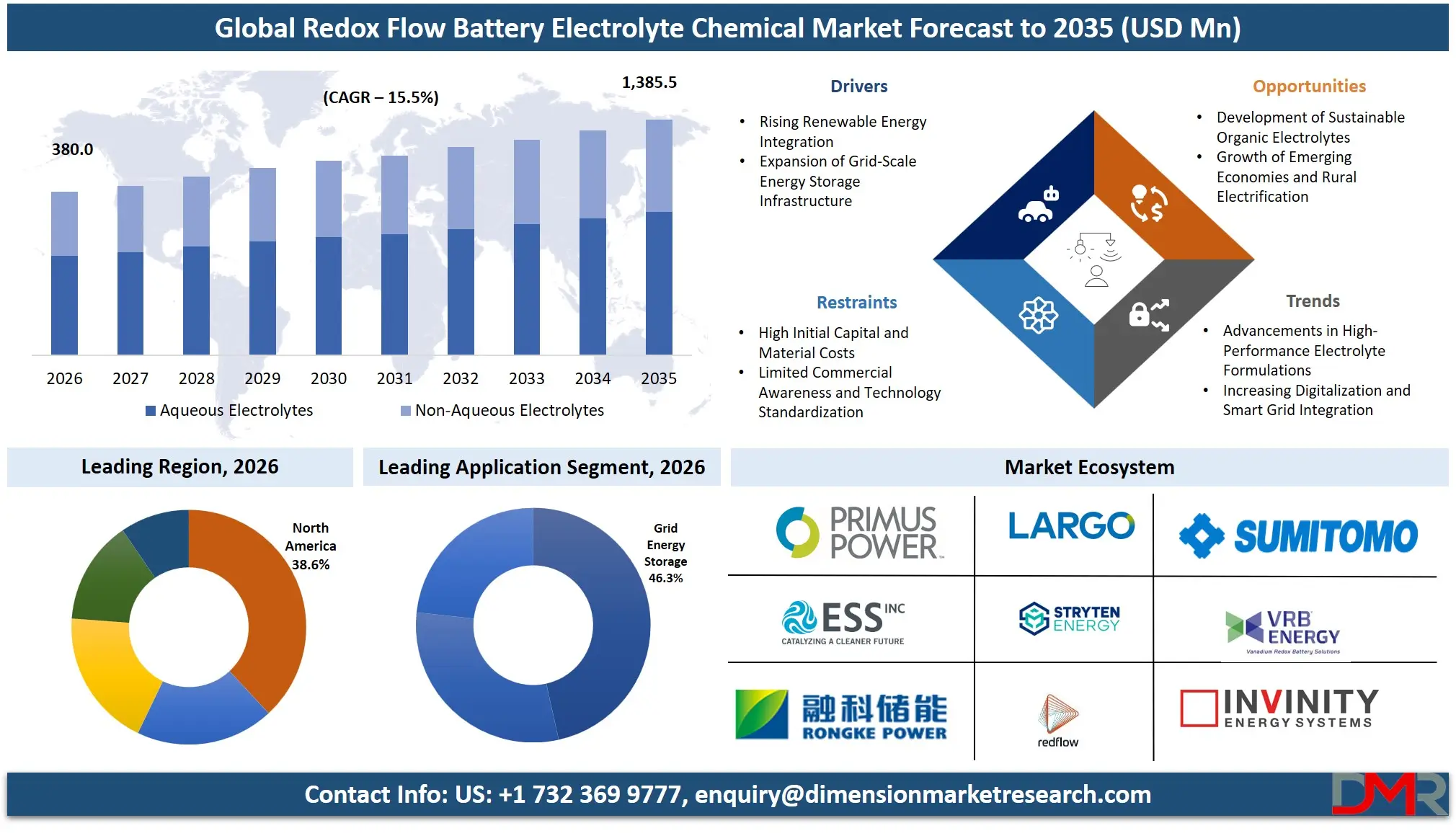
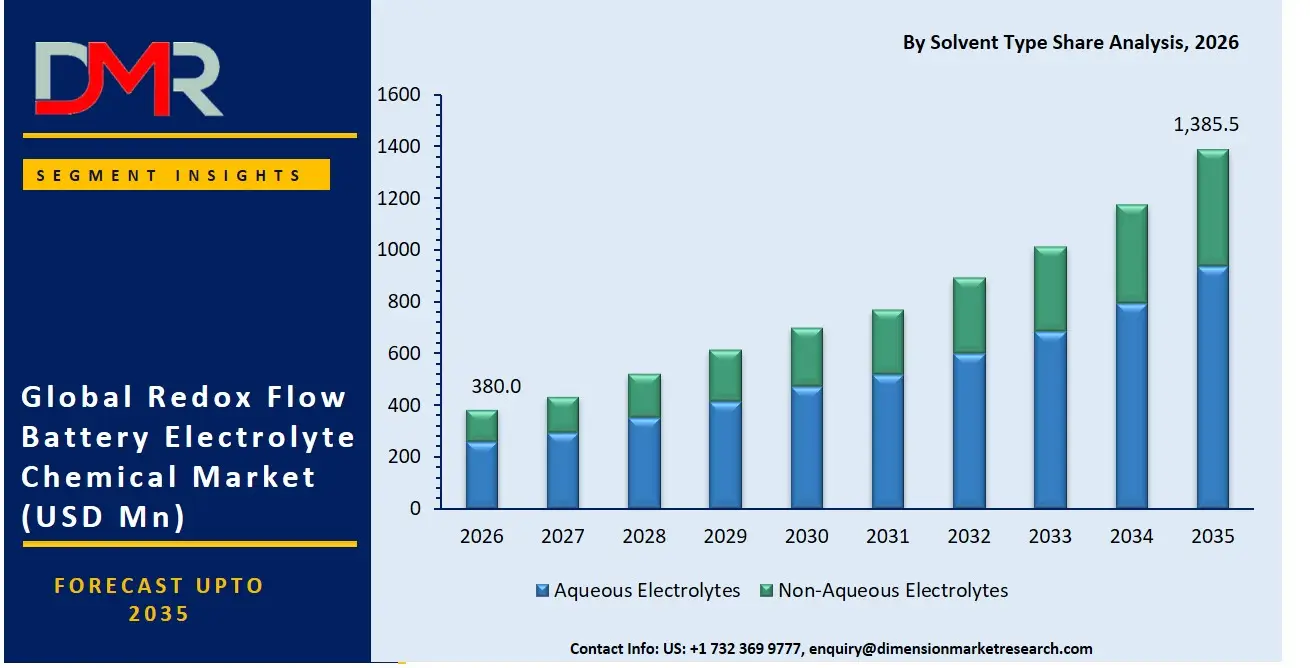
The Redox Flow Battery Electrolyte Chemical Market size is expected to be USD 380.0 million in 2026 and increase at a compound annual growth rate of 15.5% to USD 1,385.5 million in 2035 due to health growing installation of renewable energy infrastructure across the globe.
ℹ
To learn more about this report –
Download Your Free Sample Report Here
Redox Flow Battery Electrolyte Chemicals Market is growing continuously due to high demand for energy storage devices for long duration among various industries. This is because these electrolytes chemicals help in storage of energy through electrochemical reaction. Investments in grid development, renewables and sustainable energy storage solutions, coupled with technological advances in organic and metal based electrolyte chemicals, have been contributing towards the growth of the global market.
ℹ
To learn more about this report –
Download Your Free Sample Report Here
The US Redox Flow Battery Electrolyte Chemical Market
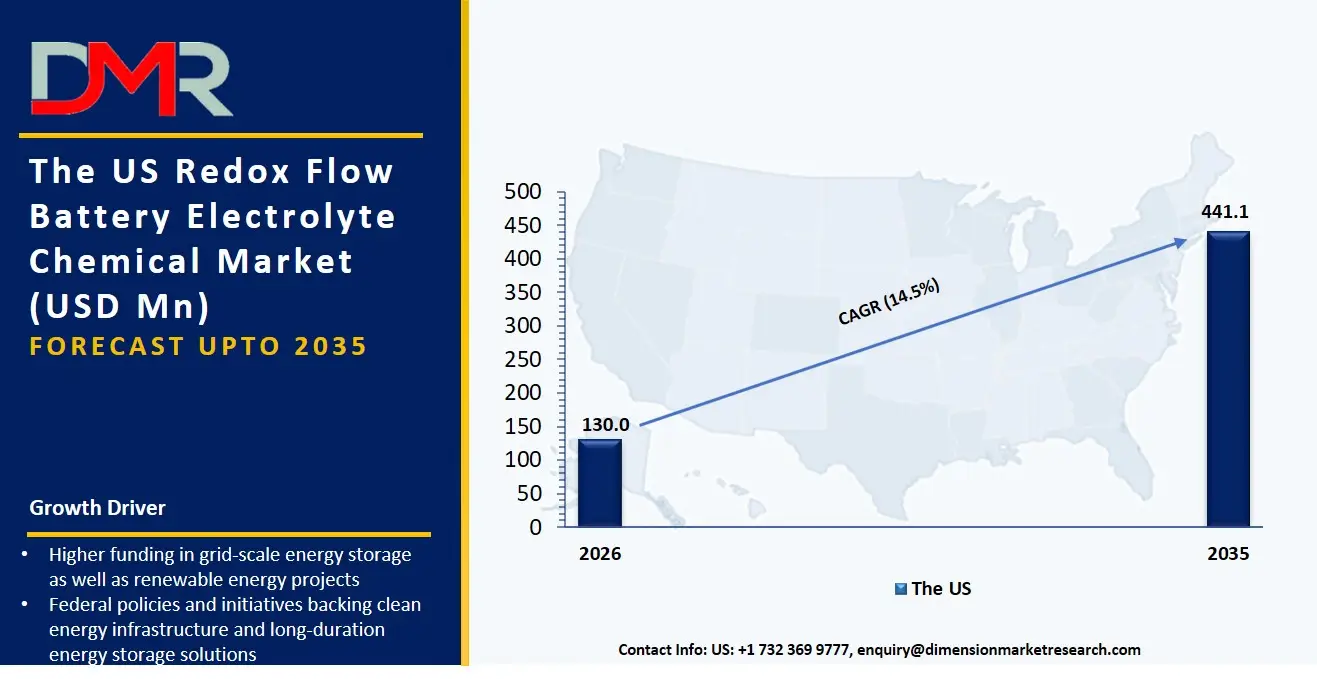
The US Redox Flow Battery Electrolyte Chemical Market size is estimated to be USD 130.0 million in 2026 and is expected to increase at a CAGR of 14.5% over the forecast period.
The US Market for Redox Flow Battery Electrolytes is expected to grow on account of higher funding in grid-scale energy storage as well as renewable energy projects. The federal policies and initiatives backing clean energy infrastructure and long-duration energy storage solutions are contributing towards market growth. Grid operators are investing in vanadium and zinc-based redox flow battery systems for improving the reliability of their electricity grids. The collaboration between technology vendors, research labs, and energy authorities will further drive innovation in the electrolyte space.
ℹ
To learn more about this report –
Download Your Free Sample Report Here
Europe Redox Flow Battery Electrolyte Chemical Market
The Europe Redox Flow Battery Electrolyte Chemical Market size is estimated to be USD 95.0 million in 2026 and is expected to increase at a CAGR of 14.2% over the forecast period.
The Redox Flow Battery Electrolyte Chemical market in Europe is expected to grow considerably as a result of policies that mandate carbon reductions and promote renewable energy under the European Green Deal. Nations like Germany, France, and the Netherlands are encouraging the development of long-duration storage technologies in order to stabilize renewable-dominated power grids. Sustainable and recyclable electrochemistry technologies in redox flow battery electrolytes, including vanadium and organic-based electrochemistry solutions, are currently being developed and deployed in the region.
Japan Redox Flow Battery Electrolyte Chemical Market
The market size of Japan Redox Flow Battery Electrolyte Chemical will be USD 15.2 million in 2026 and at a CAGR of 14.7% in the forecast period.
The market for Redox Flow Battery Electrolyte Chemicals in Japan is witnessing steady growth because of the growing preference for reliable energy systems and disaster-proof power systems. Various government projects that promote energy transitions and the use of hydrogen, along with renewable energy storage, are boosting electrolyte demand. Japan-based vendors are focusing on using high-end vanadium and advanced organic electrolytes for grid stabilization and commercial back-up purposes. Increasing urbanization, growing power demand, and scarce land area are pushing the use of compact energy storage systems, whereas advanced technological skills are making Japan a significant innovator in flow batteries chemistry.
Key Takeaways
- Market Size & Forecast: The Redox Flow Battery Electrolyte Chemical Market size is projected to reach USD 380.0 million in 2026 and is anticipated to have a value of USD 1,385.5 million in 2035.
- Growth Rate & Outlook: The Redox Flow Battery Electrolyte Chemical Market size is set to grow at a compound annual growth rate of 15.5% during the forecast period of 2026 to 2035.
- Primary Growth Drivers: Some of the major growth drivers in the market include Rise in Integration of Renewable Energy, and more.
- Key Market Trends: Some of the major trends in the market are Advances in High-Performing Electrolyte Formulations, and more.
- By Solvent Type: Aqueous Electrolytes segment is anticipated to get the majority share of the Redox Flow Battery Electrolyte Chemical market in 2026.
- By End User: Energy & Ultilities is expected to get the largest revenue share in 2026 in the Redox Flow Battery Electrolyte Chemical market.
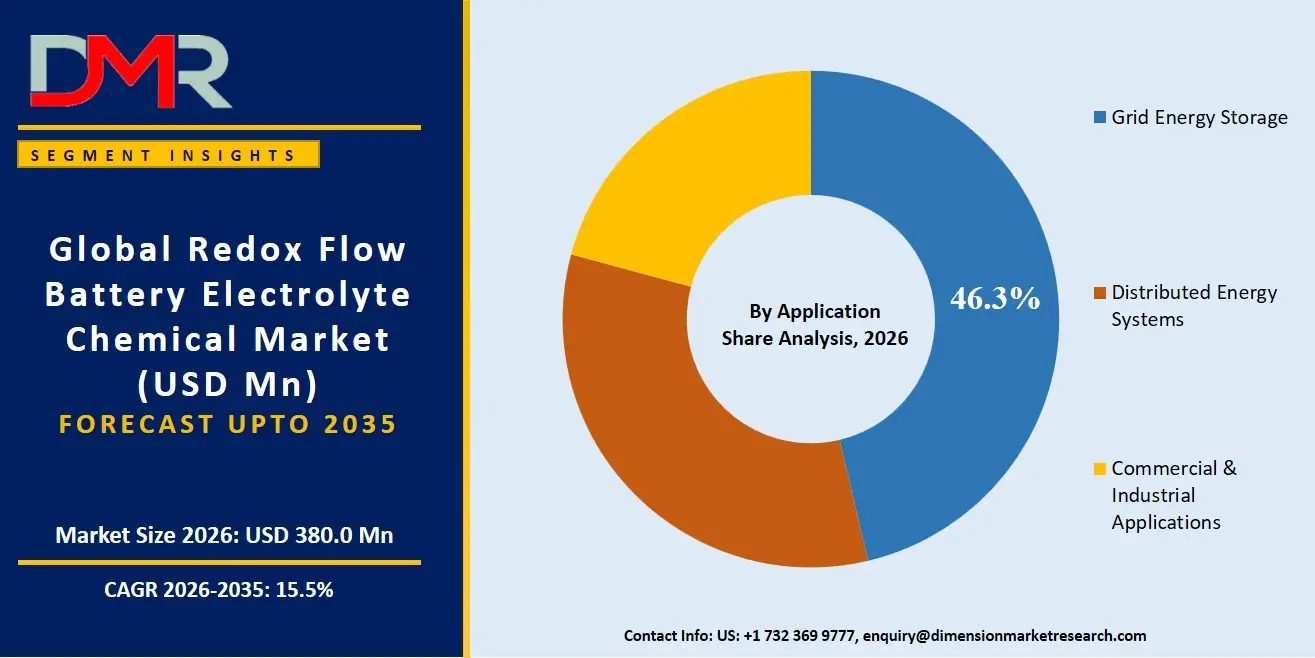
- By Application: Grid Energy Storage segment is expected to get the largest revenue share in 2026 in the Redox Flow Battery Electrolyte Chemical market.
- Regional Leadership: North America is set to lead the Redox Flow Battery Electrolyte Chemical market with an estimated 38.6% share in 2026.
What is the Redox Flow Battery Electrolyte Chemical?
Redox Flow Battery Electrolyte Chemical describes the electrolytic fluid that is used in redox flow batteries for energy storage by means of the process of redox reaction. This includes the use of vanadium, zinc-bromine, iron chromium and organic electrolytes, which are meant to provide highly efficient energy transfer and a prolonged period of operation. Market trends have seen an increase in demand owing to growing penetration of renewables into the energy sector, grid transformation and the need for long-term energy storage. Improved electrolyte performance and environmental friendliness of the formulation has spurred adoption.
Use Cases
- Grid Energy Storage: The chemical components in redox flow batteries find wide applications in large-scale utility storage solutions that help stabilize electric grids, integrate renewables, and handle peak electricity consumption. Thanks to their long-term performance and high scalability, redox flow battery electrolyte chemicals are excellent storage solutions for intermittent solar and wind energy.
- Microgrid Energy Management Solutions: Microgrids that deliver energy to rural locations, military installations, and large companies rely on electrolyte chemicals to deliver power in emergencies, gain energy independence, and keep the electricity flowing even when main grids fail or in case of natural disasters.
- Commercial Power Systems: Electrolyte solutions are used in commercial establishments like communication towers, office buildings, and data centers. The capability of such chemicals to undergo numerous charge/discharge cycles without substantial degradation ensures continuous operation and reliability of critical infrastructures.
- Renewables Integration Applications: Solar and wind farms install advanced electrolyte solutions that allow storing surplus energy generated during high-generation periods. Such energy can be used during times of increased demand when renewables cannot satisfy energy needs of the population.
How AI Is Transforming the Redox Flow Battery Electrolyte Chemical Market
The use of artificial intelligence is enhancing efficiency and optimizing the performance of redox flow battery electrolytes. Predictive analysis enabled by AI will allow for optimal monitoring of electrolyte degradation and preventive maintenance of the batteries to enhance their life span. Machine learning will assist researchers in the development of electrolyte formulations that have increased conductivity, energy density, and thermal stability.
The adoption of artificial intelligence technologies can be utilized in smart grid deployment through the optimization of energy distribution and load balancing, besides renewable energy forecasting to support the performance of redox flow battery systems. Continuous data analysis enabled by AI tools will enable operators to optimize charging cycles. In manufacturing, AI tools are assisting manufacturers in reducing electrolyte costs and optimizing electrolyte quality.
Market Dynamic
Driving Factors in the Redox Flow Battery Electrolyte Chemical Market
Rise in Integration of Renewable Energy
The growing installation of renewable energy infrastructure across the globe acts as one of the key factors driving the global Redox Flow Battery Electrolyte Chemicals market. Renewable energy generation through solar and wind power requires an energy storage system with long-duration capability to balance the energy production. The use of electrolytes in redox flow batteries provides better scalability, long lifecycle, and safety when compared to the traditional lithium-ion battery system.
Restraints in the Redox Flow Battery Electrolyte Chemical Market
High Upfront Investment and Material Costs
The high upfront costs involved in setting up flow battery systems and the use of unique electrolytes is one of the key constraints on the global Redox Flow Battery Electrolyte Chemicals Market. Specifically, vanadium electrolytes are very expensive because of volatile prices of raw materials, as well as the unavailability of mining channels for sourcing. Infrastructure set-ups like tanks, pumps, and electrolyte circulation units that have been set up to operate on large scales need heavy investments to be made.
Opportunities in the Redox Flow Battery Electrolyte Chemical Market
Large Initial Investments and Raw Material Prices
One of the main factors that are expected to limit the overall progress of the Global Redox Flow Battery Electrolyte Chemicals Market during the forecast period would be the large amount of initial investments required along with the use of specific types of electrolytes such as vanadium electrolytes which require large amounts of investments due to volatility in raw material prices. Moreover, lack of mineral mining routes makes it costly to produce these electrolytes.
Trends in the Redox Flow Battery Electrolyte Chemical Market
Advances in High-Performing Electrolyte Formulations
The consistent advances in electrolyte formulation science have been contributing to a shift within the Redox Flow Battery Electrolyte Chemical market. New developments of highly stable formulations that offer high ionic conductivity, excellent thermal characteristics, and extended lifecycles have been taking place. Electrolyte solutions based on mixed acids and hybrids of chemicals continue to receive growing attention due to their capability to increase energy density and overall efficiency. Further advances in low-cost metals and additive formulations are contributing to increased competition with traditional batteries.
Research Scope and Analysis
The Redox Flow Battery Electrolyte Chemical Market Research Report is conducted to provide an in-depth analysis of various parameters such as electrolyte chemistry, solvent type, composition, application, end-users, and regional trends. Vanadium Redox flow battery electrolytes dominate the market at present owing to commercialization; however, organic electrolytes and advanced hybrid types have been experiencing fast-paced growth. The growing trend of renewable energy integration and advancements in sustainable electrolyte solutions are projected to impact future growth.
ℹ
To learn more about this report –
Download Your Free Sample Report Here
By Electrolyte Chemistry Type Analysis
The Vanadium-Based Electrolytes are projected to take the lead with a market share of about 41.8% for the Redox Flow Battery Electrolyte Chemical market in 2026 owing to their excellent electrochemical stability, longevity of cycle life, and efficiency in large scale applications. The all-vanadium redox flow batteries are highly preferred owing to their ability to avoid cross contamination with efficient performance in long duration storage applications. Increasing investments in renewable energy infrastructure and utility modernization are helping increase the demand for vanadium-based electrolytes across the world. On the other hand, the Organic Electrolytes are forecasted to grow at the highest rate owing to increasing developments in more environment-friendly and cost-effective electrolyte compositions. The quinone based electrolytes and electrolytes enhanced with polymers have drawn considerable attention since they rely less on costly metals.
By Solvent Type Analysis
Aqueous Electrolytes are anticipated to capture around 67.4% of the market share by 2026 as these are safer with minimum flammability issues and possess an excellent electrochemical performance. Among the different types of aqueous electrolytes, acidic aqueous electrolytes are expected to hold maximum dominance since they are widely used in vanadium redox flow batteries. These are preferred in stationary energy storage applications. Moreover, scalability along with better performance has increased the deployment of aqueous electrolytes in utility and industrial energy storage systems. On the other hand, Non-aqueous Electrolytes are likely to be fastest growing due to manufacturers' desire to have high energy density along with greater voltage ranges. This can be achieved using ionic liquid-based electrolytes as well as organic solvent-based electrolytes.
By Chemical Composition Analysis
The Metal Salts-Based Electrolytes are anticipated to dominate with a market share of nearly 58.9% in 2026 owing to their wide usage in commercial redox flow batteries and especially because of their high ionic conductivity, proven commercial performance, and ability to work well with larger energy storage systems. These electrolytes are highly preferred by utilities and industrial users because of their ability to operate for extended periods of time without failing. The Advanced Formulations segment is anticipated to be the fastest growing due to the efforts of companies in enhancing electrolyte chemistry using additives and hybrids to increase efficiency and decrease degradation rates.
By Application Analysis
Grid Energy Storage is projected to lead the market by accounting for about 46.3% of the total market in 2026 owing to growing worldwide efforts to integrate renewable energy and stabilize utility-scale energy storage solutions. Applications of utility-scale storage and frequency regulation are likely to boost the demand for robust and scalable electrolyte solutions suitable for extended energy discharge processes. The governments and utilities across the world are showing increased interest in flow batteries owing to the need to tackle renewable intermittency issues and bolster grid stability. On the other hand, distributed energy storage is poised to show the fastest growth rate on account of increasing use of microgrids and community energy storage systems, especially in rural areas.
By End User Analysis
The Energy & Utilities category is expected to generate nearly 52.1% market share by 2026 owing to the increased use of redox flow batteries in renewable integration, power transmission, and grid balancing at utility scales. Energy & Utilities are actively adopting advanced electrolyte technology to ensure greater efficiency of the energy storage system. Increased renewable energy production and modernization of grids will strengthen the position of this segment. At the same time, the Commercial & Industrial segment is likely to show the fastest growth owing to the need for reliable and efficient backup energy sources that can handle the load without much degradation.
The Redox Flow Battery Electrolyte Chemical Market Report is segmented on the basis of the following:
By Electrolyte Chemistry Type
- Vanadium-Based Electrolytes
- All-Vanadium Electrolytes (VRFB)
- Mixed-Acid Vanadium Electrolytes
- Sulfate-Based Vanadium Electrolytes
- Iron-Based Electrolytes
- Iron-Chromium Electrolytes
- Iron Salt Electrolytes
- Iron-Air Electrolytes
- Zinc-Based Electrolytes
- Zinc-Bromine Electrolytes
- Zinc-Iodide Electrolytes
- Zinc-Cerium Electrolytes
- Organic Electrolytes
- Quinone-Based
- Viologen-Based
- TEMPO-Based
- Anthraquinone-Based
- Other Emerging Electrolytes
- Polysulfide-Bromide
- Cerium-Based
- Manganese-Based
- Chromium-Based
By Solvent Type
- Aqueous Electrolytes
- Non-Aqueous Electrolytes
- Organic Solvent-Based
- Ionic Liquid-Based
By Chemical Composition
- Metal Salt-Based
- Sulfate Electrolytes
- Bromide Electrolytes
- Chloride Electrolytes
- Mixed Acid Systems
- Organic-Based
- Organic Molecule Electrolytes
- Polymer-Based Electrolytes
- Advanced Formulations
- Additive-Enhanced Electrolytes
- Hybrid Chemical Systems
By Application
- Grid Energy Storage
- Utility-Scale Storage
- Renewable Integration Storage
- Peak Shaving
- Frequency Regulation
- Distributed Energy Systems
- Microgrids
- Community Energy Storage
- Off-Grid Systems
- Commercial & Industrial Applications
- Data Centers
- Telecommunications Backup
- EV Charging Infrastructure
- Backup Power Systems
By End User
- Energy & Utilities
- Electric Utilities
- Independent Power Producers (IPPs)
- Renewable Energy Developers
- Commercial & Industrial
- Manufacturing Facilities
- Data Centers
- Commercial Buildings
- Others
- Government & Defense
- Mining Operations
- Remote Infrastructure Sites
Regional Analysis
Leading Region in the Redox Flow Battery Electrolyte Chemical Market
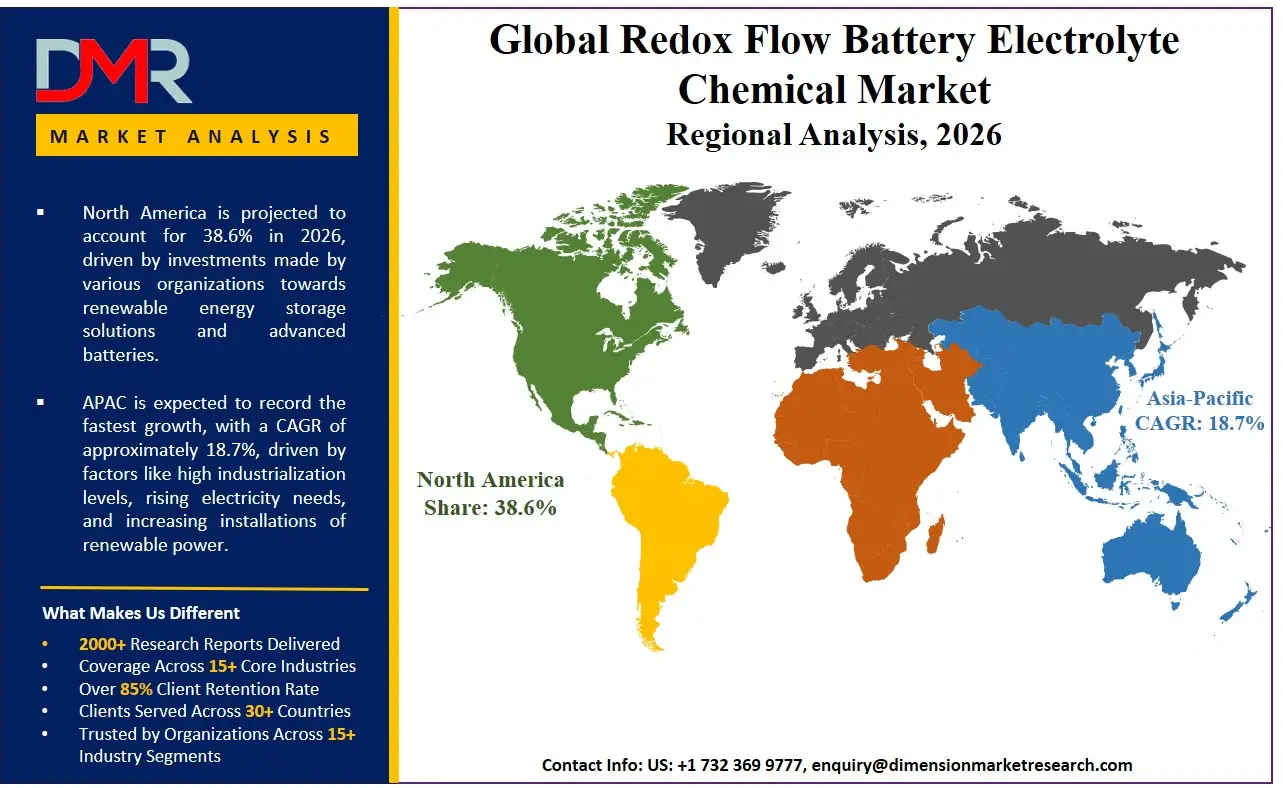
North America will lead the Redox Flow Battery Electrolyte Chemical market in 2026 with an estimated market share of 38.6%, attributable to investments made by various organizations towards renewable energy storage solutions and advanced batteries. United States will be the main contributor to the regional growth owing to the clean energy initiatives put forth by the federal government along with increasing utility scale battery energy storage installations and renewable energy integration projects. Research and development efforts carried out extensively by regional companies regarding advanced electrolyte chemistries further enhance the competitive edge held by North America in the global redox flow battery electrolyte chemical market.
ℹ
To learn more about this report –
Download Your Free Sample Report Here
Fastest Growing Region in the Redox Flow Battery Electrolyte Chemical Market
The Asia-Pacific region is estimated to grow at the highest rate among all regions in the Redox Flow Battery Electrolyte Chemical market owing to factors like high industrialization levels, rising electricity needs, and increasing installations of renewable power. Various governments in this region are encouraging the use of energy storage solutions via different measures. High urbanization levels and the need for a sound grid structure are adding to this growth. Investments in advanced electrolytes and increased manufacturing capacity have been identified as other growth drivers for this region.
By Region
North America
Europe
- Germany
- The U.K.
- France
- Italy
- Russia
- Spain
- Benelux
- Nordic
- Rest of Europe
Asia-Pacific
- China
- Japan
- South Korea
- India
- ANZ
- ASEAN
- Rest of Asia-Pacific
Latin America
- Brazil
- Mexico
- Argentina
- Colombia
- Rest of Latin America
Middle East & Africa
- Saudi Arabia
- UAE
- South Africa
- Israel
- Egypt
- Rest of MEA
Competitive Landscape
Competitiveness will come from innovations, supply assurance, and investment in high quality energy storage products. Companies will focus on R&D initiatives to increase stability of the electrolytes, reduce cost of materials, and improve energy density of the electrolytes. Collaboration among utilities, renewable energy providers, and other industries will be critical for growing and promoting the redox flow batteries electrolytes market. Important barrier to enter this industry is knowledge about electrolyte formulas, securing intellectual property rights, and costly manufacturing plants.
Some of the prominent players in the global Redox Flow Battery Electrolyte Chemical are:
- Sumitomo Electric Industries
- VRB Energy
- Invinity Energy Systems
- ESS Tech
- Largo Inc.
- Redflow Limited
- Stryten Energy
- Primus Power
- CellCube Energy Storage
- StorEn Technologies
- Rongke Power
- Bushveld Energy
- VanadiumCorp Resource Inc.
- Vecco Group
- Electrochem Technologies & Materials Inc.
- Elestor
- VoltStorage GmbH
- UniEnergy Technologies
- Enerox GmbH
- Vessolyte
- Other Key Players
Recent Developments
- In September 2025, The American company, Storion Energy LLC that provides Vanadium Redox Flow Batteries (VRFBs) parts has announced obtaining its first buyer for vanadium electrolyte manufactured using the manufacturing line established as part of MAKE IT Prize awarded by the United States Department of Energy ($5 million). Storion Energy LLC has concentrated on increasing production of domestic electrolytes due to the growing demand for energy storage solutions and especially because of the expected rapid development of VRFBs installations up until 2031.
- In September 2025, Redox Flow Batteries (RFBs) are known to be a good choice for mid-scale energy storage because of the ability to separately increase the density of energy storage capacity and energy output. The main benefit of VRFBs is the possibility to vary the system's design according to its needs. In terms of the technologies used for storage, VRFBs rank highly. They benefit from the use of vanadium due to its ability to have different valance states and, thus, to operate in both electrolytes.
- In July 2025, LPV Physical Vanadium Corp. has announced that they are backing the energy storage project by Storion Energy. This partnership is part of a strategic agreement made between Storion Energy and Terraflow that will provide a vanadium electrolyte lease for their 9.6 MW, 5-hour flow battery project located in Bellville, Texas, which is considered to be one of the biggest projects in the U.S. Largo Vanadium's vanadium lease platform will assist the project in becoming successful.
Report Details
| Report Characteristics |
| Market Size (2026) |
USD 380.0 Mn |
| Forecast Value (2035) |
USD 1385.5 Mn |
| CAGR (2026–2035) |
15.5% |
| Historical Period |
2021 – 2025 |
| Forecast Period |
2027 – 2035 |
| Base Year |
2025 |
| Estimate Year |
2026 |
| Segments Covered |
By Electrolyte Chemistry Type, By Solvent Type, By Chemical Composition, By Application, By End User |
| Regional Coverage |
North America – The US and Canada; Europe – Germany, The UK, France, Russia, Spain, Italy, Benelux, Nordic, & Rest of Europe; Asia-Pacific – China, Japan, South Korea, India, ANZ, ASEAN, Rest of APAC; Latin America – Brazil, Mexico, Argentina, Colombia, Rest of Latin America; Middle East & Africa – Saudi Arabia, UAE, South Africa, Turkey, Egypt, Israel, & Rest of MEA |
Frequently Asked Questions
How big is the Redox Flow Battery Electrolyte Chemical Market?
▾ The Redox Flow Battery Electrolyte Chemical Market size is expected to reach USD 380.0 million by 2026 and is projected to reach USD 1,385.5 million by the end of 2035.
What is the CAGR of the Redox Flow Battery Electrolyte Chemical Market from 2026 to 2035?
▾ The market is growing at a CAGR of 15.5 percent over the forecasted period.
What factors are driving the growth of the Redox Flow Battery Electrolyte Chemical Market?
▾ Rise in Integration of Renewable Energy, and more are the factors driving the growth of the Redox Flow Battery Electrolyte Chemical Market.
What are the major trends in the Redox Flow Battery Electrolyte Chemical Market?
▾ Advances in High-Performing Electrolyte Formulations, and more are some of the major trends in the market.
Who are the key players in the Redox Flow Battery Electrolyte Chemical Market?
▾ Some of the key players in the Redox Flow Battery Electrolyte Chemical Market include VRB, ESS, Largo, and more.
How is the Redox Flow Battery Electrolyte Chemical Market segmented?
▾ The Redox Flow Battery Electrolyte Chemical Market is segmented by electrolyte chemistry type, solvent type, chemical composition, application, end user.
Which region held the largest share of the Redox Flow Battery Electrolyte Chemical Market in 2026?
▾ North America is set to lead the Redox Flow Battery Electrolyte Chemical market with an estimated 38.6% share in 2026.
Which region is expected to grow the fastest in the Redox Flow Battery Electrolyte Chemical Market?
▾ Asia Pacific is the fastest-growing region in the Redox Flow Battery Electrolyte Chemical market during the forecast period.