What is the Global Redox Flow Battery Market Size?
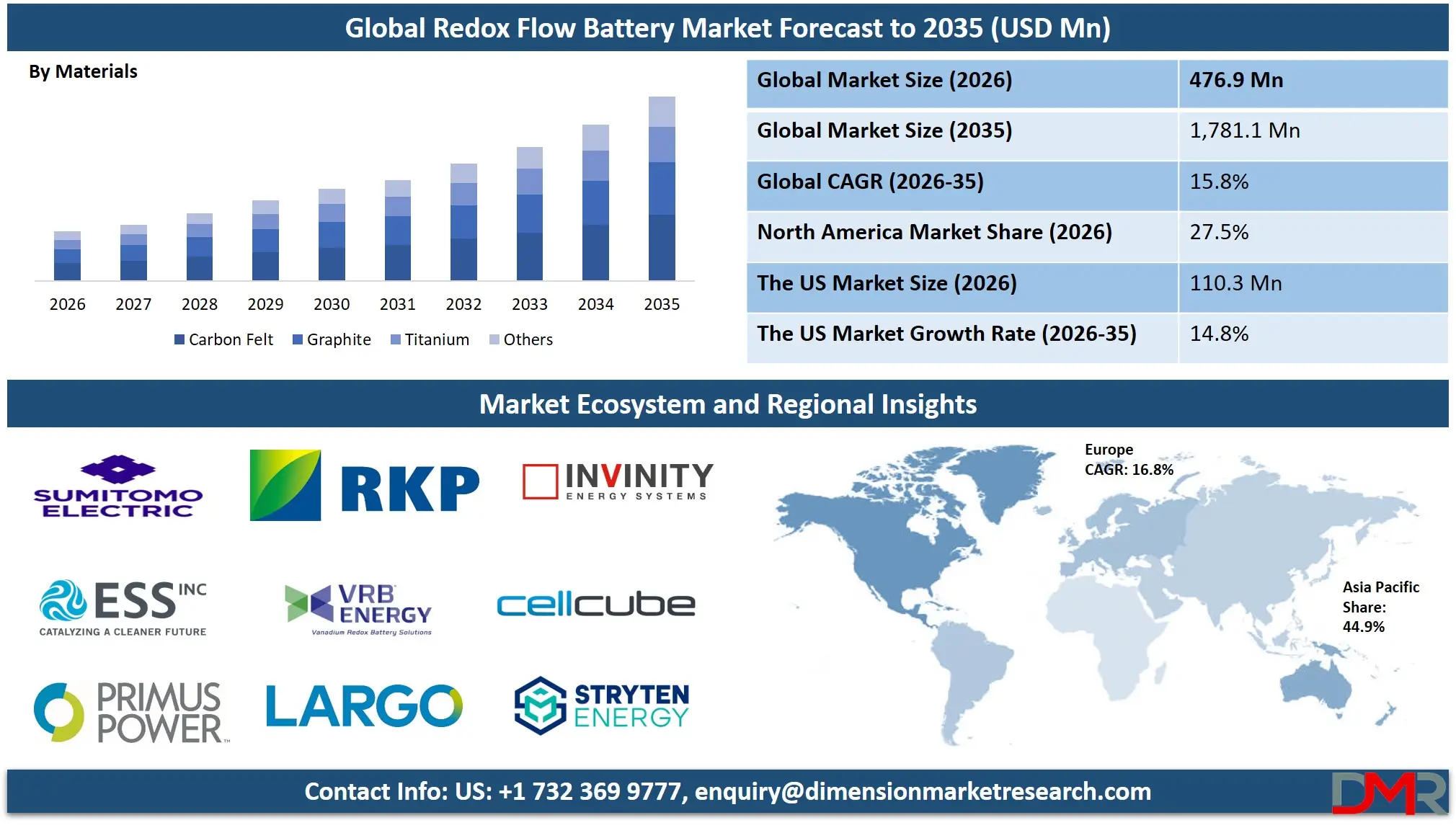
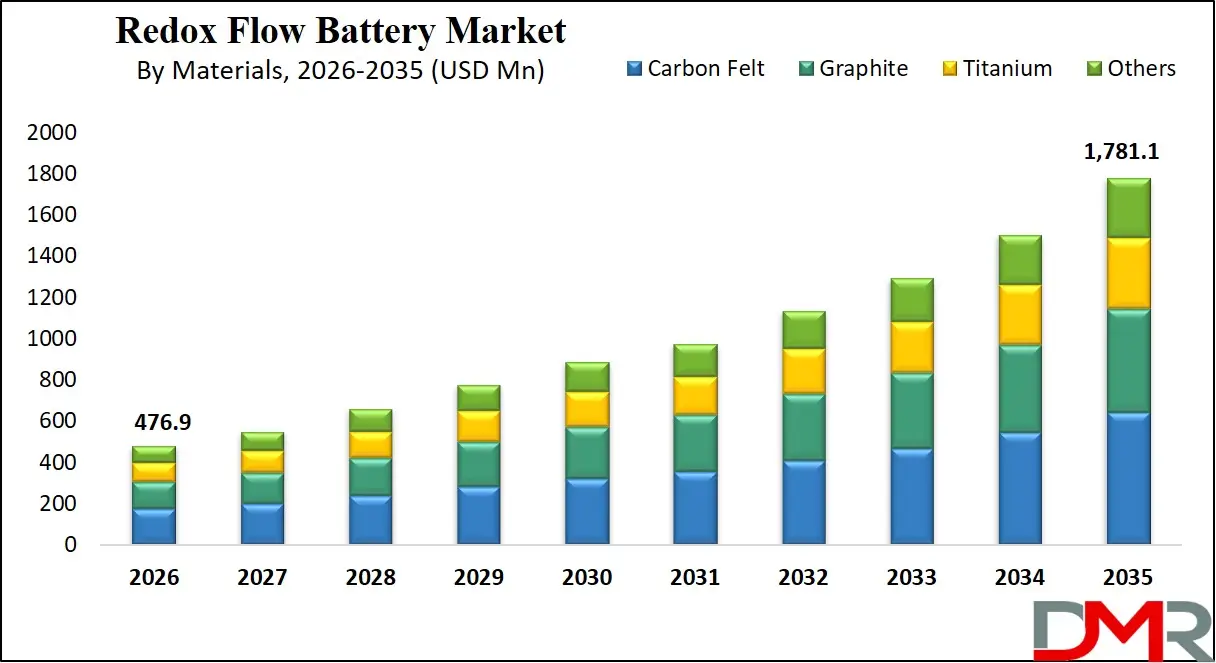
The Global Redox Flow Battery Market size is estimated at USD 476.9 million in 2026 and is expected to reach USD 1,781.1 million by 2035, expanding at a CAGR of 15.8%, driven by AI-enabled electrolyte engineering, automation, and integrated charge-discharge workflows in long-duration energy storage.
ℹ
To learn more about this report –
Download Your Free Sample Report Here
The growth of the Redox Flow Battery Market can be attributed to an increase in machine learning techniques for electrolyte formulation optimization and stack performance modeling, government mandates that minimize the likelihood of failure of grid storage systems and shorten the timeline for the deployment of utility-scale batteries, and higher investment in automated flow battery production lines by private companies and governments. Additional factors driving the growth include breakthroughs in real-time electrolyte state-of-charge tracking technologies, cell voltage modeling and prediction, automated stack assembly, and high-throughput electrode screening, among other developments in interoperability systems which facilitate flow battery integration in renewable energy operations.
Digital modernization in utility and industrial energy storage companies has helped optimize stack design and improve operational outcomes, including reduced time to grid connection. Automation of manufacturing workflows, predictive maintenance processes, and artificial intelligence-enabled design-build-test systems have accelerated adoption, and clean energy national strategies have supported sustainability in long-duration storage.
ℹ
To learn more about this report –
Download Your Free Sample Report Here
The US Redox Flow Battery Market
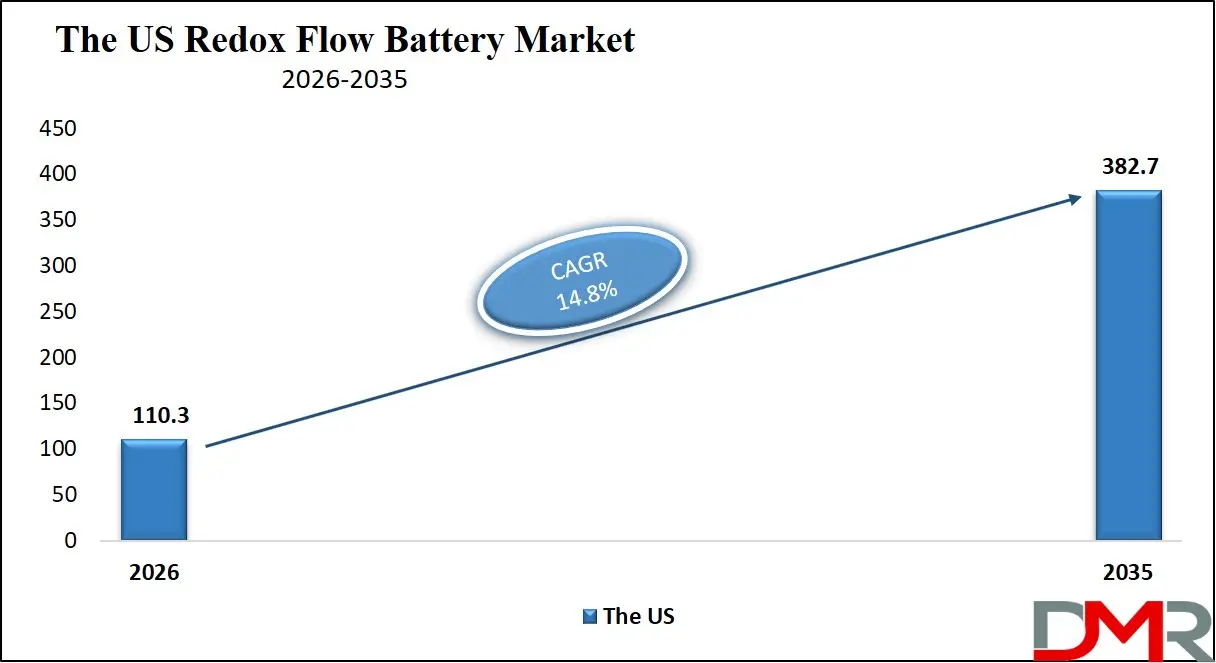
The US Redox Flow Battery Market is estimated to grow to USD 110.3 million in 2026 with a compound annual growth rate of 14.8% during the forecast period.
ℹ
To learn more about this report –
Download Your Free Sample Report Here
The US market is defined by the existence of significant federal funding schemes like the Long-Duration Storage Shot Initiative, the DOE's flow battery manufacturing R&D centers, and the FERC-involved AI/ML-enabled grid control pathways for renewable integration and peak load management, all of which will help the development of the necessity of AI-driven electrolyte engineering, real-time stack telemetry of automated flow battery modules and robotic assembly cells, and predictive energy management software. Automated flow battery hardware systems remain to be more rapidly adopted in the region, and the US needs highly developed interoperability frameworks, integration of real-world performance data using digital logbooks, and verifiable flow battery AI assurance. Also, service providers are being pressured by initiatives like the Energy Act of 2020 and national AI in energy storage strategies to create dedicated integration and deployment services to guarantee data interoperability, security, and compliance across a variety of utility R&D departments and academic energy research centers.
Europe Redox Flow Battery Market
The Europe Redox Flow Battery Market is estimated to be valued at USD 107.9 million in 2026, witnessing growth at a CAGR of 16.8%, during the forecast period.
Europe is a key growth region in the redox flow battery market, supported by strong regulatory frameworks such as the EU Green Deal Industrial Plan and the European Battery Alliance, along with national energy storage initiatives across countries like Germany and France. The region is actively promoting long-duration energy storage deployment and grid modernization. While flow battery technologies in Europe are still in an early commercialization phase, significant progress is being made in modular system design, advanced battery monitoring, and digital grid integration. Public-private partnerships and standardized testing frameworks are accelerating adoption, positioning Europe as one of the fastest-growing regions in the global redox flow battery market.
Japan Redox Flow Battery Market
The Japan Redox Flow Battery Market is projected to be valued at USD 42.8 million in 2026, progressing at a CAGR of 15.2%, during the period spanning from 2026 to 2035.
Japan boasts a mature redox flow battery market supported by high-performance automated stack assembly systems, diagnostic electrolyte integration technology, and a wide network of robotic cell processing AI innovations. Automation, precision, and process integrity are the priorities in the country and are achieved by predictive cell voltage degradation models and intelligent thermal management systems for grid-scale storage. Growth is stimulated by government actions under the Society 5.0 initiative and constant investment in digital energy storage infrastructure. The high volume of utility-scale R&D, industrial electrolyte development for grid stabilization, and flow battery lab automation requires efficient AI for real-time evidence-based inference. The difficulties are high validation costs for new flow battery automation architectures and integration with legacy grid systems, yet the prospects are in exporting developed flow battery technologies to Asian and Pacific markets.
Key Takeaways
- Market Size & Forecast: The Global Redox Flow Battery Market is estimated to be valued at USD 476.9 million in 2026 and is expected to grow to USD 1,781.1 million by 2035.
- Growth Rate & Outlook: The market is expected to witness growth at a compound annual growth rate of 15.8% in the forecast period.
- Primary Growth Drivers: Technological progress in machine learning-based engineering of electrolyte formulations for grid storage and industrial backup, regulatory requirements for faster storage deployment and reduced failure rates, and utility/industrial deployment of intelligent flow battery platforms are some of the key drivers of growth in the market.
- Key Market Trends: The use of predictive cell voltage degradation monitoring, real-time state-of-charge optimization, and transition to cloud-based battery telemetry and fleet management systems are some of the primary market trends.
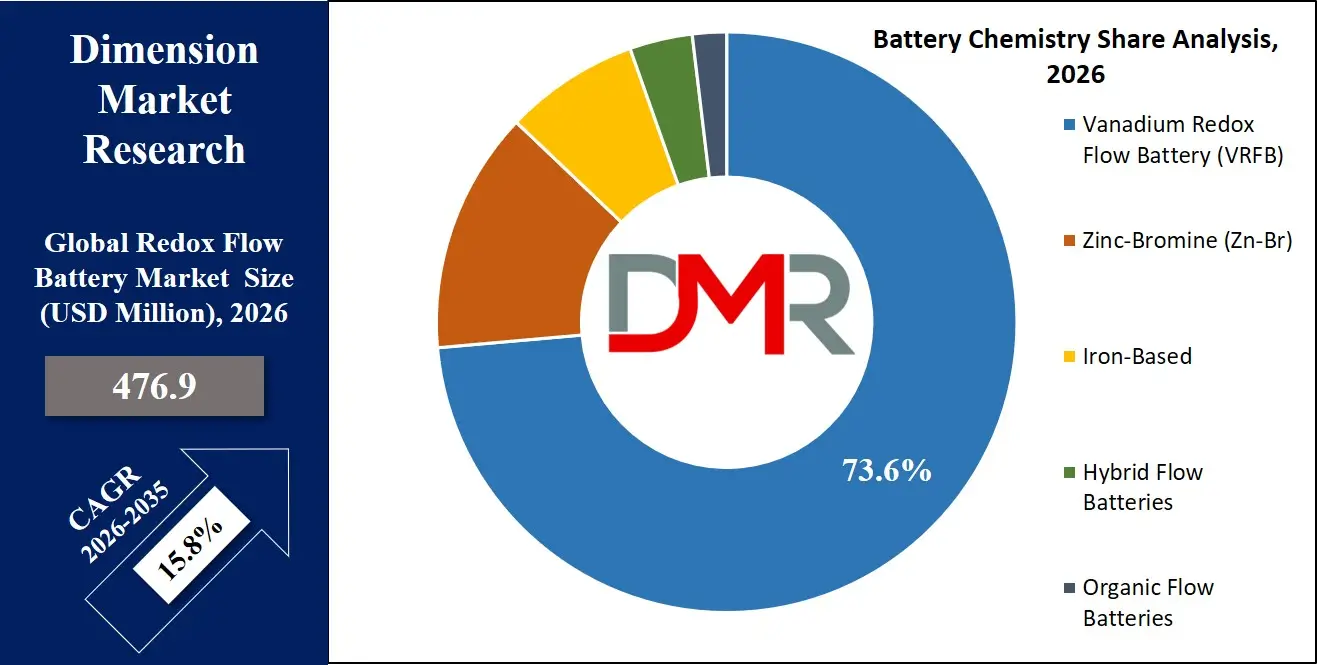
- By Battery Chemistry: The Vanadium Redox Flow Battery (VRFB) segment is anticipated to get the majority share of the redox flow battery market in 2026.
- By Materials: The Carbon Felt segment is expected to occupy the largest revenue share in 2026 in the redox flow battery market.
- By Application: The Renewable Energy Integration segment (specifically Solar & Wind Pairing) is expected to get the largest revenue share in 2026 in the redox flow battery market.
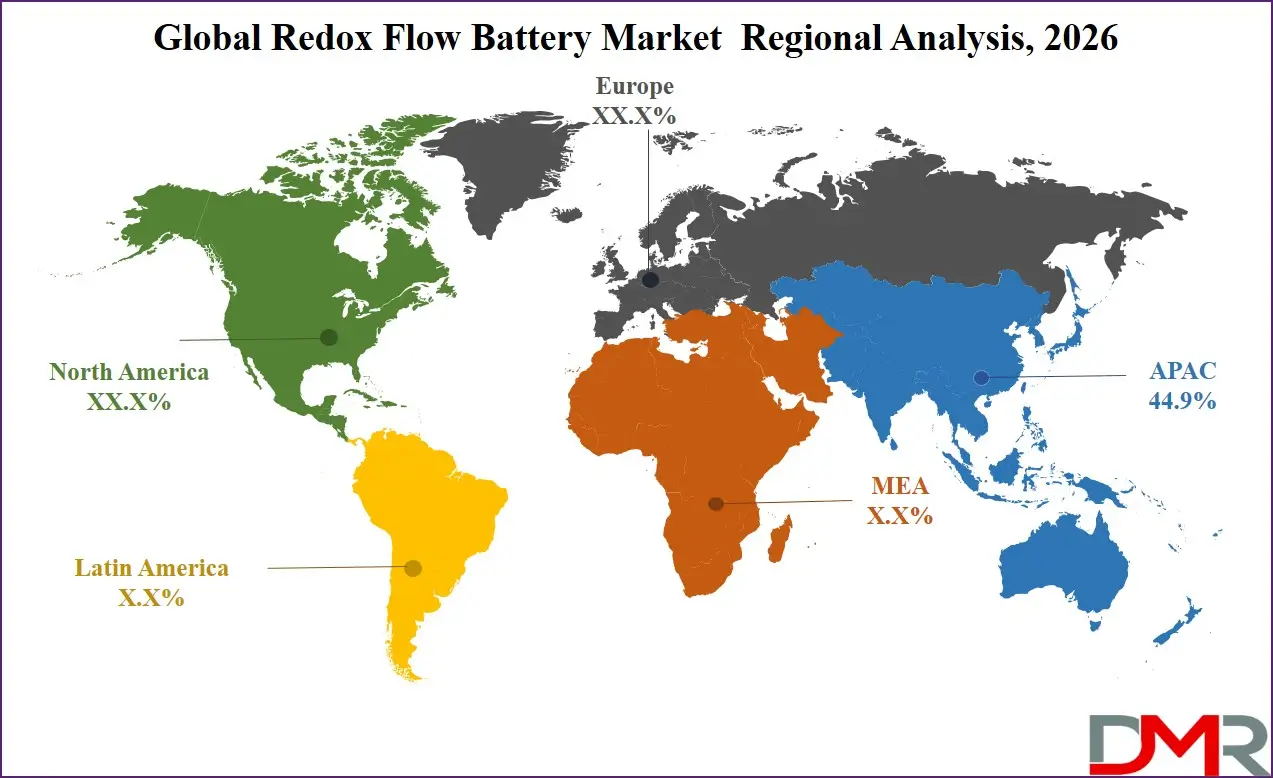
- Regional Leadership: Asia-Pacific is predicted to dominate the market with an estimated 44.9% share in 2026, with high energy storage manufacturing capacity and flow battery technology adoption.
What is a Redox Flow Battery?
A redox flow battery refers to an integrated electrochemical storage system that uses externally stored electrolyte solutions containing active species (e.g., vanadium, zinc-bromine, iron) that circulate through a cell stack to convert chemical energy into electricity. These systems use pumping systems, membrane stacks, electrodes, and power management technologies to enable scalable energy storage, improved cycling stability, and accelerated deployment of long-duration grid storage. Redox flow batteries are increasingly used in utility-scale storage and industrial backup power to enhance grid stability, support renewable energy integration, and advance the production of reliable, safe, and scalable energy storage solutions.
Use Cases
- Renewable Energy Integration: Redox flow batteries are capable of storing excess solar and wind energy in real-time to deliver power during low-generation periods with discharge durations on the order of 8–12 hours, saving orders of magnitude over time compared with lithium-ion battery systems for daily cycling applications.
- Electrolyte State-of-Health Optimization: Long-term cycling and capacity fade data, such as cumulative energy throughput and shunt current losses, are modeled to give maintenance recommendations and keep safely managing storage runs without interruption to ensure grid stability and operational confidence.
- Stack Performance Monitoring & Control: Industrial deployments are employing machine learning and cell voltage analytics to perform on-device real-time efficiency prediction, system anomaly detection, and automated electrolyte flow adjustment with quantifiable and proven accuracy.
- Population Health & Government Programs: More efficient redox flow batteries contribute to the success of grid modernization, rural electrification, and smart microgrid surveillance, facilitate national clean energy adoption, contribute to deployment reliability, and help implement policies, such as the energy storage governance policy and grid resiliency standards.
How AI Is Transforming the Global Redox Flow Battery Market?
Artificial intelligence is revolutionizing the field of redox flow batteries, allowing predictive modeling of the likelihood of electrolyte stability success, automatic detection of anomalies in cell voltage patterns, and optimization of stack design parameters in a chemistry-specific scenario. Grid telemetry and electrochemical data can be processed using AI algorithms to identify any degradation or performance drift and optimize operational outcomes at scale. This saves time, is verifiable and cheaper than manual data analysis.
Moreover, AI enhances system reliability assurance through offering adaptive computational event-based scheduling, anticipating workflow threats to stack health, and intelligent prioritization of flow battery module health monitoring. It is also involved in reducing the cost of baseline testing and ongoing performance tracking, allowing energy storage IT operators to reduce the cost and physical footprint of on-prem test campaigns and improve the reliability of flow battery workloads and their financial returns.
Market Dynamics
Key Drivers of the Global Redox Flow Battery Market
Rapid developments in Machine Learning and Real-Time Stack Inference
The market is being pushed by a fast uptake of AI-driven electrolyte and stack optimization, high-efficiency battery data processing, API-based interoperability with digital logbooks and energy management systems (EMS), and real-time telemetry analytics from flow battery stacks. These technologies enable monitoring of the performance of flow battery systems in real-time, identify system anomalies early, predict cell voltage degradation rates, and simplify the process of experimental validation. Consequently, operational uptime and R&D efficiency are highly enhanced while minimizing the costs of manual data analysis. The growth of machine learning models for electrolyte pathway design, in particular, is also accelerating the need for intelligent flow battery automation, as grid operators are increasingly adopting automation and workflow optimization based on battery performance data.
Growing Focus on Grid Resiliency and Sustainable Energy Storage
The world is increasingly focused on grid safety and quality, with governments and regulatory bodies introducing energy storage efficiency frameworks, such as the EU Green Deal provisions and the US DOE's Long-Duration Storage Shot framework for renewables and microgrids. These structures are driving demand for efficient flow battery automation capable of supporting real-time system monitoring and continuous learning. In parallel, global initiatives promoting storage manufacturing standardization and workforce development are encouraging the adoption of evidence-based flow battery architectures. The increasing focus on transparency in system design and reduction in failure rates is also enhancing the necessity of reliable and scalable flow battery automation in both public and private grid storage systems.
Restraints in the Global Redox Flow Battery Market
High Costs of Integration and System Validation
Redox flow battery platforms are expensive and time-intensive to implement, need to be heavily tested in field settings, and system logic reliability is tested, and long-term performance evaluation of new components is needed. Also, regulatory limitations and data privacy regulations (e.g., grid security protocols, trade secret protections for electrolyte formulations) add to the complexity and cost of deployment. These aspects pose barriers to entry, lengthen deployment, and raise initial capital investments.
Limited Standardization Across Battery Data and Workflows
The industry continues to rely on multiple flow battery automation architectures, including pump-based, AI-based for efficiency optimization, and sensor-based for electrolyte monitoring. However, the lack of standardized battery data interfaces beyond platforms like Modbus for industrial control and IEC 61850 for grid communication remains a key challenge. Redox flow batteries lack universal plug-and-play standards compared to traditional lithium-ion systems, making integration complex and limiting interoperability of flow battery models across different utility and industrial storage systems.
Growth Opportunities in the Global Redox Flow Battery Market
Expansion of Emerging Energy Storage Programs
Developing energy storage markets such as Brazil, Indonesia, Nigeria, the UAE, and Vietnam are investing in digital grid infrastructure and advanced flow battery capabilities. These regions present strong growth potential due to increasing demand for automated electrolyte formulation, stack monitoring, and remote battery consultation applications. With limited legacy grid storage infrastructure, they provide opportunities for the deployment of modern flow battery automation optimized for utility and microgrid environments.
Rising Demand for Cloud-Based Flow Battery Deployment
The increased requirement for advanced flow battery automation is being generated by the growth of remote grid collaboration, distributed energy storage, and real-time charge control applications. These technologies play a vital role in virtual power plant platforms, remote microgrids, and energy innovation hubs. With the rising importance of sub-hour response latency as a major grid concern, cloud-based flow battery inference capabilities are likely to be fundamental to future energy storage and grid IT infrastructure.
Global Redox Flow Battery Market Trends
Predictive Cell Voltage Degradation Monitoring and Computational Analytics
Redox flow battery platforms are being monitored and system logic anomalies are detected in real time, and degradation patterns are predicted using on-system learning. The use of digital twin models of cell voltage decay and machine learning algorithms is enhancing battery workflow scheduling, system lifespan, and deployment reliability. This shift is transforming flow battery management from manual data review to a fully automated, continuously optimized system monitoring.
Cloud-Based Telemetry and Fleet Management Systems
Cloud computing and digital twin technologies are taking centre stage in the operations of flow battery clusters. These platforms enable real-time storage and analysis of battery performance data, centralized fleet management of stack modules, and remote monitoring of battery cell health. Cloud-based systems enhance transparency, lower on-prem infrastructure expenses, and provide quicker responses to workflow changes across storage sites, as experienced by operators of large flow battery networks.
Research Scope and Analysis
By Battery Chemistry Analysis
The Vanadium Redox Flow Battery (VRFB) segment is expected to remain the largest in 2026, accounting for about 73.6% of the global redox flow battery market, driven by its dominant use in large-scale grid storage, seamless EMS workflow integration, and flexibility across diverse utility frameworks where real-time battery data access and chemistry ecosystem maturity are essential.
ℹ
To learn more about this report –
Download Your Free Sample Report Here
Meanwhile, the Zinc-Bromine segment is witnessing strong growth, driven by rising demand for lower-cost electrolyte solutions and modular stack designs in C&I and remote power settings where real-time data capture and system reproducibility are critical. Adoption is further supported by workflow optimization, real-time efficiency improvements, and modular configurations that integrate multiple battery logic types for improved operational flexibility and operator satisfaction.
By Materials Analysis
The Carbon Felt segment is expected to account for 27.2% share in 2026, as redox flow batteries heavily rely on carbon felt electrodes for electrolyte distribution, electron transfer, and long cycle life. The segment is further supported by increasing deployment of advanced carbon felt materials, graphite felt electrodes, and integrated membrane-electrode assemblies that enhance system reproducibility and operational efficiency across grid storage and industrial backup applications. It is also among the fastest-growing segments in the redox flow battery market, driven by rapid adoption of fully automated electrode manufacturing and scalable materials supply chains.
By System Size Analysis
The Medium-Scale Systems (1–10 MWh / 100 kW–1 MW) segment is expected to account for the largest share in 2026, driven by its widespread adoption in commercial & industrial peak shaving, community storage, and island microgrids where modular deployment and rapid ROI are critical. Meanwhile, the Large-Scale Systems (>10 MWh / >1 MW) segment is witnessing the strongest growth, driven by utility-scale renewable pairing and grid ancillary services where long-duration discharge and low levelized cost are essential.
By Storage Duration Analysis
The Long Duration (≥4 Hours) segment is expected to dominate the market in 2026, as redox flow batteries are uniquely suited for applications requiring 6–12 hours of discharge, such as solar pairing, wind firming, and overnight load shifting. The segment is further supported by policy mandates in key markets (California, EU, China) requiring new storage capacity to have minimum 4-hour duration. It is also the fastest-growing segment, driven by increasing renewable penetration and declining electrolyte costs through recycling and leasing models.
By Application Analysis
The Renewable Energy Integration segment (specifically Solar & Wind Pairing) is expected to dominate with around 44.2% market share in 2026, driven by the critical need for long-duration storage to balance intermittent generation from solar and wind farms. Redox flow batteries support renewable integration scenarios due to their ability to provide long discharge durations, delivering rapid response times while maintaining system data within grid management systems. The Utility Services segment (specifically Grid Peak Shaving), while smaller, is witnessing strong growth, driven by utility companies and grid operators where lower upfront costs and integration with existing substation infrastructure are required. The Off-Grid & Remote Power Systems segment has the fastest development, with AI-powered electrolyte optimization for microgrids and remote communities.
The Global Redox Flow Battery Market Report is segmented based on the following:
By Battery Chemistry
- Vanadium Redox Flow Battery (VRFB)
- Zinc-Bromine (Zn-Br)
- Iron-Based
- Hybrid Flow Batteries
- Organic Flow Batteries
By Materials
- Carbon Felt
- Graphite
- Titanium
- Others
By System Size
- Small-Scale Systems (<1 MWh / <100 kW)
- Medium-Scale Systems (1–10 MWh / 100 kW–1 MW)
- Large-Scale Systems (>10 MWh / >1 MW)
By Storage Duration
- Short Duration (<4 Hours)
- Long Duration (≥4 Hours)
By Application
- Utility Services
- Renewable Energy Integration
- Commercial & Industrial (C&I)
- EV Charging Infrastructure
- Uninterruptible Power Supply (UPS)
- Telecommunications
- Military & Defense
- Off-Grid & Remote Power Systems
Regional Analysis
Leading Region in the Redox Flow Battery Market
Asia-Pacific is the largest market for redox flow batteries, accounting for the highest share of approximately 44.9% of the global market in 2026. The region's dominance is driven by massive investments in renewable energy capacity (China, India, Japan, South Korea), strong government mandates for long-duration energy storage, and the presence of leading flow battery manufacturers such as Sumitomo Electric, Dalian Rongke Power, and VRB Energy. Asia-Pacific benefits from well-established supply chains for vanadium, carbon felt, and graphite electrodes, along with rapidly declining manufacturing costs.
ℹ
To learn more about this report –
Download Your Free Sample Report Here
Countries across the region are actively deploying grid-scale flow battery projects for renewable integration, peak shaving, and rural electrification. Additionally, continuous investments in automated stack assembly and AI-enabled battery management systems further reinforce the region's leadership position. The combination of high energy demand, aggressive clean energy targets, and supportive policies makes Asia-Pacific the undisputed leader in the global redox flow battery market.
Fastest-Growing Region in the Redox Flow Battery Market
Europe is the fastest-growing region in the global redox flow battery market, registering the highest CAGR during the forecast period. Europe's accelerated growth is driven by aggressive decarbonization targets under the European Green Deal, the REPowerEU plan, and the phase-out of coal and natural gas generation. The region is witnessing rapid deployment of long-duration energy storage to support offshore wind and solar PV expansion, particularly in Germany, the UK, France, Spain, and the Nordic countries. Strong regulatory push for energy independence, coupled with increasing investments in domestic flow battery manufacturing (e.g., CMBlu, VoltStorage, CellCube), is accelerating market expansion. Additionally, European countries are actively funding flow battery demonstration projects and offering capacity market mechanisms that favor long-duration storage technologies. The region's focus on circular economy principles, including vanadium recycling and organic flow battery development, further supports high growth momentum. Moreover, cross-border collaboration on energy storage standards and grid interconnection projects is expected to sustain Europe's position as the fastest-growing market for redox flow batteries.
By Region
North America
Europe
- Germany
- The U.K.
- France
- Italy
- Russia
- Spain
- Benelux
- Nordic
- Rest of Europe
Asia-Pacific
- China
- Japan
- South Korea
- India
- ANZ
- ASEAN
- Rest of Asia-Pacific
Latin America
- Brazil
- Mexico
- Argentina
- Colombia
- Rest of Latin America
Middle East & Africa
- Saudi Arabia
- UAE
- South Africa
- Israel
- Egypt
- Rest of MEA
Competitive Landscape
The redox flow battery market is highly competitive, with innovation and strategic alliances shaping the competitive environment. In order to achieve a competitive advantage, companies and research labs are focused on the development of advanced manufacturing architectures (e.g., AI-based electrolyte formulation, robotics for stack assembly, and machine learning for charge-discharge optimization), AI-powered battery telemetry, and digital twin-enabled system monitoring platforms. There are high barriers to entry due to capital-intensive validation infrastructure, specialized electrochemistry expertise, and the need for mature software ecosystems and grid regulatory and procurement compliance.
Strategic approaches in the market to increase market presence include partnerships with utility companies and renewable energy developers, mergers between automation solution providers and system integrators, and long-term support contracts with R&D labs and academic institutions. Moreover, research and development in interoperability frameworks and scalable software architectures are important factors in maintaining competitiveness and addressing the evolving needs of the energy storage community.
Some of the prominent players in the Global Redox Flow Battery Market are:
- Sumitomo Electric Industries Ltd.
- Dalian Rongke Power Co., Ltd.
- Invinity Energy Systems PLC
- ESS Tech, Inc.
- VRB Energy Ltd.
- CellCube Enerox GmbH
- Redflow Limited
- Primus Power Corporation
- SCHMID Group
- Largo Inc.
- Stryten Energy
- StorEn Technologies Inc.
- Elestor B.V.
- VoltStorage GmbH
- H2, Inc.
- VFlowTech Pte. Ltd.
- CMBlu Energy AG
- ViZn Energy Systems
- UniEnergy Technologies
- Vionx Energy Corporation
- Other Key Players
Recent Developments
- February 2025: Sumitomo Electric Industries Ltd., introduced next-generation Vanadium Redox Flow Battery (VRFB) at Energy Storage North America, featuring higher energy density and up to 30-year lifespan.
- October 2025: ESS Tech, Inc., announced a major long-duration energy storage deployment agreement with Salt River Project in the United States, involving a 5 MW / 50 MWh iron flow battery system designed to support grid reliability and renewable integration.
- December 2024: Invinity Energy Systems PLC, launched its next-generation vanadium redox flow battery "ENDURIUM", designed for 4–18 hours of storage duration with higher energy density and lower cost, targeting gigawatt-scale long-duration energy storage projects.
Report Details
| Report Characteristics |
| Market Size (2026) |
USD 476.9 Mn |
| Forecast Value (2035) |
USD 1,781.1 Mn |
| CAGR (2026–2035) |
15.8% |
| The US Market Size (2026) |
USD 110.3 Mn |
| Historical Period |
2021 – 2025 |
| Forecast Period |
2027 – 2035 |
| Base Year |
2025 |
| Estimated Year |
2026 |
| Segments Covered |
By Battery Chemistry (Vanadium Redox Flow Battery, Zinc-Bromine, Iron-Based, Hybrid Flow Batteries, Organic Flow Batteries), By Materials (Carbon Felt, Graphite, Titanium, Others), By System Size (Small-Scale Systems (<1 MWh / <100 kW), Medium-Scale Systems (1–10 MWh / 100 kW–1 MW), Large-Scale Systems (>10 MWh / >1 MW)), By Storage Duration (Short Duration (<4 Hours), Long Duration (≥4 Hours)), By Application (Utility Services, Renewable Energy Integration, Commercial & Industrial, EV Charging Infrastructure, Uninterruptible Power Supply, Telecommunications, Military & Defense, Off-Grid & Remote Power Systems) |
| Regional Coverage |
North America – The US and Canada; Europe – Germany, The UK, France, Russia, Spain, Italy, Benelux, Nordic, & Rest of Europe; Asia-Pacific – China, Japan, South Korea, India, ANZ, ASEAN, Rest of APAC; Latin America – Brazil, Mexico, Argentina, Colombia, Rest of Latin America; Middle East & Africa – Saudi Arabia, UAE, South Africa, Turkey, Egypt, Israel, & Rest of MEA |
Frequently Asked Questions
How big is the Global Redox Flow Battery Market?
▾ The Global Redox Flow Battery Market size is estimated to have a value of USD 476.9 million in 2026 and is expected to reach USD 1,781.1 million by the end of 2035.
What is the CAGR of the Global Redox Flow Battery Market from 2026 to 2035?
▾ The market is growing at a CAGR of 15.8% over the forecasted period.
What factors are driving the growth of the Global Redox Flow Battery Market?
▾ The market is driven by advances in machine learning-based electrolyte and stack engineering and real-time battery data generation, regulatory pressure to accelerate storage deployment and reduce failure rates, and increasing government investment in national clean energy infrastructure.
What are the major trends in the Global Redox Flow Battery Market?
▾ The key market trends include the adoption of predictive cell voltage degradation monitoring and real-time state-of-charge control, along with a growing shift toward cloud-based flow battery platforms and telemetry-enabled fleet management systems.
Which region held the largest share of the Global Redox Flow Battery Market in 2026?
▾ Asia-Pacific is expected to account for the largest market share in 2026, with a share of about 44.9%.
Which region is expected to grow the fastest in the Global Redox Flow Battery Market?
▾ Europe is the fastest-growing region in the market during the forecast period, registering the highest CAGR.
Who are the key players in the Global Redox Flow Battery Market?
▾ Some of the major key players in the Global Redox Flow Battery Market are Sumitomo Electric Industries, Ltd., Invinity Energy Systems plc, Largo Clean Energy Corp., ESS Inc., Redflow Limited, Dalian Rongke Power Co., Ltd., and many others.
How is the Global Redox Flow Battery Market segmented?
▾ The market is segmented by battery chemistry, materials, system size, storage duration, application, and end-user industry.