Market Snapshot
- The Global Remote Control Delivery Robot Market was valued at USD 3.33 Billion in 2025 and is projected to reach USD 12.56 Billion by 2035, at a CAGR of 14.2%.
- Food Delivery led the Application segment with a 40.7% share in 2025.
- Commercial led the End Use segment with a 39.8% share in 2025.
- Outdoor Delivery Robots led the Type segment with a 60.7% share in 2025.
- North America was the dominant region with a 46.9% share in 2025.
Market Overview
The remote control delivery robot market covers autonomous and semi-autonomous ground vehicles designed to transport goods across last-mile routes. Product categories span outdoor sidewalk robots, indoor facility robots, and hybrid configurations integrating GPS, computer vision, and LiDAR guidance. The market excludes aerial drones, autonomous passenger vehicles, and warehouse automation systems that do not perform external delivery functions.
Structurally, Remote Control Delivery Robot Market sits at the intersection of logistics automation and urban mobility. Retailers, food-service platforms, and healthcare operators all face the same pressure: reduce per-delivery cost without scaling headcount. As reported by Startup House, modern sidewalk robots measure roughly 50 cm long, 45–50 cm wide, and 30–40 cm high, moving at 5–8 km/h and carrying payloads of 20–25 kg. These specifications define the commercial sweet spot, compact enough for pedestrian infrastructure, capable enough to serve high-frequency urban routes.
API integration between robot platforms and consumer ordering apps has shortened deployment cycles. A restaurant chain or campus operator no longer needs proprietary logistics software to add robotic delivery to its service mix. Orders placed through standard delivery apps now route directly to robot fleets, removing one of the largest adoption barriers from two years ago.
Market Size and Forecast
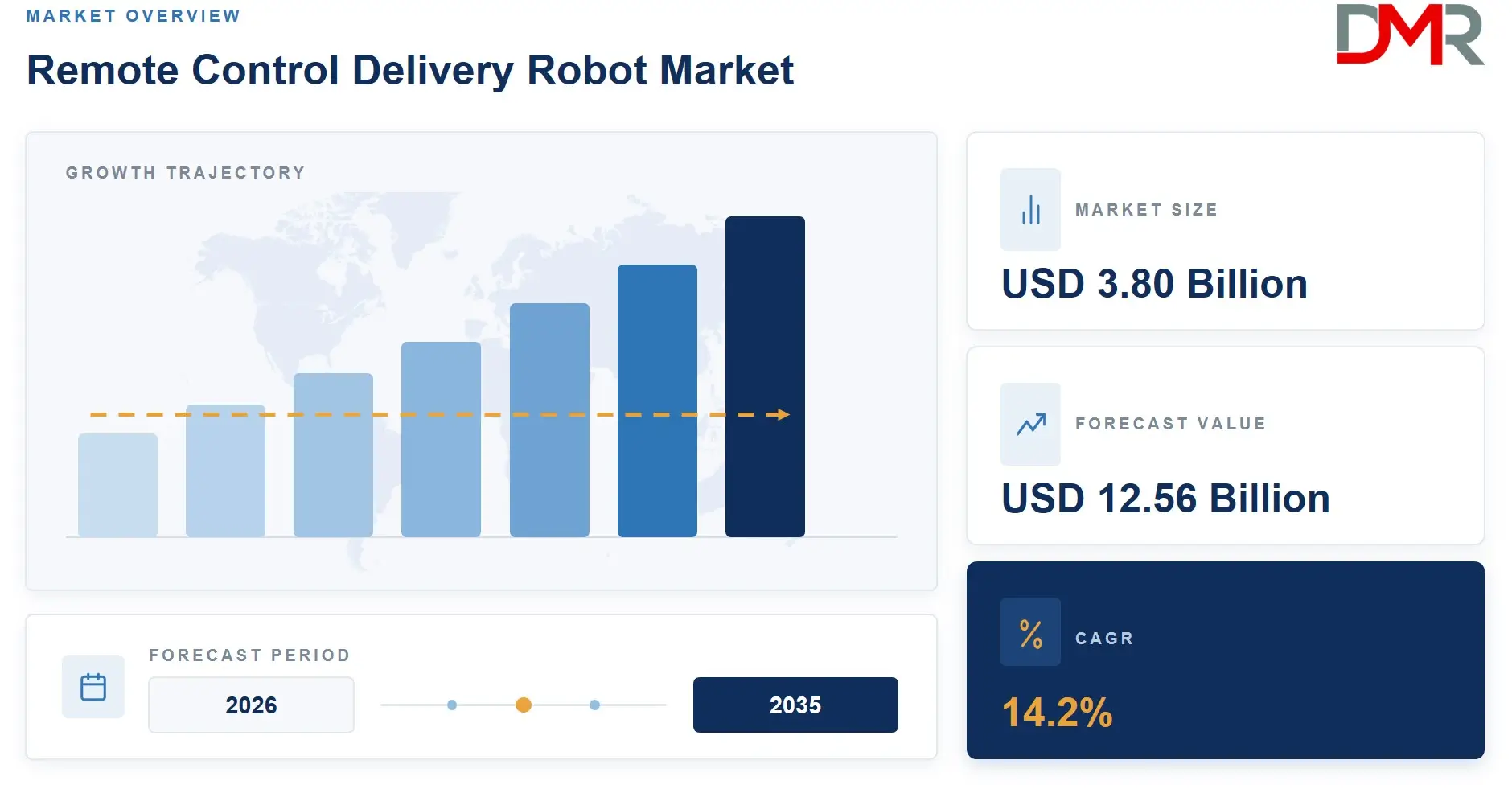
The Global Remote Control Delivery Robot Market size is estimated at USD 3.80 Billion in 2026 from USD 3.33 Billion in 2025, and is projected to reach USD 12.56 Billion by 2035, exhibiting a CAGR of 14.2% during the forecast period.
Historical growth reflects operator-level proof points compounding faster than analysts originally modeled. Starship Technologies surpassed 8 million autonomous deliveries and over 10 million miles globally by April 2025, as reported by Starship. Each completed delivery adds to a publicly verifiable dataset that enterprise buyers use to justify procurement decisions. Volume milestones, not press releases, are what shift institutional purchase cycles.
ℹ
To learn more about this report –
Download Your Free Sample Report Here
In October 2025, Starship Technologies completed a USD 50 million Series C round led by Plural, bringing total funding above USD 280 million to support U.S. urban market expansion. Capital raises of this size indicate that institutional investors now view the 2026–2028 window as the critical scale period. The forecast assumes continued cost compression in robot hardware, stable regulatory frameworks in core markets, and food delivery maintaining volume leadership through 2028 before healthcare and retail verticals close the gap.
Application Analysis
Food Delivery led the Application segment with a 40.7% share in 2026.
Food delivery's dominance reflects operational conditions that favour sidewalk robots more than any other category. High order frequency within dense residential zones creates the route repetition robots require for efficiency. Platforms such as Uber Eats and DoorDash have already built the consumer behaviour and the infrastructure that robots plug into directly, reducing adoption friction for operators.
Retail delivery, healthcare delivery, and logistics support each represent expansion territory with distinct adoption curves. Retail deployments concentrate on convenience items with predictable demand windows, giving operators manageable scheduling complexity. Healthcare delivery is advancing fastest in controlled campus settings where route variability is low and regulatory tolerance is higher than on public sidewalks. Logistics support inside corporate campuses and warehouses operates entirely outside public right-of-way regulation, which removes the single largest barrier slowing outdoor deployment. Vendors targeting all three verticals simultaneously will spread fleet resources thin. Concentrated vertical entry with API-ready platforms gives challengers the faster path to unit economics.
End Use Analysis
With a 39.8% share in 2026, Commercial outpaced all other End Use categories.
Commercial operators, including restaurant chains, retailers, and mixed-use property owners, generate the order density that justifies fleet investment. A single commercial district contract can sustain dozens of robots across predictable route patterns. Campus and business-district deployments offer 24/7 operation cycles that residential routes cannot match, which directly improves return on each deployed unit.
Residential adoption remains constrained by uneven order density across suburban and low-rise housing stock. Robots running one or two deliveries per hour per unit are not commercially viable. Healthcare as an end-use segment bypasses density requirements, because hospitals and care campuses generate consistent internal logistics demand. Pharmacy-to-patient delivery within facility grounds is the fastest-growing use case inside this segment, driven by infection-control protocols that make contactless internal transport a clinical preference rather than a cost convenience.
Type Analysis
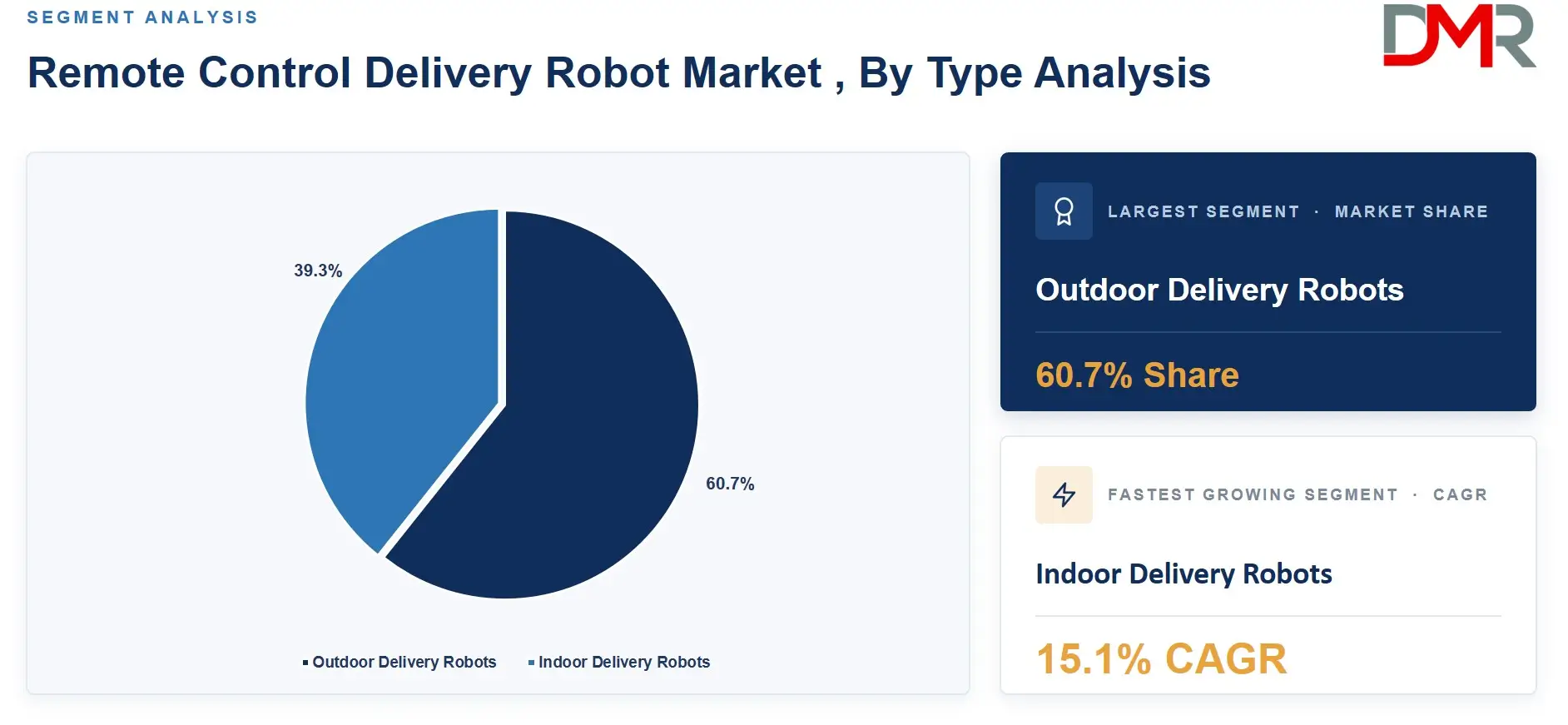
Outdoor Delivery Robots accounted for 60.7% of Type demand in 2026, the highest of any category.
Outdoor robots serve the routes that generate the most commercial volume: public sidewalks connecting restaurants, retailers, and residential buildings. GPS-plus-computer-vision navigation stacks now handle the majority of standard urban environments without human intervention, making outdoor platforms viable at commercial scale. North America's 46.9% regional share reinforces this, since U.S. cities have produced the regulatory frameworks and the operator base where outdoor robots have earned the most deployment hours.
ℹ
To learn more about this report –
Download Your Free Sample Report Here
Indoor delivery robots operate in environments with controlled variables: consistent lighting, predictable foot traffic, and no weather exposure. Hotels, hospitals, and office towers represent the primary deployment base. Growth inside this sub-segment is accelerating as building operators seek to reduce internal logistics labour costs. A hybrid architecture, where an outdoor robot hands off a payload to an indoor unit at a building entry point, is emerging as the model for dense urban towers and large campuses. Vendors that engineer clean handoff protocols between outdoor and indoor units will own the premium tier of corporate campus contracts.
Navigation Technology Analysis
A combined GPS Navigation, Computer Vision, and LiDAR Technology stack defines competitive capability in 2026, with no single navigation method holding category dominance in isolation.
GPS navigation provides the foundational route-level positioning that makes autonomous sidewalk travel commercially executable. Computer vision handles dynamic obstacle detection, the capability that determines pedestrian-safety outcomes at the street level. LiDAR adds depth mapping precision that neither GPS nor cameras deliver alone, particularly in low-light conditions and crowded pedestrian environments where shadow and glare reduce camera reliability.
Vendors competing on navigation stack integration, rather than on any single sensor technology, hold structural advantage. A robot dependent on GPS alone fails in urban canyons. A camera-only unit underperforms in night-time and poor-weather conditions. The commercial winners are platforms that fuse all three modalities and apply remote human oversight as the backstop for edge cases. Buyers evaluating fleets now treat navigation redundancy as a procurement baseline, not a premium feature.
Key Market Segments
By Application
- Food Delivery
- Retail Delivery
- Healthcare Delivery
- Logistics Support
By End Use
- Residential
- Commercial
- Healthcare
By Type
- Outdoor Delivery Robots
- Indoor Delivery Robots
By Navigation Technology
- GPS Navigation
- Computer Vision
- LiDAR Technology
Regional Analysis
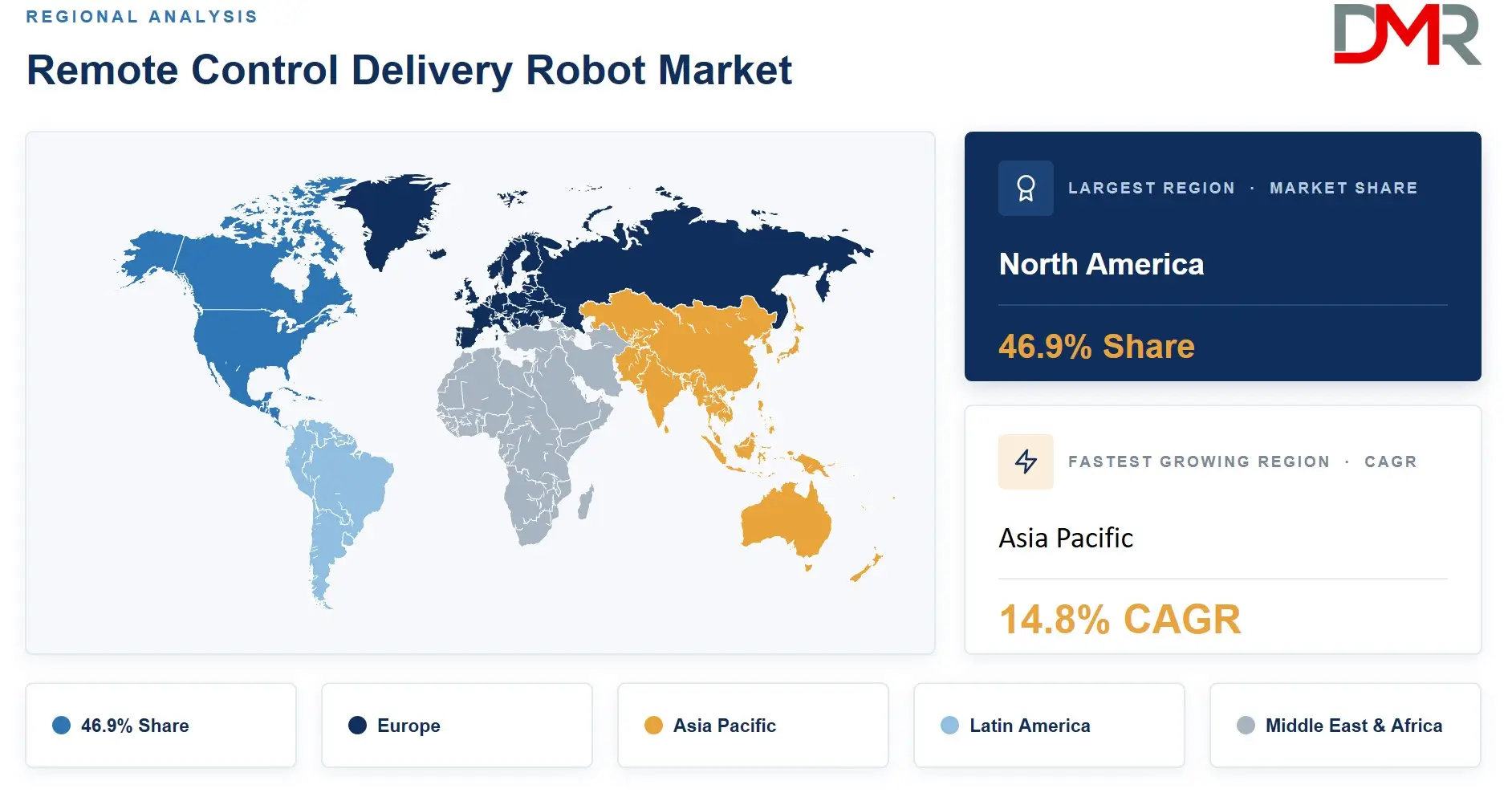
North America led all regions with a 46.9% share in 2026, equivalent to USD 1.56 Billion of the global market.
North America's position reflects a combination of regulatory experimentation, platform density, and venture-backed fleet scaling that no other region has yet matched. U.S. cities including Los Angeles, San Jose, and Miami have issued operational permits that allow commercial sidewalk robots at scale. The dominant food delivery platforms, Uber Eats and DoorDash, are headquartered in the U.S. and have actively integrated robot fleets into their app ecosystems, providing a commercial demand base that European and Asian operators are still assembling.
ℹ
To learn more about this report –
Download Your Free Sample Report Here
Europe holds the second-largest revenue base, with Starship Technologies' U.K., German, and Estonian deployments accounting for the majority of commercial robot-hours outside North America. Asia Pacific is the fastest-growing region, where dense urban environments in China, Japan, and South Korea combine high order volumes with supportive municipal infrastructure pilots. Latin America and the Middle East and Africa remain early-stage, but campus and corporate logistics deployments in Brazil and the UAE are establishing the operational benchmarks that will underpin broader regional rollouts through 2030.
Key Regions and Countries
North America
Europe
- Germany
- France
- The UK
- Spain
- Italy
- Rest of Europe
Asia Pacific
- China
- Japan
- South Korea
- India
- Australia
- Rest of APAC
Latin America
- Brazil
- Mexico
- Rest of Latin America
Middle East & Africa
- GCC
- South Africa
- Rest of MEA
Market Dynamics
Last-Mile Cost Elimination Reshapes Operator Economics
Eliminating human driver expenses cuts per-delivery cost by 30–50%, based on operator data from active commercial deployments. Robots running 1–1.5 mile routes consume energy equivalent to boiling one kettle cup per delivery, against the full fuel, insurance, and labour cost of a gas-vehicle courier. Cost reductions of this magnitude do not require high delivery volumes to justify fleet investment; they change the unit economics from day one of deployment.
Serve Robotics delivered over 120 new third-generation robots ahead of schedule in Q2 2025, as confirmed by the company. Speed of fleet delivery signals that hardware manufacturing bottlenecks, which slowed commercial scaling in 2022 and 2023, are now resolved. In August 2025, Serve Robotics and Little Caesars launched autonomous robot pizza delivery via Uber Eats across Serve's Los Angeles service area, converting a platform integration into a named commercial partnership that other restaurant operators can benchmark against.
Pedestrian Safety Incidents and Municipal Bans Limit Deployment Zones
A five-day study on the Northern Arizona University campus documented 40 dangerous near-misses and an additional 60 moderate-risk interactions between pedestrians and sidewalk delivery robots, with robots most often at fault, as reported by Policy Options in January 2025. Cities including Jackson, Wyoming and Knoxville, Tennessee have enacted outright sidewalk-robot bans in response to safety complaints. Each new ban reduces the total addressable deployment area and signals to risk-averse municipalities that caution is the politically defensible default.
Crash-test studies cited in 2025 show that impacts involving larger 60-kilogram robots travelling at 11 km/h can cause severe injuries, particularly torso and head trauma for children, as reported by Policy Options. Older adults, wheelchair users, and people with disabilities face disproportionate risk on shared pedestrian infrastructure. Vendors that cannot demonstrate measurable safety improvements in independent studies will find regulatory doors closing faster than commercial partnerships can open them.
Vertical Expansion and Service Models Open New Revenue Pools
Food delivery robots operating profitable routes prove the hardware and software stack before operators expand into pharmaceuticals, convenience retail, and internal corporate logistics. Each new vertical does not require a redesigned robot; it requires a new API integration and a revised regulatory filing. Robot-as-a-Service models lower the ownership barrier for retailers and campus operators who cannot justify fleet capital expenditure but will pay per-delivery fees. Startup House data confirms that robots operate most cost-effectively at 50+ daily orders per square kilometre within a 3-mile radius, a density threshold that campus deployments routinely exceed.
Hybrid drone-plus-sidewalk-robot architectures extend service range beyond the 3-mile sidewalk limit, opening suburban and peri-urban zones that pure sidewalk fleets cannot serve. Campus and mixed-use district operators represent the most accessible entry point: controlled environments, 24/7 demand cycles, and no public right-of-way permit required. Vendors that own a campus or corporate logistics contract by 2027 will hold a reference account that accelerates adjacent municipal contract bids.
Market Trends
Teleoperation and Regulatory Standardisation Define the Next Operating Model
Remote human monitoring layered over GPS-camera-AI navigation is replacing fully autonomous operation as the commercial standard. A human operator overseeing dozens of robots simultaneously reduces liability exposure without sacrificing delivery speed. Policy Options confirmed in January 2025 that sidewalk robots generally max out at 45 kilograms with speeds of 7 km/h, and cities are now drafting regulatory sandboxes that encode these limits as enforceable standards. Operators that build compliant fleets now avoid costly retrofits as regulations firm up through 2027.
Market Competition Overview
The remote control delivery robot market is moderately fragmented, with a small number of venture-backed specialists holding significant share alongside a broader tier of regional and vertical-focused entrants. No single operator controls more than a quarter of global deployment hours, but fleet scale is rapidly becoming the differentiator that separates fundable businesses from those unable to secure enterprise contracts. Starship operated more than 3,000 robots across eight countries as of April 2026, as reported by ZAGdaily, making multi-country deployment reach the clearest proxy for competitive standing.
Platform partnerships with major food delivery apps represent the most consequential competitive variable. Operators locked into multi-year agreements with Uber Eats or DoorDash gain order volume guarantees that justify hardware investment. Rivals without platform agreements must self-generate demand through direct restaurant or retailer contracts, which increases sales cycles and raises customer acquisition costs. Consolidation pressure will intensify through 2027 as hardware manufacturing costs fall and scale advantages compound for early fleet leaders.
Company Profiles
Starship Technologies built its competitive position on proof-by-volume at a pace no rival has matched. By April 2026, the company reached 10 million autonomous deliveries and had travelled over 22 million autonomous kilometres, completing around 200 million individual road crossings across eight countries, as reported by ZAGdaily. Operating in the UK, US, Germany, Switzerland, Sweden, Estonia, and beyond, Starship's multi-country reach gives it a regulatory learning advantage: insights from compliance frameworks in one country accelerate permit applications in the next. The risk is concentration in food and campus delivery segments as new verticals attract competing specialist platforms.
Serve Robotics executed the fastest fleet scaling in U.S. history for this category. By December 2025, the company built 2,000 autonomous delivery robots, growing its active fleet twentyfold during 2025 to become the largest sidewalk delivery fleet in the U.S., as confirmed by GlobeNewswire. Multi-year contracts with Uber Eats and expanding partnerships with DoorDash and 7-Eleven create demand-side lock-in that limits fleet downtime. Serve's third-generation hardware, delivered ahead of schedule, signals a manufacturing relationship mature enough to support rapid further expansion.
Key Players
- Starship Technologies
- Savioke
- Nuro
- Einride
- Gatik
- Robomart
- Kiwibot
- Amazon Robotics
- Fetch Robotics
- Kindred AI
- TeleRetail
- Manna Aero
- Drone Delivery Canada
- Agility Robotics
- TUG Robotics
- Berkshire Grey
- Serve Robotics
Supply Chain and Value Chain Analysis
Component supply for delivery robots flows from semiconductor and sensor manufacturers supplying LiDAR modules, cameras, and GPS units, through battery and chassis fabricators, to robot assembly operations concentrated in North America, Europe, and East Asia. Software development and navigation stack integration represent the highest-value layer: platform operators that own proprietary navigation software retain margin that hardware assemblers cannot. The downstream layer, comprising restaurant operators, retailers, and campus logistics managers, holds leverage through platform partnership agreements that determine fleet utilisation rates. The primary bottleneck in 2025 and 2026 is LiDAR module supply, where a small number of suppliers serve the entire autonomous mobility category simultaneously.
Regulatory Landscape
North America's regulatory environment is bifurcated. States including California, Texas, and Virginia have enacted legislation explicitly permitting sidewalk robots on public pavements within defined speed and weight limits. Outright bans in cities including Jackson, Wyoming and Knoxville, Tennessee demonstrate that municipal governments retain authority to override state-level permissive frameworks. Operators must manage a city-by-city permit matrix rather than a single national standard, which raises compliance costs proportionally with fleet geographic spread.
European regulators are advancing through pilot-programme frameworks, with the UK and Germany the most active. China-style deployments at scale are influencing Western city planners to draft regulatory sandboxes that encode speed ceilings and weight limits as enforceable standards. Operators whose hardware already complies with the emerging 8–10 km/h speed cap and sub-30 kg weight standard face no retrofit cost when sandbox frameworks become binding regulation.
Investment and White Space Analysis
Venture capital has concentrated in fleet-scale operators and navigation software platforms, with Coco Robotics, Starship Technologies, and Serve Robotics collectively raising hundreds of millions across 2025 and 2026. White space exists in three areas: pharmaceutical last-mile delivery where regulatory approval for robot-based drug transport remains underdeveloped; indoor-to-outdoor handoff technology where no vendor has yet established a dominant protocol standard; and Latin American and Middle Eastern urban markets where robot deployments are minimal despite sufficient order density in major metro areas. A Robot-as-a-Service business model targeting campus operators in Asia Pacific and the Middle East requires lower capital deployment than fleet ownership models and carries faster payback periods in high-density environments.
Recent Developments
- June 2025 — Coco Robotics raised USD 80 million in strategic financing backed by Sam and Max Altman, Pelion, and Ryan Graves, advancing its AI platform toward a target of 10,000 vehicles by 2026.
- November 2025 — Serve Robotics expanded its platform agreements by adding DoorDash alongside Uber Eats, with contracts covering deployment of up to 2,000 robots on Uber Eats and a new 7-Eleven retail partnership.
- June 2026 — Serve Robotics launched an autonomous laundry delivery vertical through a new partnership with NoScrubs, moving beyond food delivery into on-demand household services.
Report Details
| Report Characteristics |
| Market Value (2025) |
USD 3.33 Billion |
| Market Value (2026) |
USD 3.80 Billion |
| Forecast Revenue (2035) |
USD 12.56 Billion |
| CAGR (2026–2035) |
14.2% |
| Base Year for Estimation |
2025 |
| Historic Period |
2020 – 2024 |
| Forecast Period |
2026 – 2035 |
| Report Coverage |
Revenue Forecast, Market Dynamics, Competitive Landscape, Recent Developments |
| Segments Covered |
By Application (Food Delivery, Retail Delivery, Healthcare Delivery, Logistics Support), By End Use (Residential, Commercial, Healthcare), By Type (Outdoor Delivery Robots, Indoor Delivery Robots), By Navigation Technology (GPS Navigation, Computer Vision, LiDAR Technology) |
| Regional Analysis |
North America – US and Canada; Europe – Germany, France, The UK, Spain, Italy, and Rest of Europe; Asia Pacific – China, Japan, South Korea, India, Australia, and Rest of APAC; Latin America – Brazil, Mexico, and Rest of Latin America; Middle East & Africa – GCC, South Africa, and Rest of MEA |
| Competitive Landscape |
Savioke, Nuro, Starship Technologies, Einride, Gatik, Robomart, Kiwibot, Amazon Robotics, Fetch Robotics, Kindred AI, TeleRetail, Manna Aero, Drone Delivery Canada, Agility Robotics, TUG Robotics, Berkshire Grey, Serve Robotics |
| Customization Scope |
Customization for segments and region or country level will be provided. Additional customization can be done based on requirements. |
| Purchase Options |
Three license options: Single User License, Multi-User License (Up to 5 Users), and Corporate Use License (Unlimited Users and Printable PDF) |
Frequently Asked Questions
What is the biggest investment opportunity in Remote Control Delivery Robot Market ?
▾ Robot-as-a-Service models targeting campus and mixed-use district operators represent the most accessible entry point for new capital. These deployments avoid public right-of-way regulatory risk, generate 24/7 utilisation rates, and require lower upfront fleet investment than urban sidewalk programmes. Pharmaceutical last-mile delivery is the highest-value underpenetrated vertical through 2030.
Who are the top companies in Remote Control Delivery Robot Market ?
▾ Starship Technologies and Serve Robotics lead on active fleet size and commercial deployment scale. Starship holds the largest global footprint across eight countries, while Serve Robotics operates the largest sidewalk delivery fleet in the U.S. Nuro, Kiwibot, and Amazon Robotics are the most strategically positioned among the second tier.
Which segment is growing fastest opportunity in Remote Control Delivery Robot Market and why?
▾ Indoor Delivery Robots within the Type segment and Healthcare within the End Use segment are both expanding faster than their respective category averages. Controlled facility environments remove the pedestrian-safety and regulatory variables that slow outdoor deployments. Hospital and care-campus operators face structural labour cost pressure that makes robotic internal logistics a financial necessity rather than a discretionary investment.
Which region is growing fastest opportunity in Remote Control Delivery Robot Market and why?
▾ Asia Pacific is the fastest-growing region, driven by dense urban environments in China, Japan, and South Korea that combine high food delivery order volumes with municipal infrastructure designed to accommodate autonomous vehicles. Government-backed pilot programmes in China are producing the regulatory templates that other APAC cities are now adapting and accelerating commercial rollout timelines across the region.
What is the biggest challenge holding Remote Control Delivery Robot Market back?
▾ Fragmented municipal regulation is the primary constraint on commercial scaling. City-level bans and inconsistent permit requirements force operators to manage a complex compliance matrix that raises costs and limits fleet geographic coverage. A five-day campus study published in January 2025 documented 40 dangerous near-misses between pedestrians and sidewalk robots, giving regulators the safety evidence base to justify restrictive action.