Market Overview
The global reusable period panties market covers washable, multi-layer absorbent underwear designed to manage menstrual flow without disposable inserts. The category excludes disposable menstrual pads, tampons, menstrual cups, and hormonal contraceptive products, though it competes directly with all of them at the point of purchase. Buyers range from individual consumers seeking lower lifetime menstrual costs to institutional purchasers such as schools, health insurers, and employers procuring starter kits for menstrual-wellness programs.
Period underwear sits at the intersection of femtech, sustainable apparel, and women's health. Consumer health brands repositioned the product from a backup protection item to a primary standalone menstrual-care solution between 2022 and 2025, expanding the addressable buyer pool well beyond early adopters. Brands that built direct-to-consumer subscription channels in that window now hold structural acquisition cost advantages over late entrants selling through general retail.
Aisle's Super Boxer, for example, replaces more than 100 disposable menstrual products over its usable life while remaining machine-washable and machine-dryable, a specification that directly quantifies the lifetime value argument brands use to convert price-sensitive buyers. In March 2026, WUKA scaled its UK brick-and-mortar footprint from 300 to more than 1,800 Tesco and Tesco Express locations, demonstrating that the category has moved beyond specialty retail into mainstream grocery channels.
Key Takeaways
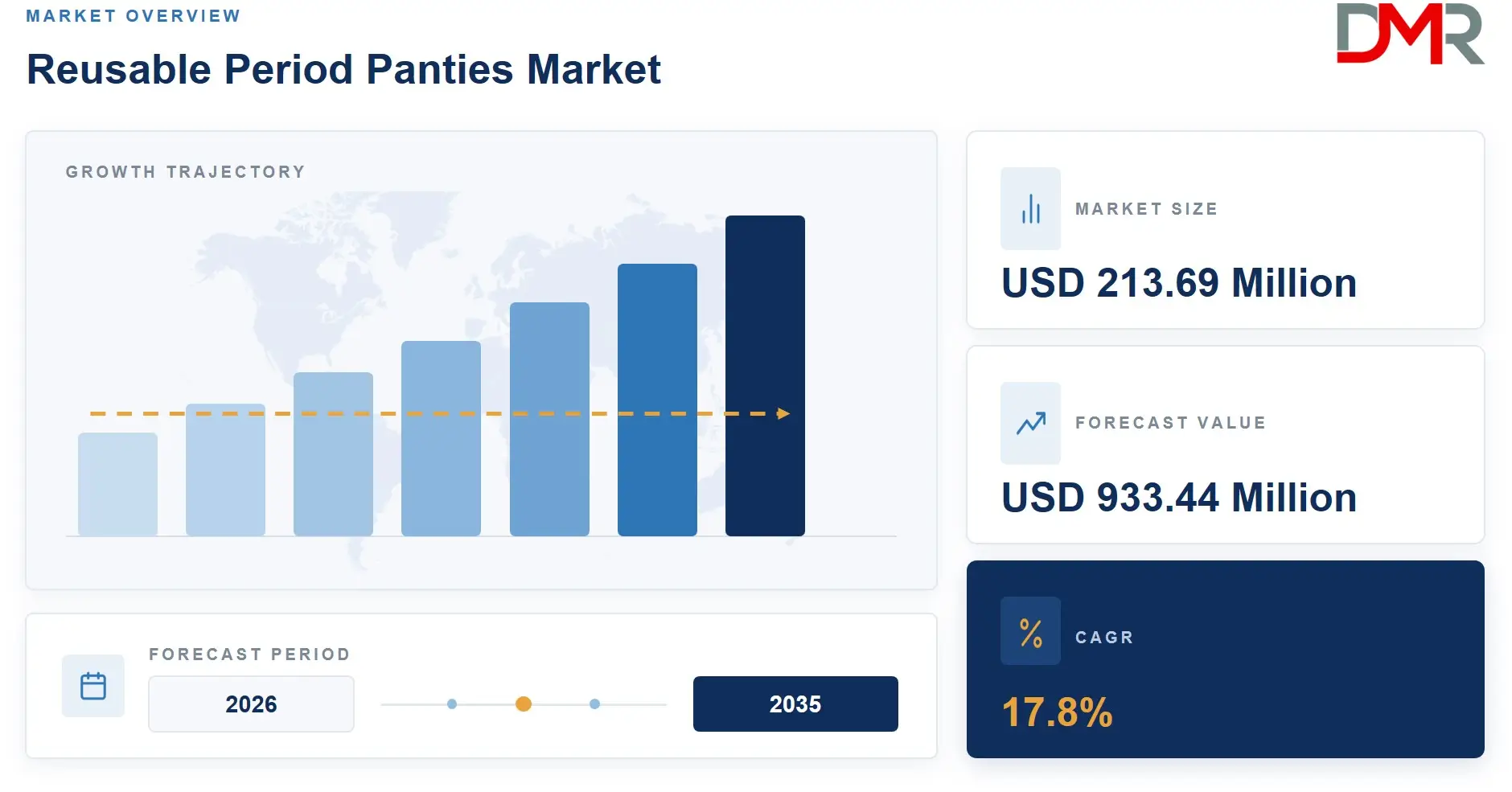
- The market size is USD 213.69 Million in 2026, and is projected to hit USD 933.44 Million by 2035 at a CAGR of 17.8%.
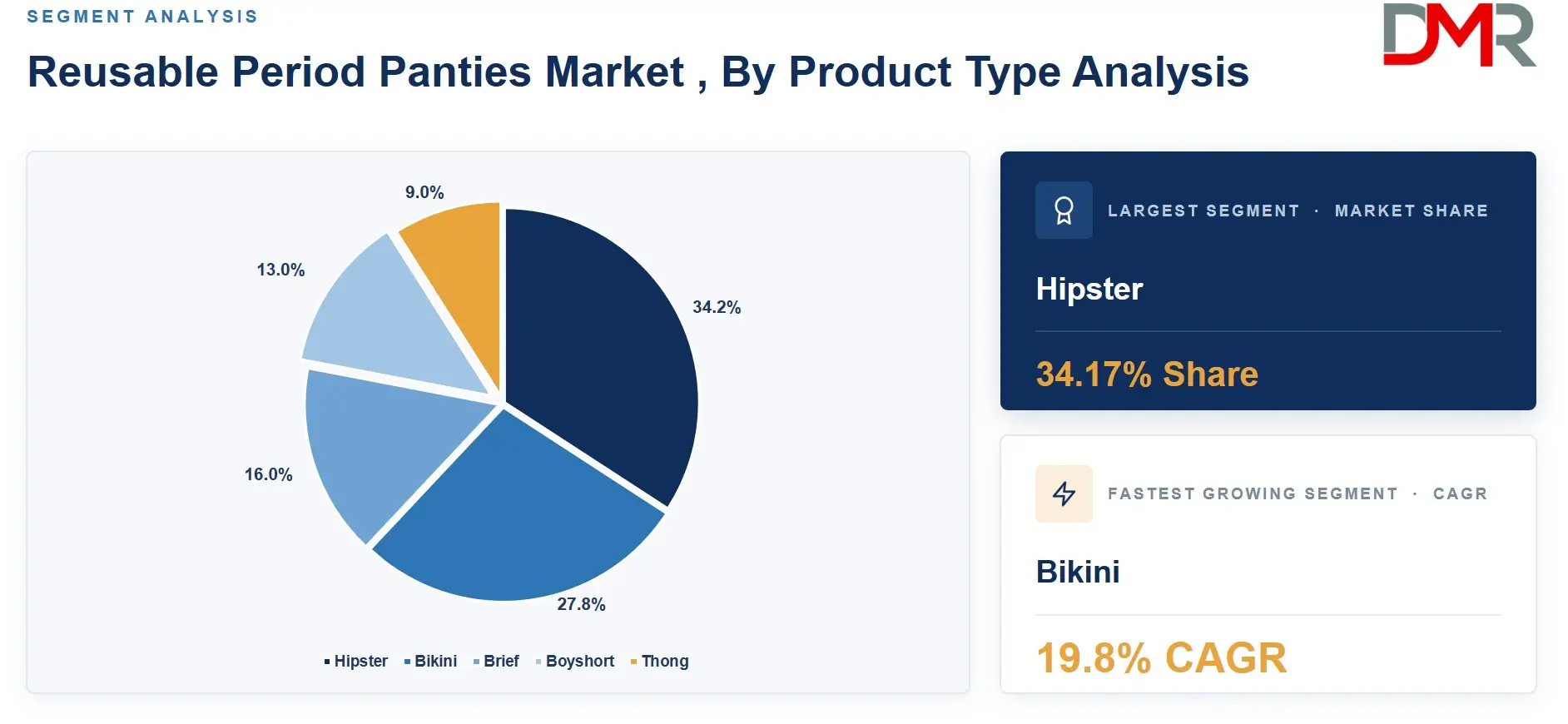
- By Product Type: Hipster led with a 34.17% share in 2026.
- By Distribution Channel: Pharmacies and Drug Stores led with a 55.7% share in 2026.
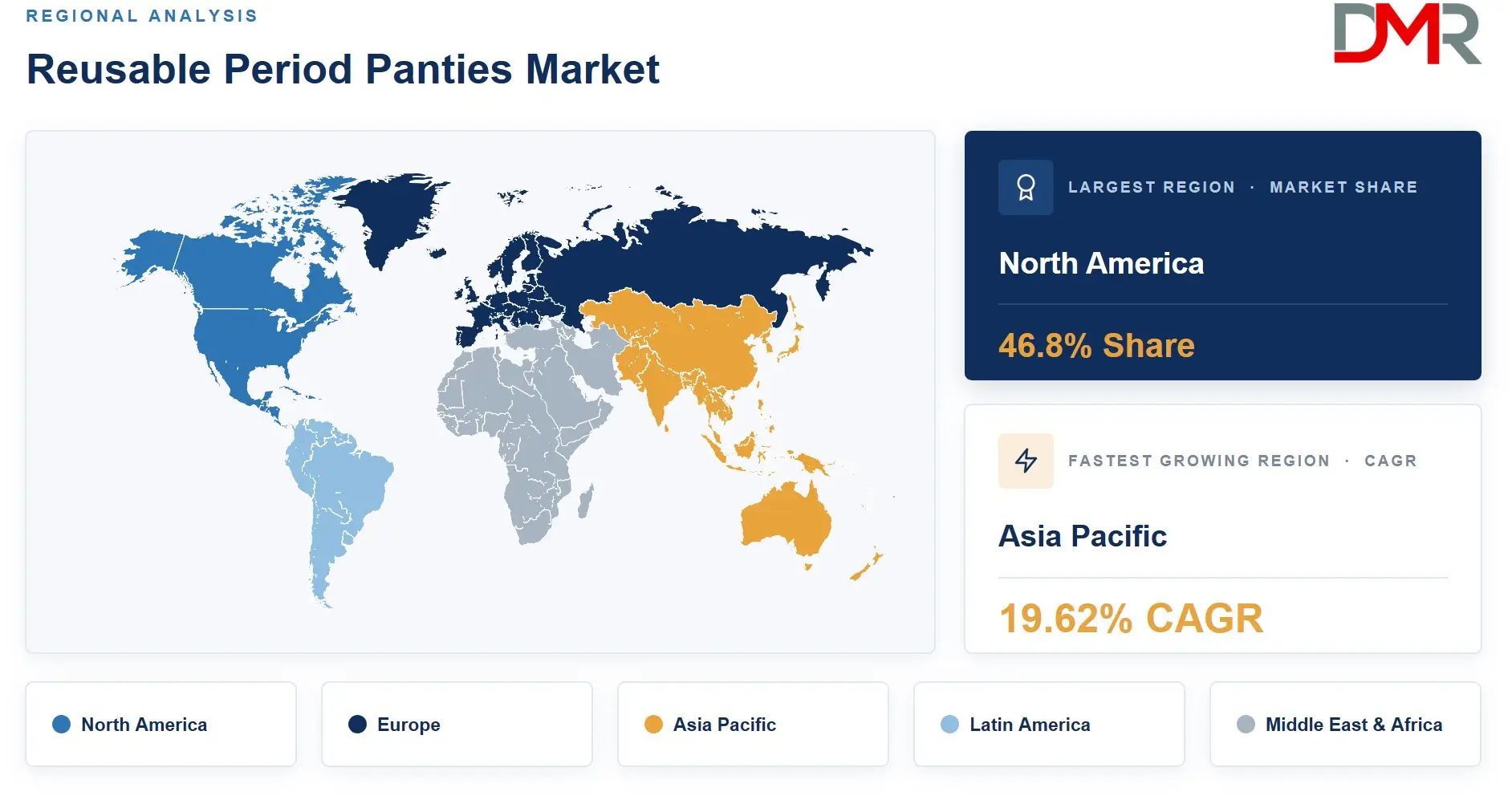
- By Region: North America led with a 46.8% share, valued at USD 99.99 Million, in 2026.
- Bikini is the fastest-growing product type at a CAGR of 19.8%, outpacing the overall market rate.
- Online Retail is the fastest-growing distribution channel at a CAGR of 19.4%, driven by direct-to-consumer subscription models and social-led brand education.
- Asia-Pacific is the fastest-growing region at a CAGR of 19.62%, ahead of the global market average.
Market Size and Forecast
The Global Reusable Period Panties Market size is estimated at USD 213.69 Million in 2026, and is projected to reach USD 933.44 Million by 2035, exhibiting a CAGR of 17.8% during the forecast period.
Growth between 2020 and 2024 was driven by a narrow base of sustainability-focused consumers in North America and Western Europe. Category awareness expanded after femtech brands invested in social-led education campaigns that normalized menstrual conversation and positioned reusable underwear as a cost-saving primary-use product rather than an emergency backup. Those early-market dynamics created a platform on which the current forecast compounds.
ℹ
To learn more about this report –
Download Your Free Sample Report Here
The 17.8% CAGR reflects two structural assumptions: continued trade-down from disposable products as cost-per-cycle comparisons become more visible to buyers, and incremental market expansion into adjacent use cases including postpartum recovery and light bladder leakage. Downside risk concentrates around PFAS and textile-chemical scrutiny, which raises brand compliance costs and could slow conversion in markets where product safety trust remains low.
Product Type Analysis
Hipster led the Product Type segment with a 34.17% share in 2026.
The Hipster style commands the largest share because its mid-rise coverage profile and full-seat gusset geometry suit the widest range of flow volumes and body shapes. Buyers selecting a first pair of period underwear default to a familiar, low-risk silhouette, and the Hipster delivers that while meeting moderate-to-heavy absorbency requirements. WUKA's 2026 Super Heavy variant demonstrates how far the format has scaled: a single Hipster-adjacent style now holds up to 60 ml, equivalent to approximately 12 regular tampons, serving very heavy flow, postpartum use, long work shifts, and overnight wear simultaneously.
ℹ
To learn more about this report –
Download Your Free Sample Report Here
Bikini is the fastest-growing product type at a 19.8% CAGR, driven by warmer-climate markets and younger buyers who prioritize low-profile underwear under fitted clothing. Brief and Boyshort styles retain steady demand among buyers prioritizing security over aesthetics, while the Thong remains a specialist category for light-flow days or spotting. Vendors that offer a complete absorbency spectrum across multiple silhouettes reduce the barrier to full disposable replacement, which is now the core conversion goal for the category's leading brands.
Distribution Channel Analysis
With a 55.7% share in 2026, Pharmacies and Drug Stores outpaced all other Distribution Channel categories.
Pharmacy dominance reflects the category's positioning as a health and hygiene purchase rather than a fashion item. Consumers browsing menstrual care aisles encounter period underwear alongside pads and tampons, reducing the perceived category leap. Pharmacy chains provide the planogram adjacency that accelerates trial among buyers who have not yet searched online for the product. That positioning also supports the premium price point, as health-channel shoppers consistently assign higher product credibility to pharmacy-distributed goods than to general-retail equivalents.
Online Retail is the fastest-growing channel at a 19.4% CAGR, compressing the gap with pharmacy every year. Direct-to-consumer brands built subscription replenishment programs and social content engines between 2022 and 2025 that lowered customer acquisition costs and raised repeat-purchase rates beyond what physical retail can match. Supermarkets and Hypermarkets and Specialty Stores serve distinct buyer profiles: grocery buyers prioritize convenience and brand recognition, while specialty store buyers seek technical performance specifications and expert staff guidance.
Key Market Segments
By Product Type
- Hipster
- Bikini
- Brief
- Boyshort
- Thong
By Distribution Channel
- Pharmacies and Drug Stores
- Supermarkets and Hypermarkets
- Specialty Stores
- Online Retail
Regional Analysis
North America led the regional segment with a 46.8% share, valued at USD 99.99 Million, in 2026.
North America
North America dominates because the category was commercially pioneered and scaled there. US-based brands built direct-to-consumer infrastructure, social proof ecosystems, and pharmacy distribution networks years before competitors in other regions achieved comparable reach. Consumer willingness to pay a premium for certified organic or PFAS-free products sustains average selling prices well above the global mean, protecting margin even as the market broadens to price-sensitive segments.
Asia-Pacific
Asia-Pacific is the fastest-growing region at a 19.62% CAGR, ahead of the global market average. Menstrual-hygiene education programs in India, Southeast Asia, and parts of East Asia are converting first-time buyers at scale, many of whom previously lacked reliable access to any standardized menstrual product. Localized value-tier manufacturing reduces cost-per-unit to levels that open addressable markets that premium North American pricing structures cannot reach.
ℹ
To learn more about this report –
Download Your Free Sample Report Here
Europe
European growth is anchored by the UK, Germany, and the Nordic countries, where regulatory pressure on single-use plastics and consumer-facing sustainability reporting accelerate trade-up from disposable pads. UK brands operate with particularly strong brand equity. WUKA's national scale in UK pharmacy and grocery channels reflects how domestic-brand incumbency creates distribution advantages that offshore entrants struggle to replicate quickly.
Latin America
Latin America represents an early-stage opportunity. Brazil and Mexico hold the largest addressable populations, but price sensitivity limits penetration to mid-tier and premium SKUs among urban, higher-income buyers. Affordability remains the primary structural constraint. Brands entering this region through B2B2C pharmacy or health-insurer partnerships face lower customer-acquisition costs than pure direct-to-consumer strategies.
Middle East & Africa
Middle East and Africa is the smallest regional segment by current revenue, but menstrual-health advocacy programs and NGO-led distribution initiatives are seeding awareness ahead of commercial-scale retail entry. GCC markets show demand for premium period-care products among higher-income urban women, while Sub-Saharan Africa requires locally manufactured, sub-USD price points to achieve meaningful volume.
Key Regions and Countries
North America
Europe
- Germany
- France
- The UK
- Spain
- Italy
- Rest of Europe
Asia Pacific
- China
- Japan
- South Korea
- India
- Australia
- Rest of APAC
Latin America
- Brazil
- Mexico
- Rest of Latin America
Middle East & Africa
- GCC
- South Africa
- Rest of MEA
Macroeconomic Impact
Disposable pad and tampon price inflation between 2022 and 2025 materially strengthened the lifetime-cost argument for reusable period underwear. Consumers calculating cost-per-cycle found that a two-to-four pair starter kit, amortized over two or more years, undercuts annual disposable expenditure by a measurable margin. Inflation therefore acted as an involuntary marketing event for the reusable category, accelerating conversion among price-aware buyers who would not otherwise have evaluated the switch.
Interest rate environments that constrain discretionary spending create a short-term headwind for first-purchase conversion, as the upfront multi-pair cost remains a barrier for lower-income households. Currency depreciation in high-growth emerging markets raises the local-currency cost of imported premium brands, creating openings for domestically manufactured value-tier products. GDP growth in Asia-Pacific and Latin America generates the expanding middle-class income base that underpins the category's fastest-growth regional forecasts.
Market Dynamics
Driver: Lifetime Cost Savings and Waste Reduction Converting Buyers
Single-use menstrual waste reduction has become a consumer-facing priority, and brands that quantify the environmental and financial payoff of switching convert buyers faster than those relying on abstract sustainability messaging. Aisle's Essential High-Rise Brief is designed to replace more than 100 disposable menstrual products over its usable life, a product-specification claim that directly addresses the payback-period objection at the point of purchase.
Multi-layer leakproof fabric engineering compounds the driver by eliminating the performance anxiety that historically kept buyers tethered to disposables. WUKA's Super Heavy Flow Period Pants absorb up to 60 ml of menstrual fluid, equivalent to approximately 12 regular tampons in a single garment. Technical performance at that level removes the residual use-case gap between reusable and disposable protection, enabling brands to target heavy-flow consumers who previously had no credible reusable alternative.
Restraint: Upfront Cost and PFAS Scrutiny Slowing Adoption
A full starter kit of three to four pairs from a premium brand represents a meaningful upfront spend for price-sensitive consumers in lower-income brackets. Buyers accustomed to paying per-pack for disposables face a purchasing psychology shift, and without a trial or subsidy mechanism, many defer the conversion decision indefinitely. The upfront cost barrier is structurally most acute in emerging markets where per-capita disposable income is lowest and category awareness is newest.
PFAS and textile-chemical scrutiny adds compliance cost and reputational risk for brands that cannot demonstrate ingredient transparency. Regulatory bodies in the US, EU, and Australia have each initiated investigation or disclosure requirements covering per- and polyfluoroalkyl substances in textiles. Brands selling into multiple markets now carry parallel testing, disclosure, and reformulation burdens that smaller challengers with fewer resources struggle to absorb without raising prices.
Opportunity: Adjacent Use Cases and B2B Distribution Expanding the Market
Postpartum recovery, light bladder leakage, and perimenopause represent three adjacent use cases that extend period underwear revenue beyond the menstrual cycle. Modibodi's 2026 absorbency architecture spans Light at up to 4 tampons' worth of fluid through Moderate at up to 6, and Super at up to 10, covering a range wide enough to address postpartum flow and light incontinence in a single product line. Brands that claim these adjacencies now build recurring revenue from buyers who no longer menstruate but retain a reusable-underwear habit.
In June 2026, WUKA launched the Lunafly Competition Swimwear Collection, developed with three-time Olympian Hannah Miley, positioning period underwear technology inside competitive sport apparel for the first time. B2B2C partnerships with health insurers, employers, and pharmacies offer a parallel channel to acquire buyers at subsidized first-purchase costs, reducing the price-barrier restraint while building brand exposure in institutional procurement pipelines.
Porter's Five Forces
Competitive rivalry in the global reusable period panties market is high among premium direct-to-consumer brands and moderate at the mass-market tier, where fewer than five brands command meaningful consumer recognition. New entrant barriers are low on paper because the manufacturing process relies on established textile-industry inputs, but brand trust and PFAS-free certification requirements raise the real cost of credible entry. Good Housekeeping's 2026 laboratory-oriented product review captured the consumer-facing performance spectrum: validated styles range from 1–3 tampon capacity at the light end to 7–11 tampons at the ultra tier, and one tested style showed no shrinkage or visible appearance change after 5 wash cycles. That kind of independent performance verification is becoming a buyer-decision input, raising the cost of entry for brands that cannot secure third-party review placement. Supplier bargaining power is moderate; specialized moisture-wicking and absorbent-layer fabrics are available from a limited set of technical textile manufacturers, creating switching costs for brands that have co-developed proprietary fabric constructions. Buyer bargaining power is increasing as the number of viable brands expands and price comparison becomes easier through e-commerce aggregators. Substitute threat remains relevant from menstrual cups and discs, which offer comparable sustainability credentials at lower per-unit cost, though they require a different use behavior that limits direct overlap.
AI and Gen AI Impact
Generative AI is reshaping demand generation and customer education in the reusable period underwear category more than any other part of the value chain. Direct-to-consumer brands use AI-driven content engines to produce personalized fit guides, flow-absorbency matching tools, and social-commerce content at a scale and speed that traditional marketing teams cannot match. Early movers that built AI-assisted educational content libraries between 2023 and 2025 now operate with lower customer acquisition costs and higher first-purchase conversion rates than brands relying on static product pages.
AI also enters supply chain forecasting, where demand variability tied to seasonal menstrual-wellness campaigns and influencer-driven spikes makes inventory planning complex. Brands using predictive demand models reduce overstock risk on slow-moving silhouettes and avoid stockouts on hero SKUs. Laggards managing inventory manually face margin pressure from both directions simultaneously.
Market Trends
Direct-to-Consumer Channels and Ingredient Transparency Reshaping Category Standards
Direct-to-consumer brands built e-commerce subscription programs and social education channels that now define category norms. A Healthfab reusable period panty rated at 6 times absorbency and designed for up to 2 years of reuse illustrates how the category has made durability a measurable, marketable specification rather than an implied benefit. PFAS-free, organic-cotton, and plastic-free claims are moving from premium differentiators to baseline consumer expectations, meaning brands that cannot substantiate ingredient transparency claims will face buyer skepticism regardless of price positioning. Period underwear has also shifted from a backup-protection to a primary-use product, redefining who the target buyer is and what volume of SKUs brands must carry to serve her across her full flow range.
Market Competition Overview
The reusable period panties market is fragmented at the global level but shows early signs of consolidation in North America and the UK, where two to three brands hold disproportionate awareness share. Direct-to-consumer incumbents built brand moats through content investment, community, and proprietary absorbent-gusset technology. Modibodi's Moderate brief, specified at a 30 ml capacity equivalent to up to 6 tampons, exemplifies how market leaders compete on verified performance data rather than price alone. That shift toward specification-led marketing raises the cost of competing for brands that cannot match the testing and certification investment.
White-label manufacturers supply unbranded period underwear to multiple retail channels simultaneously, compressing margin for branded players in the mass-market segment. Branded leaders respond by deepening patent portfolios, expanding absorbency ranges, and entering adjacent categories such as period swimwear and sport apparel. The competitive dynamic rewards brands with the broadest product range and the highest brand trust simultaneously, a combination that smaller, single-SKU entrants cannot replicate without significant capital investment.
Pricing Analysis
Premium direct-to-consumer brands price individual pairs between USD 20 and USD 50, with absorbency level, fabric certification, and silhouette complexity driving variation within that band. Aisle's Super Hipster, rated for more than 8 tampons' worth of flow, sits at the higher end of the performance tier, where consumers pay a premium for heavy-flow reliability that entry-level products cannot match. Pharmacy-distributed mid-tier products typically price at USD 10 to USD 20 per pair, targeting the same buyers accustomed to purchasing branded pads and tampons in that retail environment.
Brands entering emerging markets face a structural pricing ceiling well below North American or European norms. Localized manufacturing and simplified fabric constructions allow value-tier products to reach USD 5 to USD 12 price points without sacrificing the core absorbency proposition. Challenger brands use entry price points to acquire first-time buyers and then upsell to performance tiers as repeat purchase trust builds. Market leaders protect blended average selling price by ensuring that premium SKUs, not value tiers, anchor their brand perception.
Company Profiles
Thinx Inc. pioneered the category's mainstream positioning in North America and built an early brand equity advantage through high-visibility media campaigns that normalized menstrual conversation. The company's strategic strength lies in brand recognition rather than performance-specification leadership. Sustained competition from technically oriented challengers has pressured Thinx to expand its absorbency range and improve transparency around fabric safety, areas where newer entrants have moved faster.
Aisle Inc. competes on verified technical performance, a positioning that commands premium pricing and generates buyer loyalty among heavy-flow consumers who cannot afford performance failure. Aisle's Essential High-Rise Period Brief absorbs the equivalent of at least 4 regular tampons and is engineered to withstand more than 100 wash cycles, while the Super Boxer holds more than 8 tampons' worth of flow with leak-resistant coverage extending front-to-back and down the inner thigh. Aisle's certification as a B-Corp reinforces ingredient-transparency claims, a competitive differentiator in markets where PFAS scrutiny is rising.
Key Players
- Thinx Inc.
- Knix Wear Inc.
- Modibodi Pty Ltd.
- WUKA Wear Ltd.
- Aisle Inc.
- Saalt LLC
- Proof
- TomboyX
- The Period Company
- Flux Undies
- Ruby Love
- Dear Kate
- Bambody
- Rael
- Femi.Eko
- Hannah Life Technologies
- Neione
- TENA
- Victoria's Secret
- SPEAX
Supply Chain and Value Chain Analysis
The value chain begins at technical textile mills supplying specialized moisture-wicking, absorbent, and leak-barrier fabric layers. Fabric sourcing is the highest-risk node: a limited number of mills produce performance-grade menstrual textile constructions, and brands co-developing proprietary layer configurations face long lead times and minimum-order thresholds that disadvantage small challengers. Cut-and-sew manufacturing is geographically concentrated in South and Southeast Asia, with some nearshore production in Portugal and Mexico serving European and North American brands respectively.
Care requirements constrain end-user behavior throughout the product's life and directly affect durability claims. WUKA's 2026 guidance specifies machine-washing Super Heavy period pants at 30–40°C and air-drying to protect absorbency performance over the garment's usable life. Brands that communicate care requirements clearly at the point of sale reduce return rates and extend average product lifespan, which in turn strengthens the lifetime-value argument that sits at the center of consumer conversion strategy.
Regulatory Landscape
PFAS disclosure and restriction regulations represent the most material regulatory risk for period underwear brands. US state-level legislation, EU REACH restrictions, and Australia's chemical regulatory framework each require brands selling into multiple markets to maintain parallel testing and reformulation programs. Non-compliance carries both legal liability and reputational exposure in a category where consumer trust is the primary purchase driver. Brands that invested in PFAS-free reformulation before regulatory deadlines now hold a compliance advantage that doubles as a marketing claim.
Product care labeling requirements also carry regulatory weight. Modibodi's 2026 care guidance sets a maximum wash temperature of 30°C and instructs users to avoid fabric softeners because they reduce absorbency. Accurate care label compliance is a mandatory product requirement across the EU, UK, and Australian markets. Brands selling globally must maintain jurisdiction-specific labeling that satisfies each market's consumer protection framework without generating conflicting guidance across regions.
Investment and White Space Analysis
Investment currently concentrates in direct-to-consumer brand infrastructure, patent-protected absorbent-gusset technology, and PFAS-free fabric certification. North America and the UK attract the majority of venture and growth-equity capital because brand awareness and consumer willingness to pay are established. The white space in these markets lies in clinical-grade performance for postpartum and light-incontinence use, a segment that pharmacy chains are positioned to distribute but that few brands have formally claimed.
Asia-Pacific and Latin America present high-growth, low-competition entry windows for value-tier brands willing to invest in localized manufacturing. School, university, and workplace menstrual-wellness subsidy programs in India and Southeast Asia create a B2B2C distribution path that bypasses the direct consumer acquisition cost entirely. Brands that can supply institutional buyers at scale in these regions will build volume-based revenue that branded premium players structurally cannot access from their current price positions.
Recent Developments
- March 2025: Saalt launched the Saalt Wear Teen Sport Short, featuring a patent-pending moisture-wicking super-absorbent gusset engineered to prevent ride-up during sports, school, and sleepovers, targeting a younger first-time buyer cohort.
- Early 2025: Saalt highlighted its proprietary patented leakproof gusset technology across marketing channels, reinforcing a verified engineering edge over white-labeled competitors and raising the category's performance-credibility standard.
- Mid-2025: WUKA rolled out a comprehensive brand evolution encompassing teen-inclusive design, vibrant new colorways, the Go Bag range, and swimming initiatives, broadening its addressable demographic beyond adult menstrual users.
- November 2025: North American B-Corp Aisle launched a limited-edition Holiday Edit collaboration with New Zealand sister-brand AWWA, introducing exactly 4 new styles and 5 new colors to engage existing customers and attract gift-season buyers.
- June 2026: Female Engineering, a femtech brand by Lindex, partnered with mountain sports brand Mammut to launch a performance period panty optimized for rugged alpine training, extending the category into technical outdoor apparel for the first time.
Report Details
| Report Characteristics |
| Market Value (2026) |
USD 213.69 Million |
| Forecast Revenue (2035) |
USD 933.44 Million |
| CAGR (2026–2035) |
17.8% |
| Historical Data |
2020 – 2024 |
| Forecast Data |
2026 – 2035 |
| Base Year |
2025 |
| Report Coverage |
Revenue Forecast, Market Dynamics, Competitive Landscape, Recent Developments |
| Segments Covered |
By Product Type (Hipster, Bikini, Brief, Boyshort, Thong), By Distribution Channel (Pharmacies and Drug Stores, Supermarkets and Hypermarkets, Specialty Stores, Online Retail) |
| Regional Coverage |
North America – US, Canada; Europe – Germany, France, UK, Spain, Italy, Rest of Europe; Asia-Pacific – China, Japan, South Korea, India, Australia, Rest of APAC; Latin America – Brazil, Mexico, Rest of Latin America; Middle East & Africa – GCC, South Africa, Rest of MEA |
| Prominent Players |
Thinx Inc., Knix Wear Inc., Modibodi Pty Ltd., WUKA Wear Ltd., Aisle Inc., Saalt LLC, Proof, TomboyX, The Period Company, Flux Undies, Ruby Love, Dear Kate, Bambody, Rael, Femi.Eko, Hannah Life Technologies, Neione, TENA, Victoria's Secret, SPEAX, and Other Key Players |
| Customization Scope |
Customization for segments and region or country level will be provided. Additional customization can be done based on requirements. |
| Purchase Options |
We have three licenses to opt for: Single User License, Multi-User License (Up to 5 Users), and Corporate Use License (Unlimited Users and Printable PDF). |
Frequently Asked Questions
What is the biggest investment opportunity in the Reusable Period Panties market?
▾ The clearest investment opportunity lies in value-tier manufacturing for Asia-Pacific and Latin American markets, where addressable buyer populations are large but premium pricing creates structural exclusion. B2B2C distribution through schools, employers, and health insurers in these regions offers a subsidized first-purchase path that bypasses direct consumer acquisition costs. Brands able to deliver credible absorbency performance at accessible price points will unlock volume that the current premium-market structure cannot reach.
Who are the top companies in the Reusable Period Panties market?
▾ Leading companies include Thinx Inc., Knix Wear Inc., Modibodi Pty Ltd., WUKA Wear Ltd., Aisle Inc., Saalt LLC, Proof, TomboyX, The Period Company, Flux Undies, Ruby Love, Dear Kate, Bambody, Rael, Femi.Eko, Hannah Life Technologies, Neione, TENA, Victoria's Secret, and SPEAX. North American and UK-based brands hold the strongest consumer awareness and distribution reach in their respective home markets. New entrants from Asia and Europe are gaining ground by targeting specific performance or demographic niches.
Which segment is growing fastest in the Reusable Period Panties market and why?
▾ Bikini is the fastest-growing product type at a CAGR of 19.8%, driven by younger buyers and warmer-climate markets prioritizing low-profile coverage under fitted clothing. Online Retail is the fastest-growing distribution channel at 19.4% CAGR, powered by direct-to-consumer subscription programs and social-led education that reduce repeat-purchase friction. Both growth vectors converge on the same buyer profile, creating a compounding advantage for brands with strong digital channels and a complete silhouette portfolio.
Which region is growing fastest in the Reusable Period Panties market and why?
▾ Asia-Pacific is the fastest-growing region at a CAGR of 19.62%, ahead of the global market average of 17.8%. Menstrual-hygiene education programs across India and Southeast Asia are converting first-time buyers at scale, many of whom are accessing structured menstrual care products for the first time. Expanding middle-class income in China, India, and Vietnam generates the purchasing power base that underpins this growth trajectory.
What is the biggest challenge holding Reusable Period Panties Market back?
▾ The high upfront multi-pair purchase cost remains the single most persistent barrier to mass-market conversion, particularly for lower-income consumers in emerging markets. PFAS and textile-chemical scrutiny compounds the challenge by raising compliance costs for brands, which pass through to consumer pricing and slow the affordability trajectory. Both constraints are structural rather than cyclical, meaning they require deliberate product and distribution strategy to overcome rather than resolving with time or market growth alone.