Market Overview
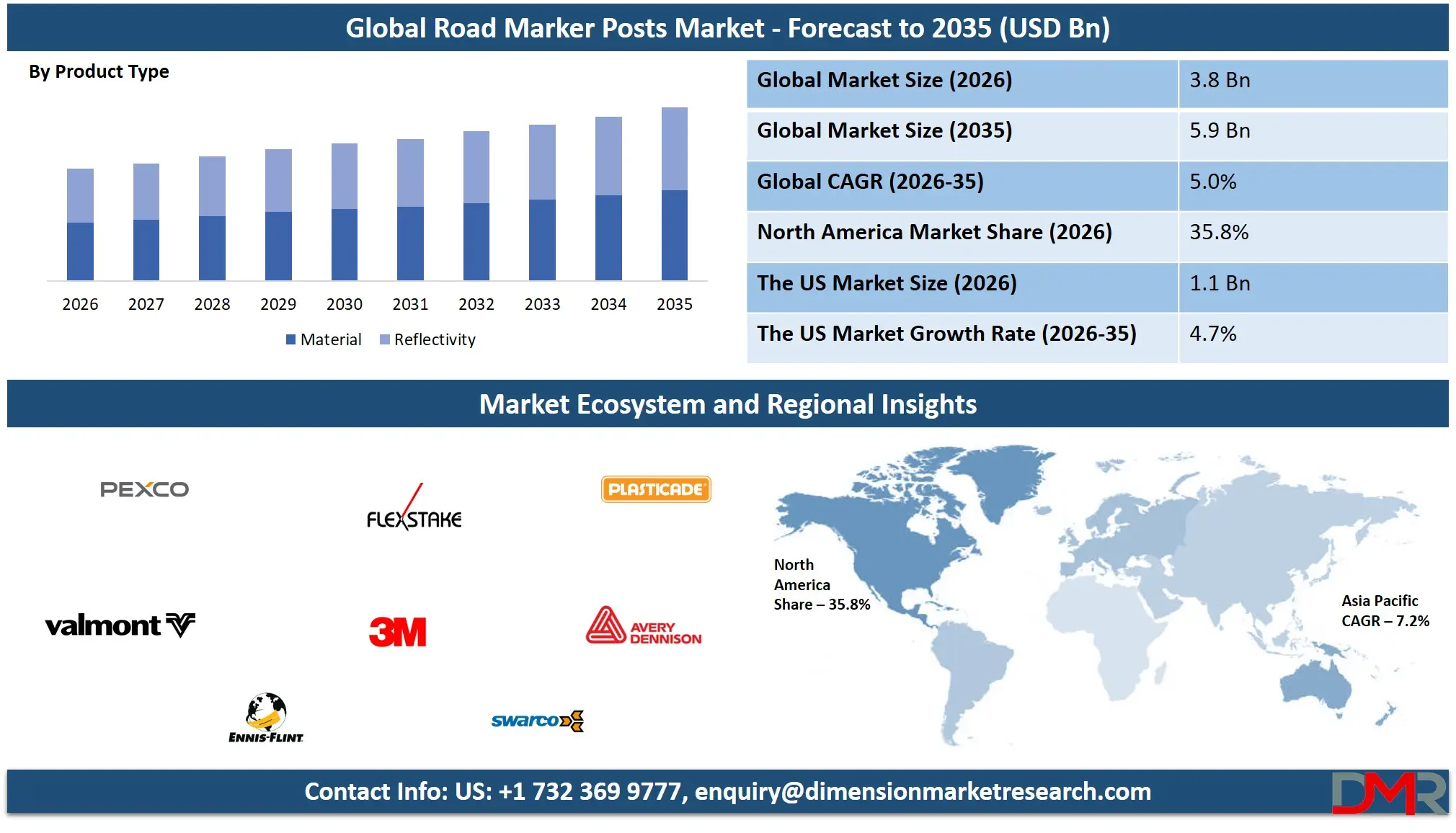
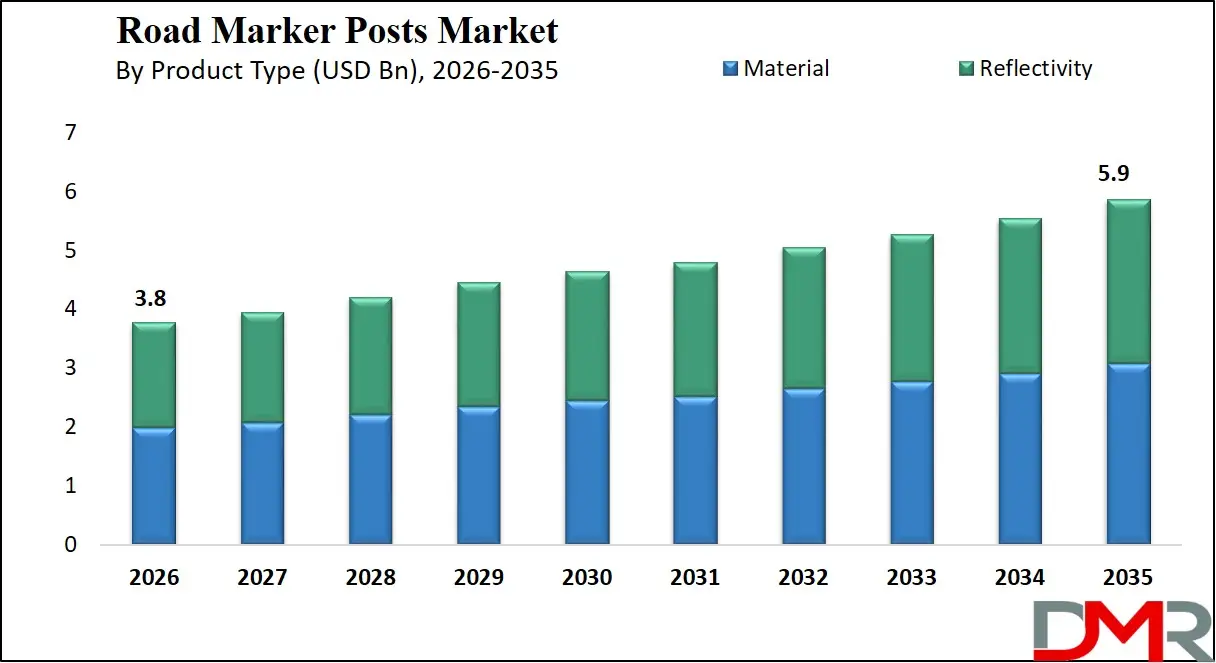
The Global Road Marker Posts Market size is projected to reach USD 3.8 billion in 2026 and grow at a compound annual growth rate of 5.0% to reach a value of USD 5.9 billion in 2035.
ℹ
To learn more about this report –
Download Your Free Sample Report Here
Road Marker Posts are roadside safety and guidance installations used across highways, urban streets, rural roads, and construction zones to improve traffic delineation and visibility. Manufactured using plastic, metal, or composite materials, these posts may feature reflective or non-reflective surfaces depending on operational requirements. They are critical components of modern road safety infrastructure, supporting lane discipline, reducing collision risks, and enhancing driver awareness, particularly in low-visibility conditions.
The market has gained prominence due to increasing vehicle density, large-scale infrastructure development, and heightened focus on traffic safety. Governments and road authorities highly rely on road marker posts as cost-effective safety solutions that can be rapidly deployed across permanent and temporary road networks. Advancements in reflectivity, material durability, and modular design have expanded their functional scope beyond traditional delineation.
ℹ
To learn more about this report –
Download Your Free Sample Report Here
Sustainability initiatives, smart city programs, and stricter compliance standards continue to influence market growth. Emerging trends include recyclable materials, removable systems, and integration with intelligent transport infrastructure, positioning road marker posts as essential assets within global transportation ecosystems.
The US Road Marker Posts Market
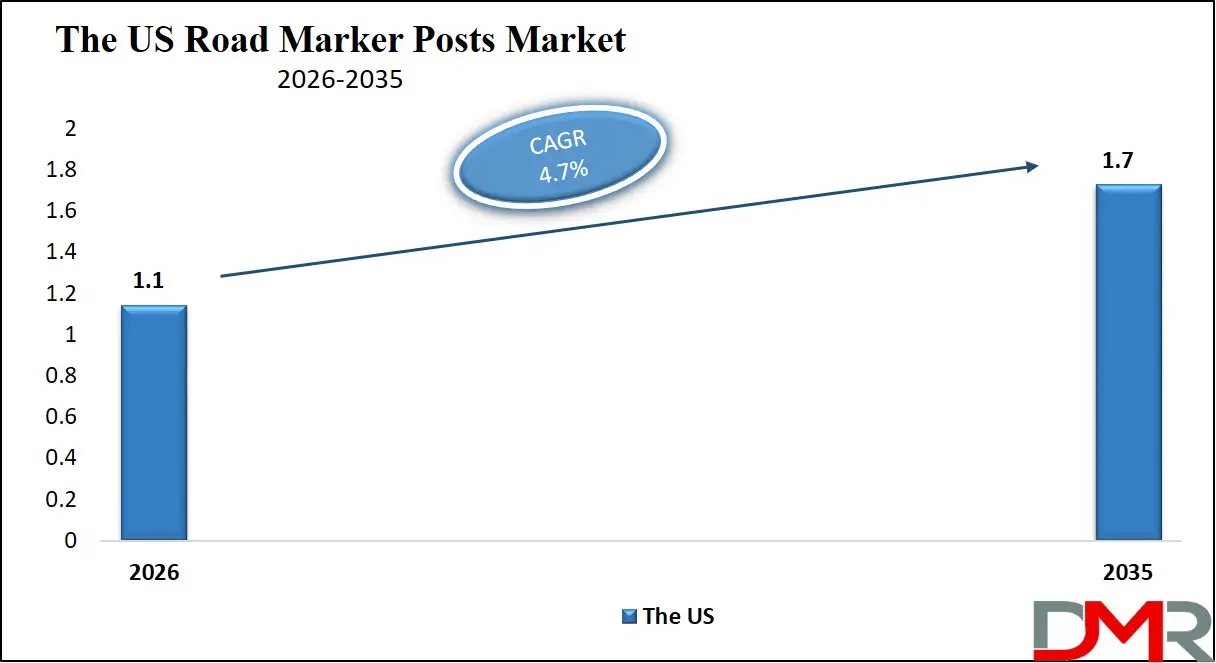
The US Road Marker Posts Market size is projected to reach USD 1.1 billion in 2026 at a compound annual growth rate of 4.7% over its forecast period.
The US Road Marker Posts market is supported by extensive highway networks, steady federal and state infrastructure funding, and strict road safety regulations. Programs targeting accident reduction and roadway modernization have increased demand for high-visibility and durable marker systems. Replacement demand from aging infrastructure further sustains market activity, while smart road initiatives encourage the adoption of advanced reflective and impact-resistant designs.
ℹ
To learn more about this report –
Download Your Free Sample Report Here
Europe Road Marker Posts Market
Europe Road Marker Posts Market size is projected to reach USD 969 million in 2026 at a compound annual growth rate of 4.9% over its forecast period.
Europe’s market is shaped by strong regulatory frameworks emphasizing safety, sustainability, and reduced road fatalities. EU-wide policies promote modern road safety infrastructure, driving adoption of reflective and environmentally compliant marker posts. Urban mobility projects and cross-border highway upgrades support consistent demand, while sustainability mandates influence material selection and lifecycle efficiency.
Japan Road Marker Posts Market
Japan Road Marker Posts Market size is projected to reach USD 190 million in 2026 at a compound annual growth rate of 5.0% over its forecast period.
Japan’s market benefits from advanced urban planning, dense road networks, and a strong emphasis on pedestrian and traffic safety. Continuous infrastructure upgrades, combined with disaster-resilient design requirements, drive demand for flexible and high-visibility marker posts. Government support for smart transportation systems further encourages technological innovation in this segment.
Road Marker Posts Market: Key Takeaways
- Market Growth: The Road Marker Posts Market size is expected to grow by USD 1.9 billion, at a CAGR of 5.0%, during the forecasted period of 2027 to 2035.
- By Component: The material segment is anticipated to get the majority share of the Road Marker Posts Market in 2026.
- By Application: The highways & expressways segment is expected to get the largest revenue share in 2026 in the Road Marker Posts Market.
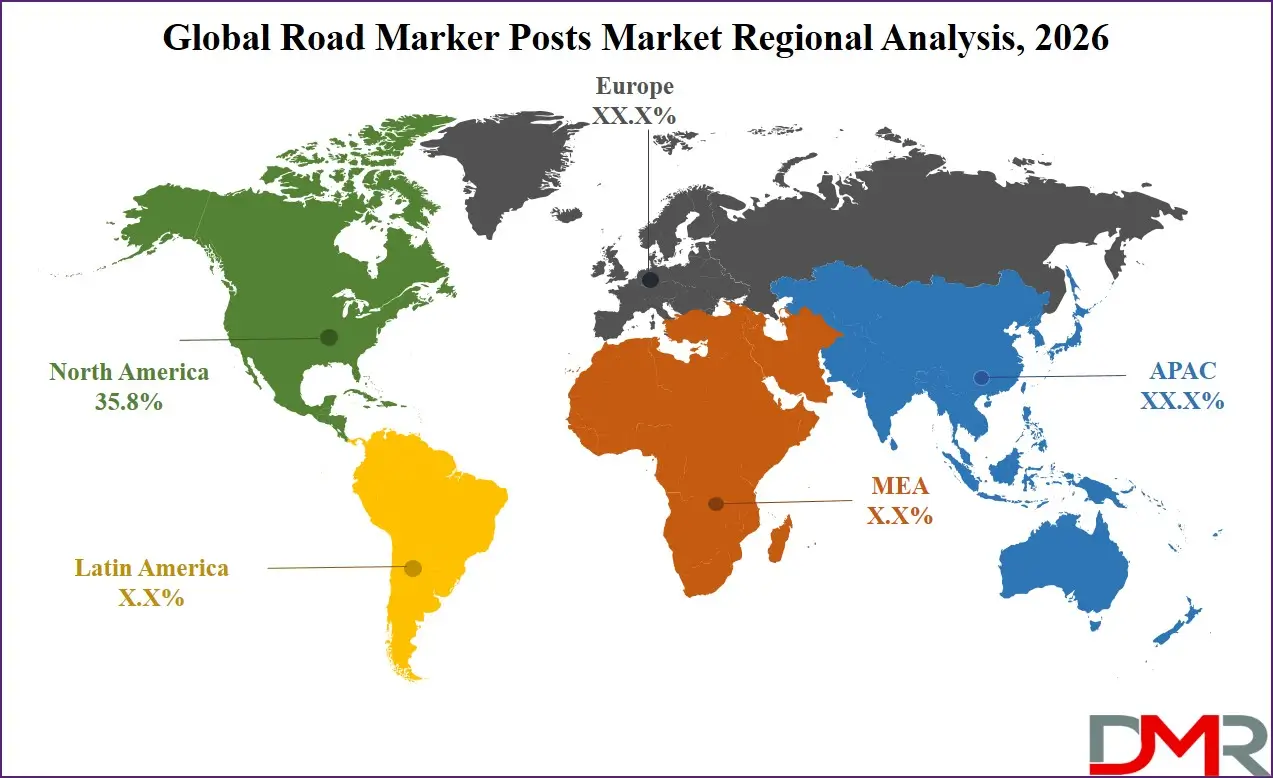
- Regional Insight: North America is expected to hold a 35.8% share of revenue in the Global Road Marker Posts Market in 2026.
- Use Cases: Some of the use cases of Road Marker Posts include rural road visibility, accident-prone curves, and more.
Road Marker Posts Market: Use Cases
- Highway Lane Delineation: Enhances lane clarity and road edge definition on high-speed corridors.
- Urban Traffic Management: Supports safe separation of vehicles, cyclists, and pedestrians.
- Construction Zone Safety: Provides temporary guidance around work sites to reduce accidents.
- Rural Road Visibility: Improves navigation on unlit or low-traffic roads.
- Parking & Commercial Areas: Controls traffic flow and access management.
- Accident-Prone Curves: Highlights sharp bends and hazardous intersections.
- Smart Road Integration: Enables compatibility with intelligent transport systems.
Stats & Facts
- European Commission reported 19,940 road fatalities in the EU in 2024.
- OECD International Transport Forum highlighted continued global investment in road safety infrastructure during 2024–2025.
- World Bank Global Road Safety Facility improved infrastructure safety access for 65 million people through 2024.
- Federal Highway Administration documented sustained US highway safety modernization funding in 2024.
- Japan Ministry of Land, Infrastructure, Transport and Tourism reported steady growth in road safety asset procurement in 2024.
- National Highway Authority of India recorded installation of over one million roadside safety devices in 2024.
- UK Department for Transport identified 5–7 year replacement cycles for road safety assets in 2024.
- Australian Department of Infrastructure reported increased reflective road furniture investment in 2025.
- Canadian transport authorities noted rising adoption of removable road safety posts in urban projects.
- OECD data indicated continued global growth in transport infrastructure spending through 2025.
Market Dynamic
Driving Factors in the Road Marker Posts Market
Technological Advancements
The Road Marker Posts market is driven by innovations such as reflective coatings, solar-powered markers, and modular designs that enhance visibility, durability, and safety. Smart markers integrated with sensors improve traffic monitoring and maintenance efficiency. These advancements align with increasing government safety regulations and public demand for safer roads. The adoption of durable, low-maintenance, and eco-friendly materials reduces replacement costs, making technologically advanced markers highly appealing to municipalities and infrastructure developers, ultimately driving widespread market adoption.
Government Initiatives and Infrastructure Expansion
Government investments in highway construction, urban road networks, and road safety programs significantly drive the market. Incentives, public contracts, and modernization projects encourage procurement of high-quality, compliant road markers. Expanding infrastructure in both developed and developing regions increases replacement cycles and installation needs. Supportive policies targeting traffic safety and sustainable construction further create consistent demand, making government initiatives a core driver shaping the growth trajectory of the Road Marker Posts market worldwide.
Restraints in the Road Marker Posts Market
High Capital Costs and Maintenance Requirements
The initial investment in advanced road marker posts, particularly those with reflective, solar, or sensor-integrated technologies, can be significant. Municipalities and contractors may face budget limitations, slowing adoption. Additionally, certain markers require regular maintenance to sustain visibility and compliance with safety standards, which adds to lifecycle costs. These financial and operational constraints can deter smaller players from entering the market and may limit the large-scale replacement of aging infrastructure, restraining overall market growth.
Technological and Regulatory Challenges
Complex regulations governing safety standards and road marker materials vary by region, posing compliance challenges for manufacturers. Technological limitations, such as power reliability for solar markers or durability in harsh climates, further restrict adoption. Fragmented standards across countries complicate cross-border product deployment, increasing costs and limiting scalability. Such regulatory and technological hurdles can slow market penetration, making it difficult for companies to achieve consistent growth while ensuring product safety and performance.
Opportunities in the Road Marker Posts Market
Emerging Urbanization and Highway Development
Rapid urbanization and highway expansion in Asia-Pacific, Latin America, and the Middle East present significant growth opportunities. Newly constructed road networks require large-scale deployment of durable, reflective, and sustainable markers. Infrastructure modernization projects also create demand for advanced solutions, such as solar-powered or sensor-equipped markers, enabling companies to capture untapped regional markets. This expanding infrastructure-driven demand allows manufacturers to scale operations and innovate product offerings tailored to diverse geographic requirements.
Sustainability and Eco-Friendly Solutions
Growing awareness of environmental impact and sustainability drives the adoption of eco-friendly road markers made from recycled or low-impact materials. Solar-powered and long-lasting markers reduce energy consumption and maintenance, aligning with government green initiatives. Companies investing in sustainable innovations gain a competitive edge, especially in regions with strict environmental policies. These solutions not only meet regulatory standards but also appeal to environmentally conscious stakeholders, representing a major opportunity to differentiate products and expand market share.
Trends in the Road Marker Posts Market
Digitalization and Smart Road Solutions
Integration of sensors, IoT-enabled monitoring, and data-driven maintenance planning is transforming road marker applications. Smart markers enhance road safety, track traffic patterns, and reduce operational downtime by enabling predictive maintenance. This trend toward digital infrastructure is accelerating adoption in technologically advanced regions and positions manufacturers to leverage innovation for long-term contracts with governments and infrastructure developers.
Durable and Modular Designs
The trend toward modular, easy-to-install, and highly durable road markers is gaining traction. Such markers reduce installation time, replacement frequency, and overall maintenance costs. Innovations in reflective and weather-resistant materials further improve lifespan and performance, aligning with urban development and safety mandates. These evolving design trends reflect the market’s focus on efficiency, cost-effectiveness, and compliance with stringent road safety standards.
Impact of Artificial Intelligence in Road Marker Posts Market
- Predictive Maintenance: AI analyzes wear and traffic data to forecast when markers need replacement, reducing operational downtime.
- Optimized Placement: AI-driven mapping tools identify high-risk zones for marker installation, improving road safety outcomes.
- Supply Chain Efficiency: AI algorithms streamline logistics, inventory management, and delivery schedules for manufacturers and contractors.
- Quality Control: Machine learning ensures consistent marker quality through automated inspection of materials and reflective coatings.
- Cost Reduction: AI-driven design simulations minimize material waste and production costs while maximizing durability.
- Traffic Data Analysis: AI sensors in markers collect and analyze traffic flow data to support urban planning.
- Enhanced Safety Monitoring: AI-enabled markers can detect accidents or obstructions, alerting authorities in real time.
- Product Innovation: AI assists R&D teams in developing advanced materials and energy-efficient designs.
- Regulatory Compliance: AI tools ensure marker designs meet regional safety standards and certifications.
- Customer Experience: AI platforms provide municipalities with actionable insights, improving planning, maintenance, and reporting.
Research Scope and Analysis
By Product Type Analysis
The material segment dominates the product type category, accounting for 52.3% of the market share in 2026, due to its combination of durability, cost efficiency, and adaptability across highways, urban streets, rural roads, and temporary traffic zones. Governments and infrastructure contractors prefer material-based posts for large-scale deployments because they offer superior performance, easy installation, and lower maintenance costs. Technological innovations in polymers, corrosion-resistant metals, and composite materials have enhanced resilience against weathering, UV exposure, and vehicle impacts, ensuring longevity. Increasing investments in infrastructure modernization and replacement of aging road posts further reinforce material as the preferred solution globally, maintaining steady demand growth.
Reflectivity is rapidly gaining traction due to growing regulatory focus on road safety and increasing demand for improved nighttime and low-visibility guidance. Reflective posts are now mandated across highways, urban arterials, and accident-prone zones, while non-reflective posts are used in controlled environments like industrial campuses, private roads, and parking areas. Advances in microprismatic coatings, retroreflective materials, and LED-assisted posts improve visibility under adverse weather conditions. Adoption is increasing worldwide, particularly in regions implementing stricter road safety policies and investing in smart traffic management systems to enhance overall traffic efficiency.
By Application Analysis
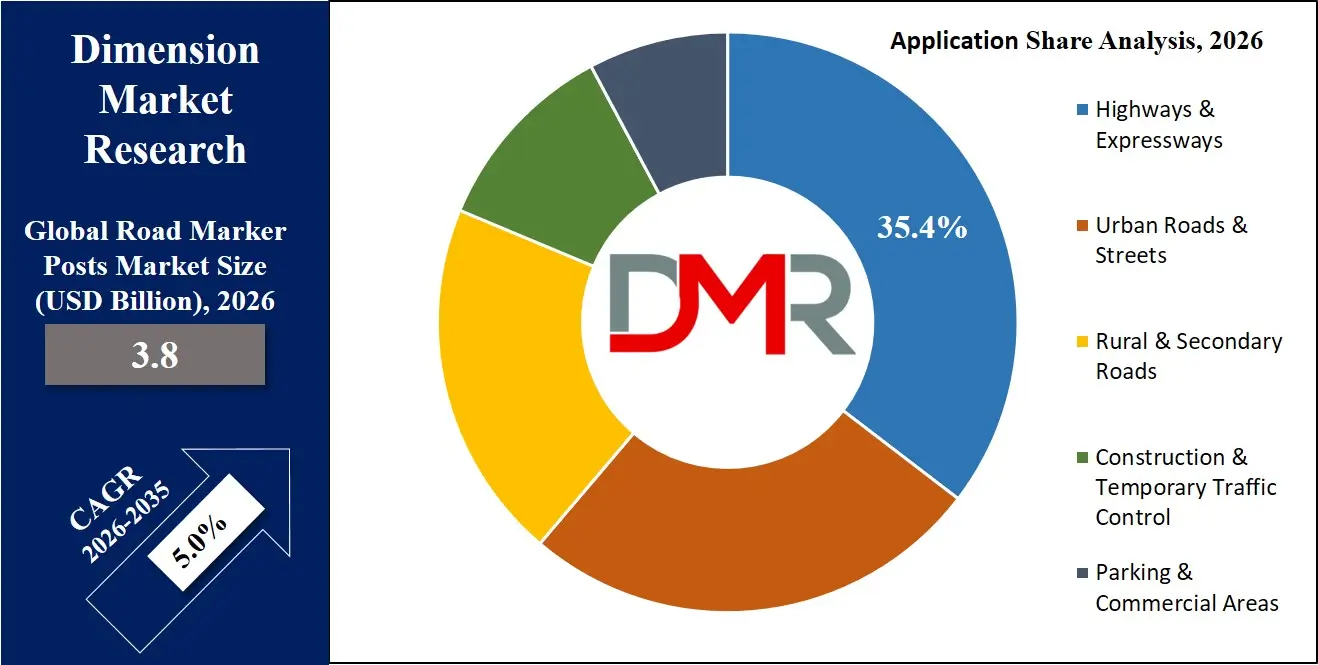
Highways and expressways are the largest application segment, expected to hold 35.4% of the market share in 2026, driven by high traffic density, stringent safety regulations, and large-scale infrastructure projects. Road marker posts are critical in these zones for improving lane discipline, reducing accidents, and supporting driver guidance at high speeds. Ongoing highway modernization initiatives, replacement of aging posts, and public-private partnership projects are driving sustained deployment. The combination of durability requirements, reflective visibility standards, and ease of maintenance makes these roads the largest end-use for marker posts.
ℹ
To learn more about this report –
Download Your Free Sample Report Here
Urban deployments are expanding rapidly due to smart city programs, urban congestion mitigation, and pedestrian safety initiatives. Marker posts in urban streets and roads improve traffic management, delineate lanes, and enhance safety in high-density traffic areas. Adoption is particularly high in metropolitan cities where construction, parking management, and temporary traffic control require flexible, durable posts. Technology-driven solutions, including reflective and removable posts, are increasingly deployed to manage dynamic urban traffic flows. Rising government funding for urban infrastructure ensures rapid growth of this segment.
By End User Analysis
Government bodies are the primary end users of road marker posts, projected to account for 51.8% of the market share in 2026, due to large-scale infrastructure programs, regulatory mandates, and public safety initiatives. Direct procurement through tenders ensures high-volume adoption across highways, urban streets, and construction zones. Government projects prioritize compliance with safety standards, requiring durable materials, reflective capabilities, and long service life. Investment in highway modernization, urban mobility projects, and accident-prone zone improvements further strengthens demand, making government authorities the most significant buyers globally.
Private contractors are increasingly procuring marker posts for temporary traffic management, industrial facilities, and commercial infrastructure projects. Demand is fueled by rising private-sector investments in road construction, urban development, and temporary construction site safety measures. Contractors require flexible, easy-to-install, and cost-efficient solutions that can be rapidly deployed and removed as needed. Increasing adoption of reflective posts and modern materials helps meet both safety standards and operational efficiency. The segment is growing steadily as more private players participate in urban and highway construction projects.
By Installation Type Analysis
Surface-mounted posts dominate the installation segment, projected to hold 56.3% of the market share in 2026, due to ease of installation, low upfront cost, and adaptability for both permanent and temporary applications. Their versatility makes them suitable across highways, urban roads, parking areas, and construction zones. Surface-mounted posts are preferred for projects requiring rapid deployment, lower maintenance, and the ability to replace damaged posts efficiently. Their compatibility with various materials and reflective designs enhances performance and safety, meeting regulatory standards. Governments and private contractors favor surface-mounted installations, ensuring this segment maintains its leading share.
Embedded or anchored installations are increasingly used in high-impact, permanent settings such as highways, expressways, and accident-prone zones. These installations provide superior stability, resistance to vehicle impact, and longevity under harsh conditions. Although more expensive and time-consuming to install compared to surface-mounted posts, embedded posts offer lower long-term maintenance costs and enhanced durability. The segment is growing rapidly due to increasing highway modernization projects, accident prevention programs, and adoption of long-term infrastructure strategies in developed and developing regions.
By Sales Channel Analysis
Direct sales through government tenders dominate, expected to account for 62.1% of the market share in 2026, due to large-scale infrastructure projects, tender-based procurement, and compliance requirements. Governments prefer bulk orders with standardized specifications, ensuring consistent quality, high-volume deployment, and predictable revenue streams for manufacturers. Direct procurement allows better oversight, guarantees regulatory compliance, and supports long-term road safety initiatives. High adoption in highways, urban roads, and construction zones strengthens market share, consolidating direct sales as the preferred channel globally.
Distributor and dealer networks are expanding in private sector, industrial, and commercial applications. These channels help reach remote or smaller urban areas where direct government procurement is less frequent. Growing adoption of marker posts for private infrastructure, temporary construction projects, and parking facilities is increasing demand. Manufacturers leverage distributors for market expansion, faster delivery, and local support. The segment benefits from flexibility, rapid deployment, and access to diverse customer segments, contributing to steady growth worldwide.
By Price Tier Analysis
Premium posts dominate the market, projected to hold 48.9% of the market share in 2026, due to high durability, advanced materials, enhanced reflectivity, and compliance with stringent road safety standards. These posts are preferred for highways, high-speed roads, smart infrastructure projects, and accident-prone zones, where performance and longevity are critical. Governments and contractors choose premium posts for long-term cost efficiency, reduced replacement cycles, and compliance with regulatory standards. Innovations such as LED-assisted reflectivity, impact-resistant polymers, and corrosion-resistant metals further support adoption, solidifying their leading position globally.
Mid-range posts are increasingly adopted in urban roads, commercial areas, parking facilities, and temporary construction zones due to their balanced cost and performance advantages. They provide sufficient durability and reflectivity for low- to medium-speed applications while remaining budget-friendly. Growing urbanization, commercial infrastructure development, and private sector investment are accelerating adoption. Manufacturers are introducing improved mid-range solutions with enhanced material and visibility features, driving faster growth compared to premium and economy tiers.
The Road Marker Posts Market Report is segmented on the basis of the following:
By Product Type
- Material
- Reflectivity
- Reflective
- Non-Reflective
By Application
- Highways & Expressways
- Urban Roads & Streets
- Rural & Secondary Roads
- Construction & Temporary Traffic Control
- Parking & Commercial Areas
By End User
- Government & Public Authorities
- Road Construction & Infrastructure Contractors
- Commercial & Industrial Facility Operators
By Installation Type
- Surface-Mounted
- Embedded / Anchored
- Removable / Portable
By Sales Channel
- Direct Sales / Government Tenders
- Distributors & Dealers
By Price Tier
- Premium
- Mid-Range
- Economy
Regional Analysis
Leading Region in the Road Marker Posts Market
North America is projected to hold 35.8% of the Road Marker Posts market share in 2026, supported by its advanced transportation infrastructure, stringent safety regulations, and high replacement demand for aging road markers. The region benefits from well-established manufacturing facilities, strong public-private partnerships, and continuous government investment in road maintenance and highway modernization. Rising urban traffic and increasing focus on road safety further drive demand for durable, reflective, and technologically advanced road marker posts. Companies leverage innovation, regulatory compliance, and long-term maintenance contracts to strengthen their presence, making North America a mature and highly competitive market for road safety solutions.
ℹ
To learn more about this report –
Download Your Free Sample Report Here
Fastest Growing Region in the Road Marker Posts Market
The Asia-Pacific Road Marker Posts market is experiencing rapid growth, driven by urbanization, expanding highway networks, and large-scale government infrastructure programs across countries such as China, India, and Southeast Asian nations. Increasing vehicular traffic, road safety initiatives, and the modernization of transport networks are boosting demand for durable and cost-effective road markers. Rising public and private investment in smart and sustainable road infrastructure encourages the adoption of innovative, reflective, and modular marker posts. Market expansion is further supported by competitive manufacturing, favorable labor costs, and regional partnerships, positioning Asia-Pacific as the fastest-growing and highly dynamic region in the global Road Marker Posts market.
By Region
North America
Europe
- Germany
- The U.K.
- France
- Italy
- Russia
- Spain
- Benelux
- Nordic
- Rest of Europe
Asia-Pacific
- China
- Japan
- South Korea
- India
- ANZ
- ASEAN
- Rest of Asia-Pacific
Latin America
- Brazil
- Mexico
- Argentina
- Colombia
- Rest of Latin America
Middle East & Africa
- Saudi Arabia
- UAE
- South Africa
- Israel
- Egypt
- Rest of MEA
Competitive Landscape
The Road Marker Posts market has moderate entry barriers, with competition driven by pricing, durability, compliance, and innovation. Key players focus on R&D to develop modular, long-lasting designs and secure public contracts. Efficient supply chains and strategic partnerships enhance market reach, while sustainability-focused products strengthen brand positioning. Companies differentiate through eco-friendly materials, advanced reflective technologies, and reliable service, creating a dynamic, innovation-driven environment where technological advancement and regulatory adherence are critical to maintaining competitiveness.
Some of the prominent players in the global Road Marker Posts are:
- 3M Company
- SWARCO AG
- Valmont Industries
- Pexco LLC
- Avery Dennison Corporation
- Lindsay Corporation
- Geveko Markings
- Ennis-Flint
- Sherwin-Williams Company
- Plasticade
- Impact Recovery Systems
- FlexStake Inc.
- Swareflex
- Roadtech Manufacturing
- Shur-Tite Products
- Zumar Industries
- Vanguard ADA Systems
- Traffic Safety Store
- Eastern Metal Supply
- Three D Traffic Works
- Other Key Players
Recent Developments
- In January 2026, The Haryana Rural Roads Infrastructure Development Agency, the Haryana Public Works Department, and the Ministry of Rural Development jointly hosted an annual Road Safety Solutions session at the PWD Rest House in Panchkula. Organised during National Road Safety Month in collaboration with Kataline, the session aligned with the national road safety theme. Discussions focused on strengthening road safety infrastructure across rural roads, highways, blackspots, school zones, and pedestrian corridors, with emphasis on visibility improvement, accident reduction, and inter-agency coordination.
- In October 2025, The National Highways Authority of India has announced the rollout of QR code sign boards across National Highway corridors to enhance transparency, commuter convenience, and road safety. Introduced under the Ease of Commuting initiative, the digitally enabled boards provide instant access to project details, emergency contacts, and nearby facilities through a simple scan. Strategically placed along highways, the QR boards offer information on highway locations, project timelines, helplines, and essential services such as hospitals, fuel stations, repair shops, and upcoming toll plazas.
Report Details
| Report Characteristics |
| Market Size (2026) |
USD 3.8 Bn |
| Forecast Value (2035) |
USD 5.9 Bn |
| CAGR (2026–2035) |
5.0% |
| The US Market Size (2026) |
USD 1.1 Bn |
| Historical Data |
2021 – 2025 |
| Forecast Data |
2027 – 2035 |
| Base Year |
2025 |
| Estimate Year |
2026 |
| Report Coverage |
Market Revenue Estimation, Market Dynamics, Competitive Landscape, Growth Factors and etc. |
| Segments Covered |
By Product Type (Material, Reflectivity), By Application (Highways & Expressways, Urban Roads & Streets, Rural & Secondary Roads, Construction & Temporary Traffic Control, Parking & Commercial Areas), By End User (Government & Public Authorities, Road Construction & Infrastructure Contractors, Commercial & Industrial Facility Operators), By Installation Type (Surface-Mounted, Embedded / Anchored, Removable / Portable), By Sales Channel (Direct Sales / Government Tenders, Distributors & Dealers), By Price Tier (Premium, Mid-Range, Economy) |
| Regional Coverage |
North America – The US and Canada; Europe – Germany, The UK, France, Russia, Spain, Italy, Benelux, Nordic, & Rest of Europe; Asia-Pacific – China, Japan, South Korea, India, ANZ, ASEAN, Rest of APAC; Latin America – Brazil, Mexico, Argentina, Colombia, Rest of Latin America; Middle East & Africa – Saudi Arabia, UAE, South Africa, Turkey, Egypt, Israel, & Rest of MEA |
| Prominent Players |
3M Company, SWARCO AG, Valmont Industries, Pexco LLC, Avery Dennison Corporation, Lindsay Corporation, Geveko Markings, Ennis-Flint, Sherwin-Williams Company, Plasticade, Impact Recovery Systems, FlexStake Inc., Swareflex, Roadtech Manufacturing, Shur-Tite Products, Zumar Industries, Vanguard ADA Systems, Traffic Safety Store, Eastern Metal Supply, Three D Traffic Works, and Other Key Players |
Frequently Asked Questions
How big is the Global Road Marker Posts Market?
▾ The Global Road Marker Posts Market size is expected to reach USD 3.8 billion by 2026 and is projected to reach USD 5.9 billion by the end of 2035.
Which region accounted for the largest Global Road Marker Posts Market?
▾ North America is expected to have the largest market share in the Global Road Marker Posts Market, with a share of about 35.8% in 2026.
How big is the Road Marker Posts Market in the US?
▾ The US Road Marker Posts market is expected to reach USD 1.1 billion by 2026.
Who are the key players in the Road Marker Posts Market?
▾ Some of the major key players in the Global Road Marker Posts Market include 3M, Swarco, Pexco, and others.
What is the growth rate in the Global Road Marker Posts Market?
▾ The market is growing at a CAGR of 5.0 percent over the forecasted period.