What is the Robot-as-a-Service (RaaS) Market Size?
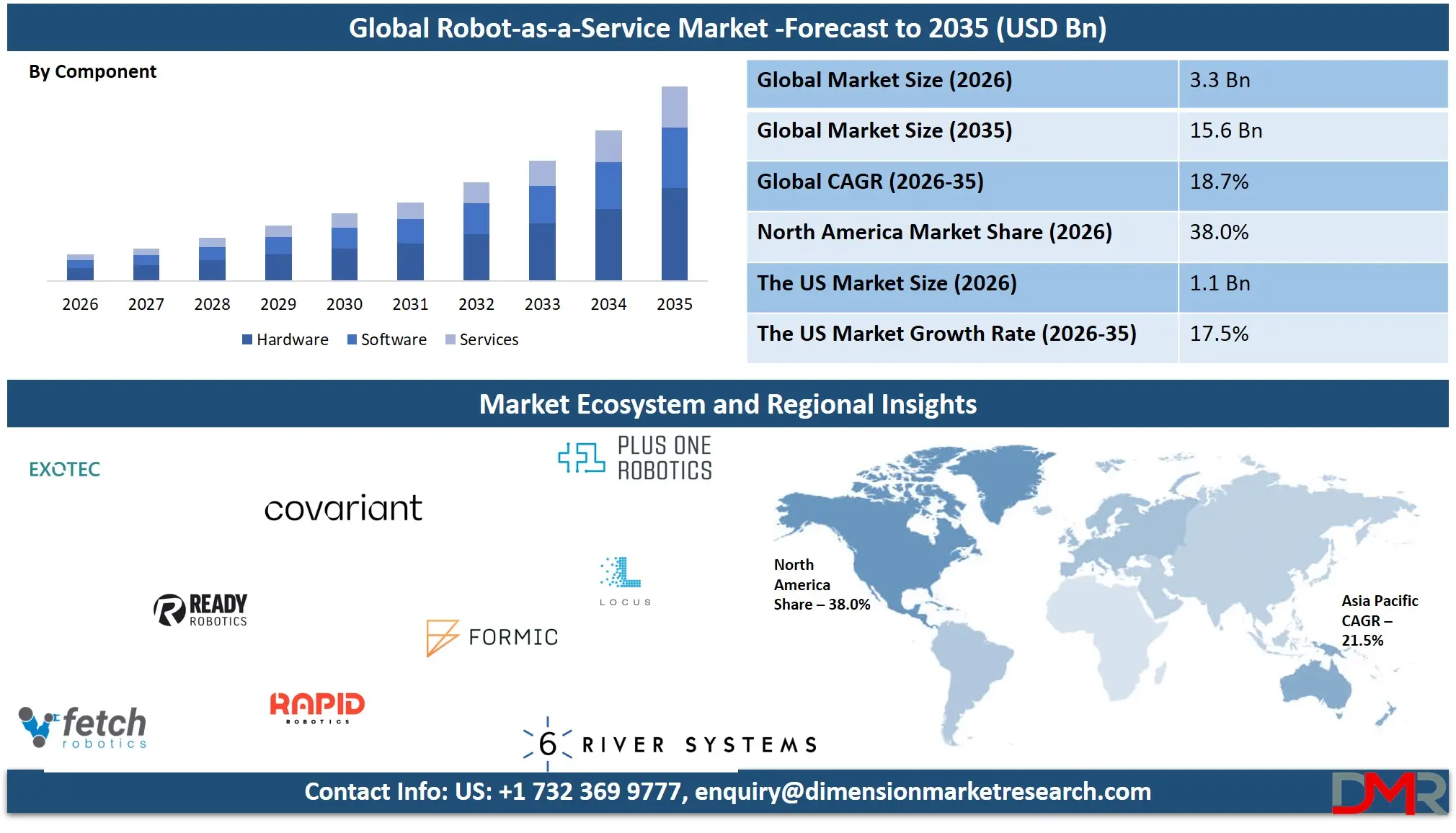
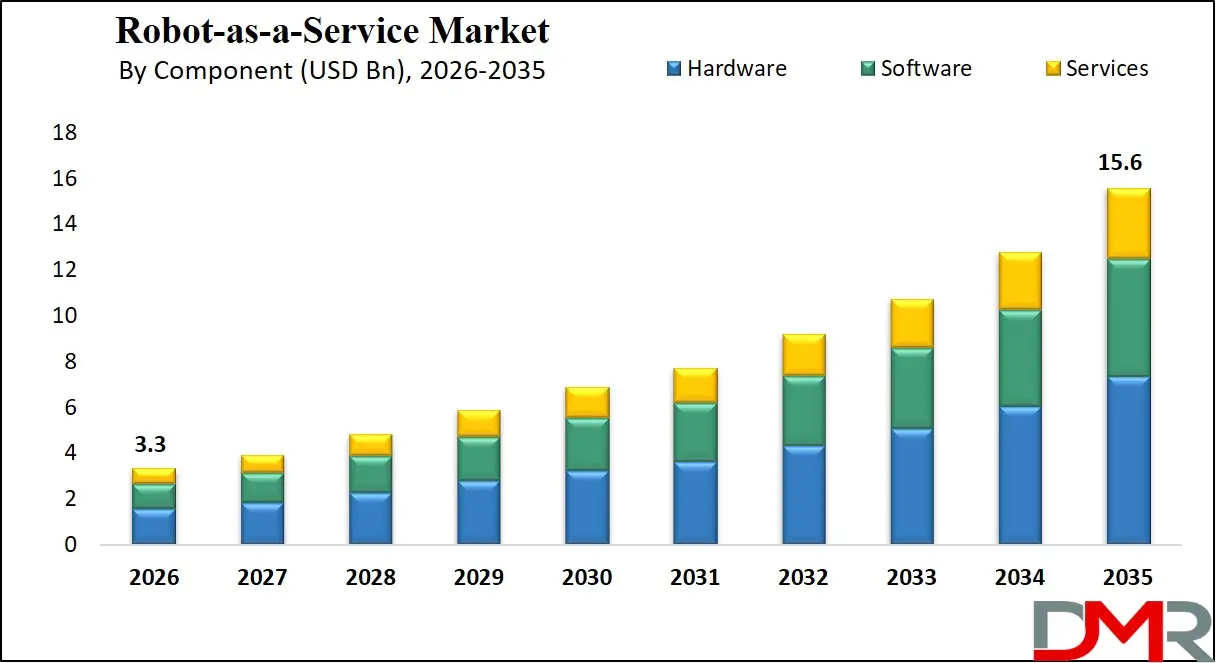
The Robot-as-a-Service Market size is expected to be USD 3.3 billion in 2026 and increase at a compound annual growth rate of 18.7% to USD 15.6 billion in 2035 due to shift in corporate strategy from capital-intensive projects to subscription-based services that offer flexibility.
ℹ
To learn more about this report –
Download Your Free Sample Report Here
Robot-as-a-Service (RaaS) business model represents a trend when the robot or robotics solution is provided by means of subscription or per-use service model, which enables firms to automate their activities at a minimal financial cost. This refers to robots' hardware and software components as well as associated services in such industries as manufacturing, logistics, healthcare, and agriculture. The growing demand for flexible automation, labor force shortage, and fast development of AI and robotics contribute to the adoption of RaaS. Moreover, cloud computing and edge computing are reshaping robotics implementation, and thus RaaS is vital for the automation revolution.
ℹ
To learn more about this report –
Download Your Free Sample Report Here
The US Robot-as-a-Service (RaaS) Market
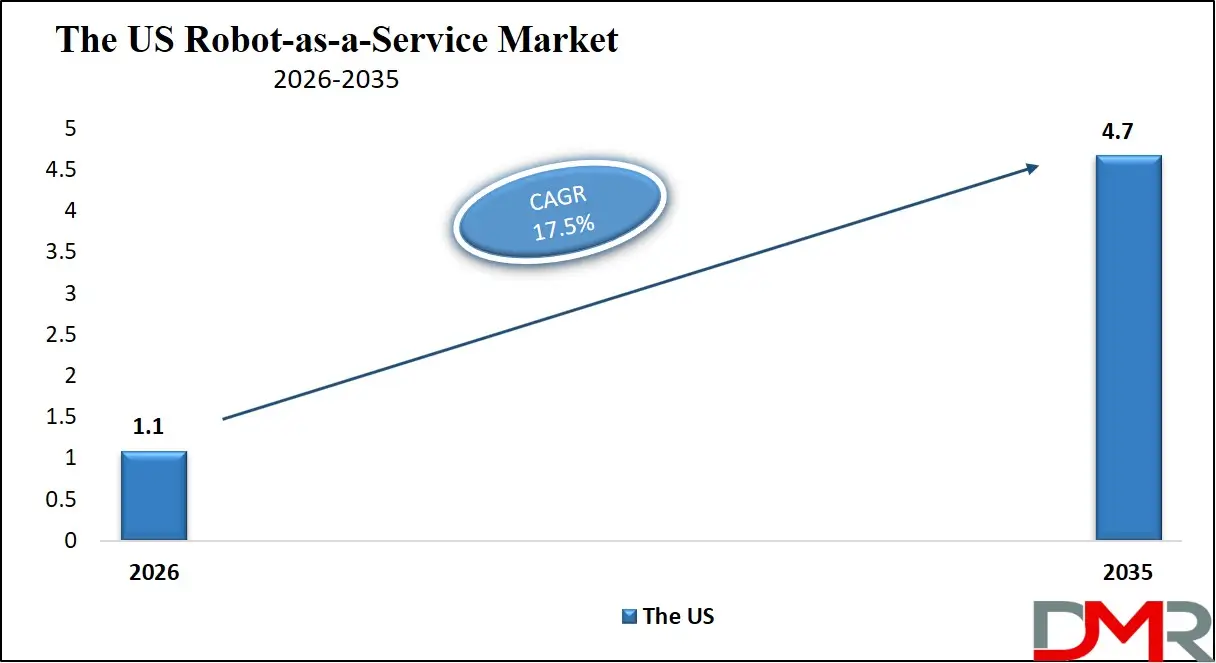
The US Robot-as-a-Service Market size is estimated to be USD 1.1 billion in 2026 and is expected to increase at a CAGR of 17.5% over the forecast period.
ℹ
To learn more about this report –
Download Your Free Sample Report Here
The growth of the US RaaS market is aided by the availability of advanced technology, high wages, and extensive use of automation in both logistics and manufacturing processes. The major players in this market are known to be innovators and form strategic alliances, while government policies on advanced manufacturing and AI development support the adoption of the RaaS model.
Europe Robot-as-a-Service (RaaS) Market
The Europe Robot-as-a-Service Market size is estimated to be USD 957 million in 2026 and at a CAGR of 18.1% over the forecast period.
Europe has sustainability-based RaaS marketplaces due to sustainable policies and regulations such as the European Green Deal. The growth in automation is attributed to the strength of the manufacturing industry and automobile industry in Germany and France. Grants by governments and collaborations with international players have helped in innovating new technologies while RaaS is increasingly adopted by SMEs to compete with rising costs.
Japan Robot-as-a-Service (RaaS) Market
The market size of Japan's Robot-as-a-Service will be USD 132 million in 2026, with a CAGR of 18.2% in the forecast period.
The growth of the Japanese RaaS market comes due to the aging demographics and robotics readiness in the country. The manufacturing sector remains the largest market share holder; however, the demand for health and hospitality service robots continues rising. This is facilitated through the government initiatives encouraging robotics and advanced manufacturing technologies. Nonetheless, it faces issues related to expensive prices and constant innovations that need to be done, despite many business opportunities available.
Key Takeaways
- Market Size & Forecast: The Robot-as-a-Service Market size is projected to reach USD 3.3 billion in 2026 and is anticipated to have a value of USD 15.6 billion in 2035.
- Growth Rate & Outlook: The Robot-as-a-Service Market size is set to grow at a compound annual growth rate of 18.7% during the forecast period of 2026 to 2035.
- Primary Growth Drivers: Some of the major growth drivers in the market include rising demand for flexible automation, advancements in AI and cloud technologies, and more.
- Key Market Trends: Some of the major trends in the market are integration of AI-driven analytics, shift toward subscription-based models, and more.
- By Component: The hardware segment is anticipated to get the majority share of the Robot-as-a-Service market in 2026.
- By End Use Industry: The manufacturing segment is expected to get the largest revenue share in 2026 in the Robot-as-a-Service market.
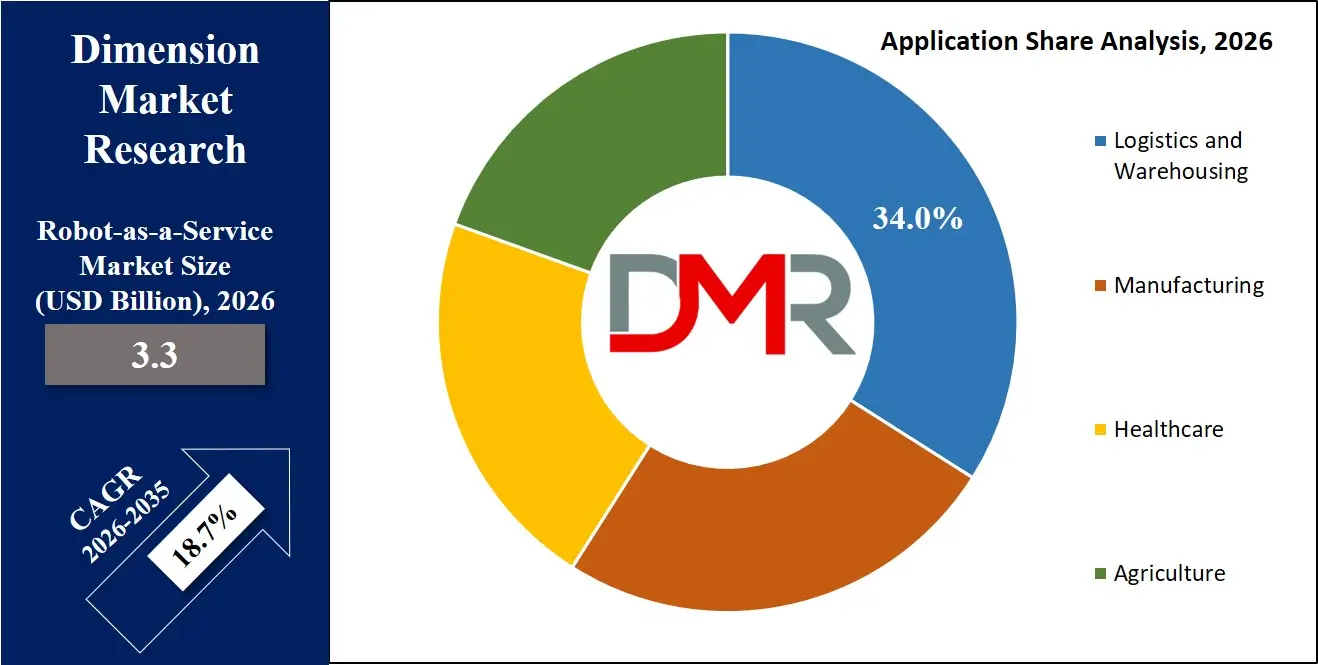
- By Application: The logistics & warehousing segment is expected to get the largest revenue share in 2026 in the Robot-as-a-Service market.
- Regional Leadership: North America is set to lead the Robot-as-a-Service market with an estimated 38.0% share in 2026.
What is the Robot-as-a-Service (RaaS)?
The Robot-as-a-Service (RaaS) approach involves the use of robots on a subscription, leasing, or pay-per-use arrangement through cloud technology. RaaS comprises robot technology, artificial intelligence-enabled software, data management, and service provision. RaaS offers cost reduction, improved scalability, and adaptability. The application of RaaS becomes more pertinent in industries seeking to automate their operations without making substantial capital investments and is driven by elements such as artificial intelligence incorporation and IoT.
Use Cases
- Warehouse Automation: RaaS allows businesses to use robots for picking, sorting and stock management tasks, enhancing efficiency and labor reduction in high-demand logistics areas.
- Healthcare Assistance: RaaS helps hospitals in surgery, sterilization, and patient care, improving accuracy, cleanliness and efficiency, while decreasing the strain on human resources.
- Agricultural Automation: Robots are used for crop monitoring and harvesting, and to support precision agriculture, contributing to overcoming labor shortages and increasing crop yield via data analytics.
- Manufacturing Operations: RaaS helps with assembly, welding and material handling, enabling manufacturers to adopt automation without upfront costs.
How AI Is Transforming the Robot-as-a-Service (RaaS) Market
One of the areas that AI is helping in is through enabling robot-as-a-service. This can be achieved because AI offers autonomous processes, predictive maintenance, and even real-time processes. AI enables robots to be more flexible in various environments, to learn from experiences, and to improve on process efficiency.
The other way AI improves RaaS is by enhancing user experiences and automations. AI allows for predictive maintenance of robots, thus reducing costs and extending their lifespan.
Market Dynamic
Driving Factors in the Robot-as-a-Service (RaaS) Market
Rising Demand for Flexible Automation
The rise in demand for flexibility is a crucial driver behind the RaaS phenomenon. There is a shift in corporate strategy from capital-intensive projects to subscription-based services that offer flexibility. The RaaS business model is particularly suited for sectors with fluctuating demand such as e-commerce and logistics, where RaaS offers rapid implementation and affordability without any capital investment.
Advancements in AI and Cloud Technologies
The rapid advancements in AI, machine learning, and cloud technologies have helped make RaaS systems better. This is because it enables predictive maintenance, monitoring, and decision-making, leading to higher levels of productivity and efficiency.
Restraints in the Robot-as-a-Service (RaaS) Market
High Integration and Customization Costs
While costs at the outset might be reduced, the integration of RaaS within existing infrastructures could be expensive. The application of RaaS within diverse industry settings might necessitate customization of services, leading to higher deployment costs, thus making it less affordable for smaller and mid-sized companies.
Data Security and Privacy Concerns
There is an issue of insecurity with the use of cloud services and the Internet of Things. Businesses that have sensitive information might not adopt the model since there is a risk of cybersecurity attacks, thereby hampering the growth of the market.
Opportunities in the Robot-as-a-Service (RaaS) Market
Expansion in Emerging Markets
New market areas can be tapped into due to the increased level of industrialization, and a lack of skilled manpower. The government is actively promoting automation and digitization, and this is conducive to the adoption of RaaS.
Growth of Collaborative Robots (Cobots)
Collaborative robots usage has seen tremendous growth. This can present new opportunities in the robot as a service sector. Collaborative robots have been designed to work alongside humans. This makes them suitable for applications that require agile automation. These types of robots are relatively cheap to implement.
Trends in the Robot-as-a-Service (RaaS) Market
Integration of AI-Driven Analytics
Incorporation of artificial intelligence into analytical systems is a developing practice in RaaS, which leads to better predictions and optimization for making better decisions. It will turn robots from automated to intelligent and adaptive machines.
Shift Toward Subscription-Based Models
Moving from selling products to a pay-per-use model is transforming the robotics industry. The advantage of the pay-per-use model for businesses lies in reducing risk and being flexible. Hence, its adoption has been quite widespread.
Research Scope and Analysis
By Robot Type Analysis
The most commonly employed robots in the RaaS market are industrial robots. These robots will occupy a market share of 58% in 2026. They are efficient, precise, and can perform repetitive actions, thus contributing immensely in high-volume manufacturing processes. Articulated and collaborative robots are two types of robots that have become popular within this market because of their adaptability and safety features. Their integration with artificial intelligence and Internet of Things technology further increases their functionality to offer intelligent solutions. The sector that is experiencing the highest growth rate is service robots. This is attributed to an increase in the application of these robots in health care, agricultural, and domestic industries. The rising number of professional service robots is fueled by the absence of competent personnel and automation in non-manufacturing environments.
By Component Analysis
The hardware component will hold a major share of 47%, owing to the high significance of sensors, actuators, and controllers in robotics. Innovations in the development of sensors and edge computing devices will improve robot efficiency and resilience. However, the software component will show the highest growth rate owing to advancements in the field of artificial intelligence, machine learning, and robot operating system. In line with the increasing requirement for smart automation processes, software that supports real-time analytics and monitoring of robots remotely is being used increasingly. Cloud computing solutions are boosting market growth as well.
By Service Model
It is anticipated that subscription-based service will hold the major market share of RaaS at 52% in 2026 because of its reliable pricing and scalability. Subscription services are sought after by organizations that want to automate using the predictable and scalable method and without making any initial investments, while this type of service is quite preferred by SMEs. It can provide maintenance and upgrade possibilities for businesses. In addition, there is an increasing trend towards pay-per-use service because it allows scaling according to the number of services used.
By Application Analysis
Waste management and logistics applications account for more than 34% in the market's applications segment by 2026, attributed to the rise in e-commerce and effective supply chain management. Robots have been used extensively in picking, sorting, and last-mile deliveries. Moreover, the adoption of autonomous mobile robots (AMRs) improves the efficiency of work done in warehouses.
ℹ
To learn more about this report –
Download Your Free Sample Report Here
In terms of the fasted-growing end-user industries, the healthcare industry ranks highest due to increased demand for surgical robotics, therapeutic robotics, and disinfection robots.
By End Use Industry Analysis
The manufacturing sector makes up the biggest share of RaaS applications as it is expected to reach 41% by 2026, and that is because of the use of RaaS in assembly and material handling equipment, which is critical to increase efficiency and save costs. However, the main reason is due to the growing trend of implementing technologies into smart factories and industry 4.0. The healthcare sector is where RaaS is expected to grow the fastest, owing to technological advancements and the need for effective treatment of patients.
The Robot-as-a-Service (RaaS) Market Report is segmented on the basis of the following:
By Robot Type
- Industrial Robots
- Articulated Robots
- SCARA Robots
- Cartesian Robots
- Collaborative Robots (Cobots)
- Service Robots
- Professional Service Robots
- Delivery & Logistics Robots
- Inspection & Maintenance Robots
- Medical & Healthcare Robots
- Agricultural Robots
- Security & Surveillance Robots
- Personal Service Robots
- Domestic Cleaning Robots
- Companion Robots
By Component
- Hardware
- Sensors
- Actuators
- Controllers
- Software
- AI & Machine Learning
- Robot Operating Systems
- Services
- Deployment & Integration
- Maintenance & Support
By Service Model
- Subscription-Based
- Pay-Per-Use
- Outcome-Based
By Application
- Logistics & Warehousing
- Picking & Sorting
- Last-Mile Delivery
- Manufacturing
- Assembly
- Material Handling
- Healthcare
- Surgery Assistance
- Disinfection
- Agriculture
By End-User Industry
- Manufacturing
- Logistics & Transportation
- Healthcare
- Agriculture
- Retail & E-commerce
Regional Analysis
Leading Region in the Robot-as-a-Service (RaaS) Market
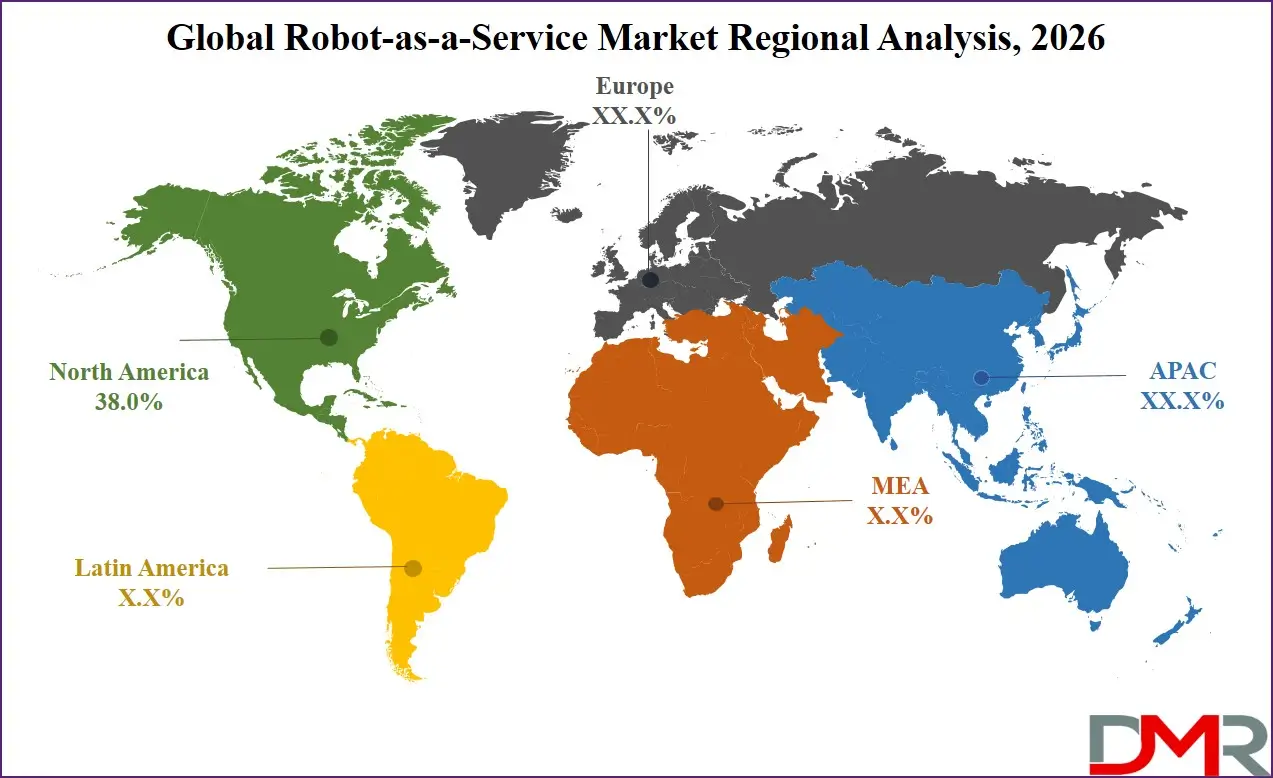
North America leads the way with the highest market share expected to reach 38% by 2026. The advanced level of technology, presence of robotics innovators, and robotics adoption in logistic and manufacturing sectors play critical roles in driving the market forward. The high levels of government support for automation and artificial intelligence, coupled with significant investments in research and development activities, drive the market. Leading e-commerce players and tech giants play important roles in the quick adoption of automation in warehouses.
ℹ
To learn more about this report –
Download Your Free Sample Report Here
Fastest Growing Region in the Robot-as-a-Service (RaaS) Market
The most rapid development of the RaaS industry is observed in the Asia-Pacific region owing to the fast pace of industrialization, urbanization, and introduction of automation techniques. Robotics is being adopted extensively in China, Japan, and India for raising efficiency levels and overcoming the shortage of labor force. The supportive government regulations, booming manufacturing industries, and high demand for service robots from the healthcare and agriculture sector have significantly contributed towards growth in the region. In addition, the rising number of local robotics startups and investments from foreign sources are further adding fuel to the fire.
By Region
North America
Europe
- Germany
- The U.K.
- France
- Italy
- Russia
- Spain
- Benelux
- Nordic
- Rest of Europe
Asia-Pacific
- China
- Japan
- South Korea
- India
- ANZ
- ASEAN
- Rest of Asia-Pacific
Latin America
- Brazil
- Mexico
- Argentina
- Colombia
- Rest of Latin America
Middle East & Africa
- Saudi Arabia
- UAE
- South Africa
- Israel
- Egypt
- Rest of MEA
Competitive Landscape
RaaS market competition is intense and focused on innovation, technology improvements and service differentiation. Firms prioritize subscription services, alliances, and ongoing R&D to develop their products. Barriers to entry are high, given the technical challenges and investment needs. Players focus on scalability, flexibility and integration services to stay ahead of the competition while tapping new markets.
Some of the prominent players in the global Robot-as-a-Service (RaaS) are:
- Formic
- Rapid Robotics
- Ready Robotics
- Locus Robotics
- 6 River Systems
- Fetch Robotics
- Plus One Robotics
- Covariant
- Hirebotics
- Berkshire Grey
- Exotec
- inVia Robotics
- Cobalt Robotics
- Relay Robotics
- Knightscope
- CYBERDYNE
- KUKA
- ABB
- FANUC
- Yaskawa Electric
- Other Key Players
Recent Developments
- In April 2026, NEURA Robotics and Amazon Web Services announced a strategic partnership to scale Physical AI by combining robotics with cloud and AI infrastructure. The collaboration aims to train, validate, and deploy intelligent robots capable of perceiving and acting in real-world environments. By integrating NEURA's cognitive platform with AWS's global infrastructure, the partnership addresses data limitations and accelerates large-scale deployment of advanced robotics.
- In March 2026, Hyundai Motor Group launched the MobED Alliance to accelerate commercialization of its MobED mobile robot platform in South Korea. Introduced at Automation World 2026, the initiative brings together industry partners, public agencies, and suppliers to scale deployment. The alliance marks a shift from global demonstrations to full business rollout, supporting versatile applications across delivery, security, research, and media production.
- In November 2025, Otsaw Limited announced a nine-year Robot-as-a-Service agreement to deploy its Transcar 5 autonomous mobile robots at a leading public hospital in Singapore. The partnership expands automation in healthcare logistics, enhancing clinical workflows, resource optimization, and operational resilience while strengthening the company's presence within the SingHealth network.
Report Details
| Report Characteristics |
| Market Size (2026) |
USD 3.3 Bn |
| Forecast Value (2035) |
USD 15.6 Bn |
| CAGR (2026-2035) |
18.7% |
| Historical Period |
2021 – 2025 |
| Forecast Period |
2027 – 2035 |
| Base Year |
2025 |
| Estimate Year |
2026 |
| Segments Covered |
By Robot Type (Industrial Robots, Service Robots), By Component (Hardware, Software, Services), By Service Model (Subscription-Based, Pay-Per-Use, Outcome-Based), By Application (Logistics & Warehousing, Manufacturing, Healthcare, Agriculture), By End-User Industry (Manufacturing, Logistics & Transportation, Healthcare, Agriculture, Retail & E-commerce) |
| Regional Coverage |
North America – The US and Canada; Europe – Germany, The UK, France, Russia, Spain, Italy, Benelux, Nordic, & Rest of Europe; Asia-Pacific – China, Japan, South Korea, India, ANZ, ASEAN, Rest of APAC; Latin America – Brazil, Mexico, Argentina, Colombia, Rest of Latin America; Middle East & Africa – Saudi Arabia, UAE, South Africa, Turkey, Egypt, Israel, & Rest of MEA |
Frequently Asked Questions
How big is the Robot-as-a-Service Market?
▾ The Robot-as-a-Service Market size is expected to reach USD 3.3 billion by 2026 and is projected to reach USD 15.6 billion by the end of 2035.
What is the CAGR of the Robot-as-a-Service Market from 2026 to 2035?
▾ The market is growing at a CAGR of 18.7 percent over the forecasted period.
What factors are driving the growth of the Robot-as-a-Service Market?
▾ Rising demand for flexible automation, advancements in AI and cloud technologies, and other factors are driving the growth of the Robot-as-a-Service Market.
What are the major trends in the Robot-as-a-Service Market?
▾ Integration of AI-driven analytics, shift toward subscription-based models, and more are some of the major trends in the market.
Who are the key players in the Robot-as-a-Service Market?
▾ Some of the key players in the Robot-as-a-Service Market include Formic, Rapid Robotics, Ready Robotics, and more.
How is the Robot-as-a-Service Market segmented?
▾ The Robot-as-a-Service Market is segmented by robot type, component, service model, application, end-user industry.
Which region held the largest share of the Robot-as-a-Service Market in 2026?
▾ North America is set to lead the Robot-as-a-Service market with an estimated 38.0% share in 2026.
Which region is expected to grow the fastest in the Robot-as-a-Service Market?
▾ Asia-Pacific is the fastest-growing region in the Robot-as-a-Service market during the forecast period.