Market Overview
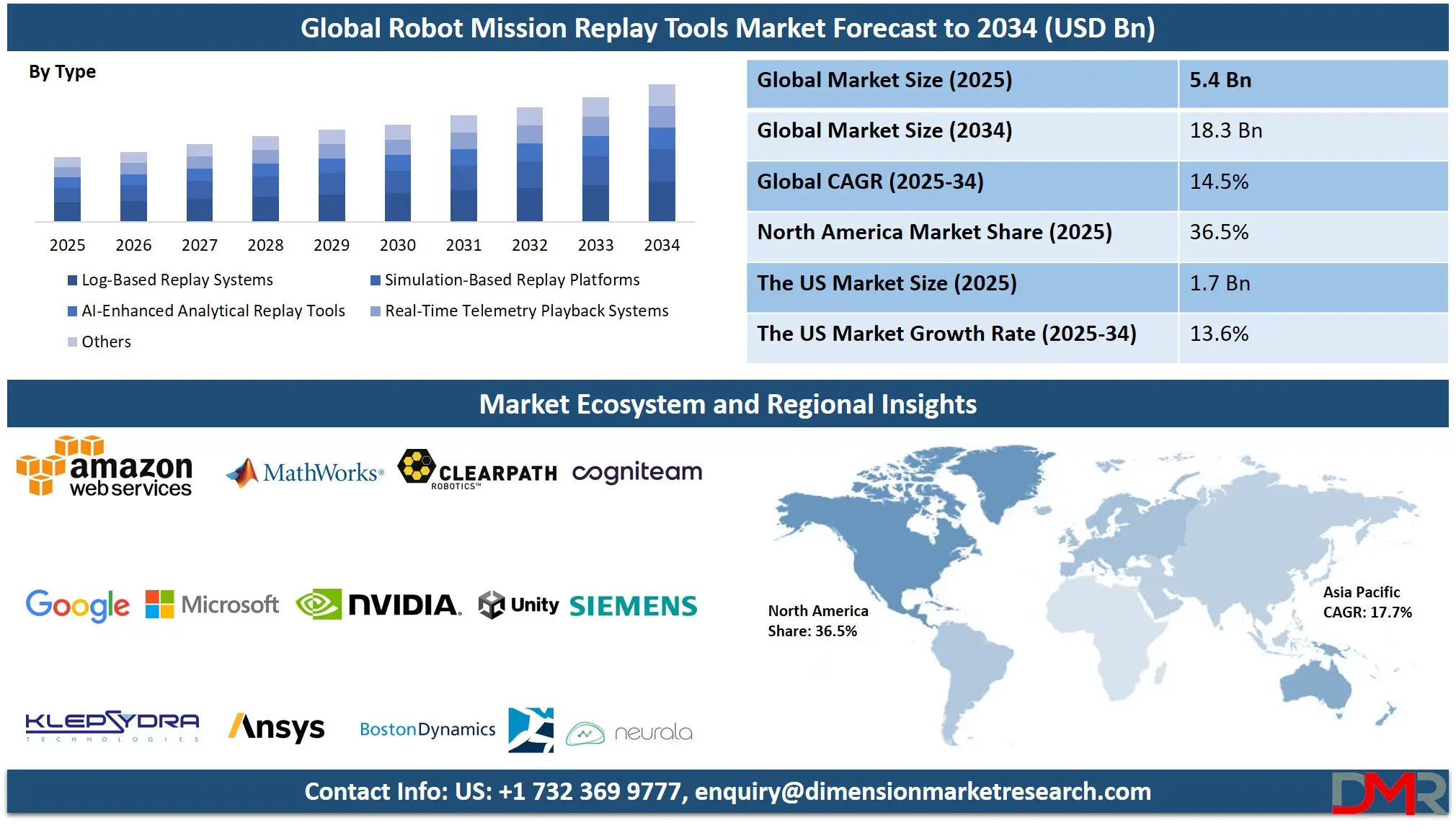
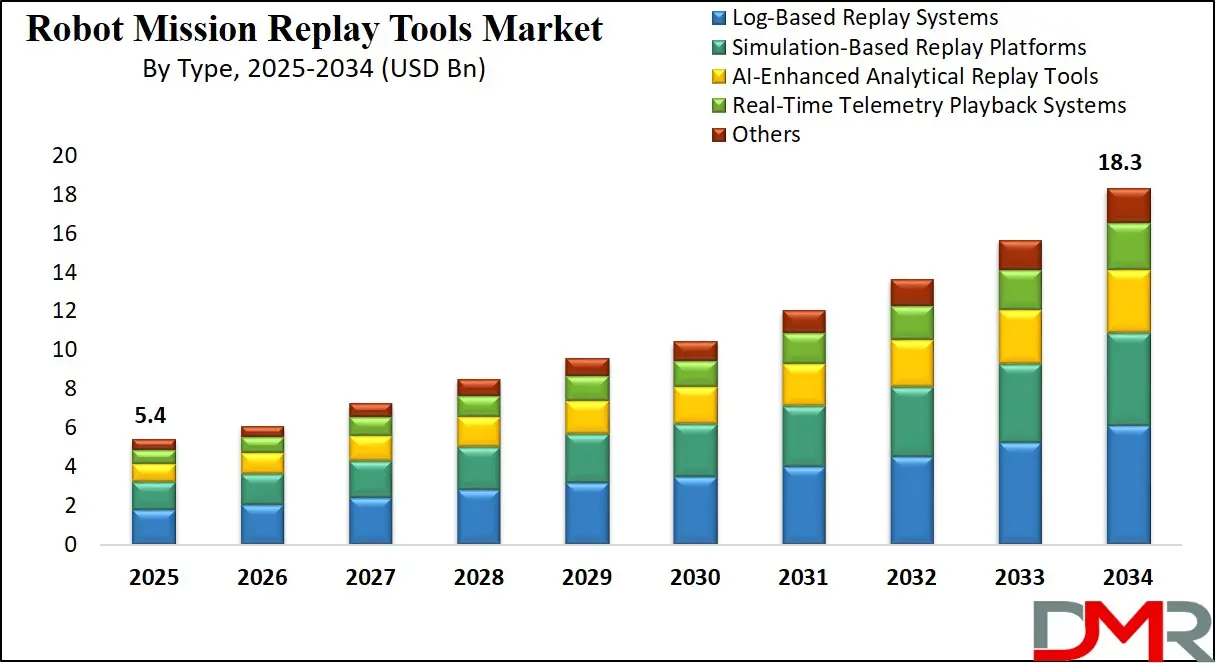
The Global Robot Mission Replay Tools Market is valued at USD 5.4 billion in 2025 and is expected to grow at a CAGR of 14.5% from 2025 to 2034, attaining a value of USD 18.3 billion by 2034. The market's rapid growth is driven by the escalating deployment of autonomous robots across industrial, defense, and commercial sectors, combined with the critical need for post-mission analysis, performance validation, and operational debugging.
ℹ
To learn more about this report –
Download Your Free Sample Report Here
Robot Mission Replay Tools enable the reconstruction, visualization, and in-depth analysis of robot operations through playback of sensor data, control logs, and environmental recordings. This supports developers, operators, and maintenance teams in diagnosing failures, optimizing paths, validating AI decisions, and training new systems. The model addresses global challenges related to robot reliability and safety, affecting millions of autonomous hours annually, and helps reduce operational downtime through precise forensic analysis.
Technological advancements, including high-fidelity simulation engines, cloud-based replay platforms, AI-driven anomaly detection, 5G-enabled real-time data streaming, and integrated DevOps workflows, are transforming the market into a scalable and essential component of the robot lifecycle. Integration of machine learning algorithms for predictive failure analysis, behavior clustering, and scenario regeneration is reshaping operational intelligence.
ℹ
To learn more about this report –
Download Your Free Sample Report Here
Growing industry initiatives promoting robot certification, regulatory compliance for autonomous systems, and the adoption of digital twin technologies further accelerate global adoption. However, barriers such as high computational requirements, data synchronization challenges, lack of standardization, and cybersecurity concerns remain. Despite these limitations, the convergence of robotics, AI analytics, and cloud computing positions mission replay tools as a central driver of global autonomous system maturity through 2034.
The US Robot Mission Replay Tools Market
The U.S. Robot Mission Replay Tools Market is estimated to reach USD 1.7 billion in 2025 and grow at a CAGR of 13.6%, reaching USD 5.2 billion by 2034. The U.S. leads global adoption due to its advanced robotics ecosystem, high concentration of autonomous vehicle and drone developers, and stringent safety and validation requirements from regulatory bodies.
More than 40% of global autonomous robot developers are based in the U.S., fueling demand for advanced replay and debugging tools for ground robots, drones, and marine autonomous systems. Agencies such as DARPA, NASA, and the Department of Defense are scaling replay solutions for mission-critical robotics. Major technology and automotive players such as Boston Dynamics, Waymo, and Tesla have integrated AI-enhanced replay systems for validation, training, and incident investigation.
.webp)
ℹ
To learn more about this report –
Download Your Free Sample Report Here
U.S. regulatory frameworks, including NHTSA guidelines for autonomous vehicles and FAA regulations for drones, mandate robust data recording and analysis capabilities, propelling the adoption of replay tools. National initiatives such as the National Robotics Initiative further demonstrate the strategic importance of post-mission analytics in advancing robot autonomy and safety.
The rapid rise of cloud-based replay platforms, real-time telemetry visualization, AI-powered root cause analysis, and synthetic data generation continues to redefine the U.S. robotics development landscape, positioning the country as a global leader in robot operational intelligence.
The Europe Robot Mission Replay Tools Market
The Europe Robot Mission Replay Tools Market is projected to be valued at approximately USD 1,485.0 million in 2025 and is projected to reach around USD 5,032.5 million by 2034, growing at a CAGR of about 14.5% from 2025 to 2034. Europe's leadership is anchored by strong regulatory frameworks, robust automotive and manufacturing robotics sectors, and significant EU funding for digital and industrial automation.
Countries such as Germany, the U.K., France, Italy, and the Nordic region have widely adopted replay tools, driven by automotive OEMs, industrial robot integrators, and aerospace and defense contractors. The EU's stringent safety standards for machinery and autonomous systems necessitates comprehensive mission analysis and validation tools.
Europe's leadership in industrial automation, alongside a growing ecosystem of AGV and AMR developers, further drives replay tool uptake. Funding through Horizon Europe, the Digital Europe Programme, and national Industry 4.0 strategies supports the adoption of AI in robot testing, digital twin integration, and cloud-based analytics platforms.
Manufacturing plants, research institutes, and defense organizations increasingly deploy high-fidelity simulation replay, log analysis suites, and collaborative review platforms. With strong engineering heritage, digital innovation, and investment in robotic validation, Europe remains one of the most advanced regions in mission replay tool penetration.
The Japan Robot Mission Replay Tools Market
The Japan Robot Mission Replay Tools Market is anticipated to be valued at approximately USD 675.0 million in 2025 and is expected to attain nearly USD 2,287.5 million by 2034, expanding at a CAGR of about 14.5% during the forecast period. Japan's leadership in industrial robotics, aging workforce, and focus on service and companion robots drives high demand for mission analysis and continuous improvement tools.
The Ministry of Economy, Trade and Industry (METI) actively supports robotics innovation through national strategies, enabling advanced testing, simulation, and replay capabilities for next-generation robots. Japan's excellence in precision engineering, mechatronics, and sensor technology accelerates innovation in high-fidelity data recording and playback systems.
Japan's concept of "Society 5.0", driven by companies like Fanuc, Yaskawa, and SoftBank Robotics, integrates IoT-enabled robots with cloud-based analytics and replay platforms. Industries from electronics manufacturing to logistics and healthcare use replay tools for quality assurance, maintenance prediction, and operator training. Japan's cultural emphasis on quality, reliability, and continuous improvement (Kaizen), combined with cutting-edge robotics, positions the country as a high-growth innovator in mission replay technologies.
Global Robot Mission Replay Tools Market: Key Takeaways
- Strong Global Market Growth Outlook: The Global Robot Mission Replay Tools Market is expected to be valued at USD 5.4 billion in 2025 and is projected to reach USD 18.3 billion by 2034, showcasing rapid expansion supported by rising robot deployments and the need for operational assurance.
- High CAGR Driven by Autonomy Validation: The market is expected to grow at an impressive CAGR of 14.5% from 2025 to 2034, fueled by the proliferation of autonomous systems, regulatory mandates for data recording, and the integration of AI into development and maintenance cycles.
- Strong Growth Trajectory in the United States: The U.S. Robot Mission Replay Tools Market stands at USD 1.7 billion in 2025 and is projected to reach USD 5.2 billion by 2034, expanding at a CAGR of 13.6% due to robust R&D investment, a mature robotics sector, and stringent validation standards.
- North America Maintains Regional Dominance: North America is expected to capture approximately 36.5% of the global market share in 2025, supported by leading robotics corporations, advanced cloud infrastructure, and early adoption of AI-driven analytics in robot operations.
- Rapid Advancement in Replay Technologies: Innovations including AI-based anomaly detection, cloud-synced simulation replay, real-time telemetry visualization, and digital twin integration are significantly accelerating the depth, speed, and scalability of post-mission analysis.
- Growing Complexity of Robot Operations Boosts Adoption: Increasing deployment of robots in unstructured environments, collaborative workspaces, and safety-critical applications is driving sustained demand for sophisticated tools to debug, verify, and optimize autonomous behavior.
Global Robot Mission Replay Tools Market: Use Cases
- Autonomous Vehicle Incident Analysis: Developers replay sensor fusion data (LiDAR, camera, radar) and control logs to reconstruct and diagnose the root cause of navigation failures or collisions.
- Industrial Robot Performance Validation: Manufacturing engineers use replay tools to verify robotic arm precision, cycle times, and coordination in digital twin environments before and after deployment.
- Drone Mission Debriefing: Operators replay full flight telemetry and video feeds to assess mission success, identify sensor errors, and train AI models for improved obstacle avoidance.
- AGV/AMR Fleet Optimization: Logistics centers analyze replay data from entire fleets of Autonomous Guided Vehicles to optimize traffic flow, prevent deadlocks, and improve charging strategies.
- Defense & Security Robot Training: Mission logs from unmanned ground vehicles (UGVs) are replayed in simulated environments to train AI algorithms and prepare for complex operational scenarios.
Global Robot Mission Replay Tools Market: Stats & Facts
International Federation of Robotics (IFR)
- Global industrial robot installations reached about 542,000 units in 2024, one of the highest annual volumes recorded.
- The global operational stock of industrial robots stood at approximately 4.66 million units in 2024.
- Asia accounted for nearly 74% of all new industrial robot installations worldwide.
- China represented about 54% of global industrial robot installations in 2024.
- China’s installed base of industrial robots exceeded 2 million units, the largest globally.
- Chinese robot manufacturers supplied around 57% of China’s domestic robot demand.
- Global annual industrial robot installations more than doubled compared to 2014 levels.
- IFR data covers robot installations across over 40 countries worldwide.
- The IFR World Robotics program tracks robots by application, industry, and type.
- IFR defines robot density as the number of robots per 10,000 manufacturing employees.
International Federation of Robotics (IFR) – Robot Density Statistics
- South Korea recorded the world’s highest robot density, at roughly 1,012 robots per 10,000 manufacturing workers.
- Singapore’s robot density exceeded 770 robots per 10,000 manufacturing workers.
- China’s robot density reached around 470 robots per 10,000 manufacturing workers.
- Germany recorded approximately 429 robots per 10,000 manufacturing workers.
- Japan’s robot density stood at about 419 robots per 10,000 manufacturing workers.
- The United States recorded roughly 295 robots per 10,000 manufacturing workers.
- Global robot density has increased at an average annual rate of about 5% since 2018.
International Federation of Robotics (IFR) – Industry & Usage Trends
- The automotive industry remains the largest adopter of industrial robots globally.
- The electronics and electrical industries rank among the top three robot-using sectors worldwide.
- Industrial robot adoption has expanded beyond manufacturing into logistics, inspection, and service-related tasks.
- IFR reports show consistent year-on-year growth in non-automotive robot installations.
- Robot deployments increasingly rely on software platforms for monitoring, diagnostics, and task replay.
Global Robot Mission Replay Tools Market: Market Dynamics
Driving Factors in the Global Robot Mission Replay Tools Market
Proliferation of Autonomous Robots
The exponential growth in deployments of industrial robots, autonomous vehicles, drones, and service robots across sectors is a major driver. This expansion increases the volume and criticality of operational data that must be analyzed for performance, safety, and optimization. Replay tools are essential for debugging autonomous decisions, verifying compliance, and training AI models, especially as robots operate in more dynamic and human-collaborative environments.
Advancements in Simulation & Digital Twin Technologies
The market benefits heavily from progress in high-fidelity simulation engines, real-time rendering, and cloud-based digital twins. Modern replay tools can synchronize real-world robot log data with simulated environments, enabling "what-if" analysis and scenario regeneration. AI-powered analytics automatically flag anomalies, predict failures, and suggest optimizations. This integration dramatically improves development speed, reduces physical testing costs, and enhances operational reliability.
Restraints in the Global Robot Mission Replay Tools Market
High Computational and Data Management Costs
Replaying complex missions, especially from sensor-rich robots (cameras, LiDAR, etc.), requires significant storage, bandwidth, and processing power. Managing and synchronizing terabytes of time-series data from distributed fleets poses a major challenge, particularly for small and medium-sized enterprises. The cost of high-performance computing infrastructure and specialized software can limit adoption.
Lack of Standardization and Interoperability
The robotics industry lacks universal standards for data logging formats, telemetry streams, and replay interfaces. Proprietary systems from different robot manufacturers create silos, making it difficult to use a single replay tool across a heterogeneous fleet. This fragmentation increases integration complexity and cost, slowing down widespread deployment of unified replay solutions.
Opportunities in the Global Robot Mission Replay Tools Market
Integration with Robot DevOps and CI/CD Pipelines
There is a significant opportunity to embed replay tools into the continuous integration and delivery (CI/CD) pipelines for robot software. Automated replay of test missions in simulation after each code commit can catch regressions early. This "replay-driven development" approach is gaining traction among leading autonomous system developers, creating a sustained demand for integrated, automated replay platforms.
Expansion in Emerging Robotics Hubs
Emerging economies in Asia-Pacific, Latin America, and the Middle East are rapidly adopting automation in manufacturing, logistics, and agriculture. These regions represent major growth opportunities due to new greenfield robot deployments that can mandate replay tools from the start. Government initiatives promoting Industry 4.0 and local partnerships with global robotics firms will drive demand for affordable, scalable replay solutions.
Trends in the Global Robot Mission Replay Tools Market
AI-Powered Anomaly Detection and Root Cause Analysis
Moving beyond simple playback, advanced tools now use machine learning to automatically detect unusual patterns, operational inefficiencies, or potential failures within mission data. These systems can correlate events across multiple data streams (e.g., linking a motor temperature spike to a specific navigation command) and suggest root causes, dramatically reducing the time for engineers to diagnose issues.
Cloud-Native, Collaborative Replay Platforms
Replay tools are evolving into cloud-based platforms that enable geographically distributed teams to simultaneously review, annotate, and discuss mission replays. These platforms offer version control for mission data, role-based access, and integration with project management tools, transforming post-mission analysis from a solitary activity into a collaborative, institutional learning process.
Global Robot Mission Replay Tools Market: Research Scope and Analysis
By Type Analysis
Simulation-Based Replay Platforms are projected to dominate the global market. These tools allow mission data to be replayed within a high-fidelity virtual environment, enabling context-rich analysis beyond raw logs. This is crucial for understanding robot interaction with complex, dynamic surroundings. They are essential for validating autonomous systems in safety-critical applications like self-driving cars and surgical robots, where understanding the "why" behind a robot's action is as important as the action itself. The integration of digital twins and the ability to generate synthetic scenarios from real data solidify this segment's dominance. Log-Based Replay Systems form a substantial segment, providing the fundamental capability to replay recorded sensor data, actuator commands, and system states. Their relative simplicity and lower cost ensure continued use for basic debugging and training purposes across a wide range of robot types, especially in cost-sensitive or less complex applications.
By Application Analysis
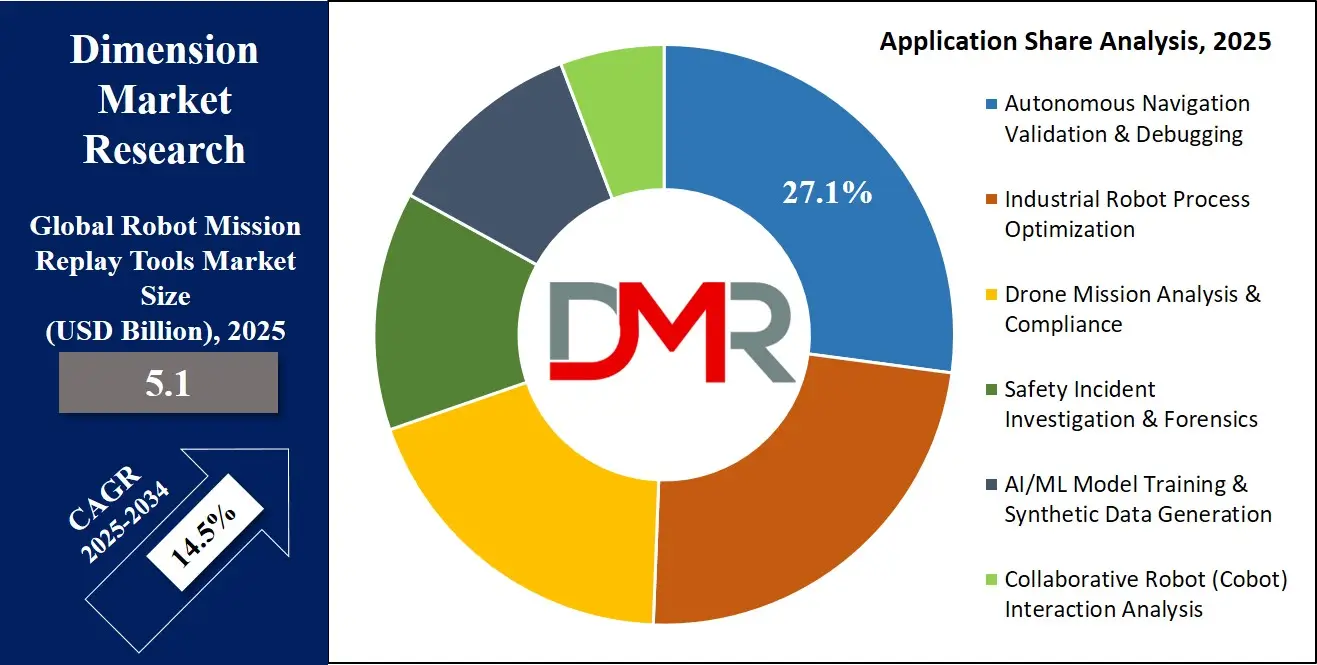
Autonomous Navigation Validation & Debugging is poised to be the largest and most dominant application segment. As robots move beyond structured factory floors into warehouses, roads, and public spaces, ensuring reliable and safe navigation is paramount. Replay tools are indispensable for reconstructing navigation failures, testing perception system performance, and tuning path-planning algorithms.
ℹ
To learn more about this report –
Download Your Free Sample Report Here
This segment's dominance is reinforced by the rapid growth of autonomous mobile robots (AMRs) and autonomous vehicles. Industrial Robot Process Optimization ranks as the second-largest application segment. In manufacturing, replay tools are used to analyze cycle times, identify motion inefficiencies, verify collaboration with human workers, and optimize production flows. The drive for higher productivity and quality in smart factories sustains strong demand in this segment.
By End User Analysis
Robot Manufacturers & OEMs are anticipated to dominate the market. They are the primary users, integrating replay tools into their development, testing, and validation cycles. These tools are critical for R&D, quality assurance, and providing diagnostic capabilities to their end customers. The need to reduce time-to-market and ensure product reliability makes this group the largest and most essential end user. Large-Scale Robot Operators & Integrators are the second-largest end-user segment. This includes logistics companies running fleets of AGVs, automotive plants with hundreds of robots, and defense contractors operating UGVs. They use replay tools for daily operational analysis, preventive maintenance, operator training, and incident investigation to maximize uptime and return on investment.
The Global Robot Mission Replay Tools Market Report is segmented on the basis of the following:
By Type
- Log-Based Replay Systems
- Simulation-Based Replay Platforms
- AI-Enhanced Analytical Replay Tools
- Real-Time Telemetry Playback Systems
- Others
By Application
- Autonomous Navigation Validation & Debugging
- Industrial Robot Process Optimization
- Drone Mission Analysis & Compliance
- Safety Incident Investigation & Forensics
- AI/ML Model Training & Synthetic Data Generation
- Collaborative Robot (Cobot) Interaction Analysis
By End User
- Robot Manufacturers & OEMs
- Large-Scale Robot Operators & Integrators
- Defense & Security Agencies
- Research & Academic Institutions
- Robotics Software Developers
- Service & Maintenance Providers
Impact of Artificial Intelligence in the Global Robot Mission Replay Tools Market
- AI for Automated Anomaly Detection: AI algorithms automatically scan petabytes of replay data to identify deviations from normal operation, subtle performance degradations, or precursors to failure, enabling proactive maintenance.
- AI-Assisted Scenario Reconstruction & "What-If" Analysis: AI can reconstruct ambiguous sensor data and generate plausible alternative scenarios from a single log, helping engineers explore counterfactuals and improve system robustness.
- AI-Based Root Cause Correlation: Machine learning models correlate events across disparate data streams (e.g., software logs, hardware telemetry, environmental data) to pinpoint the likely root cause of complex failures.
- Intelligent Data Compression for Efficient Storage: AI models learn to compress high-volume sensor data (like video and point clouds) without losing critical forensic information, drastically reducing storage and bandwidth costs for long-term mission archives.
- AI-Driven Synthetic Test Case Generation: By analyzing replay data, AI can automatically generate challenging edge-case scenarios in simulation to stress-test and improve robot algorithms, closing the loop between operation and development.
Global Robot Mission Replay Tools Market: Regional Analysis
Region with the Largest Revenue Share
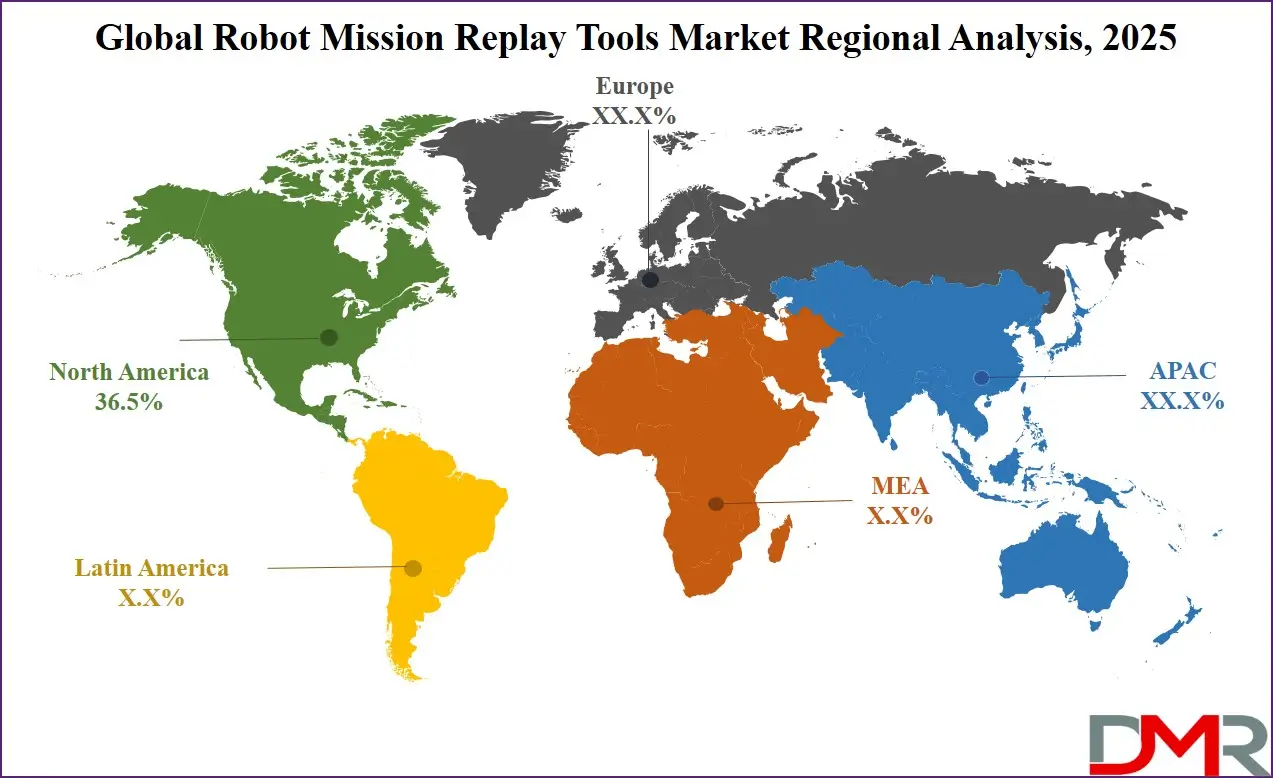
North America is projected to dominate the Global Robot Mission Replay Tools Market with 36.5% of market share by the end of 2025. This leadership stems from the concentration of leading robotics companies, autonomous vehicle developers, and defense contractors. The region's advanced cloud computing infrastructure, strong venture capital funding for robotics, and regulatory push for autonomous system validation create an ideal environment. The U.S., in particular, hosts major players like Boston Dynamics, Waymo, and countless startups that rely on sophisticated replay tools for development and certification.
ℹ
To learn more about this report –
Download Your Free Sample Report Here
Region with the Highest CAGR
Asia-Pacific holds the highest CAGR and is poised to achieve the largest market share in the long term. This is driven by its massive manufacturing base, aggressive adoption of industrial automation, and government-led initiatives like "Made in China 2025" and India's "National Robotics Strategy." Countries like China, Japan, and South Korea are not only major consumers but also leading producers of robots. The rapid scale-up of robot deployments in electronics manufacturing, e-commerce logistics, and electric vehicle production creates enormous, immediate demand for tools to ensure these systems operate efficiently and safely.
By Region
North America
Europe
- Germany
- The U.K.
- France
- Italy
- Russia
- Spain
- Benelux
- Nordic
- Rest of Europe
Asia-Pacific
- China
- Japan
- South Korea
- India
- ANZ
- ASEAN
- Rest of Asia-Pacific
Latin America
- Brazil
- Mexico
- Argentina
- Colombia
- Rest of Latin America
Middle East & Africa
- Saudi Arabia
- UAE
- South Africa
- Israel
- Egypt
- Rest of MEA
Global Robot Mission Replay Tools Market: Competitive Landscape
The Global Robot Mission Replay Tools Market is moderately fragmented and dynamic, featuring a mix of established simulation software giants, specialized robotics software firms, and emerging AI analytics startups. Leading simulation providers ANSYS, Siemens (Simcenter), MathWorks (Simulink), and NVIDIA (Isaac Sim) dominate the high-fidelity replay and simulation-based analysis segment. Robotics-focused software companies Clearpath Robotics (ROS), Boston Dynamics (Spot SDK), and Unity (Unity Robotics) offer tailored replay and analysis tools integrated into their ecosystems.
AI-focused analytics innovators such as cogniteam, Neurala, AIS, and Klepsydra Technologies significantly influence the market by offering intelligent log analysis, anomaly detection, and automated reporting features. Their solutions reduce the engineering burden of sifting through massive datasets.
Major cloud providers Amazon Web Services (AWS RoboMaker), Microsoft Azure (Azure Robotics), and Google Cloud are expanding their offerings with cloud-native robot data management and replay services, aiming to become the central platform for robot operational data. Meanwhile, specialized players like Rostam, Tangram Vision, and Locus Robotics provide deep vertical solutions for specific robot types or applications.
Some of the prominent players in the Global Robot Mission Replay Tools Market are:
- ANSYS, Inc.
- Siemens AG
- MathWorks, Inc.
- NVIDIA Corporation
- Clearpath Robotics Inc.
- Boston Dynamics
- Unity Technologies
- cogniteam
- Neurala, Inc.
- AIS (Advanced Intelligent Systems)
- Klepsydra Technologies
- Amazon Web Services, Inc.
- Microsoft Corporation
- Google LLC
- Rostam
- Tangram Vision
- Locus Robotics
- ABB Ltd.
- Fanuc Corporation
- Yaskawa Electric Corporation
- Other Key Players
Recent Developments in the Global Robot Mission Replay Tools Market
- November 2025: NVIDIA introduced Isaac Replay 4.0 with enhanced AI synthesis capabilities, allowing developers to generate thousands of variant scenarios from a single real-world robot log, drastically accelerating simulation-based testing and validation.
- October 2025: Siemens presented its integrated digital twin and mission replay solutions at Automate 2025, demonstrating seamless data flow from physical robots to the cloud-based Simcenter platform for performance analytics and virtual commissioning.
- October 2025: The International Conference on Intelligent Robots and Systems (IROS) 2025 featured major discussions on using mission replay as a core data source for training and refining robot AI, highlighting trends in offline reinforcement learning and synthetic data generation.
- September 2025: Amazon Web Services enhanced AWS RoboMaker with new tools for aggregating and analyzing replay data across entire robot fleets, enabling operators to identify systemic issues and benchmark performance at scale.
- August 2025: MathWorks completed the acquisition of a specialized startup to integrate advanced log parsing and visualization tools directly into Simulink, strengthening its toolchain for autonomous system development and verification.
- July 2025: Clearpath Robotics announced a deep partnership with Microsoft to integrate its robot data management and replay tools with Azure IoT and Azure Digital Twins, providing a unified platform for industrial mobile robot operations.
- June 2025: ROS World 2025 showcased several community-driven open-source projects for ROS 2 bag file visualization, analysis, and conversion, lowering the barrier to entry for sophisticated mission replay.
Report Details
| Report Characteristics |
| Market Size (2025) |
USD 5.4 Bn |
| Forecast Value (2034) |
USD 18.3 Bn |
| CAGR (2025–2034) |
14.5% |
| The US Market Size (2025) |
USD 1.7 Bn |
| Historical Data |
2019 – 2024 |
| Forecast Data |
2026 – 2034 |
| Base Year |
2024 |
| Estimate Year |
2025 |
| Report Coverage |
Market Revenue Estimation, Market Dynamics, Competitive Landscape, Growth Factors and etc. |
| Segments Covered |
By Type (Log-Based Replay Systems, Simulation-Based Replay Platforms, AI-Enhanced Analytical Replay Tools, Real-Time Telemetry Playback Systems, Others), By Application (Autonomous Navigation Validation & Debugging, Industrial Robot Process Optimization, Drone Mission Analysis & Compliance, Safety Incident Investigation & Forensics, AI/ML Model Training & Synthetic Data Generation, Collaborative Robot (Cobot) Interaction Analysis), By End User (Robot Manufacturers & OEMs, Large-Scale Robot Operators & Integrators, Defense & Security Agencies, Research & Academic Institutions, Robotics Software Developers, Service & Maintenance Providers) |
| Regional Coverage |
North America – The US and Canada; Europe – Germany, The UK, France, Russia, Spain, Italy, Benelux, Nordic, & Rest of Europe; Asia-Pacific – China, Japan, South Korea, India, ANZ, ASEAN, Rest of APAC; Latin America – Brazil, Mexico, Argentina, Colombia, Rest of Latin America; Middle East & Africa – Saudi Arabia, UAE, South Africa, Turkey, Egypt, Israel, & Rest of MEA |
| Prominent Players |
ANSYS, Inc., Siemens AG, MathWorks, Inc., NVIDIA Corporation, Clearpath Robotics Inc., Boston Dynamics, Unity Technologies, cogniteam, Neurala, Inc., AIS (Advanced Intelligent Systems), Klepsydra Technologies, Amazon Web Services, Inc., Microsoft Corporation, Google LLC, Rostam, Tangram Vision, Locus Robotics, ABB Ltd., Fanuc Corporation, Yaskawa Electric Corporation, and Other Key Players |
| Purchase Options |
We have three licenses to opt for: Single User License (Limited to 1 user), Multi-User License (Up to 5 Users) and Corporate Use License (Unlimited User) along with free report customization equivalent to 0 analyst working days, 3 analysts working days and 5 analysts working days respectively. |
Frequently Asked Questions
How big is the Global Robot Mission Replay Tools Market?
▾ The Global Robot Mission Replay Tools Market size is estimated to have a value of USD 5.4 billion in 2025 and is expected to reach USD 18.3 billion by the end of 2034.
What is the growth rate in the Global Robot Mission Replay Tools Market?
▾ The market is growing at a CAGR of 18.3 percent over the forecasted period of 2025 to 2034.
What is the size of the US Robot Mission Replay Tools Market?
▾ The US Robot Mission Replay Tools Market is projected to be valued at USD 1.7 billion in 2025. It is expected to reach USD 5.2 billion in 2034 at a CAGR of 13.6%.
Which region accounted for the largest Global Robot Mission Replay Tools Market?
▾ North America is expected to have the largest market share in the Global Robot Mission Replay Tools Market with a share of about 36.5% in 2025.
Who are the key players in the Global Robot Mission Replay Tools Market?
▾ Some of the major key players in the Global Robot Mission Replay Tools Market are ANSYS, Inc., Siemens AG, MathWorks, Inc., NVIDIA Corporation, Clearpath Robotics Inc., Boston Dynamics, and many others.