Market Overview
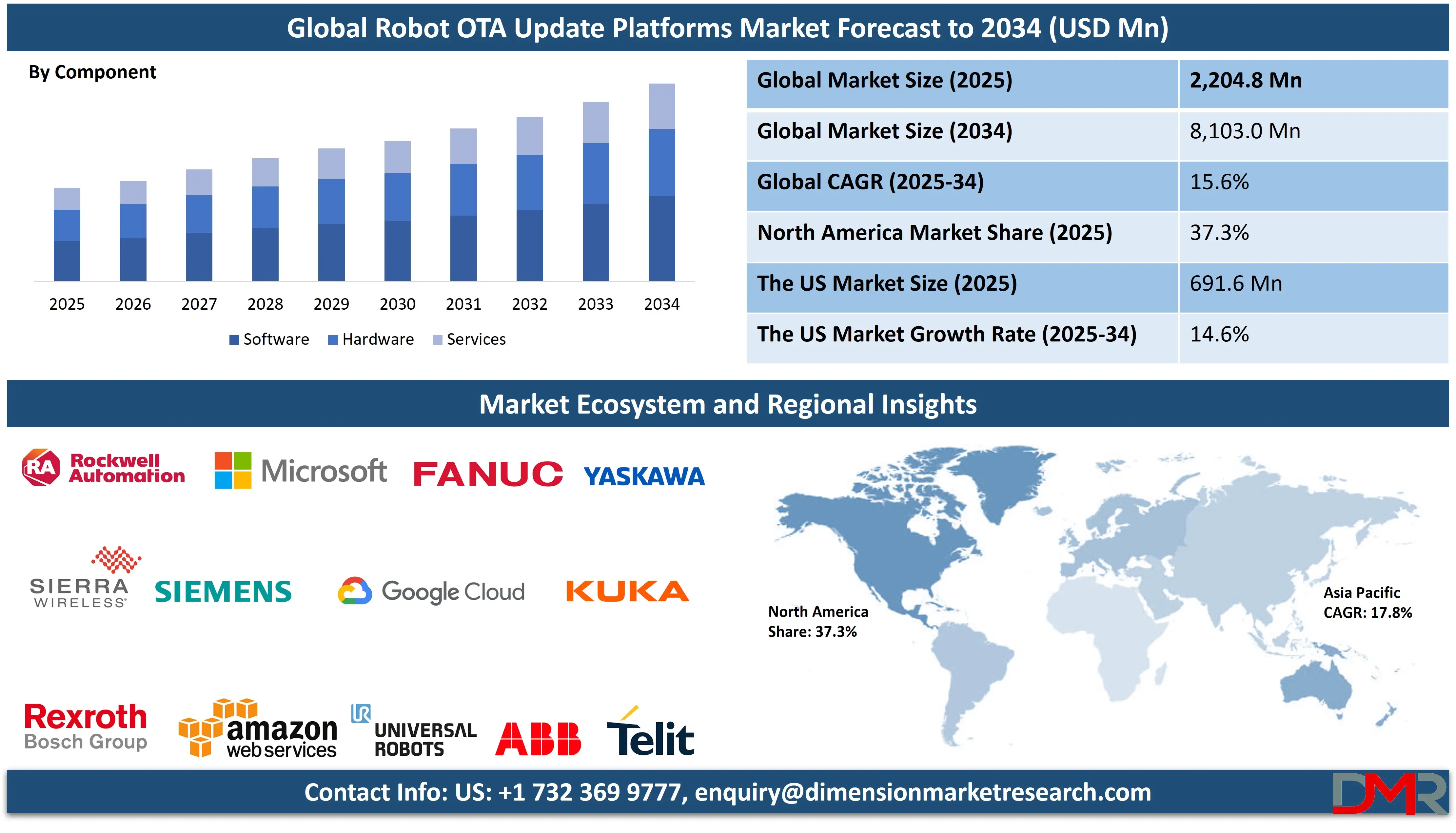
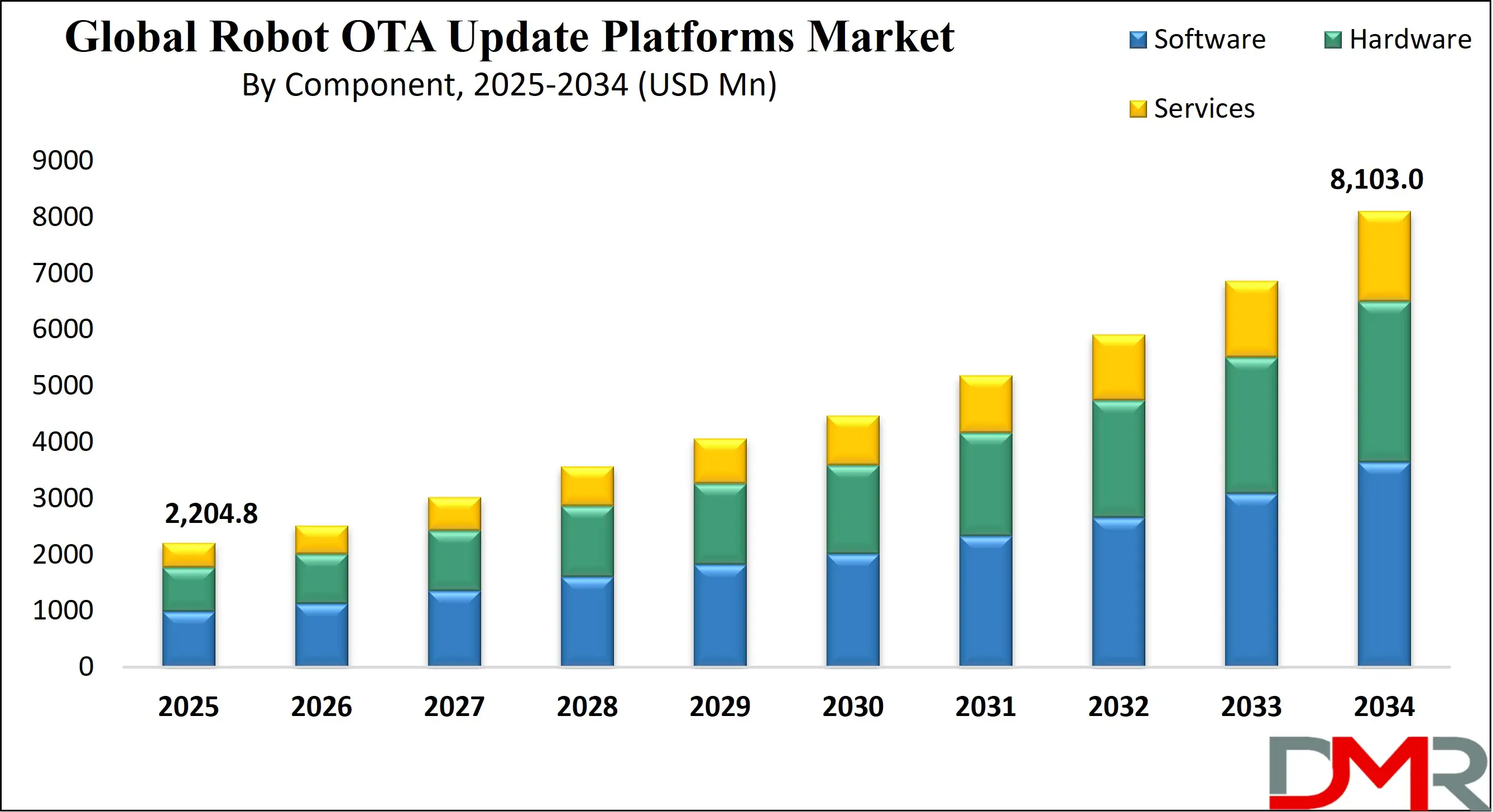
The Global Robot OTA Update Platforms Market is projected to reach USD 2,204.8 million in 2025 and is expected to grow at a CAGR of 15.6% from 2025 to 2034, attaining a value of USD 8,103.0 million by 2034. The market's rapid growth is driven by the increasing adoption of industrial, service, and consumer robots, combined with the critical need for remote performance optimization, security vulnerability management, and functional enhancement across robotic fleets.
ℹ
To learn more about this report –
Download Your Free Sample Report Here
OTA update platforms enable remote deployment of firmware, software, and security patches to robots through cloud-based management consoles, AI-driven update scheduling, and secure delta-update mechanisms, supporting operations in logistics, manufacturing, healthcare, and domestic environments. The model addresses global challenges related to robot downtime, cybersecurity threats, and rapid technological obsolescence, helping maintain operational continuity and scalability.
Technological advancements, including 5G-enabled high-speed updates, blockchain-verified patch integrity, AI-based predictive maintenance scheduling, edge-computing for localized updates, and containerized software deployment, are transforming the market into a scalable and highly reliable ecosystem. Integration of machine learning algorithms for update impact prediction, failure risk assessment, and bandwidth optimization is reshaping platform efficiency.
ℹ
To learn more about this report –
Download Your Free Sample Report Here
Growing industry standards promoting robotic interoperability, cybersecurity mandates, and the rise of Robot-as-a-Service (RaaS) business models further accelerate global adoption. However, barriers such as limited connectivity in harsh environments, high initial integration costs, fragmented robot operating systems, and data security concerns remain. Despite these limitations, the convergence of IoT, AI, and cloud robotics positions OTA update platforms as a central driver of global robotic autonomy and lifecycle management through 2034.
The US Robot OTA Update Platforms Market
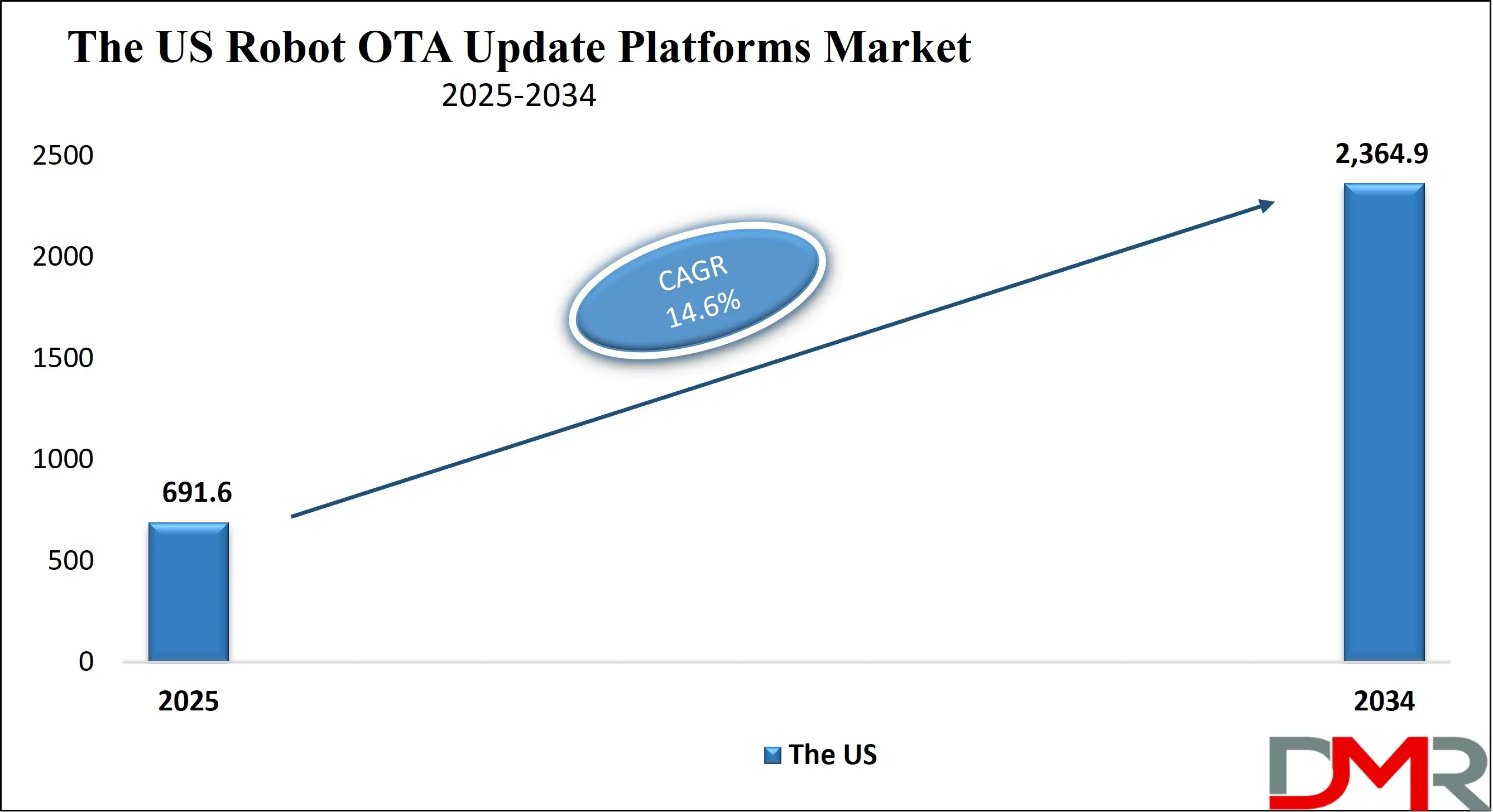
The U.S. Robot OTA Update Platforms Market is projected to reach USD 691.6 million in 2025 and grow at a CAGR of 14.6%, reaching USD 2,364.9 million by 2034. The U.S. leads global adoption due to its advanced IoT infrastructure, high concentration of robotic manufacturers and integrators, and stringent industrial cybersecurity regulations.
ℹ
To learn more about this report –
Download Your Free Sample Report Here
More than 60% of large-scale robotic deployments in manufacturing and logistics now mandate OTA update capabilities to ensure compliance and operational efficiency. Organizations such as NIOSH, NIST, and the Industrial Internet Consortium (IIC) are promoting standardized OTA frameworks. Major technology and robotics firms such as Boston Dynamics, iRobot, and Amazon Robotics have integrated AI-optimized update pipelines, secure rollback features, and fleet-wide version control.
U.S. regulatory and industry standards are expanding, with UL 5500 and NIST SP 1800-15 providing guidelines for secure OTA implementations in critical infrastructure. Meanwhile, national initiatives such as the Advanced Robotics for Manufacturing (ARM) Institute emphasize OTA as a core component of resilient robotic ecosystems.
The rapid rise of autonomous mobile robots (AMRs), collaborative robots (cobots), AI-driven diagnostic robots, and interoperable cloud robotics platforms continues to redefine the U.S. robotics landscape, positioning the country as a global leader in secure and scalable robotic OTA innovation.
The Europe Robot OTA Update Platforms Market
The Europe Robot OTA Update Platforms Market is projected to be valued at approximately USD 485 million in 2025 and is projected to reach around USD 1,783 million by 2034, growing at a CAGR of about 15.6% from 2025 to 2034. Europe's leadership is anchored by strong industrial IoT policies, GDPR-aligned data security frameworks, and EU-wide robotics standardization initiatives such as the Robotics 2025 Multi-Annual Roadmap.
Countries such as Germany, the U.K., France, Italy, Sweden, and the Netherlands have widely adopted OTA platforms, driven by automotive manufacturing, pharmaceutical robotics, and smart factory initiatives. The German Industry 4.0 framework and UK Robotics and Autonomous Systems (RAS) strategy represent some of the world's most integrated OTA ecosystems, managing thousands of robotic assets through centralized update hubs.
Europe's strong manufacturing base, increasing adoption of cobots, and emphasis on green and efficient production further drive OTA update uptake. Funding through the Horizon Europe program, Digital Europe Programme, and national digital innovation hubs supports the adoption of AI in update management, 5G-enabled update corridors, and cyber-physical system security.
Industrial and service robot operators increasingly deploy cloud-based OTA orchestration, predictive failure analytics, and blockchain-secured update logs. With strong regulatory governance, digital maturity, and investment in industrial autonomy, Europe remains one of the most advanced regions in robot OTA platform penetration.
The Japan Robot OTA Update Platforms Market
The Japan Robot OTA Update Platforms Market is anticipated to be valued at approximately USD 168 million in 2025 and is expected to attain nearly USD 616 million by 2034, expanding at a CAGR of about 15.6% during the forecast period. Japan's leadership in robotics manufacturing, precision engineering, and aging society support robots drives high demand for continuous functional upgrades, security patching, and performance optimization.
The Ministry of Economy, Trade and Industry (METI) actively supports OTA adoption through national strategies like Society 5.0 and the Robot Revolution Initiative, enabling remote robotic management, AI-based update scheduling, and fleet-wide health monitoring. Japan's expertise in industrial automation, sensor technology, and edge AI accelerates innovation in low-latency delta updates, real-time integrity checks, and multi-robot synchronization.
Japan's concept of "Connected Factory Ecosystems", driven by companies like FANUC, Yaskawa, and SoftBank Robotics, integrates IoT-enabled robots with cloud OTA platforms. Automotive and electronics manufacturing hubs deploy AI-driven update kiosks and secure over-the-air patch management systems, while healthcare and service robotics use remote update systems to ensure compliance and safety. Japan's emphasis on precision, reliability, and innovation positions the country as a high-growth innovator in robot OTA platforms.
Global Robot OTA Update Platforms Market: Key Takeaways
- Strong Global Market Growth Outlook: The Global Robot OTA Update Platforms Market is expected to be valued at USD 2,204.8 million in 2025 and is projected to reach USD 8,103.0 million by 2034, showcasing rapid expansion supported by rising demand for remote robotic management, security compliance, and operational agility.
- High CAGR Driven by Industrial IoT and Automation: The market is expected to grow at an impressive CAGR of 15.6% from 2025 to 2034, fueled by accelerated smart factory adoption, AI-integrated update analytics, cloud-based fleet management, and increasing robotic deployment across sectors.
- Strong Growth Trajectory in the United States: The U.S. Robot OTA Update Platforms Market stands at USD 691.6 million in 2025 and is projected to reach USD 2,364.9 million by 2034, expanding at a CAGR of 14.6% due to robust cybersecurity mandates, deep integration of OTA into robotic value chains, and leading R&D in autonomous systems.
- North America Maintains Regional Dominance: North America is expected to capture approximately 37.3% of the global market share in 2025, supported by advanced industrial IoT infrastructure, high robotic density, early AI adoption in update management, and strong regulatory support for secure OTA.
- Rapid Advancement in OTA Technologies: Innovations including AI-based predictive updates, 5G-enabled multi-robot synchronization, blockchain-verified patch delivery, and containerized software rollouts are significantly accelerating the security, efficiency, and scalability of robotic fleet management.
- Growing Complexity of Robotic Fleets Boosts Adoption: Rising global deployment of heterogeneous robotic fleets in logistics, manufacturing, healthcare, and agriculture is driving sustained demand for centralized, secure, and efficient OTA update solutions to ensure interoperability, security, and continuous functionality.
Global Robot OTA Update Platforms Market: Use Cases
- Manufacturing Robot Fleet Updates: Automotive plants remotely deploy firmware updates and performance patches to welding, assembly, and painting robots during planned downtime, minimizing production disruption and enhancing capabilities.
- Logistics AMR Security Patching: Warehouse operators use OTA platforms to seamlessly apply critical security updates to fleets of Autonomous Mobile Robots (AMRs), ensuring vulnerability management without halting operations.
- Healthcare Robot Compliance Updates: Hospital service and surgical robot vendors remotely update software to meet new medical standards and regulatory requirements, ensuring continuous compliance and safety.
- Agricultural Robot Functional Upgrades: Farm operators deploy new navigation algorithms and sensor calibration updates to autonomous tractors and drones via OTA, adapting to new crops or terrain conditions.
- Consumer Robot Feature Rollouts: Home robot manufacturers deliver new features, voice integrations, and security enhancements to domestic robots through scheduled, user-transparent OTA updates.
Global Robot OTA Update Platforms Market: Stats & Facts
- The International Federation of Robotics (IFR) reports over 3.5 million industrial robots operational worldwide, with OTA update capability becoming a standard requirement in over 60% of new deployments by 2025, highlighting the critical role of remote management in scaling robotic fleets.
- The Industrial Internet Consortium (IIC) projects that unplanned robot downtime can cost manufacturers up to USD 260,000 per hour; OTA-enabled predictive maintenance and updates can reduce such downtime by up to 40%, validating OTA as essential for operational resilience.
- The U.S. Cybersecurity and Infrastructure Security Agency (CISA) emphasizes that over 70% of industrial robots have unpatched vulnerabilities; secure OTA platforms are critical for mitigating ransomware and intrusion risks, with modern systems achieving over 99.5% update integrity rates.
- The European Union Agency for Cybersecurity (ENISA) reports that standardized OTA frameworks can reduce cybersecurity incident response time in robotic systems by over 60%, proving essential for critical infrastructure and smart manufacturing.
Global Robot OTA Update Platforms Market: Market Dynamic
Driving Factors in the Global Robot OTA Update Platforms Market
Proliferation of Robotic Fleets and IoT Integration
The exponential growth in deployment of industrial, commercial, and consumer robots across sectors is a primary driver for OTA update platforms. The expansion of Industry 4.0, smart factories, and Robot-as-a-Service (RaaS) models necessitates remote management capabilities to ensure uptime, security, and feature currency. OTA platforms enable scalable update deployment, security patching, and performance tuning across geographically dispersed fleets, reducing the need for physical intervention and minimizing operational disruption.
Advancements in Connectivity and Edge Computing
OTA platforms benefit heavily from advancements in 5G networks, edge computing infrastructure, and secure communication protocols. High-speed, low-latency connectivity enables large update packages and synchronized multi-robot deployments. Edge computing allows localized update validation and rollback capabilities, enhancing reliability. Integration with AI for predictive analytics optimizes update timing and impact assessment. These technological enablers improve the security, efficiency, and scalability of OTA platforms, making them indispensable for modern robotic ecosystems.
Restraints in the Global Robot OTA Update Platforms Market
Legacy System Integration and Fragmentation
Many existing robotic installations operate on legacy control systems, proprietary firmware, and isolated networks that lack OTA compatibility. Retrofitting these systems is often costly and complex. Furthermore, the robotics market is fragmented with diverse operating systems (ROS, proprietary OS), hardware architectures, and communication protocols, creating significant challenges for developing universal OTA solutions. This fragmentation slows down widespread adoption and increases integration overhead.
Cybersecurity and Reliability Concerns
The OTA update process itself presents a cyber-attack vector; compromised update servers or packages can cripple entire robotic fleets. Ensuring end-to-end encryption, digital signature verification, and secure boot mechanisms is critical but adds complexity. Additionally, the risk of bricking devices via faulty updates or network interruptions during deployment creates reliability concerns. These security and operational risks can deter adoption, especially in safety-critical applications like healthcare or aerospace.
Opportunities in the Global Robot OTA Update Platforms Market
AI-Driven Predictive and Autonomous Update Management
The integration of Artificial Intelligence and Machine Learning with OTA platforms creates significant opportunities. AI can analyze robot performance data, usage patterns, and network conditions to predict optimal update times, assess update impact, and automatically schedule deployments during low-activity windows. It can also autonomously prioritize critical security patches and perform A/B testing of new software versions on subset fleets. This intelligent automation reduces human oversight, minimizes downtime, and enhances the value proposition of OTA platforms.
Expansion in Emerging Robotics Markets
Emerging economies in Asia-Pacific, Latin America, and Eastern Europe are rapidly adopting automation in manufacturing, logistics, and agriculture. These regions represent major growth opportunities due to greenfield robotic deployments that can incorporate OTA capabilities from the start. Government initiatives promoting industrial digitization and smart city projects further drive demand. The adoption of cloud-based OTA services offers a cost-effective model for these markets, bypassing legacy integration challenges and accelerating market penetration.
Trends in the Global Robot OTA Update Platforms Market
Containerization and Microservices Architecture
A key trend is the shift towards containerized software deployment (e.g., using Docker, Kubernetes) for robot software updates. This allows isolated, lightweight, and portable application updates independent of the underlying host OS. Coupled with a microservices architecture, it enables granular, incremental updates to specific robot functions without full system reboots. This trend enhances update flexibility, reduces bandwidth usage, and simplifies version management across heterogeneous fleets.
Blockchain for Update Integrity and Audit Trails
Blockchain technology is increasingly being integrated into OTA platforms to create immutable audit trails for update transactions. Each update package's hash, deployment status, and robot acceptance are recorded on a distributed ledger, ensuring tamper-proof traceability. This is crucial for regulatory compliance (especially in medical and automotive robotics), liability management, and enhancing trust in the OTA process. It also helps in quickly identifying and isolating compromised updates.
Global Robot OTA Update Platforms Market: Research Scope and Analysis
By Component
The Software segment is unequivocally projected to dominate the market, with its central pillar being the Update Management & Orchestration Engine. This sophisticated software layer constitutes the intelligent command center of the OTA ecosystem, responsible for the end-to-end automation of packaging, dependency resolution, secure scheduling, mass distribution, and cryptographic validation of updates across diverse and sprawling robotic fleets. Its dominance is fundamentally driven by the escalating complexity inherent in managing multi-vendor environments, where a single platform must coordinate updates for robots from different OEMs, each with unique operating systems and hardware dependencies. The software must expertly handle intricate sequencing to avoid operational conflicts and provide robust, automated rollback capabilities to ensure fleet safety.
While hardware components like Secure Communication Gateways are critical enablers, they are becoming standardized modules integrated into robot designs or industrial networks. Services, though vital for integration and support, follow a derivative demand model. The software's value is further amplified by its role as the integration point for AI-driven predictive analytics, automated compliance reporting, and seamless connectivity with enterprise IT systems like ERP and DevOps pipelines. This positions the software suite not just as a tool, but as the strategic platform for robotic lifecycle management, guaranteeing it captures the largest and most defensible share of market revenue through continuous innovation in orchestration intelligence and embedded security.
By Update Type
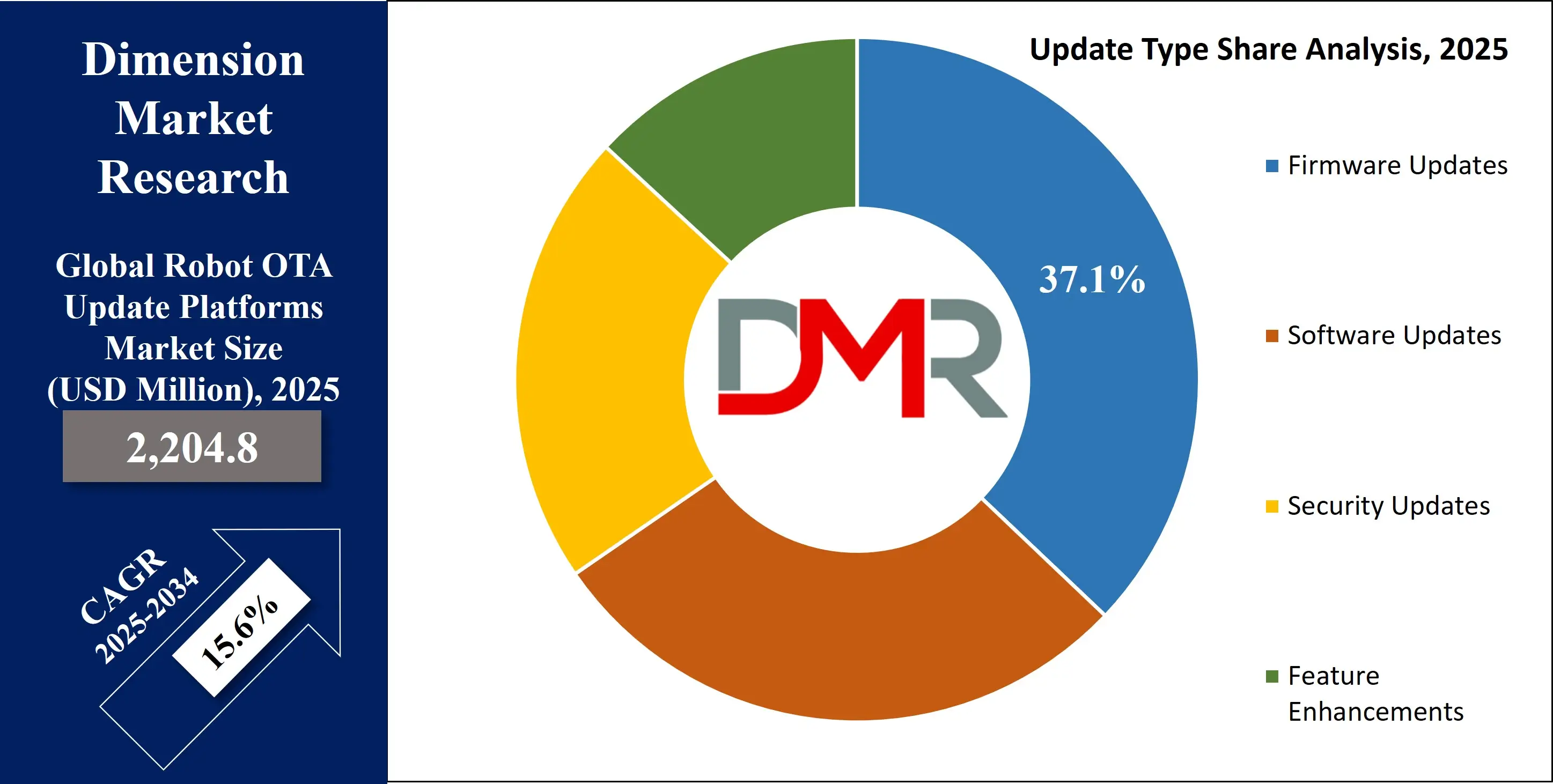
Software Updates are positioned to be the dominant and highest-volume update type, surpassing even critical firmware revisions. The primary driver is the operational paradigm shift towards continuous improvement and agile development in robotics. Firmware Updates, while essential for patching deep-seated security vulnerabilities and calibrating hardware, are inherently high-risk events deployed infrequently after extensive validation. Conversely, Software Updates target the application layer encompassing AI perception models, path-planning algorithms, task-specific applications, and user interfaces and are deployed with far greater regularity. This is especially true for Autonomous Service Robots and Mobile Robots operating in dynamic environments like warehouses and hospitals, where software must constantly adapt. The industry-wide adoption of containerized and microservices architectures decouples application software from the underlying OS, enabling safe, incremental, and isolated updates without full system reboots.
ℹ
To learn more about this report –
Download Your Free Sample Report Here
Furthermore, the explosive growth of the Robot-as-a-Service (RaaS) business model is fundamentally predicated on delivering ongoing value through new features and performance enhancements, which are exclusively enabled via software updates. While Security Updates are non-negotiable, they are increasingly delivered as a component of broader software or firmware packages. Therefore, the relentless need for functional agility, feature monetization, and iterative optimization establishes Software Updates as the core, recurring transaction fueling the OTA platform market.
By Robot Type
Industrial Robots including articulated arms, SCARA, and delta robots will dominate this segment in terms of market value and revenue generation throughout the forecast period. This dominance is anchored by their immense, decades-deep installed base within global manufacturing, particularly in the automotive, electronics, and metalworking sectors. These are high-capital assets with operational lifespans exceeding a decade, making OTA updates a critical lever to protect investment, extend functional relevance, and ensure cybersecurity over time. The financial impact of unplanned downtime in a high-volume production line is monumental, creating an imperative for reliable, remote update capabilities to perform optimizations, bug fixes, and security patches without halting production. While Autonomous Mobile Robots (AMRs) represent the segment with the highest growth rate and update frequency due to their dynamic software needs, their collective asset value and scale currently pale in comparison to the entrenched base of traditional industrial robots.
Furthermore, industrial applications demand OTA platforms that meet rigorous functional safety certifications (e.g., SIL, PL) and integrate seamlessly with industrial control systems, creating a market for high-value, robust solutions. The strategic push towards smart factories and flexible manufacturing necessitates the remote re-tasking and performance tuning of these robots, a capability enabled solely through sophisticated OTA systems. Thus, the confluence of massive scale, high asset value, and critical uptime requirements ensures Industrial Robots remain the primary revenue driver for OTA platforms.
By Organization Size
Large Enterprises are projected to command a dominant share of the OTA platform market. These global corporations including tier-1 automotive manufacturers, multinational electronics producers, and giant logistics and e-commerce networks operate the most extensive, complex, and often multi-vendor robotic fleets, numbering in the hundreds or thousands. This scale creates a compelling ROI for investing in comprehensive, enterprise-grade OTA platforms that provide centralized visibility, control, and security governance across all robotic assets. Large enterprises possess the necessary capital for significant upfront licensing and integration costs and typically maintain dedicated in-house IT/OT teams capable of managing and customizing these sophisticated platforms. Their operational complexity and size also make them primary targets for stringent industry regulations and cybersecurity standards (e.g., NIST, IEC 62443), making certified OTA update management not just an efficiency tool, but a compliance and risk mitigation necessity.
In contrast, Small & Medium Enterprises (SMEs), while a rapidly growing adopter of robotics, typically deploy smaller, more homogeneous fleets. They often lack specialized internal IT resources and budget for standalone OTA platforms, instead relying on simpler, cloud-managed update services that are bundled and abstracted by their robot vendor or system integrator. Therefore, while SME adoption is expanding the total addressable market, the revenue from large-scale, direct enterprise platform sales and subscriptions will constitute the bulk of the market value.
By Deployment Mode
Cloud-Based OTA Platforms are set for decisive dominance in the deployment mode segment, fundamentally reshaping how robotic fleets are managed. The cloud model delivers unparalleled strategic advantages: it offers infinite scalability to manage fleets from dozens to hundreds of thousands of robots globally, provides a single centralized dashboard for disparate operations, and drastically reduces the need for costly on-premises server infrastructure and maintenance. Crucially, cloud platforms seamlessly integrate with other cloud-native services, such as AI/ML analytics for predictive maintenance, big data lakes for performance telemetry, and advanced cybersecurity threat intelligence feeds, creating a powerful, synergistic ecosystem. This architecture is perfectly aligned with the burgeoning Robot-as-a-Service (RaaS) and Fleet-as-a-Service business models, where the service provider requires a ubiquitous, low-overhead channel to deliver value-added updates.
While On-Premises deployments will persist in environments with extreme data sovereignty requirements, air-gapped security needs (e.g., defense, certain critical infrastructure), or legacy network constraints, they sacrifice agility and global manageability. Hybrid Models will see adoption for balancing specific data residency rules with cloud benefits, but the core orchestration intelligence, update repository, and management console will increasingly be cloud-hosted. The overarching trend towards industrial IoT and connected operations inexorably drives the market toward the efficiency and innovation pace enabled by cloud-based OTA platforms.
By End-User Industry
The Manufacturing sector encompassing discrete manufacturing (automotive, electronics, machinery) and process industries will overwhelmingly dominate as the leading end-user industry for OTA update platforms. This dominance is rooted in manufacturing's status as the foundational and largest adopter of robotics globally, with a vast installed base of industrial arms and a rapidly growing population of collaborative robots (cobots). In these high-stakes environments, production line continuity is paramount; even minutes of unplanned downtime can result in six- or seven-figure losses. This creates an extremely powerful economic incentive to implement highly reliable OTA systems for preventative maintenance updates, performance optimizations, and urgent security patches that can be applied during planned pauses without physical technician dispatch.
The sector's transformational journey towards Industry 4.0 and flexible, reconfigurable production is critically dependent on the ability to remotely deploy new software to robots, enabling quick changeovers and new task assignments. While Logistics & Warehousing is the fastest-growing vertical due to the AMR boom, and Automotive is a massive sub-segment of manufacturing, the aggregated Manufacturing industry represents the most mature, deep-pocketed, and economically critical market. Its complex, large-scale robotic ecosystems demand the most robust and feature-rich OTA solutions, ensuring it generates the highest and most stable revenue stream for platform providers throughout the forecast period.
The Global Robot OTA Update Platforms Market Report is segmented on the basis of the following
By Component
- Software
- Update Management & Orchestration Engine
- Rollback & Version Control Systems
- Compliance & Reporting Dashboard
- Security & Cryptography Module
- Hardware
- Embedded Connectivity Modules
- Secure Communication and Gateway Devices
- Services
- Professional Services
- Managed Services
By Update Type
- Firmware Updates
- Software Updates
- Security Updates
- Feature Enhancements
By Robot Type
- Industrial Robots
- Collaborative Robots (Cobots)
- Autonomous Mobile Robots (AMRs)
- Service Robots
- Special-Purpose & Custom Robots
By Organization Size
- Large Enterprises
- Small & Medium Enterprises (SMEs)
By Deployment Mode
- Cloud-Based OTA Platforms
- On-Premises OTA Platforms
- Hybrid Deployment Models
By End-User Industry
- Manufacturing
- Logistics & Warehousing
- Healthcare
- Automotive
- Aerospace & Defense
- Retail & Hospitality
- Others
Impact of Artificial Intelligence in the Global Robot OTA Update Platforms Market
- AI for Predictive Update Scheduling: AI analyzes robot operational data, network load, and maintenance schedules to predict the optimal time for non-critical updates, minimizing disruption to production or service cycles.
- AI-Assisted Impact Analysis: Machine learning models simulate the potential impact of an update on different robot models and configurations before wide deployment, identifying risks of failures or performance regressions.
- AI-Driven Security Patch Prioritization: AI algorithms correlate robot vulnerability data with global threat intelligence feeds to autonomously prioritize and sequence critical security patches, reducing the window of exposure.
- Anomaly Detection Post-Update: AI monitors robot behavior and performance metrics after an update is applied, quickly detecting anomalies that may indicate a faulty update, enabling automated rollback.
- Intelligent Bandwidth Management: AI optimizes the distribution of update packages across a fleet, considering available bandwidth, robot priority, and data caps, ensuring efficient use of network resources.
Global Robot OTA Update Platforms Market: Regional Analysis
Region with the Largest Revenue Share
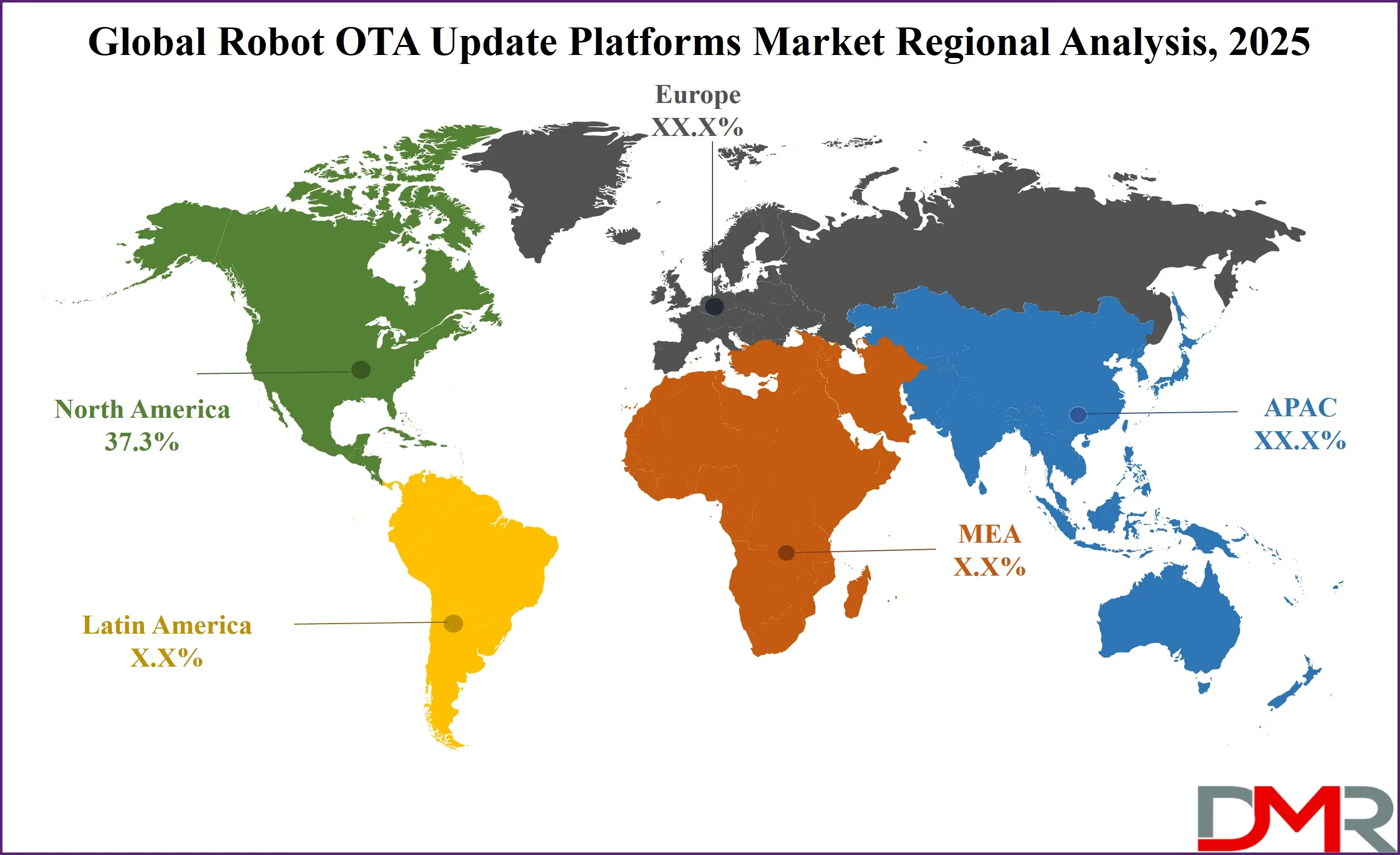
North America is projected to dominate the Global Robot OTA Update Platforms Market with 37.3% of market share by the end of 2025. This is owing to a powerful combination of advanced manufacturing base, high robotic adoption rates, strong cybersecurity focus, and leading robotics R&D. The United States and Canada have numerous robot OEMs, large system integrators, and tech giants investing heavily in cloud robotics and IoT management platforms. Regulatory pressures for industrial cybersecurity and the prevalence of RaaS business models necessitate robust OTA capabilities. Major automotive and tech companies with extensive robotic fleets are setting global benchmarks for OTA implementation.
ℹ
To learn more about this report –
Download Your Free Sample Report Here
Region with the Highest CAGR
Asia-Pacific holds the highest CAGR and is poised to achieve the largest market share in robot OTA update platforms due to its massive manufacturing sector, government-led initiatives in automation (e.g., China's "Made in China 2025", India's "Make in India"), and rapid growth of e-commerce logistics. The region accounts for over 70% of global industrial robot sales. Countries like China, Japan, South Korea, and Singapore are at the forefront, but emerging economies like India, Vietnam, and Thailand are rapidly adopting automation, often with modern, connected robots from the outset. This creates enormous greenfield demand for OTA platforms. The critical shortage of skilled robotics technicians in many APAC countries further accelerates the need for remote management solutions.
By Region
North America
Europe
- Germany
- The U.K.
- France
- Italy
- Russia
- Spain
- Benelux
- Nordic
- Rest of Europe
Asia-Pacific
- China
- Japan
- South Korea
- India
- ANZ
- ASEAN
- Rest of Asia-Pacific
Latin America
- Brazil
- Mexico
- Argentina
- Colombia
- Rest of Latin America
Middle East & Africa
- Saudi Arabia
- UAE
- South Africa
- Israel
- Egypt
- Rest of MEA
Global Robot OTA Update Platforms Market: Competitive Landscape
The Global Robot OTA Update Platforms Market is moderately fragmented and evolving, featuring a mix of established industrial automation giants, specialized OTA software providers, cloud platform hyperscalers, and robotics-focused cybersecurity firms. Leading industrial robotics firms FANUC, Yaskawa (Motoman), KUKA, and ABB are embedding proprietary OTA capabilities into their control systems and offering cloud management suites. Technology giants Microsoft (Azure IoT), Amazon (AWS IoT RoboRunner), and Google Cloud are providing scalable, cloud-agnostic OTA infrastructure services.
Specialized OTA and device management players like Sierra Wireless, Telit, BlackBerry (QNX), and Wind River are adapting their IoT platforms for the robotic segment. Cybersecurity-focused entrants such as Claroty, Dragos, and Nozomi Networks are integrating secure OTA patch management into their industrial threat detection platforms. Meanwhile, startups like Fetch Robotics (now Zebra), inVia Robotics, and Covariant are building OTA as a core component of their robotics-as-a-service offerings.
Some of the prominent players in the Global Robot OTA Update Platforms Market are
- ABB Ltd.
- FANUC Corporation
- Yaskawa Electric Corporation
- KUKA AG
- Teradyne Inc. (Universal Robots)
- Microsoft Corporation
- Amazon Web Services, Inc.
- Google LLC (Google Cloud)
- Siemens AG
- Bosch Rexroth AG
- Rockwell Automation, Inc.
- Sierra Wireless
- Telit
- BlackBerry Limited
- Wind River Systems, Inc.
- Claroty
- Dragos, Inc.
- Zebra Technologies (Fetch Robotics)
- inVia Robotics, Inc.
- Covariant
- Other Key Players
Recent Developments in the Global Robot OTA Update Platforms Market
- November 2025: Microsoft introduced specialized Azure IoT Edge modules optimized for robotic OTA workflows, featuring local update caching, delta compression, and integration with Azure Defender for IoT for security validation before deployment.
- October 2025: FANUC presented its new cloud-based OTA Hub integrated into its FIELD platform at Automate 2025, enabling centralized firmware and software update management for thousands of CNCs and robots across factory networks.
- October 2025: The International Federation of Robotics symposium featured major discussions on standardizing secure OTA protocols, with global experts emphasizing the role of blockchain and hardware security modules (HSM) in update integrity.
- September 2025: Amazon Web Services and Zebra Technologies (Fetch Robotics) announced a deep integration where AWS IoT RoboRunner will provide the core OTA and fleet management layer for Fetch's AMR fleets in logistics centers.
- August 2025: Siemens completed the acquisition of a specialist OTA software firm to bolster its Xcelerator platform's capabilities for managing updates across its industrial automation and robotics portfolios.
- July 2025: KUKA partnered with industrial cybersecurity firm Claroty to integrate continuous threat detection and secure, verified OTA patch delivery into KUKA IIoT platforms.
- April 2025: Google Cloud announced an AI-powered update orchestrator service for robotics, using machine learning to predict update failure risks and optimize rollout schedules across heterogeneous fleets.
Report Details
| Report Characteristics |
| Market Size (2026) |
USD 2,204.8 Mn |
| Forecast Value (2035) |
USD 8,103.0 Mn |
| CAGR (2026–2035) |
15.6% |
| The US Market Size (2026) |
USD 691.6 Mn |
| Historical Data |
2021 – 2025 |
| Forecast Data |
2027 – 2035 |
| Base Year |
2025 |
| Estimate Year |
2026 |
| Report Coverage |
Market Revenue Estimation, Market Dynamics, Competitive Landscape, Growth Factors, etc. |
| Segments Covered |
By Component (Software, Hardware, Services), By Update Type (Firmware Updates, Software Updates, Security Updates, Feature Enhancements), By Robot Type (Industrial Robots, Collaborative Robots (Cobots), Autonomous Mobile Robots (AMRs), Service Robots, Special-Purpose & Custom Robots), By Organization Size (Large Enterprises, Small & Medium Enterprises (SMEs)), By Deployment Mode (Cloud-Based OTA Platforms, On-Premises OTA Platforms, Hybrid Deployment Models), By End-User Industry (Manufacturing, Logistics & Warehousing, Healthcare, Automotive, Aerospace & Defense, Retail & Hospitality, Others) |
| Regional Coverage |
North America – US, Canada; Europe – Germany, UK, France, Russia, Spain, Italy, Benelux, Nordic, Rest of Europe; Asia-Pacific – China, Japan, South Korea, India, ANZ, ASEAN, Rest of APAC; Latin America – Brazil, Mexico, Argentina, Colombia, Rest of Latin America; Middle East & Africa – Saudi Arabia, UAE, South Africa, Turkey, Egypt, Israel, Rest of MEA |
| Prominent Players |
ABB Ltd., FANUC Corporation, Yaskawa Electric Corporation, KUKA AG, Teradyne Inc. (Universal Robots), Microsoft Corporation, Amazon Web Services, Inc., Google LLC (Google Cloud), Siemens AG, Bosch Rexroth AG, Rockwell Automation, Inc., Sierra Wireless, Telit, BlackBerry Limited, Wind River Systems, Inc., Claroty, Dragos, Inc., Zebra Technologies (Fetch Robotics), inVia Robotics, Inc., Covariant, and Other Key Players |
| Purchase Options |
We have three licenses to opt for: Single User License (Limited to 1 user), Multi-User License (Up to 5 Users), and Corporate Use License (Unlimited User) along with free report customization equivalent to 0 analyst working days, 3 analysts working days, and 5 analysts working days respectively. |
Frequently Asked Questions
How big is the Global Robot OTA Update Platforms Market?
▾ The Global Robot OTA Update Platforms Market size is estimated to have a value of USD 2,204.8 million in 2025 and is expected to reach USD 8,103.0 million by the end of 2034.
What is the growth rate in the Global Robot OTA Update Platforms Market in 2025?
▾ The market is growing at a CAGR of 15.6 percent over the forecasted period of 2025 to 2034.
What is the size of the US Robot OTA Update Platforms Market?
▾ The US Robot OTA Update Platforms Market is projected to be valued at USD 691.6 million in 2025. It is expected to witness subsequent growth in the upcoming period as it holds USD 2,364.9 million in 2034 at a CAGR of 14.6%.
Which region accounted for the largest Global Robot OTA Update Platforms Market?
▾ North America is expected to have the largest market share in the Global Robot OTA Update Platforms Market with a share of about 37.3% in 2025.
Who are the key players in the Global Robot OTA Update Platforms Market?
▾ Some of the major key players in the Global Robot OTA Update Platforms Market are ABB Ltd., FANUC Corporation, Yaskawa Electric Corporation, KUKA AG, Microsoft Corporation, Amazon Web Services, Inc., and many others.