Market Overview
The global robotic CNC machine tending market covers automated systems that load raw workpieces into CNC machines, unload finished parts, and manage in-process part handling without sustained human intervention. The market spans cobot tending cells, six-axis articulated systems, gantry loaders, and mobile manipulators deployed across automotive, aerospace, medical, electronics, and precision engineering production environments. Contract machine shops and captive manufacturing facilities both fall within scope; manual loading and raw CNC equipment without automation integration fall outside it.
As reported by Standard Bots in a 2026 deployment guide, a single synchronized tending robot can service two or three CNC machines simultaneously when machine cycles and robot paths align. That multiplier effect redefines labor economics at the cell level. One operator previously tied to repetitive loading can redirect attention toward setup, programming, and quality, shifting the cost structure of job shops that run mixed-part volumes.
Robotic machine tending connects directly to the broader factory automation ecosystem, sitting at the intersection of industrial robotics, CNC controls, vision systems, and manufacturing execution software. Buyers who automate tending unlock pathways to broader lights-out operations, digital twin integration, and closed-loop quality systems. The tending cell, once a standalone productivity tool, now functions as the entry point for full production floor connectivity.
Key Takeaways
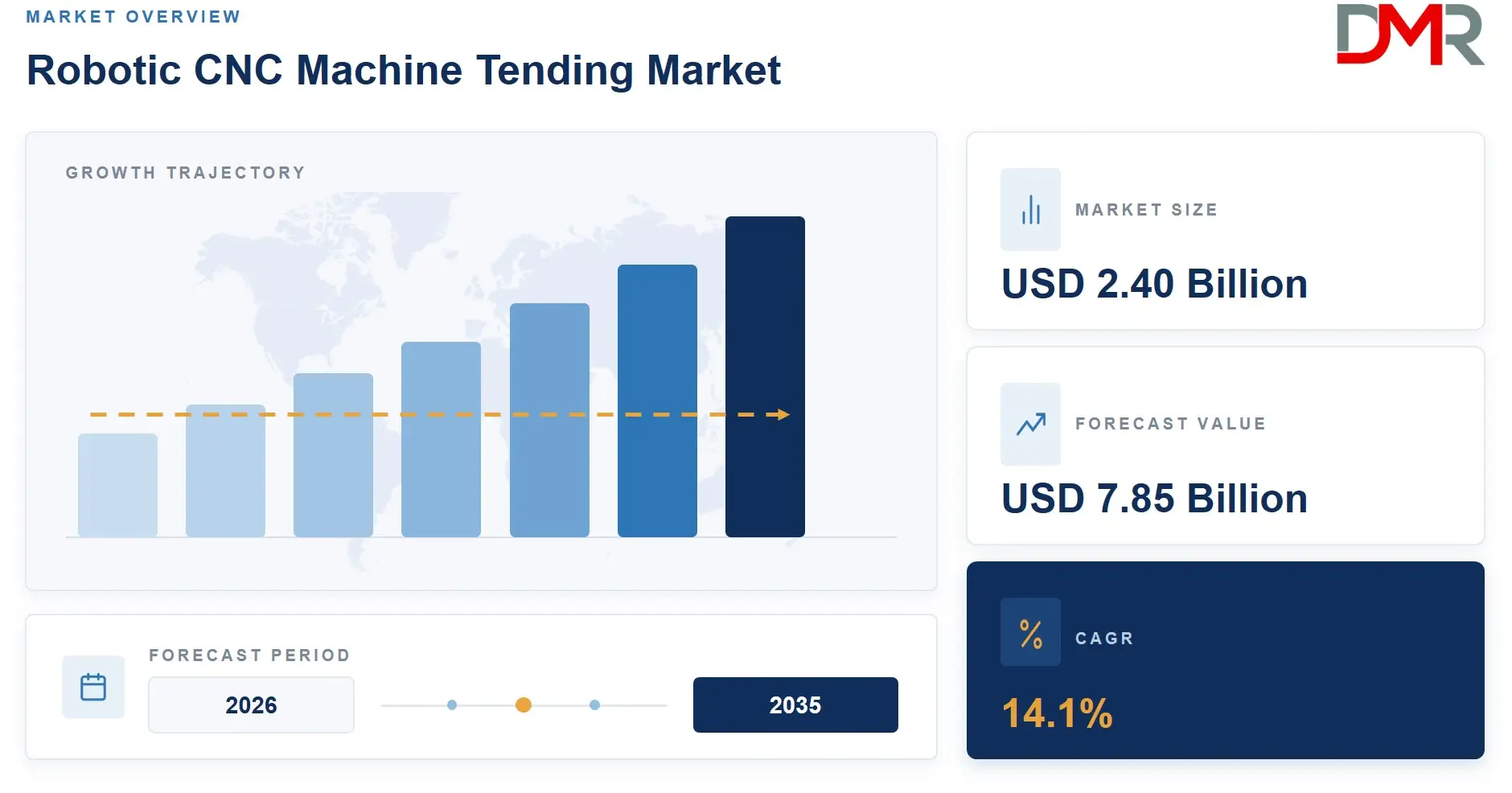
- The market size is USD 2.40 Billion in 2026, and is projected to hit USD 7.85 Billion by 2035 at a CAGR of 14.1%.
- By Robot Type: Cobot Tending Cells led with a 39.7% share in 2024.
- By Application: CNC Machine Tending led with a 30.8% share in 2024 and is also the fastest-growing application.
- By Cell Configuration: Fixed Cells led with a 56.8% share in 2024; Movable/Flexible Cells are the fastest growing.
- By End-Use Industry: Automotive led as the largest category in 2024; Precision Engineering is the fastest-growing end-use segment.
- By Organization Size: Large Enterprises led as the largest category; SMEs are the fastest-growing organizational segment.
- By Region: Asia Pacific led with a 43.5% share in 2024.
- Collaborative Robots (Cobots) are the fastest-growing robot type at a 14.9% CAGR, outpacing overall market growth and reflecting accelerating cobot adoption in space-constrained and high-mix production environments.
Market Size and Forecast
The Global Robotic CNC Machine Tending Market size is estimated at USD 2.40 Billion in 2026, and is projected to reach USD 7.85 Billion by 2035, exhibiting a CAGR of 14.1% during the forecast period.
Historical growth through 2024 was anchored by large automotive and aerospace tier suppliers deploying fixed robot cells to address throughput bottlenecks on high-volume, low-mix production lines. Captive programs at Tier 1 facilities provided early volume that validated the return on automation investment for smaller buyers watching from the sidelines. Skilled machinist shortages accelerated adoption from 2022 onward, converting what had been a capital preference into an operational necessity for shops unable to fill loading positions.
ℹ
To learn more about this report –
Download Your Free Sample Report Here
The 2026 to 2035 forecast rests on three structural assumptions. Cobot price deflation continues to expand the addressable base of small and mid-size job shops. Government reshoring incentives in North America, Europe, and select Asia Pacific economies sustain capital expenditure through mid-decade. Robotics-as-a-Service financing models convert upfront cell costs into operating expenditure, removing the balance sheet barrier that historically excluded SMEs. Any reversal in reshoring policy or sustained rise in interest rates represents the primary downside risk to the forecast trajectory.
Robot Type Analysis
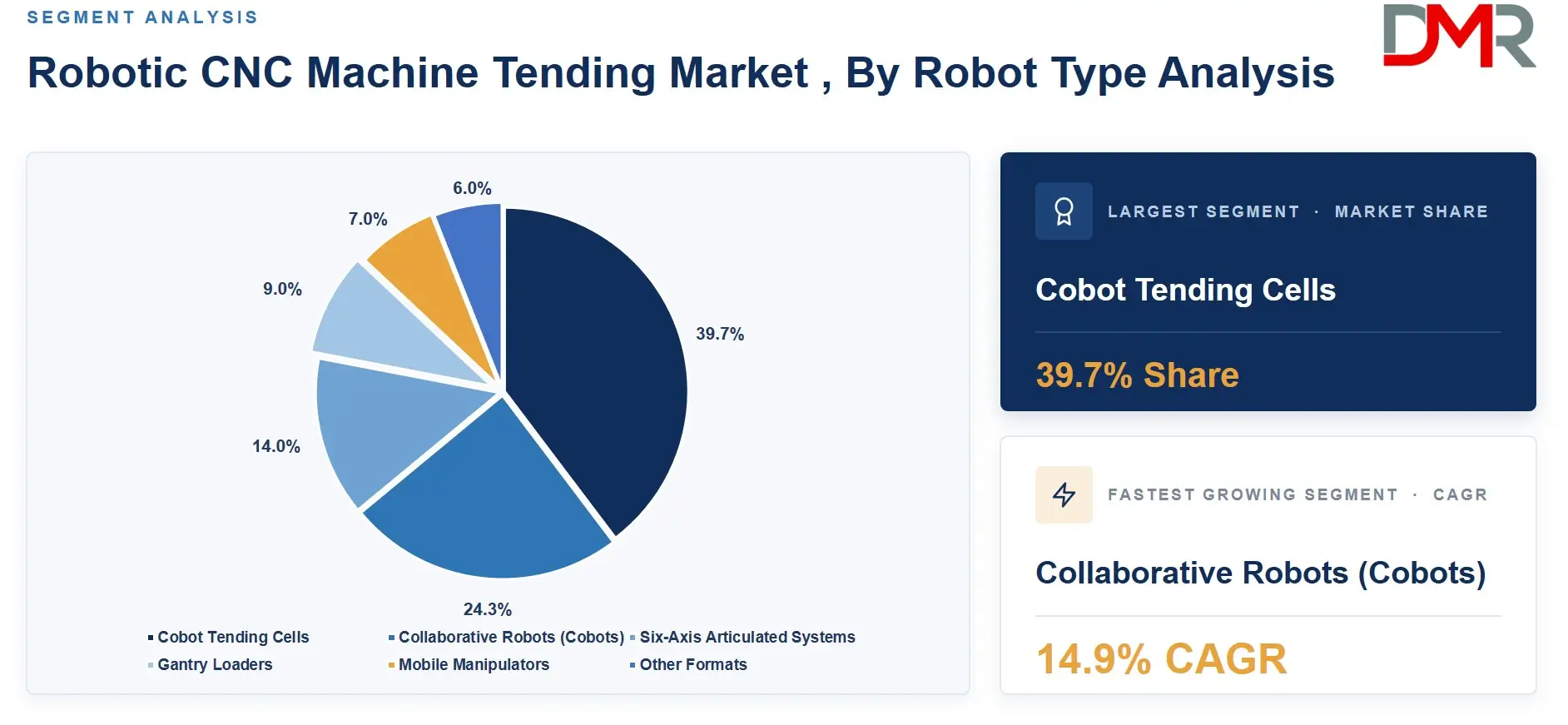
Cobot Tending Cells led the Robot Type segment with a 39.7% share in 2024.
Cobot Tending Cells dominate because they resolve the two constraints that most machine shops face simultaneously: floor space scarcity and the absence of dedicated robotics engineering staff. Unlike full-cage industrial systems, cobots operate in direct proximity to machinists without hard guarding in many configurations. That proximity cuts cell footprint and installation complexity, making automation viable in shops where a traditional articulated system would require costly facility modifications.
ℹ
To learn more about this report –
Download Your Free Sample Report Here
Six-Axis Articulated Systems retain strong share in high-throughput, single-part-number environments where cycle speed and reach matter more than deployment flexibility. Gantry Loaders serve high-volume horizontal machining centers where linear motion and overhead access suit the machine layout. Mobile Manipulators represent the fastest-emerging format, giving shops the ability to redeploy a single robot across multiple machines without fixed infrastructure. As reported by Standard Bots in 2026, a simple cobot tending setup can be installed and calibrated in under one week, while advanced multi-machine cells take two to four weeks, a deployment window that most shops can accommodate without halting production. Collaborative Robots as a sub-category are growing at a 14.9% CAGR, the highest rate among all robot type categories, signaling that the cobot share advantage will widen further through the forecast period.
Application Analysis
CNC Machine Tending accounted for 30.8% of Application demand in 2024, the highest of any category.
CNC Machine Tending commands the largest share because automated loading and unloading of machining centers represents the highest-frequency, most labor-intensive repetitive task on any precision production floor. Every unmanned spindle hour directly recovers revenue that manual shift dependency cannot. Buyers in Robotic CNC Machine Tending Market application also benefit from the clearest ROI calculation: cycle time, labor rate, and idle-spindle cost are all measurable, shortening the internal approval process for capital requests.
Injection Molding, Metal Stamping, Die Casting, Forging, and Grinding each represent established robotic handling applications where tending automation follows mature playbooks. Laser Cutting and Inspection are attracting fresher deployments as vision and sensing technology matures. Packaging and Automated Material Handling link tending cells to broader intralogistics automation, allowing buyers to extend robot utilization beyond the machine itself. CNC Machine Tending is simultaneously the dominant and fastest-growing application, a combination that signals consolidation of investment around proven use cases before the market diversifies into secondary applications.
Cell Configuration Analysis
With a 56.8% share in 2024, Fixed Cells outpaced all other Cell Configuration categories.
Fixed Cells lead because the majority of installed machine tending automation targets dedicated production lines running high volumes of identical or closely related parts. A fixed cell optimized around one machine or one part family delivers the highest throughput and the most predictable cycle time. Automotive suppliers running transmission housings or engine blocks at scale have no operational need for reconfigurability, making fixed architecture the rational default.
Movable and Flexible Cells are the fastest-growing configuration, reflecting a structural shift in order patterns across precision manufacturing. High-mix, low-volume job shops cannot justify fixed cell economics when part changeovers happen weekly or daily. Flexible cells address that constraint by enabling the same robot infrastructure to serve multiple machines or part families with minimal reprogramming. As Robotic CNC Machine Tending Market segment of the buyer base automates, movable cells will capture a rising share of new deployments even as fixed cells retain their installed-base advantage.
End-Use Industry Analysis
Automotive led the End-Use Industry segment as the largest category in 2024.
Automotive manufacturers drove early and sustained investment in robotic CNC tending because volume, part repeatability, and shift continuity requirements all align with what fixed robot cells do best. A high-volume powertrain component running across three shifts on a single machine design generates a clear and computable automation return. Tier 1 and Tier 2 suppliers followed OEM programs, creating a pull-through effect that built the installed base faster than any other end-use vertical.
Aerospace and Defense demand precision and traceability above cycle-time maximization, creating a distinct deployment profile centered on inspection-integrated tending cells. Electronics manufacturing requires fine handling and cleanroom compatibility, conditions that cobots address better than legacy industrial arms. Medical Devices combine tight tolerances with stringent validation requirements, slowing initial deployment but producing sticky long-term contracts once cells pass qualification. Precision Engineering is the fastest-growing end-use segment, driven by demand for high-accuracy, low-volume component production across defense, medical, and semiconductor supply chains. SMEs within precision engineering are entering automation for the first time, responding to cobot affordability and faster deployment timelines.
Organization Size Analysis
Large Enterprises led the Organization Size segment as the largest category in 2024.
Large enterprises account for the majority of robotic CNC tending spend because they hold the capital budgets, engineering resources, and volume commitments that justify full-system deployments. Multi-site manufacturers can amortize integration and programming costs across dozens of cells, reducing per-unit automation cost and accelerating internal payback calculations.
SMEs are the fastest-growing organizational segment as cobot affordability, simplified programming interfaces, and Robotics-as-a-Service financing lower the entry threshold. A small job shop that previously could not justify a USD 200,000 industrial cell installation can now deploy a cobot tending solution within its operating budget. As SME adoption scales, the addressable market for machine tending automation expands structurally beyond its traditional large-enterprise base.
Key Market Segments
By Robot Type
- Cobot Tending Cells
- Six-Axis (Articulated) Systems
- Gantry Loaders
- Mobile Manipulators
- Other Formats
- Collaborative Robots (Cobots)
By Application
- CNC Machine Tending
- Injection Molding
- Metal Stamping
- Die Casting
- Forging
- Grinding
- Laser Cutting
- Inspection
- Packaging
- Automated Material Handling
By Cell Configuration
- Fixed Cells
- Movable/Flexible Cells
By End-Use Industry
- Automotive
- Aerospace & Defense
- Electronics
- Medical Devices
- Industrial Machinery
- Metal Fabrication
- Plastics Processing
- Consumer Goods
- Precision Engineering
By Organization Size
- Large Enterprises — Dominant
- Small and Medium Enterprises (SMEs) — Fastest Growing
Regional Analysis
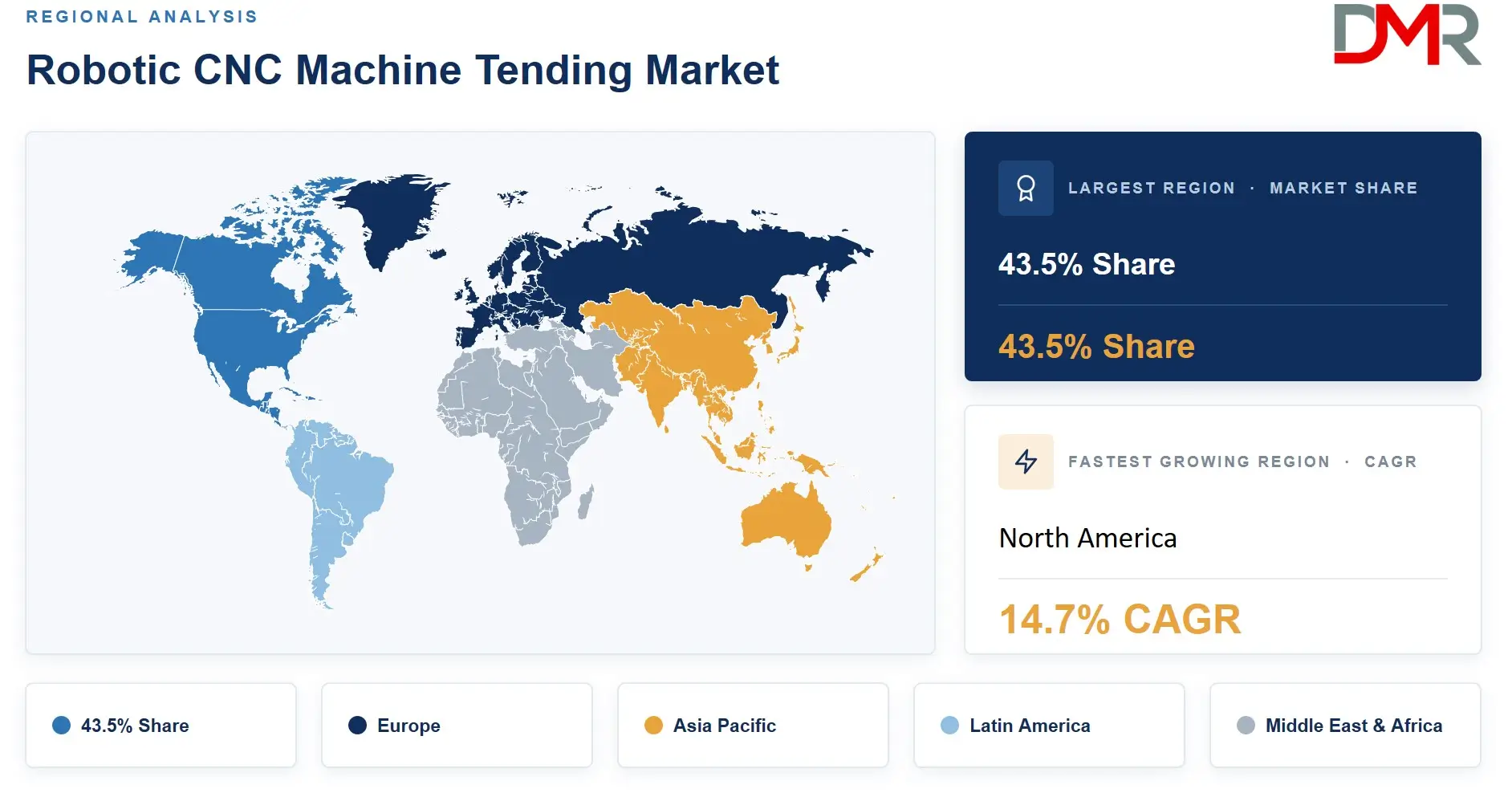
Asia Pacific led the Regional Analysis with a 43.5% share in 2024, valued at approximately USD 1.05 Billion.
Asia Pacific
Asia Pacific dominates because China, Japan, South Korea, and Taiwan collectively host the highest concentration of precision manufacturing capacity outside Germany. China's government-backed industrial modernization programs have directed capital toward factory automation at a scale that no other regional bloc has matched. Japanese machine tool builders and Korean electronics manufacturers operate at volumes and shift structures that make unattended robotic tending economically self-evident, rather than aspirational.
North America
North America is the fastest-adopting Western market as reshoring incentives embedded in manufacturing policy programs redirect capital back to domestic CNC capacity. American job shops that previously relied on offshore machining partners are now investing in robotic tending to compete on labor cost without relocating production. Canada follows a similar pattern, particularly in aerospace and precision component supply chains serving US prime contractors.
ℹ
To learn more about this report –
Download Your Free Sample Report Here
Europe
Germany anchors European demand through its dense network of mid-size machine tool manufacturers and Tier 1 automotive suppliers. German manufacturers face the sharpest skilled machinist shortages among Western European economies, creating direct pressure to automate repetitive loading tasks. Southern European markets including Italy and Spain are at an earlier adoption stage, with EU automation subsidies providing the financing bridge that smaller manufacturers require before committing to capital investment.
Latin America
Brazil and Mexico serve as the primary Latin American entry points, driven by automotive OEM and Tier 1 supplier investments tied to North American vehicle production networks. Mexico's manufacturing base benefits from nearshoring demand that has pulled robotic automation investment from US-based buyers seeking supply chain proximity. Adoption rates remain below global averages, but the infrastructure for broader deployment is forming faster than it did a decade ago.
Middle East & Africa
The Middle East, led by GCC economies, is building precision manufacturing capacity as part of economic diversification away from hydrocarbon dependency. Saudi Arabia and the UAE have both announced industrial development programs that include CNC automation targets. South Africa holds the largest manufacturing base on the continent but faces infrastructure and financing constraints that slow adoption relative to GCC peers.
Key Regions and Countries
North America
Europe
- Germany
- France
- The UK
- Spain
- Italy
- Rest of Europe
Asia Pacific
- China
- Japan
- South Korea
- India
- Australia
- Rest of APAC
Latin America
- Brazil
- Mexico
- Rest of Latin America
Middle East & Africa
- GCC
- South Africa
- Rest of MEA
Macroeconomic Impact
Interest rate environments directly shape capital expenditure timing for robotic CNC tending cells. When credit is expensive, SMEs defer automation investment even when the operational case is clear. Large enterprises with access to internal financing are less sensitive, which partly explains why large-enterprise adoption leads SME adoption in every region where interest rates have risen since 2022.
Reshoring and friend-shoring trade policy has functioned as a demand multiplier in North America and Europe. Manufacturers building or expanding domestic CNC capacity treat robotic tending as a baseline requirement rather than an upgrade, because new facilities are designed around labor efficiency from the ground up. Currency appreciation in Asian export economies raises the landed cost of imported components, reinforcing the case for on-shore precision manufacturing and, by extension, the automation that makes domestic production competitive.
Market Dynamics
Driver: Skilled Machinist Shortages Forcing Unattended Production
CNC machine shops across North America, Europe, and Japan cannot fill skilled machinist positions at the rate production volumes require. Robotic tending directly addresses the gap by removing the human dependency from repetitive part loading and unloading. FANUC reports that CNC machine-tending robots can raise job-shop production by 40% to 60% through reduced lead times and sustained machine uptime, a productivity gain that no hiring campaign can replicate in constrained labor markets.
Standard Bots estimates typical machine-tending automation payback at 12 to 24 months, with the fastest recovery in cells supporting two or more unattended shifts per day. That payback horizon fits within standard capital budgeting cycles for both large enterprises and well-capitalized SMEs. Buyers who delay face compounding idle-spindle losses as unfilled operator positions translate directly into unmachined revenue.
Restraint: Integration Complexity Across Legacy CNC Fleets
High upfront costs for robots, vision systems, end-of-arm tooling, safety enclosures, and integration services remain a hard barrier for smaller buyers. A single cell deployment requires capital commitment before a single part is produced, creating a cash flow exposure that many job shops cannot absorb without financing support. The absence of standardized communication interfaces between robot controllers and legacy CNC machines compounds the problem by extending integration timelines and requiring specialized engineering resources that most shops must hire externally.
Cybersecurity management for networked robot-to-CNC interfaces adds a layer of ongoing operational complexity that buyers rarely price into initial deployment budgets. As reported by FANUC, CRX collaborative robots offer up to 8 years of zero scheduled maintenance for motors, reducers, cables, sensors, and grease. However, that longevity advantage applies to the robot arm only. Integration software, connectivity hardware, and legacy CNC controllers require their own maintenance regimes, and mismatched support cycles create validation and uptime risks that buyers discover after deployment rather than before.
Opportunity: RaaS and Reconfigurable Cells Expanding SME Access
Robotics-as-a-Service financing converts the upfront cell cost into a usage-based operating expense. A job shop that cannot justify a USD 90,000 capital outlay can subscribe to machine-tending capacity at a monthly rate tied to production hours. As confirmed by Standard Bots in a 2026 deployment guide, a robotic CNC tending cell can support 24/7 unattended production including overnight and weekend operation, giving RaaS subscribers a utilization profile that generates enough throughput revenue to cover subscription costs within the first operating quarter.
Reconfigurable tending cells address the high-mix, low-volume job shop segment that fixed automation cannot serve. A cell designed for rapid part changeover allows a shop running ten different components per week to automate without committing a robot to a single part family. Brownfield retrofits using controller-agnostic connectivity extend Robotic CNC Machine Tending Market opportunity to manufacturers with mixed-age CNC fleets, removing the requirement to replace serviceable machines as a precondition for automation.
Porter's Five Forces
Competitive rivalry in the robotic CNC machine tending market is high among a tier of specialized integrators and moderate among the major robot OEMs, where differentiation on payload, repeatability, and software ecosystem creates defensible positioning. Supplier power is concentrated among robot arm manufacturers and vision system providers, whose components represent the highest-cost and longest-lead-time elements of any tending cell; buyers who depend on a single robot platform face limited leverage in pricing negotiations. Buyer power is rising as cobot proliferation gives machine shops credible alternatives across multiple vendors at similar price points, and as RaaS models lower switching costs by removing ownership lock-in. The threat of substitutes is low in core machining applications where part precision, cycle speed, and unattended operation requirements rule out manual labor as a cost-competitive alternative; it is moderate in lighter-duty handling tasks where simpler automation equipment could serve. New entrant barriers are meaningful at the full-system integration level, where application knowledge, safety certification expertise, and established relationships with CNC machine builders create moats that pure-software or hardware-only entrants cannot cross quickly.
AI and Gen AI Impact
Artificial intelligence reshapes robotic CNC machine tending most visibly at the perception and decision layer. AI-enabled vision systems allow tending robots to handle part variation, bin picking, and unstructured loading scenarios that rigid rule-based programming cannot accommodate. Early movers embedding adaptive gripping and AI-guided path planning into their cells report fewer stoppages from part presentation errors, a production continuity gain that compounds across multi-shift unattended operation.
Generative AI accelerates cell programming and changeover by translating part geometry data into candidate robot paths without manual teach pendant work. Vendors who integrate generative programming tools into their software platforms reduce deployment timelines and lower the skill threshold for cell commissioning. Laggards relying on manual programming face longer changeover windows that erode the economic case for flexible cell investments in high-mix environments.
Market Trends
Lights-Out and Connected Production Reshaping Cell Value
Robotic tending cells are moving from standalone productivity assets to nodes in connected production architectures. Lights-out manufacturing frameworks link tending robots with automated material storage, scheduling systems, and remote monitoring platforms, extending unattended production windows from single shifts to full weekend cycles. Digital twin integration and OEE analytics give production managers real-time visibility into cell throughput, tool wear, and part quality, shifting the value proposition of tending automation from labor replacement toward data-driven process control.
Market Competition Overview
The robotic CNC machine tending market is fragmented at the cell integration layer and moderately consolidated among robot arm OEMs. A small number of global robot manufacturers supply the core hardware to a much larger ecosystem of regional integrators, software providers, and turnkey cell builders. Hardware OEMs compete on payload range, repeatability, software openness, and total lifecycle cost. Integrators compete on application knowledge, deployment speed, and after-sales support quality.
As estimated by EVS International in 2026, cobot tending cells reach payback in 12 to 18 months, compared with 24 to 36 months for conventional industrial-robot cells. That gap is accelerating a competitive shift toward cobot-based solutions, particularly among vendors targeting SME buyers. Vendors who cannot demonstrate a sub-24-month payback case face a rising close-rate disadvantage as buyers use cobot economics as the reference benchmark for all automation investment decisions.
Pricing Analysis
Entry-level robotic CNC tending setups including a cobot, basic gripper, and safety sensors are estimated at $40,000 to $75,000 in 2026, based on Standard Bots pricing data. A complete cell with conveyors, custom end-of-arm tooling, and shop-floor software integration ranges from $75,000 to $90,000. For medium-duty cobots, EVS International's 2026 pricing guide places robot-arm costs at $25,000 to $50,000 and total deployed-system costs at $50,000 to $120,000, reflecting significant variation by payload class, reach, and integration complexity.
Annual operating costs extend the total cost of ownership beyond the initial deployment figure. EVS International estimates annual cobot energy costs at $300 to $2,500 depending on duty cycle, and annual preventive maintenance at $1,500 to $5,000. Pricing strategy diverges between OEM robot suppliers and specialist integrators. OEMs compete on hardware margin and software subscription, while integrators compete on total cell cost and deployment timeline. Buyers with volume across multiple cells gain negotiating leverage on hardware pricing, while single-cell buyers pay closer to list price and bear full integration cost.
Company Profiles
FANUC Corporation holds one of the strongest positions in the robotic CNC machine tending market by combining a broad collaborative robot portfolio with an installed base of CNC controls that creates natural cross-sell pathways. The CRX series addresses the full spectrum of machine tending payload requirements: the CRX-10iA/L handles 10 kg components at a 1,418 mm reach with 0.04 mm repeatability, estimated at $50,723; the CRX-20iA/L targets 20 kg parts at the same reach for $55,889; the CRX-30iA covers heavy tending at 30 kg and 1,889 mm reach for $60,868; and the M-20iD/35 industrial arm handles large 35 kg components at 1,831 mm reach with 0.03 mm repeatability, cited at $70,000 to $75,000. The CRX line's claimed 8-year zero scheduled maintenance window reduces lifecycle cost for buyers who price total ownership rather than purchase price alone.
HALTER CNC Automation focuses exclusively on machine tending, a strategic narrowing that gives it application depth that generalist robot suppliers cannot match. HALTER's product architecture centers on pre-engineered tending cells that minimize integration engineering for the buyer and compress deployment timelines. Standard Bots, whose Core cobot covers CNC loading and unloading at 18 kg payload, 1.3 m reach, and ±0.025 mm repeatability, and whose Thor cobot extends to 30 kg payload and 2.0 m reach at a listed $49,500, positions on deployment simplicity and transparent pricing rather than the broad platform strategies of larger OEMs.
Key Players
- HALTER CNC Automation
- Fastems
- RoboJob
- Flexxbotics
- Robotiq
- Universal Robots
- FANUC Corporation
- ABB Ltd.
- KUKA AG
- Yaskawa Electric Corporation
- Mitsubishi Electric Corporation
- Kawasaki Heavy Industries Ltd.
- Omron Corporation
- DENSO Corporation
- Stäubli International
- Makino Milling Machine Co., Ltd.
- Bosch Rexroth AG
- Nachi-Fujikoshi
- Seiko Epson Corporation
- Techman Robot
Recent Developments
- February 2024: Flexxbotics partnered with Vention to launch a combined offering for advanced robotic machine tending, integrating robot-cell design and automation hardware with Flexxbotics' machine-tending software for next-generation machining environments.
- April 2024: Flexxbotics was selected by Darmann Abrasive Products to connect Universal Robots with CNC machines for advanced robotic machine tending and automated workcell control.
- May 2024: ABB launched the OmniVance Collaborative Machine Tending Cell, an integrated solution combining its GoFa 12 collaborative robot, tray system, gripper, and software for automated machine tending.
- August 2024: Kawasaki Robotics and Hurco announced a strategic collaboration to develop turnkey robotic CNC machine tending solutions by integrating Kawasaki industrial robots with Hurco CNC machines and controls.
- September 2024: Kawasaki Robotics introduced a turnkey robotic machine tending shelf system developed with Hurco, combining a Kawasaki robot with a Hurco VM15Di CNC machine and WinMax CNC controls in a no-code machine-tending solution.
- September 2024: Flexxbotics partnered with GelSight to integrate tactile sensing and precision inspection into robotic machine tending, supporting automated machining applications requiring high-precision quality control and process traceability.
Report Details
| Report Characteristics |
| Market Value (2026) |
USD 2.40 Billion |
| Forecast Revenue (2035) |
USD 7.85 Billion |
| CAGR (2026–2035) |
14.1% |
| Base Year for Estimation |
2025 |
| Historic Period |
2020 – 2024 |
| Forecast Period |
2026 – 2035 |
| Report Coverage |
Revenue Forecast, Market Dynamics, Competitive Landscape, Recent Developments |
| Segments Covered |
By Robot Type (Cobot Tending Cells, Six-Axis Systems, Gantry Loaders, Mobile Manipulators, Other Formats), By Application (CNC Machine Tending, Injection Molding, Metal Stamping, Die Casting, Forging, Grinding, Laser Cutting, Inspection, Packaging, Automated Material Handling), By Cell Configuration (Fixed Cells, Movable/Flexible Cells), By End-Use Industry (Automotive, Aerospace & Defense, Electronics, Medical Devices, Industrial Machinery, Metal Fabrication, Plastics Processing, Consumer Goods, Precision Engineering), By Organization Size (Large Enterprises, SMEs) |
| Regional Analysis |
North America – US and Canada; Europe – Germany, France, The UK, Spain, Italy, and Rest of Europe; Asia Pacific – China, Japan, South Korea, India, Australia, and Rest of APAC; Latin America – Brazil, Mexico, and Rest of Latin America; Middle East & Africa – GCC, South Africa, and Rest of MEA |
| Competitive Landscape |
HALTER CNC Automation, Fastems, RoboJob, Flexxbotics, Robotiq, Universal Robots, FANUC Corporation, ABB Ltd., KUKA AG, Yaskawa Electric Corporation, Mitsubishi Electric Corporation, Kawasaki Heavy Industries Ltd., Omron Corporation, DENSO Corporation, Stäubli International, Makino Milling Machine Co. Ltd., Bosch Rexroth AG, Nachi-Fujikoshi, Seiko Epson Corporation, Techman Robot |
| Customization Scope |
Customization for segments and region or country level will be provided. Additional customization can be done based on requirements. |
| Purchase Options |
Three license options: Single User License, Multi-User License (Up to 5 Users), and Corporate Use License (Unlimited Users and Printable PDF) |
Frequently Asked Questions
What is the biggest investment opportunity in the Robotic CNC Machine Tending market?
▾ Robotics-as-a-Service financing models represent the most structurally significant investment opportunity by converting machine-tending automation from capital expenditure into usage-based operating spend. SMEs that previously could not clear capital budget thresholds become an addressable market at scale. Vendors and financiers who build RaaS infrastructure now will capture the SME adoption wave before the market consolidates around a small number of platform providers.
Who are the top companies in the Robotic CNC Machine Tending market?
▾ Leading companies include HALTER CNC Automation, Fastems, RoboJob, Flexxbotics, Robotiq, Universal Robots, FANUC Corporation, ABB Ltd., KUKA AG, and Yaskawa Electric Corporation. The market also includes Mitsubishi Electric, Kawasaki Heavy Industries, Omron, DENSO, Stäubli, Makino, Bosch Rexroth, Nachi-Fujikoshi, Seiko Epson, and Techman Robot. Robot OEMs and specialist tending integrators compete across overlapping but distinct buyer segments.
Which segment is growing fastest in the Robotic CNC Machine Tending market and why?
▾ Collaborative Robots are the fastest-growing robot type at a 14.9% CAGR, outpacing total market growth by a measurable margin. Cobots unlock machine tending in space-constrained facilities and among buyers who lack robotics engineering staff, expanding the addressable market beyond traditional fixed-cell deployments. SMEs represent the fastest-growing organizational segment for the same underlying reason: lower cost, simpler programming, and faster payback windows remove barriers that previously kept smaller shops out of automation.
Which region is growing fastest in the Robotic CNC Machine Tending market and why?
▾ North America is the fastest-adopting Western market, driven by reshoring policy incentives that are pulling CNC manufacturing capacity back to domestic facilities. New greenfield and brownfield manufacturing sites in the US and Canada are being designed with automation as a baseline requirement, rather than a retrofit consideration. Asia Pacific retains the largest regional share at 43.5%, supported by sustained government-backed industrial modernization across China, Japan, and South Korea.
What is the biggest challenge holding Robotic CNC Machine Tending Market market back?
▾ Non-standard robot-to-CNC interfaces represent the most persistent structural barrier in Robotic CNC Machine Tending Market market. Legacy machine fleets across mid-size manufacturing facilities use proprietary communication protocols that require custom integration engineering for every new deployment. High upfront cell costs compound the problem by concentrating risk in the pre-production deployment phase, where buyers commit capital before any machined output is validated.