Market Overview
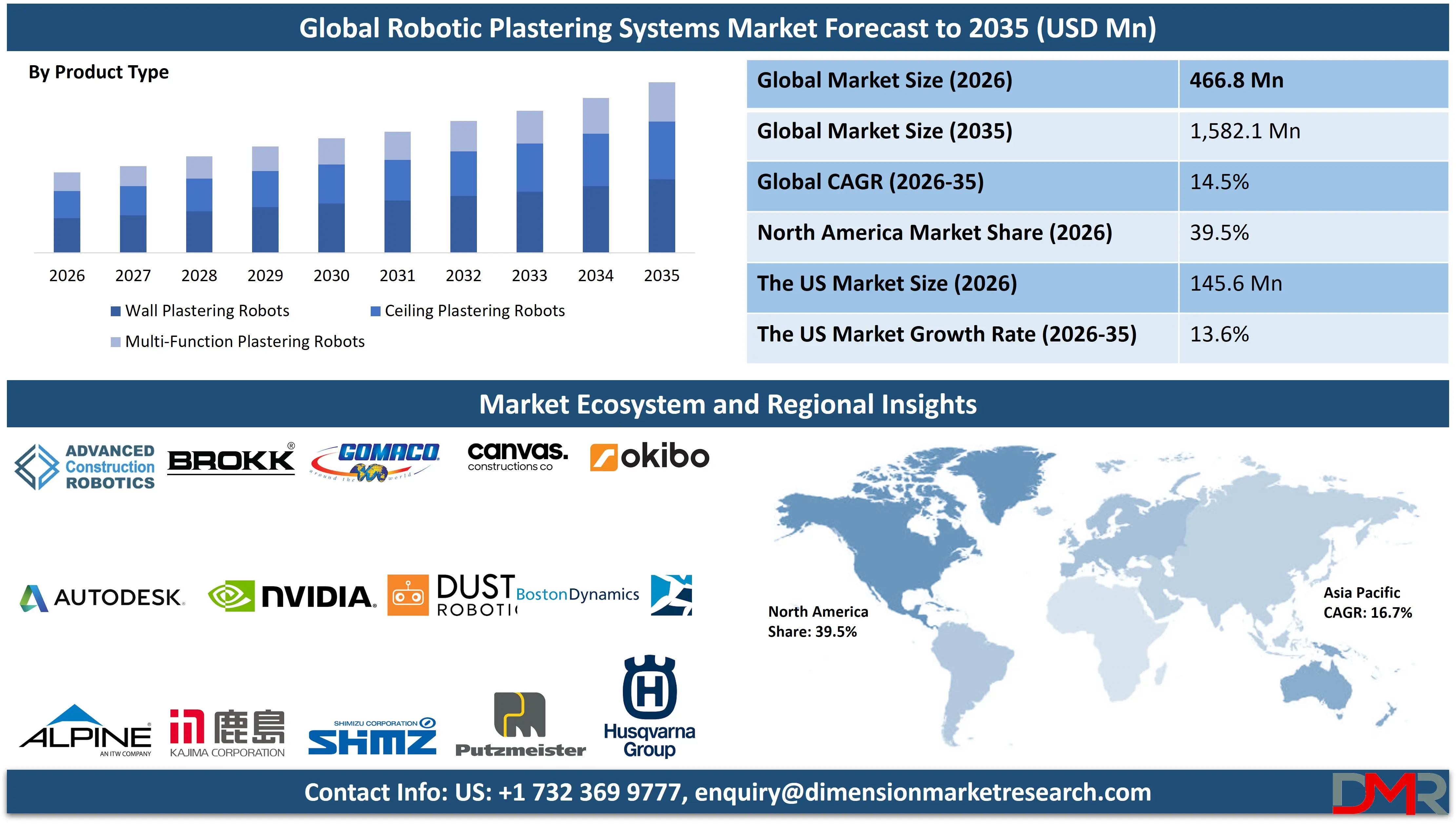
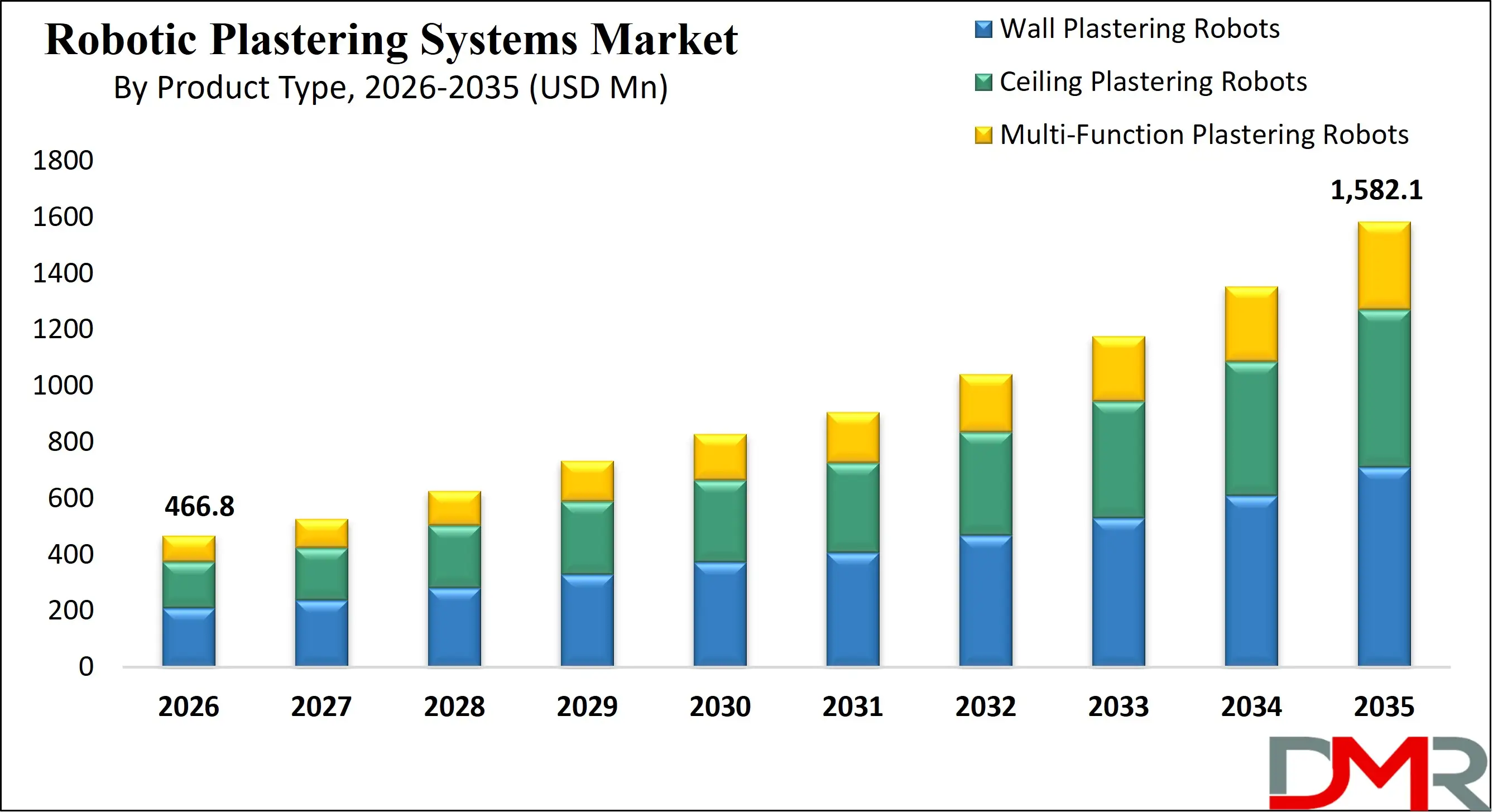
The Global Robotic Plastering Systems Market is projected to reach USD 466.8 million in 2026 and is expected to grow at a CAGR of 14.5% from 2026 to 2035, attaining a value of USD 1,582.1 million by 2035. The market's rapid growth is driven by the increasing global labor shortage in construction, rising demand for consistent and high-quality wall finishing, and the accelerated adoption of automation and digitalization in building practices.
ℹ
To learn more about this report –
Download Your Free Sample Report Here
Robotic plastering enables precise, efficient, and uniform application of plaster, mortar, and finishing materials through AI-guided path planning, automated mixing and pumping systems, and real-time surface scanning. The model addresses critical industry challenges related to skilled labor scarcity, project timeline overruns, and material waste, supporting contractors and developers in achieving higher productivity and reduced operational costs.
Technological advancements, including 3D surface mapping, IoT-enabled mortar delivery, AI-driven consistency control, cloud-based project management, and fully autonomous multi-room plastering units, are transforming the market into a scalable and highly efficient ecosystem. Integration of machine learning algorithms for surface defect detection, thickness optimization, and adaptive application techniques is reshaping construction quality and speed.
ℹ
To learn more about this report –
Download Your Free Sample Report Here
Growing government initiatives promoting construction automation, sustainable building practices, and digital twin integration in smart city projects further accelerate global adoption. However, barriers such as high initial investment, limited retrofit compatibility with existing sites, variable regulatory standards, and skilled operator requirements remain. Despite these limitations, the convergence of robotics, AI, and modular construction positions robotic plastering as a central driver of global construction transformation through 2035.
The US Robotic Plastering Systems Market
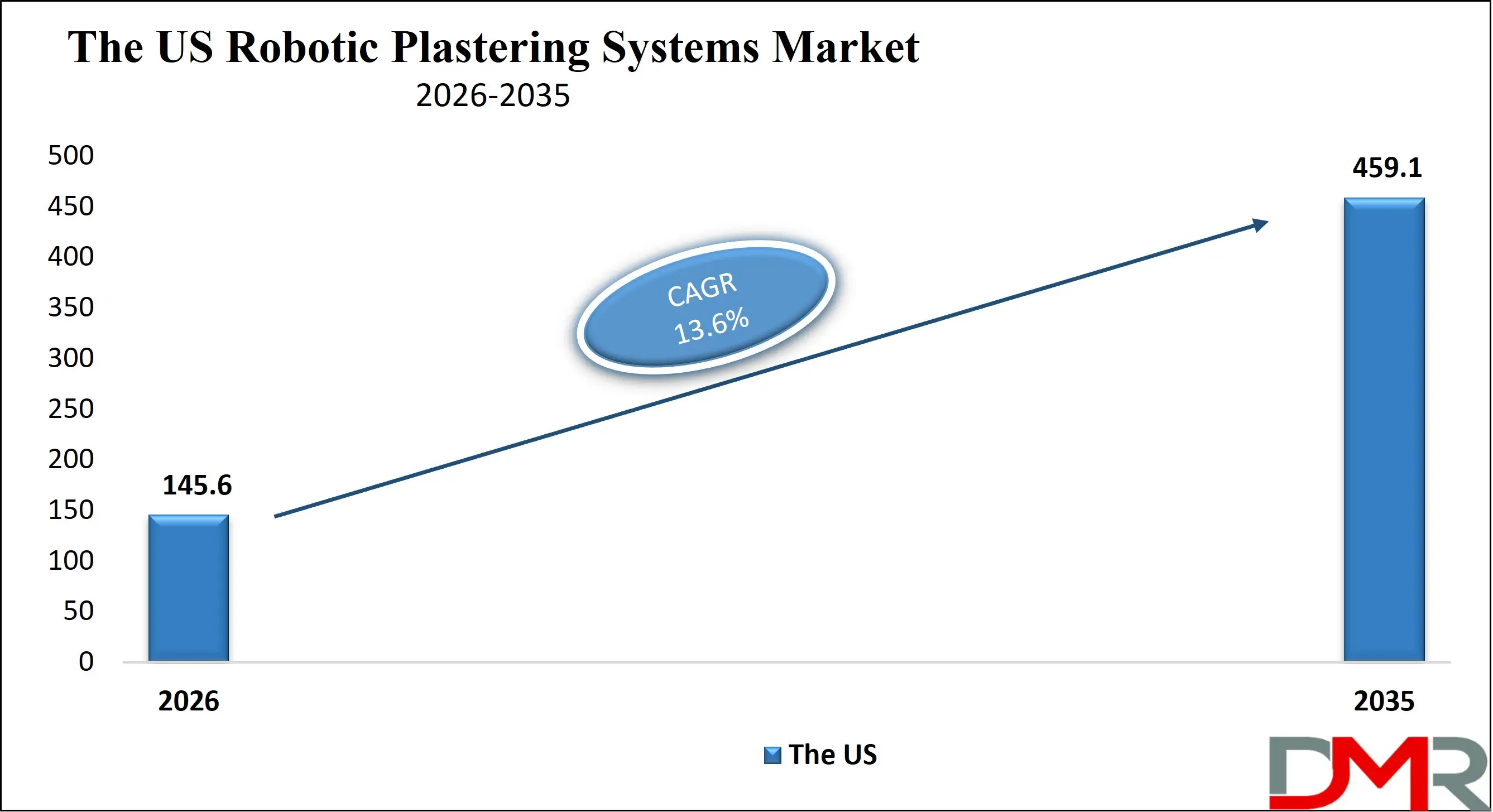
The U.S. Robotic Plastering Systems Market is projected to reach USD 145.6 million in 2026 and grow at a CAGR of 13.6%, reaching USD 459.1 million by 2035. The U.S. leads global adoption due to its advanced construction technology ecosystem, high labor costs, and strong emphasis on building efficiency and quality assurance.
ℹ
To learn more about this report –
Download Your Free Sample Report Here
The chronic shortage of skilled plasterers and masons, coupled with rising construction volumes, fuels demand for automated plastering solutions. Major construction firms, residential developers, and commercial contractors are integrating robotic systems to maintain schedules and reduce dependency on manual labor. Companies such as D.R. Horton, Turner Construction, and Skanska are piloting and deploying AI-enabled plastering robots on large-scale projects.
U.S. regulatory support for building innovation and safety, alongside incentives for technology adoption in construction under the Infrastructure Investment and Jobs Act, encourages investment. Training programs and partnerships with vocational schools are emerging to develop robotic operator expertise, ensuring smooth integration into existing workflows.
The rapid rise of mobile robotic platforms, real-time adaptive spraying technology, and integrated BIM (Building Information Modeling) compatibility continues to redefine the U.S. construction landscape, positioning the country as a global leader in automated building finishes.
The Europe Robotic Plastering Systems Market
The Europe Robotic Plastering Systems Market is projected to be valued at approximately USD 134.9 million in 2026 and is projected to reach around USD 433.6 million by 2035, growing at a CAGR of about 13.6% from 2026 to 2035. Europe's leadership is anchored by strong regulatory emphasis on construction quality, energy efficiency, and workforce digitalization.
Countries such as Germany, the U.K., France, the Nordic region, and the Netherlands are widely adopting robotic plastering, driven by stringent building standards, high labor costs, and government-backed initiatives like the EU’s Construction 2026 strategy. The German Mittelstand of specialized engineering firms and equipment manufacturers is particularly active in developing and deploying advanced plastering robotics.
Europe's aging construction workforce, demand for precision in high-end residential and commercial projects, and push for sustainable material usage further drive adoption. Funding through Horizon Europe and national digital construction funds supports R&D in autonomous site robotics, AI optimization, and human-robot collaboration.
Urban and large-scale housing projects increasingly deploy cloud-connected robotic fleets, automated mortar preparation systems, and quality monitoring via embedded sensors. With strong technical standards, digital twin integration, and emphasis on lean construction, Europe remains one of the most advanced regions in robotic plastering penetration.
The Japan Robotic Plastering Systems Market
The Japan Robotic Plastering Systems Market is anticipated to be valued at approximately USD 12.1 million in 2026 and is expected to attain nearly USD 43.7 million by 2035, expanding at a CAGR of about 15.5% during the forecast period. Japan's rapidly aging population and severe construction labor shortage drive high demand for automation in traditional building trades, including plastering and finishing.
The Ministry of Land, Infrastructure, Transport and Tourism (MLIT) actively supports construction robotics through national productivity campaigns, subsidies for SME adoption, and integration of robotics into public housing projects. Japan's leadership in precision robotics, servo technology, and compact automation accelerates innovation in lightweight, maneuverable plastering robots suitable for dense urban worksites and complex interiors.
Japan's concept of "Construction 5.0", driven by companies like Shimizu Corporation, Kajima, and Panasonic, integrates IoT, AI, and robotics into seamless site workflows. Robotic plastering units are being deployed in Tokyo's high-rise developments, Osaka's commercial retrofits, and regional public infrastructure projects. Japan's cultural emphasis on craftsmanship-quality finishes, combined with robotic precision, positions the country as a high-growth innovator in automated plastering.
Global Robotic Plastering Systems Market: Key Takeaways
- Strong Global Market Growth Outlook: The Global Robotic Plastering Systems Market is expected to be valued at USD 466.8 million in 2026 and is projected to reach USD 1,582.1 million by 2035, showcasing rapid expansion supported by rising demand for construction automation and labor efficiency.
- High CAGR Driven by Automation Adoption: The market is expected to grow at an impressive CAGR of 14.5% from 2026 to 2035, fueled by accelerating robotic integration, AI-driven process optimization, cloud-based site management, and increasing construction volume worldwide.
- Strong Growth Trajectory in the United States: The U.S. Robotic Plastering Systems Market stands at USD 598.7 million in 2026 and is projected to reach USD 3,245.6 million by 2035, expanding at a CAGR of 21.2% due to robust construction activity, high labor costs, and advanced technology adoption.
- North America Maintains Regional Dominance: North America is expected to capture approximately 39.5% of the global market share in 2026, supported by mature construction technology infrastructure, significant R&D investment, and early adoption of fully autonomous site systems.
- Rapid Advancement in Plastering Robotics Technologies: Innovations including AI-based surface mapping, autonomous multi-axis applicators, real-time mortar flow control, and cloud-integrated fleet management are significantly accelerating speed, consistency, and scalability of robotic plastering services.
- Growing Labor Shortages Boost Adoption: Rising global scarcity of skilled plasterers and masons, coupled with project complexity and timeline pressures, is driving sustained demand for automated, repeatable, and high-quality finishing solutions.
Global Robotic Plastering Systems Market: Use Cases
- High-Rise Residential Interior Finishing: Robotic systems apply consistent plaster layers across large apartment complexes, reducing manual labor and ensuring uniform surface quality.
- Commercial Office & Retail Fit-Outs: Autonomous plastering units work alongside other trades to accelerate shell-and-core finishing, enabling faster project handover.
- Industrial Warehouse & Facility Construction: Large-area robotic plasterers cover vast interior walls and ceilings with minimal human intervention, optimizing material usage and schedule.
- Renovation & Retrofit Projects: Compact, semi-autonomous robots assist in plaster application in confined or complex existing structures, improving worker safety and precision.
- Sustainable & Modular Housing Production: Integrated within prefab and modular construction lines, robotic plastering ensures finish quality in factory-controlled environments before on-site assembly.
Global Robotic Plastering Systems Market: Stats & Facts
- The International Federation of Robotics (IFR) reports that construction robotics adoption is growing at over 25% annually, with plastering and finishing robots representing one of the fastest-growing segments due to direct labor replacement potential.
- The U.S. Bureau of Labor Statistics projects a shortfall of over 500,000 construction tradesworkers by 2026, reinforcing how robotic plastering through automation, consistency, and speed can maintain project pipelines, especially in regions where over 60% of contractors report labor availability as a major constraint.
- Construction Robotics Research Consortium data indicates robotic plastering systems can reduce material waste by up to 20% and increase application speed by 3–5x compared to manual methods, validating robotics as essential for sustainable and efficient construction.
- The European Construction Industry Federation (FIEC) notes that robotic finishing solutions improve worksite safety by reducing high-repetition injuries and exposure to airborne particulates; musculoskeletal disorders currently account for over 30% of construction absenteeism.
- According to Global Construction Technology Surveys, adoption of AI-guided plastering robots is growing over 35% annually in emerging markets, as systems become more affordable and adaptable to diverse building styles and material specifications.
- The World Economic Forum reports over 70% of construction firms are investing in automation to address productivity gaps; robotic plastering mitigates skilled labor shortages by enabling remote operation, precision application, and integrated quality assurance.
Global Robotic Plastering Systems Market: Market Dynamic
Driving Factors in the Global Robotic Plastering Systems Market
Severe Skilled Labor Shortages
The growing global deficit of experienced plasterers, masons, and finishers is a major driver for robotic plastering adoption. Aging workforces in developed regions and shifting career preferences among younger generations significantly increase reliance on automation. Robotic systems ensure consistent quality, maintain project timelines, and reduce dependency on scarce manual skills. This allows construction firms to undertake more projects simultaneously and meet tightening deadlines, especially in booming residential and commercial sectors.
Technology Innovation and Integration
Robotic plastering benefits heavily from rapid progress in computer vision, AI path planning, IoT-enabled material handling, and cloud-based site coordination. Advanced systems feature real-time LiDAR mapping, adaptive mortar viscosity control, collision avoidance, and seamless BIM integration. These innovations enable robots to work in dynamic, unstructured environments, adjust to surface variations, and optimize material usage. The convergence of robotics with digital twin technology and modular construction further enhances planning accuracy and on-site execution, making robotic plastering a cornerstone of modern construction methodology.
Restraints in the Global Robotic Plastering Systems Market
High Initial Capital Investment
The significant upfront cost of robotic plastering systems, including the robot, peripherals, software, and training, limits adoption among small and medium-sized contractors. Many firms face financing challenges and uncertain ROI timelines, particularly in cost-sensitive markets. Additionally, retrofit and integration into existing site workflows can require further investment in site preparation and connectivity infrastructure, creating adoption friction.
Regulatory and Site Compatibility Challenges
Construction regulations, building codes, and union agreements vary widely across regions, creating uncertainty in robotic system deployment. Issues include safety certification for autonomous site equipment, liability frameworks for robotic work, and restrictive traditional trade practices. Furthermore, not all construction sites especially retrofit or irregular projects are easily adaptable to robotic workflows. Variability in architectural designs, material specifications, and site access can limit robot utilization without significant customization.
Opportunities in the Global Robotic Plastering Systems Market
Expansion into Emerging Economies
Emerging markets represent major growth opportunities due to rapid urbanization, large-scale housing initiatives, and increasing government focus on construction technology. Countries in Asia-Pacific, the Middle East, and Latin America are launching smart city projects and infrastructure programs where robotic plastering can ensure quality and speed. Local manufacturing partnerships, rental/leasing models, and government subsidies can improve accessibility, driving the next wave of market expansion.
AI-Driven Predictive Maintenance and Optimization
The integration of AI not only for application but for system health monitoring, predictive maintenance, and process optimization creates new value streams. AI can analyze performance data to preempt failures, optimize mortar mixes for different climates, and continuously improve application techniques based on historical project data. This transforms robotic systems from standalone tools into intelligent, learning assets that increase uptime and reduce lifecycle costs.
Trends in the Global Robotic Plastering Systems Market
Collaborative Robotics (Cobots) in Finishing
The rise of semi-autonomous collaborative robots (cobots) designed to work alongside human operators is gaining traction. These systems enhance worker productivity by handling the heavy, repetitive spraying tasks while the human focuses on detail work, corners, and quality oversight. This hybrid model lowers the barrier to adoption, improves acceptance among tradespeople, and combines robotic consistency with human adaptability.
Cloud-Based Fleet and Project Management
Centralized cloud platforms are enabling remote monitoring, scheduling, and performance analytics for multiple robotic units across different sites. Supervisors can track progress, material consumption, and quality metrics in real time, optimizing resource allocation and project management. This trend supports the scalable deployment of robotic plastering across large contractors and developers with geographically dispersed projects.
Global Robotic Plastering Systems Market: Research Scope and Analysis
By Product Type Analysis
Wall Plastering Robots are projected to dominate the Product Type segment of the Global Robotic Plastering Systems Market. This dominance is driven by the fundamental prevalence and scale of vertical wall surfaces in all construction types residential, commercial, and industrial which creates the largest and most consistent addressable market. Wall finishing represents the single most labor-intensive and repetitive plastering task on any project, making it the primary target for automation to address skilled labor shortages and improve productivity. The technology for wall application is also the most mature; robotic systems utilizing vertical rail guides, mobile platforms, or robotic arms have been successfully deployed and refined for flat and simple curved walls, offering proven reliability and a clear return on investment.
While Ceiling Plastering Robots address a critical and challenging task often involving ergonomic risks and access issues their adoption is currently more niche. The technical complexity of overhead operation, including material adhesion against gravity and the need for more sophisticated stabilization or positioning systems, has led to slower commercialization and higher costs. Multi-Function Plastering Robots, capable of handling walls, ceilings, and sometimes other tasks like spraying insulation or primer, represent the most advanced and flexible segment. They are gaining traction in high-value, complex projects but remain a smaller portion of the market due to their higher price point, operational complexity, and the fact that many contractors initially seek to automate their highest-volume task (walls) before investing in multi-capability systems. Therefore, the immediate and widespread need to automate the vast surface area of walls, coupled with more accessible technology and stronger immediate ROI, secures Wall Plastering Robots' leading market position throughout the forecast period.
By Automation Level Analysis
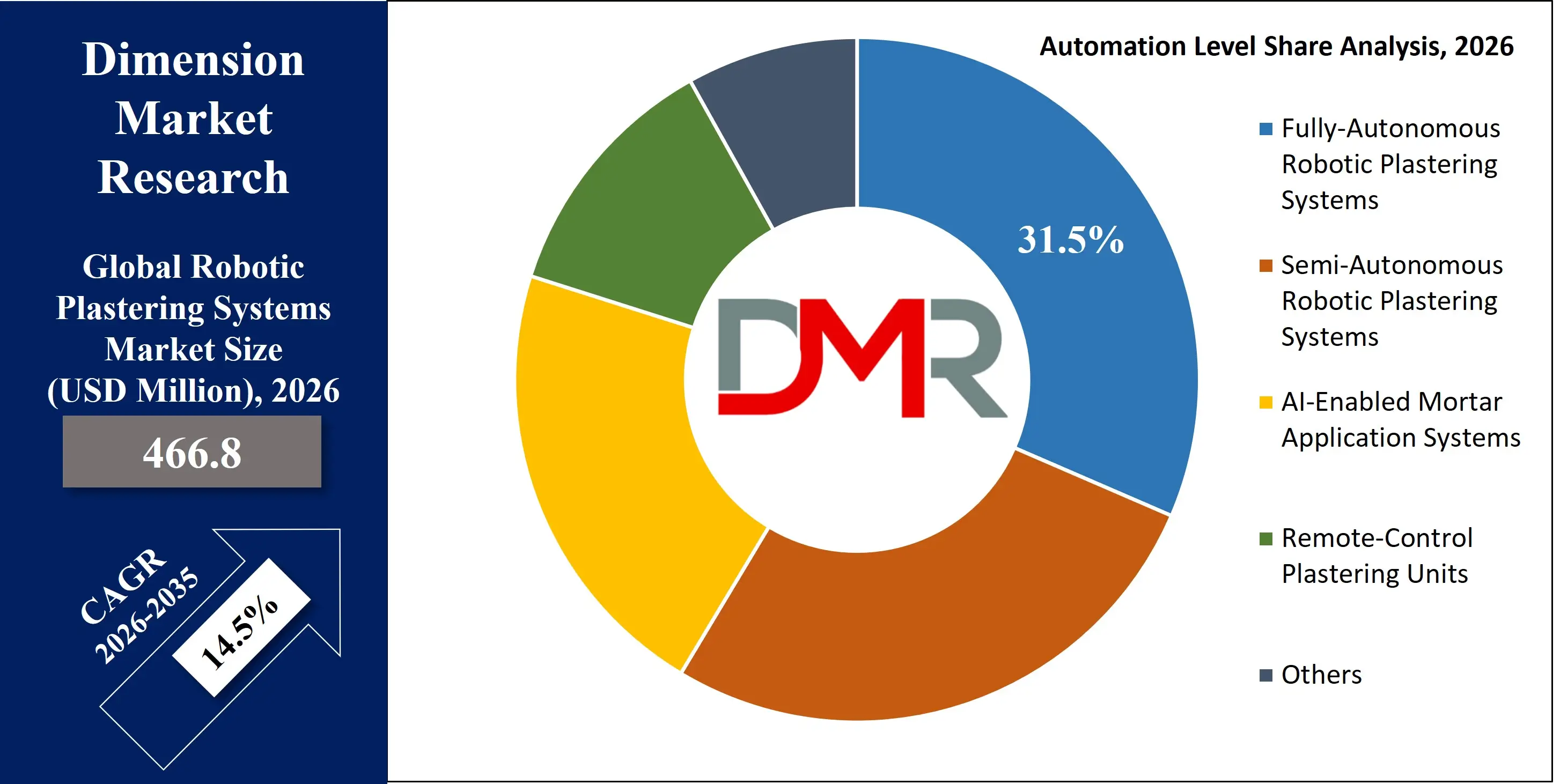
Fully-Autonomous Robotic Plastering Systems are projected to dominate the global market, fundamentally transforming plastering from a manual trade into a controlled, digital manufacturing process. Their dominance stems from an unparalleled value proposition for large-scale, repetitive projects, such as residential towers, warehouse interiors, and big-box commercial spaces. By integrating advanced LiDAR scanning, AI-driven path planning, and real-time adjustment via machine vision, these systems execute the entire plastering cycle from surface assessment to final quality inspection with minimal human intervention. This maximizes productivity, reduces material waste, and delivers exceptional consistency. The driving forces behind their market leadership are tri-fold: the increasing reliability of autonomous navigation in dynamic environments, the plummeting cost of critical sensors and computing power, and the growing confidence of major contractors in automation's return on investment. As labor shortages persist and project timelines compress, the economic case for full automation in volume-driven construction becomes irresistible, solidifying these systems as the cornerstone of modern, industrialized finishing.
Semi-Autonomous Robotic Plastering Systems form the crucial and substantial second-largest segment, effectively bridging the gap between traditional methods and full autonomy. These systems, which typically automate the core spraying function but require human oversight for setup, guidance, or complex detailing, cater to the vast majority of construction projects that are not purely repetitive. Their strength lies in flexibility and adaptability, making them ideal for renovation work, custom residential builds, historic retrofits, and commercial projects with intricate layouts or numerous obstructions. By handling the physically demanding and repetitive spraying task, they boost a single operator's productivity and consistency while preserving the critical human judgment needed for non-standard site conditions. This balance of efficiency and versatility makes them a lower-risk, more accessible entry point for small and mid-sized contractors seeking to modernize. As such, semi-autonomous systems will remain indispensable for the foreseeable future, addressing the nuanced realities of the built environment where every site presents unique challenges.
By Application Analysis
Residential Construction is poised to be the largest and most dominant application segment for robotic plastering, driven by powerful global macro-trends. The relentless demand for housing, particularly in multi-unit developments like apartments and condominiums, creates a perfect use case: endless repetitions of similar wall and ceiling surfaces. This repetition is where robotics excel, ensuring identical finish quality and thickness across hundreds of units while dramatically accelerating project schedules. The sector is also acutely affected by chronic labor shortages in skilled finishing trades, making robotic systems a strategic solution to a critical bottleneck. Beyond speed, robots offer developers predictable costs and reduced material variance, directly impacting profitability and program certainty. From large-scale suburban housing projects to urban high-rises, the economic and operational pressures in residential construction make the adoption of robotic plastering not merely advantageous but increasingly essential for maintaining viability and scale.
ℹ
To learn more about this report –
Download Your Free Sample Report Here
Commercial Construction ranks as the second-largest application segment, fueled by its own set of demanding requirements. Projects such as office complexes, hotels, hospitals, and retail spaces feature vast interior wall areas that must be completed to a high standard under tight deadlines. The precision and consistency of robotic plastering directly address the need for flawless finishes in highly visible public and professional environments, reducing rework and ensuring brand standards. Furthermore, the scale of these projects justifies the upfront investment in robotic technology, as the efficiency gains are realized across thousands of square meters. While more variable in layout than repetitive residential units, commercial projects often have large, open areas where robotic systems can operate with high efficiency. The drive for faster project delivery and reduced lifecycle costs in commercial development strongly aligns with the robotic value proposition, securing its role as a transformative technology for interior build-outs.
By End User Analysis
Large Construction Contractors & Developers are anticipated to dominate the market as the primary drivers and beneficiaries of robotic plastering integration. These entities possess the necessary capital for significant technological investment, the high-volume project pipelines to achieve rapid ROI, and the operational scale to support dedicated robotics teams. For them, the adoption is a strategic move to secure a formidable competitive edge: guaranteed scheduling, predictable costing, and superior, uniform quality across entire portfolios. They often serve as crucial innovation partners for robotics firms, co-developing solutions on live projects and paving the way for broader industry acceptance. Their focus on systematizing construction processes aligns perfectly with robotics, allowing them to transform plastering from a subcontractor-dependent variable into a controlled, in-house production line. This control over a critical path activity enhances their overall project management capability and market positioning.
Specialist Finishing Subcontractors represent the vital second-largest end-user segment, for whom robotic adoption is a strategic pivot for business survival and growth. Faced with intense margin pressure, an aging workforce, and difficulty attracting skilled labor, these firms are turning to robotics to differentiate their services, increase their bidding capacity, and guarantee output quality. For them, a semi-autonomous or compact robotic system represents a tangible asset that can be deployed across multiple projects for general contractors, offering a "tech-aided" finishing solution that commands a premium. Adoption in this segment is often calculated through careful medium-term ROI models and is frequently accelerated by partnerships with forward-thinking general contractors who specifically seek out technologically advanced subcontractors. By mastering robotic operation, these specialists future-proof their businesses, transitioning from purely labor providers to technology-enabled finishing experts.
The Global Robotic Plastering Systems Market Report is segmented on the basis of the following
By Product Type
- Wall Plastering Robots
- Ceiling Plastering Robots
- Multi-Function Plastering Robots
By Automation Level
- Fully-Autonomous Robotic Plastering Systems
- Semi-Autonomous Robotic Plastering Systems
- AI-Enabled Mortar Application Systems
- Remote-Control Plastering Units
- Others
By Application
- Residential Construction
- Commercial Construction
- Industrial Construction
- Infrastructure & Public Projects
- Renovation & Retrofit
By End User
- Contractors & Developers
- Specialist Finishing Subcontractors
- Modular & Prefab Housing Manufacturers
- Government & Public Works Agencies
- Rental & Service Providers
Impact of Artificial Intelligence in the Global Robotic Plastering Systems Market
- AI for Autonomous Path Planning & Surface Adaptation: AI analyzes 3D site scans to generate optimal spraying paths, adjusting for wall contours, obstacles, and openings in real time. This ensures complete coverage, minimizes overspray, and adapts to unforeseen site conditions without manual reprogramming.
- AI-Driven Mortar Consistency & Flow Control: Sensors and AI algorithms monitor and adjust mortar viscosity, air pressure, and flow rate dynamically based on environmental conditions and surface absorption. This maintains optimal application quality, reduces clogging, and ensures consistent finish thickness.
- Predictive Quality Assurance & Defect Detection: AI-powered vision systems inspect the plastered surface in-process, identifying imperfections like streaks, voids, or uneven thickness. Immediate feedback allows for on-the-spot correction, reducing rework and ensuring adherence to specifications.
- AI-Based Fleet Optimization & Maintenance: AI analyzes operational data from multiple robots to predict maintenance needs, optimize battery or material reload schedules, and assign tasks based on robot location and capability. This maximizes uptime and efficiency across a fleet.
- Learning from Historical Project Data: AI systems aggregate data across projects to continuously improve application strategies for different materials, wall types, and climatic conditions, building a knowledge base that enhances performance over time.
Global Robotic Plastering Systems Market: Regional Analysis
Region with the Largest Revenue Share
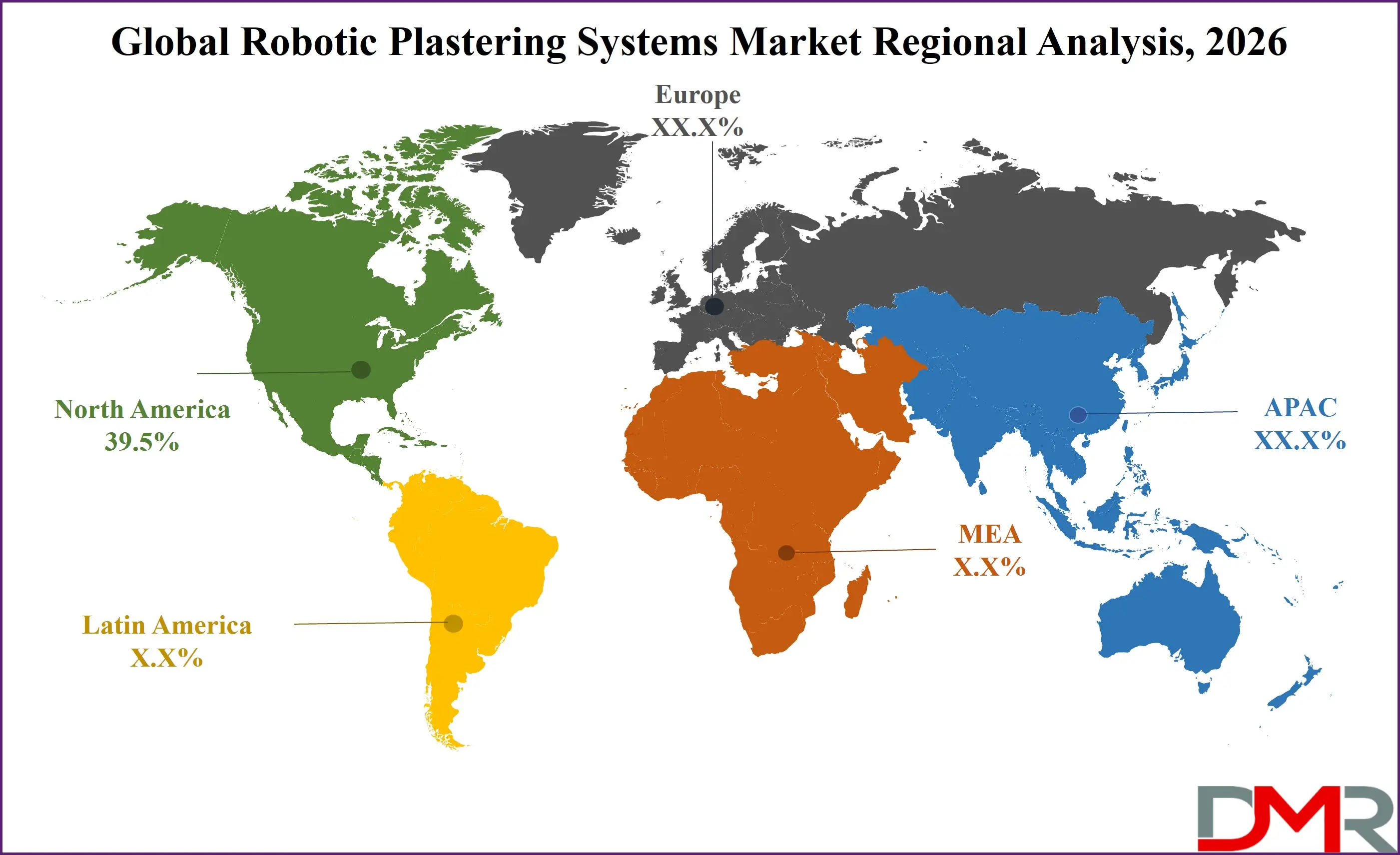
North America is projected to dominate the Global Robotic Plastering Systems Market with 39.5% of market share by the end of 2026, owing to a powerful combination of high construction activity, acute labor shortages, strong technology investment, and the presence of leading robotics innovators. The United States and Canada have rapidly integrated construction robotics into project planning, supported by a culture of innovation and productivity focus. Major contractors and developers are institutionalizing robotic plastering to maintain competitive margins and project reliability.
ℹ
To learn more about this report –
Download Your Free Sample Report Here
The region's booming residential and commercial sectors, coupled with high labor costs, create a strong economic case for automation. Supportive industry consortia and gradual regulatory adaptation for autonomous site equipment further solidify North America's leadership position.
Region with the Highest CAGR
Asia-Pacific holds the highest CAGR and is poised to achieve rapid market share growth due to its massive urban development, government-led infrastructure push, and severe skilled labor deficits. Countries like China, India, Japan, and Australia are investing heavily in construction technology to meet ambitious building goals. China's "Made in China 2026" initiative in construction robotics and India's "Smart Cities Mission" are creating fertile ground for adoption. The region's cost sensitivity is being addressed through local manufacturing, robotics-as-a-service models, and partnerships between global tech firms and local contractors. This, combined with an immense project pipeline, positions APAC as the fastest-growing market for robotic plastering systems.
By Region
North America
Europe
- Germany
- The U.K.
- France
- Italy
- Russia
- Spain
- Benelux
- Nordic
- Rest of Europe
Asia-Pacific
- China
- Japan
- South Korea
- India
- ANZ
- ASEAN
- Rest of Asia-Pacific
Latin America
- Brazil
- Mexico
- Argentina
- Colombia
- Rest of Latin America
Middle East & Africa
- Saudi Arabia
- UAE
- South Africa
- Israel
- Egypt
- Rest of MEA
Global Robotic Plastering Systems Market: Competitive Landscape
The Global Robotic Plastering Systems Market is moderately fragmented, featuring a mix of established construction equipment manufacturers, specialized robotics startups, and technology firms diversifying into building automation. Leading equipment players Brokk, Husqvarna, and Putzmeister are leveraging their expertise in material handling and application to develop robotic plastering solutions. Pure-play robotics innovators such as Canvas, Dusty Robotics, and Okibo are driving market dynamics with agile, software-centric systems focused on interior finishing.
AI and software specialists like nVIDIA (for vision processing), Boston Dynamics (for mobile platform integration), and Autodesk (for BIM workflow integration) play increasingly influential roles as enablers and partners. Traditional plastering and drywall subcontractors are also entering the space through strategic investments and JVs, aiming to vertically integrate automation into their service offerings.
Some of the prominent players in the Global Robotic Plastering Systems Market are
- Brokk AB
- Husqvarna Group
- Putzmeister Holding GmbH
- Canvas Construction
- Dusty Robotics
- Okibo
- Shimizu Corporation
- Kajima Corporation
- Alpine (an ITW company)
- GOMACO Corporation
- nVIDIA
- Boston Dynamics
- Autodesk, Inc.
- Advanced Construction Robotics
- COBOD International
- Fastbrick Robotics (FBR)
- MX3D
- KUKA AG
- ABB Robotics
- Samsung C&T Corporation
- Other Key Players
Recent Developments in the Global Robotic Plastering Systems Market
- November 2025: Canvas launches next-gen interior finishing robot
Canvas introduced its Generation 3 autonomous drywall finishing and plastering robot, featuring enhanced AI vision for complex corners and improved material efficiency. The system integrates directly with major BIM platforms, streamlining the path from design to automated execution.
- October 2025: Husqvarna showcases autonomous plastering fleet at Bauma
Husqvarna presented its integrated fleet of autonomous plastering and surface preparation robots at Bauma 2026. The demonstration highlighted swarm coordination, real-time site data sharing, and seamless handoff between demolition, priming, and finishing robots.
- September 2025: Dusty Robotics secures major U.S. contractor partnership
Dusty Robotics announced a multi-year agreement with a top-10 U.S. general contractor to deploy its robotic finishing systems across a national portfolio of multi-family housing projects, signaling mainstream acceptance of automated plastering.
- August 2025: Brokk acquires AI vision startup for robotic construction
Brokk completed the acquisition of a specialist AI vision firm to enhance its robotic demolition and plastering systems' ability to "see" and adapt to unstructured environments, accelerating its move towards fully autonomous site solutions.
- July 2025: EU funds cross-border research on sustainable robotic plastering
A Horizon Europe grant was awarded to a consortium developing low-carbon plaster mixes optimized for robotic application and recycling, linking automation with circular economy goals in construction.
- June 2025: Okibo partners with Japanese prefab housing leader
Okibo partnered with a major Japanese modular home manufacturer to integrate its semi-autonomous plastering robot into fully automated factory production lines, aiming to set new standards for finish quality in off-site construction.
Report Details
| Report Characteristics |
| Market Size (2026) |
USD 466.8 Mn |
| Forecast Value (2035) |
USD 1,582.1 Mn |
| CAGR (2026–2035) |
14.5% |
| The US Market Size (2026) |
USD 145.6 Mn |
| Historical Data |
2021 – 2025 |
| Forecast Data |
2027 – 2035 |
| Base Year |
2025 |
| Estimate Year |
2026 |
| Report Coverage |
Market Revenue Estimation, Market Dynamics, Competitive Landscape, Growth Factors, etc. |
| Segments Covered |
By Product Type (Wall Plastering Robots, Ceiling Plastering Robots, Multi-Function Plastering Robots), By Automation Level (Fully-Autonomous Robotic Plastering Systems, Semi-Autonomous Robotic Plastering Systems, AI-Enabled Mortar Application Systems, Remote-Control Plastering Units, Others), By Application (Residential Construction, Commercial Construction, Industrial Construction, Infrastructure & Public Projects, Renovation & Retrofit), By End User: Contractors & Developers, Specialist Finishing Subcontractors, Modular & Prefab Housing Manufacturers, Government & Public Works Agencies, Rental & Service Providers |
| Regional Coverage |
North America – US, Canada; Europe – Germany, UK, France, Russia, Spain, Italy, Benelux, Nordic, Rest of Europe; Asia-Pacific – China, Japan, South Korea, India, ANZ, ASEAN, Rest of APAC; Latin America – Brazil, Mexico, Argentina, Colombia, Rest of Latin America; Middle East & Africa – Saudi Arabia, UAE, South Africa, Turkey, Egypt, Israel, Rest of MEA |
| Prominent Players |
Brokk AB, Husqvarna Group, Putzmeister Holding GmbH, Canvas Construction, Dusty Robotics, Okibo, Shimizu Corporation, Kajima Corporation, Alpine (an ITW company), GOMACO Corporation, nVIDIA, Boston Dynamics, Autodesk, Inc., Advanced Construction Robotics, COBOD International, Fastbrick Robotics (FBR), MX3D, KUKA AG, ABB Robotics, and Samsung C&T Corporation, and Other Key Players |
| Purchase Options |
We have three licenses to opt for: Single User License (Limited to 1 user), Multi-User License (Up to 5 Users), and Corporate Use License (Unlimited User) along with free report customization equivalent to 0 analyst working days, 3 analysts working days, and 5 analysts working days respectively. |
Frequently Asked Questions
How big is the Global Robotic Plastering Systems Market?
▾ The Global Robotic Plastering Systems Market size is estimated to have a value of USD 466.8 million in 2026 and is expected to reach USD 1,582.1 million by the end of 2035.
What is the growth rate in the Global Robotic Plastering Systems Market in 2026?
▾ The market is growing at a CAGR of 14.5 percent over the forecasted period of 2026.
What is the size of the US Robotic Plastering Systems Market?
▾ The US Robotic Plastering Systems Market is projected to be valued at USD 145.6 million in 2026. It is expected to witness subsequent growth in the upcoming period as it holds USD 459.1 million in 2035 at a CAGR of 13.6%.
Which region accounted for the largest Global Robotic Plastering Systems Market?
▾ North America is expected to have the largest market share in the Global Robotic Plastering Systems Market with a share of about 39.5% in 2026.
Who are the key players in the Global Robotic Plastering Systems Market?
▾ Some of the major key players in the Global Robotic Plastering Systems Market are Brokk AB, Husqvarna Group, Putzmeister Holding GmbH, Canvas Construction, Dusty Robotics, Okibo, and many others.