Global Robotic Process Automation in Legal Services Market Snapshot
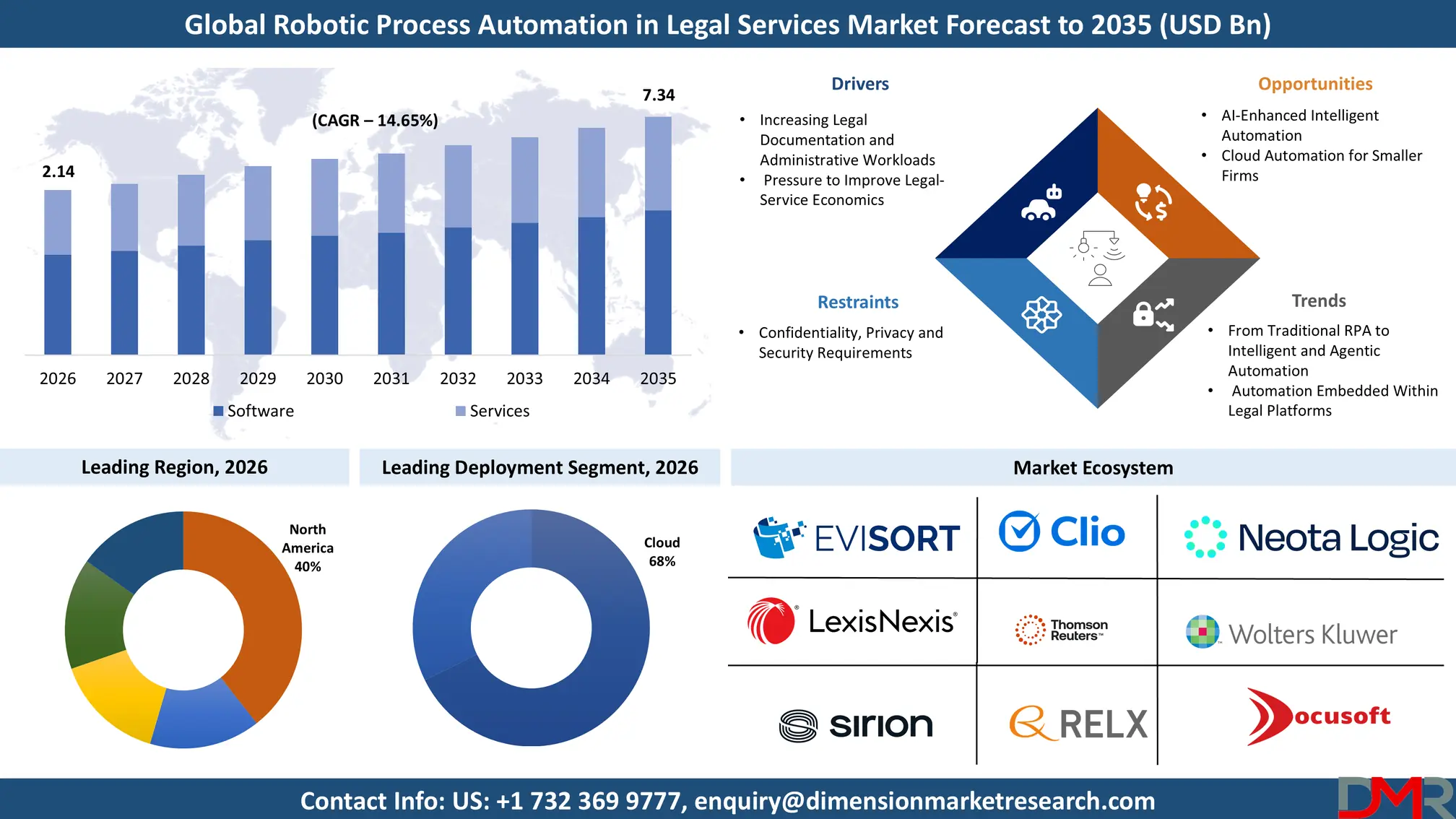
- Global Robotic Process Automation in Legal Services Market Size in 2026: USD 2.14 Billion
- Global Robotic Process Automation in Legal Services Market Size in 2035: USD 7.34 Billion
- Global CAGR from 2026 to 2035: 14.65%
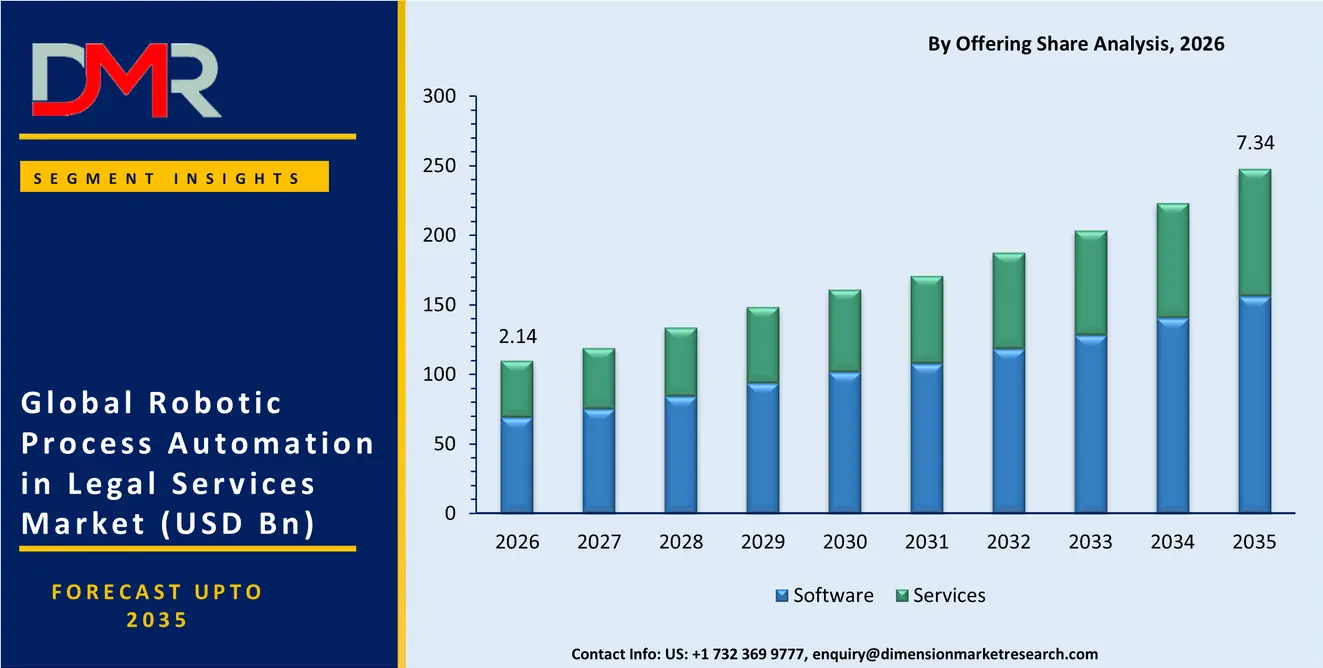
- Leading offering: Software, 63%
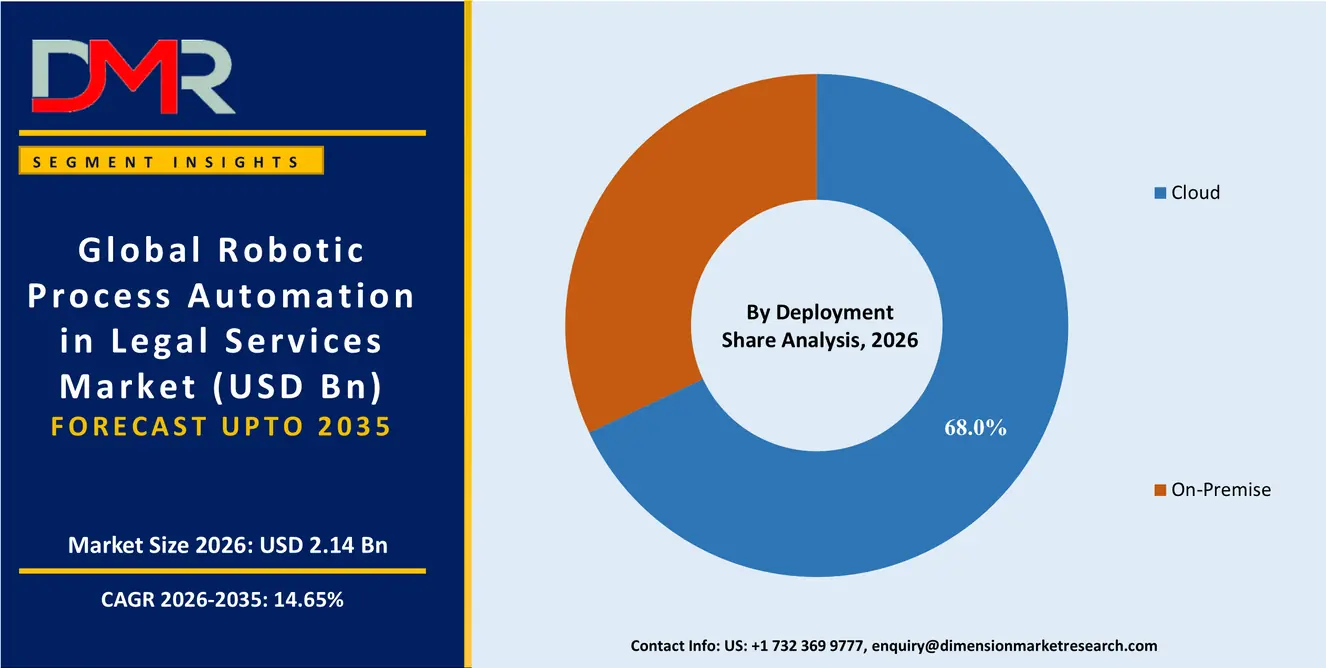
- Leading deployment: Cloud, 68%
- Leading automation type: Rule-based RPA, 57%
- Leading application: Document Review & Processing, 22%
- Fastest-growing segment: Intelligent Automation, 20% CAGR
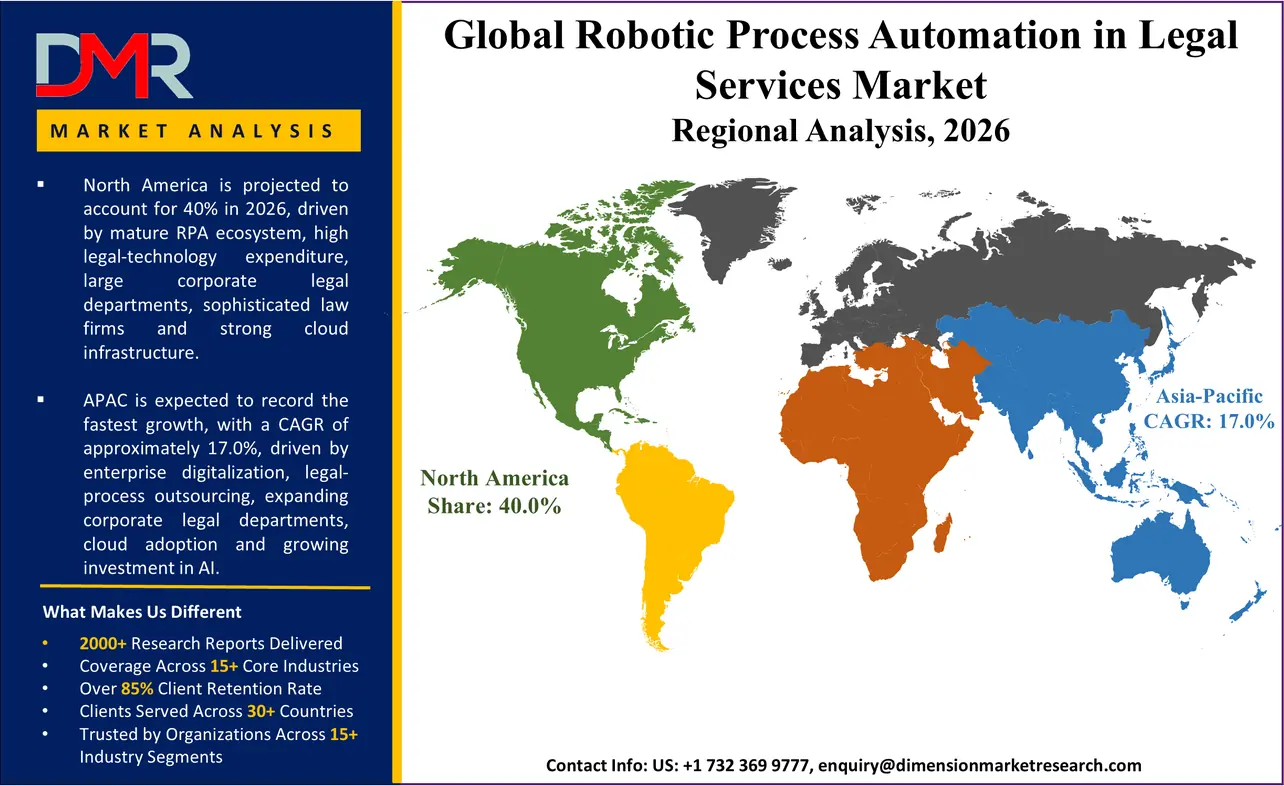
- Leading region: North America, 40%
- Fastest-growing region: Asia-Pacific, 17% CAGR
What is the Global Robotic Process Automation in Legal Services and its Market Size?
The Global Robotic Process Automation in Legal Services Market is projected to reach USD 2.14 billion in 2026 and grow at a compound annual growth rate of 14.65% from there until 2035 to reach a value of USD 7.34 billion.
ℹ
To learn more about this report –
Download Your Free Sample Report Here
Growth is supported by increasing legal-document volumes, pressure on law firms and corporate legal departments to control operating costs, rising demand for standardized legal operations, expansion of alternative legal services, and increasing integration between RPA and AI technologies. The economics are particularly attractive where workflows involve high transaction volumes and relatively predictable rules.
The addressable opportunity is expanding beyond traditional "bots." Intelligent document processing, natural-language processing, generative AI and AI agents increasingly allow automation systems to interpret information and manage exceptions. Nevertheless, deterministic RPA remains valuable for repetitive, stable processes where reliability and auditability are more important than sophisticated reasoning.
Use Cases
- Contract Management: Automates contract intake, metadata extraction, approvals, renewals, obligation tracking and repository updates.
- Document Review & Processing: Classifies, extracts, validates, renames, routes and archives large volumes of legal documents.
- Legal Billing & Invoicing: Automates invoice preparation, time-entry validation, reconciliation, billing exceptions and reporting.
- Client Onboarding & KYC: Automates intake, identity checks, conflict screening, data entry and documentation.
- Compliance & Regulatory Processes: Automates monitoring, data collection, reporting, control checks and audit preparation.
- Case & Matter Management: Automates matter creation, notifications, deadlines, document routing and status updates.
Key Takeaways
- Strong growth: The market is modeled to expand from about USD 2.14 billion in 2026 to USD 7.34 billion in 2035.
- Primary drivers: Cost pressure, growing document volumes, compliance workloads and legal-operations modernization are central growth forces.
- Segment leadership: Software, cloud deployment and rule-based automation remain the largest categories in 2026.
- Fastest growth: Intelligent automation is expected to outpace conventional RPA as AI makes semi-structured workflows automatable.
- Regional leadership: North America leads because of its mature legal-tech ecosystem, high technology spending and large corporate legal market.
- Regional opportunity: Asia-Pacific should grow fastest, supported by digital transformation, legal outsourcing and enterprise automation.
- Competitive shift: Vendors are moving from standalone bots toward integrated AI, workflow orchestration and agentic automation.
How AI/Gen AI is Transforming the Robotic Process Automation in Legal Services Market?
The legal-RPA market is moving from conventional screen-based automation toward intelligent automation. Traditional bots remain useful for structured activities such as transferring information between systems, generating reports or reconciling records. AI adds capabilities for document classification, information extraction, summarization, natural-language interaction and exception handling. Generative AI and agentic systems increasingly extend automation across multi-step legal workflows.
The principal benefit is a broader automation envelope. Instead of automating only predictable keystrokes, firms can automate portions of workflows involving contracts, emails, correspondence and other semi-structured information. This can reduce administrative workload, accelerate processing and improve consistency.
Key Drivers in the Global Robotic Process Automation in Legal Services Market
Increasing Legal Documentation and Administrative Workloads
Legal organizations process enormous quantities of contracts, correspondence, invoices, discovery material, regulatory records, client documents and matter information. Much of the associated administrative work does not require substantive legal judgment and can therefore be standardized and automated. RPA is particularly suitable where users repeatedly transfer information between practice-management systems, document repositories, billing applications, spreadsheets, email systems and regulatory portals.
Pressure to Improve Legal-Service Economics
Law firms and corporate legal departments increasingly need to increase output without proportionally increasing administrative headcount. Alternative legal services providers have demonstrated the commercial value of combining specialized legal expertise with technology and process management.
Restraints in the Global Robotic Process Automation in Legal Services Market
Confidentiality, Privacy and Security Requirements
Legal information frequently contains privileged communications, personal information, trade secrets, financial records and commercially sensitive documents. Automation introduces additional technology layers, vendors, credentials, APIs, cloud repositories and potentially AI models into workflows. This increases the need for strong identity management, encryption, audit logs, data residency controls and vendor-risk assessments.
Growth Opportunities in the Global Robotic Process Automation in Legal Services Market
AI-Enhanced Intelligent Automation
The largest medium-term opportunity is combining RPA with AI. Conventional RPA is strongest when instructions are explicit; AI can help interpret documents, emails, unstructured data and exceptions. Legal organizations can therefore build hybrid workflows in which AI interprets information, RPA executes deterministic system actions and lawyers approve high-risk outputs. Academic research is also exploring LLM-based compliance automation because legal compliance involves contextual interpretation that conventional classification and extraction approaches cannot always handle effectively.
Cloud Automation for Smaller Firms
Large enterprises have historically had greater resources for RPA implementation, but cloud-based SaaS platforms can lower barriers for small and medium-sized firms. Subscription-based platforms can provide preconfigured workflows for client intake, billing, document generation, scheduling, reporting and compliance without requiring extensive internal infrastructure. This creates a large potential market among firms that cannot justify dedicated automation teams.
Trends in the Global Robotic Process Automation in Legal Services Market
From Traditional RPA to Intelligent and Agentic Automation
The market is gradually shifting from deterministic bots toward systems that combine RPA, AI models and autonomous workflow orchestration. Agentic systems can potentially perform multiple steps from a natural-language instruction, while RPA remains the execution layer for reliable interactions with established enterprise applications.
Automation Embedded Within Legal Platforms
Automation is increasingly becoming an embedded capability rather than a separate RPA project. Legal platforms are integrating document intelligence, AI research, workflow automation, contract intelligence and practice-management functionality.
Research Scope and Analysis
The market is segmented by offering, deployment, automation type, application, organization size and end user. The analysis separates conventional RPA from intelligent automation because AI-enabled legal workflows increasingly overlap with, but are not identical to traditional RPA.
ℹ
To learn more about this report –
Download Your Free Sample Report Here
By Offering Analysis
Software is estimated to represent approximately 63% of the 2026 market, making it the dominant offering category. Software leads because recurring platform subscriptions, automation orchestration, workflow management and AI capabilities form the technological core of most deployments. Services—including consulting, implementation, integration and support—remain essential because legal organizations often require customization across legacy applications and sensitive data environments.
ℹ
To learn more about this report –
Download Your Free Sample Report Here
Implementation & Integration represents the largest services subcategory, while Managed Automation and Support & Maintenance are expected to expand as deployments move from pilots into production. The fastest-growing offering area is expected to be intelligent automation software, with an estimated CAGR of roughly 20%, reflecting growing demand for document intelligence, AI-assisted workflow execution and agentic orchestration. Consulting remains important for process discovery and governance, but software is likely to capture an increasing proportion of incremental spending as cloud deployment and reusable automation templates reduce implementation friction.
By Deployment Analysis
Cloud deployment is estimated to hold approximately 68% of the market in 2026 and remain the dominant deployment model. Cloud RPA reduces infrastructure requirements, supports distributed legal teams and allows vendors to deliver continuous software and AI updates. SaaS pricing also makes automation more accessible to smaller firms. On-premises deployment remains important for large law firms, government departments and organizations with strict security, sovereignty or integration requirements. Hybrid deployment is expected to be the fastest-growing deployment approach in highly regulated environments because it allows sensitive data and critical workloads to remain within controlled infrastructure while less-sensitive automation services operate in the cloud. Cloud adoption should continue expanding as legal technology providers improve security controls and integrations, although data residency and client confidentiality requirements will prevent complete migration for some users.
By Automation Type Analysis
Rule-Based Automation is estimated to account for approximately 57% of 2026 revenue, reflecting the large installed base of conventional RPA workflows. These systems are well suited to repetitive tasks such as transferring information, generating reports, reconciling records and triggering workflow actions. However, Intelligent Automation is projected to be the fastest-growing segment, with an estimated 20% CAGR, because legal workflows increasingly contain documents, emails and information that cannot be handled efficiently through fixed rules alone. Intelligent automation combines RPA with AI, NLP, machine learning and intelligent document processing. Over the forecast period, intelligent automation is expected to gain share as legal organizations seek to automate more complex processes. Generative AI and agents will increasingly serve as an interpretation and orchestration layer, while conventional RPA remains the dependable execution mechanism for deterministic tasks.
By Application Analysis
Document Review & Processing is estimated to lead the application market with approximately 22% share in 2026, reflecting the high volume of documents processed by legal organizations. Contract management, billing and client onboarding follow closely because these workflows combine large transaction volumes with repetitive administrative activity. Contract Management should remain one of the strongest growth categories as organizations seek automated extraction, renewal tracking, obligation monitoring and workflow routing. Compliance & Regulatory Processes are expected to grow rapidly because regulatory requirements create recurring data-collection and reporting workloads. Client onboarding and KYC also represent attractive use cases because organizations can automate identity information collection, conflict checks, data validation and account creation. Litigation support remains significant but typically requires greater human judgment and therefore presents a more complex automation opportunity.
By Organization Size Analysis
Large Firms & Enterprises are estimated to represent the larger share of spending because they possess greater technology budgets, larger document volumes and more complex legal operations. However, small and medium-sized firms should achieve faster percentage growth as cloud-based SaaS automation reduces upfront investment requirements. Prebuilt workflows and low-code tools can make automation economically viable for firms without dedicated RPA teams.
By End User Analysis
Law firms are estimated to remain the largest end-user group in 2026 because of their large administrative workloads and extensive document-intensive processes. Corporate legal departments represent a major growth engine as legal operations teams increasingly adopt technology to control spending and improve internal service levels. LPO providers have strong automation incentives because technology directly supports their volume-based delivery model. Government legal departments represent a longer-term opportunity, particularly where digital-government programs create standardized workflows and centralized document-processing requirements.
The Global Robotic Process Automation in Legal Services Market Report is segmented on the basis of the following:
By Offering
- Software
- Services
- Consulting & Advisory
- Implementation & Integration
- Support & Maintenance
By Deployment
By Automation Type
- Rule-Based Automation
- Intelligent Automation
By Application
- Contract Management
- Document Review & Processing
- Legal Research & Due Diligence
- Legal Billing & Invoicing
- Compliance & Regulatory Processes
- Client Onboarding & KYC
- Case & Matter Management
- Litigation Support
By Organization Size
- Small & Medium-Sized Firms
- Large Firms & Enterprises
By End User
- Law Firms
- Corporate Legal Departments
- Legal Process Outsourcing (LPO) Providers
- Government Legal Departments
Regional Analysis
North America is the Leading Region in the Global Robotic Process Automation in Legal Services Market
North America is estimated to account for approximately 40% of the global market in 2026, making it the largest regional market. The region benefits from a mature RPA ecosystem, high legal-technology expenditure, large corporate legal departments, sophisticated law firms and strong cloud infrastructure. The United States is particularly important because legal organizations face substantial labor and technology costs, increasing the economic incentive to automate administrative workflows.
ℹ
To learn more about this report –
Download Your Free Sample Report Here
Asia Pacific is the Fastest-Growing Region in the Global Robotic Process Automation in Legal Services Market
Asia-Pacific is projected to be the fastest-growing region, with an estimated 17% CAGR through 2035. Growth should be supported by enterprise digitalization, legal-process outsourcing, expanding corporate legal departments, cloud adoption and growing investment in AI. India is particularly relevant because of its legal-process outsourcing and technology-services ecosystem, while Japan has strong enterprise automation capabilities. China, South Korea and Southeast Asia add substantial long-term demand as organizations modernize legal and compliance operations.
The Europe Robotic Process Automation in Legal Services Market
The European market is estimated at approximately USD 0.47 billion in 2026 and is modeled to reach roughly USD 1.45 billion by 2035, representing an estimated 13.3% CAGR. Demand is supported by GDPR-driven data governance, legal and regulatory complexity, enterprise digital transformation and growing AI adoption. The EU's AI regulatory environment is becoming particularly important. As of August 2026, the AI Act's transparency rules and enforcement mechanisms are entering application, while the broader implementation timetable extends into 2027-2028 for certain high-risk systems.
Latin America Robotic Process Automation in Legal Services Market
Latin America's market is estimated at approximately USD 0.15 billion in 2026 and is modeled to reach approximately USD 0.51 billion by 2035, implying roughly 14.5% CAGR. Brazil and Mexico represent the principal opportunities. Demand is driven by digital transformation, compliance requirements, growing corporate legal functions, cloud adoption and pressure to lower administrative costs. The region's legal-process outsourcing potential also creates opportunities for automation vendors serving high-volume workflows.
MEA Robotic Process Automation in Legal Services Market
MEA is estimated at approximately USD 0.13 billion in 2026 and is modeled to reach approximately USD 0.45 billion by 2035, representing approximately 14.8% CAGR. Saudi Arabia and the UAE are expected to lead regional adoption because of government digitization, smart-government programs, AI investment and corporate modernization. Saudi Arabia's broader AI momentum is significant: a 2026 academic survey found very high self-reported generative-AI use among surveyed Saudi nationals, although it also identified privacy, misinformation and skills concerns.
Major Countries Analysis
United States Robotic Process Automation in Legal Services Market
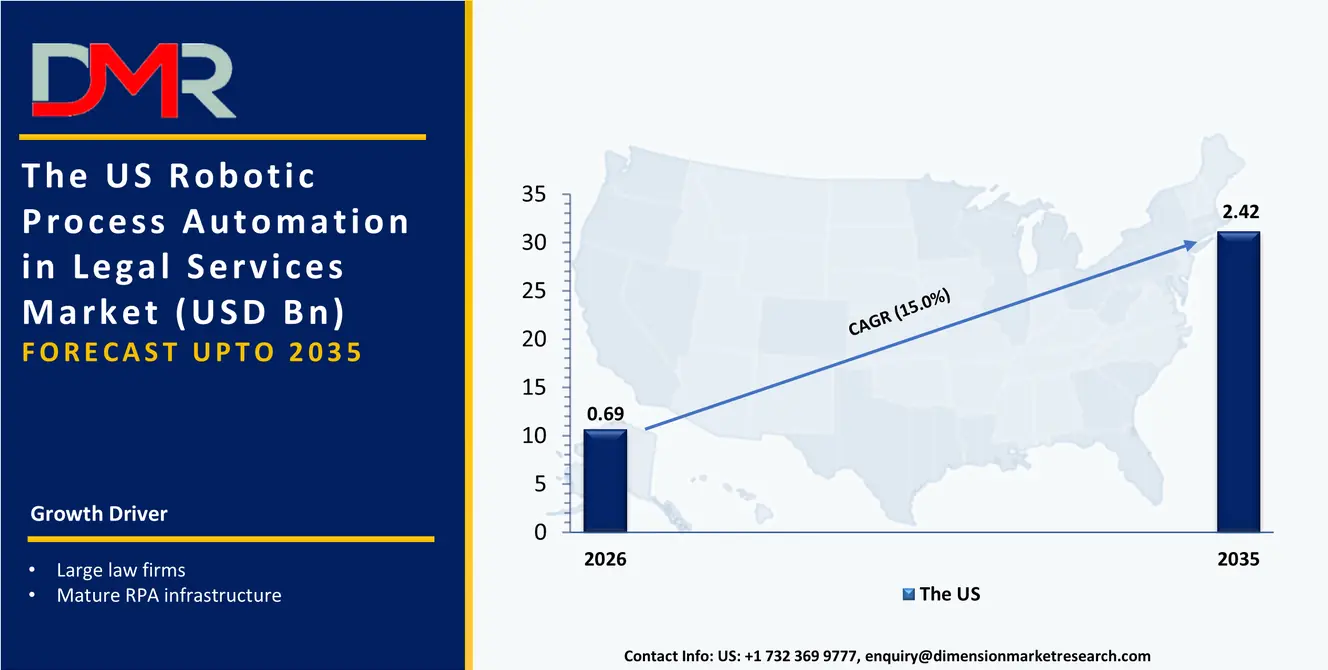
The U.S. market is estimated at approximately USD 0.69 billion in 2026, rising to around USD 2.42 billion by 2035, implying approximately 15% CAGR. Demand is supported by large law firms, corporate legal departments, legal operations, high technology spending and mature RPA infrastructure. AI adoption is accelerating the addressable automation opportunity. Reuters reported that large U.S. law firms reduced entry-level hiring in 2025 for the first time in a decade, with analysts pointing partly to changing demand for routine work amid generative AI adoption.
ℹ
To learn more about this report –
Download Your Free Sample Report Here
Japan Robotic Process Automation in Legal Services Market
Japan's market is estimated at approximately USD 0.12 billion in 2026 and approximately USD 0.45 billion by 2035, representing roughly 16% CAGR. Labor constraints, enterprise automation culture, digital transformation and demand for efficiency support adoption. Japan also has an emerging legal-AI ecosystem, illustrated by LegalOn's expansion of AI-enabled contract capabilities.
Saudi Arabia Robotic Process Automation in Legal Services Market
Saudi Arabia is estimated at approximately USD 0.035 billion in 2026, reaching roughly USD 0.13 billion by 2035, or about 16% CAGR. Vision 2030, government digitization, cloud infrastructure, AI investment and modernization of corporate and professional services should support adoption. The primary opportunity is likely to emerge around compliance, government legal processes, contract management and enterprise workflow automation.
Regulatory Landscape
RPA deployments in legal services are affected less by a single "RPA regulation" than by the regulations governing the information and decisions processed by the automation. GDPR applies to personal-data processing regardless of whether processing is automated or manual, making privacy-by-design, access controls, retention policies and vendor governance important requirements in Europe.
The EU AI Act adds another layer where RPA systems incorporate AI capabilities. Its implementation is progressive, with significant rules applying from August 2026 and certain high-risk provisions scheduled for later dates.
In the United States and other jurisdictions, organizations must additionally consider professional responsibility, attorney-client confidentiality, cybersecurity, consumer privacy, records retention and sector-specific obligations. Consequently, enterprise legal automation increasingly requires auditability and human oversight.
Investment and White Space Analysis
The most attractive white spaces are AI-enhanced RPA for smaller law firms, contract lifecycle automation, legal compliance automation, client onboarding, regulatory reporting and secure private-cloud automation. Another substantial opportunity lies in LPO providers, where automation can improve the economics of high-volume document and administrative work.
Geographically, India and Southeast Asia offer strong growth potential because of legal-services outsourcing and technology expertise. Saudi Arabia and the UAE represent emerging opportunities through government digitalization. Europe offers opportunities for privacy-first and compliance-oriented automation. Investors should favor platforms that combine RPA with AI while retaining strong governance, audit trails, security and human approval mechanisms.
By Region
North America
Europe
- Germany
- France
- The U.K.
- Italy
- Spain
- Rest of Europe
Asia-Pacific
- China
- Japan
- India
- Australia
- South Korea
- Rest of APAC
Latin America
- Mexico
- Brazil
- Rest of LATAM
Middle East & Africa
- Saudi Arabia
- The UAE
- South Africa
- Rest of MEA
Competitive Landscape
The market is moderately fragmented at the application level but increasingly consolidated at the enterprise-platform level. Traditional RPA providers compete with enterprise workflow platforms, legal-tech vendors and AI-native legal companies.
Key competitive differentiators include integration capability, security, AI performance, legal-domain specialization, ease of deployment, low-code functionality, workflow orchestration and total cost of ownership.
Some of the prominent players in the Global Robotic Process Automation in Legal Services Market are:
- Thomson Reuters
- Wolters Kluwer
- RELX
- LexisNexis
- Clio
- Ironclad
- Icertis
- Litera
- Relativity
- DocuSign
- ContractPodAi
- Evisort
- Onit
- Agiloft
- Sirion
- Docusoft
- Neota Logic
- Checkbox
- BRYTER
- LawGeex
- Luminance
- Kira Systems
- Eigen Technologies
- Harvey
- Casetext
- vLex
- DISCO
- Everlaw
- Clio Manage
- PracticePanther
- MyCase
- Smokeball
- Filevine
- Litify
- NetDocuments
- iManage
- Aderant
- Intapp
- HighQ
- Microsoft
- Other Key Players
Recent Developments
- August 2026: Thomson Reuters continued accelerating its AI strategy across legal and professional services. Reuters reported in August 2026 that approximately 32% of its contract value involved generative AI in Q2, up from 30% in the previous quarter.
- June 2026: Harvey announced integrations with Datasite and SS&C Intralinks to bring live deal information into AI-powered workflows, demonstrating the industry's move toward connected, multi-system legal automation rather than isolated AI assistants.
- June 2026: Harvey expanded its enterprise customer footprint, announcing firmwide deployments at organizations including Bae, Kim & Lee, WKB Lawyers, Maddocks, Faegre Drinker and BonelliErede. These deployments demonstrate increasing movement from experimentation toward organization-wide legal AI adoption.
- March 2026: Harvey announced a $200 million growth round at an $11 billion valuation, saying the capital would support expansion of AI agents and embedded legal-engineering teams. Harvey reported that customers were running more than 25,000 custom agents.
- November 2025: Clio completed its $1 billion acquisition of vLex and simultaneously announced a USD 500 million Series G financing at a $5 billion valuation. The transaction combines legal research, practice management and AI capabilities, illustrating the industry's convergence toward integrated legal platforms.
Report Details
| Report Characteristics |
| Market Size (2026) |
USD 2.14 Bn |
| Forecast Value (2035) |
USD 7.34 Bn |
| CAGR (2026–2035) |
14.65% |
| Historical Period |
2021 – 2025 |
| Forecast Period |
2027 – 2035 |
| Base Year |
2025 |
| Estimate Year |
2026 |
| Segments Covered |
By Offering, By Deployment, By Automation Type, By Application, By Organization Size, By End User |
| Regional Coverage |
North America – The US and Canada; Europe – Germany, The UK, France, Spain, Italy, & Rest of Europe; Asia-Pacific – China, Japan, South Korea, India, Australia, Rest of APAC; Latin America – Brazil, Mexico, Argentina, Colombia, Rest of Latin America; Middle East & Africa – Saudi Arabia, The UAE, South Africa, & Rest of MEA |
Frequently Asked Questions
What is the global RPA in legal services market size in 2026?
▾ The market is estimated at approximately $2.14 billion in 2026, derived from the published 2025 benchmark and its 14.65% growth rate.
What will the market be worth by 2035 of Robotic Process Automation in Legal Services Market?
▾ Maintaining the 14.65% modeled CAGR produces an estimated $7.34 billion market by 2035.
What is the expected CAGR of Robotic Process Automation in Legal Services Market ?
▾ The modeled 2026-2035 CAGR is approximately 14.65%, consistent with the published 2025-2030 benchmark.
What are the major growth drivers in Robotic Process Automation in Legal Services Market?
▾ Cost reduction, increasing legal-document volumes, compliance workloads, digital transformation, legal outsourcing and growing adoption of AI-enabled automation are the principal drivers.
What technology is changing the Robotic Process Automation in Legal Services Market most?
▾ The biggest technological shift is the combination of conventional RPA with intelligent document processing, generative AI, NLP and increasingly agentic AI.
Which region currently leads the Robotic Process Automation in Legal Services Market ?
▾ North America is estimated to lead with approximately 40% of global revenue in 2026, supported by mature legal technology adoption and high enterprise spending.
Which region is growing fastest in Robotic Process Automation in Legal Services Market?
▾ Asia-Pacific is modeled as the fastest-growing region, at approximately 17% CAGR through 2035, driven by digital transformation and legal-services outsourcing.
Who are the major competitive participants in Robotic Process Automation in Legal Services Market?
▾ The competitive ecosystem includes enterprise RPA providers, workflow platforms and legal-tech companies such as UiPath, Microsoft, Automation Anywhere, IBM, Pega, ServiceNow, Thomson Reuters and Clio.