Market Overview
The global robotic truck and container unloading market covers autonomous and semi-autonomous systems that physically remove freight from floor-loaded trailers, intermodal containers, and shipping vehicles without requiring workers to enter the load space. The scope spans case-handling robotic arms, mobile manipulators, vacuum wall systems, and conveyor-integrated cells. Manual pallet unloading, automated storage and retrieval systems, and robotic depalletizing of pre-stacked unit loads fall outside this definition.
Receiving docks represent the last unmechanized frontier in warehouse automation. Sortation, storage, and order fulfillment have automated rapidly over the past decade, while trailer unloading remained manual because unstructured, floor-loaded freight resisted reliable robotic handling. AI vision and adaptive gripping now close that gap, pulling Robotic Truck Unloading Market into direct connection with broader warehouse execution and autonomous mobile robot ecosystems. Buyers purchasing unloading robots also invest in conveyor integration, warehouse control software, and autonomous putaway, making Robotic Truck Unloading Market a gateway spend category for full inbound automation.
As reported by Boston Dynamics, Gap employees can position a Stretch robot for trailer unloading in under 1 hour and reach certified independent operation within 2 days, a deployment speed that removes the integration friction that previously blocked adoption at mid-market operators. In May 2025, DHL Group signed a strategic memorandum of understanding with Boston Dynamics for the deployment of more than 1,000 additional Stretch robots, building on existing container-unloading operations and extending into broader warehouse applications. That single commitment signals that hyperscale logistics operators have shifted from pilot evaluation to fleet-scale procurement.
Key Takeaways
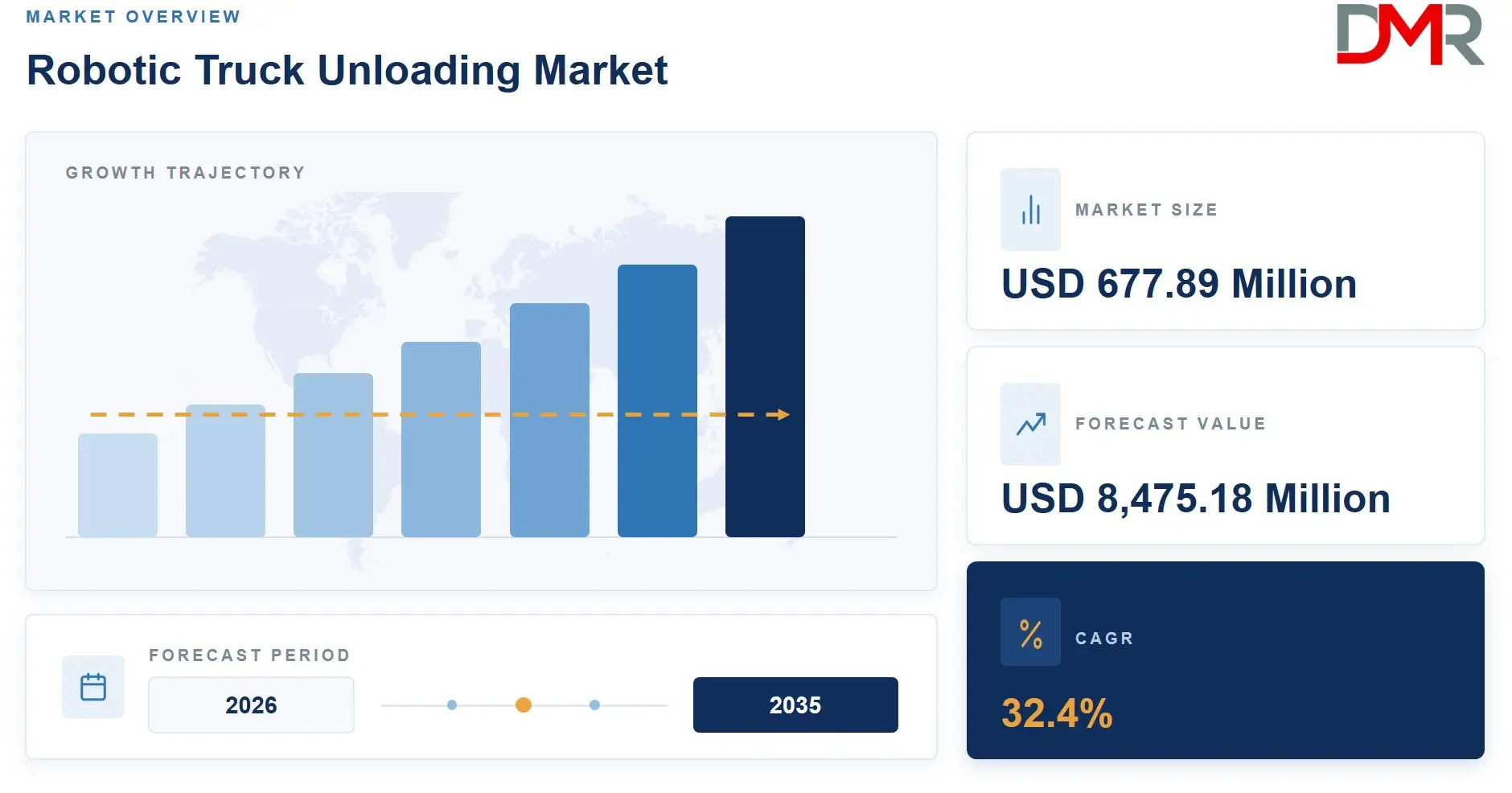
- The market size is USD 677.89 Million in 2026, and is projected to hit USD 8,475.18 Million by 2035 at a CAGR of 32.4%.
- By Technology: Case-handling robotic arms led with a 42.8% share in 2026.
- By Application: Floor-loaded trailer unloading led with a 44.7% share in 2026.
- By Component: Hardware led with a 59.7% share in 2026.
- By End-Use Industry: Parcel and Post led with a 33.7% share in 2026.
- By Business Model: Direct purchase led with a 38.6% share in 2026, while Robots-as-a-Service is the fastest-growing sub-segment.
- By Region: North America led with the dominant regional share, with Asia Pacific identified as the fastest-growing region.
Market Size and Forecast
The Global Robotic Truck and Container Unloading Market size is estimated at USD 677.89 Million in 2026, and is projected to reach USD 8,475.18 Million by 2035, exhibiting a CAGR of 32.4% during the forecast period.
Growth from 2020 through 2024 followed a proof-of-concept trajectory. Early deployments at large parcel carriers and e-commerce fulfillment centers established performance benchmarks and de-risked procurement decisions for followers. The forecast assumes AI vision maturation, declining hardware costs, and RaaS contract availability pull mid-market 3PLs into the addressable buyer pool at scale from 2026 onward. As reported by Slip Robotics, the SlipBot+Bin system handles more than 1,200 parcels per hour, reduces dock dwell time by over 90%, and cuts overall freight-processing time by over 60%, performance data that removes residual doubt about throughput viability at enterprise scale.
ℹ
To learn more about this report –
Download Your Free Sample Report Here
In November 2024, Pickle Robot raised USD 50 million in Series B funding and secured new orders for more than 30 truck-unloading robots, with capital committed to product development and commercial expansion. Venture inflows at that scale confirm investor confidence in near-term revenue conversion rather than speculative R&D bets, and they compress the commercialization timeline embedded in the forecast model.
Technology Analysis
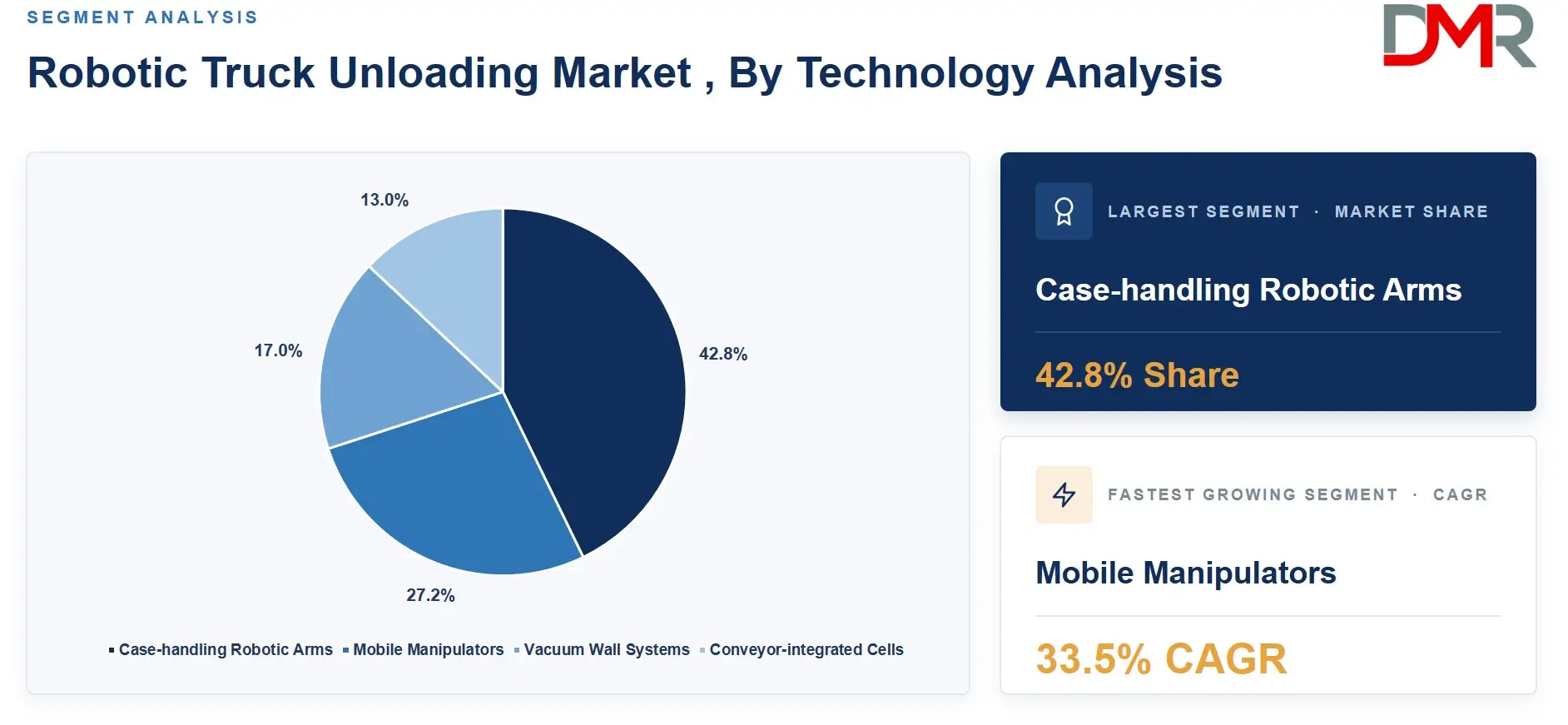
Case-handling robotic arms led the Technology segment with a 42.8% share in 2026.
Case-handling robotic arms dominate because they map directly onto the highest-volume unloading task: removing individual cartons from floor-loaded trailers at sustained throughput rates. At China Tobacco's Taizhou Cigarette Distribution Center, RockyOne managed more than 150 SKUs and unloaded 550–650 cases per hour, while handling cartons weighing up to 17 kg in multipick configurations. Data published by XYZ Robotics confirms that mixed-SKU, variable-weight freight environments no longer require uniform carton inputs, closing the core objection that kept arm-based systems off high-complexity dock assignments.
Mobile manipulators are the fastest-growing technology sub-segment. Operators running multiple dock doors increasingly favor mobile architectures because a single robot can serve several trailer positions rather than being fixed to one lane. Vacuum wall systems and conveyor-integrated cells address specific freight types and facility configurations but face a narrower addressable install base. Vendors anchored in fixed arm configurations face margin pressure as buyers gain negotiating leverage from a broadening choice of mobile alternatives.
ℹ
To learn more about this report –
Download Your Free Sample Report Here
Application Analysis
With a 44.7% share in 2026, floor-loaded trailer unloading outpaced all other Application categories.
Floor-loaded trailer unloading dominates because it is the application with the highest labor intensity, the highest injury rate, and the least existing automation coverage. Every carton must be lifted individually from an unstructured pile, often in a hot or refrigerated environment. Replacing that task creates immediate, measurable savings that justify capital outlay faster than any competing application.
Container destuffing shares the same freight profile but adds complexity from international shipment variability, irregular dunnage, and mixed-origin carton geometry. Parcel induction automation benefits distribution centers feeding high-speed sortation lines. Truck loading, while included in several vendors' platform capabilities, addresses a different operational pain point and commands a smaller share of current deployments. Buyers evaluating multi-application platforms should expect vendor roadmaps to converge loading and unloading into unified dock-automation suites within the forecast period.
Component Analysis
Hardware accounted for 59.7% of Component demand in 2026, the highest of any category.
Hardware dominance reflects the capital structure of first-generation deployments. Robots, end-effectors, conveyor interfaces, and safety infrastructure carry the majority of procurement spend. AI Software commands a growing proportion of total contract value as vendors embed vision models, motion planning algorithms, and exception-handling logic into subscription or licensing layers. Services revenue grows as fleet sizes scale and operators seek maintenance contracts and performance guarantees rather than managing uptime internally.
End-Use Industry Analysis
Parcel and Post captured 33.7% of the End-Use Industry segment in 2026, ahead of all rivals.
Parcel and post operators face the sharpest labor and throughput pressure. Volume growth from e-commerce compounds seasonal peak stress, and same-day delivery commitments leave no buffer for understaffed unloading shifts. Those conditions make the ROI case for robotic unloading faster and clearer than in any other vertical.
Third-party logistics providers and retail distribution centers represent the next tier of adoption. Both operate on thin margins and serve multiple shipper accounts, creating incentive to automate high-labor tasks while maintaining flexibility across freight types. Manufacturing end-users come later in the adoption curve because inbound freight at factory docks tends to be more standardized, reducing urgency relative to the mixed-case chaos at fulfillment centers.
Business Model Analysis
Direct purchase led the Business Model segment as the largest category in 2026.
Large-enterprise buyers with capital budgets and multi-site rollout plans prefer direct purchase to retain ownership and maximize long-term cost savings. RaaS is the fastest-growing model because it removes upfront equipment ownership for mid-market operators and aligns vendor incentives with uptime performance. Lease and pilot program structures serve evaluation-stage buyers and facilities where volume projections remain uncertain. Vendors offering all four commercial structures gain broader market access than those anchored to a single transaction model.
Key Market Segments
By Technology
- Case-handling robotic arms
- Mobile manipulators
- Vacuum wall systems
- Conveyor-integrated cells
By Application
- Floor-loaded trailer unloading
- Container destuffing
- Parcel induction
- Truck loading
By Component
- Hardware
- AI Software
- Services
By End-Use Industry
- Parcel and Post
- Third-party logistics
- Retail distribution centers
- Manufacturing
By Business Model
- Direct purchase
- Robots-as-a-service
- Lease
- Pilot programs
Regional Analysis
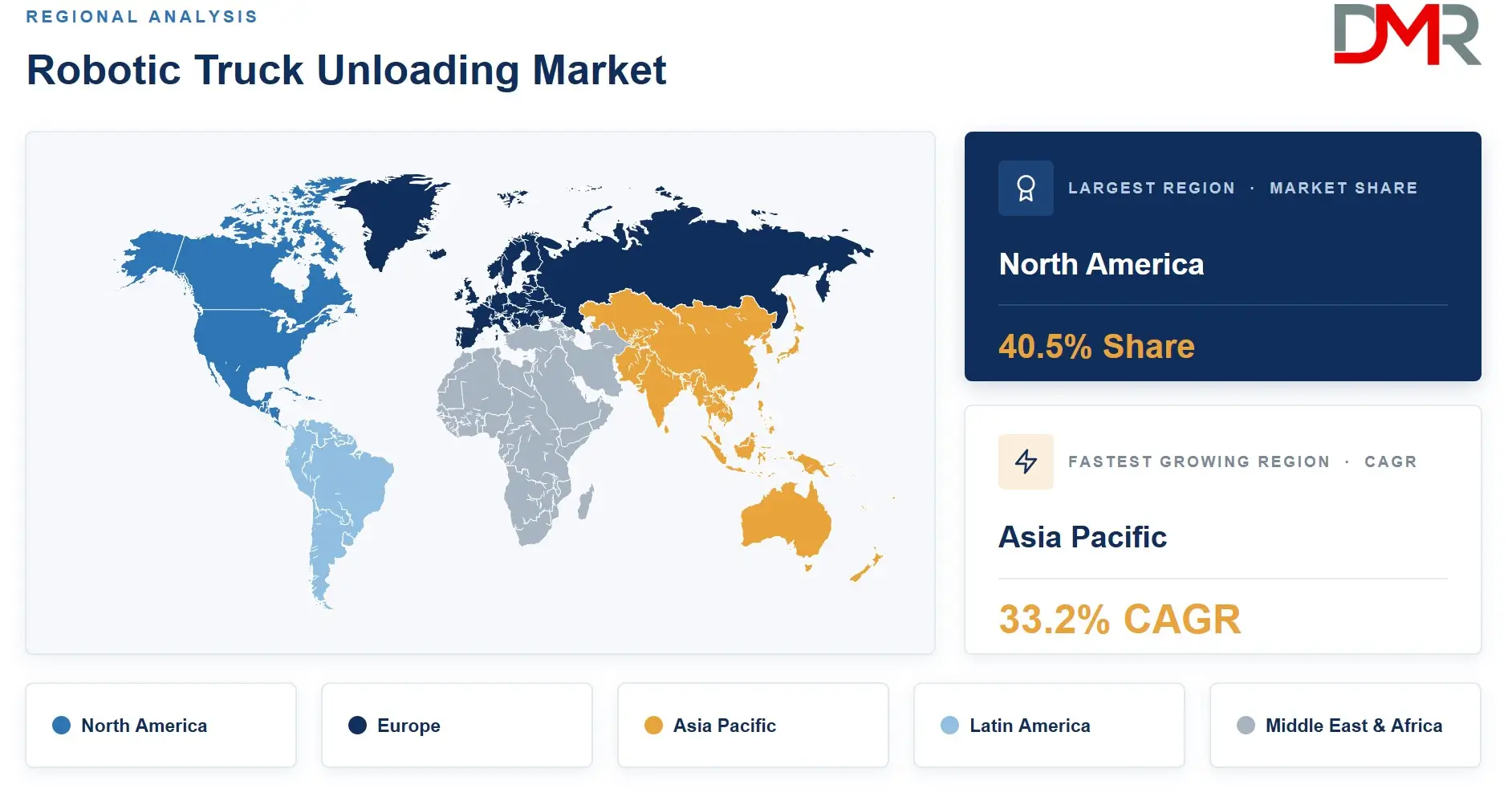
North America led the Regional segment with the dominant share in 2026, anchored by the United States' concentration of large-scale e-commerce fulfillment and parcel distribution infrastructure.
North America
North America leads because the structural conditions that make robotic unloading necessary converged here first and fastest. Dock labor shortages are severe, e-commerce fulfillment volumes are the highest globally, and occupational safety enforcement raises the cost of maintaining manual unloading workflows. Based on data from XYZ Robotics, Marubeni Logistics reduced the unloading of a 40-foot high-cube container to 1.5–2 hours with RockyOne deployment, a benchmark now circulating actively in North American 3PL procurement evaluations. The region's dense concentration of third-party logistics operators and retail distribution networks creates a replicable rollout environment that accelerates vendor revenue per commercial relationship.
Asia Pacific
Asia Pacific is the fastest-growing region. Japan leads adoption within the region, driven by acute demographic labor constraints and a cultural disposition toward automation in physical industries. China adds scale through manufacturing and port modernization programs, where flexible robotic systems capable of handling non-modified trucks fill a gap that fixed conveyor infrastructure cannot. India and Southeast Asia represent the next wave, where regional distribution hub investment and rising e-commerce penetration are creating dock infrastructure that new buyers can equip with robotics from the outset rather than retrofitting legacy facilities.
ℹ
To learn more about this report –
Download Your Free Sample Report Here
Key Regions and Countries
North America
Europe
- Germany
- France
- The UK
- Spain
- Italy
- Rest of Europe
Asia Pacific
- China
- Japan
- South Korea
- India
- Australia
- Rest of APAC
Latin America
- Brazil
- Mexico
- Rest of Latin America
Middle East & Africa
- GCC
- South Africa
- Rest of MEA
Macroeconomic Impact
Tightening labor markets across North America and Western Europe remove the macroeconomic safety valve that historically allowed operators to absorb dock labor shortfalls through wage increases or temporary staffing. When central banks raise rates, capital equipment purchases face longer internal approval cycles, but RaaS contract structures convert capex to opex and insulate adoption from interest rate headwinds at mid-market operators. Currency depreciation in Asia Pacific emerging markets raises the USD cost of imported robotic hardware, creating an incentive for regional manufacturing of key components to reduce exposure.
Trade policy uncertainty affects container volumes at port facilities, creating uneven demand signals for port-side unloading automation. A sustained reduction in cross-border freight volumes delays the ROI case for container destuffing deployments without affecting domestic trailer unloading, which depends on domestic e-commerce demand rather than import activity. Buyers in export-dependent manufacturing regions carry higher demand volatility risk than parcel and post operators whose volumes track domestic consumption.
Market Dynamics
Driver: Labor Scarcity and Safety Mandates Force Dock Automation
Receiving-dock labor markets in the United States, Germany, and Japan face structural shortfall rather than cyclical tightening. Trailer unloading ranks among the most physically demanding warehouse tasks, with high turnover rates that compound the cost of recruiting and training replacements. Occupational safety regulators in both North America and Europe have increased scrutiny of repetitive-strain and heat-exposure incidents inside trailers, raising the compliance cost of maintaining all-manual unloading operations.
As reported by Boston Dynamics, DHL's Stretch deployments achieved container case-unloading rates of up to 700 cases per hour, while at Gap, 1–2 people using Stretch process 10,000 cases per day compared with 12–15 people before automation. At Four Hands, findings from Slip Robotics show SlipBots increased throughput 4 times and reduced trailer-unloading time by 75%. Those three data points, from three different operators in three different freight categories, confirm that the labor-replacement value proposition holds across diverse unloading environments, not just controlled pilot conditions.
Restraint: Capital Barriers and Freight Variability Slow Mid-Market Adoption
Low-volume distribution centers cannot achieve payback periods short enough to justify direct capital purchase. Facility retrofit costs, including conveyor interfaces, safety perimeters, and floor modifications, add significantly to the system price and extend breakeven timelines. Operators running fewer than two unloading shifts per day face a structural disadvantage in ROI modeling relative to high-volume fulfillment centers running three-shift operations.
Freight variability compounds the capital risk. As per XYZ Robotics, RockyOne at Sanwa Supply handles cartons up to 25 kg, while the prior manual configuration required 2–3 employees per container. Irregular carton geometry, load shifting during transit, and collapsed or wet cartons all trigger exception events that current robotic systems escalate to human operators. Until exception-recovery rates improve, buyers at facilities with highly variable inbound freight retain a legitimate reason to delay full automation commitment.
Opportunity: RaaS Contracts and Extreme-Environment Deployments Open New Segments
RaaS contract structures remove the upfront capital barrier for mid-market 3PLs. Vendors absorbing equipment ownership in exchange for per-case or per-hour fees align their revenue model with operator throughput, creating shared incentive for uptime optimization. As confirmed by Anyware Robotics, the commercial deployment of its Pixmo robot at Saddle Creek Logistics' Modesto facility in August 2025 demonstrates that mid-market contract logistics operators are now entering the active buyer pool rather than remaining in extended evaluation cycles.
Purpose-built systems for temperature-controlled, hazardous, and extreme-environment containers address a segment that standard warehouse robots cannot serve. Cross-dock integration linking robotic unloading directly to sortation, dimensioning, and autonomous putaway creates a platform acquisition dynamic. Also as reported by XYZ Robotics, RockyOne at Sanwa Supply unloads up to 470 cases per hour, approximately 1.5 times faster than manual handling, a productivity multiple that cross-dock operators can apply directly to shrinking inbound cycle times and improving same-day inventory availability.
Porter's Five Forces
The robotic truck and container unloading market carries moderate-to-high competitive intensity, shaped by high entry barriers, concentrated supplier leverage, and growing buyer power as the vendor field broadens. New entrants face capital-intensive hardware development cycles, the need to accumulate real-world freight-handling data to train reliable vision models, and long sales cycles with enterprise logistics buyers who require proven throughput before committing to fleet purchases. Figures from MIT News confirm that Pickle Robot's unloading systems lift boxes weighing up to 50 lb, a capability threshold that requires advanced end-effector engineering and structural validation, raising the minimum viable product bar for new competitors. Component suppliers for custom actuators, vacuum grippers, and edge-compute hardware hold meaningful leverage where components lack substitutes. Buyer power is rising as procurement teams evaluate competing platforms from Boston Dynamics, XYZ Robotics, Slip Robotics, Pickle Robot, and others, enabling price and performance comparisons that were impossible during the early pilot era. Substitutes, primarily expanded human labor or conventional conveyor systems, remain cost-competitive only at low-volume facilities. Competitive rivalry centers on throughput rate, exception-handling reliability, and integration depth with existing warehouse management systems rather than price alone.
AI and Gen AI Impact
Computer vision and AI-driven motion planning are the technologies that made robotic truck unloading commercially viable. Earlier robotic systems required uniform, pre-sorted cartons. Current models train on mixed-SKU, floor-loaded freight data accumulated across real-world deployments, enabling reliable handling of the irregular, variable-weight cases that define actual inbound logistics environments. AI acts most directly on the perception and planning layer of the value chain, converting raw sensor data into reliable pick decisions under dynamic freight conditions.
In July 2026, Boston Dynamics introduced its Multipick capability for Stretch, enabling the warehouse robot to pick and place up to four boxes simultaneously to improve trailer and container unloading productivity. Data published by Boston Dynamics confirms that Stretch's Multipick feature can lift 2, 3, or sometimes 4 boxes per pick, a gain that multiplies throughput without adding hardware units. Vendors that fail to embed AI-driven multi-pick and predictive exception-handling into their platforms risk displacement by competitors who deliver higher cases-per-hour metrics from the same physical footprint.
Market Trends
Mobile Architectures and Teleoperation Redefine Dock Flexibility
Before SlipBots, Four Hands required 8–10 people and up to 90 minutes to manually load or unload one trailer, a baseline that illustrates why fixed automation alone cannot serve multi-door dock environments with variable trailer arrival schedules. Mobile manipulator architectures address this directly, allowing a single robot to rotate across dock doors rather than sitting idle between trailer calls. Human-in-the-loop teleoperation is becoming the standard exception-handling layer, enabling remote operators to resolve complex pick events without halting throughput. Competitive consolidation is accelerating around integrated trailer-unloading platforms that combine robots, conveyors, and warehouse-control software into a single commercial offering.
Market Competition Overview
The robotic truck and container unloading market is fragmented today but consolidating around integrated platform vendors. No single provider holds a dominant share across all freight types, geographies, and facility sizes. Vendors with proprietary AI vision models trained on large real-world freight datasets hold a durable advantage over those relying on generic perception systems. Research by XYZ Robotics shows that at NITORI's Satte Distribution Center, RockyOne handles cartons up to 22.5 kg at more than 650 cases per hour, a real-deployment performance benchmark that smaller or less-experienced competitors struggle to match without equivalent data infrastructure.
In June 2026, Pickle Robot and Ambi Robotics announced the commercial integration of their robotic systems to automate inbound logistics from truck and trailer unloading through pallet stacking and warehouse receiving. End-to-end platform integration of this kind shifts competitive dynamics from point-solution comparison toward total inbound automation value, raising the switching cost for buyers and disadvantaging vendors that offer unloading capability alone without downstream workflow connectivity.
Pricing Analysis
Direct purchase pricing for robotic trailer unloading systems spans a wide range depending on robot type, end-effector complexity, integration scope, and conveyor infrastructure requirements. RaaS pricing structures shift the conversation from capital cost to cost-per-case or cost-per-hour, making price comparisons between vendors more transparent and accelerating competitive pressure on performance guarantees. Larger fleet commitments command volume discounts, giving hyperscale operators a structural cost advantage over smaller buyers evaluating single-unit deployments.
Figures from Slip Robotics show that at Four Hands, SlipBots reduced loading time by 50%, product touches by 50%, and nighttime contract labor by half. Labor cost savings of that magnitude allow operators to model attractive payback periods even at premium system pricing, which in turn reduces buyers' sensitivity to upfront price differences between competing vendors. Challengers entering the market compete on throughput rates and exception-handling metrics rather than list price, because buyers sophisticated enough to evaluate ROI weigh performance outcomes over equipment cost.
Company Profiles
Boston Dynamics built its commercial position in Robotic Truck Unloading Market on the Stretch platform, a purpose-designed warehouse robot with a high-reach arm and custom end-effector optimized for case unloading. As reported by MIT News and confirmed in field deployments, Pickle Robot's systems handle boxes from 5-inch cubes to 24-by-30-inch boxes and can unload 400–1,500 cases per hour across varied freight configurations — cited here as a market performance reference against which Boston Dynamics positions Stretch's throughput credentials. Boston Dynamics' strategic advantage lies in deep enterprise relationships, a large and growing real-world deployment dataset, and its integration into DHL's global automation roadmap at fleet scale. The primary risk is premium pricing that limits penetration below the top tier of global logistics operators without a complementary RaaS offering.
Pickle Robot pursues a focused strategy targeting the highest-volume, hardest-to-automate dock environments. The company's Series B raise and commercial expansion into apparel fulfillment, combined with its integration partnership with Ambi Robotics, signal an intent to compete on end-to-end inbound automation rather than unloading hardware alone. Pickle Robot's differentiator is broad carton-size compatibility across its unloading platform, which broadens the addressable facility base beyond operators with uniform freight profiles.
Key Players
- Boston Dynamics
- Pickle Robot
- Mujin
- Anyware Robotics
- Contoro Robotics
- Dexterity
- FANUC
- KUKA
- Yaskawa Electric Corporation
- ABB Robotics
- Universal Robots
Supply Chain and Value Chain Analysis
The value chain runs from component manufacturers supplying actuators, vacuum grippers, depth cameras, and edge-compute processors through robot OEMs that integrate hardware with proprietary AI software, then to systems integrators managing facility retrofit, conveyor connection, and warehouse-control-software handshake, and finally to the end-user operator running the deployed system at the dock. Maximum value creation sits at the AI software and integration layer, where proprietary vision models and motion-planning algorithms create switching costs that commoditized hardware cannot replicate.
The biggest supply-chain risk lies in custom actuator and end-effector components with limited qualified suppliers. A constraint in precision pneumatic or electric gripper supply compresses vendor production capacity during periods of rapid order growth. Systems integrators represent a secondary bottleneck: the pool of integrators qualified for robotic dock automation is smaller than the buyer pipeline, particularly in emerging markets where local integration expertise is scarce.
Regulatory Landscape
Occupational safety regulation in North America and Europe directly accelerates Robotic Truck Unloading Market by raising the cost of maintaining manual trailer-entry workflows. The U.S. Occupational Safety and Health Administration (OSHA) and European equivalents enforce heat-stress, ergonomic, and confined-space entry standards that apply directly to workers entering enclosed trailers. Non-compliance penalties and workers' compensation liabilities create a measurable financial incentive to replace human trailer entry with robotic systems, shifting regulation from a constraint into a procurement accelerant.
CE marking and UL certification requirements for robotic systems operating near human workers add compliance cost and time-to-market friction for vendors entering new regional markets. Emerging regulations on AI-driven industrial machinery, particularly in the European Union under the AI Act, will require vendors to document and validate the decision-making logic of vision and motion-planning models deployed in commercial environments. Buyers in regulated industries, including tobacco distribution and pharmaceutical logistics, face additional product-handling compliance layers that vendors must accommodate in system design.
Investment and White Space Analysis
Investment is concentrating in three areas: AI software for vision and exception handling, RaaS platform infrastructure that allows vendors to finance and manage deployed fleets, and end-to-end inbound automation integration that links unloading to sortation and putaway. Mujin's December 2025 Series D raise of USD 233 million and Pickle Robot's USD 50 million Series B confirm that growth-stage capital is available for vendors demonstrating commercial revenue from real deployments rather than prototype performance.
The clearest white space sits at mid-market 3PLs operating five to twenty dock doors, a segment too large to remain manual and too small to justify the integration complexity of first-generation enterprise deployments. Temperature-controlled and hazardous-environment container unloading represents a second underserved segment where standard warehouse robot certifications do not apply and purpose-built systems command premium pricing. Emerging-market port and regional distribution hub modernization programs offer a third entry point for vendors willing to adapt systems for non-modified-truck environments where trailer standardization cannot be assumed.
Recent Developments
- March 2024: Anyware Robotics unveiled an unloading add-on for its Pixmo robot designed to increase container and truck unloading throughput, expanding the capabilities of its mobile robotic unloading platform.
- January 2025: Pickle Robot announced that its robotic unloading system had entered production operations at Randa Apparel & Accessories' Fort Worth fulfillment center, where the robot had unloaded more than 1.5 million pounds of apparel since deployment in October 2024.
- March 2025: Anyware Robotics secured USD 12 million in seed funding and announced the commercial deployment of its Pixmo robot, designed for container and truck unloading as well as palletizing, depalletizing, and other warehouse tasks.
- April 2025: Anyware Robotics received the MHI Best New Innovation Award at ProMat 2025 for its Pixmo solution, which demonstrated the ability to transition from container unloading to mobile palletization using a conveyor add-on.
- March 2025: Dexterity launched Mech, an industrial superhumanoid robot designed for logistics applications including truck loading and unloading, with its initial commercial application focused on autonomous truck loading.
- December 2025: Mujin raised USD 233 million in a Series D first close, including USD 133 million in equity and USD 100 million in debt financing, to accelerate global growth and further productize its intelligent robotics technologies, including TruckBot for autonomous trailer and shipping-container unloading.
Report Details
| Report Characteristics |
| Market Value (2026) |
USD 677.89 Million |
| Forecast Revenue (2035) |
USD 8,475.18 Million |
| CAGR (2026–2035) |
32.4% |
| Base Year for Estimation |
2025 |
| Historic Period |
2020 – 2024 |
| Forecast Period |
2026 – 2035 |
| Report Coverage |
Revenue Forecast, Market Dynamics, Competitive Landscape, Recent Developments |
| Segments Covered |
By Technology (Case-handling robotic arms, Mobile manipulators, Vacuum wall systems, Conveyor-integrated cells), By Application (Floor-loaded trailer unloading, Container destuffing, Parcel induction, Truck loading), By Component (Hardware, AI Software, Services), By End-Use Industry (Parcel and Post, Third-party logistics, Retail distribution centers, Manufacturing), By Business Model (Direct purchase, Robots-as-a-service, Lease, Pilot programs) |
| Regional Analysis |
North America – US and Canada; Europe – Germany, France, The UK, Spain, Italy, and Rest of Europe; Asia Pacific – China, Japan, South Korea, India, Australia, and Rest of APAC; Latin America – Brazil, Mexico, and Rest of Latin America; Middle East & Africa – GCC, South Africa, and Rest of MEA |
| Competitive Landscape |
Boston Dynamics, Pickle Robot, Mujin, Anyware Robotics, Contoro Robotics, Dexterity, FANUC, KUKA, Yaskawa Electric Corporation, ABB Robotics, Universal Robots |
| Customization Scope |
Customization for segments and region or country level will be provided. Additional customization can be done based on requirements. |
| Purchase Options |
Three license options: Single User License, Multi-User License (Up to 5 Users), and Corporate Use License (Unlimited Users and Printable PDF) |
Frequently Asked Questions
What is the biggest investment opportunity in the Robotic Truck and Container Unloading market?
▾ The clearest investment opportunity lies in RaaS platforms serving mid-market 3PLs that cannot fund direct purchase deployments. Vendors building fleet-financing infrastructure alongside capable robotic hardware access a buyer segment that currently has no viable automation path. Temperature-controlled and hazardous-environment unloading represents a premium-priced adjacent segment with minimal competitive coverage today.
Who are the top companies in the Robotic Truck and Container Unloading market?
▾ Leading companies include Boston Dynamics, Pickle Robot, Mujin, Anyware Robotics, Contoro Robotics, Dexterity, FANUC, KUKA, Yaskawa Electric Corporation, ABB Robotics, and Universal Robots. Boston Dynamics and Pickle Robot hold the most visible enterprise deployment track records, while Mujin's USD 233 million Series D positions it for accelerated global commercial scale.
Which segment is growing fastest opportunity in the Robotic Truck and Container Unloading market and why?
▾ Robots-as-a-service is the fastest-growing business model segment because it eliminates the capital ownership barrier for operators who cannot justify direct purchase payback periods at current system prices. Mobile manipulators are the fastest-growing technology sub-segment, as multi-door dock environments demand flexible systems that serve several trailer positions rather than being fixed to a single lane.
Which region is growing fastest opportunity in the Robotic Truck and Container Unloading market and why?
▾ Asia Pacific is the fastest-growing region, driven by Japan's acute labor constraints, China's port and manufacturing modernization programs, and rising e-commerce penetration across India and Southeast Asia. Unlike North America where the market is maturing toward fleet-scale rollouts, Asia Pacific buyers are entering at the initial commercial deployment stage, compressing adoption timelines that took longer in Western markets.