Market Snapshot
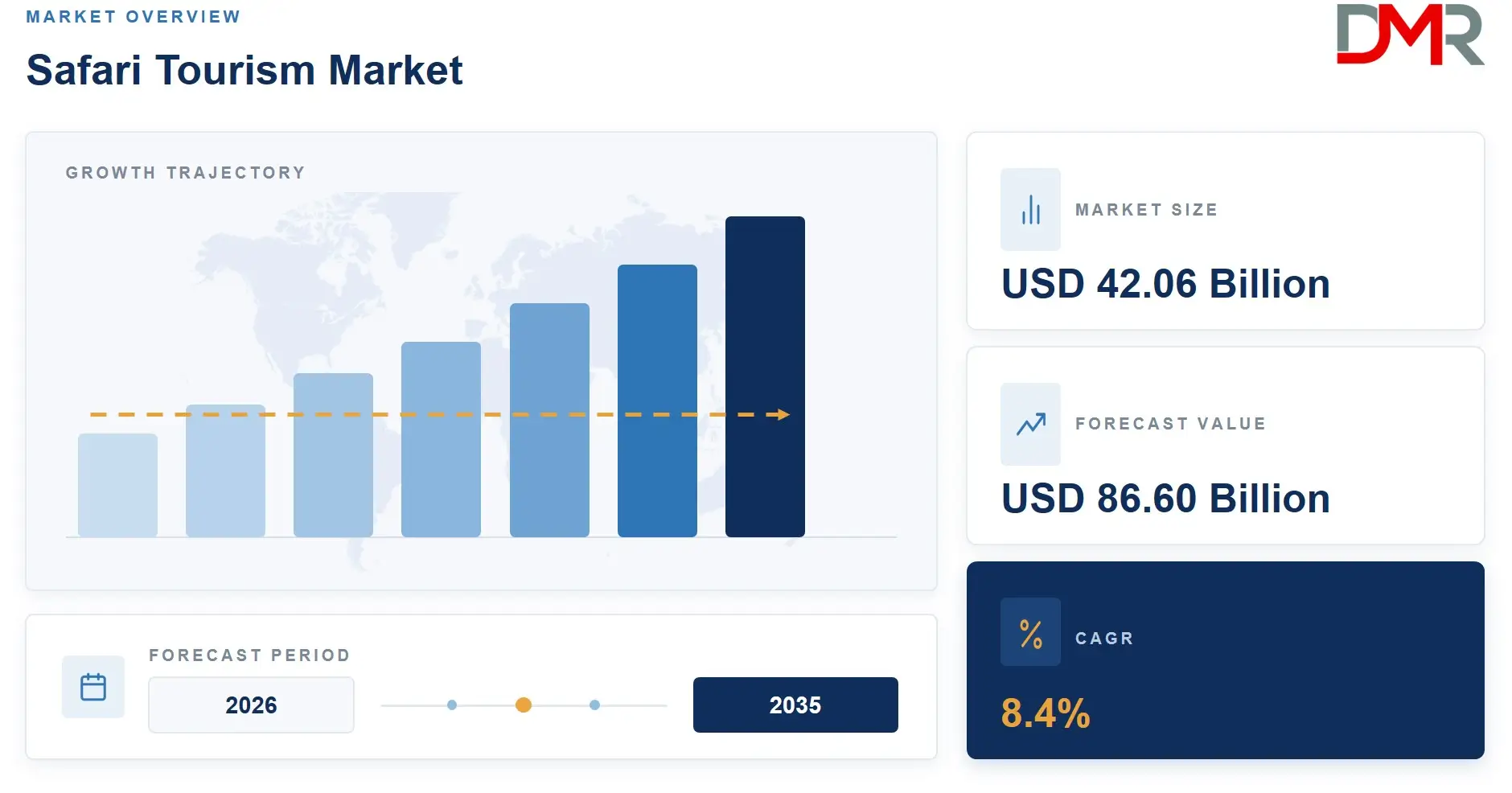
- The Global Safari Tourism Market was valued at USD 38.8 Billion in 2025 and is projected to reach USD 86.60 Billion by 2035, at a CAGR of 8.4%.
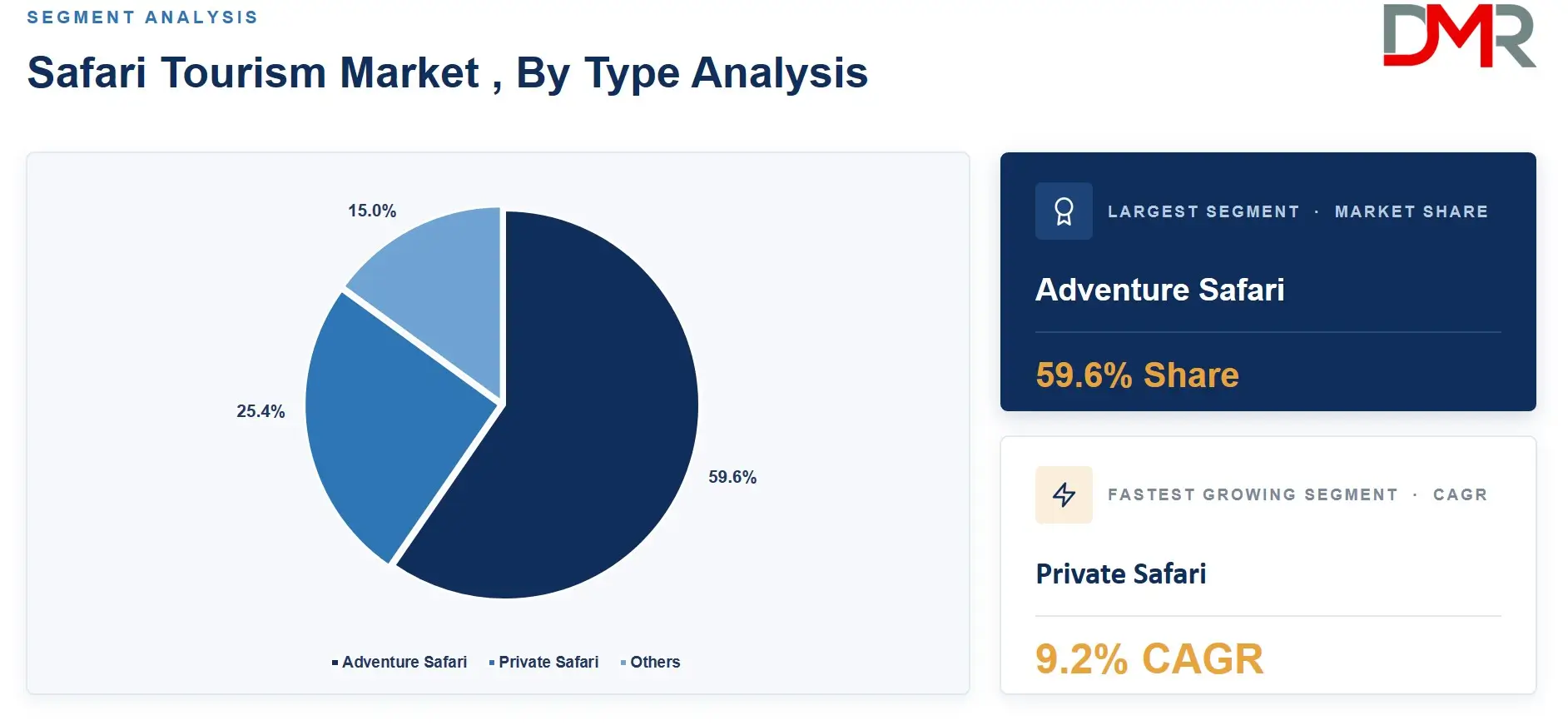
- Adventure Safari led the Type segment with a 59.6% share in 2025.
- Safari Resorts & Lodges dominated the Accommodation Type segment with a 61.7% share in 2025.
- Couples led the Group segment with a 44.8% share in 2025.
- Direct Booking led the Booking Mode segment with a 66.3% share in 2025.
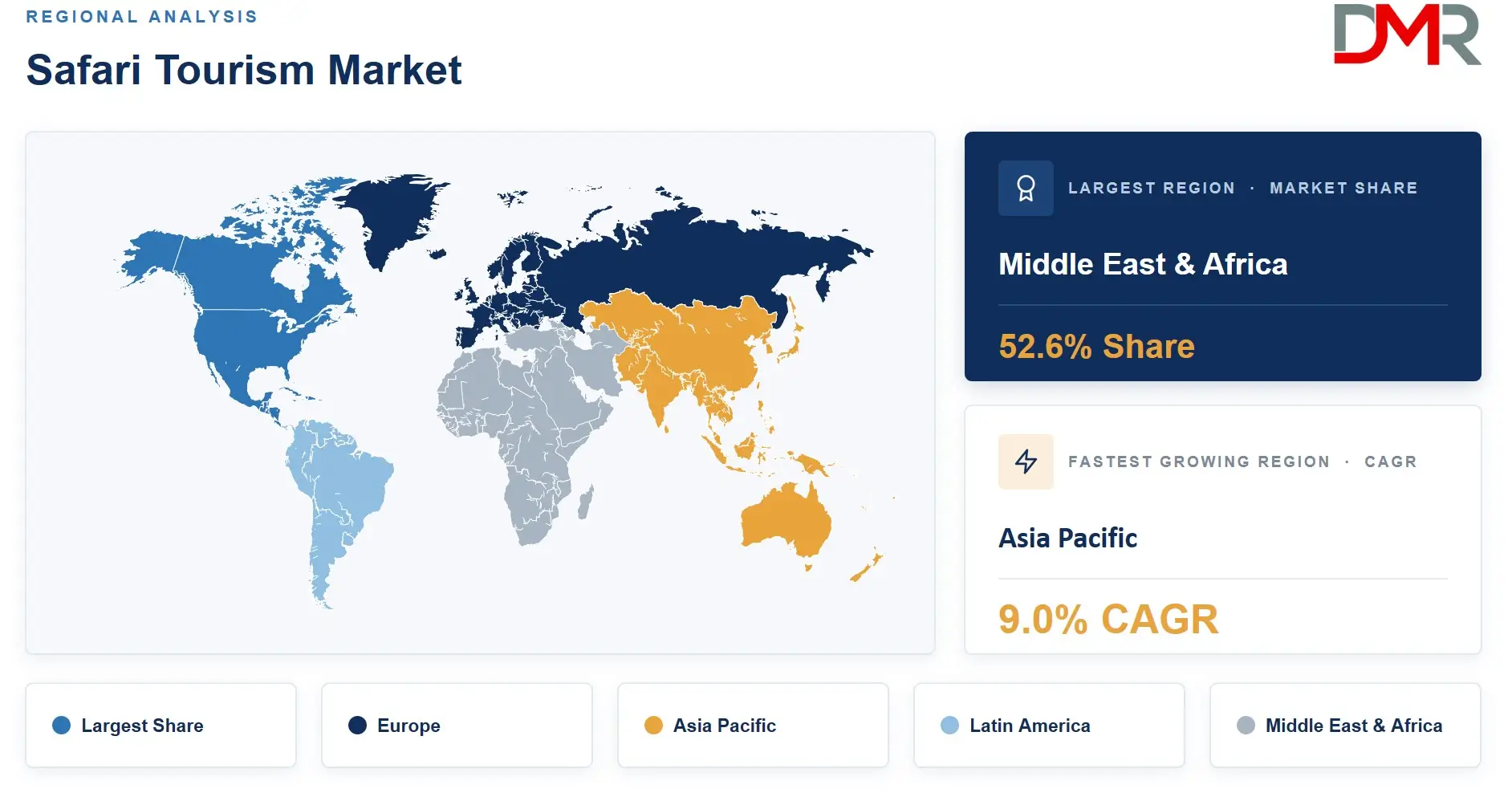
- Middle East & Africa held the largest regional share at 52.6% in 2025.
Market Overview
The safari tourism market covers guided wildlife experiences delivered across protected reserves, national parks, and private conservancies in Africa, Asia, and select Latin American ecosystems. Products range from ultra-luxury private-guide camps and branded lodge circuits to mid-market group packages and budget tented camps. Excluded from the market scope are standard nature tourism, conventional hotel stays adjacent to parks, and consumptive hunting tourism, which operates under separate licensing and regulatory structures in most jurisdictions.
Safari tourism sits at the intersection of experiential travel, conservation finance, and premium hospitality. Operators depend on healthy wildlife populations and functioning park systems to deliver a product that cannot be replicated in an urban context. Conservation area expansion by governments — particularly across East and Southern Africa — directly enlarges the land base available for commercially licensed safari operations. Branded operators have responded by consolidating lodge networks across multiple reserves, creating itinerary depth that independent camps cannot match.
Digital channels have altered how safaris are discovered, packaged, and booked. Social media platforms converted wildlife imagery into demand-generation tools that bypass traditional travel agent networks. Operators with strong content pipelines now command conversion rates that outpace legacy brochure-led sales. The rise of AI-assisted itinerary curation also allows operators to cross-sell cultural, culinary, and wellness extensions within a single booking interface, raising average per-trip revenue without increasing headcount.
Market Size and Forecast
The Global Safari Tourism Market size is estimated at USD 42.06 Billion in 2026 from USD 38.8 Billion in 2025, and is projected to reach USD 86.60 Billion by 2035, exhibiting a CAGR of 8.4% during the forecast period.
Growth through the forecast horizon rests on three structural conditions: sustained expansion of protected land through government conservation designations, continued airline route development into hub airports serving East and Southern Africa, and the durability of experience-led spending among high-income cohorts in North America, Europe, and Northeast Asia. The forecast assumes no material reversal of these conditions. A downside scenario would emerge if wildlife disease events or geopolitical instability closes key reserves for extended periods. An upside scenario materializes if mid-market package penetration accelerates beyond current operator capacity, pulling forward demand from 2030 onward.
ℹ
To learn more about this report –
Download Your Free Sample Report Here
Historical momentum supports the base case. Airline capacity increases on routes into Nairobi, Dar es Salaam, and Johannesburg from 2022 onward compressed long-haul pricing and reduced one of safari tourism's most persistent barriers to first-time buyers. Branded lodge and camp consolidation added scalable product capacity, allowing operators to absorb demand surges without the long lead times required to build individual properties. These structural investments created a market architecture capable of sustaining the 8.4% annual rate through 2035.
Type Analysis
Adventure Safari led the Type segment with a 59.6% share in 2026.
Adventure Safari commands its position because it delivers the wildlife encounter that defines category demand. Game drives, walking safaris, and night excursions are the primary purchase motivation for international travelers, particularly in East and Southern Africa. Branded operators structured their lodge and camp networks around these core activities, giving adventure products the distribution breadth and marketing investment that private and alternative formats have not yet matched.
Private Safari carved a premium niche by removing shared-vehicle constraints and allowing guests to design itineraries around species-specific or photography-focused objectives. Demand for private formats accelerated after 2020 as health-related preferences for smaller group travel became embedded consumer behavior. Other formats — including walking-only safaris, horseback safaris, and boat-based river safaris — remain a small share of the total but attract a disproportionately high spend-per-night. For operators, these niche products offer stronger margin profiles than
ℹ
To learn more about this report –
Download Your Free Sample Report Here
volume-dependent adventure formats.
Accommodation Type Analysis
With a 61.7% share in 2026, Safari Resorts & Lodges outpaced all other Accommodation Type categories.
Safari Resorts & Lodges lead because they combine guaranteed wildlife access with branded hospitality standards that international buyers trust before traveling to unfamiliar destinations. Multi-lodge operators invested heavily in consistent service design, food and beverage quality, and digital booking infrastructure, making resorts and lodges the default choice for first-time safari buyers. The lodge format also supports year-round operation regardless of season, giving operators revenue stability that tented camps cannot replicate.
Safari Camps retain a loyal segment among repeat travelers who prioritize immersion over amenity. Seasonal camps can be positioned inside reserve boundaries where permanent structures are prohibited, offering unique access that lodges cannot provide. The remaining accommodation formats — including mobile camping and community-run bandas — serve budget-conscious travelers and researchers. These categories are growing in visibility as operators integrate them into multi-tier itineraries, but their share of total revenue remains constrained by lower per-night yields.
Group Analysis
Couples accounted for 44.8% of Group demand in 2026, the highest of any category.
Couples dominate because safari trips function as milestone travel — honeymoons, anniversaries, and bucket-list experiences that justify high per-person spend. Operators structured premium lodge packages around two-guest occupancy, which aligns with the resort-and-lodge accommodation model that leads the market. The couples segment sustains higher net revenue per booking than any other group category because it combines maximum willingness to pay with minimal logistical complexity for the operator.
Friends groups represent the fastest-growing group category as younger affluent travelers combine social bonding with adventure travel. Families form a structurally important segment that operators are actively targeting with child-friendly lodge infrastructure and tailored activity schedules. Solo travelers, the smallest segment, are gaining commercial attention as operators design structured departures with fixed departure dates and shared-vehicle formats that make solo bookings economically viable. Each of these segments requires distinct product design, and operators who build category-specific offerings hold a clear margin advantage over those relying on general-purpose itineraries.
Booking Mode Analysis
A 66.3% share made Direct Booking the clear leader across Booking Mode categories in 2026.
Direct Booking dominates because branded lodge and camp operators invested in proprietary web platforms, CRM systems, and loyalty programs that reduce dependency on intermediaries. A direct booking eliminates commission payments to agents and affiliates, which typically run 10–20% of package value, materially improving operator net margins. Repeat travelers, who represent a high proportion of safari buyers, are particularly inclined to book directly once trust is established.
Agents and Affiliates retain a critical role for first-time buyers who lack the expertise to self-plan multi-country itineraries. Specialist travel agents command a premium advisory position in North American and European source markets, where their destination knowledge justifies the fee. Marketplace Booking platforms are growing fastest, particularly among millennial and Gen Z buyers who preference price transparency and peer review validation before committing. This shift creates a dual pressure on traditional agents: compete on expertise or lose volume to digital aggregators.
Key Market Segments
By Type
- Adventure Safari
- Private Safari
- Others
By Accommodation Type
- Safari Resorts & Lodges
- Safari Camps
- Others
By Group
- Couples
- Friends
- Families
- Solos
By Booking Mode
- Direct Booking
- Agents and Affiliates Account
- Marketplace Booking
Regional Analysis
Middle East & Africa led all regions with a 52.6% share in 2026, equivalent to approximately USD 20.4 Billion.
Middle East & Africa holds its dominant position because the continent hosts the world's most commercially developed safari infrastructure. East Africa — particularly Kenya and Tanzania — operates mature reserve networks with established lodge circuits, international air access, and deep tour operator ecosystems. Southern Africa adds high-density wildlife regions in Botswana, Zimbabwe, and South Africa, where private concessions allow premium operators to control guest experience from arrival to departure. Designs such as those deployed at Samode Safari Lodge at Bandhavgarh (5,371 square meters on 9.8 acres using passive design and natural ventilation, as documented by CSE India) signal how the region's operators are embedding sustainability into built infrastructure to meet conservation licensing requirements and attract ethical travelers.
ℹ
To learn more about this report –
Download Your Free Sample Report Here
Asia Pacific is the fastest-growing safari region, driven by expanding wildlife tourism infrastructure in India, Sri Lanka, and emerging markets across Southeast Asia. India's tiger reserve circuit attracted substantial repeat international visitors from Europe and North America, while domestic Indian tourism into national parks grew as middle-class disposable income rose. Latin America remains underpenetrated relative to its biodiversity assets, with operators in the Pantanal and Amazon beginning to attract cross-over demand from African safari veterans. North America and Europe function primarily as source markets rather than destination markets, though bespoke North American dude ranch and wildlife experiences are being positioned under the safari tourism umbrella by some aggregators.
Key Regions and Countries
North America
Europe
- Germany
- France
- The UK
- Spain
- Italy
- Rest of Europe
Asia Pacific
- China
- Japan
- South Korea
- India
- Australia
- Rest of APAC
Latin America
- Brazil
- Mexico
- Rest of Latin America
Middle East & Africa
- GCC
- South Africa
- Rest of MEA
Market Dynamics
Rising Arrivals and Affluent Cohorts Expand the Paying Safari Base
Kenya recorded approximately 2.4 million international arrivals in 2024, a 14.6% year-on-year increase, as reported by Atlasperk Intelligence. A single market posting that volume signals that aggregate safari demand across East Africa substantially exceeded pre-pandemic baselines. Operators who had invested in capacity during the recovery period were positioned to capture margin rather than scramble for inventory.
Middle-class expansion in South and Southeast Asia is simultaneously enlarging the origin market pool. Indian and Chinese travelers now represent a meaningful and growing proportion of first-time safari buyers across East Africa. Airlines responded with additional direct and one-stop routing into Nairobi and Kilimanjaro, removing cost barriers that previously limited arrivals to long-haul specialists. Branded operators accelerating their multilingual booking and guest services infrastructure will capture this cohort before competitors do.
Rising Compliance Costs and Visitor Caps Constrain Operator Margins
Non-resident adults visiting Kenya's top national parks pay approximately USD 90 per person in high season, as per KWS 2025–2026 published rates. Park entry costs now represent a material line item in package costing, and any further increase compresses the operator's pricing flexibility without reducing the guest's price sensitivity. Operators who cannot absorb these costs through economies of scale will face margin pressure that smaller independent camps cannot fully offset.
Vehicle acquisition costs add a parallel layer of cost pressure. Tata Safari diesel variants showed on-road price increases of INR 8,700–22,000 in 2026, based on data published by CarWale. For Indian wildlife tourism operators using these vehicles as safari fleet workhorses, the price increase translates directly into higher capital expenditure per vehicle and elevated depreciation charges. Visitor quota restrictions in overcrowded reserves further limit the revenue ceiling that operators can achieve, regardless of demand strength.
Mid-Market Packages and Electrified Fleets Open New Revenue Channels
An ICCT study published in 2026 found that achieving national and state-level EV targets could cut India's transport CO₂ emissions by approximately 50% relative to a business-as-usual baseline by 2050. Safari operators electrifying their game drive and transfer fleets can use this trajectory to substantiate carbon-neutral itinerary claims, a differentiator that attracts climate-conscious buyers willing to pay a premium for verified sustainability credentials.
In October 2025, Asilia Africa announced its first expansion into the mountain gorilla-trekking market with the planned mid-2026 launch of Erebero Hills, an eight-suite lodge on 45 acres of reforested land adjacent to Uganda's Bwindi Impenetrable Forest. The move signals that established mid-market operators are building into underserved product categories where competitor density is low and per-night yields are high. Operators who enter underpenetrated niches before category consolidation sets in hold a durable first-mover advantage.
Market Trends
Ethical Travel Narratives and Digital Channels Reshape Safari Discovery and Demand
Photographic and non-consumptive safaris have displaced trophy hunting as the dominant experiential format, driven by traveler demand for ethically positioned wildlife encounters. Chambal Safari Lodge's publicly reported water positivity rate of 37,400 liters per year and its 100% solar energy target, as documented in its ESG report, illustrate how operators are converting sustainability metrics into marketing assets for climate-conscious buyer segments. Social media storytelling now functions as the primary demand-generation channel, compressing the traditional discovery-to-booking funnel from months to days for content-driven operators.
Market Competition Overview
The safari tourism market is moderately fragmented at the global level but consolidating rapidly within premium tiers. A small group of branded multi-property operators controls a disproportionate share of high-spend bookings by offering itinerary networks that span multiple countries and reserves. Buyers selecting a multi-country Africa trip overwhelmingly choose a single operator brand with properties across all destinations rather than assembling an itinerary across independent camps. Brand trust and itinerary depth function as the primary competitive moat.
NITI Aayog transport scenario modeling indicates that modal shifts and electrification can reduce urban transport emissions by 30–50% under ambitious scenarios. Operators that electrify guest transfer vehicles ahead of regulatory requirements position themselves as sustainability leaders in a market where conservation credibility is becoming a selection criterion for high-value buyers. Share is shifting toward operators who can demonstrate measurable environmental outcomes alongside premium guest experiences. Independent operators without the balance sheet to invest in fleet electrification, digital booking infrastructure, or multi-reserve networks face structural disadvantage as the market consolidates around experience-centric brands.
Company Profiles
Singita operates one of the most concentrated ultra-luxury safari networks in Africa, with properties positioned inside exclusive private concessions across Tanzania, South Africa, Rwanda, and Zimbabwe. The brand's strategy centers on controlling access to high-density wildlife areas through long-term concession agreements that competitors cannot replicate without equivalent investment scale. In November 2025, Singita entered a 25-year public-private partnership with the Mozambique government, committing USD 102 million to build a 60-bed luxury lodge on Santa Carolina Island and support marine conservation across the Bazaruto Archipelago National Marine Park. The move diversifies Singita's portfolio into coastal and marine ecosystems, reducing its dependence on land-based game reserves and opening a product category that no direct competitor currently occupies at this quality tier.
Wilderness built its competitive position through a conservation-led ownership model that ties lodge viability directly to the ecological health of surrounding wilderness areas. Wilderness operates across more African countries than any comparable operator, giving it itinerary breadth that corporate travel buyers and group planners find difficult to source from a single alternative provider. The model creates a structural barrier: as Wilderness expands its conservation land partnerships, it simultaneously enlarges its exclusive inventory and reduces the addressable reserve area available to competing operators.
Key Players
- Wilderness
- Thomas Cook Group
- Singita
- Scott Dunn Ltd.
- Wellworth Hospitality Collection
- Marriott International, Inc.
- Rothschild Safaris
- &Beyond
- Abercrombie & Kent USA, LLC
- Gamewatchers Safaris Ltd.
- Backroads
- TUI Group
- Angama
- One&Only
Supply Chain and Value Chain Analysis
The safari tourism value chain begins with governments and conservation bodies that designate and manage protected land. Concession rights flow from these bodies to private lodge and camp operators, who invest in built infrastructure, wildlife management, and community benefit programs. Operators then package experiences through direct sales channels, specialist travel agents, and digital marketplaces before delivering to the end guest. Maximum value accrues at the lodge operator level, where brand premiums, occupancy leverage, and ancillary revenue from activities and food-and-beverage are captured.
The biggest supply-side bottleneck is concession renewal risk. Operators whose competitive position rests on exclusive reserve access face existential exposure when government policy or conservation designation changes. Secondary bottlenecks include skilled guide availability, which constrains service quality in fast-growing markets such as Uganda and Mozambique, and reliable cold-chain logistics for food and beverage supply to remote properties. Operators who vertically integrate guide training and local procurement partnerships reduce both cost exposure and supply reliability risk.
Regulatory Landscape
Conservation licensing and park entry fee structures set by national wildlife authorities define the operating parameters for all safari operators. Kenya's Wildlife Service, South African National Parks, and Tanzania's TANAPA each set visitor quotas, vehicle limits per sighting, and concession renewal conditions that directly cap the revenue ceiling any operator can achieve within a given reserve. Regulatory tightening on wildlife interaction — including bans on off-road driving and mandatory guide licensing — has raised compliance costs across East and Southern Africa since 2022.
Transboundary corridor designations, such as the Kavango-Zambezi Conservation Area spanning five Southern African nations, create new opportunities for cross-border itinerary products but introduce multi-jurisdictional compliance obligations. Operators building products across KAZA or similar corridors must navigate differing permit structures, foreign exchange rules, and community benefit requirements in each country. Governments across the region are moving toward performance-based concession contracts that tie lease renewals to biodiversity outcomes, shifting regulatory risk from inputs to measurable conservation results.
Investment and White Space Analysis
Investment flows within safari tourism currently concentrate in ultra-luxury lodge development across East Africa and private marine conservation concessions in Mozambique and the Indian Ocean islands. The white space sits one tier below: mid-market packages priced for value-conscious international travelers who cannot access the USD 1,000-plus-per-night segment but seek a genuine wildlife experience. No single branded operator has built national-scale mid-market safari infrastructure with the consistency and booking ease that the luxury tier already delivers.
Regionally, Uganda, Zambia, and the nascent safari markets of West Africa represent low-competition, high-biodiversity environments where land concession costs remain well below East Africa benchmarks. Solo female travel and multigenerational family products are structurally underserved segments where demand exists but purpose-built itinerary design does not. Operators entering these segments with safety-certified, customization-enabled products face limited direct competition and command significant pricing power in the absence of category-defining incumbents.
Recent Developments
- November 2025 — Abercrombie & Kent launched a new bespoke experiential itinerary in Uganda centered on wilderness and gorilla-trekking, based at its newly opened Gorilla Forest Lodge, deepening the operator's East Africa portfolio in a high-yield, low-competition destination.
Report Details
| Report Characteristics |
| Market Value (2025) |
USD 38.8 Billion |
| Market Value (2026) |
USD 42.06 Billion |
| Forecast Revenue (2035) |
USD 86.60 Billion |
| CAGR (2026–2035) |
8.4% |
| Base Year for Estimation |
2025 |
| Historic Period |
2020 – 2024 |
| Forecast Period |
2026 – 2035 |
| Report Coverage |
Revenue Forecast, Market Dynamics, Competitive Landscape, Recent Developments |
| Segments Covered |
By Type (Adventure Safari, Private Safari, Others), By Accommodation Type (Safari Resorts & Lodges, Safari Camps, Others), By Group (Couples, Friends, Families, Solos), By Booking Mode (Direct Booking, Agents and Affiliates Account, Marketplace Booking) |
| Regional Analysis |
North America – US and Canada; Europe – Germany, France, The UK, Spain, Italy, and Rest of Europe; Asia Pacific – China, Japan, South Korea, India, Australia, and Rest of APAC; Latin America – Brazil, Mexico, and Rest of Latin America; Middle East & Africa – GCC, South Africa, and Rest of MEA |
| Competitive Landscape |
Wilderness, Thomas Cook Group, Singita, Scott Dunn Ltd., Wellworth Hospitality Collection, Marriott International Inc., Rothschild Safaris, &Beyond, Abercrombie & Kent USA LLC, Gamewatchers Safaris Ltd., Backroads, TUI Group, Angama, One&Only |
| Customization Scope |
Customization for segments and region or country level will be provided. Additional customization can be done based on requirements. |
| Purchase Options |
Three license options: Single User License, Multi-User License (Up to 5 Users), and Corporate Use License (Unlimited Users and Printable PDF) |
Frequently Asked Questions
What is the biggest investment opportunity in Safari Tourism Market ?
▾ Mid-market safari packages for value-conscious international travelers represent the largest underserved segment. No branded operator has built nationally consistent mid-market infrastructure at scale. Operators entering this tier face minimal direct competition and can capture demand currently lost to the pricing gap between budget camping and ultra-luxury lodges.
Who are the top companies in Safari Tourism Market ?
▾ Wilderness and Singita are the two operators with the broadest multi-country lodge networks and the clearest conservation-led brand positioning. &Beyond, Abercrombie & Kent, and TUI Group compete across volume and premium segments. Gamewatchers Safaris and Angama hold strong positions in specific East African markets.
Which segment is growing fastest in Safari Tourism Market and why?
▾ Private Safari and Marketplace Booking are both growing faster than their respective segment averages. Private Safari expanded as post-2020 health preferences embedded demand for exclusive, small-group wildlife access. Marketplace Booking platforms accelerated as millennial buyers replaced agent consultation with peer-review-driven, price-transparent self-booking.
Which region is growing fastest in Safari Tourism Market and why?
▾ Asia Pacific is the fastest-growing region, driven by India's expanding tiger reserve circuit and rising outbound safari travel from China and South Korea. Government investment in park infrastructure and growing airline connectivity between Asian hubs and East African gateway airports are removing structural barriers to first-time safari travel from this region.
What is the biggest challenge holding Safari Tourism Market back?
▾ Escalating park entry fees, compliance costs, and visitor quota caps constrain operator margin and limit capacity expansion in the highest-demand reserves. Kenya's non-resident adult park fees of approximately USD 90 per person in high season represent a cost floor that operators cannot negotiate, and further government fee increases would compress package affordability without equivalent reductions in buyer willingness to pay.