What is the Saudi Arabia Accounting & VAT Software Market Size in 2026?
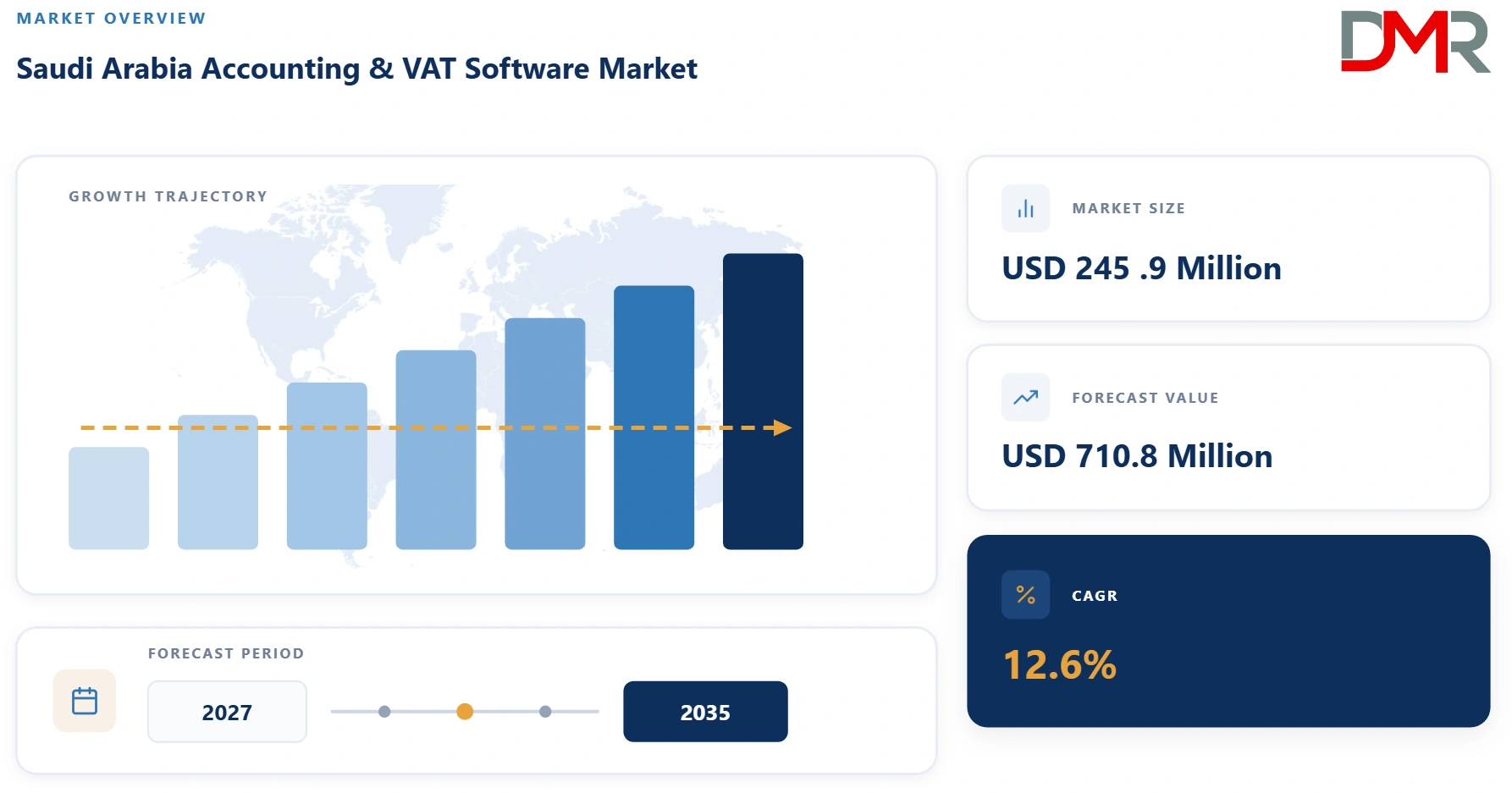
The Saudi Arabia Accounting & VAT Software Market size is estimated at USD 245.9 Million in 2026, and it is further anticipated to reach a market value of USD 710.8 Million by 2035 at a CAGR of 12.6%. Growth is driven by expanding mandatory electronic invoicing requirements, increasing digitalization among small and medium enterprises, growing adoption of cloud-based accounting solutions, and rising demand for automated financial and tax management.
ℹ
To learn more about this report –
Download Your Free Sample Report Here
Saudi Arabia Accounting & VAT Software Market represents software tools that facilitate business organizations in managing financial transactions, maintaining their accounts, calculating their taxes, and complying with tax laws and regulations within the region. These include software for accounting and VAT, as well as combined accounting and tax management software. With these tools, businesses can automate bookkeeping, create electronic invoices, and file their VAT returns.
The Saudi Arabia Accounting & VAT Software Market includes independent accounting software, independent VAT software, and integrated software solutions that companies use for accounting and VAT-related operations. The Saudi Arabia Accounting & VAT Software Market comprises cloud and on-premise solutions that serve enterprises from different industries and different provinces. The revenue generated from the sale of software licenses, subscriptions, support, upgrades, and modules related to accounting and VAT in enterprise software platforms is included in the market.
Saudi Arabia Accounting & VAT Software Market Snapshot
Saudi Arabia Accounting & VAT Software Market Snapshot, 2026-2035
| Metric |
Value |
| Market Size (2026) |
USD 245.9 Million |
| Forecast Value (2035) |
USD 710.8 Million |
| CAGR (2027-2035) |
12.6% |
| Leading Software (2026) |
Integrated Accounting & VAT Software, 56.8% share |
| Leading Deployment (2026) |
Cloud-Based, 64.2% share |
| Leading Enterprise Size (2026) |
Micro & Small Enterprises, 51.0% share |
| Leading End-Use Industry (2026) |
Retail & E-Commerce, 26.4% share |
| Key Players |
Automated Cloud for Communications and Information Technology Company (Qoyod), Wafeq AlAlamiyya for Information Technology Company (Wafeq), Izam, Inc. (Daftra), Arab Sea Information System Company (SMACC), Zoho Corporation Private Limited, SAP SE, Oracle Corporation, and Odoo S.A. |
Saudi Arabia Accounting & VAT Software Market: Key Takeaways
- Market Growth: The market is projected to grow from USD 245.9 million in 2026 to USD 710.8 million by 2035, at a CAGR of 12.6%.
- Software Leader: Integrated Accounting & VAT Software holds a 56.8% share of the market in 2026, supported by demand for unified accounting and tax compliance solutions.
- Fastest-Growing Software: Standalone VAT Software is expected to grow at a CAGR of 13.2% through 2035, driven by increasing demand for specialized tax compliance solutions.
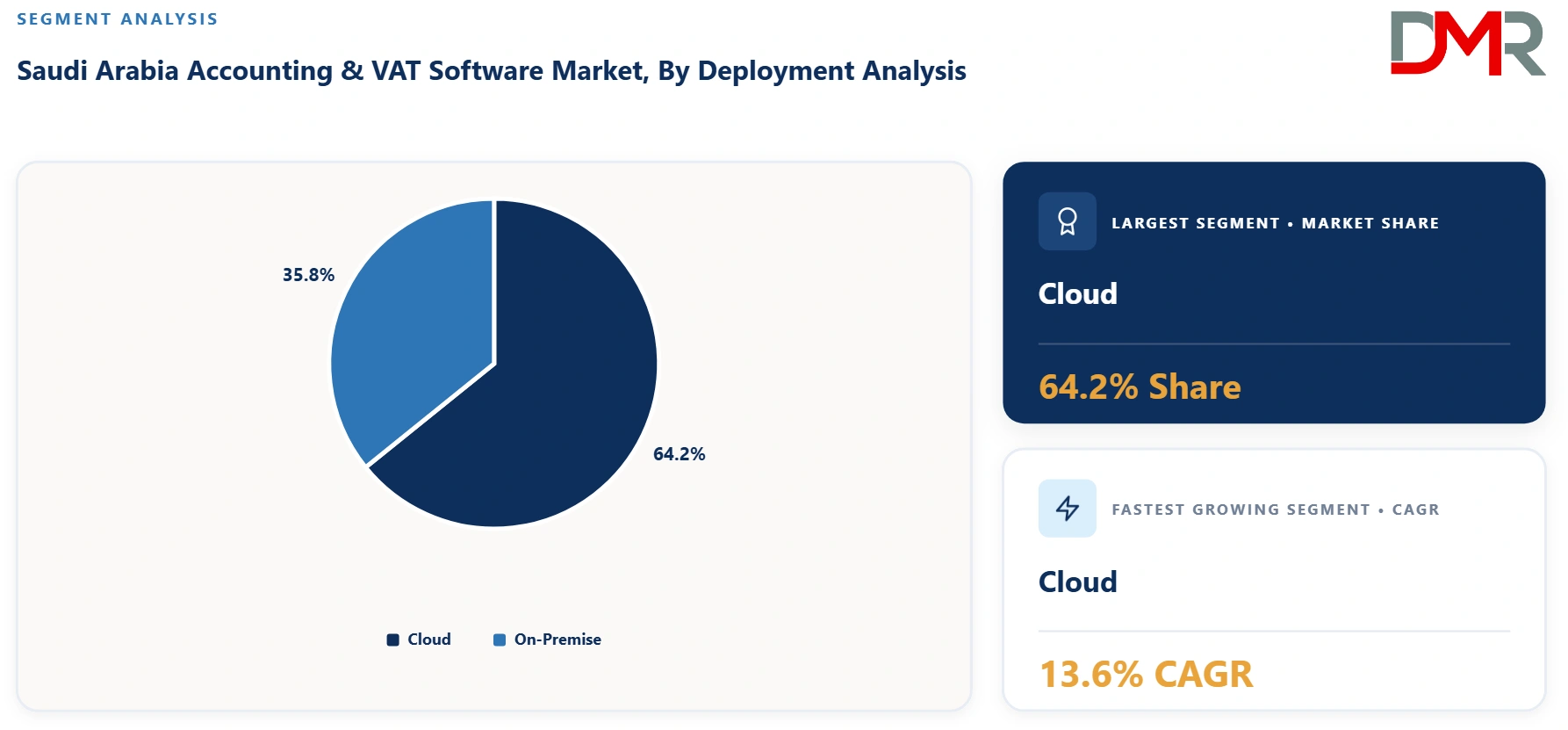
- Deployment Leader: Cloud-Based accounts for 64.2% of market revenue in 2026, supported by affordable subscriptions, remote accessibility, and simplified regulatory updates.
- Fastest-Growing Deployment: Cloud-Based is projected to grow at a CAGR of 13.6%, driven by increasing enterprise digitalization and demand for scalable financial management solutions.
- Enterprise Size Leader: Micro & Small Enterprises account for 51.0% of market revenue in 2026, supported by their extensive presence and increasing adoption of affordable accounting software.
- Fastest-Growing Enterprise Size: Medium Enterprises are expected to grow at a CAGR of 13.9%, supported by expanding business operations and advanced financial management requirements.
What are the Key Use Cases of Saudi Arabia Accounting & VAT Software Market?
- Financial Accounting and Bookkeeping: Records daily income, expenses, assets, and liabilities, helping businesses maintain accurate financial records and assess overall financial performance.
- VAT Compliance and Reporting: Automates tax calculations, tracks input and output VAT, and prepares tax returns, helping businesses meet Saudi Arabian taxation requirements.
- Electronic Invoicing: Generates ZATCA-compliant electronic invoices and supports digital invoice submission, enabling businesses to meet regulatory requirements and streamline billing operations.
- Bank and Payment Reconciliation: Matches bank statements with recorded transactions, helping businesses identify payment discrepancies, detect missing entries, and improve cash flow visibility.
How are Foundation Models and Generative AI Transforming the Saudi Arabia Accounting & VAT Software Market?
Foundation models and generative AI are transforming accounting and VAT software in Saudi Arabia by enabling intelligent financial forecasting, scenario analysis, and regulatory knowledge management. These technologies can help businesses assess potential cash flow shortages, evaluate expenditure patterns, and simulate the financial impact of business decisions. Generative AI can also support accounting professionals in interpreting complex taxation guidelines, identifying potential compliance gaps, and preparing documentation for internal reviews and audits.
Software providers are exploring domain-specific foundation models trained on financial terminology, accounting standards, and Saudi Arabian taxation frameworks. These models can support personalized financial recommendations, contextual compliance guidance, and automated explanations of unusual financial activities. The integration of generative AI is expected to improve strategic financial decision-making and encourage the development of more intelligent accounting platforms. However, maintaining reliable AI-generated outputs, protecting confidential financial information, and ensuring alignment with ZATCA requirements remain essential for wider adoption.
Saudi Arabia Accounting & VAT Software Market Dynamics at a Glance
Drivers, Restraints, Opportunities and Trends in the Saudi Arabia Accounting & VAT Software Market
| Type |
Factor |
Impact |
| Driver |
Expanding Mandatory ZATCA E-Invoicing Requirements |
High |
| Driver |
Increasing Digitalization Among Small and Medium Enterprises |
High |
| Restraint |
High Integration and Legacy System Migration Costs |
Medium |
| Restraint |
Growing Data Security and Privacy Concerns |
High |
| Opportunity |
Development of Industry-Specific Accounting Solutions |
Medium |
| Opportunity |
Untapped Market Potential in Underserved Provinces |
High |
| Trend |
Increasing Integration of Artificial Intelligence in Accounting |
Medium |
| Trend |
Accelerating Transition Toward Cloud-Based Accounting Platforms |
High |
What is Driving the Growth of the Saudi Arabia Accounting & VAT Software Market?
Expanding Mandatory ZATCA E-Invoicing Requirements
The gradual expansion of electronic invoicing requirements by the Zakat, Tax and Customs Authority (ZATCA) is encouraging businesses in Saudi Arabia to adopt compliant accounting and VAT software. Businesses covered under the integration phase are required to connect their invoicing systems with ZATCA’s Fatoora platform and generate invoices in the prescribed format. Many businesses using traditional accounting systems need to upgrade or replace their existing software to meet these requirements. As more businesses come under the electronic invoicing framework, demand for compliant software, automated invoice processing, and regular regulatory updates is expected to increase across industries.
Increasing Digitalization Among Small and Medium Enterprises
Small and medium enterprises in Saudi Arabia are gradually replacing manual bookkeeping and spreadsheet-based accounting with digital financial management solutions. As businesses expand, managing expenses, recording transactions, monitoring cash flow, and preparing financial statements manually becomes increasingly difficult. Accounting software helps business owners maintain organized financial records and gain better visibility into their financial performance. Government initiatives supporting entrepreneurship and business modernization are further encouraging smaller enterprises to adopt digital technologies. The growing number of businesses seeking affordable and user-friendly accounting solutions is creating a broader customer base for accounting and VAT software providers.
What are the Key Restraints in the Saudi Arabia Accounting & VAT Software Market?
High Integration and Legacy System Migration Costs
Businesses using older accounting systems often face difficulties when transitioning to modern accounting and VAT software. Transferring historical financial records, configuring existing workflows, and connecting new software with other business applications require time, technical expertise, and additional investment. Companies may also need to train employees and customize software according to their operational requirements. These expenses can be particularly challenging for smaller businesses with limited technology budgets. Large organizations with complex financial systems may experience longer migration periods and operational disruptions. Such challenges can delay software purchasing decisions and discourage businesses from replacing their existing accounting platforms.
Growing Data Security and Privacy Concerns
Accounting and VAT software handles confidential business information, including financial statements, customer details, banking records, and taxation data. Concerns regarding unauthorized access, cyberattacks, and data leakage may influence businesses when selecting accounting software providers. Organizations operating in sensitive industries often require additional security measures to protect financial information and meet applicable data protection requirements. Software providers must invest in encryption, access controls, secure data storage, and continuous security monitoring. Maintaining these capabilities increases operational expenditure and development costs, particularly for smaller software companies. Consequently, security and privacy concerns may slow software adoption among risk-sensitive businesses.
What are the Key Opportunities in the Saudi Arabia Accounting & VAT Software Market?
Development of Industry-Specific Accounting Solutions
Businesses across different industries in Saudi Arabia have financial management requirements that general accounting software may not fully address. Construction companies require project-based accounting, healthcare facilities need specialized billing capabilities, and manufacturing businesses require production cost accounting. These differences create opportunities for software providers to develop solutions tailored to individual industries. Offering specialized reporting tools, customized financial workflows, and integration with industry-specific applications can help providers address customer requirements more effectively. The diversification of Saudi Arabia’s economy is expected to expand the customer base for specialized accounting solutions, allowing software companies to strengthen their competitive position.
Untapped Market Potential in Underserved Provinces
Accounting and VAT software providers have opportunities to expand their presence beyond established commercial centers such as Riyadh, Jeddah, and Dammam. Smaller cities and developing provinces represent potential markets where businesses may have limited access to specialized accounting solutions and technical support. Growing commercial activities across provinces such as Aseer, Jazan, Qassim, and Tabuk are creating opportunities for market expansion. Software providers can reach these businesses through regional distribution partnerships, localized customer support, and affordable software packages. Establishing a presence in underserved locations can help companies diversify their customer base and generate additional recurring revenue.
What are the Latest Trends in the Saudi Arabia Accounting & VAT Software Market?
Increasing Integration of Artificial Intelligence in Accounting
Accounting software providers are increasingly incorporating artificial intelligence to simplify financial operations and reduce repetitive administrative tasks. AI-enabled applications can extract information from financial documents, categorize expenses, identify unusual transactions, and assist with account reconciliation. Generative AI is also introducing conversational features that allow users to access financial information and prepare reports using natural language. The development of Arabic-language AI assistants can make these technologies more accessible to Saudi businesses. As accounting platforms become more intelligent, software providers are focusing on improving automation capabilities while maintaining financial accuracy, reliable reporting, and appropriate human oversight.
Accelerating Transition Toward Cloud-Based Accounting Platforms
Businesses in Saudi Arabia are increasingly shifting from locally installed accounting systems towards cloud-based platforms due to their flexibility and convenience. Cloud-based software allows business owners and accounting professionals to access financial information from different locations without maintaining dedicated servers. Subscription-based pricing also enables businesses to manage software expenditure according to their operational requirements. Software providers can introduce new features, security improvements, and regulatory updates directly through cloud platforms. The growing availability of cloud infrastructure and increasing preference for remote financial management are encouraging software companies to expand their cloud-based offerings and strengthen recurring revenue models.
Research Scope and Analysis
The Saudi Arabia Accounting & VAT Software Market is segmented based on Software into Standalone Accounting Software, Standalone VAT Software, and Integrated Accounting & VAT Software, Deployment into Cloud-Based and On-Premise, Enterprise Size into Micro & Small Enterprises, Medium Enterprises, and Large Enterprises, End-Use Industry into Retail & E-Commerce, Manufacturing, BFSI, Construction & Real Estate, Healthcare & Life Sciences, IT & Telecom, Hospitality & Food Services, Professional Services, and Others.
ℹ
To learn more about this report –
Download Your Free Sample Report Here
By Software Analysis
The Integrated Accounting & VAT Software segment dominates the market with a share of 56.8% in 2026, supported by increasing demand for unified financial accounting and tax compliance platforms. The Standalone VAT Software segment is expected to grow at the fastest CAGR of 13.2% during 2027–2035, driven by growing demand for specialized tax compliance and advanced VAT reporting solutions.
By Deployment Analysis
The Cloud-Based segment leads the market with a share of 64.2% in 2026, supported by affordable subscriptions, remote accessibility, and simplified regulatory updates. The segment is also expected to register the highest CAGR of 13.6% during 2027–2035, driven by increasing enterprise digitalization and demand for scalable financial management solutions.
By Enterprise Size Analysis
The Micro & Small Enterprises segment accounts for the largest market share of 51.0% in 2026, supported by widespread adoption of affordable accounting software. The Medium Enterprises segment is projected to grow at the highest CAGR of 13.9% during 2027–2035, driven by expanding business operations and growing demand for advanced financial management solutions.
By End-Use Industry Analysis
The Retail & E-Commerce segment dominates the market with a share of 26.4% in 2026, supported by frequent sales transactions and electronic invoicing requirements. The segment is also expected to register the highest CAGR of 13.1% during 2027–2035, driven by expanding online retail activities, digital payment adoption, and automated financial management requirements.
How is the Saudi Arabia Accounting & VAT Software Market Segmented?
By Software
- Standalone Accounting Software
- Standalone VAT Software
- Integrated Accounting & VAT Software
By Deployment
By Enterprise Size
- Micro & Small Enterprises
- Medium Enterprises
- Large Enterprises
By End-Use Industry
- Retail & E-Commerce
- Manufacturing
- BFSI
- Construction & Real Estate
- Healthcare & Life Sciences
- IT & Telecom
- Hospitality & Food Services
- Professional Services
- Others
Regulatory Landscape
There are taxation and electronic invoicing rules set by the Zakat, Tax and Customs Authority (ZATCA), which heavily impact the Saudi Arabia Accounting & VAT Software market. The need for mandatory electronic invoicing and phases of integration is driving business organizations to utilize compliant accounting and VAT software. Tax management, automated reporting, and electronic invoicing solutions provided by the software companies present opportunities in this scenario. The need for the protection of the personal information also provides an opportunity for organizations to enhance their security systems. However, the updates in the regulations and technology may raise the development cost of the software.
Investment and White Space Analysis of the Saudi Arabia Accounting & VAT Software Market
The Saudi Arabia Accounting & VAT Software Market offers investment opportunities supported by growing business digitalization and increasing demand for automated financial management. Significant untapped potential exists among microenterprises and businesses operating outside major commercial centers. Investments in industry-specific accounting platforms, Arabic-language financial applications, and specialized VAT compliance solutions can help providers attract new customers. Partnerships with accounting firms and financial institutions can further strengthen distribution networks and improve market penetration. However, competitive pricing pressures, customer acquisition costs, and ongoing software development expenses may affect profitability. Offering affordable subscription packages, customized functionalities, and reliable customer support can help software providers capture emerging opportunities and establish a stronger presence across Saudi Arabia.
Who are the Leading Companies in the Saudi Arabia Accounting & VAT Software Market?
The Saudi Arabia Accounting & VAT Software Market is characterized by competition among local accounting software providers, international enterprise software companies, and specialized tax compliance solution providers. Prominent players include Qoyod, Wafeq, Izam, Arab Sea Information System Company, and Zoho Corporation. These companies compete through ZATCA compatibility, Arabic-language support, flexible subscription plans, and financial automation capabilities. Market participants focus on strategic partnerships, product enhancements, and localized software development to strengthen their competitive position.
- Automated Cloud for Communications and Information Technology Company (Qoyod) (Saudi Arabia): Provides cloud-based accounting software supporting bookkeeping, financial reporting, VAT management, and ZATCA-compliant electronic invoicing.
- Wafeq (United Arab Emirates): Offers cloud-based accounting software supporting financial management, automated VAT reporting, expense tracking, and Saudi electronic invoicing requirements.
- Izam, Inc. (Daftra) (United States): Provides integrated accounting and business management software supporting financial reporting, invoicing, expense management, and localized VAT compliance.
- Arab Sea Information System Company (Saudi Arabia): Offers SMACC software supporting financial accounting, VAT calculations, electronic invoicing, and transaction management for businesses across Saudi Arabia.
- Zoho Corporation Private Limited (India): Provides Zoho Books, a cloud-based accounting platform supporting automated bookkeeping, bank reconciliation, VAT reporting, and ZATCA-compliant electronic invoicing.
Some of the prominent players in the Saudi Arabia Accounting & VAT Software Market are:
- Automated Cloud for Communications and Information Technology Company (Qoyod)
- Wafeq AlAlamiyya for Information Technology Company (Wafeq)
- Izam, Inc. (Daftra)
- Arab Sea Information System Company (SMACC)
- Zoho Corporation Private Limited
- SAP SE
- Oracle Corporation
- Microsoft Corporation
- Odoo S.A.
- Tally Solutions Private Limited
- Defmacro Software Private Limited (ClearTax)
- Thomson Reuters Corporation
- Others
Recent Developments in the Saudi Arabia Accounting & VAT Software Market
- In September 2026, Automated Cloud for Communications and Information Technology Company (Qoyod) signed a Memorandum of Understanding (MoU) with Bank Albilad during Money20/20 Middle East in Riyadh. The agreement aims to develop financial solutions for businesses, strengthen technical integration, and expand Qoyod’s strategic partnership network. The development supports closer integration between cloud-based accounting platforms and financial services across Saudi Arabia.
- In August 2026, Qoyod introduced a bulk sales and purchase invoice import feature within its cloud-based accounting platform. The functionality enables businesses to upload multiple invoices through a single Excel file rather than entering individual transactions manually. The development helps businesses reduce administrative workloads, simplify invoice processing, and improve the efficiency of their daily accounting operations.
- In July 2026, the Zakat, Tax and Customs Authority (ZATCA) announced the twenty-fifth wave of electronic invoicing integration requirements. The announcement covers taxpayers whose VAT-taxable revenues exceeded SAR 187,500 in any year between 2022 and 2025. Eligible businesses are required to integrate their invoicing solutions with ZATCA’s Fatoora platform by February 1, 2027, creating additional demand for compliant accounting and VAT software.
Saudi Arabia Accounting & VAT Software Market Report Scope and Research Methodology
Definition: The Saudi Arabia Accounting & VAT Software Market encompasses digital solutions that enable businesses to manage financial transactions, automate bookkeeping, calculate VAT, generate electronic invoices, prepare financial reports, and comply with local taxation requirements through standalone and integrated software platforms.
Methodology: Dimension Market Research's market estimation methodology combines bottom-up analysis of accounting and VAT software-related company revenues, software subscriptions, enterprise adoption, and pricing information with top-down benchmarking against accounting software, tax management, and electronic invoicing software expenditure. Primary interviews with software providers, accounting professionals, tax consultants, and enterprise end users are recommended to validate pricing and adoption assumptions. Forecasts incorporate segment-level growth expectations for 2027–2035 and periodic assessment of regulatory developments, technological advancements, and market conditions.
Saudi Arabia Accounting & VAT Software Market Report Details
| Report Characteristics |
Details |
| Market Size (2026) |
USD 245.9 Million |
| Forecast Value (2035) |
USD 710.8 Million |
| CAGR (2027-2035) |
12.6% |
| Historical Data |
2021–2026 |
| Forecast Data |
2027–2035 |
| Base Year |
2026 |
| Estimate Year |
2027 |
| Segments Covered |
By Software, By Deployment, By Enterprise Size, By End-Use Industry |
Frequently Asked Questions
How big is the Saudi Arabia Accounting & VAT Software Market in 2026?
▾ The Saudi Arabia Accounting & VAT Software Market is valued at USD 245.9 million in 2026 and is projected to reach USD 710.8 million by 2035.
What is the growth rate of the Saudi Arabia Accounting & VAT Software Market?
▾ The Saudi Arabia Accounting & VAT Software Market is projected to grow at a CAGR of 12.6% from 2027 to 2035.
Which Software segment dominates the Saudi Arabia Accounting & VAT Software Market?
▾ Integrated Accounting & VAT Software dominates the Software segment, accounting for 56.8% of the total market share in 2026.
Which Deployment segment dominates the Saudi Arabia Accounting & VAT Software Market?
▾ Cloud-Based dominates the Deployment segment, accounting for 64.2% of the total market share in 2026.
Which Enterprise Size segment dominates the Saudi Arabia Accounting & VAT Software Market?
▾ Micro & Small Enterprises dominates the Enterprise Size segment, accounting for 51.0% of the total market share in 2026.
Who are the key players in the Saudi Arabia Accounting & VAT Software Market?
▾ The key players in the Saudi Arabia Accounting & VAT Software Market include Automated Cloud for Communications and Information Technology Company (Qoyod), Wafeq AlAlamiyya for Information Technology Company (Wafeq), Izam, Inc. (Daftra), Arab Sea Information System Company (SMACC), Zoho Corporation Private Limited, SAP SE, Oracle Corporation, Microsoft Corporation, Odoo S.A., Tally Solutions Private Limited, Defmacro Software Private Limited (ClearTax), and Thomson Reuters Corporation, among others.
What are the main challenges facing the Saudi Arabia Accounting & VAT Software Market?
▾ The main challenges facing the Saudi Arabia Accounting & VAT Software Market include high integration and legacy system migration costs, along with growing data security and privacy concerns, which may limit software adoption and increase operational expenses.