Market Overview
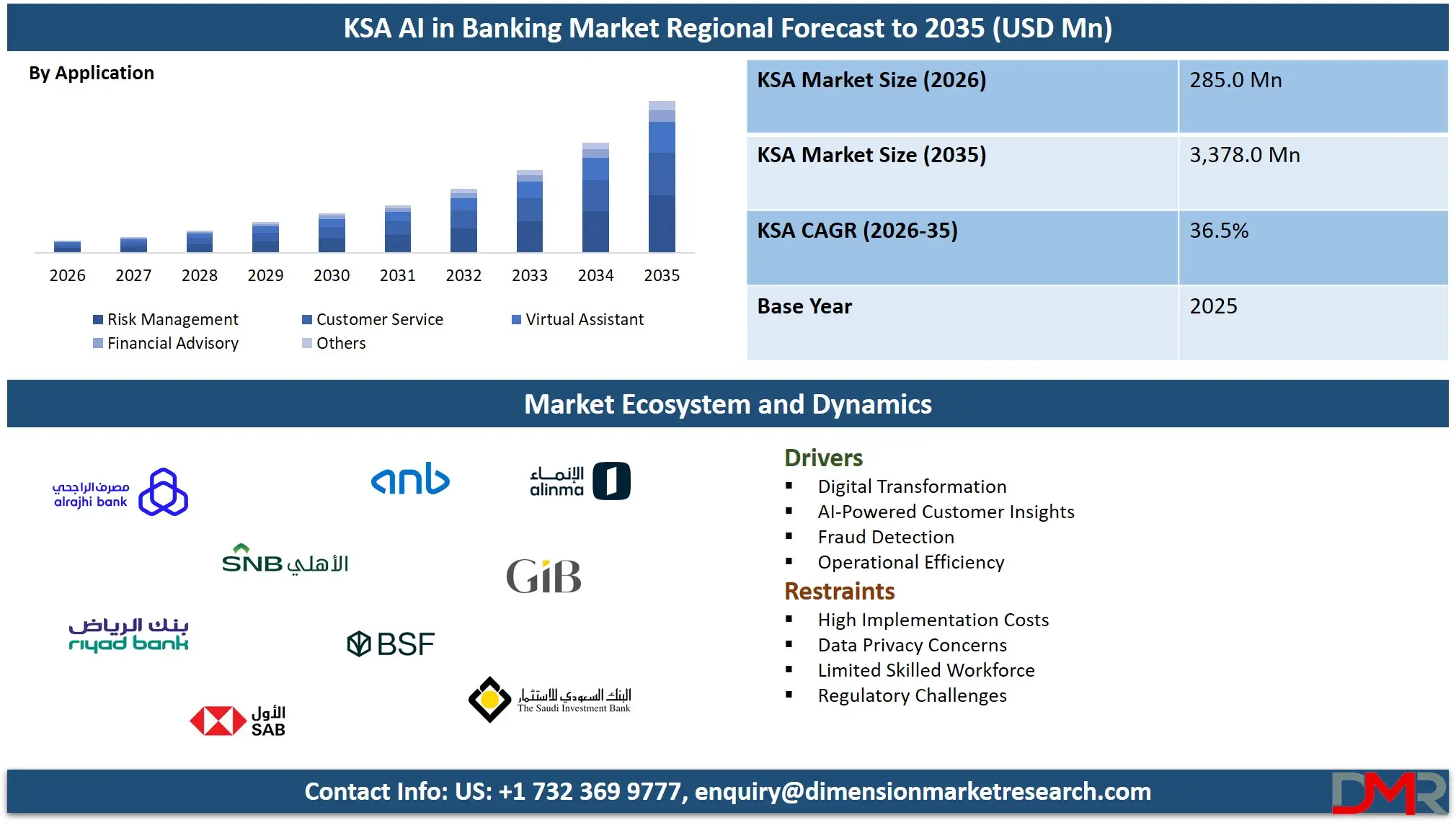
The KSA AI in banking market is forecasted to reach USD 285 million in 2026 and is expected to expand at a robust CAGR of 36.5%, driven by increasing adoption of AI-powered banking solutions, intelligent automation, predictive analytics, and digital financial services, reaching a market value of USD 3,378.0 million by 2035.
ℹ
To learn more about this report –
Download Your Free Sample Report Here
Artificial intelligence in banking refers to the integration of advanced algorithms, machine learning models, and natural language processing techniques into banking operations to enhance efficiency, decision-making, and customer experience. By leveraging AI, banks can automate routine processes, detect fraudulent activities in real time, provide personalized financial recommendations, and optimize risk management. AI-driven tools such as chatbots, predictive analytics, and virtual assistants enable financial institutions to deliver faster and more accurate services while reducing operational costs. The continuous evolution of AI technologies allows banks to harness large volumes of data to uncover patterns, anticipate market trends, and improve overall strategic planning, making AI a critical component in the transformation of the modern banking sector.
The KSA AI in banking market is experiencing rapid growth as financial institutions increasingly adopt intelligent automation and data-driven solutions to enhance their services. Saudi banks are integrating AI-powered applications to streamline customer interactions, manage risk more effectively, and improve operational efficiency across branches and digital platforms. The market is driven by government initiatives promoting digital banking, the growing adoption of cloud computing, and the demand for personalized financial services. The presence of advanced analytics tools, fraud detection systems, and virtual assistants has further strengthened the ability of banks to provide secure and efficient financial solutions while catering to the evolving needs of customers.
ℹ
To learn more about this report –
Download Your Free Sample Report Here
In addition, the KSA AI in banking market is witnessing collaboration between local banks and technology providers to develop innovative solutions tailored to the regional financial ecosystem. Investment in AI research and development, combined with the increasing digital literacy of consumers, has fueled the deployment of smart banking applications and AI-based decision-making platforms. The market growth is also supported by the rising demand for predictive analytics, real-time transaction monitoring, and automated credit scoring solutions. As Saudi banks continue to embrace digital transformation, the AI in banking market is expected to expand significantly, enabling institutions to deliver enhanced customer experiences, reduce operational risks, and remain competitive in an increasingly technology-driven financial landscape.
KSA AI in Banking Market: Key Takeaways
- Rapid Market Growth: The KSA AI in banking market is projected to reach USD 285 million in 2026 and expand to USD 3,378 million by 2035, reflecting a strong CAGR of 36.5%.
- High Adoption among Large Enterprises: Large banks are expected to dominate the market with a 60% share in 2026, leveraging AI for risk management, predictive analytics, and customer engagement.
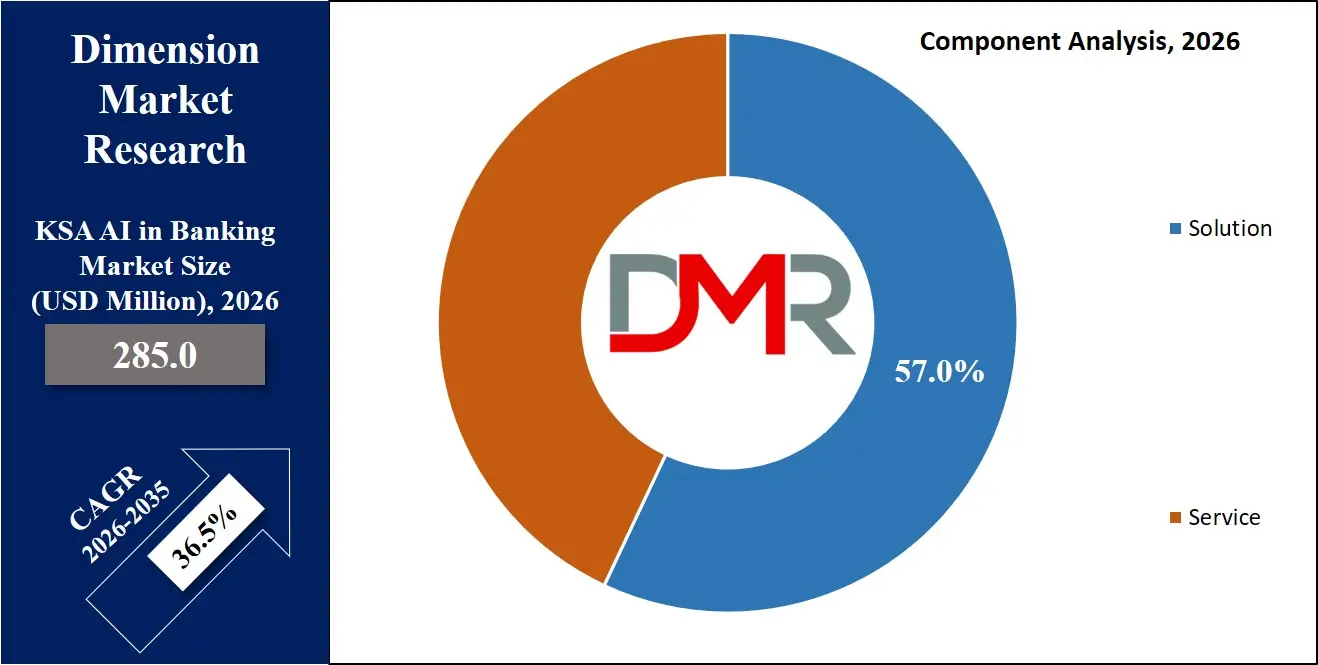
- Dominance of Solution Components: AI solutions are projected to hold 57% of the component type segment in 2026, emphasizing software-driven automation and predictive tools over service offerings.
- Technology Focus on NLP: Natural Language Processing technologies are anticipated to capture 47% of the technology segment, driving customer service automation and intelligent chatbots.
- Fintech and Digital Payment Expansion: In 2025, over 280 fintech firms are operating under regulatory frameworks, with digital payment transactions reaching 12.6 billion in 2024, highlighting rapid digital finance adoption.
KSA AI in Banking Market: Use Cases
- Fraud Detection and Risk Management: AI in KSA banks helps identify suspicious transactions, prevent fraud, and manage credit and operational risks. Machine learning models analyze large datasets in real time to flag anomalies and reduce financial losses, enhancing overall security and compliance.
- Customer Service Automation: AI-powered chatbots and virtual assistants streamline customer interactions by providing instant responses, account support, and personalized financial guidance. This improves customer experience while reducing operational workload for bank staff.
- Predictive Analytics for Lending: Banks leverage AI to assess creditworthiness, forecast loan defaults, and optimize lending decisions. Predictive analytics enables faster approvals, minimizes risk exposure, and enhances revenue from retail and corporate lending segments.
- Personalized Banking and Recommendations: AI analyzes customer behavior, transaction patterns, and financial goals to offer tailored investment advice, product suggestions, and budgeting insights. This drives customer engagement and increases adoption of digital banking services.
KSA AI in Banking Market: Stats & Facts
- General Authority for Statistics (GASTAT) – AI Adoption (2024)
- AI adoption among Saudi businesses reached 27.6% in 2024 across sectors including finance and insurance, ICT, and education.
- Within that adoption mix, 44.7% of finance and insurance establishments reported using AI technologies.
- ICT sector leads adoption at 52.8%, while education stands at 42.1%.
- Saudi Central Bank (SAMA) – Digital Payments & Fintech Growth (2024–2025)
- Electronic payments accounted for 79% of total retail payments in 2024, surpassing government digital targets.
- The number of electronic non-cash payment transactions reached 12.6 billion in 2024.
- Retail digital transaction share rose from 70% in 2023 to 79% in 2024.
- In mid-2025, over 280 fintech companies were operating under the regulatory framework.
- Fintech ecosystem expanded from 82 companies in 2022 to 281 in mid-2025.
- Saudi banking payment infrastructure deployment accelerated with digital payment system integrations planned through 2026.
- Digital Banking & Licensing (2024–2025)
- A total of 38 banks are licensed by the Saudi Central Bank, including local, foreign branch, and digital banks.
- 4 licensed digital banks had commenced or secured licenses by late 2025.
- Digital banks approved and operational included new entrants that expanded access to technology‑driven banking solutions.
KSA AI in Banking Market: Market Dynamic
Driving Factors in the KSA AI in Banking Market
Digital Transformation Initiatives
The rapid push toward digital banking in Saudi Arabia is encouraging banks to adopt AI technologies for improved efficiency. Integration of machine learning, predictive analytics, and automated workflows allows institutions to enhance customer experiences, optimize operations, and streamline service delivery across branches and mobile platforms.
Demand for Advanced Analytics
Growing volumes of financial data are prompting banks to leverage AI-powered analytics for better decision-making. Real-time data insights, risk modeling, and predictive algorithms enable institutions to detect fraud, optimize lending, and create personalized financial solutions for both retail and corporate customers.
Restraints in the KSA AI in Banking Market
High Implementation Costs
Deploying AI solutions in banking requires significant investment in software, infrastructure, and talent. Small and medium-sized banks may face challenges in adopting advanced AI platforms, slowing widespread implementation and affecting ROI timelines.
Data Privacy and Regulatory Concerns
Strict regulations and concerns around data privacy limit the full-scale deployment of AI in banking. Banks must comply with Saudi Arabian Monetary Authority guidelines while ensuring customer data security, which can complicate AI integration and adoption.
Opportunities in the KSA AI in Banking Market
AI-Driven Financial Inclusion
AI technologies can help expand banking services to underserved populations in Saudi Arabia. Intelligent credit scoring, automated loan approvals, and mobile-based banking solutions provide access to financial services for individuals and SMEs previously excluded from traditional banking.
Collaboration with Fintechs and Tech Providers
Partnerships between banks and AI technology providers present opportunities to develop innovative solutions such as virtual assistants, robo-advisors, and advanced fraud detection systems. These collaborations accelerate digital transformation and enhance competitive advantage in the market.
Trends in the KSA AI in Banking Market
Rise of Predictive and Prescriptive Analytics
Saudi banks are increasingly adopting predictive and prescriptive AI models to forecast market trends, optimize lending strategies, and personalize financial products. These models improve operational efficiency and customer satisfaction through data-driven insights.
Integration of AI with Mobile and Digital Platforms
The growing use of mobile banking and digital financial services is driving AI integration into apps, online portals, and payment platforms. AI-powered chatbots, recommendation engines, and fraud detection tools enhance the digital banking experience and encourage higher adoption rates.
KSA AI in Banking Market: Research Scope and Analysis
By Component Analysis
In the KSA AI in banking market, solution-type components are expected to dominate the component type segment, accounting for 57.0% of the market share in 2026. These solutions encompass a wide range of AI-powered applications and software that enable banks to enhance operational efficiency, improve decision-making, and deliver better customer experiences. Solutions include predictive analytics platforms that forecast customer behavior and market trends, risk management systems that identify potential credit and operational risks, and AI-driven fraud detection tools that monitor transactions in real time to prevent financial losses. Additionally, virtual assistants and intelligent chatbots integrated into banking applications allow customers to access account information, perform transactions, and receive personalized financial guidance quickly, improving overall satisfaction and engagement.
ℹ
To learn more about this report –
Download Your Free Sample Report Here
Service components in the KSA AI in banking segment complement these solution offerings by providing the necessary support, implementation, and maintenance required for effective AI adoption. These services include consulting, where banks receive guidance on selecting and integrating AI solutions tailored to their specific operational needs and customer segments. Implementation services involve deploying AI models, configuring software, and integrating them with existing banking systems to ensure seamless operation. Managed services allow banks to outsource the monitoring, maintenance, and optimization of AI applications, ensuring consistent performance and updates in line with technological advancements. Training and support services equip bank employees with the skills required to operate and leverage AI tools effectively, bridging the gap between technology and human expertise. Collectively, these service components play a critical role in enabling financial institutions in Saudi Arabia to fully harness AI solutions, ensuring both operational efficiency and enhanced customer experience.
By Technology Analysis
In the KSA AI in banking market, Natural Language Processing (NLP) technologies are expected to secure a dominant position in the technology type segment, capturing 47.0% of the total market share in 2026. NLP enables banks to analyze and interpret vast amounts of unstructured data, such as customer emails, chat conversations, and social media interactions, allowing institutions to gain actionable insights into customer behavior and sentiment. By leveraging NLP-powered tools, banks can deploy intelligent chatbots, virtual assistants, and voice-enabled applications that provide personalized customer support, streamline query resolution, and enhance user engagement. Additionally, NLP assists in automating document processing, compliance checks, and fraud detection by extracting relevant information from financial statements, contracts, and transaction records, which significantly improves operational efficiency and accuracy.
The machine learning and deep learning subsegment within this technology type focuses on the development of predictive and adaptive models that learn from historical and real-time data to optimize banking operations. Machine learning algorithms are widely applied in credit scoring, risk assessment, and anomaly detection, enabling banks to anticipate potential defaults, detect fraudulent transactions, and make data-driven lending decisions. Deep learning techniques, a subset of machine learning, are employed for complex pattern recognition tasks, such as image-based document verification, customer behavior prediction, and advanced analytics in financial forecasting. These technologies continuously improve through iterative learning, allowing banks to refine their models and deliver highly accurate insights. Combined, machine learning and deep learning empower Saudi banks to enhance decision-making, minimize risk, and provide tailored financial services, complementing the NLP-driven automation and customer experience improvements in the AI banking ecosystem.
By Enterprise Size Analysis
In the KSA AI in banking market, large enterprises are expected to maintain a leading position in the enterprise type segment, accounting for 60.0% of the total market share in 2026. Large banks and financial institutions have the resources, infrastructure, and capital to invest in advanced AI technologies, enabling them to implement comprehensive solutions across multiple branches and digital platforms. These enterprises leverage AI for automating complex operations, enhancing risk management, and improving customer engagement at scale. Their extensive data repositories allow for more accurate predictive analytics, personalized financial recommendations, and efficient fraud detection, giving them a competitive advantage over smaller institutions. Additionally, large enterprises often partner with global AI technology providers to integrate cutting-edge solutions, ensuring faster deployment and higher operational efficiency across their service networks.
The small and medium-sized enterprises subsegment in the KSA AI in banking market focuses on regional and niche banks that are gradually adopting AI solutions to enhance competitiveness. SMEs face challenges such as limited budgets, smaller IT infrastructure, and the need for specialized talent, which often restricts the scale of AI implementation. However, AI adoption among SMEs is growing through cloud-based solutions and modular platforms that allow incremental integration without heavy upfront investment. These institutions primarily use AI for improving customer support, automating repetitive tasks, and optimizing credit assessment processes. By adopting scalable AI services, SMEs can enhance operational efficiency, provide better digital banking experiences, and gradually expand their service offerings, contributing to the overall growth of the AI in banking ecosystem in Saudi Arabia.
By Application Analysis
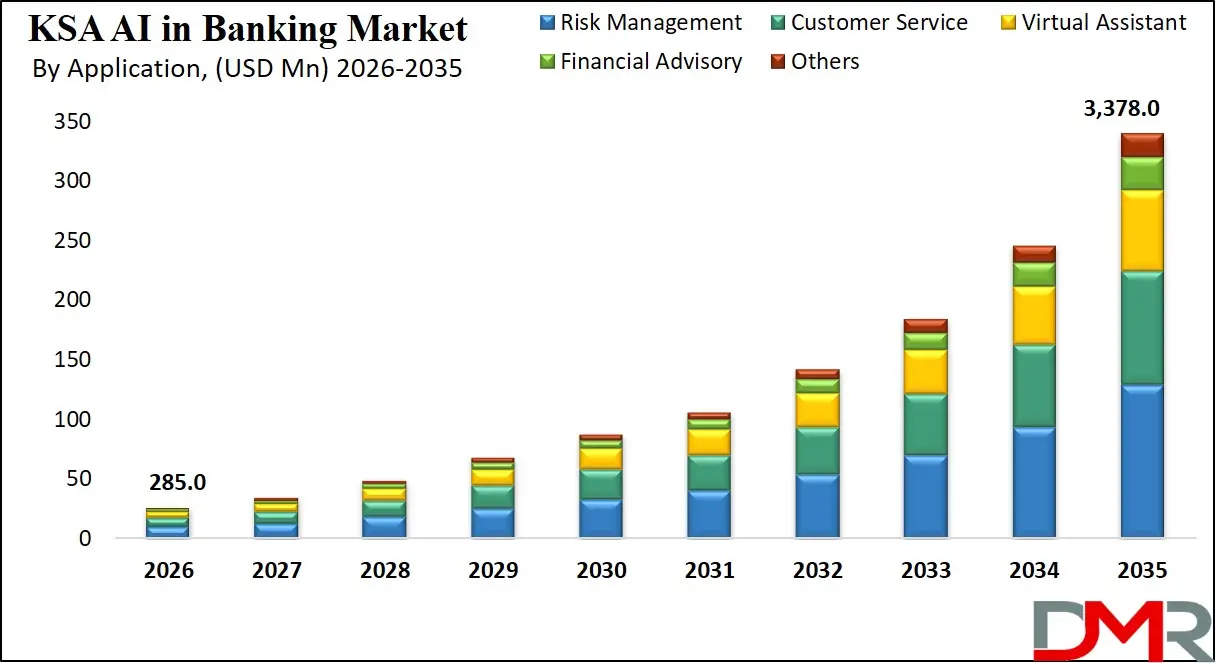
In the KSA AI in banking market, risk management applications are projected to retain their leading position in the application type segment, capturing 38.0% of the total market share in 2026. AI-driven risk management solutions enable banks to analyze vast amounts of transactional and market data to identify potential threats, credit defaults, and operational vulnerabilities in real time. These systems use predictive analytics and machine learning models to assess creditworthiness, detect fraudulent patterns, and evaluate market exposure, allowing banks to make informed decisions and mitigate financial losses. By automating compliance monitoring and regulatory reporting, AI reduces human error and ensures adherence to the guidelines set by the Saudi Arabian Monetary Authority, enhancing overall governance and operational resilience.
The customer service subsegment leverages AI technologies such as natural language processing, chatbots, and virtual assistants to provide seamless and personalized support to banking clients. These solutions allow customers to perform transactions, check account details, and resolve queries instantly without visiting a branch, significantly improving user convenience. AI systems also analyze customer interactions to provide insights on preferences and behavior, enabling banks to tailor recommendations and services. By reducing response time and streamlining communication channels, AI-powered customer service enhances engagement, boosts satisfaction, and strengthens long-term customer relationships in the Saudi banking sector.
The KSA AI in Banking Market Report is segmented on the basis of the following:
By Component
By Technology
- Natural Language Processing (NLP)
- Machine Learning & Deep Learning
- Computer Vision
- Others
By Enterprise Size
By Application
- Risk Management
- Customer Service
- Virtual Assistant
- Financial Advisory
- Others
KSA AI in Banking Market: Competitive Landscape
The competitive landscape of the KSA AI in banking market is characterized by intense adoption of advanced technologies and strategic investments in digital transformation initiatives. Financial institutions are increasingly focusing on integrating AI-driven solutions such as predictive analytics, natural language processing, and machine learning to enhance operational efficiency, improve risk management, and deliver personalized customer experiences.
ℹ
To learn more about this report –
Download Your Free Sample Report Here
The market is also witnessing collaborations with technology providers and fintech firms to deploy innovative applications including virtual assistants, fraud detection systems, and intelligent credit scoring platforms. Continuous investment in research and development, combined with the growing demand for automated and data-driven financial services, is driving competition and accelerating the adoption of AI across both large banks and emerging financial institutions in Saudi Arabia.
Some of the prominent players in the KSA AI in Banking Market are:
- Al Rajhi Bank
- Saudi National Bank (SNB)
- Riyad Bank
- Saudi Awwal Bank
- Arab National Bank
- Banque Saudi Fransi
- Alinma Bank
- Gulf International Bank
- Saudi Investment Bank
- Bank Albilad
- STC Pay
- Tamam Financing
- Fasset
- Raqamyah
- YAP
- Mozn
- Lucidya
- Humain
- Lean Technologies
- Resemble Systems
- Other Key Players
Recent Developments in the KSA AI in Banking Market
- March 2026: Dyna.Ai announces the launch of its Agentic AI Suite and AI Employees with Arabic-language functionality in the Kingdom of Saudi Arabia, showcasing enterprise-grade AI platforms tailored to financial services and automation during the Money20/20 Middle East conference in Riyadh, aimed at accelerating digital transformation and customer engagement in banking and fintech workflows.
- December 2025: Newera.ai secures USD 2.1 million in pre‑seed funding to scale its generative AI offerings for enterprise clients in Saudi Arabia, supporting the development of localized AI solutions that enhance productivity and innovation.
- October 2025: Velents.ai unveils Agent.sa, a fully integrated Arabic‑speaking AI employee designed for enterprise use, marking a product launch that enhances automated customer support, task execution, and operational workflows across banking and related business functions in the Middle East.
Report Details
| Report Characteristics |
| Market Size (2026) |
USD 285.0 Mn |
| Forecast Value (2035) |
USD 3,378.0 Mn |
| CAGR (2026–2035) |
36.5% |
| Historical Data |
2021 – 2025 |
| Forecast Data |
2027 – 2035 |
| Base Year |
2025 |
| Estimate Year |
2026 |
| Report Coverage |
Market Revenue Estimation, Market Dynamics, Competitive Landscape, Growth Factors and etc. |
| Segments Covered |
By Component (Solution, Service), By Technology (Natural Language Processing (NLP), Machine Learning & Deep Learning, Computer Vision, Others), By Enterprise Size (Large Enterprise, SMEs), and By Application (Risk Management, Customer Service, Virtual Assistant, Financial Advisory, Others). |
| Country Coverage |
Saudi Arabia |
| Prominent Players |
Al Rajhi Bank, Saudi National Bank (SNB), Riyad Bank, Saudi Awwal Bank, Arab National Bank, Banque Saudi Fransi, Alinma Bank, Gulf International Bank, Saudi Investment Bank, Bank Albilad, STC Pay, Tamam Financing, Fasset, Raqamyah, YAP, Mozn, Lucidya, Humain, Lean Technologies, Resemble Systems, and Other Key Players |
| Purchase Options |
We have three licenses to opt for: Single User License (Limited to 1 user), Multi-User License (Up to 5 Users) and Corporate Use License (Unlimited User) along with free report customization equivalent to 0 analyst working days, 3 analysts working days and 5 analysts working days respectively. |
Frequently Asked Questions
How big is the KSA AI in Banking Market?
▾ The KSA AI in Banking Market size is estimated to have a value of USD 285.0 million in 2026 and is expected to reach USD 3,378.0 million by the end of 2035.
What is the growth rate in the KSA AI in Banking Market in 2026?
▾ The market is growing at a CAGR of 36.5% over the forecasted period of 2026.
Who are the key players in the KSA AI in Banking Market?
▾ Some of the major key players in the KSA AI in Banking Market are Al Rajhi Bank, Saudi National Bank (SNB), Riyad Bank, Saudi Awwal Bank, Arab National Bank, Banque Saudi Fransi, Alinma Bank, Gulf International Bank, Saudi Investment Bank, Bank Albilad, STC Pay, Tamam Financing, Fasset, Raqamyah, and many others.