Market Overview
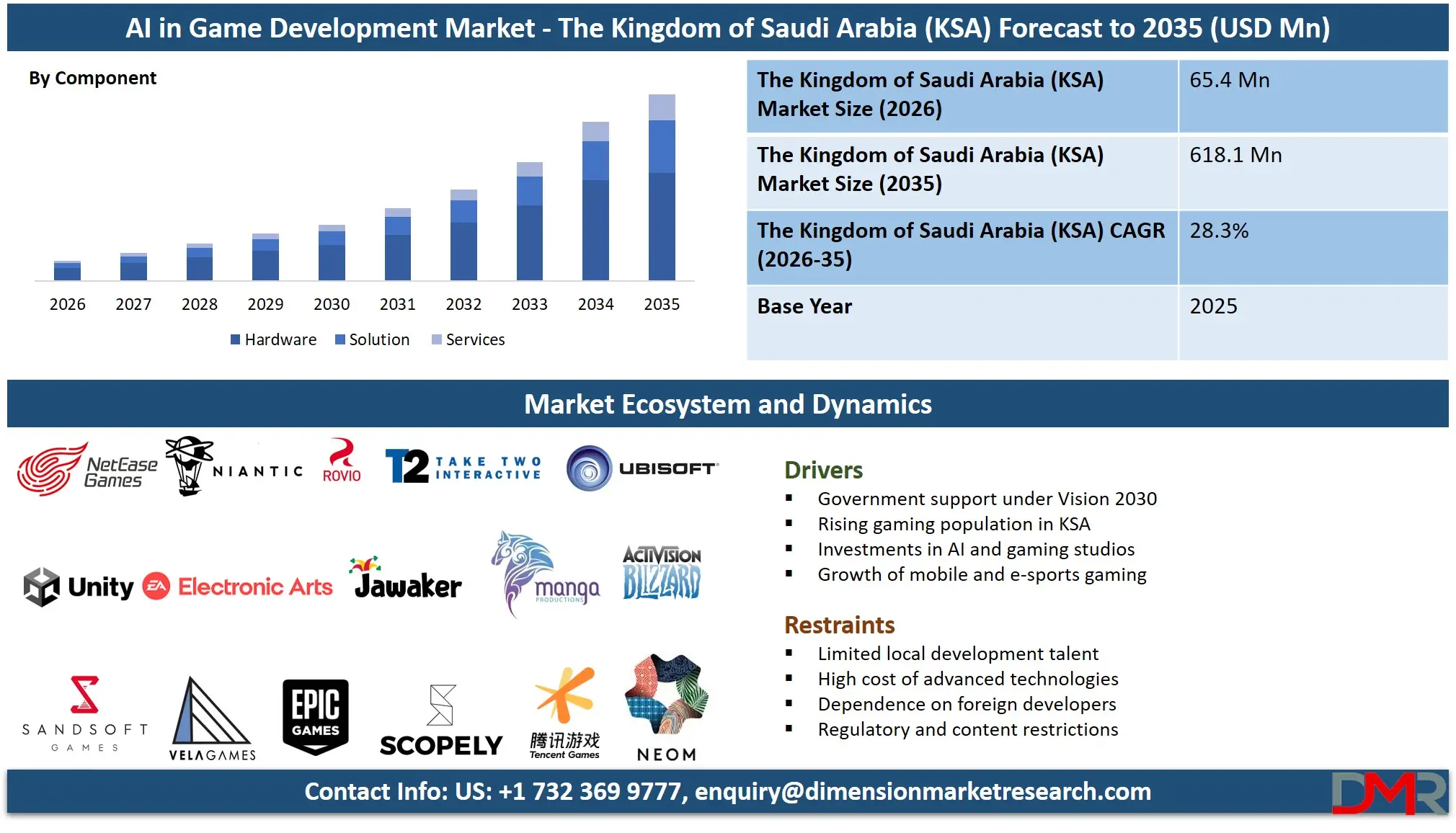
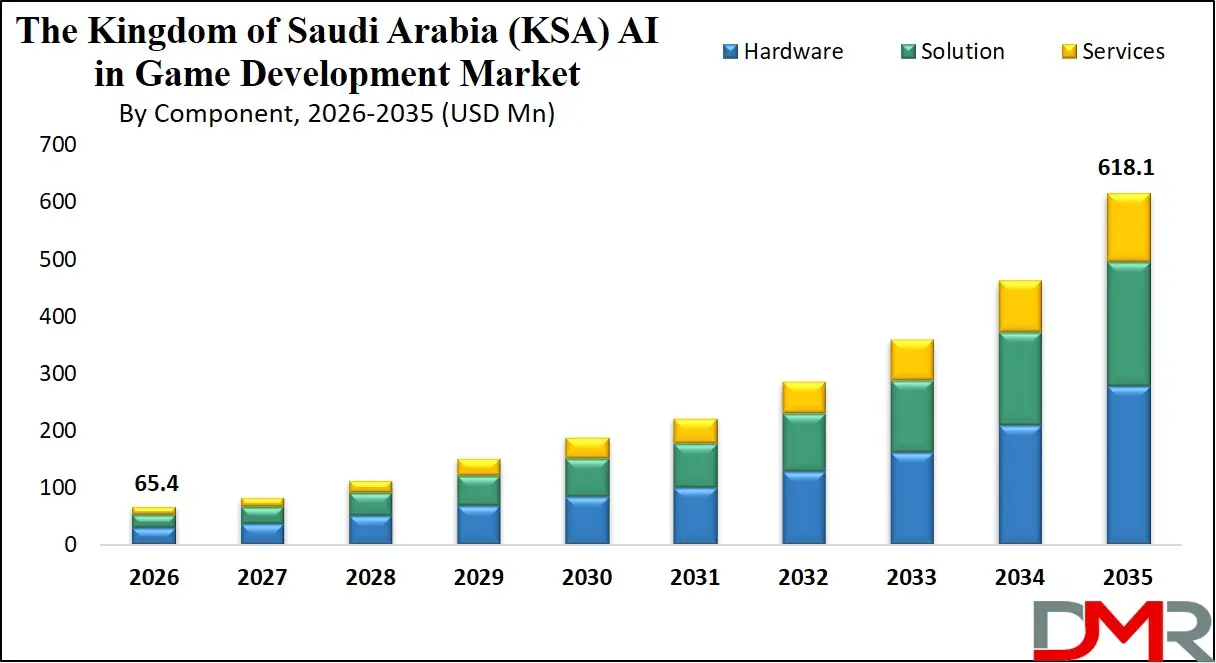
Saudi Arabia AI in game development market size is expected to reach a value of USD 65.4 million in 2026, and it is further anticipated to reach a market value of USD 618.1 million by 2035 at a CAGR of 28.3%.
ℹ
To learn more about this report –
Download Your Free Sample Report Here
The KSA's AI in game development market represents one of the most dynamic and rapidly expanding technology sectors in the Middle East, driven by the Kingdom's aggressive digital transformation initiatives, a young and tech-native population, and substantial government investment in entertainment and technology under Vision 2030. Major cities such as Riyadh, Jeddah, and Dammam are emerging as key hubs for game development and tech innovation, supported by world-class infrastructure and a thriving startup ecosystem.
AI integration in game development in KSA is increasingly becoming a cornerstone of the industry, fueled by a population with one of the highest gaming penetration rates globally. Saudi gamers and developers alike are demanding more immersive, intelligent, and personalized gaming experiences, prompting studios to leverage advanced AI tools. The growing presence of game development academies, government-backed tech incubators, and international studio partnerships is enhancing the sophistication of locally developed games.
The market has undergone significant transformation due to the democratization of AI tools and cloud-based development platforms. Technologies such as machine learning for procedural content generation, deep learning for realistic NPC behavior, and AI-driven testing suites are being widely deployed to reduce development cycles and enhance game quality. Additionally, the expansion of the Kingdom's digital infrastructure is enabling more complex and data-intensive game development processes.
The rapid growth of the domestic gaming market, with platforms such as the Saudi Esports Federation and major gaming events like Gamers8, remains a primary catalyst, driving significant investment in local game development talent and technology. The pandemic further accelerated digital entertainment adoption, making AI-enhanced game development a critical component of the Kingdom's creative economy.
ℹ
To learn more about this report –
Download Your Free Sample Report Here
Sustainability in game development is also gaining attention, with studios optimizing AI algorithms for energy efficiency and leveraging cloud-based development environments to reduce hardware footprints. Government initiatives supporting the digital creative industries are influencing industry practices.
Despite strong growth, the market faces challenges such as a shortage of specialized AI and game development talent, high costs of advanced development tools, and the complexity of integrating AI into traditional game development pipelines. Overall, the KSA AI in game development market is characterized by rapid technological adoption, evolving creative expectations, and strong economic and cultural backing.
The Kingdom of Saudi Arabia (KSA) AI in Game Development Market: Key Takeaways
- Market Growth Insights: The market is anticipated to reach approximately USD 65.4 million in 2026 and is projected to expand to around USD 618.1 million by 2035, registering a CAGR of 28.3% during the forecast period.
- By Component Insights: The solution segment, particularly AI middleware and integrated development platforms, remains the leading segment, supported by the growing availability of off-the-shelf AI tools tailored for game engines like Unity and Unreal Engine.
- By Game Genre Insights: Action and adventure games predominantly utilize AI due to their need for complex enemy behaviors and dynamic world interactions, making this genre the largest adopter of AI technologies.
- By Platform Insights: Mobile gaming holds the largest share, driven by the Kingdom's high smartphone penetration and the popularity of free-to-play and hyper-casual games that leverage AI for player retention and monetization.
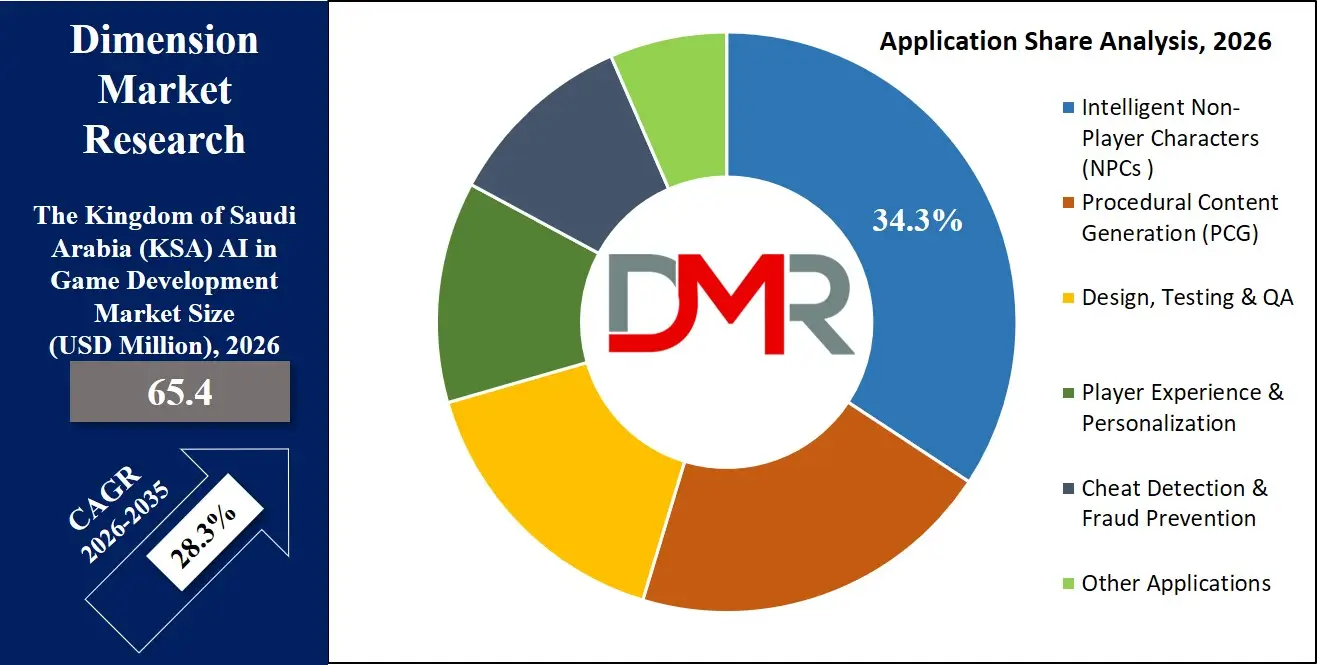
- By Application Insights: Intelligent Non-Player Characters (NPCs) account for the majority of market share, reflecting the growing demand for more lifelike and adaptive characters that enhance immersion and gameplay depth.
- Key Players Insights: Major market participants include local game studios, regional tech conglomerates, and international AI solution providers partnering with Saudi entities.
Impact of Iran Conflict on the Kingdom of Saudi Arabia (KSA) AI in Game Development Market
- Disruption to AI Infrastructure and Data Center Expansion: The ongoing Iran conflict is creating uncertainty around large-scale AI infrastructure investments in Saudi Arabia, particularly data centers and cloud computing facilities. Global tech firms have already begun reassessing billions of dollars in AI-related projects across the Gulf due to rising geopolitical risks and security concerns.
- Weakening Investor Confidence in Gaming and AI Ecosystem: Saudi Arabia's ambition to become a global hub for gaming and AI supported by multi-billion-dollar investments has been affected by regional instability. The Iran conflict has reduced confidence among international investors and developers, who may perceive the region as less stable for long-term commitments.
- Supply Chain and Semiconductor Constraints: The conflict has heightened risks to critical supply routes such as the Strait of Hormuz, which plays a vital role in global trade, including semiconductor materials and hardware components. Disruptions in these supply chains can delay the availability of GPUs, AI chips, and gaming hardware essential for AI model training and game development processes.
- Slower Progress of Saudi Arabia's Gaming Vision 2030 Initiatives: Saudi Arabia's Vision 2030 strategy includes a strong focus on building a world-class gaming and AI ecosystem, with significant investments through entities like Savvy Games Group. However, the Iran conflict has introduced risks to this long-term vision by affecting tourism, talent attraction, and global partnerships.
The Kingdom of Saudi Arabia (KSA) AI in Game Development Market: Use Cases
- Immersive Open-World Creation by Procedural Content Generation (PCG): Procedural content generation represents one of the most transformative use cases in the KSA AI in game development market. Developers are increasingly using machine learning algorithms to automatically generate vast landscapes, intricate dungeons, and unique quest structures. This reduces manual labor, accelerates development timelines, and creates highly replayable experiences. The seamless integration of PCG tools with popular game engines ensures efficient content pipeline management.
- Dynamic and Adaptive Non-Player Characters (NPCs): The development of intelligent NPCs has experienced strong growth, driven by player expectations for more realistic and reactive game worlds. AI-powered NPCs can learn from player behavior, adapt strategies in real-time, and exhibit complex emotional responses. Studios are investing in behavior trees, reinforcement learning, and natural language processing to create characters that feel genuinely alive and contribute meaningfully to narrative depth.
- AI-Driven Quality Assurance and Automated Testing: Game testing and QA segments demand high levels of efficiency and coverage. AI-powered testing bots can simulate thousands of gameplay hours, identify bugs, and balance game mechanics faster than human testers. These systems utilize computer vision and reinforcement learning to navigate game environments, ensuring comprehensive testing while reducing development costs and time-to-market.
- Personalized Player Experiences and Dynamic Difficulty Adjustment: Personalized gaming experiences are gaining significant momentum in KSA, particularly in mobile and free-to-play titles. AI systems analyze player skill levels, engagement patterns, and behavioral data to dynamically adjust difficulty, recommend in-game content, and personalize monetization offers. Advanced analytics and real-time adaptation play a crucial role in maximizing player retention and lifetime value.
The Kingdom of Saudi Arabia (KSA) AI in Game Development Market: Stats & Facts
Saudi Ministry of Communications and Information Technology (MCIT)
- Over 350 active game development studios were recorded in Saudi Arabia in 2025, highlighting rapid growth in the domestic game development ecosystem.
- More than 3,500 professionals are now employed in the game development sector, marking one of the fastest-growing creative technology workforces in the region.
- Total investments in the Saudi gaming and esports sector exceeded SAR 30 billion in 2025, with a significant portion directed toward AI-enhanced game development.
Saudi Vision 2030 / National Gaming and Esports Strategy
- The government aims to position KSA as a global hub for gaming and esports, targeting the creation of over 30 locally developed commercially successful games by 2030.
- Game development sector development is a key pillar of economic diversification, driving investments in AI research, developer training, and digital infrastructure.
Saudi Esports Federation / Game Development Data
- The Saudi Esports Federation supports over 50 game development accelerators and incubators nationwide, fostering AI integration in local game production.
- More than 1,500 students are enrolled in game development and AI-focused university programs across the Kingdom, enabling long-term talent pipeline growth.
General Authority for Statistics (GASTAT), Saudi Arabia
- Gaming adoption continues to rise steadily, with over 80% of the Saudi population engaging in gaming, contributing significantly to increased demand for higher-quality, AI-enhanced games.
- High youth population concentration is accelerating demand for more immersive and personalized gaming experiences powered by AI.
The Kingdom of Saudi Arabia (KSA) AI in Game Development Market: Market Dynamic
Driving Factors in the Kingdom of Saudi Arabia (KSA) AI in Game Development Market
Rapid Gaming Industry Expansion
The rapid expansion of the gaming industry in Saudi Arabia, driven by government initiatives such as the National Gaming and Esports Strategy, is significantly increasing investment in game development. A young, digitally native population, high disposable incomes, and widespread esports engagement are accelerating demand for high-quality, locally relevant games. Players increasingly expect sophisticated AI-driven features such as intelligent NPCs and personalized experiences, prompting developers to enhance their AI capabilities. Additionally, the rise of Saudi-owned publishing studios and international co-development partnerships is further intensifying the need for efficient, scalable, and technology-driven game production pipelines to ensure competitive, globally appealing titles.
Digital Transformation and AI Infrastructure Investment
Aggressive digital transformation and large-scale AI infrastructure initiatives are reshaping the game development landscape in Saudi Arabia. Mega projects such as the establishment of AI centers of excellence and cloud computing hubs are enabling advanced development ecosystems. Increasing availability of high-performance computing resources and AI training data is generating opportunities for more complex AI integration in games. Cloud-based development platforms and AI-as-a-service offerings are supporting real-time collaboration and reducing entry barriers for smaller studios. These developments are encouraging the adoption of cutting-edge AI techniques, improving development efficiency, and creating a more integrated and technologically advanced game development environment across the Kingdom.
Restraints in the Kingdom of Saudi Arabia (KSA) AI in Game Development Market
High Development Costs and Tool Accessibility
High development costs remain a significant challenge in the KSA AI in game development market. Expenses related to specialized AI talent, proprietary software licenses, and high-performance computing infrastructure continue to rise, putting pressure on studio profit margins, particularly for small and medium-sized developers. Additionally, investments in advanced AI technologies such as machine learning frameworks and generative AI tools require substantial capital expenditure. Balancing cost efficiency with creative ambition is increasingly difficult, especially as global competition drives expectations for AAA-quality production values. Studios must continuously optimize development workflows, leverage open-source tools, and adopt cost-effective cloud-based solutions to maintain competitiveness while managing rising operational expenditures in a dynamic and demanding market environment.
Talent Shortage and Skill Gap
The game development industry in Saudi Arabia faces increasing challenges due to a shortage of specialized AI and game development talent. While educational programs are expanding, the rapid pace of technological advancement creates a persistent skills gap. Finding professionals skilled in both AI engineering and creative game design presents ongoing difficulties. Limited local expertise in advanced AI techniques such as reinforcement learning and natural language processing for games further complicates operations. Studios must rely on international hiring, intensive training programs, and partnerships with global studios to address talent gaps. Additionally, the need to balance technical expertise with creative vision adds further complexity. These challenges require continuous investment in education, mentorship programs, and knowledge transfer initiatives to build a sustainable talent ecosystem.
Opportunities in the Kingdom of Saudi Arabia (KSA) AI in Game Development Market
Generative AI for Content Creation
The adoption of generative AI tools presents significant growth opportunities in the KSA AI in game development market. These technologies have the potential to reduce content creation costs, accelerate asset production, and enable smaller teams to achieve higher production values. In character design, environment art, and dialogue writing, generative AI can provide faster and more cost-effective solutions, particularly for resource-constrained studios. AI-assisted art and animation tools are also being explored to enhance creative workflows. Supportive government initiatives and increasing availability of localized AI models are expected to accelerate adoption, enabling developers to expand creative capabilities, improve production efficiency, and create innovative content for evolving player demands.
AI-Powered Hyper-Personalization and Live Operations
Hyper-personalization is emerging as a key opportunity in the KSA AI in game development market. Developers are increasingly adopting AI-driven systems to deliver personalized game experiences, dynamic pricing, and tailored in-game events. Machine learning algorithms analyze player behavior to optimize engagement strategies and monetization. Government policies promoting digital creative industries are encouraging the adoption of advanced analytics. Real-time player segmentation and adaptive content delivery are also being used to maximize player lifetime value. Additionally, AI-powered live operations tools are gaining traction, allowing studios to manage live-service games more efficiently. These initiatives not only enhance player satisfaction but also create sustainable revenue streams, presenting long-term growth opportunities.
Trends in the Kingdom of Saudi Arabia (KSA) AI in Game Development Market
Generative AI and Automated Asset Creation
Generative AI is transforming game development workflows in Saudi Arabia. AI-powered tools are enabling rapid creation of 2D and 3D assets, character models, textures, and even voice acting, allowing developers to prototype and iterate faster. Automated asset generation is streamlining production pipelines and minimizing manual effort. These technologies also help address talent shortages and enhance scalability in high-demand development periods. Real-time AI-assisted design enables better creative exploration and iteration. As tool adoption increases, generative AI is becoming an essential component of modern game production strategies, driving innovation and improving overall development efficiency.
Cloud-Based AI Development and Collaborative Platforms
The rise of cloud-based AI development platforms is reshaping game development in KSA. Cloud AI services provide access to powerful machine learning models without requiring significant local infrastructure investment. These platforms enable real-time collaboration across distributed teams, improving coordination and development efficiency. Cloud-based testing and deployment pipelines support continuous integration and faster iteration cycles. Developers are increasingly leveraging cloud AI for scalable compute-intensive tasks such as training NPC behavior models and running automated testing suites. This trend is enhancing development speed, reducing infrastructure costs, and making advanced AI capabilities accessible to studios of all sizes, creating a more agile and responsive game development ecosystem.
The Kingdom of Saudi Arabia (KSA) AI in Game Development Market: Research Scope and Analysis
By Component Analysis
Solutions are expected to dominate the U.S. AI in game development market due to the widespread availability of specialized AI software platforms, developer toolkits, and game engine integrations. The KSA has fostered a robust ecosystem of AI solution providers, with companies such as Unity Technologies and Epic Games embedding AI capabilities directly into their core engines. These solutions offer developers seamless access to AI functionality for animation, dialogue generation, world-building, and quality assurance without requiring specialized machine learning expertise.
Software-as-a-service AI platforms are increasingly enabling studios to access sophisticated capabilities through subscription models, reducing upfront investment barriers. Hardware components, including specialized AI accelerators and GPUs from NVIDIA and AMD, continue to play a critical supporting role, particularly for high-fidelity console and PC development requiring intensive neural network processing. Services, including consulting, implementation support, and custom AI model development, represent a growing segment as studios seek expertise in integrating AI into existing workflows. While solution adoption remains highest, the demand for professional services is expanding rapidly as AI capabilities become more complex and studio requirements become more specialized. The integration of AI across hardware, software, and service layers ensures a comprehensive and adaptable technology ecosystem supporting game development in the U.S.
By Game Genre Analysis
Action and adventure games are anticipated to dominate the U.S. AI in game development market due to the genre's extensive requirements for sophisticated NPC behaviors, dynamic combat systems, and complex environmental interactions. These games demand AI systems capable of managing large numbers of simultaneously active characters, implementing adaptive difficulty, and generating responsive enemy behaviors that maintain engagement across extended play sessions. Major franchises in this category have invested heavily in proprietary AI systems that set industry standards for character intelligence and reactivity.
Role-playing games (RPGs) represent another significant segment, leveraging AI for procedural quest generation, dynamic dialogue systems, and adaptive storytelling that responds to player choices. Shooter games (FPS/TPS) utilize AI for enemy tactics, squad behaviors, and aim assist systems that balance accessibility with challenge. Simulation and strategy games employ AI for complex resource management, opponent decision-making, and realistic physics-based interactions. Sports and racing games utilize AI for opponent behaviors, team management systems, and realistic physics simulations. The diversity of genre-specific AI applications highlights the versatility of AI technologies and their critical role in delivering genre-appropriate experiences across the market.
By Platform Analysis
Mobile gaming is projected to lead the U.S. AI in game development market due to its massive user base, diverse audience demographics, and the operational demands of free-to-play and live-service business models. AI applications in mobile gaming span personalized monetization optimization, dynamic difficulty adjustment, and efficient content delivery across millions of daily active users. Mobile developers leverage AI to optimize performance across thousands of device configurations while maintaining engaging experiences that drive retention.
PC and console platforms represent substantial market segments, with developers implementing advanced AI features that leverage higher computational resources for sophisticated NPC behaviors, real-time procedural generation, and enhanced graphical fidelity. These platforms benefit from dedicated hardware acceleration capabilities that enable more complex AI implementations. AR/VR platforms are emerging as growth segments, with AI playing a critical role in hand tracking, spatial understanding, and immersive interaction systems. Cloud and streaming gaming platforms are increasingly leveraging server-side AI processing to deliver experiences that transcend local hardware limitations. The platform diversity in the U.S. market reflects the varied requirements of different gaming contexts and the adaptability of AI technologies across all delivery channels.
By Application Analysis
Intelligent NPCs and procedural content generation are poised to dominate the U.S. AI in game development market, representing the most mature and widely implemented AI applications across the industry. Intelligent NPCs encompass behavior systems, dialogue generation, and adaptive enemy AI that respond dynamically to player actions. These systems are fundamental to creating immersive, believable game worlds that maintain engagement across diverse player interactions. Procedural content generation enables developers to create vast environments, varied quest structures, and unique item combinations with reduced manual authoring effort, addressing the scalability demands of open-world and live-service games.
ℹ
To learn more about this report –
Download Your Free Sample Report Here
Design, testing, and QA applications represent rapidly growing segments as studios seek efficiency gains in development workflows. AI-driven testing systems automate bug detection, balance analysis, and playtesting simulation, significantly reducing QA timelines. Player experience and personalization applications leverage machine learning for dynamic difficulty adjustment, engagement optimization, and retention-focused feature delivery. Cheat detection and fraud prevention applications are essential for maintaining competitive integrity in online multiplayer games. Other applications, including AI-assisted art production, voice synthesis, and localization, continue to expand as technology capabilities mature. The breadth of AI applications underscores the technology's transformative impact across all phases of game development and live operations.
The Kingdom of Saudi Arabia (KSA) AI in Game Development Market Report is segmented on the basis of the following:
By Component
- Hardware
- Solution
- Services
By Game Genre
- Action and Adventure
- Role-Playing Games (RPGs)
- Shooter (FPS/TPS)
- Simulation and Strategy
- Sports and Racing
- Other Games
By Platform
- Mobile
- PC
- Console
- AR/VR
- Cloud and Streaming Gaming
By Application
- Intelligent Non-Player Characters (NPCs)
- Procedural Content Generation (PCG)
- Design, Testing & QA
- Player Experience & Personalization
- Cheat Detection & Fraud Prevention
- Other Applications
The Kingdom of Saudi Arabia (KSA) AI in Game Development Market: Competitive Landscape
The Kingdom of Saudi Arabia's AI in game development market features a dynamic mix of local indie studios, regional publishing houses, and international technology partners, all vying for leadership in a sector rapidly transformed by Vision 2030 and the National Gaming and Esports Strategy.
International technology companies such as NVIDIA, Epic Games, and Unity Technologies hold a significant position, providing the foundational AI tools, game engines, and development platforms used by studios across the Kingdom. Their expertise in AI middleware and cloud-based development solutions is critical to the market's growth.
ℹ
To learn more about this report –
Download Your Free Sample Report Here
The market is anchored by powerful local entities. The Saudi Esports Federation and the Ministry of Communications and Information Technology are actively fostering the ecosystem through funding, accelerator programs, and talent development initiatives. Regional tech conglomerates and investment funds are increasingly backing local game development studios.
The rise of the domestic gaming industry has spurred a new wave of creative competition. Saudi-owned publishing studios and development houses are creating original IPs with AI-enhanced features. Simultaneously, international studios are establishing development centers in the Kingdom, creating a fiercely contested landscape for AI talent and creative innovation.
Some of the prominent players in the Kingdom of Saudi Arabia (KSA) AI in Game Development Market are:
- Savvy Games Group
- NEOM Tech & Digital Company
- Manga Productions
- Jawaker
- Rovio Entertainment
- Electronic Arts
- Ubisoft
- Activision Blizzard
- Take-Two Interactive
- Embracer Group
- Scopely
- Niantic
- Tencent Games
- NetEase Games
- Unity Technologies
- Epic Games
- Playtika
- Sandsoft Games
- Game Taco
- Vela Games
- Other Key Players
Recent Developments in the Kingdom of Saudi Arabia (KSA) AI in Game Development Market
March 2026
- Savvy Games Group announced a USD 500 million investment fund dedicated to AI-driven game development startups in Saudi Arabia, with a focus on generative AI tools for procedural content generation and intelligent NPC systems.
- Unity Technologies launched a regional AI research and development center in Riyadh, specializing in Arabic-language natural language processing (NLP) for NPC dialogue and localization tools tailored for Middle Eastern game developers.
- NEOM Tech & Digital Company signed a strategic partnership with NVIDIA Corporation to deploy advanced AI computing infrastructure at NEOM, designed to support cloud-based AI game development and real-time rendering for next-generation gaming experiences.
February 2026
- Manga Productions unveiled a proprietary AI-powered animation and character behavior toolset developed in collaboration with King Abdulaziz City for Science and Technology (KACST), aimed at reducing production time for its upcoming feature-length game adaptations.
- Sandsoft Games announced a strategic collaboration with Playtika to integrate AI-driven live operations and player personalization engines into its mobile game portfolio, targeting the MENA region.
- Saudi Esports Federation hosted the AI in Game Development Summit in Jeddah, featuring keynote presentations from Epic Games, Tencent Games, and Niantic, focusing on AI applications in esports training tools and player performance analytics.
January 2026
- Savvy Games Group completed the acquisition of Scopely for USD 4.9 billion, integrating Scopely's AI-powered user acquisition and monetization platforms into Savvy's expanding portfolio of mobile and casual games.
- NEOM Tech & Digital Company launched the NEOM Game Development Accelerator, a six-month program providing AI tool access, cloud computing resources, and mentorship to early-stage Saudi game studios.
- Electronic Arts announced the opening of its first AI game development studio in Riyadh, focused on leveraging machine learning for dynamic difficulty adjustment and player engagement systems in its sports franchise titles.
December 2025
- The inaugural Saudi Game Developers Conference (SGDC) was held in Riyadh, attracting over 5,000 attendees, with dedicated tracks on generative AI, procedural world generation, and AI-assisted quality assurance. Participating companies included Ubisoft, Embracer Group, and Rovio Entertainment.
- Tencent Games announced a USD 200 million joint investment fund with Saudi Arabia's Ministry of Communications and Information Technology (MCIT) to support AI-powered game development startups in the Kingdom.
- Jawaker launched an AI-driven personalized content recommendation engine for its mobile gaming platform, utilizing player behavior analytics to improve retention and engagement across its Arabic-language game portfolio.
Report Details
| Report Characteristics |
| Market Size (2026) |
USD 65.4 Mn |
| Forecast Value (2035) |
USD 618.1 Mn |
| CAGR (2026–2035) |
28.3% |
| Historical Data |
2021 – 2025 |
| Forecast Data |
2027 – 2035 |
| Base Year |
2025 |
| Estimate Year |
2026 |
| Report Coverage |
Market Revenue Estimation, Market Dynamics, Competitive Landscape, Growth Factors and etc. |
| Segments Covered |
By Component (Hardware, Solution, and Services), By Game Genre (Action and Adventure, Role-playing games (RPGs), Shooter(FPS/TPS), Simulation and Strategy, Sports and Racing, and Other Games), By Platform (Mobile, PC, Console, AR/VR, and Cloud and Streaming Gaming), and By Application (Intelligent Non-Player Characters (NPCs), Procedural Content Generation (PCG), Design, Testing & QA, Player Experience & Personalization, Cheat Detection & Fraud Prevention, and Other Application) |
| Country Coverage |
The Kingdom of Saudi Arabia (KSA) |
| Prominent Players |
Savvy Games Group, NEOM Tech & Digital Company, Manga Productions, Jawaker, Rovio Entertainment, Electronic Arts, Ubisoft, Activision Blizzard, Take-Two Interactive, Embracer Group, Scopely, Niantic, Tencent Games, NetEase Games, Unity Technologies, Epic Games, Playtika, Sandsoft Games, Game Taco, Vela Games, and Other Key Players |
| Purchase Options |
We have three licenses to opt for: Single User License (Limited to 1 user), Multi-User License (Up to 5 Users) and Corporate Use License (Unlimited User) along with free report customization equivalent to 0 analyst working days, 3 analysts working days and 5 analysts working days respectively. |
Frequently Asked Questions
How big is the KSA AI in Game Development Market?
▾ The KSA AI in Game Development Market size is estimated to have a value of USD 65.4 million in 2026 and is expected to reach USD 618.1 million by the end of 2035.
Who are the key players in the KSA AI in Game Development Market?
▾ Some of the major key players in the KSA AI in Game Development Market are Unity Technologies, Epic Games, NVIDIA Corporation, Microsoft Corporation (Xbox), Sony Interactive Entertainment, Electronic Arts, and many others.
What is the growth rate in the KSA AI in Game Development Market?
▾ The market is growing at a CAGR of 28.3 percent over the forecasted period.