Market Overview
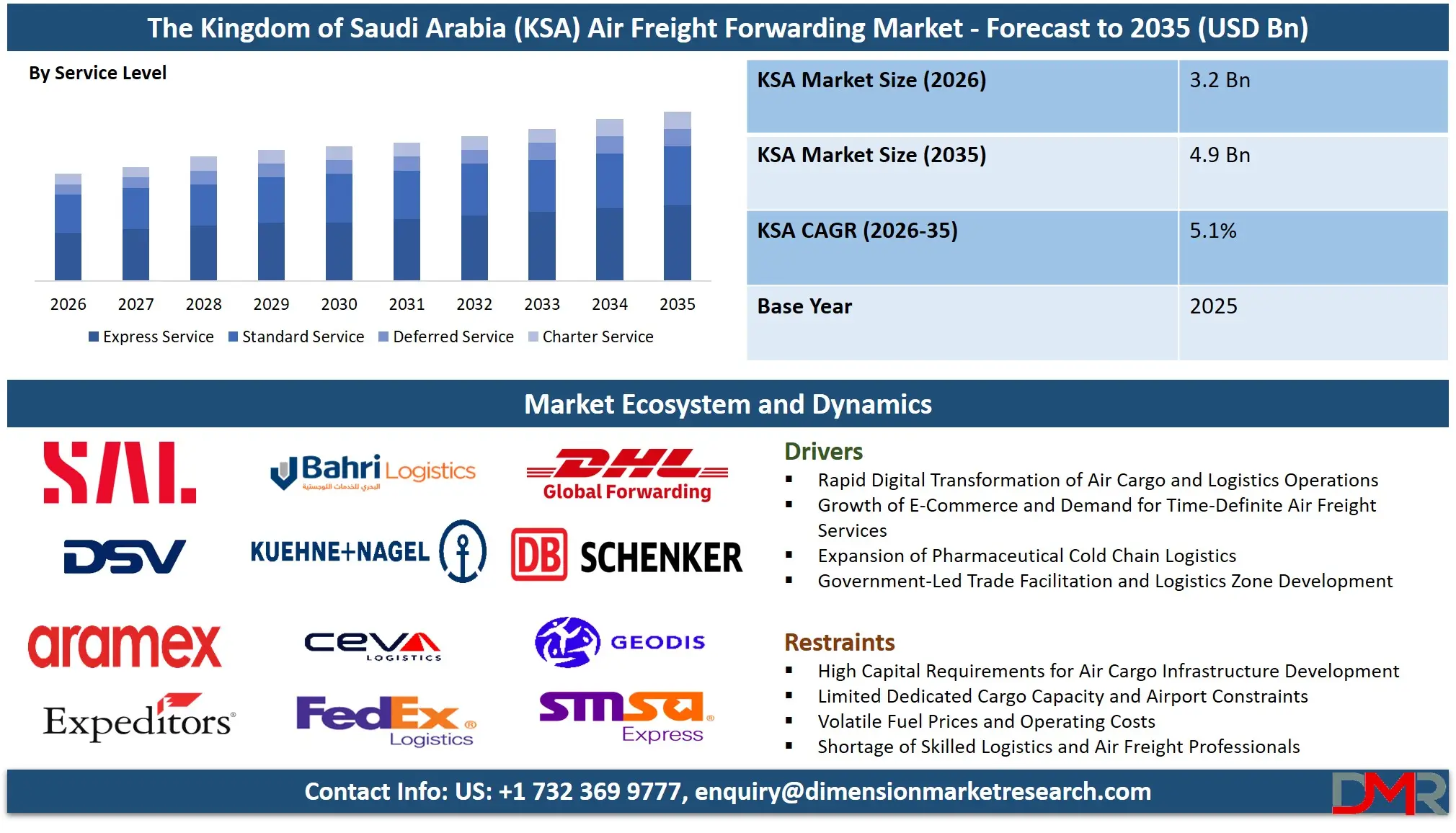
Saudi Arabia Air Freight Forwarding Market size is expected to reach a value of USD 3.2 billion in 2026, and it is further anticipated to reach a market value of USD 4.9 billion by 2035 at a CAGR of 5.1%.
ℹ
To learn more about this report –
Download Your Free Sample Report Here
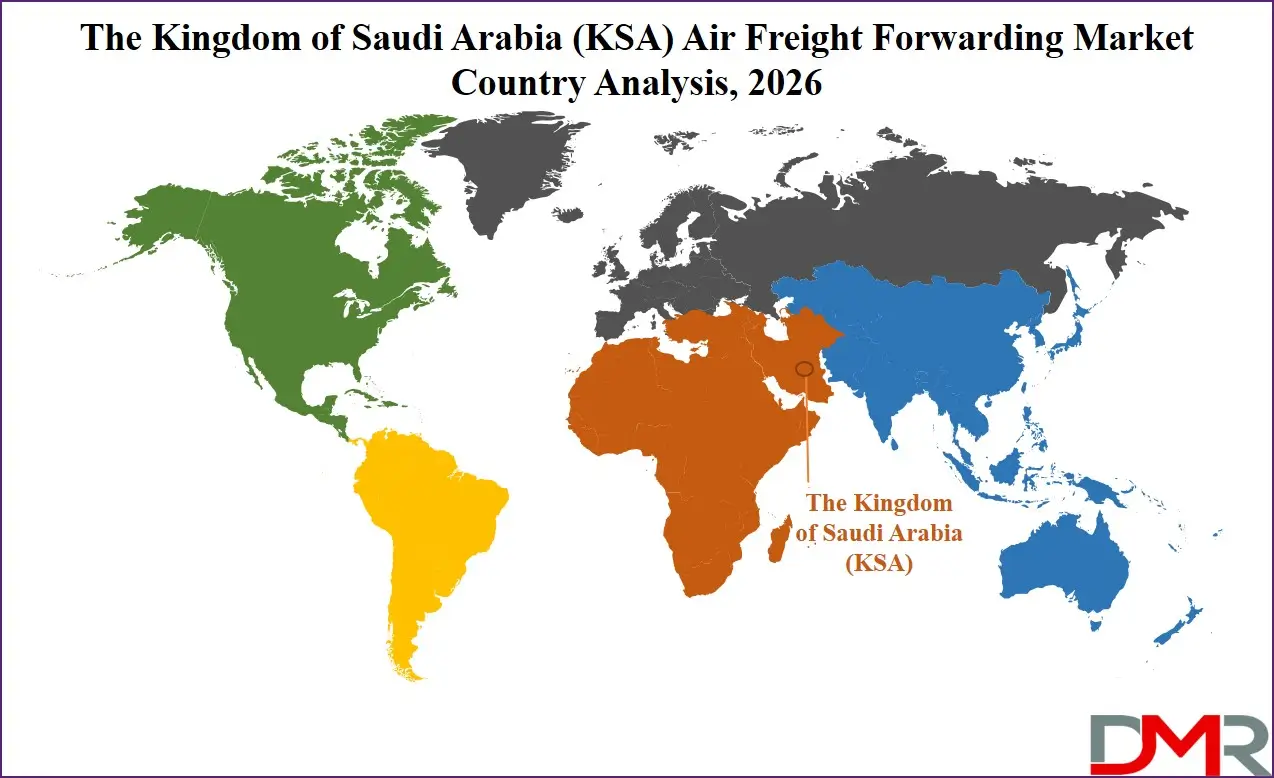
The air freight forwarding market is an important part of the economic development of the Kingdom of Saudi Arabia, led by the highly ambitious Vision 2030. Strategically located at the crossroads between Asia, Africa, and Europe, Saudi Arabia occupies a privileged position in its emergence as a key global hub for logistics and air cargo connectivity. The sector covers a wide range of freight solutions, from general cargo and specialized cold-chain shipments to time-critical express deliveries and charter services, which are important in facilitating international trade and supporting the growth of strategic sectors such as pharmaceuticals, automotive, and e-commerce. The government's commitment to diversifying the economy from oil dependency has resulted in substantial investment in logistics infrastructure and airport modernization, significantly transforming the air freight landscape.
Over the last few years, the air freight forwarding market of Saudi Arabia has witnessed a strategic transition in adopting advanced logistics technologies integrating digital platforms, IoT tracking, and automated cargo handling systems. These technologies are making freight operations more effective, developing real-time shipment visibility, facilitating easier cross-border trade, and further helping in the optimization of complex supply chains across industries. Also, with the rapid growth of e-commerce and mega-project imports like NEOM, the need for reliable air freight capacity has accelerated the demand to scale up companies' logistics capabilities. All these evolutions of technology and the market are likely to drive the sector's growth, signifying a good future outlook for the market.
Key trends currently evident within the air freight forwarding arena in Saudi Arabia are digital transitions taking hold of physical logistics by moving from traditional paper-based processes to agile-oriented, AI-driven freight management ecosystems. Aside from this, further integration of blockchain for documentation and sensor-based monitoring brings predictive shipment tracking and real-time decision-making with cost reductions along the value chain for better outputs of efficiency. Furthermore, with the augmenting emphasis on sustainability in line with Vision 2030, adaptation to fuel-efficient cargo operations and carbon-neutral logistics initiatives is on the rise. Similarly, the rise in pharmaceutical logistics has changed strategies for cold-chain distribution as healthcare providers try to meet expectations for precise and reliable temperature-controlled transportation.
ℹ
To learn more about this report –
Download Your Free Sample Report Here
The market is consequently witnessing huge opportunities on the back of high investments by the Saudi government in logistics infrastructure development. Initiatives such as the construction of new cargo terminals, logistics zones at airports, and integrated freight cities are creating a robust innovation backbone to support regional and international trade leadership. Megaprojects like NEOM City and the Red Sea Project illustrate the strategic importance of air freight forwarding in enabling Saudi Arabia's ambitious economic goals. The geographical position of the nation enhances its potential to become a global logistics hub, offering unparalleled access to key markets across three continents. Further, the focus on specialized services like pharmaceutical cold chain, hazardous material handling, and perishable cargo provides companies with opportunities to gain a competitive edge by improving service reliability and reducing transit times.
Still, some significant challenges may impede the market. Geopolitical instability in this region creates a threat to cross-border trade flows and the continuity of air freight routes, thereby threatening to put uncertainty into business. On the other hand, an emerging capacity constraint is appearing in the air freight sector amidst a growing shortage of dedicated cargo aircraft and warehousing space in key gateway airports. This factor may hamper the handling of peak season volumes. Other regulatory challenges include complex customs procedures and bureaucratic obstacles that make other difficulties worse and, hence, may discourage foreign investment in this market.
The Kingdom of Saudi Arabia (KSA) Air Freight Forwarding Market: Key Takeaways
- Market Size Insights: The Kingdom of Saudi Arabia (KSA) Air Freight Forwarding Market is estimated at USD 3.2 billion in 2026 and is projected to reach USD 4.9 billion by 2035, reflecting the country's increasing investments in logistics infrastructure, trade facilitation, and air cargo modernization.
- Market Growth Rate: The market is expected to grow at a CAGR of 5.1% from 2026 to 2035, driven by rapid trade expansion initiatives, e-commerce adoption, and the integration of digital freight platforms across multiple industries.
- Key Players: Major participants in the KSA Air Freight Forwarding Market include Saudia Cargo, Aramex, DHL Express, FedEx Express, UPS, Hellmann Worldwide Logistics, Kuehne+Nagel, DB Schenker, Agility Logistics, and CEVA Logistics, alongside emerging regional logistics companies and freight technology startups.
- Special Cargo as the Core Growth Driver: Special cargo is expected to dominate the KSA air freight forwarding market as industries increasingly require specialized handling for pharmaceuticals, perishables, and high-value goods to maintain product integrity and comply with regulatory standards.
- International as a Leading Destination: International air freight is projected to lead the destination segment, driven by Saudi Arabia's strong trade ties with Asia, Europe, and the Americas, as well as growing re-export activities through the Kingdom's advanced logistics hubs.
- Government Policy as a Catalyst: National initiatives including Saudi Vision 2030, the National Transport and Logistics Strategy (NTLS), and mega-project developments such as NEOM are accelerating the development and adoption of modern air freight forwarding services across the country.
Impact of the Iran Conflict on The Kingdom of Saudi Arabia (KSA) Air Freight Forwarding Market
- Potential Disruptions in Air Cargo Routes: Air freight forwarding relies on secure air corridors and regional overflight permissions. Regional geopolitical tensions may affect flight paths and routing options, potentially causing delays and increased operating costs for cargo carriers serving Saudi Arabia.
- Energy Market Volatility Influencing Logistics Investments: Fluctuations in global energy markets may influence industrial investment decisions and operational costs related to air freight infrastructure development within Saudi Arabia.
- Trade and Logistics Challenges in the Gulf Region: The Persian Gulf serves as a critical international air transit zone. Instability in the region may disrupt air cargo networks and transshipment operations, affecting the movement of goods requiring air freight services.
- Growing Demand for Defense and Emergency Logistics: Regional security concerns may increase investments in priority freight services for defense equipment, emergency supplies, and humanitarian cargo, which can accelerate the adoption of specialized air freight solutions in government and defense sectors.
The Kingdom of Saudi Arabia (KSA) Air Freight Forwarding Market: Use Cases
- Pharmaceutical Cold Chain Logistics: Saudi Arabia is expanding the use of temperature-controlled air freight solutions for vaccines, biologics, and sensitive medical supplies to enhance healthcare services and maintain cold-chain integrity throughout distribution.
- E-commerce and Parcel Delivery: The rapid growth of cross-border e-commerce is encouraging the adoption of express air freight services and last-mile delivery integration to streamline consumer goods movement and meet delivery expectations.
- Industrial Cargo and Project Logistics: Air freight technologies are being integrated into mega-project supply chains, enabling time-critical delivery of heavy equipment, machinery parts, and specialized materials for construction and industrial development.
- Perishable Goods Transportation: Air freight platforms are increasingly used for perishable cargo including fresh food, flowers, and agricultural products, particularly for export markets requiring rapid transit and temperature management.
- Automotive Parts and Aerospace Logistics: Air freight services are being deployed in automotive and aerospace supply chains, where they assist with just-in-time inventory management, aircraft on-ground (AOG) parts delivery, and maintenance component logistics.
The Kingdom of Saudi Arabia (KSA) Air Freight Forwarding Market: Stats & Facts
Saudi Ministry of Commerce
- Logistics and freight forwarding companies registered in Saudi Arabia reached 4,210 in 2023.
- The number of logistics-related firms increased from 3,280 companies in 2022.
Saudi Data and Artificial Intelligence Authority (SDAIA)
- Over 1 million Saudis have been trained in artificial intelligence and data skills through SDAIA programs, including logistics applications.
- More than 50 AI companies in the Kingdom have received accreditation certificates from SDAIA, including freight technology providers.
- SDAIA has launched multiple national initiatives to develop AI talent and innovation ecosystems for logistics optimization.
Global Logistics Performance Index
- Saudi Arabia ranks 5th globally in logistics connectivity improvement.
- The Kingdom ranks 1st in the Arab region for air freight infrastructure development and trade facilitation.
Stanford AI Index
- Saudi Arabia ranks among the top global countries for AI-related job growth in logistics and transportation.
- The country has experienced significant increases in AI hiring activity in recent years within freight and supply chain sectors.
Saudi Vision 2030 Program
- Saudi Vision 2030 includes approximately USD 20 billion allocated for logistics infrastructure modernization, including air cargo facilities.
- Around USD 8.5 billion has been allocated for digital trade facilitation and supply chain technology initiatives in Saudi Arabia.
- Vision 2030 identifies logistics and air freight as strategic sectors for economic diversification.
Saudi Ministry of Transport and Logistics Services
- The transport and logistics sector contributes around 10% to Saudi Arabia's GDP.
- Saudi Arabia aims to establish thousands of new logistics facilities under its National Transport and Logistics Strategy.
- Industry 4.0 technologies such as AI, robotics, and automation are being integrated into air freight development plans.
International Air Transport Association (IATA)
- Air cargo adoption in the Middle East is growing rapidly in e-commerce and pharmaceutical logistics sectors.
- Saudi Arabia is emerging as a key air freight hub in the regional logistics ecosystem.
International Telecommunication Union (ITU)
- Saudi Arabia ranks among the leading countries globally in digital government development for trade facilitation.
- The Kingdom has one of the most advanced digital infrastructure ecosystems in the Middle East for freight processing.
The Kingdom of Saudi Arabia (KSA) Air Freight Forwarding Market: Market Dynamics
Driving Factors in the Kingdom of Saudi Arabia (KSA) Air Freight Forwarding Market
Rapid Digital Transformation of Air Cargo and Logistics Operations
The air freight forwarding market in Saudi Arabia is experiencing accelerated digital transformation, driven by national initiatives under Saudi Vision 2030 aimed at building a globally competitive logistics ecosystem. Freight forwarders and logistics providers are increasingly adopting advanced technologies such as artificial intelligence, Internet of Things (IoT)-enabled tracking, and cloud-based freight management platforms to enhance air cargo operations. These technologies enable real-time shipment visibility, predictive route optimization, and automated documentation processes, including electronic air waybills (e-AWB). The integration of digital systems across airport cargo terminals and logistics networks is improving operational efficiency, reducing transit times, and strengthening Saudi Arabia’s position as a key regional air freight hub.
Growth of E-Commerce and Demand for Time-Definite Air Freight Services
The rapid expansion of e-commerce in Saudi Arabia is significantly increasing demand for air freight forwarding services, particularly for cross-border and time-sensitive shipments. Leading logistics providers such as Aramex and DHL are enhancing their express delivery and air cargo capabilities to meet rising consumer expectations for fast and reliable delivery. The growth in online retail is driving higher volumes of international shipments, prompting investments in automated sorting facilities, fulfillment centers, and integrated tracking platforms. This trend is reinforcing the role of air freight as a critical enabler of fast-moving supply chains and last-mile delivery networks in the Kingdom.
Restraints in The Kingdom of Saudi Arabia (KSA) Air Freight Forwarding Market
High Capital Requirements for Air Cargo Infrastructure Development
The development of advanced air freight infrastructure in Saudi Arabia requires substantial capital investment in cargo terminals, dedicated freighter aircraft, cold chain facilities, and automated handling systems. While government support remains strong, smaller logistics providers often face challenges in accessing the financial resources needed to invest in such infrastructure. This creates a competitive gap between large international forwarders and local small-to-medium enterprises, potentially limiting broader market participation and slowing the adoption of advanced air freight solutions.
Limited Dedicated Cargo Capacity and Airport Constraints
Despite ongoing infrastructure expansion, the availability of dedicated air cargo capacity in Saudi Arabia remains constrained, particularly during peak demand periods. Major airports such as King Khalid International Airport and King Abdulaziz International Airport experience capacity pressures due to increasing cargo volumes and limited freighter slots. A significant portion of cargo is still transported via belly space on passenger aircraft, which restricts flexibility and increases vulnerability to seasonal fluctuations. Addressing this challenge will require continued investment in dedicated cargo fleets, expanded airport infrastructure, and improved cargo handling capabilities.
Opportunities in The Kingdom of Saudi Arabia (KSA) Air Freight Forwarding Market
Adoption of Advanced Technologies and Smart Logistics Solutions
The growing adoption of advanced technologies presents significant opportunities for improving efficiency in air freight forwarding operations across Saudi Arabia. Solutions such as AI-driven route optimization, blockchain-based trade documentation, and IoT-enabled cargo monitoring are enhancing transparency, reducing operational costs, and improving shipment security. Digital freight platforms are also enabling better coordination between stakeholders, facilitating faster booking, tracking, and customs clearance processes. These innovations are transforming traditional air freight operations into more agile, data-driven logistics systems.
Expansion of Pharmaceutical and Temperature-Controlled Air Cargo
The increasing demand for temperature-sensitive pharmaceuticals, vaccines, and biologics is driving growth in cold chain air freight services in Saudi Arabia. Investments in refrigerated containers, specialized packaging, and real-time temperature monitoring systems are enabling forwarders to handle sensitive cargo with greater precision and compliance. As the Kingdom continues to strengthen its healthcare infrastructure and position itself as a regional medical hub, the need for reliable temperature-controlled air freight solutions is expected to rise significantly, creating opportunities for specialized logistics providers.
Trends in The Kingdom of Saudi Arabia (KSA) Air Freight Forwarding Market
Logistics Expansion under Vision 2030 and Mega Infrastructure Projects
Saudi Arabia’s focus on economic diversification under Saudi Vision 2030 is driving substantial investments in logistics and air freight infrastructure. Large-scale projects such as NEOM and Red Sea Global are generating significant demand for project cargo and time-sensitive shipments, increasing reliance on air freight forwarding services. Additionally, the development of Special Logistics Zones and modern cargo facilities is strengthening the Kingdom’s role as a major logistics hub connecting Asia, Europe, and Africa.
Advancement of Trade Facilitation and Air Cargo Modernization
Saudi Arabia is actively modernizing its trade and logistics ecosystem through initiatives such as the National Transport and Logistics Strategy, focusing on improving customs efficiency, digital freight platforms, and air cargo terminal expansion. Enhanced customs clearance systems, increased adoption of electronic documentation, and improved intermodal connectivity are reducing transit times and operational complexity. These developments are supporting smoother cross-border trade flows and enhancing the competitiveness of the Kingdom’s air freight forwarding market on a global scale.
The Kingdom of Saudi Arabia (KSA) Air Freight Forwarding Market: Research Scope and Analysis
By Cargo Type Analysis
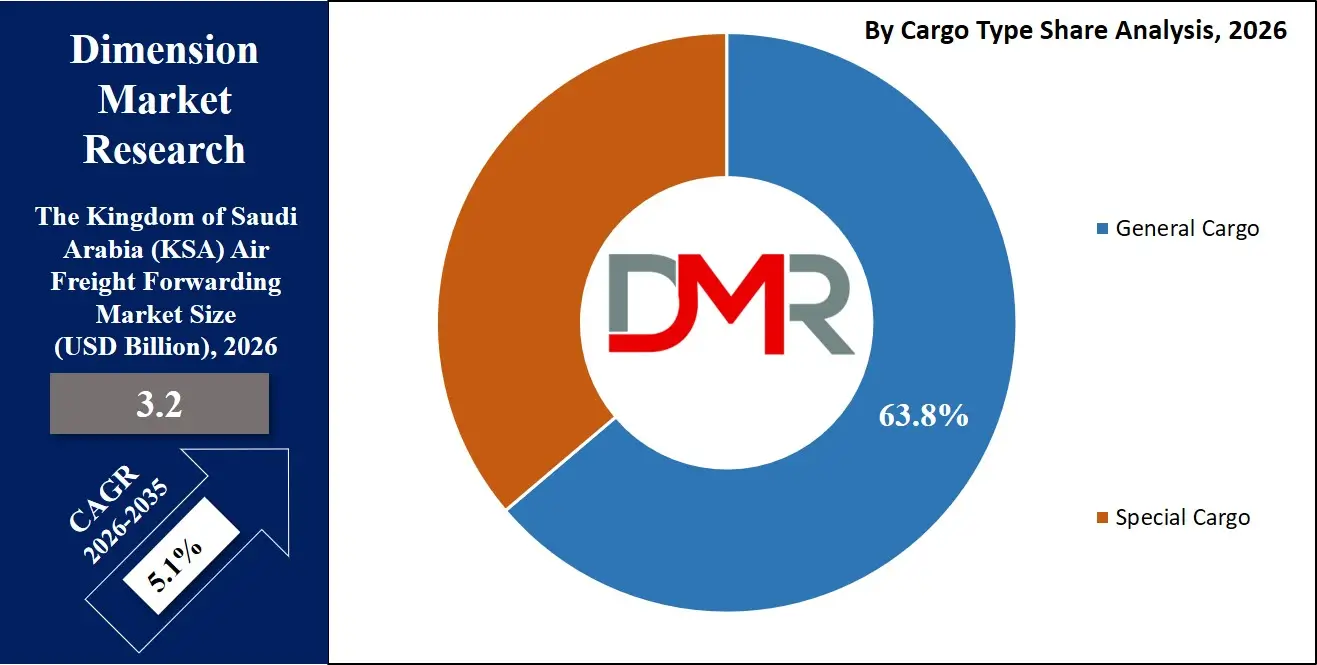
General cargo is projected to dominate the cargo type segment in the Kingdom of Saudi Arabia (KSA) air freight forwarding market, accounting for approximately 63.8% of the market share in 2026, while special cargo is expected to hold around 35.0%. The dominance of general cargo is primarily driven by the large-scale movement of industrial goods, machinery, consumer products, and e-commerce shipments across the Kingdom. Saudi Arabia’s expanding industrial base and increasing import-export activity contribute significantly to the volume of standard air freight shipments.
ℹ
To learn more about this report –
Download Your Free Sample Report Here
However, special cargo is witnessing steady growth, supported by rising investments in pharmaceutical manufacturing, healthcare infrastructure, and perishable goods trade. The demand for temperature-controlled logistics, secure handling of dangerous goods, and time-critical shipments is increasing, particularly under initiatives such as Saudi Vision 2030. This is accelerating the adoption of cold-chain logistics, pharmaceutical-grade handling systems, and advanced monitoring technologies. While special cargo remains a smaller segment, its importance is growing due to its high-value and compliance-driven nature, making it a key contributor to value-added air freight services in the Kingdom.
By Destination Analysis
International shipments are projected to dominate the destination segment in the Kingdom of Saudi Arabia (KSA) air freight forwarding market, supported by the country’s strong reliance on cross-border trade and its strategic positioning as a global logistics hub. Saudi Arabia maintains extensive trade relationships across Asia, Europe, and North America, facilitating the movement of high-value, time-sensitive goods such as electronics, pharmaceuticals, and industrial components through air freight. The expansion of cargo handling infrastructure and logistics zones near major hubs such as King Khalid International Airport and King Abdulaziz International Airport is significantly improving international shipment capacity and operational efficiency.
In addition, government-led initiatives under Saudi Vision 2030 are focused on enhancing customs digitization, trade facilitation, and multimodal connectivity, further strengthening international air freight operations. While domestic air freight is gradually expanding due to regional trade and e-commerce distribution, it remains limited in scale compared to international movements. The need for rapid, reliable, and long-distance transportation continues to position international air freight as the dominant segment, particularly for industries that rely on global supply chain integration and time-definite delivery requirements.
By Customer Type Analysis
Business-to-Business (B2B) is projected to dominate the customer type segment in the KSA air freight forwarding market, as a substantial portion of air cargo demand originates from industrial enterprises, manufacturers, and large-scale commercial operations. Key sectors such as oil & gas, industrial manufacturing, automotive, and construction rely heavily on air freight for the transportation of critical machinery, spare parts, and high-value equipment that require timely and secure delivery. These shipments often involve complex logistics planning, specialized handling, and strict delivery timelines, making air freight a preferred mode of transportation for B2B operations.
On the other hand, the Business-to-Consumer (B2C) segment is witnessing rapid growth, driven by the increasing penetration of e-commerce and rising consumer expectations for faster delivery services. Cross-border online shopping is accelerating demand for express air freight and integrated last-mile delivery solutions, prompting logistics providers to invest in digital platforms and fulfillment networks. Despite this growth, B2B continues to dominate due to higher shipment volumes, larger contract sizes, and consistent demand generated by industrial supply chains, which form the backbone of the Kingdom’s air freight forwarding market.
By Service Level Analysis
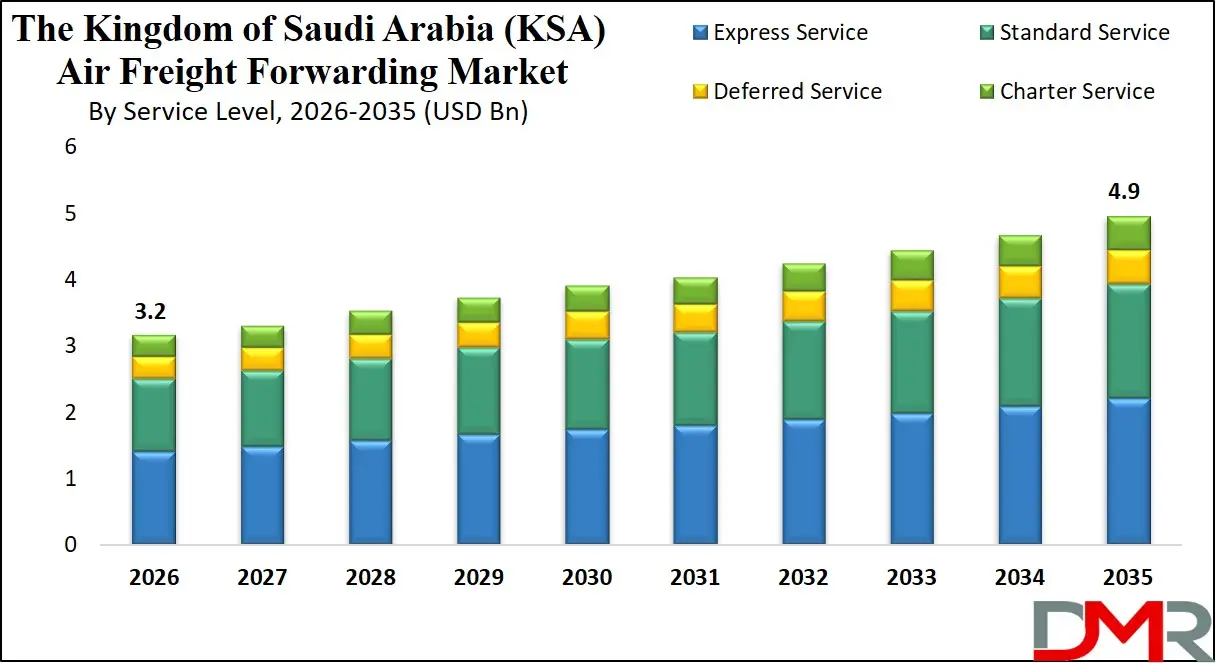
Standard service is expected to dominate the service level segment in the KSA air freight forwarding market, as it caters to the majority of shipments where cost efficiency and reliability are prioritized over speed. These services are widely used for general cargo, including industrial goods, consumer products, and bulk shipments that do not require immediate delivery. Standard air freight services provide an optimal balance between cost and transit time, making them the most preferred option for businesses managing large-scale logistics operations.
However, express services are gaining significant traction due to the rising demand for time-definite deliveries, particularly in sectors such as e-commerce, healthcare, and high-tech industries. The need for rapid transportation of pharmaceuticals, critical spare parts, and high-value goods is driving the adoption of premium air freight services. Deferred services offer economical alternatives for less urgent shipments, while charter services are increasingly utilized for specialized requirements such as oversized cargo, emergency shipments, and project logistics. The growth of large-scale infrastructure and energy projects in Saudi Arabia is further contributing to the demand for charter-based air freight solutions.
By Core Service Offering Analysis
Freight transportation is projected to dominate the core service offering segment in the KSA air freight forwarding market, as it represents the primary activity of moving goods across domestic and international routes. The increasing volume of imports and exports, coupled with the growing demand for time-sensitive shipments, continues to drive the need for efficient and reliable air cargo transportation services. Air freight forwarders play a crucial role in coordinating shipments, optimizing routes, and ensuring timely delivery across global supply chains.
In addition to transportation, other service offerings are gaining importance as companies seek end-to-end logistics solutions. Warehousing and distribution services are expanding with the development of modern logistics hubs and fulfillment centers across the Kingdom. Customs brokerage services are becoming increasingly critical in navigating complex trade regulations and ensuring smooth clearance processes. Freight consolidation enables cost optimization by combining multiple shipments, while value-added logistics services such as packaging, labeling, and real-time tracking enhance supply chain visibility and operational efficiency, making them integral components of modern air freight forwarding.
By End-Use Industry Analysis
Industrial manufacturing is projected to dominate the end-use industry segment in the KSA air freight forwarding market, driven by the Kingdom’s strong focus on infrastructure development, industrial expansion, and economic diversification. The transportation of machinery, equipment, and industrial components generates substantial demand for air freight services, particularly for time-sensitive and high-value shipments that require reliable and rapid delivery. Large-scale projects in construction, energy, and manufacturing further contribute to the consistent demand for air cargo solutions.
The healthcare sector is emerging as a high-growth segment, supported by increasing demand for pharmaceutical logistics, vaccines, and temperature-sensitive medical products. Similarly, the retail and e-commerce sector is expanding rapidly due to rising digital adoption and consumer demand for fast delivery services. Other industries such as food & beverage, high-tech & electronics, automotive, aerospace & defense, and agriculture also contribute to market growth by requiring specialized air freight solutions for perishable, fragile, and high-value goods. This diverse industry demand strengthens the overall growth and resilience of the air freight forwarding market in Saudi Arabia.
The Kingdom of Saudi Arabia (KSA) Air Freight Forwarding Market Report is segmented on the basis of the following:
By Cargo Type
- General Cargo
- Special Cargo
By Destination
By Customer Type
- Business-to-Business (B2B)
- Business-to-Consumer (B2C)
By Service Level
- Standard Service
- Express Service
- Deferred Service
- Charter Service
By Core Service Offering
- Freight Transportation
- Warehousing & Distribution
- Customs Brokerage
- Freight Consolidation
- Value-Added Logistics Services
By End-Use Industry
- Healthcare
- Food & Beverage
- High-Tech & Electronics
- Automotive
- Retail & E-commerce
- Aerospace & Defense
- Agriculture
- Industrial Manufacturing
The Kingdom of Saudi Arabia (KSA) Air Freight Forwarding Market: Competitive Landscape
The competitive landscape is fueled by participation, both domestic and international, in the Kingdom of Saudi Arabia Air Freight Forwarding Market, with dissimilar capabilities across freight operations, logistics technologies, and infrastructure. Major companies, therefore, strategize to develop advanced services such as cold-chain logistics, express delivery, and digital freight platforms to enhance air forwarding operations to better competitiveness. The leading players are Logistics Services and DHL Express in integrated logistics, while in specialized forwarding, the leading players include Kuehne+Nagel, DB Schenker, and local freight forwarders. These companies leverage Saudi Arabia's Vision 2030 initiatives by aligning their offerings with government priorities meant to attract investments and improve trade facilitation. It addresses both rising healthcare and e-commerce sectors where these focus more on niche capabilities: pharmaceutical logistics and cross-border parcel delivery, while third-party logistics providers have emerged, providing end-to-end solutions in warehousing and distribution.
ℹ
To learn more about this report –
Download Your Free Sample Report Here
Mergers and partnerships are common strategies that allow companies to expand service portfolios and reach. For instance, global forwarders partnering with local logistics providers enhance last-mile connectivity and operational agility. While the leading companies are competitive, innovation in the fields of cold-chain monitoring, autonomous freight tracking, and predictive analytics separates the leaders. These opportunities are likely to come along with an intense competitive landscape for both established players and new entrants, with strong governmental support for developing logistics zones.
Some of the prominent players in The Kingdom of Saudi Arabia (KSA) Air Freight Forwarding Market are:
- Saudi Logistics Services (SAL)
- Bahri Logistics
- DHL Global Forwarding
- Kuehne + Nagel
- DB Schenker
- DSV A/S
- Aramex
- Agility Logistics
- CEVA Logistics
- GEODIS
- Expeditors International
- UPS Supply Chain Solutions
- FedEx Logistics
- Almajdouie Logistics
- Nesma Logistics
- Globe Marine Services
- Al-Futtaim Logistics
- Kanoo Logistics
- Mosanada Logistics Services
- SMSA Express
- Other Key Players
Recent Developments in the Kingdom of Saudi Arabia (KSA) Air Freight Forwarding Market
- February 2026: Saudia Cargo reported handling over 573,000 tonnes of air freight in 2025, supported by network expansion, new cargo routes to Zhengzhou and Milan, and the planned induction of Airbus A330 freighters to enhance capacity and strengthen global connectivity.
- January 2026: Riyadh Air launched its cargo operations as part of Saudi Arabia’s broader logistics expansion strategy, leveraging a large wide-body aircraft order book to connect over 100 global destinations and strengthen the Kingdom’s role in international air freight.
- November 2025: Saudi Logistics Services (SAL) signed multiple strategic agreements, including partnerships with FedEx and Emirates SkyCargo, to enhance ground handling, improve cargo efficiency, and strengthen Saudi Arabia’s position as a regional air freight hub through expanded international connectivity.
- March 2025: Saudi Logistics Services (SAL) announced a USD 1.1 billion investment to develop a major logistics zone in Riyadh under the Shareek program, aimed at expanding cargo handling capacity, improving infrastructure, and supporting the Kingdom’s ambition to become a global logistics hub.
- June 2025: DHL Group announced an investment of over USD 577.3 million across Middle East markets, including Saudi Arabia, to expand logistics infrastructure, enhance air freight capacity, and strengthen regional supply chain capabilities.
Report Details
| Report Characteristics |
| Market Size (2026) |
USD 3.2 Bn |
| Forecast Value (2035) |
USD 4.9 Bn |
| CAGR (2026–2035) |
5.1% |
| Historical Data |
2021 – 2025 |
| Forecast Data |
2027 – 2035 |
| Base Year |
2025 |
| Estimate Year |
2026 |
| Report Coverage |
Market Revenue Estimation, Market Dynamics, Competitive Landscape, Growth Factors and etc. |
| Segments Covered |
By Cargo Type (General Cargo and Special Cargo), By Destination (Domestic and International), By Customer Type (Business-to-Business (B2B) and Business-to-Consumer (B2C)), By Service Level (Standard Service, Express Service, Deferred Service, Charter Service), By Core Service Offering (Freight Transportation, Warehousing & Distribution, Customs Brokerage, Freight Consolidation, and Value-Added Logistics Services), By End-Use Industry (Healthcare, Food & Beverage, High-Tech & Electronics, Automotive, Retail & E-commerce, Aerospace & Defense, Agriculture, and Industrial Manufacturing) |
| Country Coverage |
The Kingdom of Saudi Arabia (KSA) |
| Prominent Players |
Saudi Logistics Services (SAL), Bahri Logistics, DHL Global Forwarding, Kuehne + Nagel, DB Schenker, DSV A/S, Aramex, Agility Logistics, CEVA Logistics, GEODIS, Expeditors International, UPS Supply Chain Solutions, FedEx Logistics, Almajdouie Logistics, Nesma Logistics, Globe Marine Services, Al-Futtaim Logistics, Kanoo Logistics, Mosanada Logistics Services, SMSA Express, and Other Key Players |
| Purchase Options |
We have three licenses to opt for: Single User License (Limited to 1 user), Multi-User License (Up to 5 Users), and Corporate Use License (Unlimited User) along with free report customization equivalent to 0 analyst working days, 3 analysts working days and 5 analysts working days respectively. |
Frequently Asked Questions
How big is the Kingdom of Saudi Arabia's Air Freight Forwarding Market?
▾ The Kingdom of Saudi Arabia Air Freight Forwarding Market size is estimated to have a value of USD 3.2 billion in 2026 and is expected to reach USD 4.9 billion by the end of 2035.
Who are the key players in the Kingdom of Saudi Arabia Air Freight Forwarding Market?
▾ Some of the major key players in the Kingdom of Saudi Arabia Air Freight Forwarding Market are Saudi Logistics Services (SAL), Bahri Logistics, DHL Global Forwarding, Kuehne + Nagel, DB Schenker, DSV A/S, Aramex, and many others.
What is the growth rate in the Kingdom of Saudi Arabia Air Freight Forwarding Market?
▾ The market is growing at a CAGR of 5.1% over the forecasted period.