What is the Saudi Arabia Automotive Adaptive Front Lighting System Market Size?
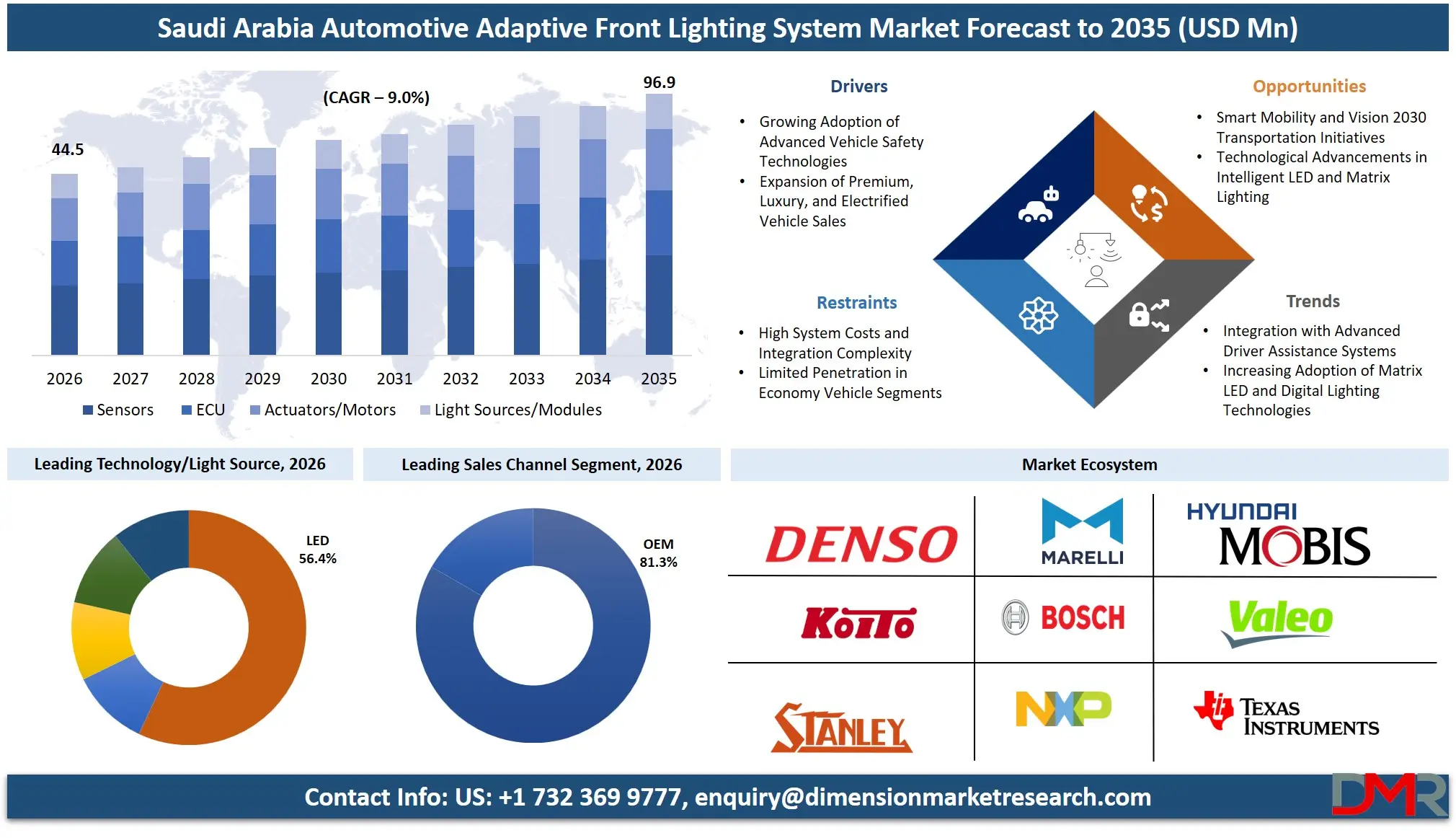
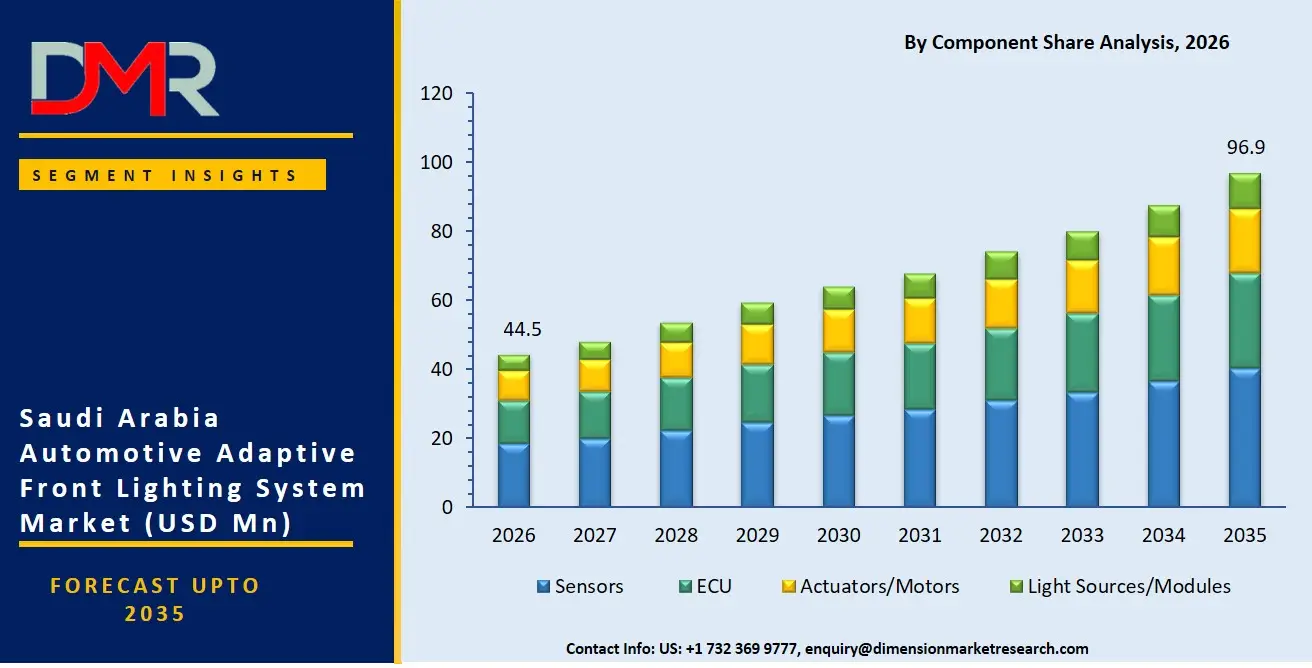
The Saudi Arabia Automotive Adaptive Front Lighting System Market size is expected to be USD 44.5 million in 2026 and increase at a compound annual growth rate of 9.0% to USD 96.9 million in 2035 owing to expansion of premium, luxury, and electrified vehicle sales.
ℹ
To learn more about this report –
Download Your Free Sample Report Here
The Saudi Arabia Automotive Adaptive Front Lighting System Market comprises advanced vehicle lighting technologies designed to automatically adjust beam direction, intensity, and distribution according to driving conditions, road geometry, weather, and surrounding traffic. The market includes electronic control units, sensors, actuators, intelligent light modules, and software-enabled lighting solutions integrated into passenger and commercial vehicles. Rising vehicle safety awareness, increasing production and sales of premium automobiles, and growing adoption of LED and matrix lighting technologies are strengthening market demand. Continuous investments in smart mobility, automotive digitalization, and advanced driver assistance systems (ADAS), together with supportive transportation modernization initiatives under Vision 2030, are further encouraging the deployment of adaptive front lighting technologies across Saudi Arabia.
Key Takeaways
- Market Size & Forecast: The Saudi Arabia Automotive Adaptive Front Lighting System Market size is projected to reach USD 44.5 million in 2026 and is anticipated to have a value of USD 96.9 million in 2035.
- Growth Rate & Outlook: The Saudi Arabia Automotive Adaptive Front Lighting System Market size is set to grow at a compound annual growth rate of 9.0% during the forecast period of 2026 to 2035.
- Primary Growth Drivers: Some of the major growth drivers in the market are Expansion of Premium, Luxury, and Electrified Vehicle Sales, and more.
- Key Market Trends: Some of the major trends in the market are Increasing Adoption of Matrix LED and Digital Lighting Technologies and more.
- By Component Type: Sensors is expected to get the largest revenue share in 2026 in the Saudi Arabia Automotive Adaptive Front Lighting System Market.
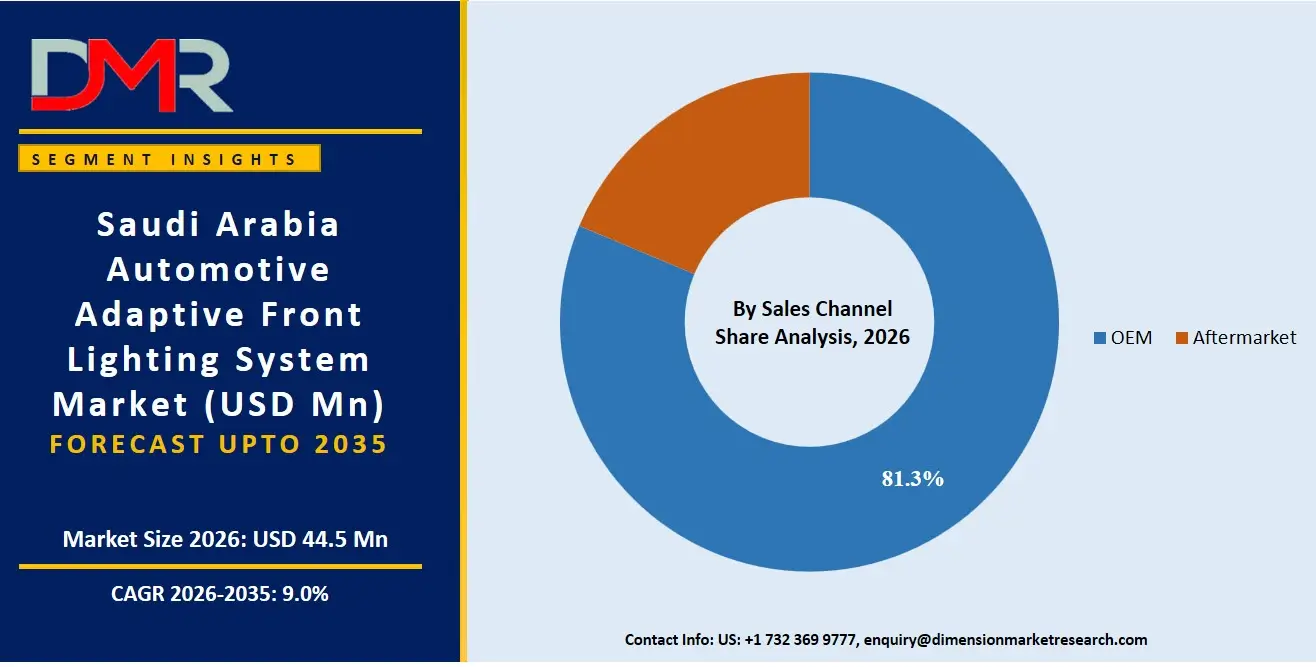
- By Sales Channel Type: OEM is expected to get the largest revenue share in 2026 in the Saudi Arabia Automotive Adaptive Front Lighting System Market.
- By Technology/Light Source Type: LED segment is expected to get the largest revenue share in 2026 in the Saudi Arabia Automotive Adaptive Front Lighting System Market.
What is the Saudi Arabia Automotive Adaptive Front Lighting System?
An automotive adaptive front lighting system is an intelligent vehicle lighting technology that dynamically adjusts headlamp direction, beam pattern, brightness, and illumination range according to vehicle speed, steering angle, road curvature, weather conditions, and surrounding traffic. The system combines electronic control units, sensors, actuators, and advanced light sources to improve nighttime visibility, reduce glare for oncoming drivers, enhance driving comfort, and strengthen overall road safety across diverse driving environments.
Use Cases
- Night-Time Highway Driving: Adaptive front lighting systems automatically extend illumination distance and optimize beam distribution during high-speed highway driving. This enables drivers to identify road hazards, lane markings, and distant obstacles earlier while reducing glare for approaching vehicles, thereby improving driving confidence and overall road safety.
- Urban and City Navigation: In urban environments, adaptive lighting adjusts beam width and intensity to illuminate pedestrians, cyclists, intersections, and roadside objects more effectively. The technology enhances visibility during low-speed maneuvers while supporting safer navigation through congested streets and densely populated commercial districts.
- Adverse Weather Operations: During rain, fog, dust storms, or low-visibility conditions common in parts of Saudi Arabia, adaptive lighting systems modify beam patterns to minimize light reflection and maximize road illumination. This improves driver visibility, reduces eye strain, and contributes to safer vehicle operation under challenging weather conditions.
- Premium and Electric Vehicles: Luxury vehicles and electric vehicles increasingly integrate adaptive front lighting with ADAS technologies to deliver intelligent lighting functions such as matrix beam control, automatic high-beam assistance, and curve lighting. These capabilities enhance vehicle safety, energy efficiency, and driving experience while supporting advanced vehicle automation.
How AI Is Transforming the Saudi Arabia Automotive Adaptive Front Lighting System Market
Artificial intelligence is transforming adaptive front lighting systems by enabling real-time analysis of driving environments using cameras, sensors, radar, and vehicle data. AI algorithms continuously evaluate road curvature, traffic density, weather conditions, pedestrian movement, and vehicle speed to optimize lighting patterns automatically. This improves nighttime visibility while reducing glare for other road users.
AI also enhances predictive maintenance, intelligent diagnostics, and software-driven lighting optimization. Machine learning models improve beam accuracy through continuous learning from driving scenarios, while AI-enabled sensor fusion supports seamless integration with advanced driver assistance systems. These capabilities increase operational efficiency, strengthen vehicle safety, reduce energy consumption, and improve the overall driving experience across both conventional and electric vehicles.
Market Dynamic
Driving Factors in the Saudi Arabia Automotive Adaptive Front Lighting System Market
Expansion of Premium, Luxury, and Electrified Vehicle Sales
Saudi Arabia is witnessing steady growth in luxury vehicles, premium SUVs, and electric vehicles that typically feature advanced lighting technologies. Automotive manufacturers are differentiating their products through intelligent lighting capabilities such as matrix LED systems, adaptive driving beams, and automatic leveling functions. Improvements in semiconductor technologies, LED efficiency, and electronic control systems are reducing integration complexity while enhancing performance, making adaptive front lighting increasingly attractive across multiple vehicle categories.
Restraints in the Saudi Arabia Automotive Adaptive Front Lighting System Market
High System Costs and Integration Complexity
Adaptive front lighting systems require sophisticated electronic control units, sensors, precision actuators, and intelligent software algorithms, increasing vehicle production costs. The higher purchase price limits adoption among cost-sensitive buyers, particularly in entry-level passenger vehicles. Additionally, system calibration, maintenance requirements, and compatibility with vehicle electronic architectures create implementation challenges for manufacturers and aftermarket service providers.
Opportunities in the Saudi Arabia Automotive Adaptive Front Lighting System Market
Technological Advancements in Intelligent LED and Matrix Lighting
Rapid innovation in LED, OLED, laser lighting, and software-controlled beam management presents substantial opportunities for manufacturers. Intelligent lighting capable of communicating with cameras, radar, and vehicle navigation systems enables improved road illumination while enhancing energy efficiency. Continuous advances in artificial intelligence, sensor fusion, and digital lighting technologies are expected to create differentiated products targeting both premium and mid-range vehicle segments.
Trends in the Saudi Arabia Automotive Adaptive Front Lighting System Market
Increasing Adoption of Matrix LED and Digital Lighting Technologies
Automotive manufacturers are shifting from conventional halogen and HID systems toward LED, matrix LED, and digital lighting solutions offering superior efficiency and precision. Matrix lighting enables selective beam control that minimizes glare while maintaining maximum road illumination. Continuous innovation in programmable lighting modules and software-defined vehicle architectures is expected to further transform adaptive lighting capabilities throughout Saudi Arabia.
Research Scope and Analysis
The research evaluates the Saudi Arabia Automotive Adaptive Front Lighting System Market across key segments, including component, technology, product type, function, vehicle type, and sales channel. It examines market trends, growth drivers, competitive dynamics, technological advancements, adoption patterns, and future opportunities to provide comprehensive insights into current performance and long-term market potential.
ℹ
To learn more about this report –
Download Your Free Sample Report Here
By Component Analysis
Among components, Sensors are estimated to hold the leading market share of 41.8% in 2026, as they form the foundation of adaptive front lighting systems by collecting real-time information related to steering angle, vehicle speed, ambient light, traffic conditions, and road geometry.
ℹ
To learn more about this report –
Download Your Free Sample Report Here
Cameras and radar sensors are increasingly integrated with electronic control units to enable intelligent beam adjustment and seamless interaction with advanced driver assistance systems. Their widespread adoption across premium passenger vehicles and the growing penetration of semi-autonomous driving features reinforce their dominant position. Meanwhile, Electronic Control Units (ECUs) are projected to be the fastest-growing segment, supported by increasing software complexity, AI-enabled lighting algorithms, and higher computing requirements for adaptive lighting functions. As vehicle manufacturers continue integrating centralized vehicle architectures and software-defined platforms, demand for advanced ECUs capable of processing multiple sensor inputs simultaneously is expected to accelerate, supporting continuous innovation in adaptive lighting technologies throughout Saudi Arabia.
By Technology / Light Source Analysis
LED (Light-Emitting Diode) technology is expected to account for the largest market share of approximately 56.4% in 2026, driven by superior energy efficiency, longer operational life, compact design, faster response time, and compatibility with intelligent adaptive lighting systems. LED technology enables precise beam control, supports matrix lighting functions, and consumes significantly less power than conventional halogen or HID solutions, making it the preferred choice for modern passenger cars, SUVs, and electric vehicles. Increasing production of premium vehicles and tightening automotive safety expectations further strengthen LED adoption. Laser lighting is anticipated to register the fastest growth during the forecast period due to its exceptional illumination range, compact packaging, and ability to complement matrix LED systems in high-end vehicles. Continued investment in intelligent lighting innovation and premium automotive technologies is expected to expand laser lighting adoption as manufacturing costs gradually decline and technological maturity improves.
By Product Type Analysis
Adaptive Driving Beam (ADB) systems are projected to dominate the Saudi Arabia Automotive Adaptive Front Lighting System Market with an estimated 38.7% market share in 2026. Their leadership is supported by the ability to automatically adjust high-beam illumination while selectively preventing glare for oncoming and preceding vehicles. ADB technology significantly enhances nighttime driving safety without requiring manual intervention, making it increasingly attractive for premium and technologically advanced vehicles. Growing consumer demand for enhanced driving comfort and intelligent safety systems is further accelerating adoption. At the same time, Matrix/Pixel Lighting is expected to emerge as the fastest-growing product segment owing to its capability to independently control numerous LED elements for highly precise illumination patterns. As automotive manufacturers continue investing in digital lighting technologies and software-controlled vehicle platforms, matrix lighting is anticipated to gain rapid acceptance across luxury models and, eventually, upper mid-range vehicle segments as production costs become more competitive.
By Function Analysis
Among functional applications, High Beam Assist / Glare-Free High Beam is estimated to hold the largest market share of 34.9% in 2026, owing to its significant contribution to nighttime driving safety and driver convenience. The technology automatically switches or selectively adjusts high-beam intensity to maximize road visibility while preventing glare for oncoming and preceding vehicles. Increasing consumer preference for advanced safety features, coupled with the growing integration of camera-based sensing systems and adaptive driving technologies, continues to strengthen demand for this function. Meanwhile, Adverse Weather Lighting is projected to be the fastest-growing segment during the forecast period. Saudi Arabia's occasional fog, heavy rainfall, and dust storms create challenging driving conditions where adaptive beam optimization substantially improves visibility. Continued advancements in sensor fusion, weather recognition algorithms, and intelligent lighting control systems are expected to accelerate adoption of this function across both premium and mid-range vehicle categories.
By Vehicle Analysis
Passenger Cars are expected to account for the largest share of the Saudi Arabia Automotive Adaptive Front Lighting System Market, representing an estimated 62.8% of the market in 2026. Their dominance is attributed to high passenger vehicle ownership, increasing demand for technologically advanced SUVs and luxury sedans, and growing consumer awareness regarding vehicle safety and comfort. Automotive manufacturers are increasingly incorporating adaptive lighting technologies into premium trims to differentiate their offerings and comply with evolving safety expectations. Within the passenger car category, SUVs are witnessing particularly strong adoption because of rising consumer preference for larger and feature-rich vehicles. Electric Vehicles (EVs) are anticipated to be the fastest-growing segment during the forecast period, supported by expanding investments in sustainable mobility, increasing availability of premium electric models, and the integration of intelligent electronic architectures that seamlessly support advanced lighting systems. As EV adoption continues to accelerate under Saudi Arabia's long-term mobility initiatives, adaptive lighting penetration is expected to increase significantly.
By Sales Channel Analysis
The OEM (Original Equipment Manufacturer) segment is projected to dominate the market with an estimated 81.3% share in 2026, primarily because adaptive front lighting systems require seamless integration with vehicle electronics, sensors, electronic control units, and advanced driver assistance systems during the manufacturing process. OEM-installed systems offer superior calibration, software compatibility, warranty support, and compliance with manufacturer specifications, making them the preferred choice for both manufacturers and consumers. The increasing production and import of premium vehicles equipped with intelligent lighting solutions further reinforce OEM leadership. In contrast, the Aftermarket segment is expected to record the fastest growth throughout the forecast period. Rising consumer interest in upgrading vehicle safety features, expanding availability of compatible retrofit kits, improvements in installation services, and growing awareness of intelligent lighting technologies are encouraging aftermarket demand. Technological advancements that simplify system integration and reduce installation complexity are also expected to support sustained expansion of aftermarket adaptive lighting solutions.
The Saudi Arabia Automotive Adaptive Front Lighting System Market Report is segmented on the basis of the following:
By Component
- Electronic Control Unit (ECU)
- Sensors
- Camera
- Radar
- Steering Angle Sensor
- Speed Sensor
- Actuators / Motors
- Light Sources / Modules
By Technology / Light Source
- Halogen
- Xenon / HID (High-Intensity Discharge)
- LED (Light-Emitting Diode)
- OLED (Organic LED)
- Laser
By Product Type
- Static Adaptive Front Lighting
- Dynamic / Bending Light
- Matrix / Pixel Lighting
- Adaptive Driving Beam (ADB)
By Function
- Cornering / Curve Lighting
- High Beam Assist / Glare-Free High Beam
- Automatic Headlight Leveling
- Highway Lighting
- City Lighting
- Adverse Weather Lighting
By Vehicle Type
- Passenger Cars
- Hatchback
- Sedan
- SUV
- Luxury Vehicles
- Light Commercial Vehicles (LCV)
- Heavy Commercial Vehicles (HCV)
- Electric Vehicles (EVs)
By Sales Channel
- OEM (Original Equipment Manufacturer)
- Aftermarket
Competitive Landscape
The Saudi Arabia Automotive Adaptive Front Lighting System Market is characterized by continuous technological innovation, increasing integration of intelligent lighting with advanced driver assistance systems, and strong emphasis on product differentiation. Market participants primarily compete through investments in research and development, software-defined lighting platforms, sensor integration, energy-efficient LED and laser technologies, and collaborations with automotive OEMs. High certification requirements, complex vehicle integration processes, and substantial engineering investments create significant barriers to entry for new participants. Companies are also strengthening their competitive position through strategic partnerships, localization initiatives, manufacturing optimization, and the development of scalable adaptive lighting platforms that support both premium and mass-market vehicle segments. The growing transition toward connected, electric, and software-defined vehicles is further intensifying competition and encouraging continuous innovation.
Some of the prominent players in the Saudi Arabia Automotive Adaptive Front Lighting System are:
- Koito Manufacturing Co., Ltd.
- Stanley Electric Co., Ltd.
- Marelli Holdings Co., Ltd.
- Denso Corporation
- Valeo
- Forvia Hella
- ams-OSRAM
- ZKW Group
- SL Corporation
- Hyundai Mobis
- Continental AG
- Bosch
- Renesas Electronics Corporation
- Infineon Technologies
- NXP Semiconductors
- Texas Instruments
- Analog Devices
- Lumileds
- Nichia Corporation
- ROHM Co., Ltd.
- Other Key Players
Recent Developments
- In April 2025, Marelli unveiled its latest intelligent automotive lighting portfolio during Auto Shanghai 2025, highlighting innovations including the world's first OLED TFT-based Pixel Rear Lamp, Near-Field Ground Projection technology, and the Thin Lit Line Headlamp. These technologies are designed to enhance vehicle-to-environment communication, improve driver awareness, and support next-generation smart mobility solutions. The showcased systems emphasize software-controlled lighting, intelligent interaction, advanced optical performance, and greater design flexibility, demonstrating Marelli's commitment to expanding digital lighting capabilities for future passenger vehicles and advanced driver assistance applications.
- In April 2025, Valeo announced a strategic partnership with Appotronics to develop a new generation of automotive front lighting systems utilizing Appotronics' ALL-in-ONE full-color laser headlight technology. The partnership aims to integrate advanced laser projection with Valeo's lighting system design, electronic control units, and software capabilities to enhance Adaptive Driving Beam (ADB) functionality, road projection, and intelligent illumination. The compact solution is designed to improve nighttime visibility, minimize glare for oncoming traffic, and provide additional display and projection features, supporting safer and more intelligent driving experiences in future vehicle platforms.
- In March 2025, Valeo entered into a strategic collaboration with TactoTek to integrate In-Mold Structural Electronics (IMSE®) technology into next-generation automotive interior and exterior lighting solutions. Under the agreement, Valeo licensed TactoTek's IMSE technology to develop lightweight, compact, and highly integrated lighting systems that improve both design flexibility and manufacturing efficiency. The collaboration combines Valeo's expertise in automotive lighting, optical systems, and over-molding processes with TactoTek's structural electronics technology to support innovative smart lighting applications for global automotive OEMs and strengthen future adaptive lighting capabilities.
Report Details
| Report Characteristics |
| Market Size (2026) |
USD 44.5 Mn |
| Forecast Value (2035) |
USD 96.9 Mn |
| CAGR (2026–2035) |
9.0% |
| Historical Period |
2021 – 2025 |
| Forecast Period |
2027 – 2035 |
| Base Year |
2025 |
| Estimate Year |
2026 |
| Segments Covered |
By Component, By Technology / Light Source, By Product Type, By Function, By Vehicle Type, By Sales Channel |
| Country Coverage |
Saudi Arabia |
Frequently Asked Questions
How big is the Saudi Arabia Automotive Adaptive Front Lighting System Market?
▾ The Saudi Arabia Automotive Adaptive Front Lighting System Market size is expected to reach USD 44.5 million by 2026 and is projected to reach USD 96.9 million by the end of 2035.
What is the CAGR of the Saudi Arabia Automotive Adaptive Front Lighting System Market from 2026 to 2035?
▾ The market is growing at a CAGR of 9.0 percent over the forecasted period.
What factors are driving the growth of the Saudi Arabia Automotive Adaptive Front Lighting System Market?
▾ Expansion of Premium, Luxury, and Electrified Vehicle Sales, and more are the factors driving the growth of the Saudi Arabia Automotive Adaptive Front Lighting System Market.
What are the major trends in the Saudi Arabia Automotive Adaptive Front Lighting System Market?
▾ Increasing Adoption of Matrix LED and Digital Lighting Technologies, and more are some of the major trends in the market.
Who are the key players in the Saudi Arabia Automotive Adaptive Front Lighting System Market?
▾ Some of the key players in the Saudi Arabia Automotive Adaptive Front Lighting System Market include Valeo, NXP, Bosch, and more
How is the Saudi Arabia Automotive Adaptive Front Lighting System Market segmented?
▾ The Saudi Arabia Automotive Adaptive Front Lighting System Market is segmented by component, technology / light source, product type, function, vehicle type, sales channel.