Market Overview
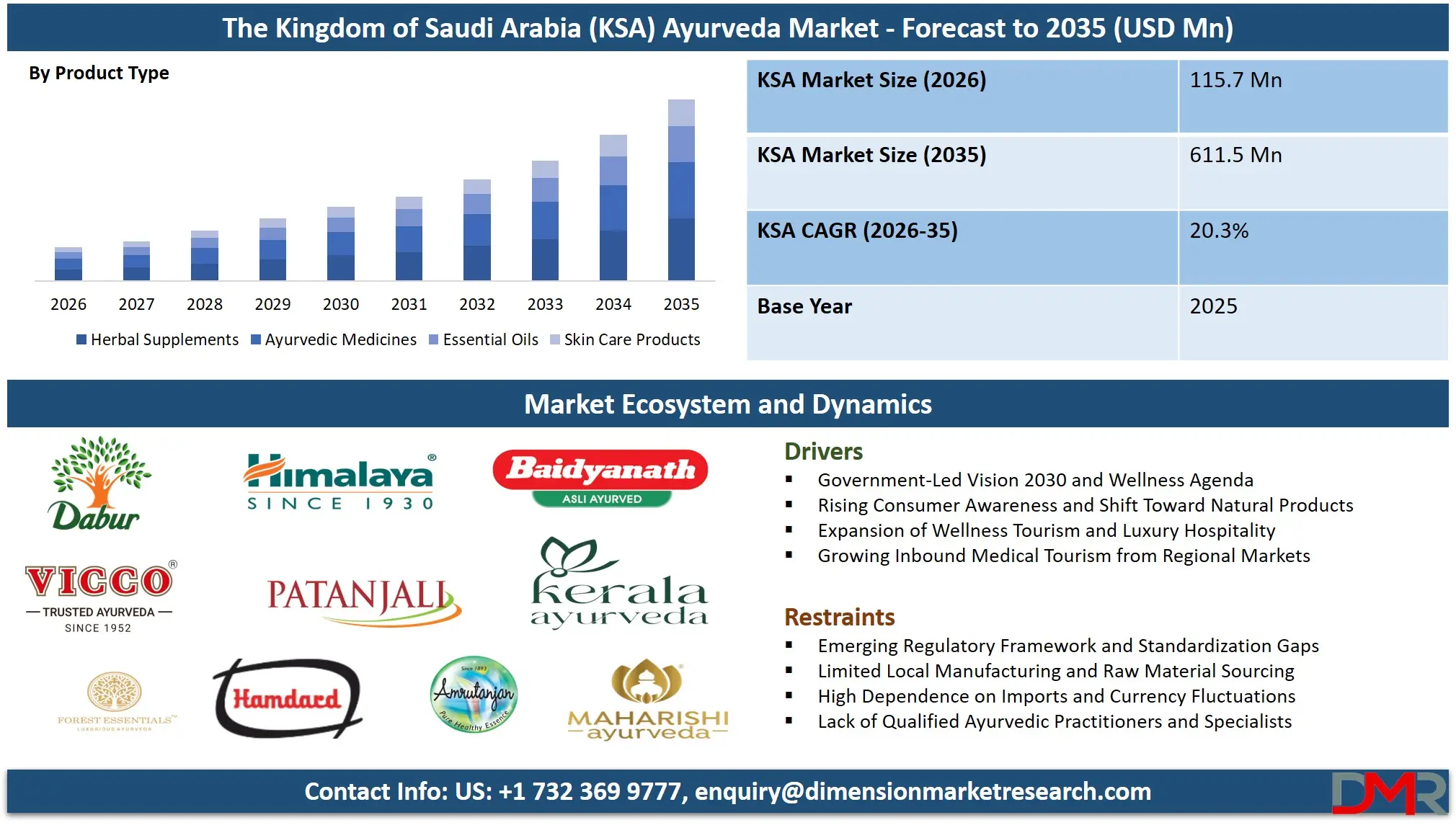
Saudi Arabia Ayurveda Market size is expected to reach a value of USD 115.7 million in 2026, and it is further anticipated to reach a market value of USD 611.5 million by 2035 at a CAGR of 20.3%.
ℹ
To learn more about this report –
Download Your Free Sample Report Here
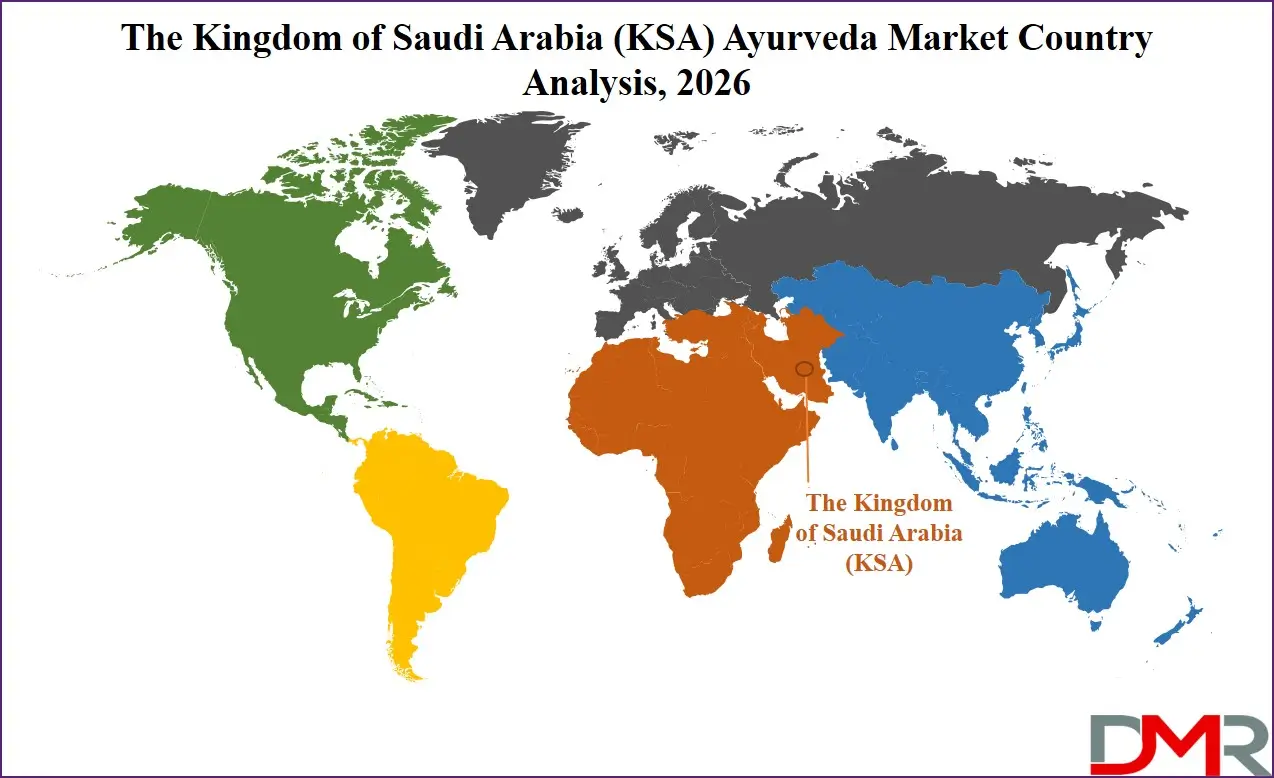
The KSA market on Ayurveda is among the fastest developing in the Middle East, as this region has ambitious wellness goals to be achieved by adopting vision 2030 and the national traditional medicine integration framework. As the population increasingly seeks preventive healthcare and natural alternatives to conventional medicine, the shift towards holistic wellness is being addressed by the private sector, as well as by the general population.
The practice of Ayurveda in KSA is becoming more advanced in the format of a national health security scenario and lifestyle diversification. The initiative taken by the government to promote complementary and alternative medicine, along with the development of mega projects like NEOM and Red Sea Projects, which are focused on wellness tourism, has created a huge demand for Ayurvedic products and therapies.
ℹ
To learn more about this report –
Download Your Free Sample Report Here
The Kingdom of Saudi Arabia (KSA) Ayurveda Market: Key Takeaways & Other Influencing Factors
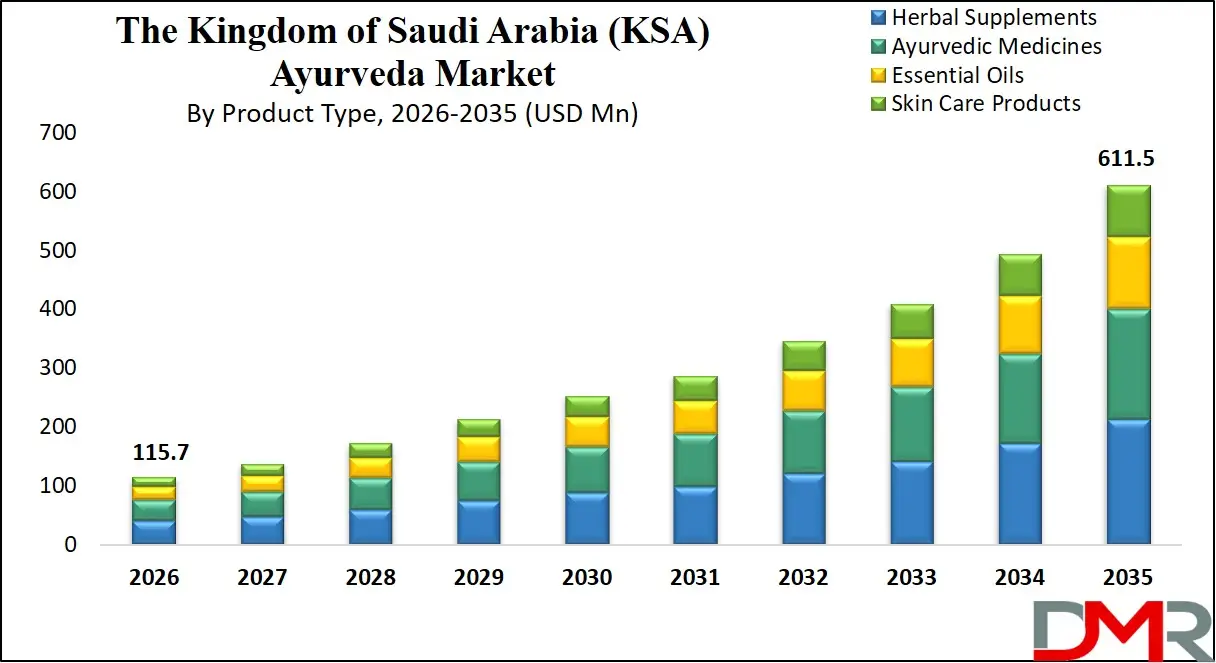
- Market Growth Insights: The market is anticipated to reach approximately USD 115.7 million in 2026 and is projected to expand to around USD 611.5 million by 2035, registering a CAGR of 20.3% during the forecast period.
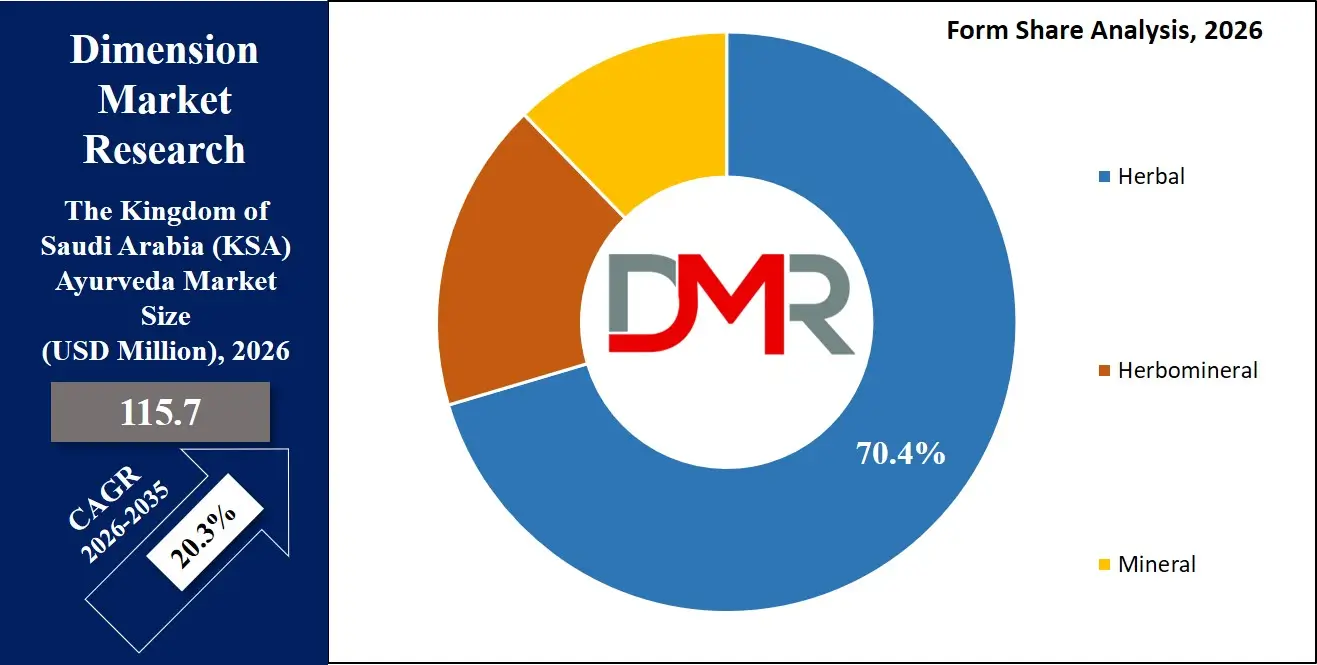
- By Form Insights: Herbal formulations, including single herbs and polyherbal combinations, are the dominant segment. Herbomineral products are rapidly gaining importance as the Kingdom seeks more potent therapeutic options.
- By Product Type Insights: Herbal supplements are projected to dominate the market, which has been fueled by the rising consumer focus on immunity and wellness. The most rapidly expanding segment is skin care products due to the growing demand for natural and organic personal care solutions.
- By Distribution Channel Insights: E-sales/online retail options are favored due to their convenience and wide product assortment, but retail & institutional sales are still applicable to government healthcare facilities and traditional retail chains.
- Saudi Green Initiative (SGI): The Saudi Green Initiative (SGI) aligns with the Ayurveda market by promoting sustainable sourcing of medicinal plants, which supports the local cultivation and availability of raw materials for Ayurvedic products.
- Ministry of Health (MOH), Saudi Arabia: KSA is witnessing increasing integration of traditional medicine into its healthcare framework, with the Ministry of Health evaluating regulatory pathways for Ayurvedic products, and quality control and standardization of herbal medicines is a national issue.
- General Authority for Statistics (GASTAT), Saudi Arabia: It is estimated that more than 90.0% of the population in KSA will be living in urban areas by 2030. This concentration increases lifestyle-related health issues and stimulates the need to develop Ayurvedic solutions for stress, digestive disorders, and chronic conditions among the urban population.
Impact of the Iran conflict on the Kingdom of Saudi Arabia (KSA) Ayurveda Market
The Iran crisis has increased supply chain and regulatory risks in the Ayurveda market of Saudi Arabia. The increasing tensions pose a threat to import routes for raw herbs and finished products, and hasten the need to have localized manufacturing capabilities that incorporate quality assurance and supply chain resilience. The players, such as NEOM Wellness, Ajmal Perfumes (Ayurveda division), and local distributors are investing in local manufacturing partnerships, e-commerce platforms, and quality certification services. The market is moving towards vertically integrated models that combine local sourcing, GMP-certified production, and digital distribution. This will provide a chance for local manufacturers, logistics providers, and certification bodies throughout the wellness initiatives in Saudi Arabia.
The Kingdom of Saudi Arabia (KSA) Ayurveda Market: Use Cases
- Wellness Tourism and Luxury Retreats: The mega project, NEOM, the Red Sea Project, and AMAALA, must be designed in an organized manner considering the issue of wellness tourism. The mega projects are using Ayurvedic wellness centers and detox centers to attract wellness tourism and ensure the sustainability of the mega projects in the luxury hospitality industry.
- Lifestyle Disease Management and Preventive Care: The other major issues faced by the country are lifestyle diseases, and the major lifestyle diseases are diabetes, obesity, and heart conditions. Ayurvedic lifestyle diseases are being highly invested in by the government and private sector companies in the form of diabetes management, stress-relieving therapies, and digestive wellness solutions to control the risk of lifestyle diseases.
- Corporate Wellness Programs and Employee Health: Saudi Aramco and SABIC are state-owned companies, and the Saudi government is keen on maintaining the productivity and health of the workforce and reducing the expenditure on employee health, and hence, the companies are using Ayurvedic wellness solutions. It is being done through investment in Ayurvedic consultations, herbal supplements, and stress management workshops.
- Regulatory Standardization and Product Certification: ESG guidelines are beginning to be implemented in the country by the Saudi Food and Drug Authority (SFDA). Large manufacturers are beginning to certify the quality of their portfolios, particularly the risks associated with heavy metals in herbomineral products and those associated with microbial contaminants in herbal products.
The Kingdom of Saudi Arabia (KSA) Ayurveda Market: Market Dynamics
Driving Factors in the Kingdom of Saudi Arabia (KSA) Ayurveda Market
Government-Led Vision 2030 and Wellness Agenda
The Vision 2030 plan for economic diversification and the national wellness initiative are the main drivers for the Ayurveda market. These are government-led initiatives for preventive healthcare and lifestyle optimization and development in traditional medicine, thereby providing a top-down demand for Ayurvedic products, therapies, and wellness services throughout the economy.
Rising Consumer Awareness and Shift Toward Natural Products
The major factors that are driving this market are the increasing health and wellness consciousness among the Saudi Arabian populace and the increasing trend towards natural, herbal, and chemical-free products compared to conventional medications. The increasing incidence of lifestyle diseases such as diabetes, obesity, and stress is driving the demand for Ayurvedic products for immunity, digestive health, and disease management.
Restraints in The Kingdom of Saudi Arabia (KSA) Ayurveda Market
Emerging Regulatory Framework and Standardization Gaps
The regulatory environment for Ayurvedic products in KSA is still in an evolving stage, unlike traditional markets such as India and the US. The lack of proper product registration procedures, quality control measures, and guidelines for herbomineral formulations may create an uncertain environment for businesses, thereby discouraging them from investing in this market.
Limited Local Manufacturing and Raw Material Sourcing
There is a lack of local manufacturing units in KSA, which are GMP-certified and specialize in the manufacture of Ayurvedic products. The Ayurvedic industry in KSA is highly dependent on the import of raw herbs, formulations, and other specialized ingredients from India and other Asian countries, which is restraining the growth of the market.
Opportunities in The Kingdom of Saudi Arabia (KSA) Ayurveda Market
Development of Local Manufacturing and Quality Capabilities
There exists a considerable opportunity in the development of local expertise in the manufacturing and quality testing of Ayurvedic products. Establishing local manufacturing facilities, GMP facilities, and quality testing facilities suitable to the Saudi Arabian market can help bridge the existing gaps and contribute to the country's independence in this important sector.
Integration with Digital Health and Telemedicine Platforms
In the development of the digital health infrastructure in KSA, there is an enormous opportunity for the integration of Ayurveda into the telemedicine platforms. The requirement for online consultations, personalized wellness programs, and product delivery to consumers is likely to generate significant opportunities for healthcare providers and technology platforms.
Trends in The Kingdom of Saudi Arabia (KSA) Ayurveda Market
Integration of Ayurveda with Modern Wellness and Fitness Culture
Another important trend in this market is that Ayurveda is being incorporated into the basic lifestyle and fitness regimens of the people in KSA. Fitness apps, clubs, and corporate sites are being fed with Ayurveda-based dietary advice, supplement advice, and individualized lifestyle plans to promote holistic well-being.
Focus on Clean Label and Sustainable Sourcing
Considering the importance of natural products, one of the major trends is transparency, which essentially means clean labeling and sustainability. Investments in such practices, like organic farming, wildcrafting, etc., are high, and it is becoming a norm for Ayurvedic product manufacturers to have third-party certifications.
The Kingdom of Saudi Arabia (KSA) Ayurveda Market: Research Scope and Analysis
By Form Analysis
The KSA market is currently dominated by Herbal formulations, which indicates the immediate consumer preference for natural remedies in the kingdom. These consist of single herbs and polyherbal combinations. The use of these products is paramount to the well-being of the people and the management of lifestyle disorders.
ℹ
To learn more about this report –
Download Your Free Sample Report Here
Herbomineral formulations are increasing at a high rate because the country's consumers are seeking more potent therapeutic options. It will consist of classical formulations containing metals and minerals processed through traditional methods. Mineral formulations are at the most initial stages and yet underway as regulatory bodies examine heavy metal safety and standardization.
By Product Type Analysis
The most prominent segment is Herbal Supplements because they deliver the core basis for daily wellness and immunity support. This involves standardized extracts, capsules, tablets, and powders for general health maintenance. The fastest growing segment is Skin Care Products due to the rising demand for natural and organic personal care solutions among Saudi consumers. This includes face creams, body oils, serums, and cleansers formulated with Ayurvedic herbs. Ayurvedic Medicines continue to play a vital role in therapeutic applications for specific health conditions, and Essential Oils are picking up as aromatherapy and wellness practices gain popularity.
By Consumer Type Analysis
This segment is poised to be dominated by Adults as they hold the highest market share in 2026. The adults that include working professionals and health-conscious individuals constitute the primary consumer base for preventive wellness products. Elderly consumers are an immature yet growing market, mainly for managing chronic conditions such as joint health and digestive issues. Children and Pregnant Women are specialized segments with unique safety considerations and are increasingly being addressed through targeted product formulations.
By Application Analysis
The Medical/Therapy segment is the top vertical, which serves as a prime driver for Ayurveda through lifestyle disease management, immunity enhancement, digestive health, and respiratory conditions. Personal Care follows closely behind as consumers increasingly prefer natural alternatives for skin care, hair care, and oral care. Food & Nutraceuticals represent one of the significant growth vectors, since the demand for functional foods and Ayurvedic beverages is rising among health-conscious consumers.
By Distribution Channel Analysis
E-sales/Online retail is expected to dominate this segment as it is preferred that online platforms be used to meet the consumer demand for convenience, privacy, and wide product assortment. Retail & institutional sales also matter, especially to government healthcare facilities, hospitals, and traditional retail chains, where consumer trust and physical accessibility are of utmost importance. Direct/distance sales, including multi-level marketing and home-based consultation models, represent a niche but growing channel.
By End-Use Analysis
Home settings account for the largest share as Ayurvedic products are predominantly used for self-care and preventive health maintenance. Hospitals & Clinics represent a growing segment with the integration of Ayurveda into mainstream healthcare facilities, particularly for chronic disease management and post-operative recovery.
The Kingdom of Saudi Arabia (KSA) Ayurveda Market Report is segmented on the basis of the following:
By Form
- Herbal
- Herbomineral
- Mineral
By Product Type
- Herbal Supplements
- Ayurvedic Medicines
- Essential Oils
- Skin Care Products
By Indication
- Nervous System
- Cardiovascular System
- Reproductive System
- Infectious Diseases
- Others
By Consumer Type
- Adults
- Elderly
- Children
- Pregnant Women
By Application
- Medical/Therapy
- Lifestyle Disease Management
- Immunity Enhancement
- Digestive Health
- Respiratory Conditions
- Personal Care
- Skin Care
- Hair Care
- Oral Care
- Food & Nutraceuticals
By Distribution Channel
- Retail & Institutional Sales
- E-sales / Online Retail
- Direct/Distance Sales
By End Use
- Hospitals & Clinics
- Home Settings
Impact of Artificial Intelligence in the Kingdom of Saudi Arabia (KSA) Ayurveda Market
AI-powered analytics platforms are also being made more intelligent and useful for Saudi Arabia's Ayurveda market by the integration of machine learning algorithms. With predictive models for consumer health trends, demand forecasting, and inventory optimization, businesses can anticipate market shifts and align their supply chains accordingly. This allows manufacturers to reduce stockouts of popular herbal supplements or a retailer to optimize seasonal product assortments right out of the box.
The integration of AI also helps in sourcing transparency and quality assurance of Ayurvedic products. AI-driven spectroscopy tools and supply chain analytics are able to authenticate raw materials, detect adulteration, and predict sourcing disruptions based on environmental and geopolitical factors. This is especially important for Saudi Arabia's wellness initiatives such as NEOM's health-focused developments, where product purity and regulatory compliance become more assured over time without requiring extensive manual testing protocols.
The Kingdom of Saudi Arabia (KSA) Ayurveda Market: Competitive Landscape
The Ayurveda market in the Kingdom of Saudi Arabia is a dynamic environment where the combination of large government-supported wellness initiatives, top international Ayurvedic brands, and the increasing ecosystem of local distributors and service providers represents a dynamic environment. The focus of competition is on the achievement of the ambitious Vision 2030 in the country. Wellness project developers, including NEOM and Red Sea Global, are anchors of the market, as well as key consumers and innovators in this field.
ℹ
To learn more about this report –
Download Your Free Sample Report Here
They also tend to collaborate with top international Ayurvedic brands and wellness operators in order to have highly skilled technical knowledge. The major companies of global wellness and consumer goods, such as Dabur, Patanjali, and Himalaya are very active and offer product distribution and strategic partnerships for the main projects. There are also local distributors and e-commerce platforms who serve the retail and online sales channels.
Some of the prominent players in The Kingdom of Saudi Arabia (KSA) Ayurveda Market are:
- Himalaya Wellness Company
- Dabur India Limited
- Patanjali Ayurved Limited
- Emami Limited
- Shree Baidyanath Ayurved Bhawan Private Limited
- Kerala Ayurveda Limited
- Vicco Laboratories
- Hamdard Laboratories (India)
- Maharishi Ayurveda Products Private Limited
- Charak Pharma Private Limited
- Sri Sri Tattva (Sriveda Sattva Private Limited)
- Organic India Private Limited
- Zandu Pharmaceuticals Works Ltd.
- Kama Ayurveda Private Limited
- Forest Essentials
- Amrutanjan Health Care Limited
- Biotique India
- Himalaya Global Holdings
- Baidyanath Group
- Kerala Ayurveda
- Other Key Players
Recent Developments in the Kingdom of Saudi Arabia (KSA) Ayurveda Market
- April 2024: Emami Limited reported strong growth in its international business, particularly in the Middle East and North Africa region, driven by increased demand for herbal healthcare and personal care products, reinforcing its strategic focus on markets such as Saudi Arabia.
- February 2024: Himalaya Wellness Company continued expanding its global footprint across the Middle East through strengthened distribution partnerships and retail presence in GCC markets, supporting the availability of herbal and Ayurvedic personal care products in Saudi Arabia.
- June 2024: Nahdi Medical Company won the Retail Asia Award for its AI-driven "Solution Project," which enhances personalized healthcare recommendations and integrates digital health services into pharmacy retail, marking a key innovation in Saudi Arabia's wellness and healthcare delivery ecosystem.
Report Details
| Report Characteristics |
| Market Size (2026) |
USD 115.7 Mn |
| Forecast Value (2035) |
USD 611.5 Mn |
| CAGR (2026–2035) |
20.3% |
| Historical Data |
2021 – 2025 |
| Forecast Data |
2027 – 2035 |
| Base Year |
2025 |
| Estimate Year |
2026 |
| Report Coverage |
Market Revenue Estimation, Market Dynamics, Competitive Landscape, Growth Factors and etc. |
| Segments Covered |
By Form (Herbal, Herbomineral, Mineral), By Product Type (Herbal Supplements, Ayurvedic Medicines, Essential Oils, Skin Care Products), By Indication (Nervous System, Cardiovascular System, Reproductive System, Infectious Diseases, Others), By Consumer Type (Adults, Elderly, Children, Pregnant Women), By Application (Medical/Therapy, Personal Care, Food & Nutraceuticals), By Distribution Channel (Retail & Institutional Sales, E-sales / Online Retail, Direct/Distance Sales), By End Use (Hospitals & Clinics, Home Settings) |
| Country Coverage |
The Kingdom of Saudi Arabia (KSA) |
| Prominent Players |
Himalaya Wellness Company, Dabur India Limited, Patanjali Ayurved Limited, Emami Limited, Shree Baidyanath Ayurved Bhawan Private Limited, Kerala Ayurveda Limited, Vicco Laboratories, Hamdard Laboratories (India), Maharishi Ayurveda Products Private Limited, Charak Pharma Private Limited, Sri Sri Tattva (Sriveda Sattva Private Limited), Organic India Private Limited, Zandu Pharmaceuticals Works Ltd., Kama Ayurveda Private Limited, Forest Essentials, Amrutanjan Health Care Limited, Biotique India, Himalaya Global Holdings, Baidyanath Group, Kerala Ayurveda, and Other Key Players |
| Purchase Options |
We have three licenses to opt for: Single User License (Limited to 1 user), Multi-User License (Up to 5 Users), and Corporate Use License (Unlimited User) along with free report customization equivalent to 0 analyst working days, 3 analysts working days and 5 analysts working days respectively. |
Frequently Asked Questions
How big is the Kingdom of Saudi Arabia's Ayurveda Market?
▾ The Kingdom of Saudi Arabia Ayurveda Market size is estimated to have a value of USD 115.7 million in 2026 and is expected to reach USD 611.5 million by the end of 2035.
Who are the key players in the Kingdom of Saudi Arabia Ayurveda Market?
▾ Some of the major key players in the Kingdom of Saudi Arabia Ayurveda Market are Himalaya Wellness Company, Dabur India Limited, Patanjali Ayurved Limited, Emami Limited, Shree Baidyanath Ayurved Bhawan Private Limited, Kerala Ayurveda Limited, and many others.
What is the growth rate in the Kingdom of Saudi Arabia Ayurveda Market?
▾ The market is growing at a CAGR of 20.3% over the forecasted period.