Market Snapshot
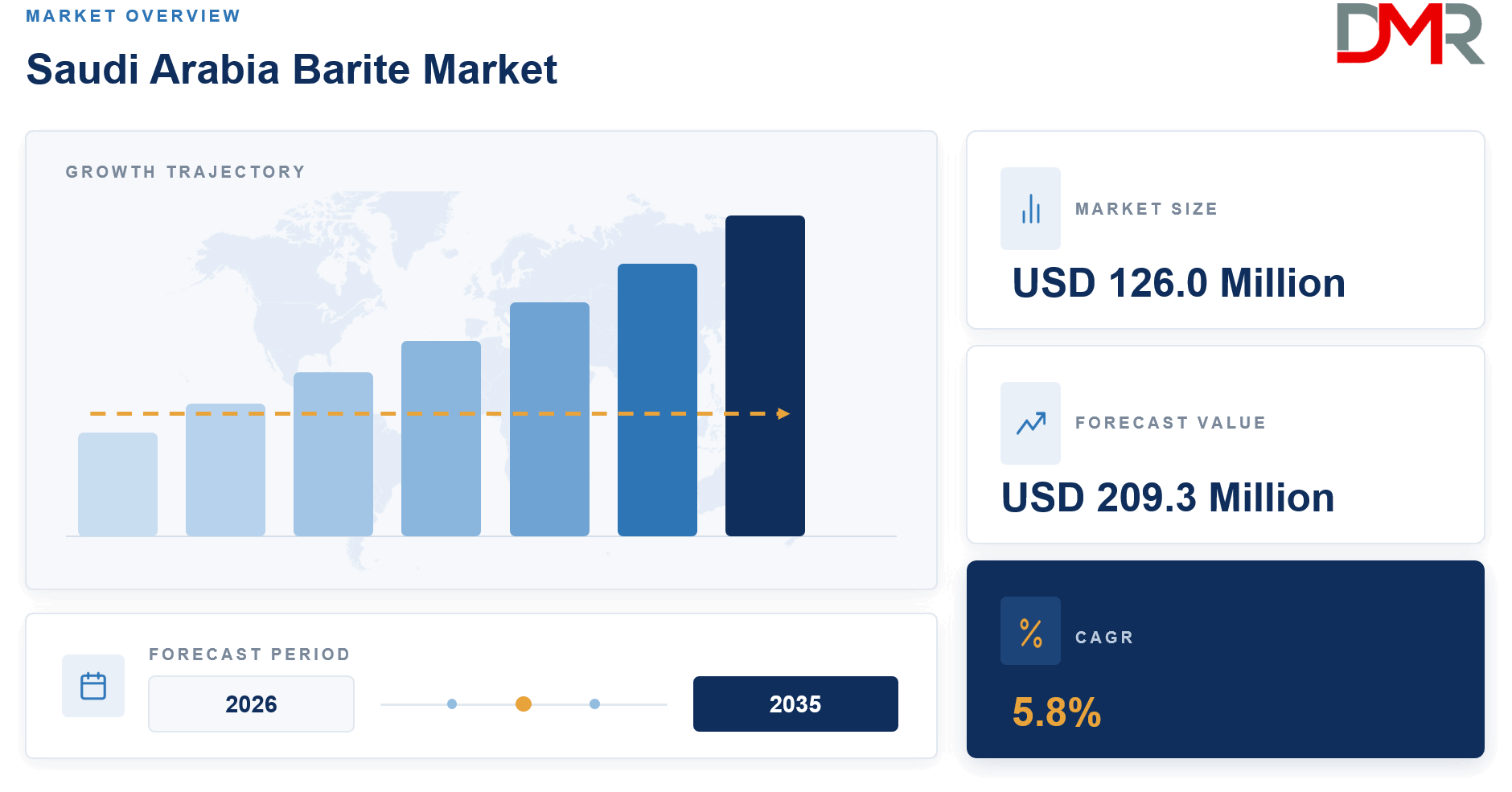
- Market Size (2026): USD 126.0 Mn
- Forecast Value (2035): USD 209.3 Mn
- CAGR (2026-2035): 5.8%
- Leading Grade (2026): Drilling Grade, around 71%
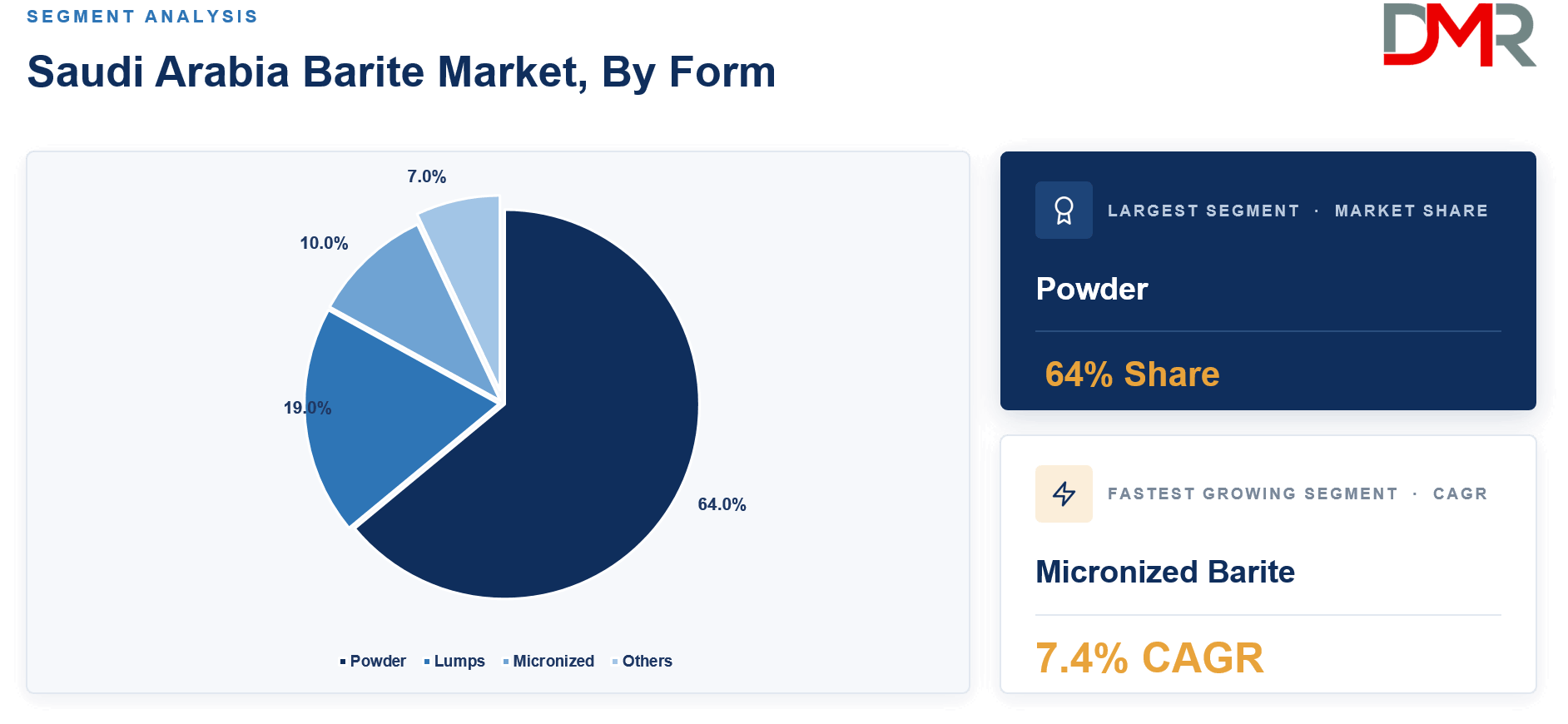
- Leading Form (2026): Powder, close to 64%
- Key Players: ATAD Energy Company Limited, Arabian Minerals and Chemicals Co. Ltd., Minerals Chemicals Factory and others
What is Saudi Arabia Barite Market and its Market Size?
The Saudi Arabia Barite Market size is estimated to reach USD 126.0 Mn in 2026 and is further anticipated to reach USD 209.3 Mn by 2035, at a CAGR of 5.8%.
ℹ
To learn more about this report –
Download Your Free Sample Report Here
Barite is a dense barium sulfate mineral used mainly as a weighting agent in drilling fluids. Saudi demand is therefore strongly connected to oil and gas well construction, where operators must control hydrostatic pressure, stabilize the wellbore and reduce kick risk. The mineral also enters coatings, plastics, rubber, chemicals and high-density construction materials because of its density, chemical inertness, low oil absorption and filler characteristics.
The market boundary covers barite consumed inside Saudi Arabia, whether the material is locally mined, processed from domestic or imported feedstock, or imported as finished drilling or industrial grade. It excludes overseas revenue of Saudi-headquartered mining, oilfield or chemical companies. The revenue pool includes raw material acquisition, crushing, grinding, micronization, testing, storage and sale through direct producer contracts, distributors and institutional supply arrangements.
Commercial value depends on more than physical ore availability. Drilling-grade barite must meet customer requirements for specific gravity, particle size and contaminants, while industrial grades can require tighter whiteness, purity and micronization standards. Freight also matters because barite is heavy relative to its selling price. Suppliers with qualified grinding, bulk storage and testing near Eastern Province drilling and industrial clusters can therefore hold an advantage over long-distance imports.
The structure is gradually changing as Saudi Arabia expands mineral exploration and domestic processing. Mining-policy support, digital licensing and local-content priorities encourage greater value addition inside the Kingdom. At the same time, oilfield customers continue to prioritize dependable bulk supply and technical consistency. These forces support integrated source-to-mill models and create an additional opportunity for higher-value micronized grades serving coatings, polymers and specialty construction.
Use Cases
- Oil and Gas Well Drilling: Drilling contractors and mud-service companies use barite to increase drilling-fluid density. Proper weighting helps manage formation pressure, reduce kick risk and maintain wellbore stability across Saudi onshore and offshore drilling programs.
- Industrial Coatings: Paint and coatings manufacturers use refined barite as an inert extender and density modifier. Controlled grades can improve formulation economics and chemical resistance while giving local processors a non-oilfield revenue outlet.
- Plastics and Rubber Compounding: Compounders use finely ground barite in selected formulations requiring additional density, dimensional stability or filler performance. Local manufacturing growth raises the value of consistent purity and particle distribution.
- Radiation-Shielding Construction: Specialty contractors can incorporate high-density barite into concrete used in selected healthcare, laboratory and industrial facilities, increasing shielding density without relying entirely on metallic materials.
Key Takeaways
- Market Size & Share: Oil and Gas Drilling Fluids are expected to account for approximately 74% of 2026 application revenue.
- Grade Analysis: Paint and Pigment Grade is projected to expand at a CAGR of 6.9% through 2035.
- Demand Concentration: Direct Sales are expected to represent roughly 49% of 2026 distribution value.
- Form Analysis: Micronized barite is forecast to grow at a CAGR of 7.4% during 2026-2035.
- Industrial Diversification: Paints and Coatings are expected to hold close to 7% of 2026 application demand.
- Supply Structure: Industrial Supply Contracts are modeled to grow at a CAGR of 6.6%.
How AI/Gen AI is Transforming the Saudi Arabia Barite Market?
Artificial intelligence has a supporting role in Saudi barite rather than changing the mineral's physical function. The most practical applications sit in exploration, grinding optimization, quality control, logistics and drilling-fluid planning. Machine-learning models can combine geological maps, assays, geochemical results and remote-sensing data to rank exploration targets. At processing plants, predictive models can track mill throughput, energy consumption and particle-size distribution to reduce off-specification output and unnecessary power use.
Generative AI is more relevant to documentation and commercial workflows. Producers can organize certificates of analysis, tender documents, safety files and customer specifications through controlled LLM systems, while procurement teams can compare historical quality and delivery performance faster. In drilling, data-driven systems can connect mud properties with downhole conditions to support weighting decisions. Final engineering responsibility remains with qualified personnel because pressure-management errors can create material safety and operational consequences.
- Exploration Targeting: AI models can rank geological prospects for field verification.
- Grinding Optimization: Predictive controls can maintain particle size while lowering energy waste.
- Quality Documentation: LLM workflows can structure certificates, specifications and tender files.
- Inventory Forecasting: Demand models can connect rig schedules with stock and replenishment needs.
Key Drivers in the Saudi Arabia Barite Market
Demand is led by upstream drilling requirements and by the Kingdom's policy push to localize mineral extraction and processing.
- Oil and Gas Drilling Activity: Drilling Grade is expected to account for approximately 71% of 2026 grade revenue because barite remains a standard weighting material in many drilling-fluid systems. Saudi Arabia's upstream program sustains bulk consumption, while deeper or higher-pressure wells can increase weighting needs. Suppliers with qualified product, local grinding and nearby bulk storage can respond quickly to drilling schedules, lower transport uncertainty and reduce the operating risk associated with long imported lead times.
- Mining Localization and Domestic Processing: Powder is projected to hold close to 64% of 2026 form revenue because customers mainly require processed material ready for blending. Saudi policy increasingly links mining with domestic processing and manufacturing. Local milling can shorten lead times, reduce freight exposure and tailor mineral quality to drilling or industrial requirements. As more industrial-mineral projects progress through exploration and licensing, domestic processors can capture a larger share of value without depending entirely on imported finished powder.
Restraints in the Saudi Arabia Barite Market
The market remains exposed to drilling cycles and to the economics of moving a heavy mineral with moderate unit value.
- Dependence on Drilling Cycles: Oil and Gas Drilling Fluids are expected to represent around 74% of 2026 application demand, creating concentration in one end-use sector. Rig suspensions, deferred wells or changes in well design can therefore reduce barite consumption quickly. Smaller industrial uses cannot fully offset a significant oilfield decline, so suppliers need flexible inventories, storage and contracts that can absorb changes in utilization without creating excessive working capital or forcing distressed spot sales.
- Freight and Quality Constraints: Barite's density makes long-distance transport expensive relative to selling price, while drilling and industrial specifications narrow the usable ore base. Filler and Industrial Grade is expected to represent approximately 8% of 2026 grade revenue, yet higher-value buyers often require tighter contaminant, brightness and particle-size controls. Producers without consistent beneficiation, blending and laboratory capability may be restricted to lower-margin outlets despite having access to mineral reserves.
Growth Opportunities in the Saudi Arabia Barite Market
The strongest white spaces sit between raw mineral extraction and customer-ready specialty products.
- Domestic Grinding and Micronization: Micronized barite is projected to expand at a CAGR of 7.4% from 2026 to 2035. Coatings, polymers and specialty formulations require finer particles and more consistent distribution than bulk drilling markets. Processing facilities close to Eastern Province demand centers can combine micronization, technical service and logistics. This raises value per tonne, reduces dependence on commodity trading and allows local suppliers to address buyers that currently rely on imported specialty grades.
- Long-Term Local Supply Contracts: Industrial Supply Contracts are forecast to grow at a CAGR of 6.6% through 2035. Multi-year agreements can support investment in grinding, laboratories, bulk silos and transport by improving demand visibility. Producers able to combine source control, processing, quality assurance and delivery can offer stronger local-content and continuity benefits than spot importers. Contracted demand also improves plant utilization and makes higher-specification processing assets easier to finance.
Trends in the Saudi Arabia Barite Market
Supplier selection is moving toward integrated, specification-led supply rather than simple mineral trading.
- Greater Emphasis on Local Content: Direct Sales are expected to account for roughly 49% of 2026 distribution value because large customers prefer qualified suppliers with documented origin, quality and delivery capability. Saudi processing assets, laboratories and bulk storage can therefore improve competitiveness. Imports remain relevant where they provide better quality or availability, but procurement increasingly rewards continuity, responsiveness, traceability and domestic value addition rather than relying on spot price alone.
- Broader Industrial Use of Refined Barite: Paint and Pigment Grade is forecast to expand at a CAGR of 6.9% through 2035. Coatings, plastics and specialty construction create smaller but higher-value outlets that diversify processors away from rig activity. These applications require more attention to classification, contamination control, brightness and customer-specific particle profiles. The trend encourages processors to treat barite as a portfolio of specifications rather than a single interchangeable bulk mineral.
Research Scope and Analysis
Segment performance is assessed across grade, form, application and distribution channel. Each axis identifies where 2026 revenue is concentrated and where demand is moving through 2035, linking mineral quality, processing intensity, end-use economics and route-to-market.
ℹ
To learn more about this report –
Download Your Free Sample Report Here
By Grade
Drilling Grade is projected to hold the largest share by grade in 2026, accounting for approximately 71% of revenue because drilling remains the primary barite use in Saudi Arabia. Large upstream customers sustain bulk demand and strict quality requirements. Growth, however, is concentrated in Paint and Pigment Grade, expected to expand at a CAGR of 6.9% during 2026-2035. Local coatings manufacturing and infrastructure maintenance increase demand for refined extenders with controlled whiteness and particle size. Although volumes remain smaller, greater processing intensity can raise value per tonne, improve processor margins and create a commercial hedge against oilfield cycles.
By Form
Powder is expected to lead the form segment in 2026 with close to 64% of revenue because drilling-fluid formulators and many industrial buyers require milled material ready for blending. Existing grinding capacity and bulk handling reinforce its position. Growth, however, is concentrated in Micronized barite, forecast to grow at a CAGR of 7.4% through 2035. Finer material is increasingly relevant to coatings, plastics and specialty applications where particle-size consistency affects performance. Investment in classification and micronization can therefore raise domestic value addition, widen the customer base and target higher-margin industrial niches.
By Application
Oil and Gas Drilling Fluids are projected to dominate application revenue in 2026 with around 74% of demand, reflecting the scale of Saudi upstream drilling and routine use of barite as a weighting agent. The segment gives drilling contractors and mud-service companies substantial influence over quality and logistics standards. Growth, however, is fastest in Paints and Coatings, projected at a CAGR of 6.8% through 2035. Local coatings production, construction activity and industrial maintenance support refined barite demand. The segment remains much smaller than drilling fluids but provides processors with a higher-value outlet and lowers dependence on one end-use cycle.
By Distribution Channel
Direct Sales are expected to account for approximately 49% of 2026 distribution revenue because large drilling and industrial users prefer bulk procurement from qualified producers and processors. Direct relationships simplify specification control, delivery scheduling and local-content documentation. Growth, however, is concentrated in Industrial Supply Contracts, forecast to expand at a CAGR of 6.6% during 2026-2035. Multi-year contracts can support mine and mill investment by improving demand visibility and bundling grinding, testing, storage and logistics. Distributors remain important for smaller industrial customers, but contractual supply fits the Kingdom's large-scale procurement environment.
The Saudi Arabia Barite Market Report is Segmented Based on the Following
By Grade
- Drilling Grade
- Chemical Grade
- Paint and Pigment Grade
- Filler and Industrial Grade
- Others
By Form
- Powder
- Lumps
- Micronized
- Others
By Application
- Oil and Gas Drilling Fluids
- Paints and Coatings
- Plastics and Rubber
- Chemicals
- Construction Materials
- Others
By Distribution Channel
- Direct Sales
- Distributors and Traders
- Industrial Supply Contracts
- Others
Competitive Landscape
Competition combines Saudi processors, oilfield-product suppliers, drilling contractors, regional traders and international industrial-mineral companies. Local producers compete on ore access, milling capacity, quality consistency, logistics and customer qualification, while imports remain relevant where they provide superior price or specification. The strongest positions integrate processing, testing, storage and delivery. Oilfield-service companies influence technical qualification because they formulate drilling fluids for end customers. Industrial-grade competition depends more on brightness, micronization and particle-size control. Local-content expectations should increasingly reward Saudi processing capability and contracted supply reliability over spot trading alone.
Some of the Prominent Players in the Saudi Arabia Barite Market Are
- ATAD Energy Company Limited
- Arabian Minerals and Chemicals Co. Ltd.
- Minerals Chemicals Factory
- Saudi Arabian Mining Company (Ma'aden)
- Saudi Arabian Oil Company (Aramco)
- Arabian Drilling Company
- ADES Holding Company
- Rawabi Holding Company
- Saudi Chemical Company Holding
- Rezayat Group
- Al-Rushaid Group
- SLB
- Halliburton
- Baker Hughes Company
- Weatherford International plc
- Newpark Resources, Inc.
- Gulf Drilling International Limited
- CS Global Group
- NOV Inc.
- Oman Drilling Mud Products Co. LLC
- Iran Kaolin and Barite Co.
- Ashapura Minechem Limited
- 20 Microns Limited
- Excalibar Minerals LLC
- Cimbar Performance Minerals
- The Kish Company, Inc.
- Milwhite, Inc.
- Barium and Chemicals, Inc.
- Sachtleben Minerals GmbH & Co. KG
- Sojitz Corporation
- Mitsui & Co., Ltd.
- Reda Chemicals
- Brenntag SE
- IMCD Group
- Azelis Group
- Univar Solutions LLC
- Gulf Minerals and Chemicals LLC
- Dubichem Marine International
- Petrochem Middle East FZE
- Bahri
- Other Key Players
Export Import Analysis
Saudi Arabia’s barite market is highly influenced by international trade because domestic demand, particularly from oil and gas drilling, is supported substantially through imports. In 2024, the Kingdom imported about USD 137.8 million of natural barytes, with India, Lao PDR, and China among the largest suppliers. This creates opportunities for diversified sourcing, local processing, and stronger supplier partnerships. However, dependence on imported material exposes buyers to freight costs, port congestion, currency movements, and geopolitical supply disruptions. Expanding domestic beneficiation capacity could reduce import reliance and improve supply security. Trade trends will remain an important determinant of availability, procurement strategies, and competitive positioning across the Saudi barite market.
Pricing Analysis
Barite pricing in Saudi Arabia is closely linked to drilling activity, import dependence, freight expenses, energy costs, and regional supply conditions. Middle East and Africa barite prices showed upward pressure in early 2026 as oil and gas exploration increased consumption, while tighter supply, shipping delays, and logistical bottlenecks affected procurement costs. Stable energy-sector demand creates opportunities for suppliers offering consistent quality, long-term contracts, and locally processed barite. However, price volatility may pressure margins for drilling contractors and downstream users, particularly when freight or sourcing costs rise sharply. Increased local production, improved port logistics, and diversified sourcing could stabilize prices. Pricing dynamics will directly influence purchasing patterns, supplier competitiveness, inventory strategies, and overall market profitability.
Recent Developments
- In August 2026, Saudi Aramco and Ma'aden announced plans for a mineral-exploration joint venture, reinforcing the Kingdom's strategy to expand domestic mineral development and processing capability.
- In March 2026, Arabian Drilling reactivated previously recalled land and offshore rigs, supporting demand for drilling consumables, weighting agents and mud chemicals.
- In February 2026, the Ministry of Industry and Mineral Resources advanced the third wave of its Exploration Enablement Program, offering incentives intended to reduce early-stage mineral exploration risk.
- In January 2026, Saudi authorities reported a large expansion in active mining licenses and exploration awards, widening the domestic project pipeline.
Report Details
| Report Characteristics |
| Market Size (2026) |
USD 126.0 Mn |
| Forecast Value (2035) |
USD 209.3 Mn |
| CAGR (2026-2035) |
5.8% |
| Historical Data |
2021 - 2025 |
| Forecast Data |
2026 - 2035 |
| Base Year |
2025 |
| Segments Covered |
By Grade, By Form, By Application and By Distribution Channel |
| Regional Coverage |
Saudi Arabia |
Frequently Asked Questions
How big is the Saudi Arabia Barite Market?
▾ The Saudi Arabia Barite Market is estimated at USD 126.0 Mn in 2026 and is projected to reach USD 209.3 Mn by 2035. Demand is concentrated in oil and gas drilling, with additional consumption from coatings, plastics, rubber, chemicals and high-density construction applications.
What is the growth rate of the Saudi Arabia Barite Market?
▾ The market is forecast to expand at a CAGR of 5.8% during 2026-2035. Growth is supported by drilling requirements, domestic mineral localization, grinding investment and gradual expansion of industrial uses. The rate remains moderate because barite is a mature industrial mineral and demand is still heavily tied to upstream activity.
What is driving demand in the Saudi Arabia Barite Market?
▾ Demand is driven primarily by oil and gas well construction, where barite increases drilling-fluid density and supports pressure control. A second driver is Saudi Arabia's push to expand domestic mining and processing. Local grinding, storage and testing can improve supply reliability and reduce dependence on imported material for qualified applications.
Which grade leads the Saudi Arabia Barite Market?
▾ Drilling Grade is expected to lead in 2026 with approximately 71% of grade revenue. Its position reflects the scale of Saudi upstream drilling and the use of high-density barite in weighted mud systems. Industrial grades remain smaller but offer higher-value opportunities where purity, whiteness and controlled particle size are required.
Which application is growing fastest in the Saudi Arabia Barite Market?
▾ Paints and Coatings are projected to record the fastest application growth at a CAGR of 6.8% through 2035. Local coatings production and infrastructure maintenance support refined barite demand. The segment remains smaller than drilling fluids but gives processors a useful route to diversify revenue.
Who are the key players in the Saudi Arabia Barite Market?
▾ Key participants include ATAD Energy Company Limited, Arabian Minerals and Chemicals Co. Ltd., Minerals Chemicals Factory, Saudi Arabian Mining Company, SLB, Halliburton and Baker Hughes. Competition also includes drilling contractors, regional mineral suppliers, distributors and international processors selling into Saudi customers.
How is the Saudi Arabia Barite Market segmented?
▾ The Saudi Arabia Barite Market is segmented by Grade, Form, Application and Distribution Channel. The structure captures drilling-grade and industrial-quality material, powder and micronized forms, oilfield and non-oilfield uses, and direct, distributor and contracted supply routes used by Saudi buyers.