Market Snapshot
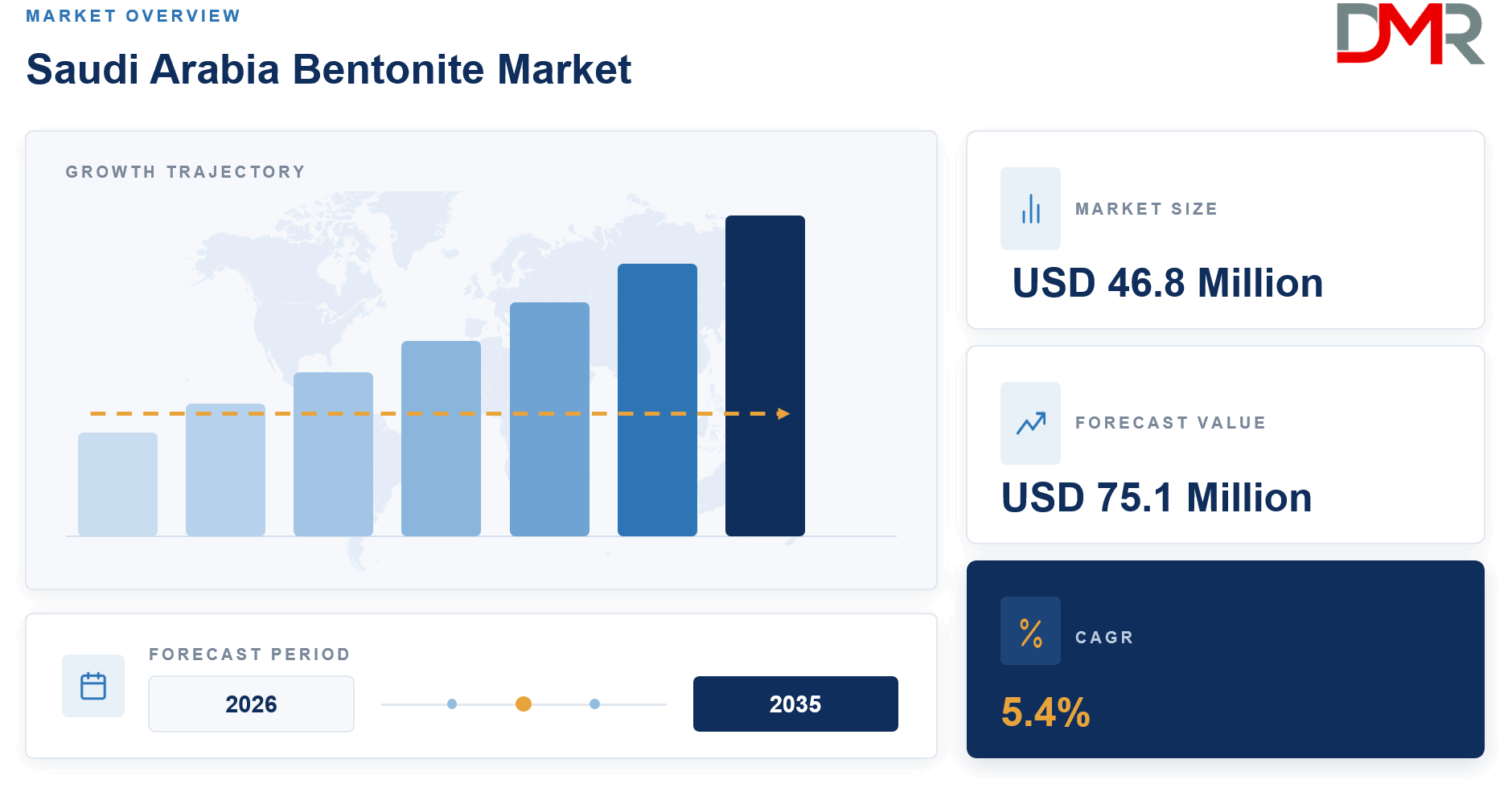
- Market Size (2026): USD 46.8 Mn
- Forecast Value (2035): USD 75.1 Mn
- CAGR (2026-2035): 5.4%
- Leading Product Type (2026): Sodium Bentonite, approximately 52.6%
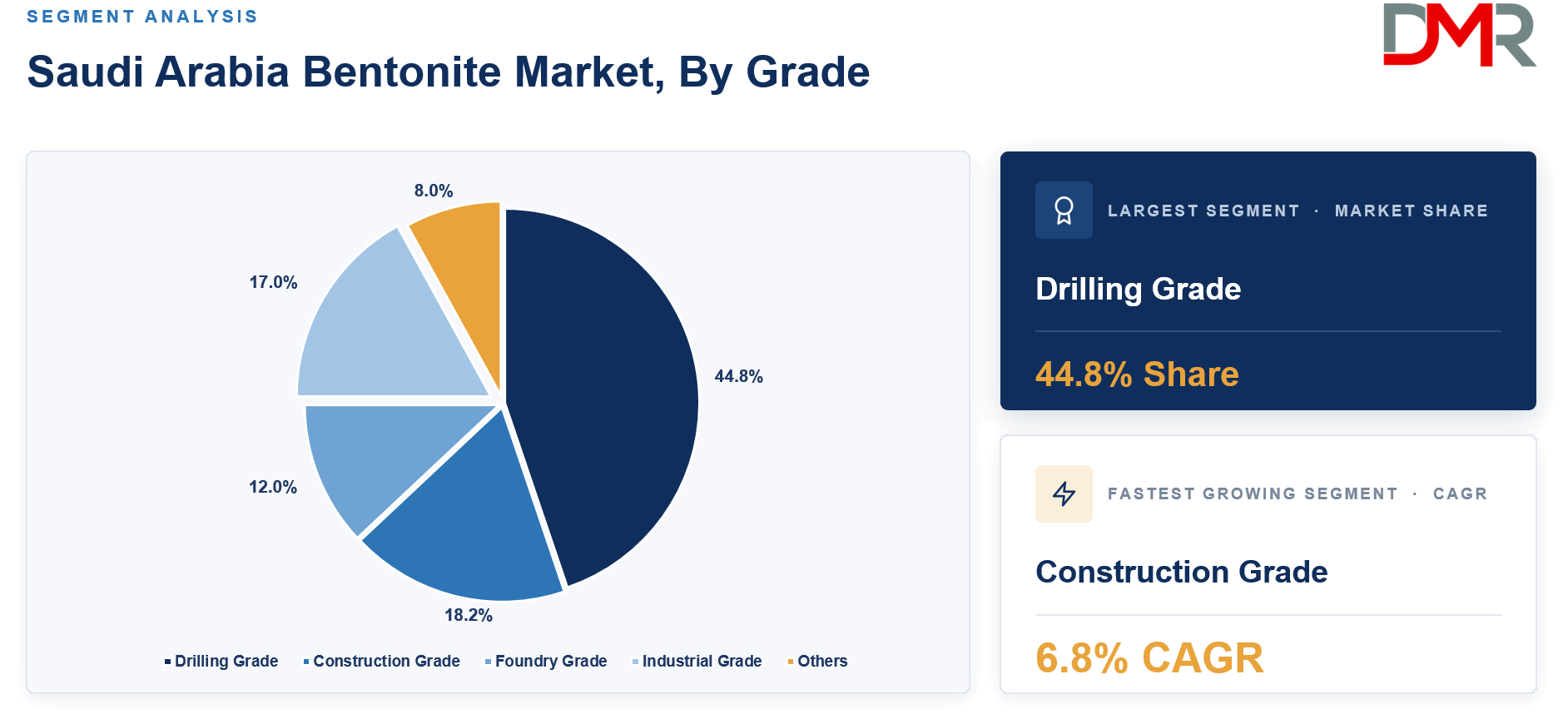
- Leading Grade (2026): Drilling Grade, around 44.8%
- Key Players: Arabian Minerals & Chemicals Co. Ltd., RTE Group, Halliburton and others
What is Saudi Arabia Bentonite Market and its Market Size?
The Saudi Arabia Bentonite Market size is estimated to reach USD 46.8 Mn in 2026 and is further anticipated to reach USD 75.1 Mn by 2035, at a CAGR of 5.4%.
ℹ
To learn more about this report –
Download Your Free Sample Report Here
Bentonite demand in Saudi Arabia covers naturally occurring and processed montmorillonite-rich clays supplied for oil and gas drilling, piling and diaphragm-wall construction, waterproofing, foundry binders, absorbents, wastewater treatment and other industrial uses. The market boundary reflects material consumed inside Saudi Arabia, whether domestically processed or imported, rather than the worldwide revenue of Saudi-headquartered companies.
Commercial value depends less on bulk tonnage alone than on swelling capacity, viscosity yield, filtration control, moisture, particle size and compatibility with specific formulations. Sodium bentonite is favored where high swelling and rheology are required, while calcium and activated grades serve applications where adsorption, binding or tailored fluid behavior matters more. API 13A compliance remains important in drilling-fluid procurement, while civil works increasingly specify consistency, low permeability and predictable hydration.
Demand is being reshaped by simultaneous investment in unconventional gas, large infrastructure packages, tunneling, water systems and industrial localization. Buyers are also becoming more selective about technical documentation and batch consistency, which shifts value toward processed grades and qualified suppliers rather than undifferentiated clay. Logistics remain important because bulk mineral economics are sensitive to freight, storage and inland handling from ports or processing locations to project sites.
Use Cases
- Oil and Gas Well Construction: Drilling contractors and fluid service companies use high-yield bentonite to build viscosity, suspend cuttings and control filtrate in water-based drilling systems. Stable mud properties reduce wellbore instability and support predictable solids transport across conventional and selected unconventional drilling programs.
- Foundation and Tunneling Works: Civil contractors deploy bentonite slurries in bored piles, diaphragm walls, trench support and microtunneling where temporary excavation stability is required. Properly conditioned slurry supports soil faces, limits groundwater inflow and improves the quality of deep foundation construction in dense urban or industrial zones.
- Environmental Containment: Water, waste and industrial infrastructure developers use bentonite in low-permeability liners, sealing layers and geosynthetic clay liner systems. The clay swells when hydrated, helping limit liquid migration around containment cells, ponds and engineered barriers where long-term hydraulic performance is required.
- Industrial Binding and Absorption: Foundries, absorbent formulators and process industries use selected bentonite grades as binders, carriers or adsorbents. The material improves green strength in molding sands, supports liquid uptake in absorbent products and provides a versatile mineral platform for customized industrial formulations.
Key Takeaways
- Market Size & Share: Sodium bentonite is projected to account for approximately 52.6% of Saudi revenue in 2026, supported by its dominant role in drilling and civil engineering slurry systems.
- Grade Analysis: Construction grade is modeled as the fastest-growing grade, expanding at a CAGR of 6.8% through 2035 as deep foundations, tunneling and containment applications scale.
- Demand Concentration: Oil and gas is expected to represent close to 46.2% of end-use demand in 2026, keeping the Eastern Province-linked drilling supply chain central to procurement.
- Application Shift: Water treatment and environmental sealing are projected to expand at a CAGR of 7.1%, outpacing the headline market as containment and water infrastructure specifications broaden.
- Channel Structure: Direct sales are expected to hold roughly 57.4% of 2026 revenue because large drilling and project buyers procure qualified mineral grades through technical supply agreements.
- Product Development: Activated bentonite is forecast to grow at a CAGR of 6.5% as processors tailor adsorption and rheology for industrial and environmental uses.
How AI/Gen AI is Transforming the Saudi Arabia Bentonite Market?
AI is affecting bentonite more through operations and quality control than through the clay itself. Computer vision and machine-learning models can classify incoming mineral lots, detect particle-size or color variation, and flag batches that may fail viscosity, moisture or swelling targets. In drilling-fluid operations, predictive models can connect mud properties with formation conditions and recommend dosage adjustments, reducing over-treatment and helping service crews maintain more stable rheology.
Generative AI is also emerging in documentation-intensive workflows. Suppliers can use language models to organize certificates of analysis, product specifications, safety data and tender responses, while procurement teams can compare technical requirements across projects. Digital twins and optimization tools are increasingly relevant to grinding, activation, blending and logistics planning, especially where local processing economics depend on throughput and energy use.
- Quality Classification: Vision models can support faster screening of mineral consistency before milling or blending.
- Drilling Fluid Optimization: Predictive analytics can recommend bentonite additions against changing viscosity and filtration targets.
- Document Automation: LLM-based workflows can structure technical submittals, compliance files and procurement comparisons.
- Process Optimization: Digital twins can test grinding, drying and activation settings before physical changes are made.
Key Drivers in the Saudi Arabia Bentonite Market
Demand is primarily tied to the Kingdom's drilling intensity and the scale of civil and industrial construction. These forces pull different grades through distinct procurement channels.
- Expansion of Drilling and Unconventional Gas Activity: Oilfield demand remains the largest commercial anchor because drilling-grade bentonite is a standard rheology and filtration-control input in many water-based systems. Oil and gas is projected to account for nearly 46.2% of end-use revenue in 2026. As gas development, well construction and field services remain active, fluid suppliers require reliable access to API-aligned material with predictable yield. The mechanism is direct: more drilled footage and more complex well programs increase fluid consumption, laboratory qualification and inventory needs. This supports not only bulk bentonite sales but also higher-value processed grades, local storage and technical distribution close to drilling centers.
- Large Civil Works and Ground Engineering Demand: Piling, diaphragm walls, tunneling and containment structures create a second demand engine that is less exposed to hydrocarbon cycles. Construction is expected to hold around 24.7% of end-use demand in 2026, with civil engineering applications requiring stable hydration and low filtrate loss. Bentonite slurry supports excavation faces and boreholes where soil conditions or groundwater create collapse risk. Saudi infrastructure investment also increases demand for waterproofing and engineered barriers. Because construction projects consume material in concentrated phases, suppliers with local warehousing, bulk handling and rapid delivery can gain share even when imported raw material remains price competitive.
Restraints in the Saudi Arabia Bentonite Market
Growth is constrained by freight economics, specification risk and competition from alternative additives. These factors can compress margins even when underlying project activity remains strong.
- Import Dependence and Freight Sensitivity: Saudi buyers source a meaningful portion of specialty and high-yield grades through international supply chains, exposing delivered cost to ocean freight, port handling, inventory carrying cost and supplier lead times. Distributor-led sales are still expected to represent approximately 42.6% of 2026 revenue, showing the importance of intermediated supply. Bentonite has a relatively low value per tonne compared with many specialty chemicals, so logistics can materially alter landed economics. This encourages buyers to qualify multiple origins, but switching is not frictionless when drilling or project specifications require repeatable rheology. Price competition therefore remains intense, particularly for standard construction and industrial grades.
- Substitution by Polymers and Engineered Additive Systems: Bentonite does not dominate every application simply because it is familiar. Synthetic polymers, specialty fluid additives, cementitious barriers and alternative absorbents can reduce clay consumption where performance per kilogram, lower solids loading or faster mixing is valued. Standard industrial grade is expected to hold around 18.9% of grade revenue in 2026, but this area faces the most direct formulation competition. Suppliers must show measurable performance, not just lower unit price. Where a polymer system lowers total fluid volume, transport cost or disposal burden, buyers may accept a higher additive price, limiting bentonite volume growth in selected projects.
Growth Opportunities in the Saudi Arabia Bentonite Market
White space is strongest where suppliers move beyond commodity bags into engineered grades, local processing and application-specific service. Construction and environmental uses provide the clearest diversification path.
- Local Processing and Activation Capacity: Activated bentonite is projected to expand at a CAGR of 6.5% from 2026 to 2035, creating an opportunity for local milling, soda activation, blending and quality-control operations. Processing inside Saudi Arabia can shorten lead times and allow suppliers to tune viscosity, swelling, particle size and adsorption to customer requirements. The value proposition is particularly strong for drilling, foundry and environmental customers that need documented batch consistency. Localization can also reduce dependence on importing finished specialty grades. Commercial success will depend on feedstock economics, laboratory capability and the ability to qualify products with major users rather than on installed capacity alone.
- Environmental Sealing and Water Infrastructure: Water treatment and environmental sealing are expected to post the fastest application CAGR at 7.1%. Growth is supported by engineered ponds, waste containment, groundwater protection, wastewater assets and geosynthetic clay liner systems where low permeability is a core requirement. Bentonite suppliers can capture more value by pairing mineral supply with specification support, hydration guidance and liner-system partnerships. This segment also diversifies revenue away from drilling cycles. Opportunity is strongest for products with controlled swelling, low contaminant sensitivity and repeatable permeability performance, especially when projects demand documented compliance and long service life.
Trends in the Saudi Arabia Bentonite Market
Procurement is shifting toward documented performance and application-specific formulations. At the same time, channel strategies are becoming more localized around major project and drilling clusters.
- Shift Toward Higher-Yield and Customized Grades: Buyers are increasingly comparing bentonite on functional output rather than only cost per tonne. Sodium bentonite is expected to retain roughly 52.6% share in 2026, but product differentiation is moving toward yield, filtration control, salt tolerance and consistent hydration. This favors suppliers that can blend or activate material for defined operating windows. In drilling, the target is stable fluid behavior with less corrective treatment. In construction, the target is reliable trench or bore support with manageable slurry conditioning. The result is a gradual widening between commodity material and certified, performance-managed grades.
- More Direct Technical Selling to Large Accounts: Direct sales are projected to represent close to 57.4% of 2026 channel revenue as major oilfield, construction and industrial buyers prefer qualified supply relationships. The trend is not eliminating distributors; instead, it is dividing the market by account complexity. Large users want technical data, predictable inventories, laboratory support and project-specific delivery planning, while smaller buyers still rely on merchant channels. Suppliers are responding with local stock points, technical sales teams and framework agreements. This increases the strategic value of Dammam and Eastern Province access for drilling customers and of broader national distribution for construction projects.
Research Scope and Analysis
Segment performance is assessed across product type, grade, application, end use industry and distribution channel. The analysis identifies where Saudi revenue is concentrated in 2026 and which sub-segments are positioned to expand faster through 2035 based on technical requirements and buyer behavior.
ℹ
To learn more about this report –
Download Your Free Sample Report Here
By Product Type
Sodium bentonite is projected to lead product type in 2026 with around 52.6% of revenue because its swelling, viscosity and filtration characteristics suit the country's largest drilling and civil engineering applications. Its installed qualification base also reduces switching risk for fluid formulators and contractors. Growth, however, is concentrated in activated bentonite, which is forecast to expand at a CAGR of 6.5% during 2026-2035 as processors modify lower-swelling feedstock to meet higher-performance industrial requirements. Activation gives suppliers more control over rheology and adsorption while creating room for local value addition. Organophilic grades also gain selective demand in specialty fluid and coating systems, but their smaller addressable base keeps them behind activated material in absolute expansion.
By Grade
Drilling grade is expected to hold the largest 2026 grade share at approximately 44.8%, supported by oilfield fluid consumption and the need for consistent API-aligned performance. Qualification requirements, field familiarity and recurring inventory needs reinforce its revenue position. The steeper trajectory sits with construction grade, growing at a CAGR of 6.8% through 2035 as piling, tunneling, diaphragm-wall and containment work broadens the buyer base. Construction-grade demand benefits from project diversity and less direct exposure to drilling cycles, although specifications vary by soil, groundwater and contractor practice. Suppliers that can provide predictable hydration, rapid delivery and technical guidance for slurry conditioning are positioned to capture a larger portion of this expansion.
By Application
Drilling fluids are set to represent the largest application in 2026, accounting for nearly 43.6% of revenue, because bentonite remains a core viscosifier and filtration-control mineral across many water-based well systems. Large oilfield service accounts also support higher-value grades and repeat procurement. Growth, however, is concentrated in water treatment and environmental sealing, advancing at a CAGR of 7.1% through 2035. The segment gains from liners, containment, ponds, sealing layers and environmental protection projects where low permeability is the performance objective. Wider use of engineered barrier systems and geosynthetic clay liners increases demand for controlled swelling and consistent mineral properties, moving the application beyond commodity civil clay toward more documented performance specifications.
By End Use Industry
Oil and gas is projected to remain the largest end-use industry in 2026 with close to 46.2% of market revenue, reflecting sustained drilling, well construction and fluid-service demand. The sector's procurement scale also favors suppliers with technical qualification and regional stock. The fastest growth is expected in water and environmental infrastructure at a CAGR of 7.0% from 2026 to 2035, driven by containment, wastewater and engineered sealing requirements. This end use gives suppliers a path to diversify beyond energy while selling on hydraulic performance rather than only bulk mineral pricing. Construction remains the second major demand pool, but environmental infrastructure shows the stronger growth profile because its use cases are expanding from isolated projects toward more formalized engineered barrier systems.
By Distribution Channel
Direct sales are expected to account for roughly 57.4% of Saudi bentonite revenue in 2026 as large drilling contractors, fluid formulators and major project buyers prefer qualified supply relationships with clear technical responsibility. Direct contracting also improves demand visibility for suppliers handling bulk inventory. Distributor and trader channels, however, are forecast to grow faster at a CAGR of 6.2% through 2035 as smaller contractors, regional industrial users and project-based buyers seek flexible quantities and multi-product sourcing. Channel partners can combine bentonite with barite, calcium carbonate, polymers and other additives, reducing procurement complexity for customers. Their advantage is strongest where rapid availability and credit terms matter more than custom product development.
The Saudi Arabia Bentonite Market Report is Segmented Based on the Following
By Product Type
- Sodium Bentonite
- Calcium Bentonite
- Activated Bentonite
- Organophilic Bentonite
- Others
By Grade
- Drilling Grade
- Construction Grade
- Foundry Grade
- Industrial Grade
- Others
By Application
- Drilling Fluids
- Civil Engineering & Construction
- Foundry Sands
- Absorbents & Adsorbents
- Water Treatment & Environmental Sealing
- Others
By End Use Industry
- Oil & Gas
- Construction
- Water & Environmental Infrastructure
- Foundry & Metalworking
- Agriculture & Animal Care
- Others
By Distribution Channel
- Direct Sales
- Distributors & Traders
- Others
Competitive Landscape
Competition combines locally established mineral and oilfield suppliers with international bentonite processors, drilling-fluid companies and chemical distributors. Large accounts compete on API-aligned quality, rheology consistency, delivery reliability and technical service, while project-based buyers place greater weight on availability and landed cost. Local processing can improve responsiveness, but imported feedstock and finished grades remain important where mineral characteristics or specialty activation are difficult to replicate. Strategic positioning therefore centers on warehousing, qualification with major users, bundled drilling additives, customized milling or activation and national distribution. The market remains fragmented outside the largest oilfield accounts, giving regional distributors room to compete alongside global mineral groups.
Some of the Prominent Players in the Saudi Arabia Bentonite Market Are
- Arabian Minerals & Chemicals Co. Ltd.
- RTE Group
- Oilfield Equipment & Services Co. (OES)
- Nassguard Trading
- Delmon Co. Ltd.
- Midad Chemicals Company Ltd.
- Saudi Lime Industries Co.
- Astra Mining
- Yusuf Bin Ahmed Kanoo Group
- Rezayat Trading Company Ltd.
- Rawabi Oil & Gas
- Abdulla Fouad Group
- Arabian Drilling
- Al-Rushaid Group
- Halliburton
- SLB
- Baker Hughes
- Weatherford
- Imerys
- Clariant
- Minerals Technologies Inc.
- Bentonite Performance Minerals LLC
- Wyo-Ben, Inc.
- Black Hills Bentonite LLC
- Cimbar Performance Minerals
- Ashapura Group
- Kutch Minerals
- 20 Microns Limited
- Kunimine Industries Co., Ltd.
- Hojun Co., Ltd.
- Tolsa Group
- Laviosa Chimica Mineraria S.p.A.
- Gulf Minerals & Chemicals LLC
- LKAB Minerals
- Elementis plc
- BYK-Chemie GmbH
- MidPoint Chemicals Company
- Reda Chemicals
- Brenntag
- IMCD Group
- Other Key Players
Export-Import Analysis
Saudi Arabia’s bentonite market is strongly influenced by import dependence, regional trade flows, and demand from oil and gas drilling, construction, foundry, and civil engineering applications. Imports from major producing countries such as India, Turkey, China, and the United States support domestic supply, while port logistics and freight rates directly affect landed costs. Opportunities exist for local distributors to develop processing, blending, and packaging capabilities that reduce reliance on finished imports. Key risks include shipping disruptions, currency movements, supplier concentration, and geopolitical instability across trade routes. Market impact is significant because supply continuity and import pricing determine availability, margins, and competitiveness for downstream industrial users across the Saudi industrial economy.
Pricing Analysis
Pricing in the Saudi Arabia bentonite market is shaped by grade, purity, swelling capacity, moisture content, processing level, packaging, freight, and end-use specifications. Higher-value sodium bentonite used in drilling fluids and advanced sealing applications typically commands premiums over standard calcium grades. Rising transport costs, energy expenses, and imported raw material dependence can create price volatility, particularly for buyers requiring consistent technical performance. Opportunities are emerging for local beneficiation, bulk handling, and long-term supplier contracts that can stabilize costs and improve margins. Key risks include sudden freight increases, oversupply in regional markets, and aggressive price competition. Pricing trends directly influence procurement strategies, project economics, and supplier positioning across major industrial segments.
Recent Developments
- In August 2026, Saudi Aramco and Ma'aden announced plans for a mineral exploration joint venture, reinforcing the Kingdom's push to expand domestic mining capability and supporting a broader ecosystem for industrial minerals, processing services and geological development.
- In February 2026, Aramco reported the start of production at Jafurah and operations at the Tanajib Gas Plant, expanding the drilling and gas-development base that supports demand for drilling-fluid minerals and related oilfield additives.
- In January 2026, Saudi Arabia's Future Minerals Forum concluded with large-scale agreements and investment activity, strengthening the policy and financing environment for mineral exploration, processing localization and downstream industrial development.
Report Details
| Report Characteristics |
| Market Size (2026) |
USD 46.8 Mn |
| Forecast Value (2035) |
USD 75.1 Mn |
| CAGR (2026-2035) |
5.4% |
| Historical Data |
2021 - 2025 |
| Forecast Data |
2026 - 2035 |
| Base Year |
2025 |
| Segments Covered |
By Product Type, By Grade, By Application, By End Use Industry and By Distribution Channel |
| Regional Coverage |
Saudi Arabia |
Frequently Asked Questions
How big is the Saudi Arabia Bentonite Market?
▾ Saudi bentonite demand is estimated at USD 46.8 Mn in 2026. The value covers material consumed in the Kingdom across drilling, construction, environmental, foundry, absorbent and industrial applications, including imported and locally processed grades. Demand is concentrated in technical mineral uses rather than consumer clay products.
What is the growth rate of the Saudi Arabia Bentonite Market?
▾ The market is forecast to expand at a CAGR of 5.4% from 2026 to 2035. Growth is supported by drilling activity, major civil works, water and environmental infrastructure, and gradual localization of mineral processing, while freight sensitivity and substitution by polymers limit a faster headline rate.
What is driving demand in the Saudi Arabia Bentonite Market?
▾ Demand is led by oil and gas well construction, where drilling-grade bentonite supports viscosity and filtration control, and by civil engineering uses such as bored piles, diaphragm walls and tunneling. Environmental sealing and water infrastructure add a smaller but faster-growing demand pool as engineered containment specifications broaden.
Who are the key players in the Saudi Arabia Bentonite Market?
▾ Key participants include Arabian Minerals & Chemicals Co. Ltd., RTE Group, Halliburton, SLB, Imerys, Ashapura Group and Wyo-Ben. Competition also includes Saudi industrial distributors, oilfield service suppliers and international mineral processors that reach the country through direct sales or regional channel partners.
Which product type leads the Saudi Arabia Bentonite Market?
▾ Sodium bentonite is expected to remain the leading product type, accounting for approximately 52.6% of revenue in 2026. Its high swelling capacity and rheological behavior make it suitable for drilling fluids, civil slurry systems and sealing applications where viscosity and low permeability are required.
Which application is growing fastest in Saudi Arabia?
▾ Water treatment and environmental sealing are projected to record the fastest application growth, with a CAGR of 7.1% through 2035. Expansion comes from containment liners, wastewater assets, ponds, sealing layers and geosynthetic clay liner systems that require controlled swelling and low hydraulic conductivity.
What is the outlook for the Saudi Arabia Bentonite Market through 2035?
▾ The Saudi Arabia Bentonite Market is expected to reach USD 75.1 Mn by 2035. The outlook favors suppliers that combine reliable mineral quality with local inventory, technical documentation and application support, particularly in drilling, construction, activated grades and environmental sealing rather than competing only on bulk price.