Market Overview
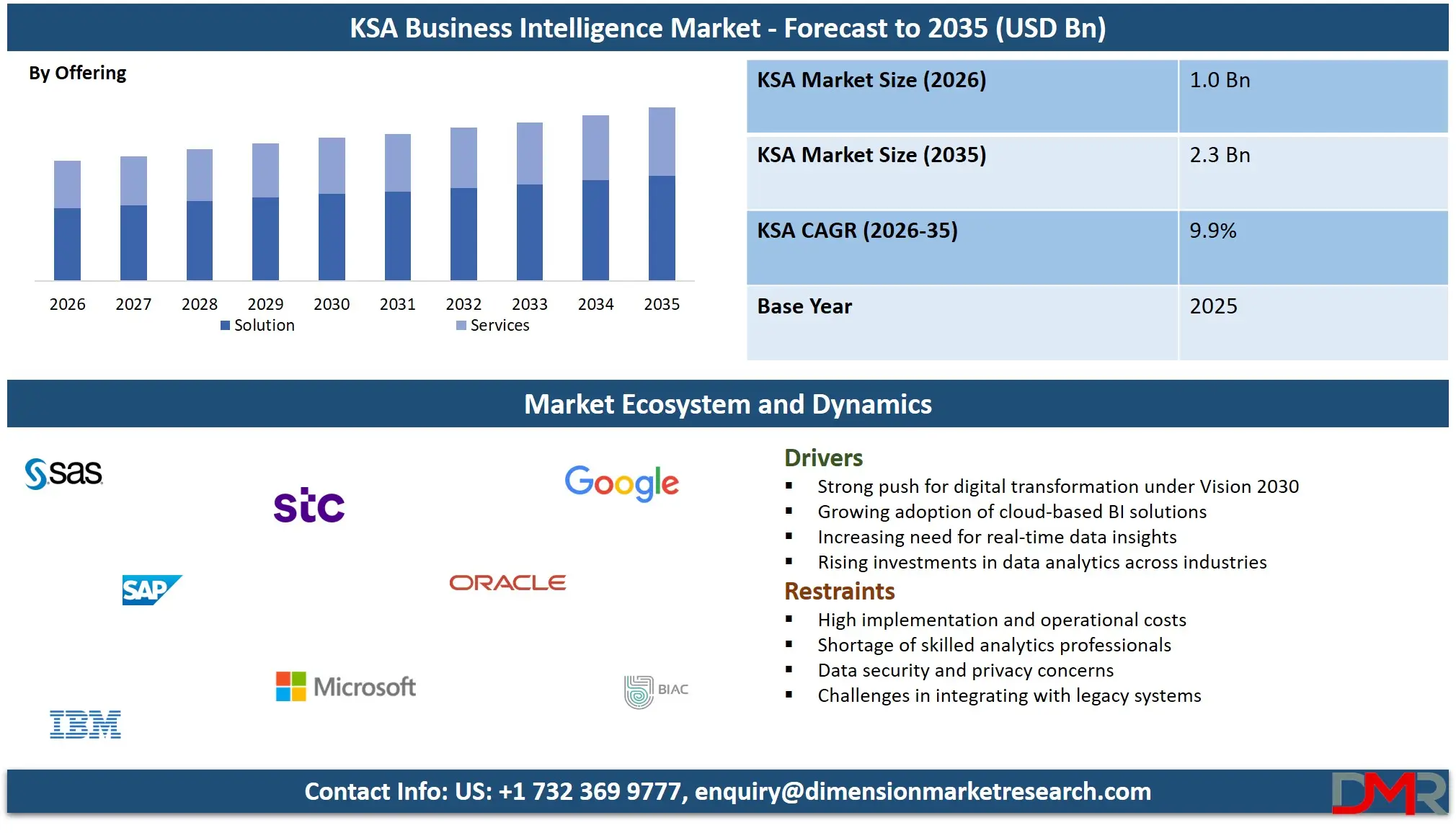
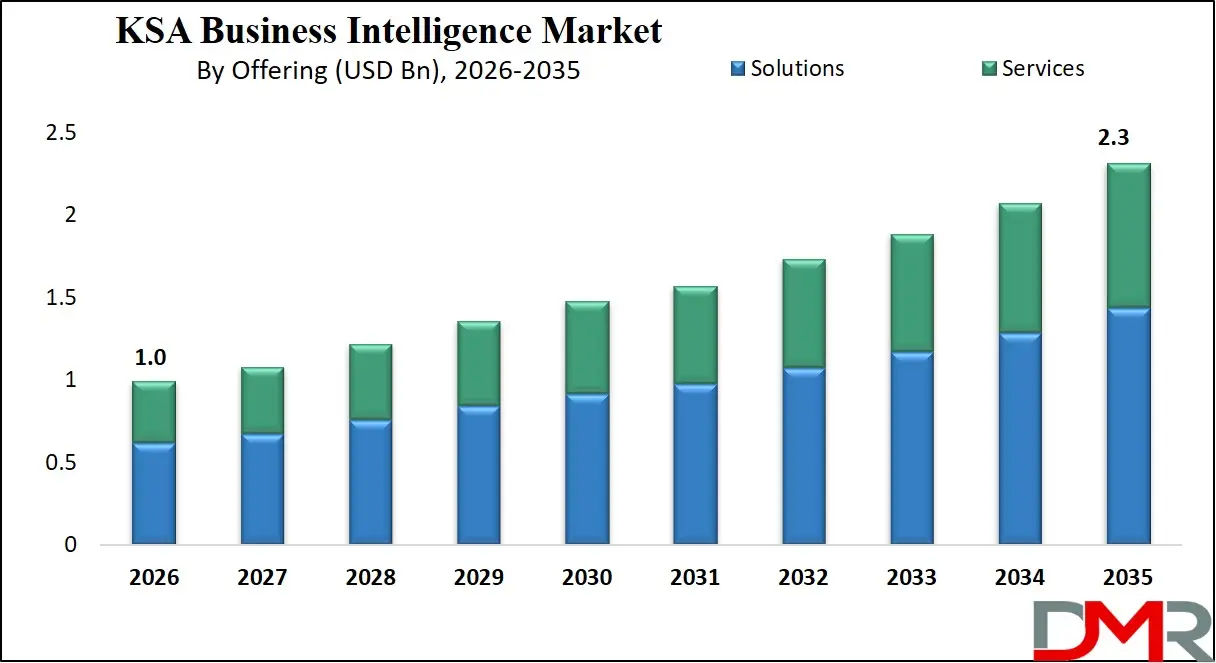
Saudi Arabia Business Intelligence Market size is projected to reach USD 1.0 billion in 2026 and grow at a compound annual growth rate of 9.9% to reach a value of USD 2.3 billion in 2035.
ℹ
To learn more about this report –
Download Your Free Sample Report Here
Business Intelligence is defined as the ecosystem of tools, platforms, and methodologies through which businesses are able to collect, integrate, analyze, and display data in order to improve decision-making. Business Intelligence includes dashboards, reporting tools, data integration tools, and analytics tools, along with consulting and deployment services. This solution enables businesses to transform their data into insights, which helps them in planning their strategies, increasing their efficiency, and gaining competitive advantage in the market.
The significance of business intelligence in region has increased largely owing to its focus on economic diversification and digitalization. Companies in sectors like finance, healthcare, retail, and manufacturing are using business intelligence tools mainly to enhance their performance and customer experience. Also, cloud-based analytics, real-time data processing, and self-service business intelligence are becoming more popular, which are helping businesses make fast and more flexible decisions. However, there is a huge shift towards predictive and prescriptive analytics using AI, which is helping businesses look into the future and not just the past.
ℹ
To learn more about this report –
Download Your Free Sample Report Here
The KSA Business Intelligence Market is also being driven by the fast technological advancements and changing business demands. Cloud computing is supporting businesses manage their complex and large data more easily. Businesses are aiming more on providing customer experience and operational flexibility, which is highly in the demand for real-time analytics. Additionally, the need to be more transparent is also helping businesses adopt good data governance practices. Investments are growing, and the number of technology vendors partnering with Saudi Arabian businesses is rising along with the popularity of cloud-based business intelligence, which is helping the market grow steadily.
KSA Business Intelligence Market: Key Takeaways
- Market Growth: KSA Business Intelligence Market size is expected to grow by USD 1.2 billion, at a CAGR of 9.9%, during the forecasted period of 2027 to 2035.
- By Offering: Solutions are anticipated to get the majority share of the KSA Business Intelligence market in 2026.
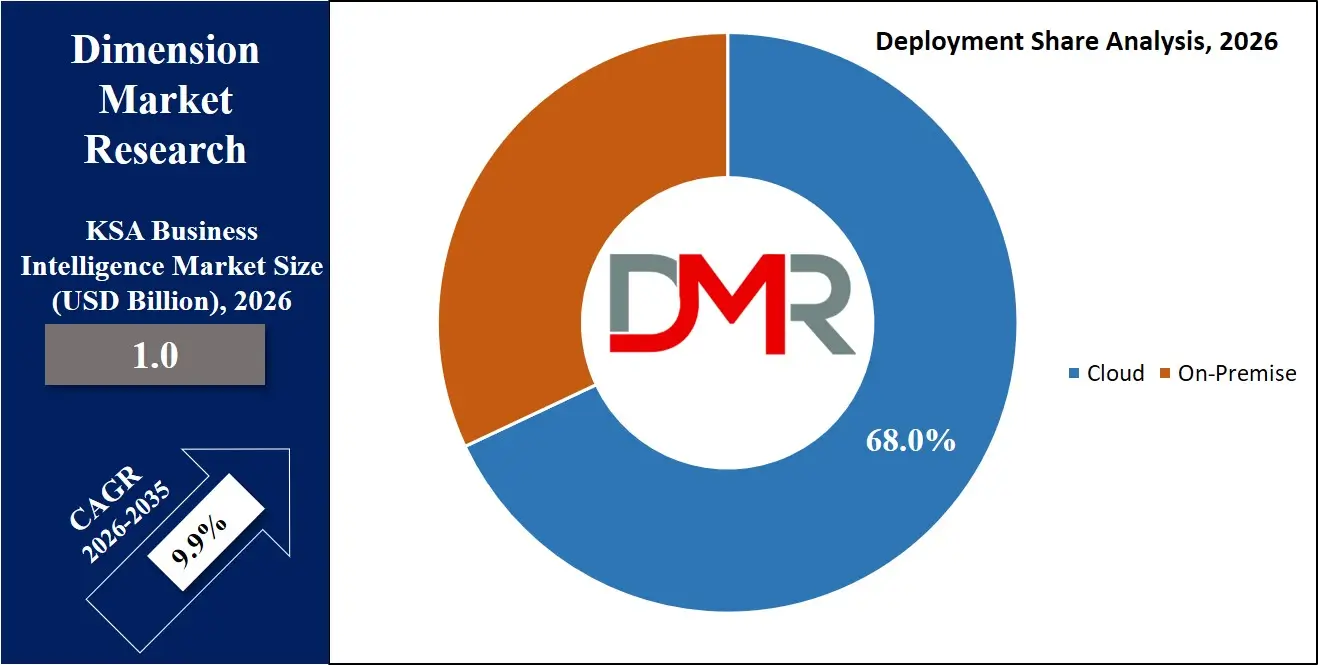
- By Deployment: The cloud segment is expected to get the largest revenue share in 2026 in the KSA Business Intelligence market.
- Use Cases: Some of the use cases of business intelligence include retail customer insights, supply chain optimization and more.
KSA Business Intelligence Market: Use Cases:
- Financial Risk Analysis: Banking & financial institutions are adopting BI tools to perform risk analysis, track fraud patterns, and ensure compliance, which is assisting them to improve their financial stability.
- Retail Customer Insights: Retail businesses are using BI tools to have insights of their customers, their behavior, and their purchase patterns, as it helps them to improve customer satisfaction.
- Healthcare Data Management: Healthcare businesses are having BI tools to track patient outcomes, manage hospital resources, and enhance the efficiency of their businesses.
- Supply Chain Optimization: Manufacturing and supply chain businesses are adopting BI tools to track their supply chain performance, which is helping them to improve their business efficiency.
- Telecom Network Optimization: Telecom businesses are using BI tools to track their network performance, customer patterns, and enhance their customer satisfaction.
- Government Performance Monitoring: Government businesses are using BI tools to track their performance, which is assisting them to improve their governance.
- Energy Sector Analytics: Energy businesses are using BI tools to track their performance, which is helping them to improve their efficiency.
Stats & Facts
- Saudi Data & AI Authority (SDAIA) reports that over 65% of government bodies have used advanced data analytics platforms in 2025.
- The General Authority for Statistics (GASTAT) shows that the digital economy’s contribution to GDP was more than 15% in 2024.
- The Ministry of Communications & Information Technology indicates that 70% of businesses have used cloud services in 2025.
- The Saudi Central Bank reveals that about 80% of banking institutions have used advanced analytics tools in 2025.
- The International Monetary Fund indicates that the growth rate of the ICT sector in Saudi Arabia was approx. 7% in 2024.
- The World Bank indicates that data-driven decision-making adoption in Middle Eastern businesses increased by 25% in 2025.
- The OECD showcases that more than 60% of large businesses in Saudi Arabia have used business intelligence tools in 2024.
- According to the United Nations Economic & Social Commission for Western Asia, the investments in the region’s big data sector recorded an increase of 18% in 2025.
- The Ministry of Investment Saudi Arabia showcase that the country recorded a rise of 30% in technology-related foreign investments in 2025.
- The Saudi Vision 2030 Office indicates that the digital transformation sector showed completion milestones of up to 75% in 2025.
- According to the International Data Corporation (IDC), the growth rate of data volume in Saudi Arabia was estimated at over 40% in 2025.
- The World Economic Forum indicates that the adoption of AI and analytics in Saudi enterprises recorded an improvement in productivity by 20% in 2024.
Market Dynamic
Driving Factors in the KSA Business Intelligence Market
Digital Transformation Initiatives
One of the major drivers that have led to the growth of the BI market in Saudi Arabia is that there is a high rate of digital transformation in the country. The initiatives & projects undertaken by the government that are in line with Vision 2030 have enabled organizations in Saudi Arabia to utilize particular data analytics tools in order to improve their efficiency in the market. The initiatives undertaken in building smart cities in Saudi Arabia have enabled organizations in the country to implement e-governance projects, which have produced huge amounts of data that need particular business intelligence tools in order to process the data. Organizations have realized that in order for them to be competitive in the market, which is highly dynamic, they need data-driven decision-making.
Growing Demand for Real-Time Insights
Most organizations are focusing on real-time data analysis primarily due to the need to respond to market and customer demands in real time. With the integration of real-time analytics in business intelligence tools, businesses are able to monitor and make decisions in real time. This is especially true for industries like finance, retail, and telecom. The need for real-time analytics is also driven by the growing number of IoT devices and digital platforms that produce data in real time. This has led many businesses to look for business intelligence solutions that can efficiently manage dynamic data environments.
Restraints in the KSA Business Intelligence Market
High Implementation Costs
The high implementation costs of modern BI solutions are another factor that could act as a constraint in the future. This is particularly true for small and medium-sized enterprises. Besides the costs of the solution itself, there are also the costs of infrastructure, personnel, and integration. Additionally, many businesses find it hard to justify the return on investment, especially at the early stages of implementation. Although the availability of cloud-based solutions has greatly reduced the costs, many businesses are still wary of the high costs of implementation, which is affecting the overall market.
Data Integration and Quality Challenges
Many businesses are facing problems integrating data from diverse sources, including legacy systems, the cloud, and external data sources. Besides, the quality of the data is also affecting the effectiveness of the solutions. This is affecting the trust that businesses have in the results generated through the use of the solutions. This is affecting the overall implementation of the solutions and the potential benefits that could be derived from the solutions.
Opportunities in the KSA Business Intelligence Market
Expansion of Cloud-Based BI Solutions
The cloud computing offers an opportunity for BI providers. Cloud computing is highly scalable, flexible, and cost-effective. Thus, it is expected to benefit organizations of all sizes. As more organizations move towards cloud computing, it is expected that the market for cloud-based BI solutions will expand. This is also expected to benefit organizations through integration with other digital solutions, which will enhance its functionality.
Rising Adoption Among SMEs
Small & medium-sized enterprises are majorly realizing the significance of data analytics in enhancing competitiveness. Inexpensive and user-friendly BI solutions for SMEs are creating fresh opportunities. Also, government initiatives and schemes are motivating SMEs to invest in digital solutions, such as BI tools.
Trends in the KSA Business Intelligence Market
Integration of AI and Machine Learning
With the integration of AI and machine learning in the BI platforms, the way data is analyzed and utilized is changing significantly. These technologies are helping organizations in predictive analytics and data modeling, which is further improving decision-making capabilities. Organizations are using AI-powered BI platforms to attain more insights and improve their business processes.
Shift Toward Self-Service BI
There is a major shift in the use of self-service BI platforms, which is allowing non-technical employees to access and analyze data independently. This is further enabling employees across different departments of the organization to make informed decisions without depending heavily on IT support. As such, organizations are moving towards self-service BI platforms with user-friendly interfaces and visualization capabilities.
Impact of Artificial Intelligence in KSA Business Intelligence Market
- Automated Data Processing: AI facilitates the process of data acquisition, cleaning, etc., which minimizes manual work.
- Predictive Analytics Enhancement: Machine learning helps in forecasting trends.
- Natural Language Processing: BI tools can be used with natural language queries.
- Real-Time Anomaly Detection: AI assists in identifying unusual patterns in the data.
- Personalized Dashboards: AI supports in personalizing BI tool dashboards.
- Operational Efficiency: Automation of repetitive work lowers operational costs.
- Customer Behavior Analysis: AI analyzes large volumes of data to identify consumer behavior.
- Data Visualization Improvements: Advanced machine learning improves data visualization.
- Decision Support Systems: AI-powered BI tools offer suggestions for better business decisions.
Impact of Iran War on KSA Business Intelligence Market
The Iran war has had an inconsistent effect on the Saudi Arabia Business Intelligence (BI) market. On one hand, due to rising political tensions and instability in the region, business conditions are becoming highly conservative, which has led to some organizations delaying large-scale investments in IT solutions. In addition, due to changing oil prices, there is uncertainty in government and business expenditure cycles. These conditions are affecting BI adoption in Saudi Arabia in the short term. On the other hand, due to political conditions and changing requirements in business expenditure cycles, organizations are majorly looking for better solutions in BI. Therefore, although it may cause minor hindrances in the short term, in the long term, the outlook for BI in Saudi Arabia is highly positive.
Research Scope and Analysis
By Offering Analysis
Solutions are leading in terms of market size due to their prevalence in business intelligence infrastructure, as they are essential for effective data collection and processing. The growing need for dashboards, data integration and ETL tools, and advanced analytics solutions is also contributing to increased demand. Furthermore, solutions that integrate various functionalities, such as reporting, data visualization, and predictive analytics, are in greater demand. The incorporation of artificial intelligence and machine learning in solutions is also contributing to their increased analytical capabilities. The preference for end-to-end solutions is also contributing to the growth of this segment, as it eliminates vendor dependency. This is also responsible for solutions retaining an expected a 62% market share in 2026.
Services are also growing at a rapid pace, with organizations needing specialized services in deploying, maintaining, and optimizing business intelligence systems. The complexity associated with business intelligence systems, which may include cloud integration, analytics, or data governance solutions, is calling for professional services. Deployment services, on the other hand, are crucial in integrating business intelligence solutions with existing IT infrastructure. Support services also play an integral part in maintaining business intelligence system performance. Managed services have also gained popularity in business intelligence system adoption, with organizations using the services to outsource IT operations. This is helping organizations focus on core business functions.
By Deployment Analysis
Cloud deployment is in the lead due to its scalability, malleability, and cost-effectiveness. These are key reasons why organizations dealing with vast and intricate data are opting for it. Organizations are increasingly moving away from conventional data deployment models and embracing cloud-based data deployment. This is because it is highly efficient in processing data and analyzing it in real-time. In addition, it is highly efficient in integration with other cloud-based applications. This is enhancing its functionality in terms of operation. Government initiatives are also pushing organizations to embrace digital transformation and cloud deployment. Therefore, it is set to lead, with a vast 68% share in 2026.
ℹ
To learn more about this report –
Download Your Free Sample Report Here
On the other hand, on-premise deployment is still relevant, especially in industries where there is a high demand for data security, privacy, and regulatory compliance. Industries such as banking, financial services, and government organizations require on-premise deployment of BI solutions to maintain complete control over their data, which is essential for such businesses. These businesses require customized solutions with high security, which can only be provided by on-premise deployment of BI solutions. Despite the general trend of shifting towards the adoption of cloud-based BI solutions, improvements in on-premise infrastructure are driving the growth of on-premise deployment of BI solutions.
By Organization Size Analysis
Large businesses will lead the market due to their extensive data ecosystems and need for specialized analytics solutions to manage business complexities. Large businesses create enormous amounts of structured and unstructured data, necessitating sophisticated business intelligence tools for proper data analysis and decision-making. Large businesses have ample financial resources to spend on advanced technology solutions, including AI-driven analytics and data solutions. Large businesses also enjoy the benefits associated with integrating business intelligence solutions with other enterprise solutions like ERP and CRM systems. This integration enables efficient business operations and decision-making, thus allowing large businesses to remain at the forefront with a 64% market share in 2026.
Small and medium-sized enterprises are also seen as a growing segment, especially for BI tools, as there is a growing realization of the benefits of data-driven decision-making. With the availability of affordable and user-friendly BI tools, especially cloud-based tools, small and medium-sized enterprises are increasingly adopting these tools for better operational efficiency and competing against larger companies. The government is also launching various initiatives to help small and medium-sized enterprises adopt new technologies, and this is resulting in a rapid adoption of BI tools by small and medium-sized enterprises.
By Application Analysis
Financial performance and strategy management is the leading segment in terms of application, as organizations focus on effective financial planning and monitoring. BI tools help businesses monitor key financial metrics such as revenue, expenses, and profitability in real time. This enables effective decision-making and planning for the future. The complexity in financial operations and stringent regulatory norms is fueling the demand for effective analytics solutions in this segment. Moreover, predictive analytics enables businesses in forecasting financial trends. This is ensuring that this segment continues to be at the forefront in the market. This segment is likely to have a 30% market share in 2026.
CRM analytics operations is another segment that is witnessing rapid growth in the market, as businesses focus on enhancing customer experience and engagement. BI tools assist businesses in analyzing customer data such as purchasing behavior and preferences. This enables businesses in developing effective marketing strategies. This is helping businesses in enhancing customer retention and acquisition rates. The rise of digital channels and e-commerce platforms is also fueling the demand for effective analytics solutions in this segment. Advanced analytics solutions and AI tools are helping businesses in enhancing customer experience and engagement.
By End User Analysis
The BFSI industry holds the highest market share because of the high adoption of data analysis for managing risks, detecting fraud, and adhering to regulations. Financial organizations process huge volumes of data, which demands the use of BI tools for better analysis. These tools enable organizations to detect potential risks, fraud, and non-compliance with regulations. BI tools also enable strategic decisions by providing information on market trends and consumer behavior. Continuous investment in digital technologies and advanced data analysis tools enables the BFSI industry to maintain its market leadership, with a 28% market share in 2026.
The healthcare industry is showing significant growth in BI tool adoption, primarily due to the increasing digitalization of the industry. BI tools are being used by healthcare organizations to analyze data, improve clinical outcomes, and increase operational efficiency. These tools enable better resource allocation, cost reduction, and quality improvements in healthcare services. The increasing focus on personalization in healthcare services is also driving the adoption of BI tools. Moreover, the increasing focus on accurate reporting by healthcare organizations is also driving the adoption of BI tools, making it one of the fastest-growing segments in the market.
The KSA Business Intelligence Market Report is segmented on the basis of the following:
By Offerings
- Solutions
- Dashboards & Scorecards
- Data Integration & ETL
- Reporting & Visualization
- Query & Analysis
- Services
- Consulting
- Deployment & Integration
- Support & Maintenance
By Deployment
By Organization Size
By Application
- Supply Chain Analytic Applications
- CRM Analytics Operations
- Financial Performance & Strategy Management
- Production Planning Analytic Operations
- Others
By End User
- BFSI
- IT & Telecom
- Retail & Consumer Goods
- Manufacturing
- Healthcare
- Others
Competitive Landscape
The competitive landscape of KSA Business Intelligence Market is dominated by constant innovations, partnerships, and high R&D investments. Companies are building capabilities in their products, which include AI, cloud, and user-friendly features. Companies are building capabilities that cater to regional regulatory needs.
ℹ
To learn more about this report –
Download Your Free Sample Report Here
However, high barriers to entry remain a challenge for KSA Business Intelligence Market, considering that it is still in the high-tech development phase. Companies are building bundled service capabilities and are entering the market through partnerships with the government and businesses.
Some of the prominent players in the KSA Business Intelligence are:
- STC Solutions
- Elm Company
- Mozn
- Ejada Systems
- Sahara Net
- NourNet
- Advanced Electronics Company (AEC)
- Bilytica
- SquareOne Technologies
- Al Barq Technologies
- AFNAM Information Technology
- SEIDOR Middle East
- Baas International Group
- BIAC (Business Incubators & Accelerators Company)
- Microsoft
- SAP SE
- Oracle Corporation
- IBM
- Google
- SAS Institute
- Other Key Players
Recent Developments
- In March 2025, SAP announced a major investment plans to enhance its data analytics and business intelligence infrastructure in Saudi Arabia. This investment has been aimed at developing new data centers using cloud technology and strengthening its artificial intelligence-based analytics solutions. SAP has been working with government and private sector institutions to provide effective business intelligence solutions.
- In January 2025, Microsoft announced the enhancement of cloud-based business intelligence capabilities, integrated into the analytics platform, in Saudi Arabia. The enhancement involved AI-driven business intelligence dashboards, improved data visualization tools, and integration with enterprise applications. The objective of the announcement was to enable organizations to speed up their digital transformation strategies, as outlined in Vision 2030.
Report Details
| Report Characteristics |
| Market Size (2026) |
USD 1.0 Bn |
| Forecast Value (2035) |
USD 2.3 Bn |
| CAGR (2026–2035) |
9.9% |
| Historical Data |
2021 – 2025 |
| Forecast Data |
2027 – 2035 |
| Base Year |
2025 |
| Estimate Year |
2026 |
| Report Coverage |
Market Revenue Estimation, Market Dynamics, Competitive Landscape, Growth Factors and etc. |
| Segments Covered |
By Offerings (Solutions, Services), By Deployment (Cloud, On-premises), By Organization Size (SMEs, Large Enterprises), By Application (Supply Chain Analytic Applications, CRM Analytics Operations, Financial Performance & Strategy Management, Production Planning Analytic Operations, Others), By End User (BFSI, IT & Telecom, Retail & Consumer Goods, Manufacturing, Healthcare, Others) |
| Country Coverage |
Saudi Arabia |
| Prominent Players |
STC Solutions, Elm Company, Mozn, Ejada Systems, Sahara Net, NourNet, Advanced Electronics Company (AEC), Bilytica, SquareOne Technologies, Al Barq Technologies, AFNAM Information Technology, SEIDOR Middle East, Baas International Group, BIAC (Business Incubators & Accelerators Company), Microsoft, SAP SE, Oracle Corporation, IBM, Google, SAS Institute, and Other Key Players |
| Purchase Options |
We have three licenses to opt for: Single User License (Limited to 1 user), Multi-User License (Up to 5 Users) and Corporate Use License (Unlimited User) along with free report customization equivalent to 0 analyst working days, 3 analysts working days and 5 analysts working days respectively. |
Frequently Asked Questions
How big is the KSA Business Intelligence Market?
▾ KSA Business Intelligence Market size is expected to reach USD 1.0 billion by 2026 and is projected to reach USD 2.3 billion by the end of 2035.
Who are the key players in the KSA Business Intelligence Market?
▾ Some of the major key players in the KSA Business Intelligence Market include IBM, Google, SAP and others.
What is the growth rate in the KSA Business Intelligence Market?
▾ The market is growing at a CAGR of 9.9 percent over the forecasted period.