Market Overview
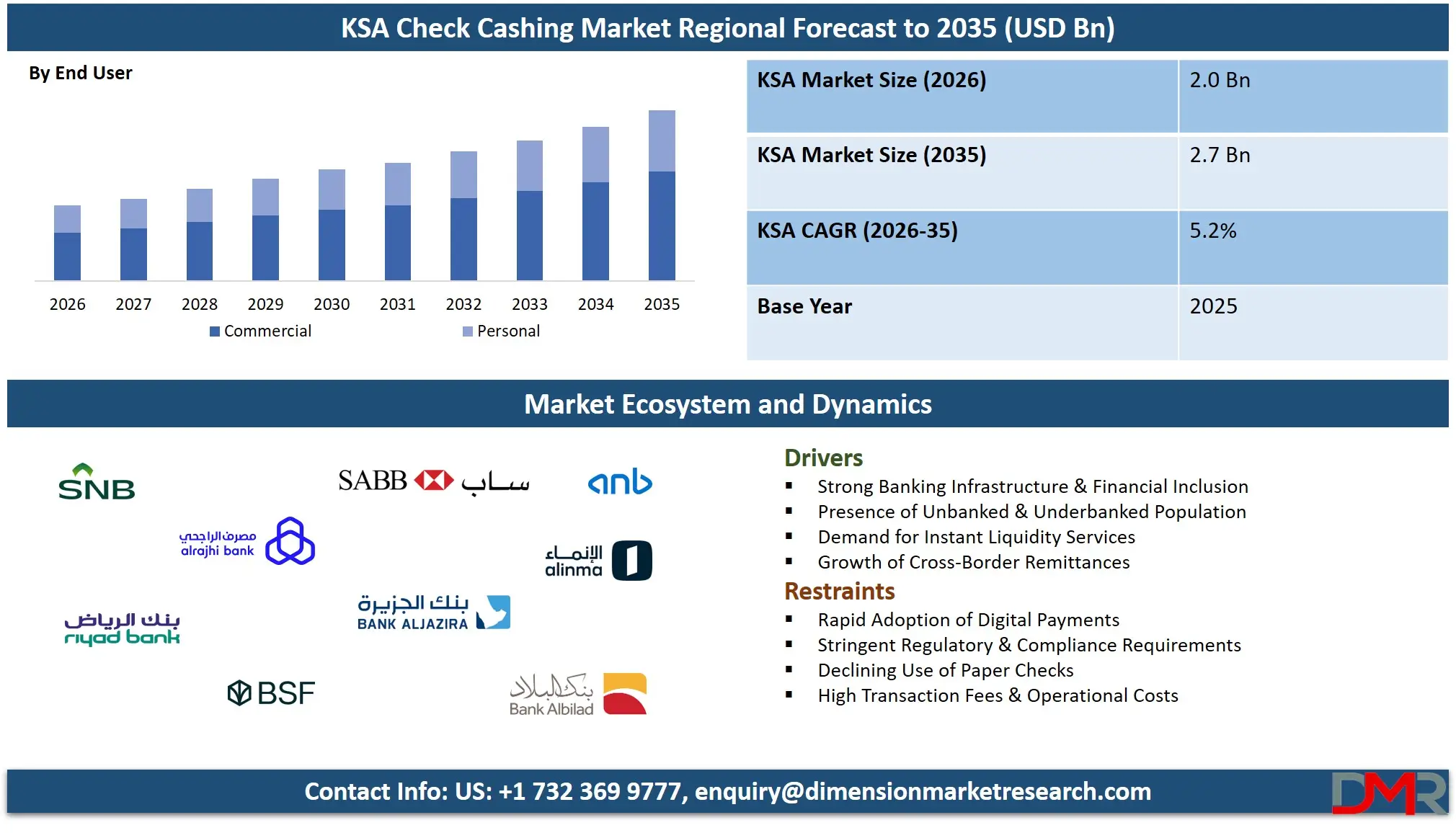
Saudi Arabia check cashing market size is estimated to reach USD 2.0 billion in 2026 and is projected to grow at a CAGR of 5.2%, reaching approximately USD 2.7 billion by 2035, driven by evolving payment processing systems, steady demand for financial liquidity services, and gradual transition within the paper based transactions ecosystem.
ℹ
To learn more about this report –
Download Your Free Sample Report Here
Check cashing refers to a financial service that allows individuals or businesses to convert a paper check into immediate cash without necessarily depositing it into a bank account. This service is commonly used for payroll checks, government issued payments, tax refunds, and personal checks, offering quick liquidity to users who may need instant access to funds. Check cashing providers verify the authenticity of the check and the issuer before releasing cash, typically charging a fee based on the check value or risk profile. The service plays an important role in financial ecosystems where segments of the population remain underbanked or prefer cash based transactions, and it also supports short term cash flow management for small enterprises and individuals seeking faster alternatives to traditional banking clearing cycles.
The KSA check cashing market is characterized by a highly structured and bank centric financial system, where check processing and encashment services are largely handled by licensed commercial banks and regulated financial institutions. The market operates within a strong regulatory framework governed by the Saudi Central Bank, ensuring secure transaction processing, fraud prevention, and compliance with financial standards. While check usage persists in corporate payments, supplier transactions, and certain government disbursements, the overall ecosystem is increasingly influenced by digital banking platforms, electronic fund transfers, and real time payment solutions that are gradually reducing reliance on paper based instruments.
ℹ
To learn more about this report –
Download Your Free Sample Report Here
Another defining aspect of the KSA check cashing market is the rapid transformation driven by Vision 2030 initiatives aimed at building a cashless economy and expanding fintech adoption. Digital wallets, mobile banking applications, and instant payment systems are reshaping consumer payment behavior, leading to a decline in personal check usage while maintaining moderate demand in business and institutional segments. Despite this shift, check cashing services continue to hold relevance in specific use cases such as legacy payment systems, contractual obligations, and formal business settlements, positioning the market as a transitioning segment within Saudi Arabia’s evolving financial services landscape.
KSA Check Cashing Market: Key Takeaways
- Market Size Projection: The market is estimated at USD 2.0 billion in 2026 and expected to reach USD 2.7 billion by 2035, highlighting steady growth in check cashing demand.
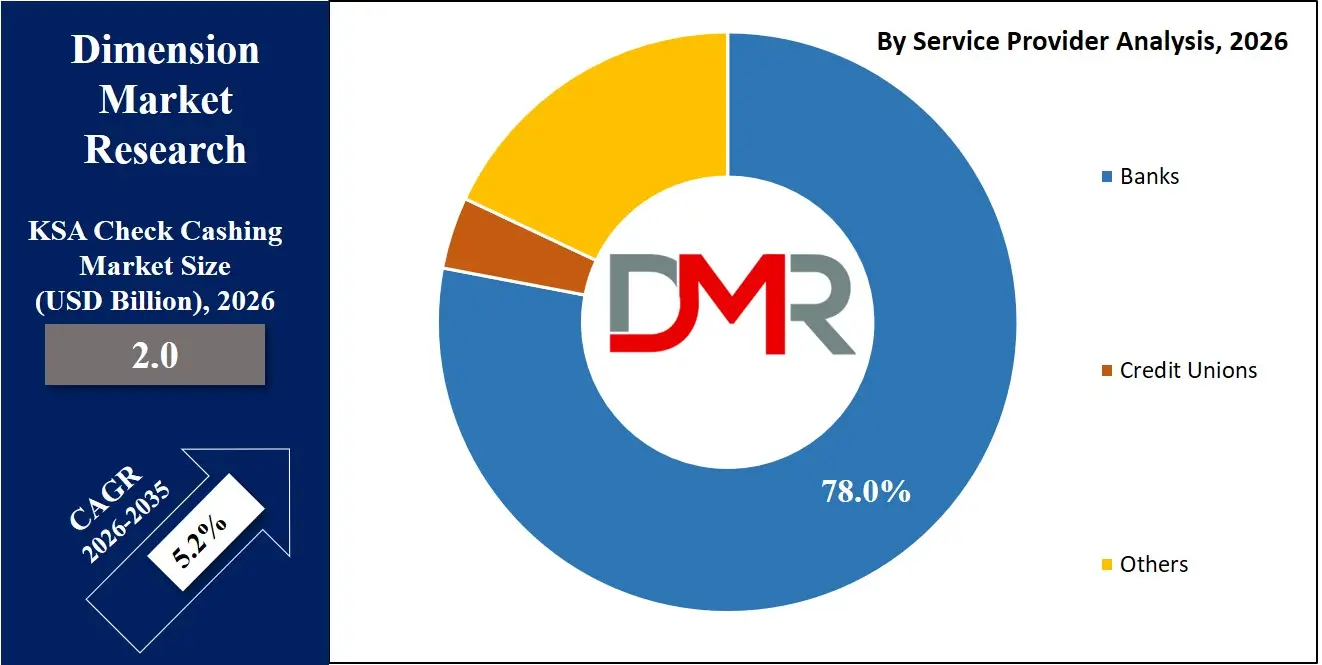
- Segment Dominance by Service Provider: Banks are projected to control 78% of the market share in 2026, underlining their central role in check processing and financial trust.
- Type Segment Leadership: Payroll checks lead the type segment with 26% market share in 2026, reflecting continued reliance for wage disbursements across specific sectors.
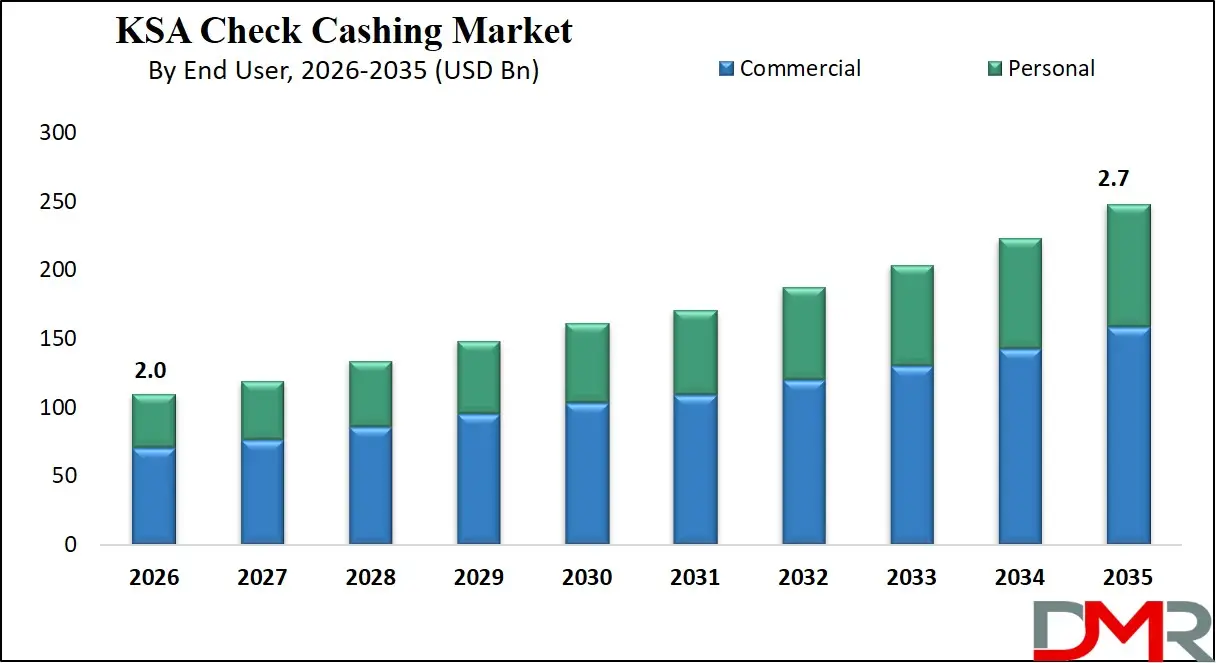
- End User Concentration: Commercial end users dominate with 64% of the total share, emphasizing business and institutional dependence on check based transactions.
- Digital Payment Penetration: Electronic payments accounted for 79% of retail transactions in 2024, showing rapid adoption and gradual impact on personal check usage.
KSA Check Cashing Market: Use Cases
- Corporate Settlements: Used by businesses for supplier payments and secure transaction clearing within formal banking systems.
- Payroll Disbursement: Enables employees to access wages quickly, supporting liquidity in less digitized workforce segments.
- Government Payments: Facilitates processing of reimbursements and institutional disbursements through regulated verification systems.
- SME Cash Flow: Helps small businesses convert receivables into instant cash, improving short term liquidity management.
KSA Check Cashing Market: Stats & Facts
- Saudi Central Bank (SAMA)
- Electronic payments accounted for 79% of total retail transactions in 2024, up from 70% in 2023.
- Non cash payment transactions reached 12.6 billion in 2024, compared to 10.8 billion in 2023.
- Digital payments increased from 62% in 2022 to 70% in 2023, showing strong adoption momentum.
- Payment system transactions grew by ~24% year on year in 2023.
- Saudi Arabia achieved a 79% digital payment share milestone ahead of Vision 2030 targets.
- SAMA continues to expand national payment infrastructure and electronic payment systems across the Kingdom.
- The central bank is actively working to reduce reliance on cash transactions in the economy.
- Collaboration between SAMA and financial institutions is driving growth in digital transaction volumes.
- Payment ecosystem expansion includes diverse digital payment options and services.
- SAMA confirmed continued efforts to enhance secure and innovative payment solutions nationwide.
KSA Check Cashing Market: Market Dynamic
Driving Factors in the KSA Check Cashing Market
Strong Banking Ecosystem and Regulatory Support
Saudi Arabia’s well established banking infrastructure and oversight by Saudi Central Bank ensure secure check verification, fraud control, and efficient clearing systems. This strengthens trust in check based financial transactions, particularly for corporate payments and institutional disbursements, supporting steady demand for check cashing services.
Continued Use in Corporate and Institutional Transactions
Despite digital transformation, checks remain relevant in B2B payments, contract settlements, and government related transactions. Businesses rely on paper based instruments for documentation, delayed payment arrangements, and financial record keeping, sustaining the need for check encashment and liquidity services.
Restraints in the KSA Check Cashing Market
Rapid Shift toward Digital Payments
The growing adoption of digital wallets, real time payment systems, and online banking solutions is reducing reliance on traditional check processing. Consumers and businesses are increasingly favoring instant fund transfers, limiting the long term growth of check cashing services.
Declining Personal Check Usage
Individual users are moving away from paper checks due to convenience and speed offered by electronic payment methods. This decline in personal transactions directly impacts volume in the check cashing ecosystem, especially in retail financial services.
Opportunities in the KSA Check Cashing Market
Integration with Fintech and Hybrid Payment Models
Financial institutions can integrate check cashing with digital platforms, enabling remote check deposit, mobile verification, and faster settlement cycles. This hybrid approach enhances customer experience while maintaining relevance in a digitizing financial ecosystem.
Support for SME Financial Liquidity
Small and medium enterprises present a key opportunity as they continue to rely on checks for receivables. Offering faster encashment, credit linked services, and working capital solutions can strengthen market demand and expand service offerings.
Trends in the KSA Check Cashing Market
Transition toward Cashless Economy Initiatives
Government led initiatives are accelerating the adoption of electronic payments, gradually reducing dependence on paper based instruments. This trend is reshaping transaction behavior while pushing check services toward niche and institutional use cases.
Automation in Check Processing Systems
Banks are adopting advanced verification technologies, automated clearing systems, and fraud detection tools to streamline check handling. This improves processing efficiency, reduces turnaround time, and enhances security within the financial services landscape.
KSA Check Cashing Market: Research Scope and Analysis
By Service Provider Analysis
Banks are expected to dominate the service provider segment in the KSA check cashing market, accounting for around 78.0% of the total market share in 2026, primarily due to their strong financial infrastructure, widespread branch networks, and high consumer trust. Licensed banks in Saudi Arabia play a central role in check verification, clearing, and settlement processes, supported by robust regulatory oversight from the Saudi Central Bank. Their ability to offer secure transaction processing, integrated banking services, and compliance driven operations makes them the preferred choice for both corporate and individual users. Banks also benefit from established relationships with businesses and government entities, where checks are still used for formal payments, contract settlements, and institutional disbursements, reinforcing their dominant position in the overall ecosystem.
ℹ
To learn more about this report –
Download Your Free Sample Report Here
At the same time, the others segment, which includes money service providers, exchange houses, and fintech agents, is gaining gradual traction by addressing niche and convenience driven use cases. These players typically focus on faster service delivery, simplified procedures, and accessibility for underbanked or expatriate populations who may not fully rely on traditional banking channels. Exchange houses and remittance service providers often integrate check cashing as part of broader financial services such as cross border transfers and currency exchange, while fintech firms are introducing digital interfaces, mobile enabled verification, and hybrid payment solutions. Although their overall market share remains smaller compared to banks, these entities contribute to market diversification by improving service reach, enhancing customer experience, and supporting evolving payment preferences within Saudi Arabia’s transitioning financial landscape.
By Type Analysis
Payroll checks are expected to dominate the type segment in the KSA check cashing market, accounting for around 26.0% of the total market share in 2026, primarily driven by their continued use in salary disbursement across certain sectors and employment categories. While Saudi Arabia is rapidly advancing toward digital payroll systems, checks are still used in specific cases such as contractual employment, temporary workforce arrangements, and smaller businesses that have not fully transitioned to electronic payment platforms. Payroll checks provide a formal and documented method of wage payment, ensuring traceability and compliance within employer employee financial transactions. Their role in supporting financial liquidity for workers who may prefer immediate cash access further sustains their relevance within the overall payment processing ecosystem.
The others category in this segment includes a mix of less standardized or infrequently used check types such as personal transfers, business reimbursements, insurance related payments, and miscellaneous financial instruments. These checks are typically used for one off or situational transactions where alternative payment methods may not be feasible or preferred. Although individually these categories hold smaller shares, collectively they contribute a notable portion to the market by addressing diverse financial needs across both individuals and organizations. This segment reflects the residual demand for paper based transactions within a gradually digitizing financial environment, where flexibility and specific use case requirements continue to support the presence of varied check types.
By End User Analysis
Commercial end users are expected to dominate the segment in the KSA check cashing market, accounting for around 64.0% of the total market share in 2026, largely due to the continued reliance of businesses on checks for formal financial transactions such as supplier payments, contract settlements, and deferred payment arrangements. Enterprises prefer checks as they provide documented proof of payment, support structured financial record keeping, and align with compliance requirements within the regulated banking framework overseen by the Saudi Central Bank. Many small and medium enterprises also use check cashing services to convert receivables into immediate liquidity, helping manage working capital and maintain operational cash flow in scenarios where payment cycles are extended.
On the other hand, the personal segment represents a smaller but still relevant share of the market, driven by individuals using checks for occasional transactions such as personal transfers, rental payments, or legacy financial arrangements. However, this segment is experiencing a gradual decline as consumers increasingly adopt digital payment methods, mobile wallets, and instant bank transfers for everyday transactions. Despite this shift, personal check usage persists in specific cases where formal documentation or delayed payment mechanisms are required, ensuring that check cashing services continue to serve a limited yet functional role for individual users within the broader financial services landscape.
The KSA Check Cashing Market Report is segmented on the basis of the following:
By Service Provider
- Banks
- Credit Unions
- Others
By Type
- Pre-Printed Checks
- Payroll Checks
- Government Checks
- Tax Checks
- Others
By End User
Impact of Artificial Intelligence in the KSA Check Cashing Market
Artificial intelligence is increasingly enhancing operational efficiency in the KSA check cashing market by automating core processes such as check verification, signature authentication, and fraud detection. AI powered systems use machine learning algorithms and image recognition to quickly validate check authenticity, detect anomalies, and reduce the risk of financial fraud. This significantly improves processing speed and accuracy compared to traditional manual methods, enabling banks and financial institutions to offer faster clearing and better customer experience. Additionally, AI driven data analytics helps institutions assess transaction patterns, optimize risk management strategies, and ensure compliance with regulatory standards set by the Saudi Central Bank.
At the same time, artificial intelligence is supporting the transition toward hybrid and digital financial services by enabling remote check deposit, automated customer onboarding, and intelligent workflow management. Fintech players and banks are leveraging AI to integrate check cashing services with mobile banking platforms, allowing users to submit and process checks digitally without visiting physical branches. This not only enhances accessibility but also aligns with Saudi Arabia’s broader push toward digital transformation and a cashless economy. As AI adoption continues to expand, it is expected to reduce operational costs, strengthen fraud prevention frameworks, and gradually reshape the role of check cashing within a more advanced and technology driven financial ecosystem.
KSA Check Cashing Market: Competitive Landscape
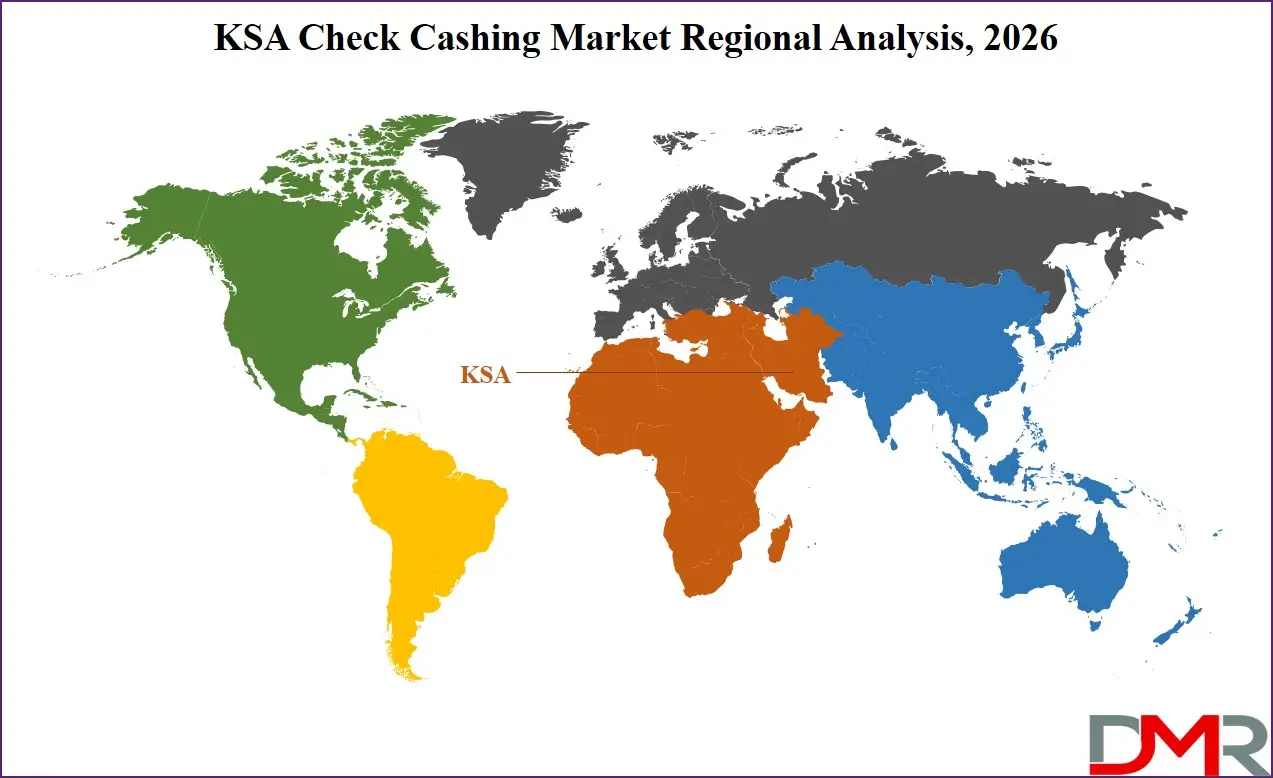
The competitive landscape of the KSA check cashing market is moderately concentrated, with a strong dominance of traditional banking institutions supported by a well-regulated financial framework and extensive branch networks. These players leverage established customer trust, integrated payment processing systems, and compliance capabilities to maintain a leading position in check verification and clearing services.
ℹ
To learn more about this report –
Download Your Free Sample Report Here
At the same time, the market is witnessing gradual participation from exchange houses, remittance service providers, and fintech firms that are introducing more agile, technology driven solutions such as mobile enabled transactions and hybrid financial services. Increasing digital payment adoption and regulatory advancements are intensifying competition, pushing service providers to focus on automation, fraud detection, and customer convenience, while partnerships and ecosystem integration are becoming key strategies to remain competitive in a transitioning payments landscape
Some of the prominent players in the KSA Check Cashing Market are:
- Saudi National Bank (SNB)
- Al Rajhi Bank
- Riyad Bank
- Banque Saudi Fransi
- Saudi British Bank (SABB)
- Arab National Bank
- Bank AlJazira
- Alinma Bank
- Bank Albilad
- Saudi Investment Bank
- Gulf International Bank
- Emirates NBD Saudi Arabia
- Alawwal Bank
- Tahweel Al Rajhi
- Enjaz Banking Services
- Western Union Saudi Arabia
- MoneyGram Saudi Arabia
- STC Bank
- UrPay
- Mobily Pay
- Other Key Players
Recent Developments in the KSA Check Cashing Market
- December 2025: Saudi fintech sector recorded cumulative investments of approximately USD 2.1 billion, reflecting strong funding momentum and expansion of digital financial services
- October 2025: Banque Saudi Fransi partnered with DBS Bank to enhance cross border payment flows, trade finance, and real time settlement solutions between Asia and the GCC region.
- September 2025: Saudi Central Bank announced the launch of Google Pay in Saudi Arabia, enabling secure mobile wallet payments and expanding digital transaction capabilities within the financial ecosystem.
Report Details
| Report Characteristics |
| Market Size (2026) |
USD 2.0 Bn |
| Forecast Value (2035) |
USD 2.7 Bn |
| CAGR (2026–2035) |
5.2% |
| Historical Data |
2021 – 2025 |
| Forecast Data |
2027 – 2035 |
| Base Year |
2025 |
| Estimate Year |
2026 |
| Report Coverage |
Market Revenue Estimation, Market Dynamics, Competitive Landscape, Growth Factors and etc. |
| Segments Covered |
By Service Provider (Banks, Credit Unions, and Others), By Type (Pre-Printed Checks, Payroll Checks, Government Checks, Tax Checks, and Others), and By End User (Commercial, Personal) |
| Country Coverage |
Saudi Arabia |
| Prominent Players |
Saudi National Bank (SNB), Al Rajhi Bank, Riyad Bank, Banque Saudi Fransi, Saudi British Bank (SABB), Arab National Bank, Bank AlJazira, Alinma Bank, Bank Albilad, Saudi Investment Bank, Gulf International Bank, Emirates NBD Saudi Arabia, Alawwal Bank, Tahweel Al Rajhi, Enjaz Banking Services, Western Union Saudi Arabia, MoneyGram Saudi Arabia, STC Bank, UrPay, Mobily Pay, and Other Key Players |
| Purchase Options |
We have three licenses to opt for: Single User License (Limited to 1 user), Multi-User License (Up to 5 Users) and Corporate Use License (Unlimited User) along with free report customization equivalent to 0 analyst working days, 3 analysts working days and 5 analysts working days respectively. |
Frequently Asked Questions
How big is the KSA Check Cashing Market?
▾ The KSA Check Cashing Market size is estimated to have a value of USD 2.0 billion in 2026 and is expected to reach USD 2.7 billion by the end of 2035.
What is the growth rate in the KSA Check Cashing Market in 2026?
▾ The market is growing at a CAGR of 5.2% over the forecasted period of 2026.
Who are the key players in the KSA Check Cashing Market?
▾ Some of the major key players in the KSA Check Cashing Market are Saudi National Bank (SNB), Al Rajhi Bank, Riyad Bank, Banque Saudi Fransi, Saudi British Bank (SABB), Arab National Bank, Bank AlJazira, Alinma Bank, Bank Albilad, Saudi Investment Bank, Gulf International Bank, Emirates NBD Saudi Arabia, and many others.