Saudi Arabia Cold Chain Logistics Market Snapshot
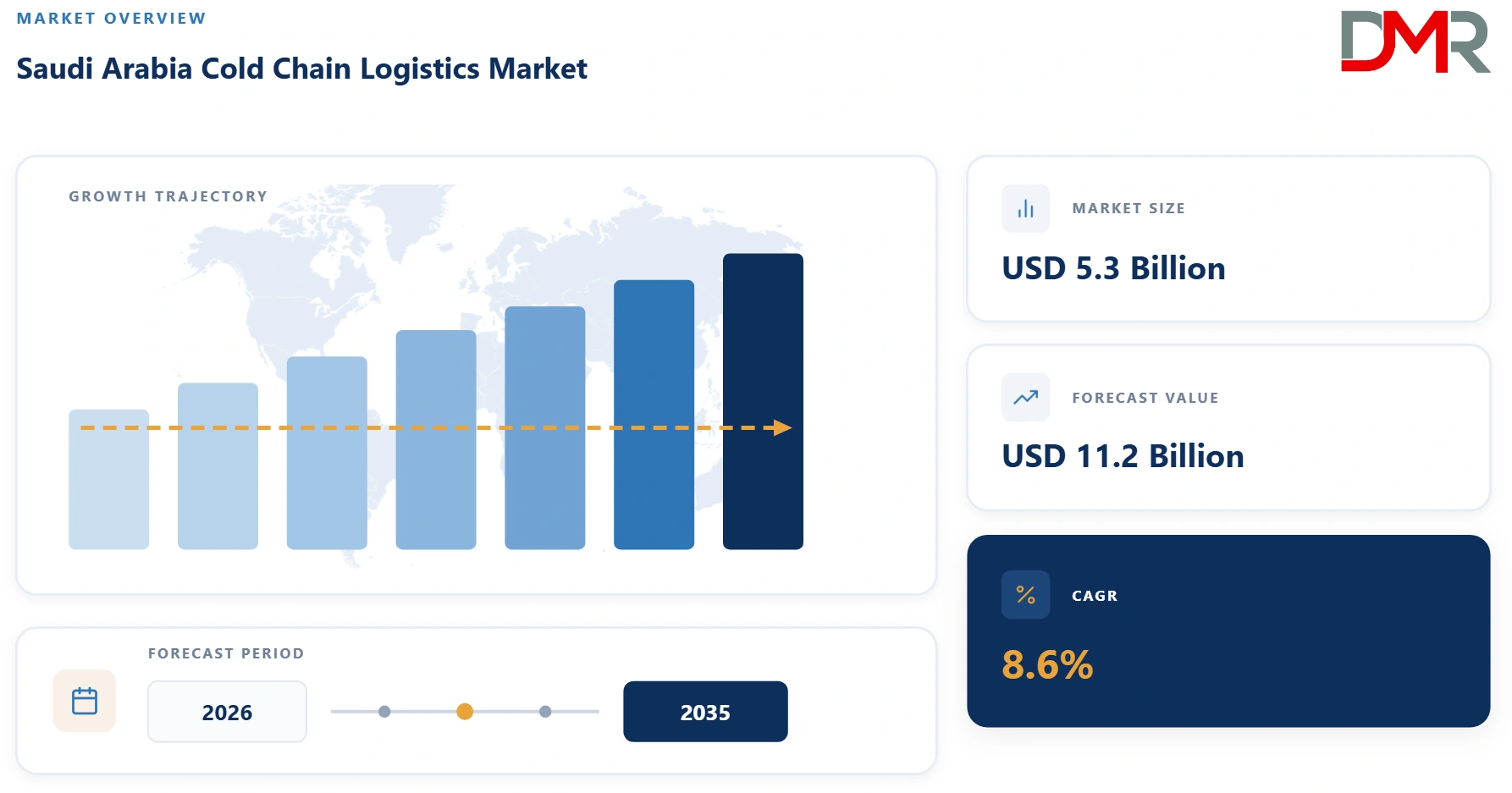
- Saudi Arabia Cold Chain Logistics Market Size in 2026: USD 5.3 Billion
- Saudi Arabia Cold Chain Logistics Market Size in 2035: USD 11.2 Billion
- Saudi Arabia CAGR from 2026 to 2035: 8.6%
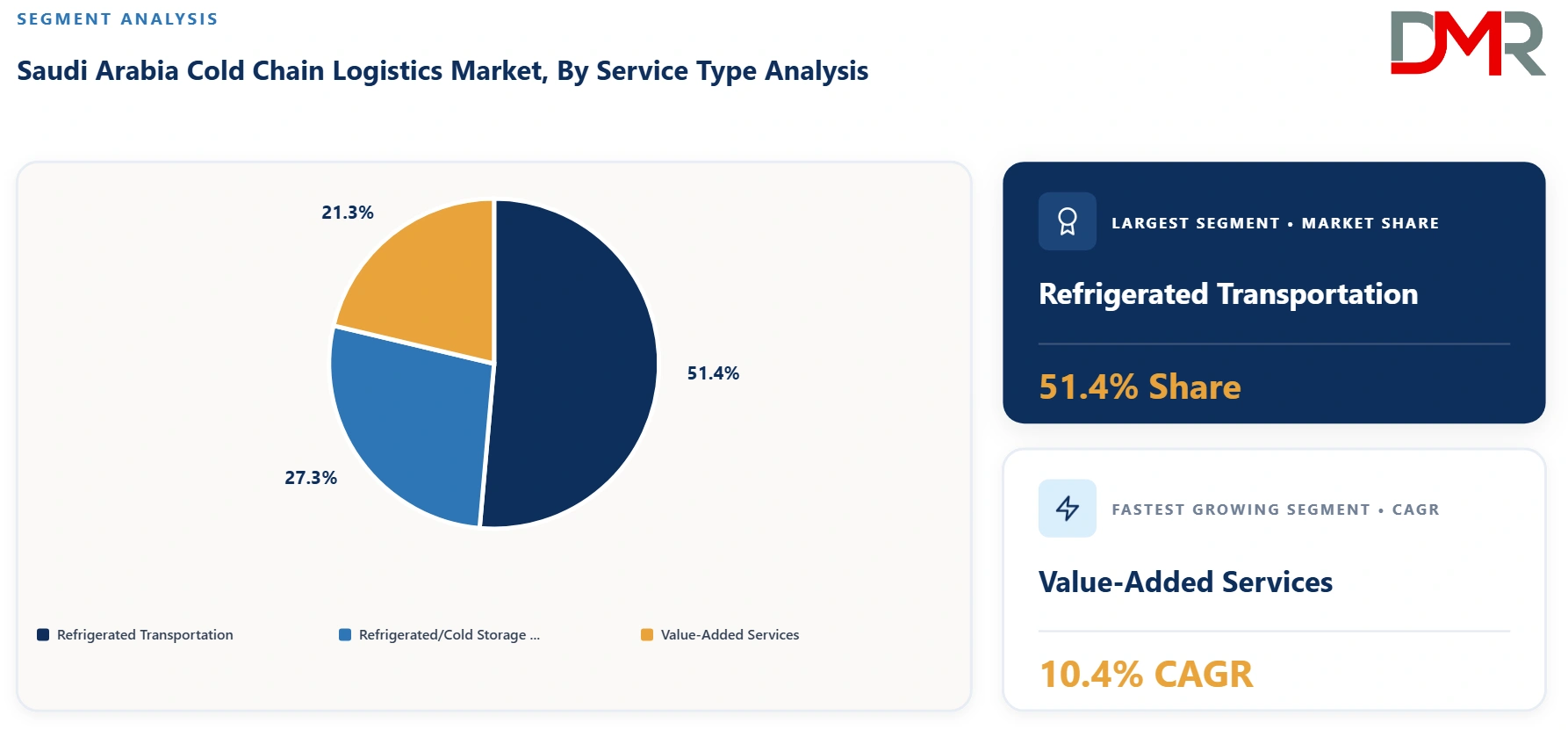
- Refrigerated Transportation is the leading service type segment in 2026: 51.4%
- Frozen is the leading temperature type segment in 2026: 44.8%
- Roadways is the leading mode of transport segment in 2026: 76.3%
- Dairy Products is the leading application segment in 2026: 28.6%
- Food and Beverage Industry is the leading end user segment in 2026: 72.4%
What is the Saudi Arabia Cold Chain Logistics Market and its Market Size?
The Saudi Arabia Cold Chain Logistics Market is projected to be valued at USD 5.3 Billion in 2026 and is projected to reach USD 11.2 Billion by 2035, expanding at a CAGR of 8.6% during the forecast period.
ℹ
To learn more about this report –
Download Your Free Sample Report Here
Growth is being propelled by Saudi Arabia's extreme climate conditions that make robust cold chain infrastructure essential to food safety and quality preservation across virtually all temperature-sensitive product categories, rapid growth in grocery e-commerce and food delivery platforms across the Kingdom's major urban centers, and substantial government investment in logistics infrastructure modernization as part of Vision 2030 economic diversification and food security priorities. The maturing of climate-resilient refrigerated transportation and warehousing technology specifically engineered for sustained extreme heat conditions, growing pharmaceutical and healthcare sector investment in temperature-controlled distribution supporting the Kingdom's expanding healthcare infrastructure, and continued development of dedicated logistics zones and cold storage hubs near major Saudi cities and ports are reshaping the market from a historically underdeveloped logistics segment into an increasingly sophisticated, technology-enabled national cold chain network. Investment is accelerating as Saudi logistics providers and food companies modernize cold chain infrastructure to meet both rising domestic consumption and Vision 2030 food security and logistics sector development objectives.
Use Cases
- Climate-Resilient Refrigerated Transportation Across Vast Geographic Distances: Saudi food distributors and retailers rely on specially engineered refrigerated trucking fleets capable of maintaining consistent temperature control despite sustained extreme ambient heat during long-distance transport across the Kingdom's vast geography connecting major urban centers.
- Temperature-Controlled Distribution for Expanding Healthcare Infrastructure: Pharmaceutical distributors and healthcare logistics providers use validated cold chain transportation and storage to support the Kingdom's rapidly expanding hospital and healthcare infrastructure, distributing vaccines, biologics, and temperature-sensitive medications across an increasingly dispersed network of healthcare facilities.
- Last-Mile Cold Chain for Grocery E-Commerce and Quick-Commerce Delivery: Online grocery platforms and quick-commerce delivery services operating in Riyadh, Jeddah, and other major Saudi cities rely on temperature-controlled last-mile delivery fleets to maintain product quality for chilled and frozen groceries delivered directly to consumers despite challenging outdoor heat conditions.
- Cold Storage Infrastructure for Dairy and Fresh Food Distribution: Saudi dairy companies and fresh food distributors depend on extensive cold storage warehousing networks to preserve product quality across the distribution chain connecting processing facilities with retail and foodservice destinations throughout the Kingdom.
Key Takeaways
- Market Size: The Saudi Arabia Cold Chain Logistics Market is anticipated to be valued at USD 5.3 Billion in 2026 and is forecast to reach USD 11.2 Billion by 2035, expanding at a CAGR of 8.6%.
- Growth Outlook: Market expansion is sustained by the Kingdom's extreme climate conditions necessitating robust cold chain infrastructure, rapid growth in grocery e-commerce and food delivery, and substantial government investment in logistics infrastructure modernization under Vision 2030.
- Primary Growth Drivers: Extreme climate conditions requiring specialized cold chain infrastructure, rapid grocery e-commerce and food delivery platform growth, expanding healthcare infrastructure driving pharmaceutical cold chain investment, and Vision 2030 logistics sector development priorities are accelerating market growth.
- By Service Type Analysis: Refrigerated Transportation is projected to lead the service type segment with a 51.4% share in 2026, reflecting the Kingdom's substantial reliance on road-based distribution across vast geographic distances. Value-Added Services is the fastest-growing service type segment at 10.4% CAGR, driven by rising demand for inventory management and specialized handling services alongside core transportation and storage.
- By Temperature Type Analysis: Frozen is expected to dominate with a 44.8% share in 2026, supported by extensive frozen food and imported protein distribution volumes. Deep-Frozen is the fastest-growing temperature type segment at 10.9% CAGR, driven by expanding pharmaceutical biologics distribution requiring ultra-low temperature handling.
- By Mode of Transport Analysis: Roadways is poised to lead with a 76.3% share in 2026, reflecting the dominant role of refrigerated trucking across the Kingdom's road-dependent distribution network. Airways is the fastest-growing mode of transport segment at 9.8% CAGR, driven by growing time-critical pharmaceutical and premium food product distribution requirements.
- By Application Analysis: Dairy Products is expected to command a 28.6% share in 2026, underpinned by the Kingdom's substantial domestic dairy production and distribution requirements. Pharmaceuticals and Healthcare is the fastest-growing application segment at 11.2% CAGR, fuelled by expanding healthcare infrastructure and biologics distribution requirements.
- By End User Analysis: Food and Beverage Industry is projected to dominate with a 72.4% share in 2026, reflecting the sector's overwhelming share of overall cold chain volume. Pharmaceutical and Healthcare Industry is the fastest-growing end user segment at 10.8% CAGR, driven by sustained growth in the Kingdom's healthcare infrastructure and temperature-sensitive drug distribution.
Key Drivers in the Saudi Arabia Cold Chain Logistics Market
Extreme Climate Conditions Necessitating Robust Cold Chain Infrastructure
Saudi Arabia's sustained extreme heat conditions, with ambient temperatures regularly exceeding levels that would compromise food safety and quality without robust temperature control, create a structural and non-discretionary requirement for comprehensive cold chain infrastructure across virtually all temperature-sensitive product distribution. Unlike markets with more moderate climates where cold chain investment may be driven primarily by convenience or premium positioning considerations, Saudi Arabia's climate makes reliable refrigerated transportation and storage an essential food safety requirement, sustaining structural demand for cold chain capacity investment across the food distribution system regardless of shorter-term economic conditions.
Rapid Growth in Grocery E-Commerce and Food Delivery Platforms
Saudi Arabia has experienced substantial growth in online grocery ordering and food delivery platform adoption, particularly across major urban centers including Riyadh and Jeddah, driven by high smartphone penetration, growing consumer comfort with digital commerce, and demanding outdoor climate conditions that make delivery-based grocery and meal fulfillment particularly attractive to Saudi consumers. This rapid e-commerce channel growth is driving substantial investment in last-mile cold chain logistics capability, as delivery platforms must maintain product quality and food safety for chilled and frozen items despite challenging climate conditions during the delivery process itself.
Restraints in the Saudi Arabia Cold Chain Logistics Market
High Energy and Operating Costs Associated with Extreme Climate Cooling Requirements
The substantial energy consumption required to maintain reliable temperature control across refrigerated transportation and storage infrastructure under Saudi Arabia's sustained extreme heat conditions represents a significant restraint on the Cold Chain Logistics Market. Cooling equipment must work considerably harder and consume more energy to maintain required temperatures than in more temperate climates, increasing operating costs for cold chain providers and potentially limiting profit margins or requiring cost pass-through that can affect broader food distribution economics across the Kingdom.
Growth Opportunities in the Saudi Arabia Cold Chain Logistics Market
Energy-Efficient, Climate-Engineered Cold Storage and Transportation Technology
Saudi Arabia's extreme climate conditions present a substantial opportunity for logistics providers and equipment manufacturers developing specifically engineered, energy-efficient cold storage and refrigerated transportation technology optimized for sustained extreme heat performance. Companies capable of demonstrating meaningfully lower energy consumption and more reliable temperature maintenance under Saudi climate conditions, relative to cold chain equipment adapted from designs developed for temperate markets, can capture premium positioning and stronger long-term client relationships.
Pharmaceutical and Healthcare Cold Chain Infrastructure Expansion
Saudi Arabia's substantial ongoing investment in expanding and modernizing healthcare infrastructure under Vision 2030 presents a significant opportunity for cold chain logistics providers to develop specialized pharmaceutical and biologics distribution capability serving the Kingdom's growing network of hospitals, clinics, and healthcare facilities. Providers capable of meeting the validation, monitoring, and chain-of-custody documentation requirements for pharmaceutical cold chain distribution, while managing the Kingdom's demanding climate conditions, are well positioned to capture premium, long-term contracts with pharmaceutical manufacturers and healthcare distribution networks.
Trends in the Saudi Arabia Cold Chain Logistics Market
Growing Investment in Dedicated Cold Storage and Logistics Zone Development
Saudi Arabia is increasingly developing dedicated cold storage and logistics zones near major cities, ports, and transportation corridors, reflecting national priorities around logistics sector development and food security under Vision 2030. These dedicated zones offer infrastructure and regulatory advantages specifically supporting cold chain investment, attracting concentrated development of modern, purpose-built cold storage facilities designed around current automation and energy efficiency standards.
Rising Adoption of Real-Time IoT-Based Temperature Monitoring
Saudi cold chain logistics providers are increasingly adopting IoT-enabled sensors and real-time temperature monitoring systems across refrigerated vehicles and storage facilities, allowing continuous visibility into product condition throughout transit and storage despite the Kingdom's demanding climate conditions. This technology adoption reflects both customer demand for verifiable cold chain integrity documentation, particularly important given the food safety risks associated with any temperature control failure under extreme heat conditions, and providers' own interest in proactively identifying and addressing potential equipment issues before they result in product loss.
Research Scope and Analysis
The Saudi Arabia Cold Chain Logistics Market is segmented by service type, temperature type, mode of transport, application, and end user, covering refrigerated transportation, cold storage warehousing, value-added services, chilled, frozen, deep-frozen temperature ranges, and food, pharmaceutical, and retail end users.
ℹ
To learn more about this report –
Download Your Free Sample Report Here
By Service Type Analysis
Refrigerated Transportation is projected to dominate the Saudi Arabia Cold Chain Logistics Market with 51.4% share in 2026, reflecting the Kingdom's substantial reliance on road-based refrigerated distribution to connect production and import facilities with population centers across its vast geography. Value-Added Services is expected to register the highest CAGR of 10.4% during 2026-2035, driven by rising demand for inventory management, specialized handling, and other services integrated alongside core transportation and storage offerings.
By Temperature Type Analysis
Frozen is anticipated to dominate the Saudi Arabia Cold Chain Logistics Market by temperature type, accounting for 44.8% share in 2026, supported by extensive frozen food and imported protein product distribution volumes given the Kingdom's substantial reliance on food imports supplementing domestic production. Deep-Frozen is projected to register the highest CAGR of 10.9% between 2026 and 2035, driven by expanding pharmaceutical biologics distribution requiring ultra-low temperature handling and storage supporting the Kingdom's growing healthcare infrastructure.
By Mode of Transport Analysis
Roadways is projected to lead the Saudi Arabia Cold Chain Logistics Market with an estimated 76.3% share in 2026, reflecting the dominant and largely unavoidable role of refrigerated trucking within the Kingdom's road-dependent distribution network connecting geographically dispersed population centers. Airways is expected to register the fastest CAGR of 9.8% through 2035, driven by growing demand for time-critical pharmaceutical, biologics, and premium food product distribution requiring the fastest possible transit times.
By Application Analysis
Dairy Products is projected to lead the Saudi Arabia Cold Chain Logistics Market with an estimated 28.6% share in 2026, underpinned by the Kingdom's substantial domestic dairy production and distribution requirements connecting processing facilities with retail and foodservice destinations nationwide. Pharmaceuticals and Healthcare is expected to register the fastest CAGR of 11.2% through 2035, driven by sustained expansion of the Kingdom's healthcare infrastructure and growing biologics and vaccine distribution requirements.
By End User Analysis
Food and Beverage Industry is projected to dominate the Saudi Arabia Cold Chain Logistics Market with 72.4% share in 2026, reflecting the sector's overwhelming share of total cold chain transportation and storage volume. Pharmaceutical and Healthcare Industry is expected to register the fastest CAGR of 10.8% through 2035, driven by sustained growth in temperature-sensitive drug, vaccine, and biologics distribution supporting the Kingdom's expanding healthcare sector.
The Saudi Arabia Cold Chain Logistics Market Report is segmented based on the following:
By Service Type
- Refrigerated Transportation
- Refrigerated/Cold Storage Warehousing
- Value-Added Services
By Temperature Type
- Chilled
- Frozen
- Deep-Frozen
By Mode of Transport
- Roadways
- Airways
- Railways
- Waterways
By Application
- Dairy Products
- Meat, Poultry and Seafood
- Fruits and Vegetables
- Bakery and Confectionery
- Pharmaceuticals and Healthcare
- Others
By End User
- Food and Beverage Industry
- Pharmaceutical and Healthcare Industry
- Retail and E-Commerce
- Others
Technology Analysis
Technology investment is increasingly shaping competitiveness in the Saudi Arabia Cold Chain Logistics Market as providers adopt climate-engineered refrigeration technology, IoT-based real-time temperature monitoring, and predictive maintenance analytics specifically calibrated for reliable performance under sustained extreme heat conditions. Growing use of route optimization software is helping minimize transit times and associated temperature control risk across the Kingdom's extensive geography. Opportunities are expanding for providers investing in energy-efficient refrigeration systems specifically engineered for extreme heat performance, solar-assisted cooling technology leveraging the Kingdom's abundant solar resources, and blockchain or digital ledger-based chain-of-custody documentation for pharmaceutical and premium food applications. However, high capital costs for climate-adapted equipment and facility development, combined with the substantial energy infrastructure required to support reliable cooling under extreme conditions, remain significant barriers for smaller or newly entering operators.
Investment and White Space Analysis
Investment opportunities in the Saudi Arabia Cold Chain Logistics Market are expanding alongside the Kingdom's structural climate-driven cold chain requirements, rapid grocery e-commerce growth, and substantial Vision 2030-aligned logistics and healthcare infrastructure investment. Significant white space exists in energy-efficient, climate-engineered cold storage and transportation technology, dedicated cold storage and logistics zone development, and specialized pharmaceutical and healthcare cold chain infrastructure. Providers with strong climate-adapted technical capability, established relationships with major Saudi food and healthcare companies, and access to dedicated logistics zone infrastructure are positioned to capture premium, longer-duration contracts. However, high energy and operating costs associated with extreme climate cooling requirements, along with the capital intensity of climate-adapted infrastructure development, can constrain margins for smaller, less capitalized operators.
Competitive Landscape
The Saudi Arabia Cold Chain Logistics Market is moderately consolidated and increasingly competitive, comprising large national and international cold chain logistics companies, regional Gulf logistics providers, and specialized pharmaceutical cold chain logistics companies. Competition centers on climate-engineered infrastructure reliability, energy efficiency, geographic coverage across the Kingdom's dispersed population centers, and specialized pharmaceutical validation and monitoring capability. Large national and international providers benefit from broad geographic coverage, integrated multimodal capability, and established relationships with major Saudi food and healthcare companies, while regional and specialized providers compete on category-specific expertise and closer client relationships in particular regions or applications. Companies increasingly differentiate through climate-adapted technology investment, energy efficiency credentials, and specialized pharmaceutical handling capability rather than transportation capacity alone.
Some of the prominent players in the Saudi Arabia Cold Chain Logistics Market are:
- Almarai Logistics Division
- NADEC Cold Chain Operations
- Bahri Logistics
- Zamil Cold Stores
- Saudi Logistics Services (Mawani-affiliated)
- Americold Logistics Saudi Arabia
- Agility Logistics Saudi Arabia
- Aramex Saudi Arabia
- DHL Supply Chain Saudi Arabia
- Kuehne+Nagel Saudi Arabia
- CEVA Logistics Saudi Arabia
- Bin Dawood Cold Chain Operations
- Panda Retail Logistics
- SAPTCO Cold Chain Solutions
- Al Sorayai Trading and Industrial Group
- Almunajem Foods Logistics
- Naqel Express
- Saudi Post (SPL) Cold Chain Services
- Gulf Cryo Logistics
- Other Key Players
Recent Developments
- July 2026: Bahri launched the Bahri Bonded Zone at Jeddah Islamic Port, offering ambient, chilled, and frozen storage across more than 95,000 sq. m. for food, pharmaceuticals, and other temperature-sensitive goods.
- February 2026: ASMO, the Aramco–DHL Supply Chain joint venture, partnered with Arcapita to develop a 1.4 million sq. m. logistics facility at SPARK, including a 43,000 sq. m. temperature-controlled Grade-A warehouse.
- November 2025: DHL Supply Chain announced a SAR 561.5 million investment in a new logistics hub at Saudi Arabia’s Special Integrated Logistics Zone in Riyadh, adding 53,000 sq. m. of advanced multi-user warehousing.
Report Details
| Report Characteristics |
| Market Size (2026) |
USD 5.3 Bn |
| Forecast Value (2035) |
USD 11.2 Bn |
| CAGR (2026–2035) |
8.6% |
| Historical Data |
2021 – 2025 |
| Forecast Data |
2026 – 2035 |
| Base Year |
2025 |
| Segments Covered |
By Service Type, By Temperature Type, By Mode of Transport, By Application, By End User |
| Country Coverage |
Saudi Arabia |
Frequently Asked Questions
How big is the Saudi Arabia Cold Chain Logistics Market?
▾ The Saudi Arabia Cold Chain Logistics Market is poised to be valued at USD 5.3 Billion in 2026 and is projected to reach USD 11.2 Billion by 2035, reflecting the Kingdom's structural climate-driven cold chain requirements and rapid growth in e-commerce and healthcare distribution.
What is the CAGR of the Saudi Arabia Cold Chain Logistics Market from 2026 to 2035?
▾ The market is projected to expand at a compound annual growth rate (CAGR) of 8.6% between 2026 and 2035, supported by extreme climate conditions necessitating robust cold chain infrastructure, rapid grocery e-commerce growth, and expanding healthcare infrastructure investment.
What factors are driving the growth of the Saudi Arabia Cold Chain Logistics Market?
▾ Growth is driven by extreme climate conditions requiring specialized cold chain infrastructure, rapid grocery e-commerce and food delivery platform growth, expanding healthcare infrastructure driving pharmaceutical cold chain investment, and Vision 2030 logistics sector development priorities.
What are the major trends in the Saudi Arabia Cold Chain Logistics Market?
▾ Major trends include growing investment in dedicated cold storage and logistics zone development, rising adoption of real-time IoT-based temperature monitoring, and expanding investment in energy-efficient, climate-engineered refrigeration technology.
Who are the key players in the Saudi Arabia Cold Chain Logistics Market?
▾ Key market participants include Almarai Logistics Division, Americold Logistics Saudi Arabia, Agility Logistics Saudi Arabia, Aramex Saudi Arabia, and DHL Supply Chain Saudi Arabia, among other national and international cold chain logistics providers.
How is the Saudi Arabia Cold Chain Logistics Market segmented?
▾ The market is segmented by service type, temperature type, mode of transport, application, and end user, with demand analysis concentrated across Riyadh, Jeddah, the Eastern Province, and the Kingdom's dedicated logistics zones.