Saudi Arabia Dairy Processing Market Snapshot
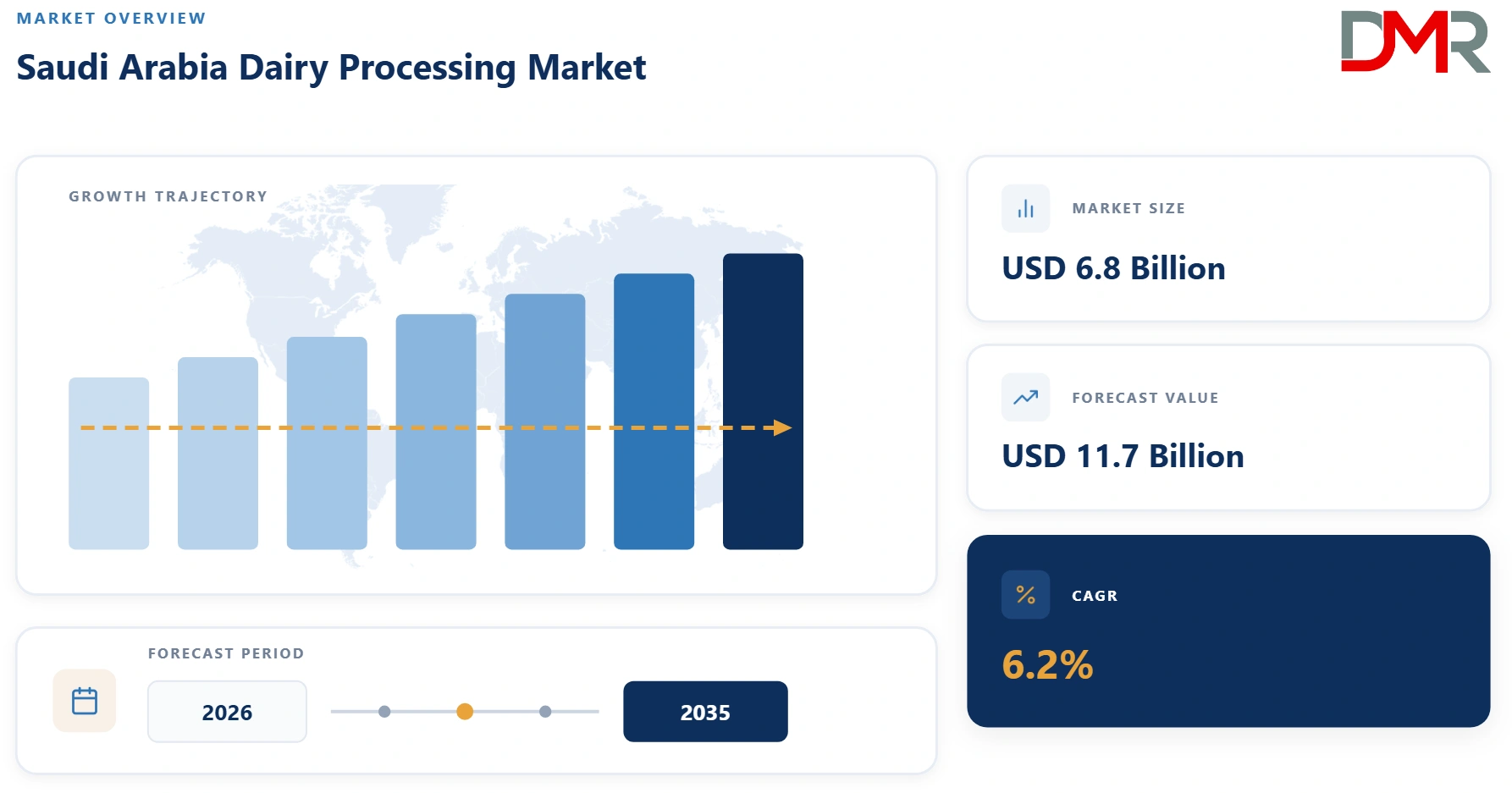
- Saudi Arabia Dairy Processing Market Size in 2026: USD 6.8 Billion
- Saudi Arabia Dairy Processing Market Size in 2035: USD 11.7 Billion
- Saudi Arabia CAGR from 2026 to 2035: 6.2%
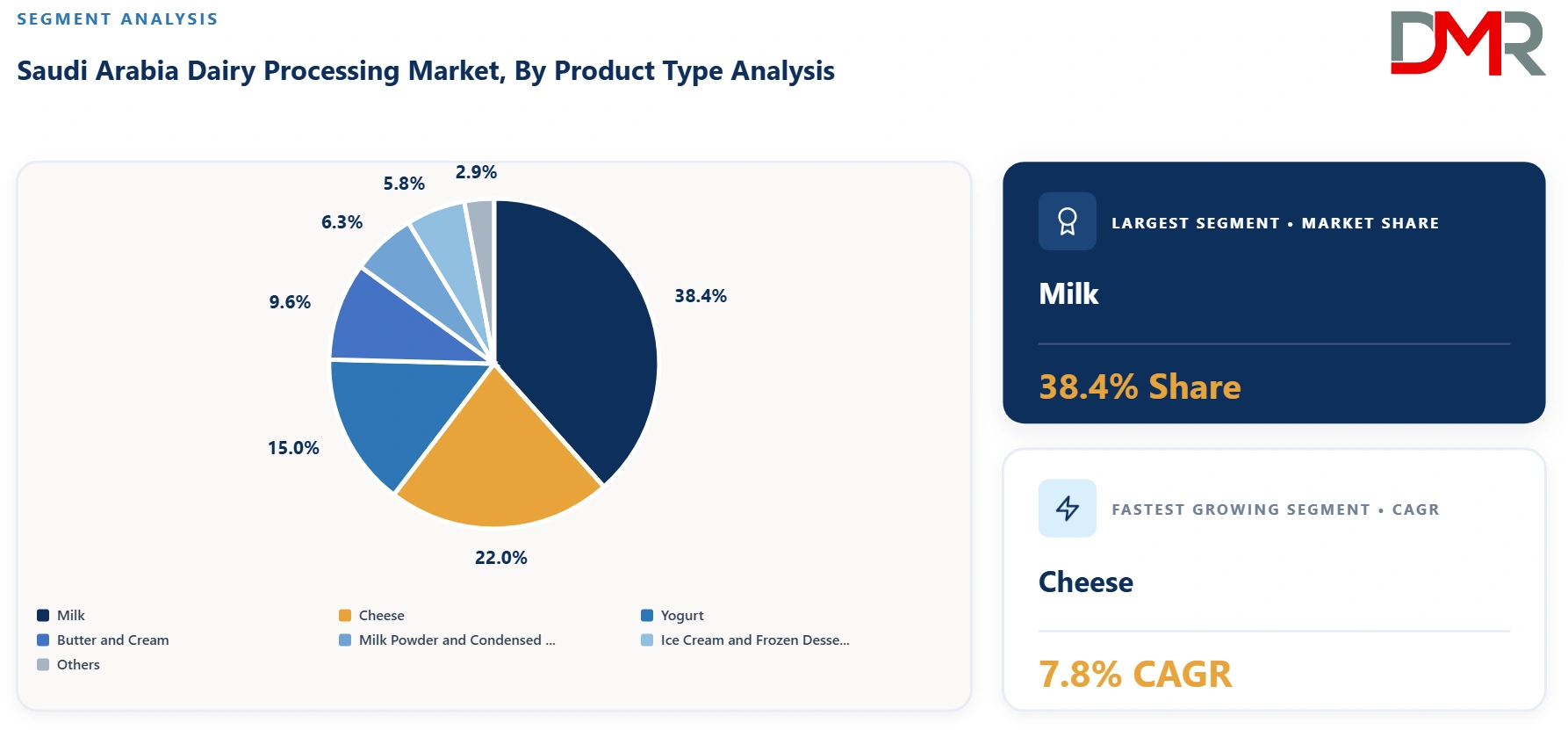
- Milk is the leading product type segment in 2026: 38.4%
- UHT/Ultra-High Temperature is the leading processing type segment in 2026: 47.9%
- Cartons and Tetra Packs is the leading packaging type segment in 2026: 44.6%
- Supermarkets and Hypermarkets is the leading distribution channel segment in 2026: 41.2%
What is the Saudi Arabia Dairy Processing Market and its Market Size?
The Saudi Arabia Dairy Processing Market is projected to be valued at USD 6.8 Billion in 2026 and is projected to reach USD 11.7 Billion by 2035, expanding at a CAGR of 6.2% during the forecast period.
ℹ
To learn more about this report –
Download Your Free Sample Report Here
Growth is being propelled by Saudi Arabia's status as the largest dairy consuming and producing market within the Gulf Cooperation Council, sustained government investment in domestic dairy production capacity under Vision 2030 food security priorities, and substantial private sector investment by leading Saudi dairy companies in expanding processing capacity, farm integration, and product portfolio diversification. The maturing of UHT and extended shelf-life processing technologies suited to the Kingdom's demanding climate and vast geographic distribution requirements, growing consumer demand for value-added and premium dairy products including flavored yogurts, specialty cheeses, and fortified milk products, and continued Saudi dairy company expansion into export markets across the broader Gulf and Middle East region are reshaping the market from a historically import-supplemented dairy supply base into one of the most vertically integrated and technologically advanced dairy processing industries in the Middle East. Investment is accelerating as Saudi dairy companies pursue continued farm-to-processing vertical integration while diversifying into higher-value product categories and expanding regional export capacity.
Use Cases
- UHT Milk Processing for Extended Shelf Life Across Vast Distribution Networks: Saudi dairy processors rely extensively on UHT processing technology to produce shelf-stable milk products capable of maintaining quality without refrigeration during extended storage and transportation across the Kingdom's large geographic area and demanding climate conditions.
- Vertically Integrated Dairy Farm-to-Processing Operations: Leading Saudi dairy companies operate large-scale, vertically integrated operations spanning dairy farming, milk processing, and distribution, enabling tighter quality control and supply chain reliability compared to companies reliant on external milk sourcing.
- Value-Added and Premium Dairy Product Development: Saudi dairy processors increasingly develop premium and value-added product lines, including flavored and Greek-style yogurts, specialty cheese varieties, and fortified milk products, responding to evolving consumer preferences and rising disposable incomes.
- Regional Export Expansion Across the Gulf Cooperation Council: Major Saudi dairy companies expand production capacity and distribution networks to serve growing dairy demand across neighboring Gulf Cooperation Council markets, leveraging the Kingdom's substantial dairy processing scale and established regional brand recognition.
Key Takeaways
- Market Size: The Saudi Arabia Dairy Processing Market is anticipated to be valued at USD 6.8 Billion in 2026 and is forecast to reach USD 11.7 Billion by 2035, expanding at a CAGR of 6.2%.
- Growth Outlook: Market expansion is sustained by Saudi Arabia's position as the largest dairy market within the Gulf Cooperation Council, continued government and private investment in domestic dairy production capacity, and growing consumer demand for premium and value-added dairy products.
- Primary Growth Drivers: Vision 2030 food security priorities supporting domestic dairy production expansion, sustained population growth and rising dairy consumption, growing vertical integration among leading Saudi dairy companies, and expanding regional export ambitions across the Gulf Cooperation Council are accelerating market growth.
- By Product Type Analysis: Milk is projected to lead the product type segment with a 38.4% share in 2026, reflecting its position as a dietary staple across Saudi households. Cheese is the fastest-growing product type segment at 7.8% CAGR, driven by rising consumer demand for both traditional and Western-style cheese varieties.
- By Processing Type Analysis: UHT/Ultra-High Temperature is expected to dominate with a 47.9% share in 2026, supported by its suitability for the Kingdom's extreme climate and extensive distribution requirements. UHT is also among the fastest-growing processing type segments given its central role in extending shelf life across Saudi Arabia's demanding logistics environment.
- By Packaging Type Analysis: Cartons and Tetra Packs is poised to lead with a 44.6% share in 2026, reflecting their compatibility with UHT processing and widespread use across Saudi retail distribution. Pouches is the fastest-growing packaging type segment at 7.4% CAGR, driven by cost-effective packaging demand for value-oriented dairy products.
- By Distribution Channel Analysis: Supermarkets and Hypermarkets are projected to dominate with a 41.2% share in 2026, reflecting the central role of modern grocery retail in Saudi dairy product distribution. Online Retail is the fastest-growing distribution channel segment at 12.1% CAGR, driven by expanding grocery e-commerce adoption across Saudi urban centers.
Key Drivers in the Saudi Arabia Dairy Processing Market
Saudi Arabia's Position as the Largest Gulf Cooperation Council Dairy Market
Saudi Arabia's substantial population, high per-capita dairy consumption reflecting strong cultural dietary tradition around milk and dairy products, and position as the largest economy within the Gulf Cooperation Council collectively establish the Kingdom as the region's largest dairy consuming and producing market. This substantial domestic market scale provides Saudi dairy companies with the production volume and revenue base necessary to support continued investment in processing technology, farm integration, and product innovation, reinforcing the country's position as a regional dairy industry leader with growing export ambitions across neighboring Gulf markets.
Sustained Government and Private Investment in Vertical Integration
Continued government support for domestic food security under Vision 2030, combined with substantial private capital investment by leading Saudi dairy companies, has driven extensive vertical integration spanning dairy farming, feed production, milk processing, and distribution. This vertical integration model, while requiring substantial capital investment, provides Saudi dairy companies with greater supply chain control, quality consistency, and resilience against international dairy commodity price volatility compared to companies relying more heavily on imported dairy inputs, supporting continued investment in this integrated operating model.
Restraints in the Saudi Arabia Dairy Processing Market
Water Scarcity and Feed Import Dependency Affecting Dairy Farming Sustainability
Saudi Arabia's arid climate and limited water resources create significant sustainability and cost challenges for the water-intensive dairy farming operations underlying the Kingdom's vertically integrated dairy processing industry. Dairy farms must rely heavily on imported animal feed and manage substantial water resource requirements, creating ongoing cost and environmental sustainability considerations that represent a meaningful restraint on the long-term expansion of domestic dairy farming capacity, even as processing and market demand continue to grow.
Growth Opportunities in the Saudi Arabia Dairy Processing Market
Regional Export Expansion Leveraging Established Saudi Dairy Brands
Saudi Arabia's leading dairy companies, having achieved substantial scale and brand recognition within the domestic market, present a significant opportunity to expand export distribution across the broader Gulf Cooperation Council and wider Middle East region. Companies capable of leveraging existing production scale, established brand equity, and regional distribution relationships can capture growing dairy demand across neighboring markets, diversifying revenue beyond domestic Saudi consumption while capitalizing on the Kingdom's position as a regional dairy processing leader.
Premium and Functional Dairy Product Innovation
Rising Saudi consumer interest in premium, functional, and health-positioned dairy products, including probiotic yogurts, fortified milk products, and specialty cheese varieties, presents an opportunity for dairy processors to develop higher-margin product lines beyond commodity milk and basic dairy staples. Companies investing in product innovation and premium positioning can capture growing consumer willingness to pay for differentiated dairy products, supporting improved margins relative to more commoditized segments of the dairy category.
Trends in the Saudi Arabia Dairy Processing Market
Continued Consolidation and Scale Expansion Among Leading Saudi Dairy Companies
The Saudi Arabia Dairy Processing Market continues to see consolidation and scale expansion among the Kingdom's leading dairy companies, as larger players acquire smaller regional dairy producers and invest in expanded processing and farming capacity to strengthen market position and pursue regional export growth. This consolidation trend reflects the substantial capital investment required for competitive vertical integration and the scale advantages available to larger, more established Saudi dairy companies in both domestic and regional export markets.
Growing Investment in Sustainable and Water-Efficient Dairy Farming Technology
Saudi dairy companies are increasingly investing in water-efficient farming technology, including advanced irrigation and feed production techniques, to address the water scarcity and environmental sustainability challenges associated with domestic dairy farming operations. This trend reflects growing recognition within the industry that long-term dairy farming sustainability in the Kingdom's arid climate requires continued technological innovation to manage water and feed resource constraints.
Research Scope and Analysis
The Saudi Arabia Dairy Processing Market is segmented by product type, processing type, packaging type, and distribution channel, covering milk, cheese, yogurt, butter, milk powder, ice cream, pasteurized, UHT, fermented, and powdered processing, and modern retail, traditional grocery, and foodservice distribution channels.
ℹ
To learn more about this report –
Download Your Free Sample Report Here
By Product Type Analysis
Milk is projected to dominate the Saudi Arabia Dairy Processing Market with 38.4% share in 2026, reflecting its position as a dietary staple deeply embedded in Saudi household consumption patterns. Cheese is expected to register the highest CAGR of 7.8% during 2026-2035, driven by rising consumer demand for both traditional Middle Eastern cheese varieties and growing interest in Western-style cheese products.
By Processing Type Analysis
UHT/Ultra-High Temperature processing is anticipated to dominate the Saudi Arabia Dairy Processing Market by processing type, accounting for 47.9% share in 2026, supported by its critical role enabling extended shelf-stable distribution across the Kingdom's vast geography and demanding climate conditions without requiring continuous refrigeration. UHT processing continues to represent a growth area as Saudi dairy companies expand distribution reach into more remote regions and pursue regional export opportunities requiring extended product shelf life.
By Packaging Type Analysis
Cartons and Tetra Packs are projected to lead the Saudi Arabia Dairy Processing Market with an estimated 44.6% share in 2026, reflecting their strong compatibility with UHT processing technology and widespread consumer familiarity across Saudi retail distribution channels. Pouches are expected to register the fastest CAGR of 7.4% through 2035, driven by cost-effective packaging demand supporting value-oriented dairy product segments popular among price-conscious consumer groups.
By Distribution Channel Analysis
Supermarkets and Hypermarkets are projected to dominate the Saudi Arabia Dairy Processing Market with 41.2% share in 2026, reflecting the central and growing role of modern grocery retail formats in Saudi dairy product distribution. Online Retail is expected to register the fastest CAGR of 12.1% through 2035, driven by rapidly expanding grocery e-commerce adoption across major Saudi urban centers, particularly Riyadh and Jeddah.
The Saudi Arabia Dairy Processing Market Report is segmented based on the following:
By Product Type
- Milk
- Cheese
- Yogurt
- Butter and Cream
- Milk Powder and Condensed Milk
- Ice Cream and Frozen Desserts
- Others
By Processing Type
- Pasteurized
- UHT/Ultra-High Temperature
- Fermented
- Powdered
By Packaging Type
- Cartons and Tetra Packs
- Bottles
- Pouches
- Cups and Tubs
- Others
By Distribution Channel
- Supermarkets and Hypermarkets
- Convenience Stores
- Traditional Grocery/Baqalas
- Online Retail
- Foodservice/HoReCa
Technology Analysis
Technology investment is increasingly shaping competitiveness in the Saudi Arabia Dairy Processing Market as companies adopt advanced UHT and aseptic processing systems, automated packaging lines, and precision dairy farm management technology to improve production efficiency and product quality consistency. Growing use of water-efficient irrigation and feed production technology is helping address the sustainability challenges associated with dairy farming in the Kingdom's arid climate. Opportunities are expanding for companies investing in cold chain and logistics technology supporting extended distribution networks, as well as digital farm management systems that optimize herd health and milk production efficiency. However, the capital intensity of vertically integrated farm-to-processing technology investment can create barriers for smaller or newly entering dairy processors seeking to compete with the Kingdom's established, large-scale integrated dairy companies.
Investment and White Space Analysis
Investment opportunities in the Saudi Arabia Dairy Processing Market are expanding alongside the Kingdom's position as the largest Gulf Cooperation Council dairy market, sustained government food security investment priorities, and growing regional export ambitions among leading Saudi dairy companies. Significant white space exists in premium and functional dairy product innovation, water-efficient and sustainable dairy farming technology, and regional export capacity expansion leveraging established Saudi dairy brands. Companies with strong vertical integration capability, established domestic brand equity, and regional distribution relationships are positioned to capture premium, longer-duration growth opportunities. However, water scarcity and feed import dependency affecting dairy farming sustainability, along with continued consolidation-driven competitive pressure, can constrain margins and expansion pace for smaller, less integrated dairy processors.
Competitive Landscape
The Saudi Arabia Dairy Processing Market is moderately consolidated and competitive, comprising several large, vertically integrated national dairy champions alongside regional and multinational dairy companies with Saudi operations. Competition centers on vertical integration and supply chain control, brand recognition and consumer trust, product portfolio breadth spanning traditional and premium categories, and regional export distribution capability. Large, vertically integrated Saudi dairy companies benefit from substantial production scale, established domestic brand equity, and growing regional export infrastructure, while multinational companies compete through global product innovation capability and international brand recognition. Companies increasingly differentiate through premium and functional product innovation, sustainability credentials in dairy farming operations, and regional export market development rather than commodity milk production alone.
Some of the prominent players in the Saudi Arabia Dairy Processing Market are:
- Almarai Company
- Saudia Dairy & Foodstuff Company (SADAFCO)
- National Agricultural Development Company (NADEC)
- Al Safi Danone
- Al Rabie Saudi Foods Company
- Nada Dairy
- Al Othman Agricultural Production & Processing Company (NADA)
- United National Dairy Company
- Gulf Union Foods Company
- Forsan Foods & Consumer Products Company
- Aujan Coca-Cola Beverages Company
- Al Rawabi Dairy Company
- Baladna Food Industries
- Lactalis Group
- Danone
- Nestlé
- FrieslandCampina
- Arla Foods
- Fonterra Co-operative Group
- Saputo
- Kerry Group
- IFF
- DSM-Firmenich
- Tetra Pak
- GEA Group
- Alfa Laval
- Krones
- SPX FLOW
- JBT Marel
- SIG Group
- Sidel
- KHS Group
- Provisur Technologies
- Bucher Industries
- Pentair
- Paul Mueller Company
- Serac Group
- IMA Group
- Syntegon Technology
- Caloris Engineering
- Other Key Players
Recent Developments
- September 2025: SADAFCO announced deployment of the Tetra Pak E3 Speed Hyper Line in Saudi Arabia to increase high-volume Saudia Milk production while reducing water, energy, and chemical consumption.
- March 2025: Tetra Pak launched a three-year project to modernize and digitize Al Rabie’s Saudi production facilities, including dairy food operations, using Industry 4.0 technologies.
- January 2025: Almarai deployed RISE with SAP on Google Cloud and SAP S/4HANA to support operational efficiency, digital transformation, scalability, and its broader Saudi food and dairy expansion strategy.
Report Details
| Report Characteristics |
| Market Size (2026) |
USD 6.8 Bn |
| Forecast Value (2035) |
USD 11.7 Bn |
| CAGR (2026–2035) |
6.2% |
| Historical Data |
2021 – 2025 |
| Forecast Data |
2026 – 2035 |
| Base Year |
2025 |
| Segments Covered |
By Product Type, By Processing Type, By Packaging Type, and By Distribution Channel |
| Country Coverage |
Saudi Arabia |
Frequently Asked Questions
How big is the Saudi Arabia Dairy Processing Market?
▾ The Saudi Arabia Dairy Processing Market is valued at USD 6.8 Billion in 2026 and is projected to reach USD 11.7 Billion by 2035, reflecting the Kingdom's position as the largest dairy market within the Gulf Cooperation Council and sustained investment in domestic production capacity.
What is the CAGR of the Saudi Arabia Dairy Processing Market from 2026 to 2035?
▾ The market is projected to expand at a compound annual growth rate (CAGR) of 6.2% between 2026 and 2035, supported by Vision 2030 food security priorities, sustained population growth, and growing regional export ambitions among leading Saudi dairy companies.
What factors are driving the growth of the Saudi Arabia Dairy Processing Market?
▾ Growth is driven by Vision 2030 food security priorities supporting domestic dairy production expansion, sustained population growth and rising dairy consumption, growing vertical integration among leading Saudi dairy companies, and expanding regional export ambitions across the Gulf Cooperation Council.
What are the major trends in the Saudi Arabia Dairy Processing Market?
▾ Major trends include continued consolidation and scale expansion among leading Saudi dairy companies, growing investment in sustainable and water-efficient dairy farming technology, and rising development of premium and functional dairy product lines.
Who are the key players in the Saudi Arabia Dairy Processing Market?
▾ Key market participants include Almarai Company, National Agricultural Development Company (NADEC), Al Safi Danone, Saudia Dairy and Foodstuff Company (SADAFCO), and Nada Dairy, among other major national and multinational dairy companies operating in the Kingdom.
How is the Saudi Arabia Dairy Processing Market segmented?
▾ The market is segmented by product type, processing type, packaging type, and distribution channel, with demand analysis concentrated across Riyadh, Jeddah, the Eastern Province, and the Kingdom's broader dairy farming regions.