Saudi Arabia Dates Market snapshot
- Saudi Arabia Dates Market size in 2026 is: USD 145.7 Million
- Saudi Arabia Dates Market size in 2035 is: USD 240.0 Million
- CAGR from 2027 to 2035 is: 5.7%
- Khalas is the leading type segment: 41.2%
- Conventional is the leading nature segment: 71.1%
- Supermarkets is the leading distribution channel segment: 62.4%
- Khalas is the fastest-growing type segment: 6.2% CAGR
- Organic is the fastest-growing nature segment: 6.5% CAGR
- Online Stores is the fastest-growing distribution channel segment: 6.1% CAGR
What is the Saudi Arabia Dates Market? Saudi Arabia Dates Market Size.
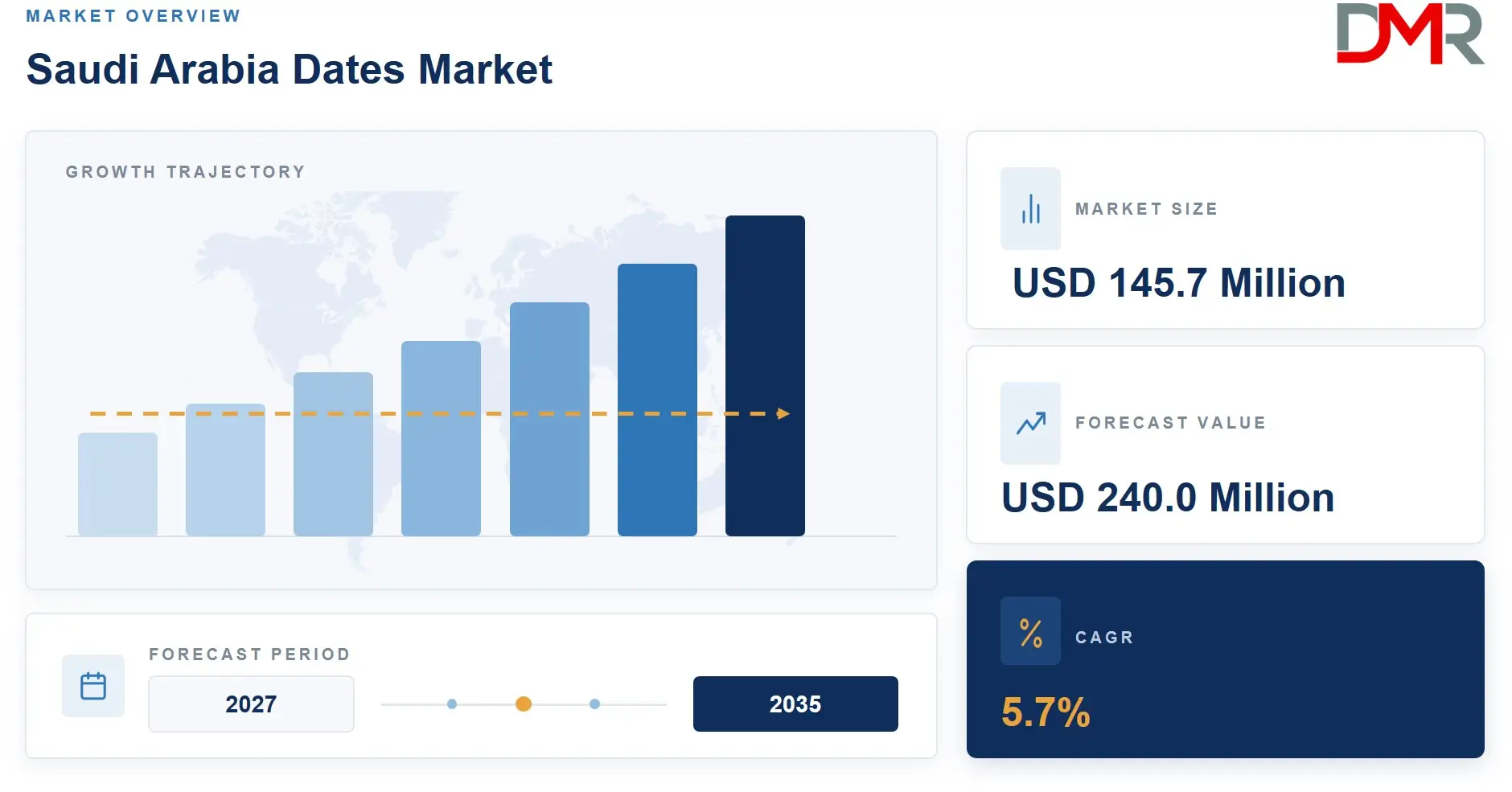
The Saudi Arabia Dates Market size is valued at USD 145.7 Million in 2026, and it is further anticipated to reach a market value of USD 240.0 Million by 2035 at a CAGR of 5.7%.
ℹ
To learn more about this report –
Download Your Free Sample Report Here
The Saudi Arabia Dates Market is one of the key sectors of agriculture in Saudi Arabia, backed by good growing conditions, age-old agriculture methods, and high consumption within the country. Dates have a variety of uses in daily life, cooking, and cultural events, which leads to sustained demand in the market. There are several varieties of dates available on the market, with products available via supermarkets, specialty shops, and online. The growing demand for high-quality dates is one of the trends influencing the market growth.
Use Cases
- Household Consumption: Consumption of dates is prevalent in the homes of Saudi Arabia as one of the components of regular dietary intake of people. They are used as snacks, included in breakfast food, and presented to visitors at social functions. Their inherent sweetness makes them a favorite substitute for processed confectionery. There are different kinds available like Khalas, Barhi, Zahidi, and Deglet Noor to suit different consumer tastes. Household consumption is one of the major application areas in the Saudi Arabia Dates Market.
- Food and Beverage Processing: Dates are being used more often as food and beverage processing ingredients due to their natural taste and versatility. The processing of dates includes adding date paste, syrup, and cut dates to baked foods, candies, energy bars, desserts, and dairy foods. Dates can be used as substitutes for regular sugar in certain food products. This application requires processed date ingredients and enables food processors to produce various product forms.
- Hospitality and Food Services: Hospitals, hotels, and restaurants in Saudi Arabia make use of dates in their food services on different occasions. These are usually offered along with the Arabic coffee as part of the traditional hospitality customs and are also used in dessert and drink recipes and special food preparations. In Ramadan, dates become particularly significant as the food that is eaten to break the fast. Dates of high quality are used by hospitality businesses for guests, gifts, and presentations.
- Gift Packaging and Seasonal Consumption: Dates have traditionally been bought as gifts in Saudi Arabia especially during the period of Ramadan and Eid as well as wedding parties and other social events. Dates of high quality can usually be found packaged in specially designed boxes and decorated packaging that would match their gifting nature. Various packs of dates with varied flavors are also available by various business entities that would meet consumers' needs to buy attractive gifts.
Key Takeaways
- Market Growth: The Saudi Arabia Dates Market is anticipated to reach USD 240.0 Million by 2035, starting from USD 145.7 Million in 2026, at a CAGR of 5.7%. Market growth is supported by strong domestic consumption, established date cultivation practices, increasing demand for premium varieties, and the growing availability of dates through different retail channels. Rising interest in product quality, organic offerings, and value-added date products is also contributing to market development.
- Khalas Leads the Type Segment: Khalas accounts for 41.2% of the market share, supported by consumer preference for its distinctive taste, soft texture, and premium positioning. Its use in household consumption, gifting, and food preparation contributes to its leading position. Khalas is also projected to be the fastest-growing type segment, registering a CAGR of 6.2%, driven by continued demand for premium date varieties and wider availability across retail channels.
- Conventional Dominates the Nature Segment: Conventional dates hold 71.1%of the market share, reflecting their widespread availability, established cultivation practices, and accessibility across different consumer groups. Their presence across supermarkets, specialty stores, and other retail outlets supports their dominant position. Organic dates are projected to record the fastest growth, at a CAGR of 6.5%, supported by increasing consumer interest in organically cultivated food products and greater attention to agricultural practices and product sourcing.
- Supermarkets Lead the Distribution Channel Segment: Supermarkets account for 62.4%of the market share, supported by their broad product availability, convenient shopping experience, and access to different date varieties and packaging options. Consumers can compare brands, product quality, and prices within a single retail location, supporting purchases through this channel. Online Stores are projected to witness the fastest growth, at a CAGR of 6.1%, driven by shopping convenience, wider product selection, and increasing adoption of e-commerce platforms.
How AI/Gen AI Is Transforming the Saudi Arabia Dates Market?
AI technology and Generative AI are generating possibilities in the Saudi Arabia Dates Market. The farmers will be able to employ the AI technology to analyze the state of the soil, weather patterns, irrigation needs and potential problems associated with growing date palms. Processing companies will also be able to use AI technology to classify the dates in terms of sizes, color, ripeness and quality of the fruits. In addition, Generative AI can be employed to assist businesses to generate new date-based products, packaging ideas and consumer preferences. With regard to the retailers in the market, AI technology can be used to forecast purchase trends, manage inventory and anticipate seasonal demand, especially during Ramadan.
Key Drivers
Strong Cultural and Religious Significance of Dates
Dates are highly valued in the culture of Saudi Arabia in regard to their significance in religious practices and the food culture of the region; this ensures their continuous consumption locally. Dates are widely consumed by the Saudi households during the fasting period of Ramadan since they are used to break the fasting period in the evening. Dates are also widely consumed along with the Arabic coffee during various social occasions and family functions.
Established Domestic Date Production and Agricultural Base
There is a domestic date growing industry in Saudi Arabia, which is well established through large palm plantations, experienced farmers, and established agriculture methods. There are many types of dates grown in the country such as Khalas, Barhi, Zahidi, and Deglet Noor among others. This is done in order to meet diverse needs of the consumers. The existence of domestic growing industries and infrastructure facilitates the development of the market for dates in Saudi Arabia.
Restraints
Water Scarcity and Irrigation Requirements
Water scarcity continues to be an issue affecting the production of dates in Saudi Arabia, a place that uses irrigation in its agricultural operations. The management of water is vital in ensuring continued production of dates, especially when there is a scarcity of water in some places. The reliance on underground water might be stressful to farmers while incurring extra cost in cultivating their dates. Producers need to manage their water needs with the available water in order to cultivate their plantations effectively.
Post-Harvest Losses and Storage Challenges
Keeping the quality of dates harvested continues to be an issue for producers and distributors in Saudi Arabia. Hot weather could influence the quality, moisture level, and freshness of dates when they are not handled and stored in the right conditions. Lack of cold storage facility, transportation system, and proper post-harvest process could lead to product loss and wastage. Farmers and companies with smaller operations could encounter more problems with storage facilities. These issues could influence product quality, handling costs, and market value of harvested dates.
Growth Opportunities
Expansion of International Date Exports
There exist several ways that Saudi Arabia may increase its participation in international date markets through exporting dates to various destinations such as Asia, Europe, among others. The local manufacturers will stand to gain from creating more awareness about the various types of dates produced in Saudi Arabia and how they can be utilized in the production of different foods, as well as their regular consumption. Investment in packaging, grading, certification, and international marketing of their products will allow companies to attract more customers.
Development of Value-Added Date Products
There is potential in developing value-added products from dates for processors and food manufacturers in Saudi Arabia. Dates can be turned into syrups, pastes, stuffed dates, chocolate-coated products, and snacks, depending on the preference of the consumer. These value-added products will give manufacturers the chance to look for alternative uses for dates beyond eating them in their original form. With investments in machinery, product innovation, and product packaging, manufacturers can diversify their products.
Trends
Growing Preference for Premium and Gift-Packaged Dates
Increasing popularity of premium and beautifully packed dates is affecting product development in the kingdom of Saudi Arabia. Consumers buy packs of assorted high-quality dates during special events such as Ramadan, Eid, marriage ceremonies and other social gatherings in order to use them as gifts and to serve their guests. Such products that have high-quality packages with selected varieties, fillings and decorations are becoming popular in specialty shops as well as in grocery stores.
Modern Farming and Processing Technology
The farmers and processors of dates in Saudi Arabia are adopting new technology to make their farming process more efficient. Modern sorting and grading machinery can enable them to sort their produce on the basis of size, color, maturity, and quality. Better irrigation system can enable better water management. Temperature controlled storage facilities will also be helpful in keeping the quality of the product after harvesting. These factors have encouraged them to adopt modern methods of production to cut down on manual efforts.
Research Scope and Analysis
The Saudi Arabia Dates Market is segmented based on Type into Sukkari, Khalas, Ajwa, Barhi, Segai, Safawi, and Others, Nature into Conventional and Organic, and Distribution Channel into Supermarkets, Specialty Stores, Online Stores, and Others.
ℹ
To learn more about this report –
Download Your Free Sample Report Here
By Type Analysis
The Khalas type segment holds the largest market share by value, accounting for 41.2% of the Saudi Arabia Dates Market in 2026. Its leading position is supported by consumer preference for its distinctive taste, soft texture, and premium quality. Khalas dates are widely used for household consumption, gifting, and hospitality purposes. The Khalas segment is also forecasted to experience the highest CAGR of 6.2% during 2027–2035.
By Nature Analysis
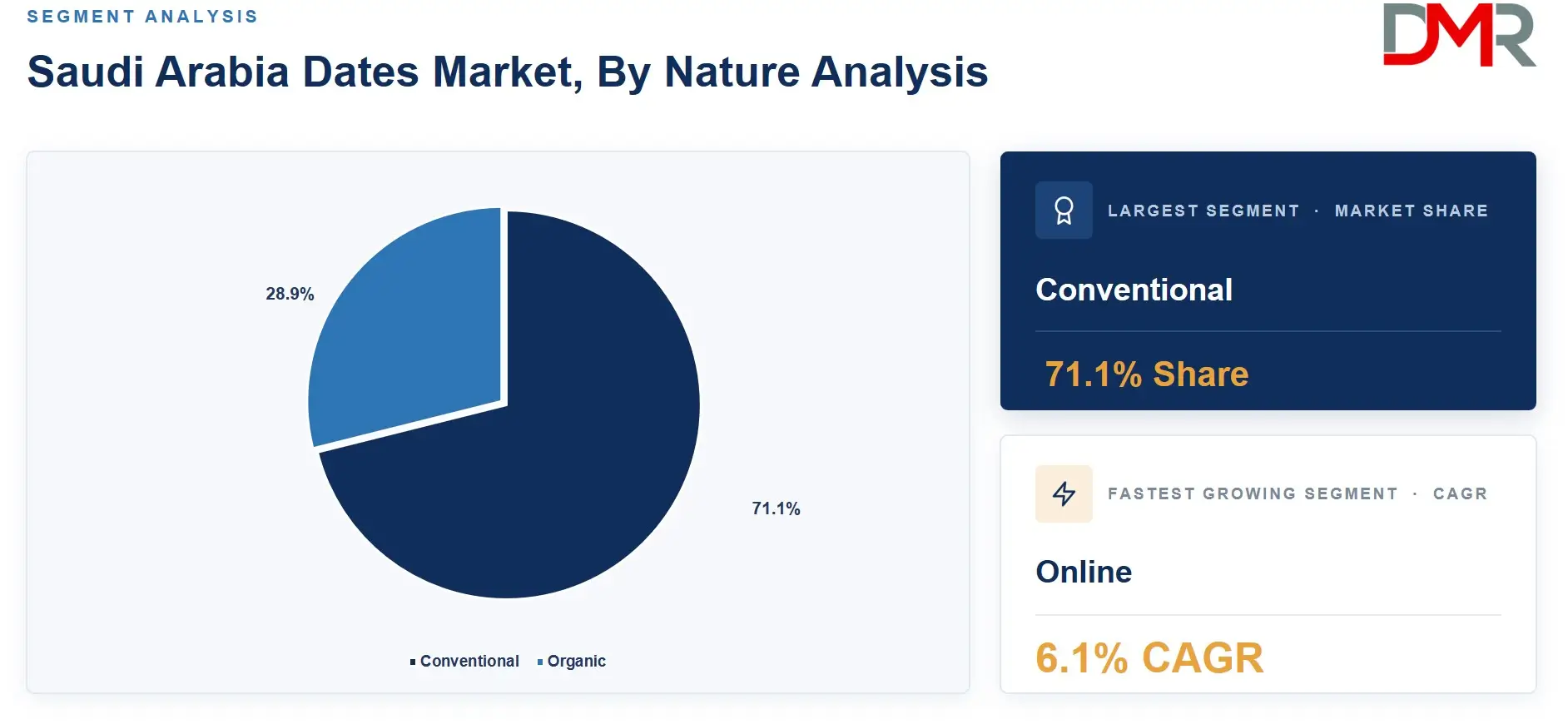
The Conventional nature segment holds the largest market share by value, accounting for 71.1%of the Saudi Arabia Dates Market in 2026. Its dominance is attributed to established cultivation practices, widespread availability, and accessibility across different consumer groups. Conventional dates are commonly available through supermarkets, specialty stores, and other retail channels. The Organic segment is forecasted to experience the highest CAGR of 6.5% during 2027–2035.
By Distribution Channel Analysis
The Supermarkets distribution channel segment holds the largest market share by value, accounting for 62.4%of the Saudi Arabia Dates Market in 2026. Its dominance is supported by convenient shopping facilities, broad product availability, and access to different date varieties, brands, and packaging options. Supermarkets also allow consumers to compare products and prices before purchasing. The Online Stores segment is forecasted to experience the highest CAGR of 6.1% during 2027–2035.
The Saudi Arabia Dates Market Report is segmented based on the following:
By Type
- Sukkari
- Khalas
- Ajwa
- Barhi
- Segai
- Safawi
- Others
By Nature
By Distribution Channel
- Supermarkets
- Specialty Stores
- Online Stores
- Others
Technology Analysis
The advancement of technology is increasingly becoming a factor in the Saudi Arabia Dates Market as far as planting, harvesting, sorting, processing, and storage methods are concerned. Irrigation technologies, automated harvesting equipment, and AI-based monitoring devices are some of the technologies that will help date farmers to manage resources and plantation efficiently. In processing plants, automation sorting and grading technology makes it possible for the companies to sort dates by size, colour, maturity and quality. Storage and packaging technologies will ensure that the dates stay fresh. High costs associated with machinery, storage technologies, and farming equipment are likely to be an obstacle to smaller farmers.
Investment and White Space Analysis
The Saudi Arabia Dates Market provides several investment areas, including investment in the processing of dates, organic dates farming, the production of premium products, and export-based companies. Increasing the demand for processed and value-added products will lead to the introduction of such products as date syrup, date paste, filled dates, chocolate coated dates, and ready-to-eat snacks. Investments in cold storages, packaging companies, and automatic grading system will be helpful in the enhancement of the quality and efficiency of the production process. In addition, investments in the expansion of online selling and international distribution networks can open up more business areas.
Competitive Landscape
The Competitive Landscape in Saudi Arabia Dates Market consists of competition between domestic companies that manufacture, process, export and distribute dates within the market. These companies compete on the basis of quality, variety, packaging, price, and the geographic locations to which their products are distributed. They manufacture and sell different varieties of dates such as Khalas, Barhi, Zahidi and Deglet Noor to satisfy the needs of different consumers. They position themselves in the market depending on their capabilities of growing, processing, grading their products, their reputation, and access to both domestic and foreign markets. They have also been improving their product lines through gift packages, stuffed dates, and processed dates to attract consumers during special days such as Ramadan and Eid.
Some of the prominent players in the Saudi Arabia Dates Market are:
- Al Fakhra Date Company Ltd
- Zadna Company
- Mazare Company Agricultural Products Ltd. Co.
- Sayafa International Industrial Company
- Golden Dates Packing and Packaging Company
- Al-Imtiaz Dates Processing and Manufacturing Factory
- Al-Mohammadiyah Dates Company
- Nakhlah Food Industries Company
- National Factory for Dates Packing
- Basqat Al-Qassim Dates Factory
- Rutab Al-Watan Dates Factory Company
- Golden Jewel Food Industries Company
- Al-Rimal Al-Tayyibah Dates Factory
- Turath Al-Madinah Company
- Sana Al-Madina Dates Company
- Al Qala’a Dates Factory
- Tayba Dates Factory
- Al Dhaif Dates Factory for Date Processing and Derivatives Co. Ltd.
- Others
Recent Developments
- In June 2026, Qutuf Al Madina initiated discussions with Boudjebel Dates, a leading Tunisian date producer and exporter, to explore potential strategic collaboration opportunities. The initiative focuses on expanding the presence of premium date varieties across regional and international markets and strengthening commercial cooperation. This development supports the company's efforts to enhance the international competitiveness and market penetration of Saudi Arabian dates.[M5]
- In February 2026, LOTTE International signed an agricultural cooperation memorandum with the Al-Ahsa Agricultural Development Association, supported by the National Center for Palms and Dates. The agreement focuses on developing processed date products, facilitating knowledge transfer, and promoting strategic investments. This collaboration supports the expansion of Saudi Arabian dates into South Korean retail markets and strengthens international distribution opportunities. [M6]
Report Details
| Report Characteristics |
| Market Size (2026) |
USD 145.7 Mn |
| Forecast Value (2035) |
USD 240.0 Mn |
| CAGR (2027–2035) |
5.7% |
| Historical Data |
2021 – 2025 |
| Forecast Data |
2027 – 2035 |
| Base Year |
2026 |
| Segments Covered |
By Type, By Nature, By Distribution Channel |
Frequently Asked Questions
How big is the Saudi Arabia Dates Market?
▾ The Saudi Arabia Dates Market is valued at USD 145.7 million in 2026 and is projected to reach USD 240.0 million by 2035.
What is the CAGR of the Saudi Arabia Dates Market from 2027 to 2035?
▾ The Saudi Arabia Dates Market is anticipated to grow at a compound annual growth rate (CAGR) of 5.7% during the forecast period from 2027 to 2035.
What factors are driving the growth of the Saudi Arabia Dates Market?
▾ The Saudi Arabia Dates Market is driven by the strong cultural and religious significance of dates, particularly during Ramadan and social occasions, along with an established domestic production base supported by extensive date palm cultivation, experienced farmers, and diverse date varieties.
What are the major trends in the Saudi Arabia Dates Market?
▾ Major trends in the Saudi Arabia Dates Market include rising demand for premium and gift-packaged dates during Ramadan, Eid, and social occasions, along with the adoption of modern farming, irrigation, sorting, grading, and temperature-controlled storage technologies to improve production efficiency and product quality.
Who are the key players in the Saudi Arabia Dates Market?
▾ The key players in the Saudi Arabia Dates Market include Al Fakhra Date Company Ltd, Zadna Company, Mazare Company Agricultural Products Ltd. Co., Sayafa International Industrial Company, Golden Dates Packing and Packaging Company, Al-Imtiaz Dates Processing and Manufacturing Factory, Al-Mohammadiyah Dates Company, Nakhlah Food Industries Company, National Factory for Dates Packing, and Basqat Al-Qassim Dates Factory among others.
How is the Saudi Arabia Dates Market segmented?
▾ The Saudi Arabia Dates Market is segmented based on Type into Sukkari, Khalas, Ajwa, Barhi, Segai, Safawi, and Others, Nature into Conventional and Organic, and Distribution Channel into Supermarkets, Specialty Stores, Online Stores, and Others.