Market Snapshot
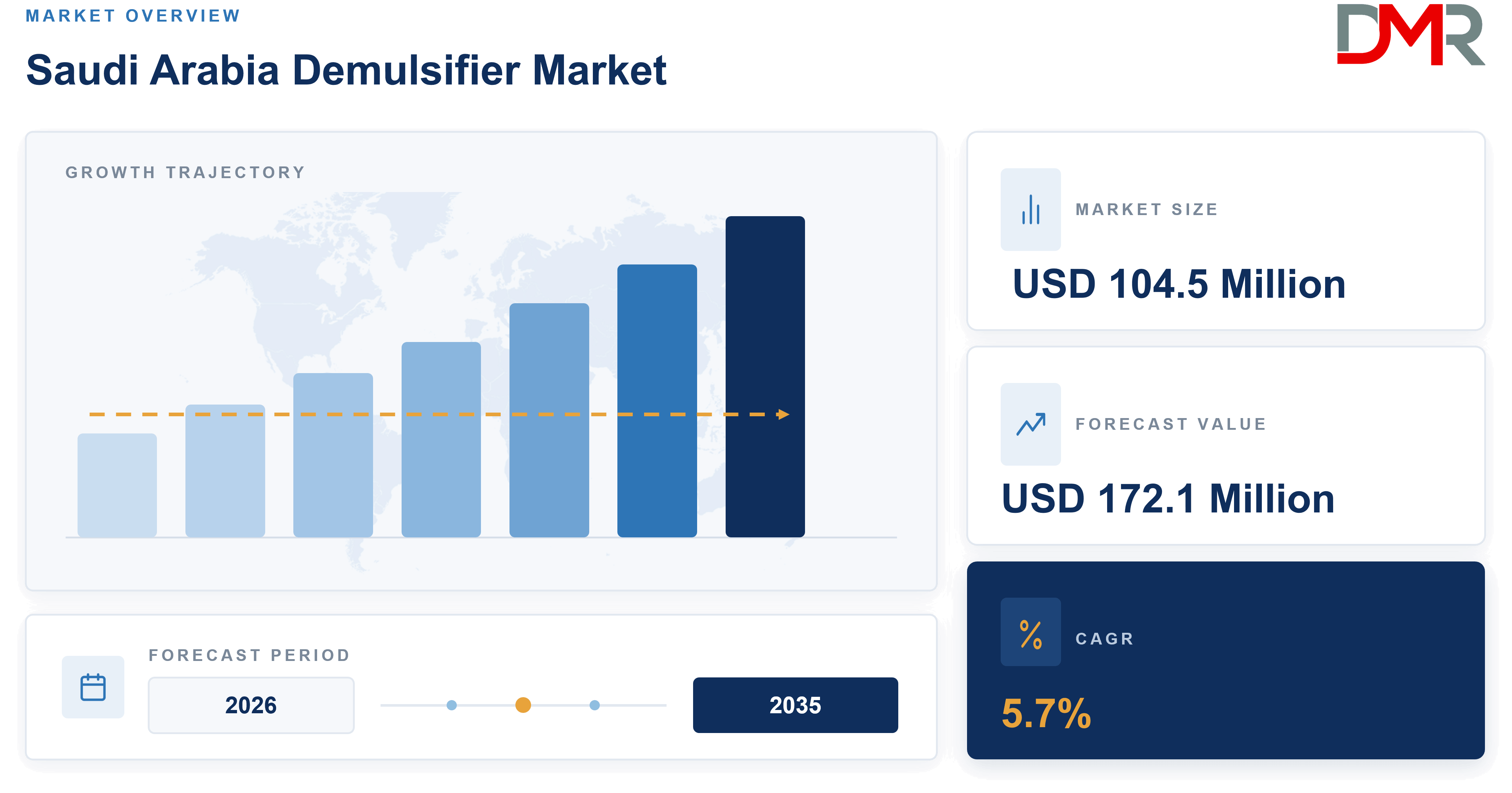
- Market Size (2026): USD 104.5 Mn
- Forecast Value (2035): USD 172.1 Mn
- CAGR (2026-2035): 5.7%
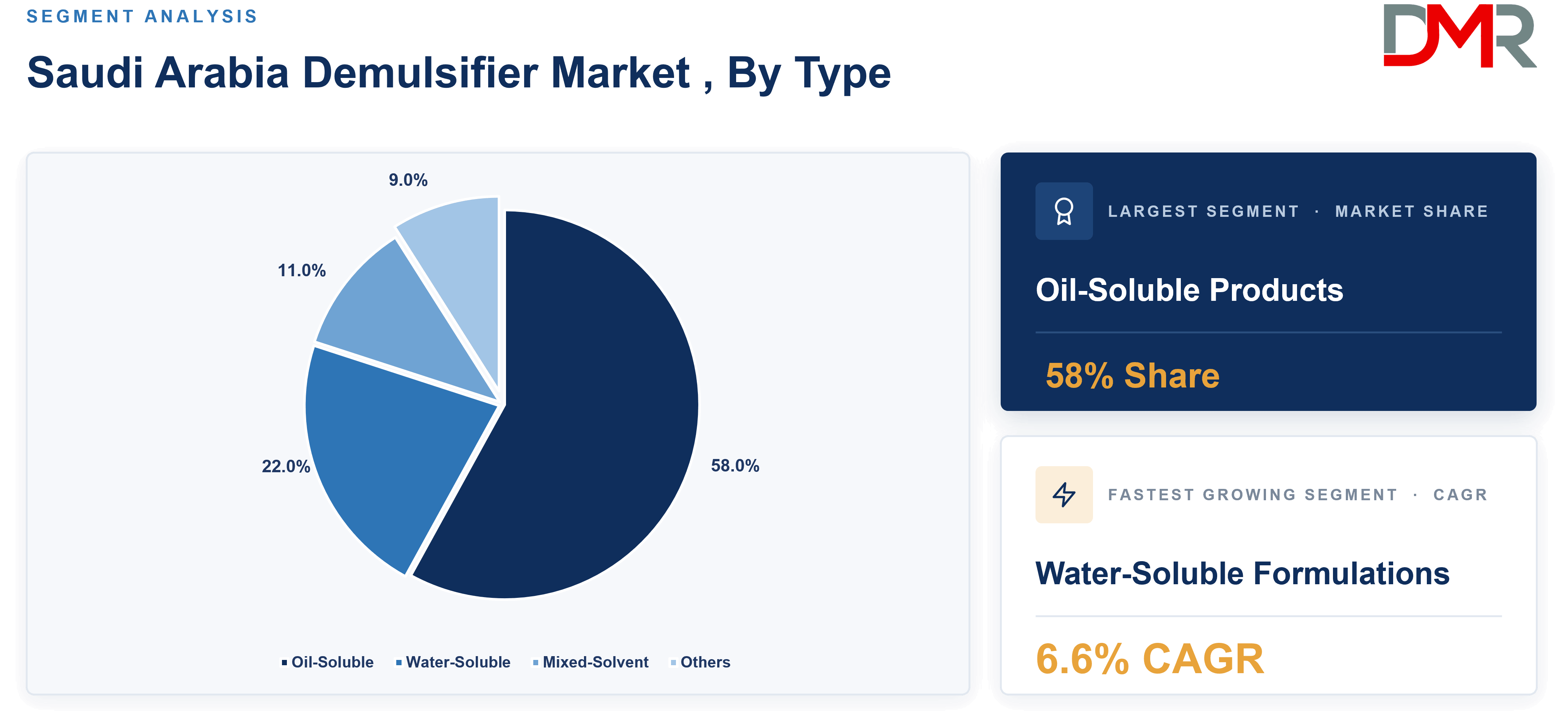
- Leading Type (2026): Oil-Soluble, approximately 58%
- Leading Chemical Composition (2026): Alkoxylated Phenolic Resins, around 31%
- Key Players: SLB, Halliburton Company, Baker Hughes Company and others
What is Saudi Arabia Demulsifier Market and its Market Size?
The Saudi Arabia Demulsifier Market size is estimated to reach USD 104.5 million in 2026 and is further anticipated to reach USD 172.1 million by 2035, at a CAGR of 5.7%. The scope covers demulsifier formulations consumed inside Saudi Arabia for crude oil separation, dehydration, refinery desalting, produced-water treatment and related hydrocarbon processing. It measures domestic demand rather than worldwide sales of suppliers headquartered in the Kingdom.
ℹ
To learn more about this report –
Download Your Free Sample Report Here
Demulsifiers are specialty chemicals formulated to destabilize water-in-oil or oil-in-water emulsions so that the phases separate more quickly under field and processing conditions. Performance depends on crude composition, asphaltene content, salinity, temperature, droplet size, residence time and separation equipment. In Saudi operations, the product is typically supplied as a formulated blend rather than a single active ingredient because field conditions vary substantially between producing assets and processing facilities.
Demand is structurally linked to the scale of Saudi hydrocarbon production and the need to maintain export crude specifications while protecting separator and refinery efficiency. Mature field operation, enhanced recovery activity and changing water cut increase the difficulty of phase separation. This encourages continuous chemical optimization even when aggregate crude output remains relatively stable. Procurement decisions therefore emphasize dosage efficiency, compatibility with downstream processes, field technical service and dependable local supply.
The competitive environment is also changing through localization. Large international oilfield service and specialty chemical companies remain important, but domestic blending, formulation and manufacturing capacity is expanding in the Eastern Province. Saudi buyers increasingly evaluate local content, delivery security and technical response alongside price. This creates room for qualified local formulators that can demonstrate repeatable field performance and shorten lead times for customized chemistry.
Use Cases
- Upstream Crude Oil Separation: Production operators dose demulsifiers into well fluids and gathering systems to break stable water-in-oil emulsions before dehydration and export. Faster water drop, cleaner interfaces and lower basic sediment and water levels improve separator throughput and reduce the risk that export crude falls outside specification.
- Central Processing Facilities: Large Saudi processing plants use tailored demulsifier packages across separators, heater treaters and electrostatic dehydration systems. Formulation is adjusted to crude blend, temperature, salinity and residence time so operators can stabilize performance as feed conditions shift between fields and production zones.
- Refinery Desalting: Refiners use demulsifiers to improve separation of brine from crude before atmospheric distillation. Better emulsion control lowers salt carryover, limits fouling and reduces corrosion risk in downstream equipment, helping refineries protect heat-transfer efficiency and maintain stable unit operation across changing crude slates.
- Produced Water and Sludge Treatment: Oilfield service providers apply demulsifier and reverse-emulsion chemistry where residual hydrocarbons must be separated from produced water or oily sludge. Improved phase separation raises hydrocarbon recovery, supports water treatment performance and reduces the volume of difficult waste requiring downstream handling.
Key Takeaways
- Market Size & Share: Saudi demand is estimated at USD 104.5 million in 2026, reflecting a large installed base of crude separation and dehydration operations.
- Type Analysis: Oil-Soluble formulations are projected to account for approximately 58% of 2026 revenue because they remain widely used in crude oil production systems.
- Demand Concentration: National Oil Companies are expected to represent around 63% of 2026 demand because large-scale upstream procurement is highly concentrated.
- Chemistry Shift: Bio-Based and Low-Toxicity Chemistry is forecast to expand at a CAGR of 8.2% from 2026 to 2035.
- Application Growth: Produced Water Treatment is forecast to grow at 7.4% through 2035 as water handling becomes more important in mature assets.
- Localization: In-Kingdom blending and manufacturing are gaining commercial value as buyers place greater weight on local supply resilience and technical response.
How AI/Gen AI is Transforming the Saudi Arabia Demulsifier Market?
AI has a practical role in demulsifier optimization because chemical performance depends on variable field conditions. Machine-learning models can relate dosage, temperature, water cut, salinity, pressure and separator performance to recommend operating windows. When connected to production data, these systems help chemical teams identify under-treatment or over-treatment more quickly than periodic manual review alone.
Generative AI is more useful around formulation knowledge, troubleshooting and documentation than around the chemical reaction itself. Controlled systems can summarize field-test histories, compare formulation responses and organize technical records for customer review. The near-term effect is better decision support rather than autonomous chemical selection.
- Dosage Optimization: predictive models can recommend chemical injection changes as water cut and production conditions vary.
- Separator Performance Monitoring: anomaly detection can identify declining separation efficiency before off-spec crude becomes a recurring problem.
- Formulation Knowledge Management: LLM-based systems can organize laboratory and field-test records for faster troubleshooting.
- Supply Planning: demand forecasting can align blend production and inventory with field consumption patterns.
Key Drivers in the Saudi Arabia Demulsifier Market
Demand is supported by the operating intensity of Saudi upstream assets and by the need to maintain separation efficiency as produced fluids become more complex.
- Large-Scale Crude Production and Separation Requirements: Crude Oil Production is expected to account for approximately 56% of 2026 application revenue. Demulsifiers are consumed continuously across well sites, gathering systems and processing facilities because export-quality crude requires controlled water and solids content. The chemical is therefore tied to throughput and fluid quality rather than to drilling activity alone. Saudi Arabia's large installed separation infrastructure creates a recurring consumption base, while variation in crude blend and operating conditions generates ongoing demand for field testing and formulation adjustment.
- Rising Water Handling Complexity in Mature Assets: Produced Water Treatment is forecast to expand at a CAGR of 7.4% between 2026 and 2035. As water cut rises in mature reservoirs, operators must manage larger fluid volumes and more stable emulsions for every barrel of saleable oil. This raises chemical treatment intensity at separators, water-treatment units and sludge systems. The mechanism is straightforward: more water creates greater separation load, and poor emulsion control can restrict throughput, increase hydrocarbon loss to water and raise treatment cost.
Restraints in the Saudi Arabia Demulsifier Market
The market faces technical qualification barriers and price pressure because buyers evaluate chemicals on total field economics rather than on formulation novelty.
- Lengthy Field Qualification and Switching Risk: Demulsifier performance is highly crude-specific, so a product that works in one field may underperform in another. Alkoxylated Phenolic Resins are expected to represent around 31% of 2026 composition revenue partly because established chemistries have long operating histories. New suppliers must complete laboratory bottle tests, compatibility work and controlled field trials before displacing incumbent formulations. Qualification time raises market-entry cost and favors vendors with technical service teams capable of supporting repeated optimization.
- Procurement Pressure on Cost per Treated Barrel: National Oil Companies are projected to account for close to 63% of 2026 end-user demand, concentrating buyer power. Large procurement programs can compare dosage, chemical price, logistics and separation performance across multiple suppliers. A lower unit price does not guarantee selection if dosage increases, but premium products also face scrutiny unless they reduce total treatment cost. This dynamic limits margin expansion and makes consistent field economics more important than nominal product differentiation.
Growth Opportunities in the Saudi Arabia Demulsifier Market
Commercial white space is concentrated in localized production, lower-toxicity formulations and services that reduce chemical consumption while protecting separation performance.
- Localized Blending and Formulation: Saudi industrial policy and operator procurement programs increasingly favor domestic value addition. Concentrated Blend products are forecast to grow at a CAGR of 7.1% through 2035 as local formulators seek to reduce freight, inventory and lead-time costs while customizing chemistry close to field operations. The strongest opportunity lies in Eastern Province facilities that combine blending, laboratory testing, warehousing and rapid field support rather than simply importing finished formulations.
- Lower-Toxicity and More Efficient Active Chemistry: Bio-Based and Low-Toxicity Chemistry is forecast to expand at a CAGR of 8.2% from 2026 to 2035. Adoption will be selective because performance remains the first requirement, but suppliers can gain share where formulations reduce solvent load, improve handling or support tighter environmental specifications without raising dosage. This creates room for specialty surfactant design, high-active concentrates and products engineered for easier produced-water treatment.
Trends in the Saudi Arabia Demulsifier Market
Buyers are moving toward performance-based chemical programs, tighter digital monitoring and a more localized supply chain.
- From Product Supply to Treatment Programs: Oil-Soluble demulsifiers are expected to retain approximately 58% of 2026 type revenue, but suppliers increasingly compete on service rather than chemistry alone. Field sampling, bottle testing, dosage optimization and separator monitoring are being bundled into treatment programs. This favors companies that can combine chemical supply with technicians and data analysis, especially where frequent crude changes make a fixed formulation less effective.
- Local Inventory and Shorter Lead Times: Liquid products are projected to account for nearly 81% of 2026 form revenue because they are easy to meter and adjust in field injection systems. The commercial trend is toward holding more finished or semi-finished inventory inside Saudi Arabia so suppliers can respond quickly to consumption changes. Local storage and blending also reduce exposure to international freight disruption and support procurement objectives linked to in-Kingdom value creation.
Research Scope and Analysis
Segment performance is assessed across five axes: type, chemical composition, form, application and end user. Each axis identifies where 2026 revenue is concentrated and where growth is moving through 2035, linking purchasing behavior to field performance, localization and operating conditions.
ℹ
To learn more about this report –
Download Your Free Sample Report Here
By Type
Oil-Soluble products are projected to hold the largest share by type in 2026, accounting for approximately 58% of revenue because they are widely suited to crude oil dehydration and upstream separation systems. Their established use in field injection programs, broad compatibility with hydrocarbon phases and familiarity among operators support continued demand. Growth, however, is concentrated in Water-Soluble formulations, expanding at a CAGR of 6.6% from 2026 to 2035. These products gain relevance where treatment objectives include produced-water cleanup, reverse-emulsion control or easier downstream water handling. Suppliers are also improving surfactant design so water-soluble systems can deliver stronger interfacial activity at lower dosage.
By Chemical Composition
Alkoxylated Phenolic Resins are expected to account for around 31% of 2026 composition revenue because their tunable molecular structure allows formulators to balance interfacial activity, water drop and crude compatibility. They remain common building blocks in multi-component demulsifier packages used across varied production conditions. The fastest growth sits with Bio-Based and Low-Toxicity Chemistry, forecast to rise at a CAGR of 8.2% through 2035. Adoption is being pulled by solvent reduction, handling preferences and broader environmental objectives, but products still need to match conventional chemistry on field performance. Growth will therefore be strongest in hybrid formulations that combine lower-toxicity carriers with high-performance active components.
By Form
Liquid demulsifiers are projected to dominate the form mix in 2026 with close to 81% of revenue because existing chemical injection systems are designed for pumpable products that can be dosed continuously and adjusted quickly. Liquid supply also simplifies field handling, sampling and blending with compatible production chemicals. The steeper trajectory sits with Concentrated Blend products, growing at a CAGR of 7.1% between 2026 and 2035. Concentrates can reduce freight and storage volume and allow local facilities to complete final dilution or customization near the customer. This model fits Saudi localization objectives and improves response time when a field needs dosage or formulation changes.
By Application
Crude Oil Production is expected to lead application demand in 2026 with approximately 56% of revenue because demulsifiers are continuously consumed in separators, gathering systems and dehydration trains serving upstream crude output. The requirement is recurring and directly linked to maintaining export specifications and processing capacity. Growth, however, is concentrated in Produced Water Treatment, forecast to expand at a CAGR of 7.4% from 2026 to 2035. Higher water handling volumes, tighter hydrocarbon-recovery targets and the need to protect downstream treatment units are increasing attention to reverse-emulsion breaking and oil removal. This creates demand for formulations optimized across both oil and water phases rather than only for crude dehydration.
By End User
National Oil Companies are projected to hold the largest end-user share in 2026, accounting for around 63% of revenue because Saudi upstream production and central processing capacity are highly concentrated. Large integrated procurement programs create substantial recurring volumes and favor qualified suppliers with field support, local stock and consistent manufacturing. Growth, however, is faster among Oilfield Service Companies, which are expected to expand at a CAGR of 6.9% through 2035. Service providers increasingly bundle production chemistry with well intervention, stimulation, separation support and digital monitoring. This allows chemical demand to grow through integrated contracts even where the operator remains the ultimate buyer.
The Saudi Arabia Demulsifier Market Report is Segmented Based on the Following
By Type
- Oil-Soluble
- Water-Soluble
- Mixed-Solvent
- Others
By Chemical Composition
- Alkoxylated Phenolic Resins
- Polyamine Derivatives
- Polyols and Polyethers
- Sulfonates
- Bio-Based and Low-Toxicity Chemistry
- Others
By Form
- Liquid
- Emulsion
- Concentrated Blend
- Others
By Application
- Crude Oil Production
- Oil Refining
- Pipeline and Storage
- Produced Water Treatment
- Others
By End User
- National Oil Companies
- Oilfield Service Companies
- Refineries
- Independent Operators and Contractors
- Others
Competitive Landscape
Competition is shaped by global oilfield service companies, specialty chemical formulators, distributors and a growing group of Saudi manufacturers. Large international suppliers retain advantages in proprietary chemistry, field application databases and long-standing technical relationships, while domestic firms compete through local content, shorter lead times and customization. Qualification history creates meaningful switching barriers because demulsifier performance varies by crude and operating condition. The dominant strategies are local blending, laboratory capability, technical service expansion and integration of chemical treatment with digital production monitoring. As procurement gives more weight to in-Kingdom value creation, suppliers with Saudi manufacturing or formulation capacity are positioned more strongly than import-only vendors.
Some of the Prominent Players in the Saudi Arabia Demulsifier industry are:
-
SLB
- Halliburton Company
- Baker Hughes Company
- BASF SE
- Clariant AG
- The Dow Chemical Company
- Croda International Plc
- Innospec Inc.
- Dorf Ketal Chemicals
- Nouryon
- Arkema S.A.
- Evonik Industries AG
- Solvay SA
- The Lubrizol Corporation
- Stepan Company
- Kemira Oyj
- Italmatch Chemicals S.p.A.
- SNF Group
- Weatherford International plc
- Nalco Water, an Ecolab company
- Saudi Basic Industries Corporation (SABIC)
- Sipchem
- REDA Chemicals
- REDA Energy
- Meta Solutions Company (MetaSol)
- Modern National Chemicals
- Energy Industry Equipment Factory
- SUGEST
- KRON Oilfield Service Company
- Sama Chemical Product Factory
- Safra Company Limited
- Neelam Aqua & Speciality Chem.
- Oilfield Production Technologies (OPT)
- Al Moghera Chemical Company
- Brenntag Saudi Arabia
- Azelis Middle East
- Rezayat Trading Company
- Arabian Chemical Company
- Gulf Chemicals and Industrial Oils Company
- Saudi Chemical Company Limited
- Other Key Players
Regulatory Landscape Analysis
Saudi Arabia’s demulsifier market is strongly influenced by environmental regulations, chemical-handling requirements, and oilfield processing standards. Growing emphasis on efficient crude oil separation, produced-water management, and environmental protection is encouraging oil and gas operators to adopt high-performance demulsifiers with improved separation efficiency and lower environmental impact. Opportunities are emerging for biodegradable, low-toxicity, and application-specific formulations that support compliance while improving operational performance. However, stringent product qualification, chemical registration requirements, and compliance costs may create entry barriers for smaller suppliers and international companies. Regulatory changes can also increase formulation and testing expenses. Overall, the regulatory environment is expected to favor technologically advanced suppliers capable of meeting Saudi Arabia’s evolving environmental and operational requirements.
Investment and White Space Analysis
Investment opportunities in Saudi Arabia’s demulsifier market are closely connected to continued oil and gas production, refinery expansion, petrochemical development, and improved produced-water treatment. Demand for customized demulsifier formulations is increasing as operators address complex crude characteristics, higher water cuts, and demanding separation conditions. Significant white-space opportunities exist in locally produced specialty chemicals, advanced formulation technologies, automated chemical dosing, and environmentally preferable demulsifiers. Suppliers that provide customized solutions, technical support, and cost-efficient formulations can strengthen their market position. However, risks include fluctuations in crude oil prices, project delays, dependence on major energy companies, and strong competition from established chemical suppliers. These factors will influence investment priorities and market expansion.
Recent Developments
- In July 2026, Halliburton received multi-year contracts from Aramco covering approximately 285 planned onshore wells, expanding integrated drilling, completion and workover activity that can increase future demand for production and separation chemicals across re-entered assets.
- In July 2026, Aramco awarded Halliburton a long-term unconventional gas stimulation and completion contract, with Halliburton also planning further local manufacturing and supply-chain investment in Saudi Arabia as field activity scales.
- In February 2026, Aramco reported that its iktva program had reached a 70% local-content level and set a new intention to reach 75% by 2030, strengthening the commercial incentive for in-Kingdom chemical manufacturing and blending.
Report Details
| Report Characteristics |
| Market Size (2026) |
USD 104.5 Mn |
| Forecast Value (2035) |
USD 172.1 Mn |
| CAGR (2026-2035) |
5.7% |
| Historical Data |
2021 - 2025 |
| Forecast Data |
2026 - 2035 |
| Base Year |
2025 |
| Segments Covered |
By Type, By Chemical Composition, By Form, By Application and By End User |
| Regional Coverage |
Saudi Arabia |
Frequently Asked Questions
How big is the Saudi Arabia Demulsifier Market?
▾ The Saudi Arabia Demulsifier Market is estimated at USD 104.5 million in 2026. The figure covers demulsifier demand within Saudi Arabia for crude production, refinery desalting, pipeline and storage treatment, and produced-water applications. Recurring consumption is supported by the country's large hydrocarbon-processing base and the continuous need to maintain crude quality and separator efficiency.
What is the growth rate of the Saudi Arabia Demulsifier Market?
▾ The market is forecast to grow at a CAGR of 5.7% from 2026 to 2035. Growth is steady rather than speculative because demulsifiers are an established production chemical. Expansion comes from rising water-handling complexity, local formulation capacity, refinery and processing investment, and more intensive optimization of chemical dosage across mature producing assets.
What is driving demand in the Saudi Arabia Demulsifier Market?
▾ Demand is driven by large-scale crude production, export-quality requirements and increasingly complex oil-water separation as producing assets mature. Demulsifiers are consumed continuously, so demand remains linked to fluid throughput and treatment intensity. Local-content procurement also encourages Saudi blending and manufacturing, giving operators more responsive supply while reducing reliance on imported finished formulations.
Which type holds the largest share of the Saudi Arabia Demulsifier Market?
▾ Oil-Soluble demulsifiers are expected to hold the largest 2026 share at approximately 58%. They remain widely used in crude dehydration because their hydrocarbon-phase compatibility supports rapid migration to the oil-water interface. The segment also benefits from established field qualification, operator familiarity and compatibility with continuous injection systems used across upstream separation infrastructure.
Which chemistry is growing fastest in the Saudi Arabia Demulsifier Market?
▾ Bio-Based and Low-Toxicity Chemistry is forecast to record the fastest growth, with a CAGR of 8.2% from 2026 to 2035. Growth is being supported by solvent reduction, safer handling and environmental objectives. Adoption will remain performance-led, so the strongest products are likely to combine lower-toxicity carriers with active chemistry capable of matching conventional treatment efficiency.
Who are the key players in the Saudi Arabia Demulsifier Market?
▾ Key participants include SLB, Halliburton Company, Baker Hughes Company, BASF SE, Clariant AG, REDA Chemicals and Meta Solutions Company. Competition also includes Saudi manufacturers, specialty chemical distributors and international formulators. The strongest positions are built around field qualification, local inventory, application support, formulation flexibility and the ability to meet local-content expectations.
What is the outlook for the Saudi Arabia Demulsifier Market?
▾ The Saudi Arabia Demulsifier Market is expected to remain a steady-growth production-chemicals niche through 2035. The main commercial shifts will be toward more localized blending, performance-based service contracts, digital dosage optimization and lower-toxicity formulations. Suppliers that combine qualified chemistry with fast local technical support should be best positioned to gain share as procurement becomes more focused on lifecycle treatment economics.