Saudi Arabia Dengue Testing Market Snapshot
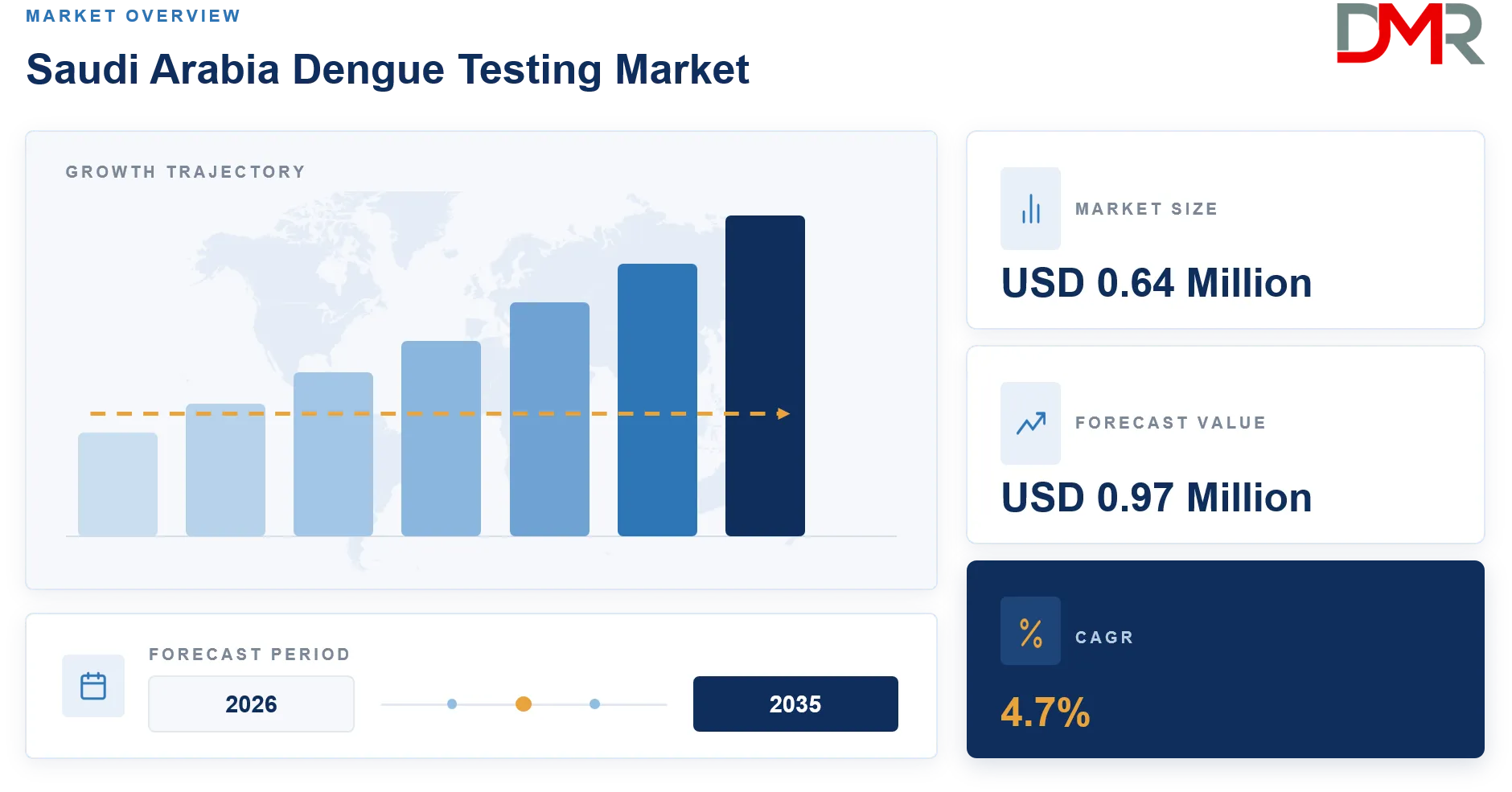
- Market Value: Saudi Arabia dengue testing market is valued at USD 0.64 million in 2026 and is expected to reach USD 0.97 million by 2035.
- CAGR: Saudi Arabia dengue testing market is expected to grow at a CAGR of 4.7% from 2026 to 2035.
- By Test Type Analysis: Rapid Diagnostic Tests (RDTs) dominated the test type segment with a 38% share in 2026.
- By Product Analysis: Consumables led the product segment with a 64% share in 2026.
- By End Use Analysis: Hospitals held a 36% revenue share in 2026.
- Major Players: QuidelOrtho Corporation, Abbott, GENBODY INC., Bio-Rad Laboratories, Inc., and others.
What is the Saudi Arabia Dengue Testing Market and its Market Size?
The Saudi Arabia Dengue Testing Market size is projected to be valued at USD 0.64 million in 2026 and is projected to reach USD 0.97 million by 2035, expanding at a steady CAGR of 4.7% during the forecast period. The market covers diagnostic products and laboratory solutions used to identify dengue virus infection, including rapid diagnostic tests, antigen-based lateral flow assays, ELISA tests, molecular diagnostic kits, instruments, and recurring consumables used by hospitals, diagnostic laboratories, public health laboratories, and research institutes.
ℹ
To learn more about this report –
Download Your Free Sample Report Here
Dengue testing demand in Saudi Arabia is closely linked to the country's distinct epidemiological profile. Published research identifies dengue as an established public health concern, particularly in western and southwestern areas such as Jeddah, Makkah, and Jazan. Saudi studies covering patient samples from multiple regions have used NS1 antigen detection, IgM and IgG ELISA, and RT-PCR for dengue confirmation, demonstrating the importance of complementary diagnostic methods rather than dependence on a single assay.
Use Cases
- Acute Dengue Screening: Rapid diagnostic tests and NS1 antigen assays help hospitals evaluate patients presenting with symptoms compatible with acute dengue. Their shorter turnaround time supports initial clinical decisions where dengue transmission is established. Early-stage antigen detection is especially relevant before antibody responses become strongly detectable.
- Laboratory Confirmation: Molecular diagnostic kits support confirmation of dengue virus infection through detection of viral RNA. RT-PCR is particularly valuable during the acute phase and can complement antigen and serological testing. Saudi clinical research has incorporated RT-PCR alongside NS1 and antibody assays when characterizing confirmed dengue infections.
- Public Health Surveillance: Government and public health laboratories use dengue testing to monitor transmission, recognize clusters, and support vector-control decisions. Testing data can improve visibility into geographical and seasonal changes in dengue activity, which is particularly important for established transmission areas in western and southwestern Saudi Arabia.
- Hospital Differential Diagnosis: Dengue can present with symptoms that overlap with other febrile illnesses. Hospitals use antigen, antibody, and molecular tests to strengthen diagnostic confidence and guide patient monitoring. Current clinical guidance supports combining nucleic acid or NS1 antigen detection with IgM testing during appropriate stages of illness.
- Epidemiological Research: Universities and research institutes use dengue assays to investigate serotypes, secondary infections, disease patterns, population exposure, and geographical distribution. Multi-region Saudi studies using thousands of patient samples indicate continuing research demand for molecular assays, immunoassays, controls, reagents, and related laboratory consumables.
How AI/Gen AI is Transforming the Saudi Arabia Dengue Testing Market?
Advanced analytics are increasingly relevant to dengue surveillance by connecting laboratory results with epidemiological, environmental, geographical, and clinical information. In Saudi Arabia, this capability can support earlier recognition of unusual case concentrations in dengue-prone locations such as Jeddah, Makkah, and Jazan. Predictive models can analyze historical case patterns, rainfall, temperature, population movement, and laboratory positivity to help public health teams allocate testing capacity more efficiently. For diagnostic laboratories, automated interpretation and laboratory information systems can also support faster result review, quality checks, workload prioritization, and surveillance reporting.
Generative and machine-assisted systems may create additional value by summarizing laboratory trends, supporting epidemiological reporting, and helping healthcare organizations interpret large volumes of surveillance information. Their role remains complementary to validated diagnostic assays and professional clinical judgment. The commercial opportunity for dengue testing suppliers therefore lies less in replacing laboratory diagnostics and more in connecting rapid tests, molecular platforms, immunoassays, and laboratory data with digital decision-support systems. This can strengthen demand forecasting, inventory planning, outbreak response, and coordination between hospitals, diagnostic laboratories, and public health authorities.
Key Drivers in the Saudi Arabia Dengue Testing Market
Established Dengue Transmission in Western and Southwestern Saudi Arabia
Persistent dengue activity in parts of Saudi Arabia is a central driver of testing demand. Published evidence identifies Jeddah, Makkah, and Jazan among areas with recurring dengue transmission, while recent research describes dengue as an emerging public health threat across the Kingdom. This epidemiological presence creates recurring requirements for patient screening, laboratory confirmation, surveillance, and outbreak investigation, supporting purchases of RDTs, antigen assays, ELISA products, molecular kits, and associated consumables.
Need for Multi-Method Dengue Diagnosis
Dengue diagnosis depends on the stage of infection, making complementary testing technologies commercially important. During acute illness, viral RNA and NS1 antigen testing can identify infection before antibody responses fully develop, while IgM and IgG assays support later-stage assessment. Current clinical testing guidance recommends combinations involving nucleic acid amplification or NS1 antigen detection with IgM testing. This testing pathway supports demand across rapid diagnostics, molecular kits, ELISA assays, reagents, controls, and laboratory supplies.
Restraints in the Saudi Arabia Dengue Testing Market
Seasonal and Geographically Concentrated Testing Demand
Saudi dengue testing demand is not distributed evenly across the country. Transmission has historically been more prominent in western and southwestern locations, while case volumes can vary with season, climate, and local mosquito activity. This uneven demand profile can limit predictable year-round test utilization outside higher-risk areas. Suppliers therefore need localized inventory planning and flexible distribution models rather than assuming uniform national consumption, particularly for products with defined storage conditions or shelf lives.
Regulatory and Market Access Requirements for IVD Products
Dengue diagnostic manufacturers entering Saudi Arabia must address the country's medical device and in vitro diagnostic regulatory framework. The Saudi Food and Drug Authority oversees medical devices and maintains market authorization requirements relevant to IVD products. Foreign manufacturers may also need an authorized representative and appropriate technical documentation before commercial access. These requirements support product quality and patient safety but can raise entry costs and extend commercialization planning for smaller diagnostic suppliers.
Growth Opportunities in the Saudi Arabia Dengue Testing Market
Expansion of Rapid and Point-of-Care Testing
Rapid diagnostic tests offer a strong opportunity because they provide practical screening where immediate access to centralized molecular laboratories is limited or turnaround time is critical. The RDT segment already accounted for 38% of the Saudi Arabia dengue testing market in 2026. Continued improvements in combined antigen and antibody formats can strengthen their role in emergency departments, outpatient settings, and surveillance programs. Field research has also evaluated commercial dengue RDTs from companies including Abbott and SD Biosensor, highlighting continued product development in this category.
Integrated Molecular and Serological Testing Strategies
Another opportunity lies in diagnostic workflows that combine molecular, antigen, and antibody testing rather than positioning these methods as direct substitutes. Saudi research involving 2,850 patient samples collected across six regions between 2022 and 2024 used NS1 antigen detection, IgM and IgG ELISA, and RT-PCR. Suppliers offering complementary assay portfolios, automated immunoassay platforms, PCR reagents, controls, and laboratory consumables can therefore address a broader portion of the clinical and public health testing workflow.
Trends in the Saudi Arabia Dengue Testing Market
Growing Preference for Faster Diagnostic Turnaround
Healthcare providers increasingly need results that can support patient triage and surveillance without lengthy processing times. This requirement is strengthening the commercial position of RDTs and antigen-based lateral flow assays, particularly for initial screening. The 38% market share held by RDTs in 2026 reflects this preference for accessible testing. At the same time, rapid methods are increasingly positioned within multi-test algorithms where molecular or serological assays can provide further confirmation according to the timing of specimen collection.
Greater Focus on Laboratory-Based Surveillance
Saudi dengue research is increasingly examining infections across multiple locations rather than focusing only on isolated outbreaks. Recent studies have evaluated thousands of samples collected across several Saudi regions and have analyzed PCR-confirmed cases from 2022 to 2024. This shift supports demand for standardized testing, reference laboratory capacity, molecular reagents, ELISA consumables, quality controls, sample-processing products, and information systems capable of connecting diagnostic results with public health surveillance.
Research Scope and Analysis
The Saudi Arabia Dengue Testing Market is segmented based on Test Type, Product, and End Use. The study provides an in-depth assessment of key segments and sub-segments, covering clinical applications, laboratory adoption, recurring consumable demand, diagnostic workflow requirements, public health use, and their contribution to overall Saudi Arabia dengue testing market growth.
By Test Type;
Rapid Diagnostic Tests (RDTs) dominated the Saudi Arabia dengue testing market by test type with a 38% share in 2026. Their leading position is supported by short turnaround time, comparatively simple workflows, and suitability for screening patients in hospitals and other testing environments where immediate decisions are important. Antigen and antibody-based rapid formats can extend diagnostic access beyond highly specialized molecular laboratories. Molecular diagnostic kits remain important for acute infection confirmation and epidemiological work, while ELISA-based tests support antibody and antigen testing at higher laboratory volumes. The future market is therefore expected to support both decentralized rapid testing and centralized confirmatory testing rather than a single dominant diagnostic technology.
ℹ
To learn more about this report –
Download Your Free Sample Report Here
By Product;
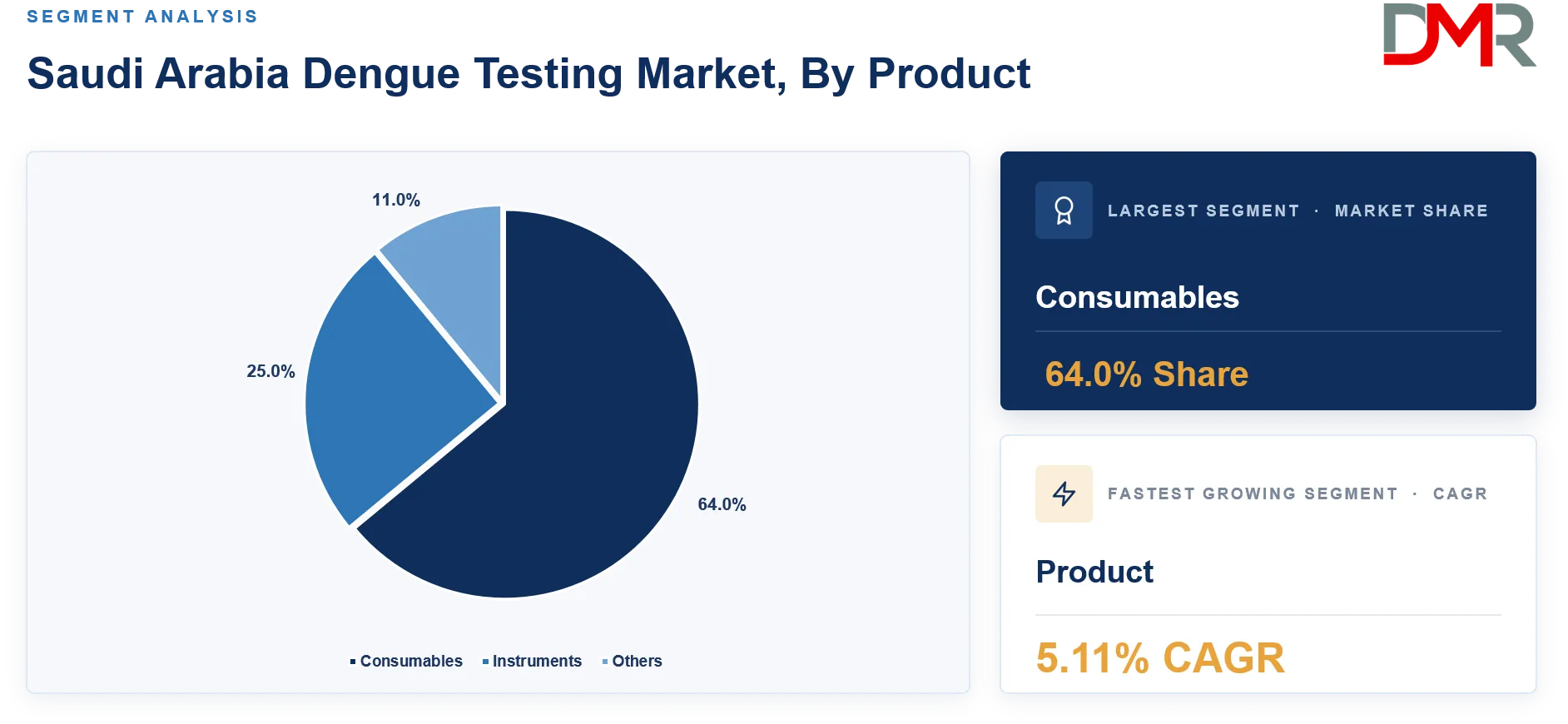
Consumables accounted for 64% of the Saudi Arabia dengue testing market by product in 2026, making them the leading revenue category. Their dominance reflects the recurring nature of diagnostic testing, as individual patient tests consume assay cartridges, test strips, reagents, extraction materials, controls, microplates, sample-handling products, and other laboratory supplies. Instruments typically have longer replacement cycles, while consumables generate repeat demand as testing volumes rise. The segment also benefits from the use of multiple diagnostic methods in dengue workflows. Hospitals and laboratories operating molecular, immunoassay, and rapid testing platforms consequently require reliable replenishment, creating recurring commercial opportunities for manufacturers and local distributors.
By End Use;
Hospitals held 36% of Saudi Arabia dengue testing market revenue in 2026. Hospitals occupy a central position because patients with fever and suspected dengue frequently enter the healthcare system through emergency departments, outpatient services, and inpatient facilities. These institutions require timely testing to support differential diagnosis, patient monitoring, and referral for confirmatory laboratory evaluation. Diagnostic laboratories contribute additional testing capacity through PCR, ELISA, and other laboratory-based methods, while government and public health laboratories support surveillance and outbreak investigation. Research institutes represent a specialized source of demand for assays used in epidemiological and virological studies.
The Saudi Arabia Dengue Testing Market Report is segmented on the basis of the following:
By Test Type
- Molecular Diagnostic Kits
- Lateral Flow Assays (Antigen-Based)
- ELISA-Based Tests
- Rapid Diagnostic Tests (RDTs)
By Product
- Instruments
- Consumables
- Others
By End Use
- Research Institutes
- Government & Public Health Laboratories
- Hospitals
- Diagnostic Laboratories
Competitive Landscape
The Saudi Arabia dengue testing market features international diagnostic companies competing across rapid tests, immunoassays, molecular diagnostics, instruments, reagents, and laboratory consumables. Major participants include QuidelOrtho Corporation, Abbott, GENBODY INC., Bio-Rad Laboratories, Inc., CTK Biotech, Inc., F. Hoffmann-La Roche Ltd, SD Biosensor, InBios International, Inc., and Thermo Fisher Scientific, Inc. Competitive advantage depends on assay performance, turnaround time, portfolio breadth, compatibility with laboratory infrastructure, regulatory readiness, distributor relationships, supply reliability, and the ability to serve both decentralized screening and centralized confirmation. Abbott and SD Biosensor products have been evaluated in field research on dengue RDT performance, while the broader competitive environment includes suppliers with established molecular and immunoassay capabilities. With consumables generating 64% of 2026 market revenue, recurring assay and reagent sales remain especially important. Vendors able to pair reliable product supply with training, technical service, quality control, and Saudi market access capabilities are positioned to compete for hospital, laboratory, research, and public health demand.
Some of the prominent players in the Saudi Arabia Dengue Testing Industry are:
- QuidelOrtho Corporation
- Abbott
- GENBODY INC.
- Bio-Rad Laboratories, Inc.
- CTK Biotech, Inc.
- F. Hoffmann-La Roche Ltd
- SD Biosensor
- InBios International, Inc.
- Thermo Fisher Scientific, Inc.
- Others
Regulatory Landscape
The regulatory landscape of the Saudi Arabia Dengue Testing Market is primarily shaped by the Saudi Food and Drug Authority (SFDA), which regulates medical devices and in vitro diagnostic products placed on the Saudi market. Dengue rapid diagnostic tests, molecular diagnostic kits, ELISA-based assays, instruments, and related products must meet applicable authorization, quality, labeling, safety, and post-market requirements before commercial distribution. Foreign diagnostic manufacturers also need to address local representation and market-access requirements where applicable. These controls make regulatory readiness an important competitive factor for companies targeting hospitals, diagnostic laboratories, and government procurement. Saudi Arabia's broader healthcare modernization is also increasing expectations for traceability, product quality, reliable supply, and diagnostic performance. As dengue testing demand expands, suppliers with established quality systems, complete technical documentation, local distribution capabilities, and efficient SFDA compliance can gain an advantage in institutional purchasing and long-term market development.
Investment and White Space Analysis
The Saudi Arabia Dengue Testing Market offers targeted investment opportunities across rapid testing, recurring consumables, molecular confirmation, laboratory automation, and localized distribution. Consumables generated 64% of market revenue in 2026, indicating an attractive recurring-revenue opportunity in reagents, test cartridges, controls, extraction materials, assay components, and sample-processing supplies. Rapid Diagnostic Tests also represented 38% of the test type segment, creating white space for easy-to-use products that improve turnaround time in hospitals and decentralized testing environments. Further opportunities exist in integrated testing strategies combining NS1 antigen detection, serology, and molecular confirmation for different stages of infection. Investors and diagnostic manufacturers can also evaluate local inventory hubs, technical support, laboratory connectivity, and public health surveillance solutions. Companies that combine regulatory readiness, dependable supply, clinically relevant assay portfolios, and partnerships with Saudi distributors can address gaps between imported diagnostic technology and localized testing requirements.
Recent Developments
- August 2026: Abbott expands rapid NS1 antigen test distribution across Saudi primary health centers, strengthening point-of-care dengue surveillance in Jeddah and Makkah regions.
- June 2026: Thermo Fisher Scientific partners with Saudi MOH to deploy multiplex RT-PCR platforms for integrated dengue, Zika, and chikungunya testing in 250+ clinics.
- March 2026: InBios International launches SFDA-certified Samba II Dengue rapid tests, enhancing early diagnosis capacity for pilgrim health screening during Hajj season.
Report Details
| Report Characteristics |
| Market Size (2026) |
USD 0.64 Million |
| Forecast Value (2035) |
USD 0.97 Million |
| CAGR (2026–2035) |
4.7% |
| Historical Data |
2021 – 2025 |
| Forecast Data |
2027 – 2035 |
| Base Year |
2025 |
| Estimate Year |
2026 |
| Segments Covered |
By Test Type (Molecular Diagnostic Kits, Lateral Flow Assays {Antigen-Based}, ELISA-Based Tests, and Rapid Diagnostic Tests {RDTs}), By Product (Instruments, Consumables, and Others), and By End Use (Research Institutes, Government & Public Health Laboratories, Hospitals, and Diagnostic Laboratories) |
| Regional Coverage |
Saudi Arabia |
Frequently Asked Questions
What is the current size of the Saudi Arabia Dengue Testing Market?
▾ The Saudi Arabia Dengue Testing Market is valued at USD 0.64 million in 2026 and forecast to reach USD 0.97 million by 2035.
What is the growth rate of the Saudi Arabia Dengue Testing Market during?
▾ The Saudi Arabia Dengue Testing Market is expected to grow at a CAGR of 4.7% during the forecast period 2026-2035.
What factors are driving the growth of the Saudi Arabia Dengue Testing Market?
▾ Dengue surveillance, faster diagnosis, hospital testing, and outbreak preparedness drive the Saudi Arabia Dengue Testing Market.
What are the major challenges restraining the Saudi Arabia Dengue Testing Market?
▾ Seasonal demand, regional case concentration, and IVD regulatory requirements restrain the Saudi Arabia Dengue Testing Market.
Which segment holds the largest share of the Saudi Arabia Dengue Testing Market?
▾ Rapid Diagnostic Tests lead the Saudi Arabia Dengue Testing Market by test type, accounting for a 38% share in 2026.
Who are the leading companies in the Saudi Arabia Dengue Testing Market?
▾ QuidelOrtho Corporation, Abbott, GENBODY INC., Bio-Rad Laboratories, Inc., CTK Biotech, Inc., F. Hoffmann-La Roche Ltd, SD Biosensor, InBios International, Inc., and Thermo Fisher Scientific, Inc. are leading companies in the Saudi Arabia Dengue Testing Market.
How is AI influencing the Saudi Arabia Dengue Testing Market?
▾ AI supports the Saudi Arabia Dengue Testing Market through outbreak forecasting, laboratory analytics, and surveillance.
What are the future opportunities and trends in the Saudi Arabia Dengue Testing Market?
▾ Rapid tests, molecular diagnostics, integrated surveillance, and laboratory expansion offer Saudi Arabia Dengue Testing Market opportunities.