Market Overview
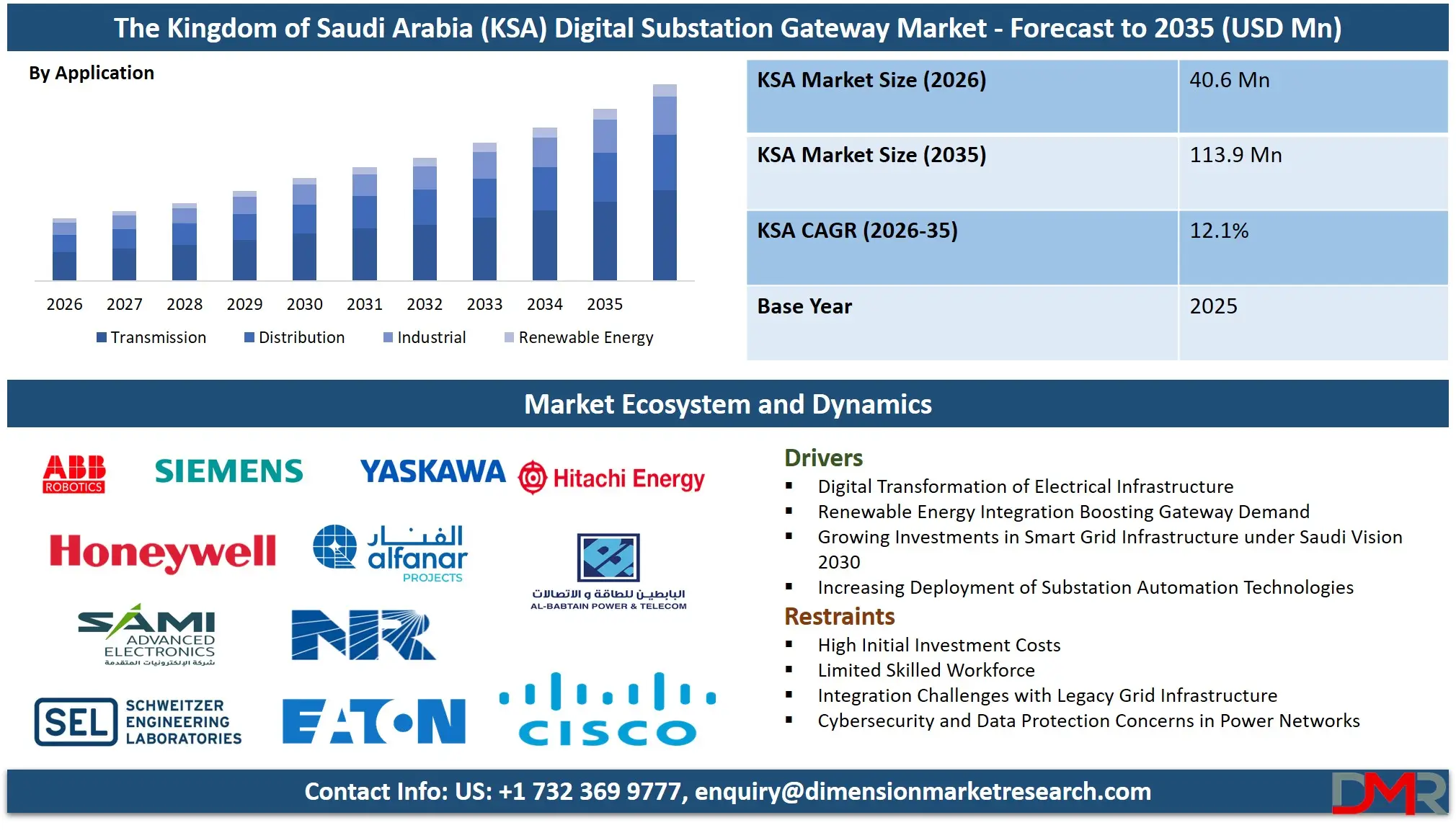
Saudi Arabia Digital Substation Gateway market size is expected to reach a value of USD 40.6 million in 2026, and it is further anticipated to reach a market value of USD 113.9 million by 2035 at a CAGR of 12.1%.
ℹ
To learn more about this report –
Download Your Free Sample Report Here
The digital substation gateway market is an important part of the economic development of the Kingdom of Saudi Arabia, led by the highly ambitious Vision 2030. Strategically located at the crossroads between Asia, Africa, and Europe, Saudi Arabia occupies a privileged position in its emergence as a key global hub for technological innovation and advanced power infrastructure. The sector covers a wide range of intelligent grid components, from protocol gateways and communication interfaces to cybersecurity software and data aggregation tools, which are important in facilitating grid modernization and supporting the growth of strategic sectors such as utilities, renewable energy, and industrial manufacturing. The government's commitment to diversifying the economy from oil dependency has resulted in substantial investment in digital infrastructure and smart grid technology, significantly transforming the digital substation landscape.
Over the last few years, the digital substation gateway market of Saudi Arabia has witnessed a strategic transition in adopting advanced communication systems integrating technologies like IEC 61850, DNP3, and Modbus protocols. These technologies are making substation operations more effective, developing real-time data exchange, facilitating easier interoperability between legacy and modern equipment, and further helping in the optimization of complex grid management across industries. Also, with the rapid growth of renewable energy projects like those under the National Renewable Energy Program, the need for intelligent gateway solutions has accelerated the demand to scale up companies' grid capabilities. All these evolutions of technology and the market are likely to drive the sector's growth, signifying a good future outlook for the market.
Key trends currently evident within the digital substation gateway arena in Saudi Arabia are digital transitions taking hold of electrical infrastructure by moving from conventional electromechanical systems to agile-oriented, software-driven substation ecosystems. Aside from this, further integration of advanced communication protocols and cybersecurity frameworks brings predictive maintenance and real-time decision-making with cost reductions along the value chain for better outputs of efficiency. Furthermore, with the augmenting emphasis on sustainability in line with Vision 2030, adaptation to energy-efficient substation systems, such as smart grid gateways and intelligent electronic devices for green power distribution, is on the rise. Similarly, the rise in renewable energy integration has changed strategies for grid management as utilities try to meet expectations for reliable and secure power delivery.
The market is consequently witnessing huge opportunities on the back of high investments by the Saudi government in technological infrastructure development. Initiatives such as the construction of smart grid zones, digital substation research centers, and test facilities for advanced communication technologies are creating a robust innovation backbone to support regional and international technological leadership. Megaprojects like NEOM City and the Red Sea Project illustrate the strategic importance of digital substation gateways in enabling Saudi Arabia's ambitious economic goals. The geographical position of the nation enhances its potential to become a global smart infrastructure hub, offering unparalleled access to key markets across three continents. Further, the focus on digital technologies like protocol conversion software, cybersecurity monitoring tools, and data aggregation platforms provides companies with opportunities to gain a competitive edge by improving grid reliability and reducing operational costs.
ℹ
To learn more about this report –
Download Your Free Sample Report Here
Still, some significant challenges may impede the market. Geopolitical instability in this region creates a threat to cross-border technology trade and the continuity of electronics supply chains, thereby threatening to put uncertainty into business. On the other hand, an emerging skill gap is appearing in the digital substation sector amidst a growing shortage of skilled engineers with advanced knowledge of communication protocols and cybersecurity systems. This factor may hamper the adoption of modern substation solutions. Other regulatory challenges include complex certification procedures and bureaucratic obstacles that make other difficulties worse and, hence, may discourage foreign investment in this market.
The Kingdom of Saudi Arabia (KSA) Digital Substation Gateway Market: Key Takeaways
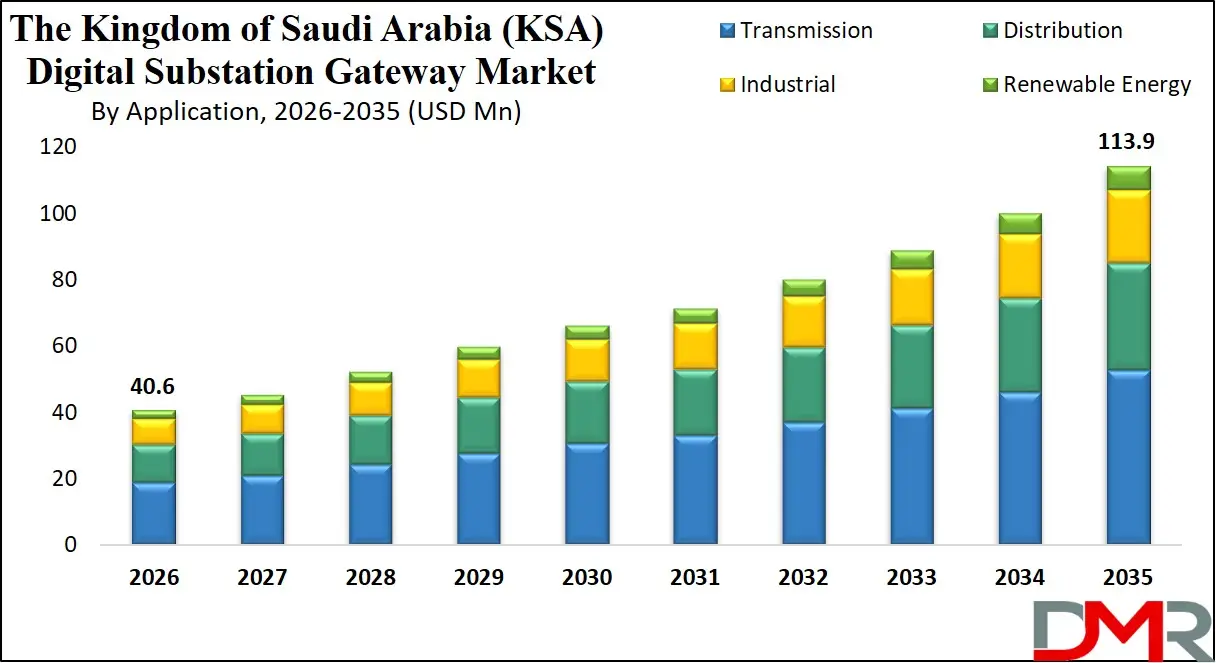
- Market Size Insights: The Kingdom of Saudi Arabia (KSA) Digital Substation Gateway Market is estimated at USD 40.6 million in 2026 and is projected to reach USD 113.9 million by 2035, reflecting the country's increasing investments in artificial intelligence, smart grid automation, and digital communication technologies.
- Market Growth Rate: The market is expected to grow at a CAGR of 12.1% from 2026 to 2035, driven by rapid digital transformation initiatives, grid modernization adoption, and the integration of intelligent gateway solutions across multiple power infrastructure sectors.
- Key Players: Major participants in the KSA Digital Substation Gateway Market include Schneider Electric, Alfanar Group, Advanced Electronics Company (AEC), and Al-Babtain Power & Telecommunication Co., alongside emerging regional technology companies and AI startups.
- Hardware as the Core Growth Driver: Hardware components are expected to dominate the KSA digital substation gateway market as utilities increasingly deploy protocol gateways, communication interfaces, and embedded data aggregators to improve operational efficiency and reduce reliance on manual grid management.
- Utilities as a Leading End-User: Utilities, independent power producers, and industrial enterprises are key end-user segments. Sectors such as power generation, water desalination, manufacturing, and smart cities are adopting digital substation gateway technologies to enhance operational productivity and safety.
- Government Policy as a Catalyst: National initiatives including Saudi Vision 2030, the National Renewable Energy Program, and smart city projects such as NEOM are accelerating the development and adoption of digital substation gateway technologies across the country.
Impact of the Iran Conflict on The Kingdom of Saudi Arabia (KSA) Digital Substation Gateway Market
- Potential Disruptions in Electronics Component Supply Chains: Digital substation gateway technologies rely on semiconductors, sensors, and advanced electronic components used in communication systems. Regional geopolitical tensions may affect global supply chains for these components, potentially slowing the deployment of digital substation technologies.
- Energy Market Volatility Influencing Technology Investments: Fluctuations in global energy markets may influence industrial investment decisions and operational costs related to substation automation and grid infrastructure development within Saudi Arabia.
- Trade and Logistics Challenges in the Gulf Region: The Persian Gulf serves as a critical international trade route. Instability in the region may disrupt shipping and logistics networks, affecting the import of substation hardware and communication technology components required for digital substation systems.
- Growing Demand for Grid Security and Resilience: Regional security concerns may increase investments in cybersecurity software, encrypted communication protocols, and real-time monitoring technologies, which can accelerate the adoption of digital substation gateway solutions in critical infrastructure sectors.
The Kingdom of Saudi Arabia (KSA) Digital Substation Gateway Market: Use Cases
- Utility Grid Modernization and Automation: Saudi Arabia is expanding the use of protocol gateways, communication interfaces, and data aggregation software to enhance grid management services and improve substation operational efficiency.
- Renewable Energy Integration: The rapid growth of solar and wind power projects is encouraging the adoption of digital substation gateways and AI-driven energy management systems to streamline renewable energy integration and power distribution.
- Industrial Automation and Smart Manufacturing: Digital substation gateway technologies are being integrated into industrial facilities and manufacturing plants, enabling predictive maintenance, automated power distribution, and real-time energy monitoring systems.
- Infrastructure Monitoring and Emergency Response: Gateway platforms equipped with advanced communication protocols are increasingly used for infrastructure inspection, grid monitoring, and emergency response operations, particularly in large industrial and construction projects.
- Education, Research, and Training Facilities: Digital substation gateways are also being deployed in universities, research institutes, technical training centers, and smart city projects, where they assist with education, research, and smart grid applications.
The Kingdom of Saudi Arabia (KSA) Digital Substation Gateway Market: Stats & Facts
Saudi Ministry of Commerce
- Digital infrastructure companies registered in Saudi Arabia reached 2,344 in 2023.
- The number of smart grid-related firms increased from 1,537 companies in 2022.
Saudi Data and Artificial Intelligence Authority (SDAIA)
- Over 1 million Saudis have been trained in artificial intelligence and data skills through SDAIA programs.
- More than 50 AI companies in the Kingdom have received accreditation certificates from SDAIA.
- SDAIA has launched multiple national initiatives to develop AI talent and innovation ecosystems.
Global AI Index
- Saudi Arabia ranks 5th globally in artificial intelligence growth.
- The Kingdom ranks 1st in the Arab region for AI development and adoption.
Stanford AI Index
- Saudi Arabia ranks among the top global countries for AI-related job growth.
- The country has experienced significant increases in AI hiring activity in recent years.
Saudi Vision 2030 Program
- Saudi Vision 2030 includes approximately USD 4.0 billion allocated for agricultural modernization projects, including smart grid and automation technologies.
- Around USD 2.13 billion has been allocated for retail automation and digital transformation initiatives in Saudi Arabia.
- Vision 2030 identifies AI and smart grid technologies as strategic enablers for economic diversification.
Saudi Ministry of Industry and Mineral Resources
- The manufacturing sector contributes around 12% to Saudi Arabia's GDP.
- Saudi Arabia aims to establish thousands of new advanced manufacturing facilities under its National Industrial Strategy.
- Industry 4.0 technologies such as AI, smart grid automation, and digital substation gateways are being integrated into industrial development plans.
International Electrotechnical Commission (IEC)
- Digital substation adoption in the Middle East is growing rapidly in utility and industrial sectors.
- Saudi Arabia is emerging as a key adopter of IEC 61850-compliant substation technologies in the regional grid automation ecosystem.
International Telecommunication Union (ITU)
- Saudi Arabia ranks among the leading countries globally in digital government development.
- The Kingdom has one of the most advanced digital infrastructure ecosystems in the Middle East.
The Kingdom of Saudi Arabia (KSA) Digital Substation Gateway Market: Market Dynamics
Driving Factors in the Kingdom of Saudi Arabia (KSA) Digital Substation Gateway Market
Digital Transformation of Electrical Infrastructure
The digital substation gateway sector in Saudi Arabia is also becoming a hub of digital transformation due to the initiatives laid down by Vision 2030 for integrating smart technologies across all electrical operations. Companies are leveraging technologies such as advanced communication protocols, cybersecurity frameworks, and data aggregation tools for real-time grid monitoring, predictive maintenance, and extended automation functionality. For example, intelligent gateways provide timely insights into substation performance, hence reducing any inefficiencies. Cloud-based data platforms enhance information sharing across complex grid operations, building trust among stakeholders. This trend significantly improves operational efficiencies, besides being in tune with global smart grid practices, and cements the Kingdom's status as a regional digital infrastructure hub.
Renewable Energy Integration Boosting Gateway Demand
This rapid growth in renewable energy projects has produced high demand in Saudi Arabia for the sector to implement digital substation gateway solutions for grid interconnection. Facilities such as the Sakaka and Dumat Al Jandal renewable plants have partnered with leading gateway providers to try to meet today's demanding expectations around grid stability and power quality. The number of utility-scale renewable projects has been on the rise; there is an increasing level of substation automation innovation, including the implementation of AI-powered communication interfaces. As clean energy becomes increasingly integral to the national grid, this trend is producing real investment in the hard infrastructure of digital substations but also increasingly in training platforms that then tie the operation together in one seamless interface for grid operators and engineers alike.
Restraints in The Kingdom of Saudi Arabia (KSA) Digital Substation Gateway Market
High Initial Investment Costs
Advanced digital substation gateway technologies and smart grid infrastructure development require huge capital investment, although governments are very supportive. Smaller enterprises can hardly afford intelligent gateways, cybersecurity software, or data aggregation platforms. This may impede market growth and further widen the gap between large utilities and SMEs in access to advanced substation solutions.
Limited Skilled Workforce
The digital substation industry will have a shortage of professionals who may manage modern communication systems like IEC 61850 or cybersecurity protocols. While workforce development is included in Vision 2030, the pace of its digital adoption outpaces supplies of trained talent. Normally, companies rely on hiring expatriates, greatly increasing operational costs. Getting over this restraint will involve considerable investments in education and training programs meant to build a local pool of talent in substation automation engineering.
Opportunities in The Kingdom of Saudi Arabia (KSA) Digital Substation Gateway Market
Integration of Emerging Technologies
The adoption of technologies such as edge computing, 5G connectivity, and digital twins presents an excellent opportunity for digital substation gateway optimization. Protocol conversion software and predictive analytics cut down operational costs, while AI-powered cybersecurity tools enhance grid resilience. Startups and established firms alike are testing such integrations, which offers an excellent opportunity for technology providers and investors to reach the Saudi digital substation gateway market.
Expansion of Defense and Security Robotics
With growing demand for encrypted communication and real-time threat monitoring, the industrial cybersecurity segment is developing at a very fast pace. There is also more inflow of investments into security software and intrusion detection systems. Additionally, grid modernization in Saudi Arabia and changing cyber threat patterns will further contribute to this segment and open doors for value-added service providers through innovative solution design.
Trends in The Kingdom of Saudi Arabia (KSA) Digital Substation Gateway Market
Vision 2030 Economic Diversification Initiatives
Saudi Arabia's Vision 2030 underlines diversification away from dependence on oil and makes the digital substation gateway and grid automation industry one of the mainstays of the economy. Huge investments in infrastructure projects like NEOM and the Red Sea Global have been driving growth. In addition, it also comprises technology-friendly policies like establishing Special Economic Zones for smart grid development and reducing import barriers for communication components, which also attract foreign and local investments. This helps strengthen the nation's standing as a leading digital infrastructure hub in the Middle East.
Increasing Healthcare Modernization
Saudi Arabia is also developing its power grid actively with its participation in initiatives such as the National Renewable Energy Program, increasing the adoption of digital substation systems, which in turn are raising demand for more sophisticated gateway solutions. The upgrading of substations, expansion of communication networks, and the development of better cybersecurity frameworks are easing the way to smoother grid automation. All these growth drivers increase the global competitiveness of the Kingdom in power technology and ensure the prosperity of the digital substation gateway sector in the globalized world economy.
The Kingdom of Saudi Arabia (KSA) Digital Substation Gateway Market: Research Scope and Analysis
By Component Analysis
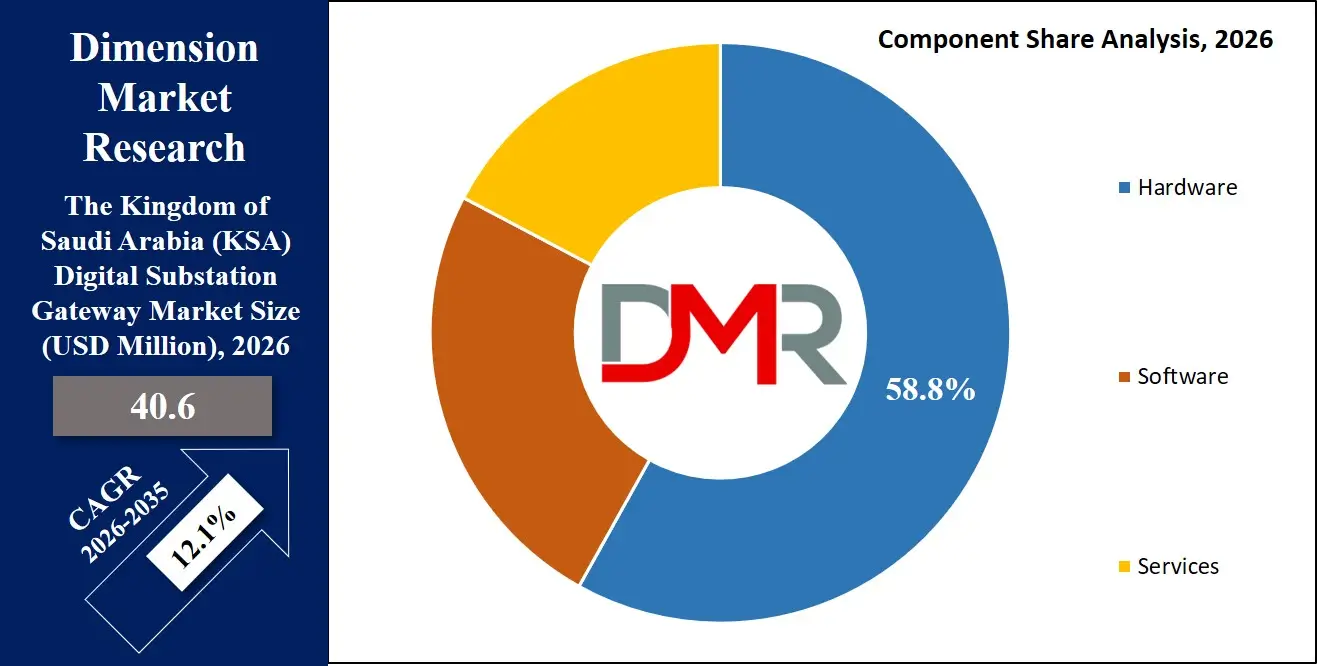
Hardware components are projected to dominate the component segment in this market as they will hold 58.8% of market share in 2026. The dominance of hardware in the component segment of the KSA Digital Substation Gateway Market is owing to rapid grid modernization and technological growth in the country. Utilities in KSA are hugely investing in substation facilities, power distribution centers, and renewable energy projects; hence, advanced hardware solutions are being used to smoothen operations, ranging from protocol gateways for data conversion to communication interfaces for device interoperability and embedded data aggregators for real-time monitoring. Saudi Arabia's Vision 2030 underlines the emphasis on integrating smart technologies for the smooth operation of automated grid systems. It therefore raises demand for intelligent gateways, rugged communication interfaces, and high-performance aggregators that help in performing complex data tasks with precision and adaptability—critical to maintaining operational efficiency in this highly competitive market. Such huge infrastructure projects spur demand for high-class hardware systems, including protocol gateways for seamless substation communication.
ℹ
To learn more about this report –
Download Your Free Sample Report Here
It will help in the complete interconnectivity of physical and digital components within an automated grid environment, thus making its future in the market indispensable. AI, IoT, and cloud computing completely depend on this basic gateway hardware for gathering and synchronizing data within their systems. Growth in the renewable energy sector also adds to the contribution of embedded data aggregators that optimize the processes of power distribution. Government-backed technology zones and initiatives advocate the use of the latest available hardware equipment to reduce operational bottlenecks, thus supporting the market of digital substation gateways. Hence, hardware components remain an integral factor as they provide the actual physical intelligence for modern substation applications in KSA.
By Communication Protocol Analysis
IEC 61850 is expected to lead the communication protocol segment, capturing the largest revenue share in Saudi Arabia, as it has become the globally recognized standard for interoperable substation communication and engineering. Its dominance in the KSA market is driven by its comprehensive framework that simplifies integration, reduces wiring costs, and enables advanced functions like GOOSE messaging and Sampled Values, which are critical for protection and automation schemes in the Kingdom's modernizing grid. The protocol's widespread mandate in Saudi utility specifications for new projects like those in NEOM and the Red Sea Global, as well as retrofit projects across the existing transmission network, ensures its continued market leadership, as it future-proofs investments and reduces vendor lock-in, making it the cornerstone of modern digital substation design in Saudi Arabia.
DNP3 retains a significant and stable share in the Saudi market, particularly for wide-area network communications between substations and national control centers operated by Saudi Electricity Company and other utilities. Its entrenched position in existing SCADA infrastructure across the Kingdom and its robustness for reliable, long-distance telemetry ensure continued demand, especially in retrofit applications where legacy systems predominate. Meanwhile, Modbus and PROFIBUS/PROFINET maintain relevance primarily within industrial substations serving Saudi Arabia's petrochemical and manufacturing sectors, and for interfacing with legacy field devices in brownfield retrofit scenarios, serving as crucial bridges during the transitional phase of the Kingdom's comprehensive grid modernization program.
Other communication protocols, including proprietary solutions and emerging standards, continue to play a role in specialized applications within Saudi Arabia's diverse industrial landscape, though their market share gradually diminishes as IEC 61850 adoption accelerates across the Kingdom's utility sector.
By Deployment Type Analysis
New Installations (Greenfield projects) represent a key high-value segment in the Saudi market, driven by rapid grid expansion under Vision 2030 and the development of new renewable energy plants, industrial cities, and transmission corridors. These projects, including massive developments like NEOM, KAEC, and the numerous solar and wind farms under the National Renewable Energy Program, allow for the deployment of fully integrated, state-of-the-art gateway solutions without legacy constraints, enabling optimal system architecture and performance. They are particularly prevalent in high-growth regions of the Kingdom where utilities and developers are building modern grid infrastructure from the ground up, leveraging the latest digital substation technologies.
Retrofit/Brownfield Upgrades constitute a substantial and strategically vital segment in Saudi Arabia, representing significant market activity across the Kingdom's established power infrastructure. This segment addresses the critical need to enhance the functionality, monitoring, and cybersecurity of thousands of existing substations operated by Saudi Electricity Company and industrial users without complete overhaul. The complexity of integrating new digital gateways with legacy protection and control systems in facilities across Riyadh, Jeddah, Dammam, and other established urban centers demands specialized solutions and services, creating a sustained market for backward-compatible, scalable upgrade packages that maximize existing asset lifespans while delivering digital capabilities essential for grid modernization.
By Voltage Level Analysis
High Voltage (HV) and Extra High Voltage (EHV) applications for transmission substations account for the largest portion of market revenue in Saudi Arabia. Gateways deployed at these voltage levels are critical for wide-area monitoring across the Kingdom's interconnected transmission network, system protection, and bulk power transfer stability from generation centers to major load centers. The high cost of grid failure at this tier, particularly for critical infrastructure supporting industrial complexes and population centers, justifies investment in premium, redundant gateway solutions, making this a technologically advanced and value-intensive segment within the KSA market. Saudi Arabia's extensive HV and EHV transmission network, spanning thousands of kilometers and connecting all regions of the Kingdom, drives sustained demand for these sophisticated solutions.
The Medium Voltage (MV) segment is projected to exhibit the highest growth rate in Saudi Arabia, fueled by national smart grid and distribution automation initiatives under Vision 2030. The integration of distributed energy resources, advanced fault detection and isolation schemes, and the need for granular visibility at the distribution level serving the Kingdom's growing cities and industrial zones are driving massive deployments of gateways in MV substations and feeder circuits. This segment's expansion is central to achieving grid resilience, renewable hosting capacity for rooftop solar and community projects, and customer-centric grid services aligned with the goals of Saudi Arabia's regulatory authorities.
Low Voltage (LV) applications, while representing a smaller market share, are gaining traction in Saudi Arabia's smart building and commercial sectors, where gateway solutions enable enhanced energy management and integration with distributed generation, supporting the Kingdom's broader energy efficiency objectives.
By Application Analysis
Transmission Substations lead the application segment in Saudi Arabia in terms of strategic importance and solution sophistication. Gateways in these nodes are essential for real-time grid management by the Saudi Electricity Company and other transmission system operators, phasor measurement for wide-area situational awareness, and ensuring the stability of the interconnected transmission network that spans the Kingdom. The complex communication requirements and critical nature of these assets, which form the backbone of Saudi Arabia's power system, make them a primary focus for advanced gateway deployments with strong cybersecurity and interoperability features, protecting the reliability of supply to millions of customers and thousands of industrial facilities.
Distribution Substations represent a significant and growing application segment, driven by urbanization, industrial expansion, and the need for enhanced reliability and efficiency in power delivery to end-users across the Kingdom. Gateway deployments in distribution substations enable advanced monitoring, automation, and integration with smart grid initiatives that improve service quality and operational efficiency for utilities serving Saudi Arabia's rapidly growing population and economic activities.
Renewable Energy Substations are projected to be the fastest-growing application segment in Saudi Arabia. The global surge in utility-scale solar PV and wind farms under the National Renewable Energy Program, targeting 58.7 GW of renewable capacity by 2030, necessitates specialized substation gateways at the point of interconnection. These gateways manage grid compliance with Saudi Grid Code requirements, power plant control for facilities like Sudair Solar and Dumat Al Jandal, and the secure flow of generation and meteorological data to grid operators, making them indispensable for the reliable and dispatchable integration of variable renewable energy into the Kingdom's power system.
Industrial Substations serving Saudi Arabia's extensive petrochemical, manufacturing, mining, and desalination sectors represent a substantial application segment. These facilities require robust gateway solutions for reliable power distribution, integration with industrial control systems, and enhanced energy management, supporting the operational excellence and efficiency goals of the Kingdom's industrial diversification strategy.
By End-User Analysis
Utilities, including Saudi Electricity Company and other transmission and distribution system operators, remain the dominant end-user segment in Saudi Arabia, responsible for the majority of market demand through large-scale, regulated grid modernization programs aligned with Vision 2030. Their procurement drives standardization, cybersecurity requirements under National Cybersecurity Authority frameworks, and long-term service contracts, establishing the foundational trends for the entire gateway market in the Kingdom. The utilities' commitment to enhancing grid reliability, efficiency, and intelligence ensures sustained investment in digital substation gateway technologies.
Independent Power Producers (IPPs), particularly in the renewable energy sector, constitute the most rapidly growing end-user segment in Saudi Arabia. As developers and owners of wind, solar, and storage assets under the National Renewable Energy Program and private sector initiatives, IPPs require reliable, grid-code-compliant gateway solutions to ensure their plants can connect to and interact with the utility grid efficiently. Their demand is characterized by a focus on cost-effectiveness, rapid deployment aligned with project timelines, and remote management capabilities essential for optimizing plant performance and maximizing energy production.
Industrial Enterprises across Saudi Arabia's petrochemical, manufacturing, mining, and water desalination sectors represent a significant end-user segment with specialized requirements for substation automation. These facilities demand robust gateway solutions that ensure power reliability for continuous operations, integrate with industrial control systems, and support energy optimization objectives that enhance competitiveness and sustainability.
Commercial Establishments, including large-scale developments like shopping malls, commercial complexes, and mixed-use developments across Saudi Arabia's major cities, represent a growing end-user segment. These facilities increasingly adopt digital substation gateway solutions for enhanced energy management, integration with building automation systems, and support for sustainability goals aligned with Saudi Vision 2030 and the Kingdom's green initiatives.
The Kingdom of Saudi Arabia (KSA) Digital Substation Gateway Market Report is segmented on the basis of the following:
By Component
- Hardware
- Protocol Gateways
- Communication Interfaces
- Embedded Data Aggregators
- Software
- Protocol Conversion Software
- Data Aggregation Tools
- Cybersecurity Software
- Services
- Installation and Commissioning
- Cybersecurity Consulting and Monitoring
- Maintenance and Support Contracts
By Communication Protocol
- IEC 61850
- DNP3
- Modbus
- PROFIBUS/PROFINET
- Others
By Deployment Type
- New Installations
- Retrofit Brownfield Upgrades
By Voltage Level
- Low Voltage (LV)
- Medium Voltage (MV)
- High Voltage (HV)
- Extra High Voltage (EHV)
By Application
- Transmission Substations
- Distribution Substations
- Industrial Substations
- Renewable Energy Substations
By End-User
- Utilities
- Independent Power Producers (IPPs)
- Industrial Enterprises
- Commercial Establishments
The Kingdom of Saudi Arabia (KSA) Digital Substation Gateway Market: Competitive Landscape
The competitive landscape is fueled by participation, both domestic and international, in the Kingdom of Saudi Arabia Digital Substation Gateway Market, with dissimilar capabilities across communication technologies, smart grid solutions, and infrastructure. Major companies, therefore, strategize to develop advanced technologies such as AI, protocol conversion, and cybersecurity to enhance digital substation operations to better competitiveness. The leading players are Siemens Energy, ABB Group, and Schneider Electric in utility automation, while in industrial gateway solutions, the leading players include General Electric, Honeywell International, and local distributors. These companies leverage Saudi Arabia's Vision 2030 initiatives by aligning their offerings with government priorities meant to attract investments and improve grid automation. It addresses both rising utility and industrial sectors where these focus more on niche capabilities: protocol gateways and cybersecurity monitoring, while third-party system integrators have emerged, providing end-to-end solutions in substation and grid automation.
ℹ
To learn more about this report –
Download Your Free Sample Report Here
Mergers and partnerships are common strategies that allow companies to expand service portfolios and reach. For instance, technology companies partnering with utility providers enhance data-driven decision-making and operational agility. While the leading companies are competitive, innovation in the fields of protocol conversion software, data aggregation tools, and predictive analytics separates the leaders. These opportunities are likely to come along with an intense competitive landscape for both established players and new entrants, with strong governmental support for developing smart grid zones.
Some of the prominent players in The Kingdom of Saudi Arabia (KSA) Digital Substation Gateway Market are:
- Siemens Energy
- ABB Ltd.
- Schneider Electric SE
- Hitachi Energy Ltd.
- Eaton Corporation plc
- Cisco Systems, Inc.
- Honeywell International Inc.
- Schweitzer Engineering Laboratories (SEL)
- NR Electric Co., Ltd.
- Moxa Inc.
- ZIV Automation
- Iskra Sistemi d.d.
- Belden, Inc.
- Advantech Co., Ltd.
- Nokia Corporation
- Huawei Technologies Co., Ltd.
- Alfanar Group
- Advanced Electronics Company (AEC)
- Al-Babtain Power & Telecommunication Co.
- Elsewedy Electric
- Other Key Players
Recent Developments in the Kingdom of Saudi Arabia (KSA) Digital Substation Gateway Market
- December 2025: Saudi National Grid (National Grid SA), in collaboration with NARI Group Corporation, deployed the Middle East’s first substation intelligent inspection system in Riyadh. The system uses AI, cloud computing, and multi-source data fusion to monitor asset conditions, detect faults, and support predictive maintenance in extra-high voltage substations.
- November 2025: TBEA secured a USD 192 million EPC contract for the Namria 380/132 kV smart substation project under Saudi Electricity Company. The project includes construction of a new substation and upgrades to two existing substations to support large-scale wind power integration.
- November 2025: Wipro Limited received a multi-year contract from National Grid SA to implement a smart meter data management system for the transmission network, enabling real-time monitoring of power flow, voltage levels, and equipment conditions to improve grid reliability.
- October 2025: Larsen & Toubro won grid infrastructure orders valued between USD 300 million and USD 600 million to build a 380 kV gas-insulated substation and transmission lines in Saudi Arabia, supporting renewable energy grid expansion.
- July 2025: Saudi Electricity Company, National Grid SA, and Huawei Digital Power signed an agreement to develop a real-time digital grid simulation platform, enabling advanced testing of renewable energy integration and grid stability under multiple operating scenarios.
Report Details
| Report Characteristics |
| Market Size (2026) |
USD 40.6 Mn |
| Forecast Value (2035) |
USD 113.9 Mn |
| CAGR (2026–2035) |
12.1% |
| Historical Data |
2021 – 2025 |
| Forecast Data |
2027 – 2035 |
| Base Year |
2025 |
| Estimate Year |
2026 |
| Report Coverage |
Market Revenue Estimation, Market Dynamics, Competitive Landscape, Growth Factors and etc. |
| Segments Covered |
By Component (Hardware, Software and Services), By Communication Protocol (IEC 61850, DNP3, Modbus, PROFIBUS/PROFINET, Others), By Deployment Type (New Installations and Retrofit Brownfield Upgrades), By Voltage Level (Low Voltage (LV), Medium Voltage (MV), High Voltage (HV) and Extra High Voltage (EHV)), By Application (Transmission Substations, Distribution Substations, Industrial Substations and Renewable Energy Substations), By End-User (Utilities, Independent Power Producers (IPPs), Industrial Enterprises and Commercial Establishments) |
| Country Coverage |
The Kingdom of Saudi Arabia (KSA) |
| Prominent Players |
Siemens Energy, ABB Ltd., Schneider Electric SE, Hitachi Energy Ltd., Eaton Corporation plc, Cisco Systems, Inc., Honeywell International Inc., Schweitzer Engineering Laboratories (SEL), NR Electric Co., Ltd., Moxa Inc., ZIV Automation, Iskra Sistemi d.d., Belden, Inc., Advantech Co., Ltd., Nokia Corporation, Huawei Technologies Co., Ltd., Alfanar Group, Advanced Electronics Company (AEC), Al-Babtain Power & Telecommunication Co., Elsewedy Electric, and Other Key Players |
| Purchase Options |
We have three licenses to opt for: Single User License (Limited to 1 user), Multi-User License (Up to 5 Users), and Corporate Use License (Unlimited User) along with free report customization equivalent to 0 analyst working days, 3 analysts working days and 5 analysts working days respectively. |
Frequently Asked Questions
How big is the Kingdom of Saudi Arabia's Digital Substation Gateway Market?
▾ The Kingdom of Saudi Arabia Digital Substation Gateway Market size is estimated to have a value of USD 40.6 million in 2026 and is expected to reach USD 113.9 million by the end of 2035.
Who are the key players in the Kingdom of Saudi Arabia Digital Substation Gateway Market?
▾ Some of the major key players in the Kingdom of Saudi Arabia Digital Substation Gateway Market are Schneider Electric SE., Alfanar Group, Advanced Electronics Company (AEC), Al-Babtain Power & Telecommunication Co., and many others.
What is the growth rate in the Kingdom of Saudi Arabia Digital Substation Gateway Market?
▾ The market is growing at a CAGR of 12.1% over the forecasted period.