Saudi Arabia Drilling Lubricants Market Snapshot
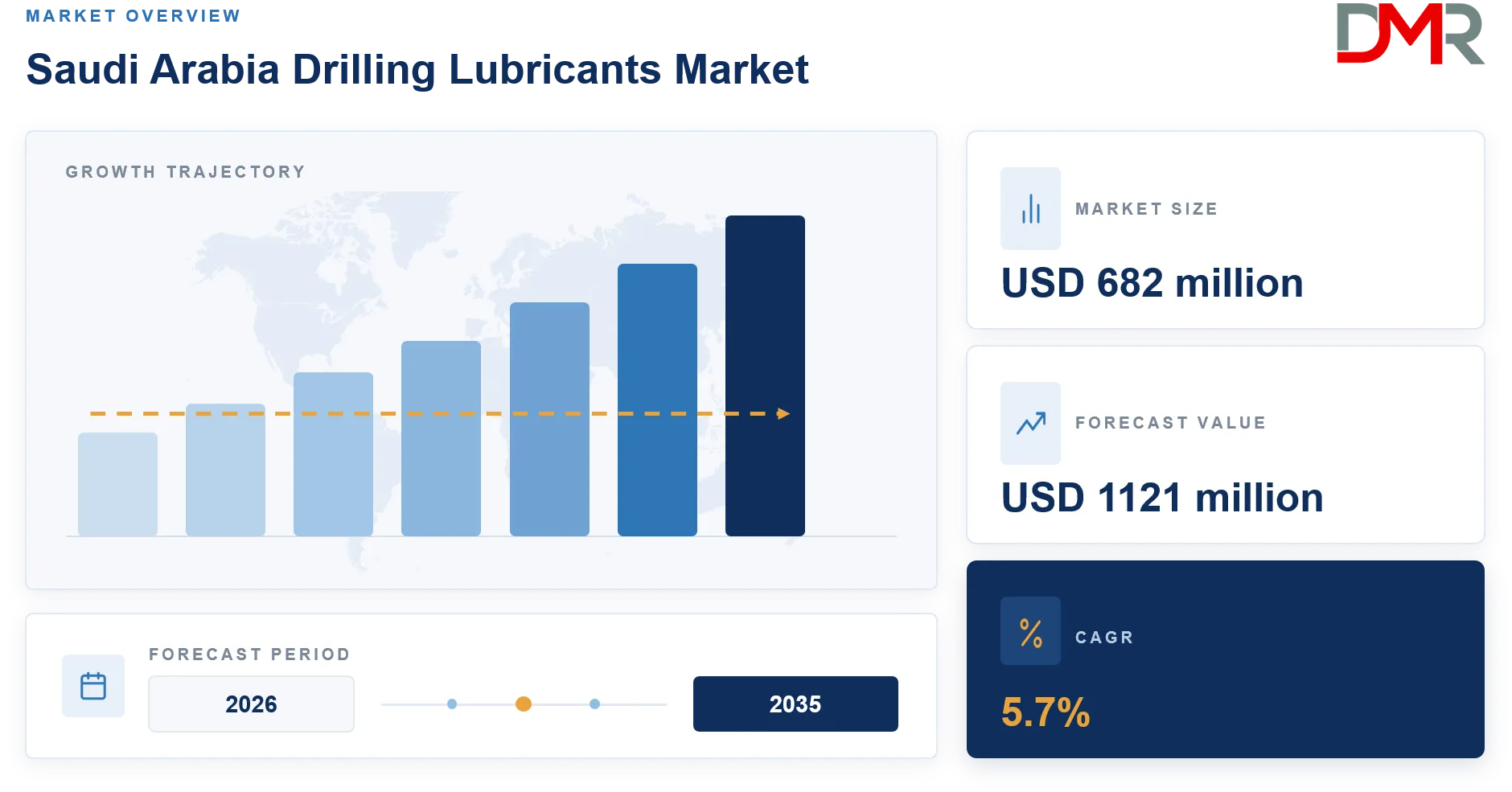
- Market Value: Saudi Arabia drilling lubricants market is valued at USD 682 million in 2026 and is expected to reach USD 1.12 billion by 2035.
- CAGR: Saudi Arabia drilling lubricants market is expected to grow at a CAGR of 5.7% from 2026 to 2035.
- By Lubricant Type Segment Analysis: Water-based lubricants led the lubricant type segment with a 38% share in 2026.
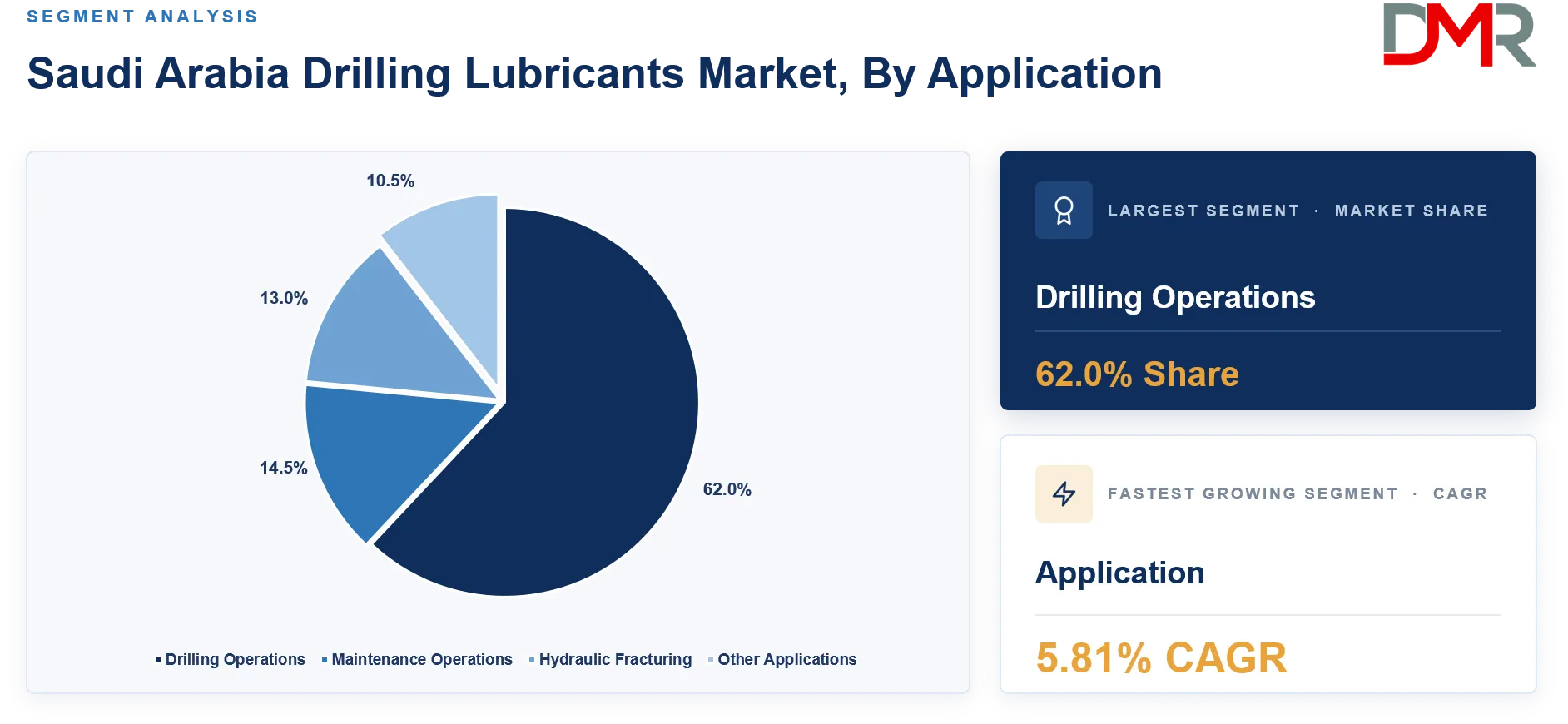
- By Application Segment Analysis: Drilling operations led the application segment with a 62% share in 2026.
- By End User Segment Analysis: Oil and gas industry led the end-user segment with a 74% share in 2026.
- Major Players: Saudi Aramco, SLB, Halliburton, Baker Hughes, and Weatherford.
What is the Saudi Arabia Drilling Lubricants Market and its Market Size?
The Saudi Arabia Drilling Lubricants Market size is projected to be valued at USD 682 million in 2026 and is projected to reach USD 1.12 billion by 2035, expanding at a CAGR of 5.7% during the forecast period. Drilling lubricants are specialized fluid additives used to lower friction between drill strings, wellbore surfaces, casing, drill bits, and drilling equipment. They support torque and drag control, reduce wear, improve drilling efficiency, and help maintain stable fluid performance under demanding downhole conditions.
ℹ
To learn more about this report –
Download Your Free Sample Report Here
Saudi Arabia drilling lubricant demand is closely connected with the Kingdom's large upstream oil and gas industry, well development programs, complex directional drilling requirements, unconventional gas development, and continuous maintenance of mature producing fields. Operators increasingly require lubricant systems that perform reliably in high-temperature formations, extended-reach wells, water-based mud systems, and chemically demanding drilling environments. The market therefore includes international oilfield service companies, local chemical manufacturers, drilling fluid formulators, lubricant suppliers, distributors, and integrated energy companies serving Saudi upstream operations.
Use Cases
- Torque and Drag Reduction: Drilling lubricants lower friction between the drill string and wellbore during directional, horizontal, and extended-reach drilling. Lower friction can improve weight transfer to the drill bit, reduce mechanical resistance, and support smoother movement of drillpipe and casing through demanding Saudi oil and gas formations.
- Drill Bit and Equipment Protection: Lubricants create a protective film on metal surfaces exposed to continuous rotation, pressure, heat, and abrasive drilling solids. This helps reduce wear on drill bits, bearings, drillpipe, and related equipment while supporting longer operating intervals and lower maintenance requirements.
- Water-Based Mud Performance: Lubricant additives are used in water-based drilling systems to improve lubricity without changing critical mud properties. Their importance is increasing as operators seek fluid programs that combine effective wellbore control with lower environmental impact and reduced dependence on conventional oil-based formulations.
- Stuck-Pipe Risk Management: Proper lubricant selection can reduce friction around drillpipe and bottom-hole assemblies where differential sticking, tight-hole conditions, or high contact forces create operational risk. This supports drilling continuity and can reduce the probability of costly fishing operations, extended rig downtime, or equipment recovery work.
- High-Performance Well Construction: Synthetic, biodegradable, and specialty drilling lubricants support wells that require greater thermal stability, salinity tolerance, compatibility with drilling additives, and controlled friction. These formulations are increasingly relevant for complex well profiles and performance-focused drilling programs across Saudi Arabia.
How AI/Gen AI is Transforming the Saudi Arabia Drilling Lubricants Market?
Digital drilling systems are changing how lubricant performance is selected, monitored, and adjusted during Saudi well construction. Operators and service companies can combine torque, drag, rate of penetration, temperature, pressure, fluid rheology, mud density, drill-string vibration, and well geometry data to identify friction patterns earlier. Predictive models can support lubricant dosage decisions and help drilling-fluid engineers determine when changing lubricant concentration may improve mechanical efficiency. For complex directional wells, this creates a stronger link between drilling lubricant chemistry and real-time well performance rather than relying only on periodic mud testing.
Generative and data-driven tools are also supporting formulation development, field reporting, chemical inventory planning, and technical knowledge management. Suppliers can compare lubricant compatibility with water-based fluids, synthetic systems, shale inhibitors, surfactants, weighting agents, and other drilling chemicals before recommending field programs. Digital optimization can also help procurement teams evaluate consumption rates and reduce unnecessary chemical use. As Saudi operators emphasize drilling efficiency and measurable operating performance, lubricant suppliers with strong laboratory data, field analytics, technical service, and digital monitoring capabilities can gain a stronger competitive position.
Key Drivers in the Saudi Arabia Drilling Lubricants Market
Expansion of Complex Oil and Gas Drilling Programs
Saudi Arabia's continued focus on hydrocarbon development supports demand for high-performance drilling lubricants used in vertical, directional, horizontal, and extended-reach wells. Complex well trajectories increase contact between drillpipe and the wellbore, raising torque, drag, and mechanical wear. Lubricants become important for improving drill-string movement, protecting equipment, and supporting consistent drilling performance. This requirement increases demand for specialty formulations designed around Saudi formation conditions and drilling-fluid programs.
Growing Focus on Drilling Efficiency and Nonproductive Time Reduction
Rig time represents a major component of well construction economics, making mechanical efficiency an important purchasing factor for drilling contractors and operators. Effective lubrication can support smoother pipe movement, lower friction, reduce vibration, and limit operational events linked with excessive torque or sticking. As Saudi drilling programs become more performance driven, lubricant selection is increasingly evaluated through total drilling cost rather than chemical price alone. Products that demonstrate measurable improvements in well delivery can gain stronger adoption.
Restraints in the Saudi Arabia Drilling Lubricants Market
Strict Fluid Compatibility and Qualification Requirements
Drilling lubricant suppliers must demonstrate compatibility with complete mud systems rather than deliver lubricity as an isolated property. An additive that affects rheology, filtration behavior, emulsion stability, foaming, formation interaction, or other drilling-fluid parameters may face limited field acceptance. Saudi oil and gas projects also require reliable quality, documentation, and technical support. These qualification requirements create longer commercialization cycles and increase testing costs for smaller or newly established lubricant suppliers seeking major upstream contracts.
Exposure to Raw Material and Specialty Chemical Costs
Drilling lubricant formulations can depend on mineral oils, synthetic base fluids, esters, surfactants, fatty derivatives, specialty polymers, and performance additives sourced through regional and international chemical supply chains. Changes in feedstock costs, freight, packaging, and chemical availability can affect supplier margins and contract pricing. Manufacturers serving Saudi projects must therefore balance cost competitiveness with thermal stability, lubricity, environmental performance, and mud compatibility, which can restrict rapid substitution with lower-cost products.
Growth Opportunities in the Saudi Arabia Drilling Lubricants Market
High-Performance Water-Based Lubricant Development
Water-based lubricants held 38% of the Saudi Arabia drilling lubricants market in 2026, creating an important opportunity for suppliers that can improve lubricity while retaining the operational advantages of aqueous drilling systems. Advanced ester-based additives, surfactant packages, nanoparticle-supported formulations, and high-temperature lubricant chemistries can help water-based fluids address friction challenges traditionally managed by nonaqueous systems. Products that combine performance, fluid compatibility, and easier waste management can gain broader adoption.
Localization of Oilfield Chemical Manufacturing
Saudi Arabia offers opportunities for local formulation, blending, packaging, laboratory testing, and technical service of drilling lubricants. Domestic manufacturing can shorten delivery times, improve inventory reliability, reduce exposure to international logistics, and support customized formulations for local field conditions. Companies including Oil Chemistry Industrial Company, Vision Chemicals Industry Co., Drilling Fluid Factory Saudi Arabia, Meta Solutions Industrial Co., Rawabi Gumpro Drilling Fluids Saudi Arabia, and Minerals Chemicals Factory strengthen the developing local oilfield chemical ecosystem.
Trends in the Saudi Arabia Drilling Lubricants Market
Shift Toward Biodegradable and Lower-Impact Formulations
Environmental performance is becoming a stronger product development criterion in drilling-fluid chemistry. Biodegradable lubricants based on ester chemistry and other lower-impact feedstocks are gaining attention where operators want effective lubricity with improved handling and disposal characteristics. Their market potential is strongest when environmental benefits can be delivered without sacrificing thermal stability, salt tolerance, or compatibility with existing mud systems. This is encouraging suppliers to position sustainability alongside technical drilling performance.
Increasing Integration of Lubricants with Engineered Fluid Systems
Drilling lubricants are increasingly supplied as part of engineered drilling-fluid programs rather than as standalone commodities. Companies such as SLB, Halliburton, Baker Hughes, and Weatherford can combine fluid design, field engineering, solids control, chemical treatment, and well data with lubricant selection. This integrated model encourages formulation around specific well geometry and formation conditions. It also shifts purchasing decisions toward performance-based technical value, increasing competition among suppliers with field laboratories and specialist engineering support.
Research Scope and Analysis
The Saudi Arabia Drilling Lubricants Market is segmented based on lubricant type, application, end user, and other relevant categories. The study provides an in-depth analysis of key segments and sub-segments, covering their applications, industry adoption, demand patterns, technical requirements, competitive positioning, and contribution to overall market growth.
ℹ
To learn more about this report –
Download Your Free Sample Report Here
By Lubricant Type;
Water-based lubricants dominated the Saudi Arabia drilling lubricants market with a 38% share in 2026. Their leadership is supported by their extensive use with water-based mud systems, where lubricants help reduce torque and drag while preserving required fluid characteristics. The segment includes specialty surfactants, ester-based lubricants, polymer-compatible additives, and other chemistries developed for demanding well conditions. Water-based products are particularly relevant where operators seek a balance between drilling performance, handling characteristics, environmental considerations, and fluid economics. Continued development of high-performance aqueous systems creates opportunities for suppliers that can deliver lubricity approaching nonaqueous alternatives while maintaining shale control, thermal stability, and fluid compatibility.
By Application;
Drilling operations accounted for 62% of market demand in 2026, reflecting the direct role of lubricants in well construction. The segment covers friction reduction during drilling, tripping, directional well construction, casing movement, and other operations involving contact between drilling equipment and the wellbore. Lubricant demand increases when well geometry creates higher contact forces or when high temperatures and difficult formations raise mechanical stress. Product performance is therefore assessed through lubricity, torque reduction, compatibility, thermal resistance, and effects on mud properties. Growth in technically demanding wells is expected to keep drilling operations as the principal application, while maintenance and hydraulic fracturing provide additional demand for specialized lubricant formulations.
By End User;
The oil and gas industry held 74% of the Saudi Arabia drilling lubricants market in 2026. The segment's dominance reflects the scale of domestic upstream operations and the recurring requirement for drilling-fluid chemicals across well construction programs. Saudi Aramco, drilling contractors, integrated oilfield service companies, and specialized fluid providers form the primary commercial ecosystem. Lubricants are selected according to formation characteristics, drilling-fluid type, operating temperature, salinity, well expansion, equipment specifications, and performance objectives. Mining and construction represent smaller but relevant opportunities, particularly for drilling activities that require friction reduction and equipment protection in abrasive formations.
The Saudi Arabia Drilling Lubricants Market Report is segmented on the basis of the following:
By Lubricant Type
- Water-Based Lubricants
- Oil-Based Lubricants
- Synthetic Lubricants
- Biodegradable Lubricants
- Other Lubricants
By Application
- Drilling Operations
- Maintenance Operations
- Hydraulic Fracturing
- Other Applications
By End User
- Oil and Gas Industry
- Mining Industry
- Construction Industry
- Other Industries
Competitive Landscape
The Saudi Arabia drilling lubricants market combines integrated oilfield service companies, multinational lubricant producers, domestic chemical manufacturers, drilling-fluid specialists, and energy-sector suppliers. SLB, Halliburton, Baker Hughes, and Weatherford compete through engineered drilling-fluid systems, technical expertise, field service, laboratory support, and the ability to integrate lubricants with broader well construction programs. FUCHS, Shell, ExxonMobil, Chevron, TotalEnergies, Gulf Oil International, Castrol, and Petromin Corporation bring lubricant formulation, base-fluid, distribution, and industrial lubrication capabilities.
Local and regional companies including Oil Chemistry Industrial Company, Vision Chemicals Industry Co., Drilling Fluid Factory Saudi Arabia, Meta Solutions Industrial Co., Global Drilling Fluids & Chemicals Ltd., Rawabi Gumpro Drilling Fluids Saudi Arabia, and Minerals Chemicals Factory strengthen domestic supply options. Competitive differentiation increasingly centers on torque reduction, thermal stability, fluid compatibility, biodegradable chemistry, product qualification, local inventory, technical responsiveness, and customized formulations suited to Saudi drilling conditions.
Some of the prominent players in the Saudi Arabia Drilling Lubricants Industry are:
- Saudi Aramco
- SLB
- Halliburton
- Baker Hughes
- Weatherford
- Oil Chemistry Industrial Company
- Vision Chemicals Industry Co.
- Drilling Fluid Factory Saudi Arabia
- Meta Solutions Industrial Co.
- Global Drilling Fluids & Chemicals Ltd.
- Rawabi Gumpro Drilling Fluids Saudi Arabia
- Minerals Chemicals Factory
- FUCHS
- Petromin Corporation
- Shell PLC
- ExxonMobil
- Chevron
- TotalEnergies
- Gulf Oil International
- Castrol
- Others
Technology Landscape
The Saudi Arabia drilling lubricants market technology landscape is shifting toward high-performance formulations that improve lubricity, thermal stability, fluid compatibility, and wellbore efficiency under demanding drilling conditions. Water-based lubricants, which accounted for 38% of the market in 2026, remain a key technology area as suppliers develop ester-based additives, advanced surfactants, polymers, and low-toxicity chemistries to reduce torque and drag. Synthetic and biodegradable lubricants are also gaining relevance for directional, horizontal, and extended-reach wells where friction control and temperature resistance are critical. Digital drilling systems further support lubricant optimization by using real-time torque, drag, vibration, pressure, temperature, and mud-property data to guide treatment rates. SLB, Halliburton, Baker Hughes, and Weatherford increasingly combine drilling-fluid chemistry with field engineering and performance monitoring. For Saudi operators, technology selection is therefore moving beyond basic lubrication toward integrated solutions that reduce equipment wear, stuck-pipe risk, chemical consumption, and nonproductive drilling time.
Investment and White Space Analysis
Investment opportunities in the Saudi Arabia drilling lubricants market are expanding around local manufacturing, specialty formulation, biodegradable chemistry, water-based lubricant performance, and technical field services. With the market projected to increase from USD 682 million in 2026 to USD 1.12 billion by 2035, suppliers have room to build domestic blending, testing, warehousing, and application-support capabilities closer to drilling operations. A key white space exists in high-temperature water-based lubricants that can deliver strong torque and drag reduction while maintaining rheology, filtration, shale inhibition, and compatibility with other drilling additives. Additional opportunities exist in biodegradable ester formulations, lubricants for horizontal and extended-reach wells, and customized products for challenging Saudi formations. Local companies can also compete through shorter lead times and field-responsive formulation services, while international suppliers can pursue technology partnerships and localized production. Investment in laboratories, performance testing, digital fluid monitoring, and Saudi-based technical teams can create stronger differentiation than competing mainly on chemical price.
Recent Developments
- August 2026: Weatherford International completed first qualification deployment of ArrayPro production logging technology with Saudi Aramco, validating integrated horizontal well logging solution for Saudi drilling operations.linkedin+1
- July 2026: FUCHS SE joint venture ALHAMRANI FUCHS PETROLEUM Yanbu production facility severely damaged by fire, suspending Saudi Arabia lubricants production; reconstruction planning initiated to restore capacity.
- November 2025: Arabian Drilling Company secured four contract renewals with Saudi Aramco totaling over SAR 2 billion, adding significant rig-year backlog supporting drilling fluids and lubricants demand in Saudi Arabia.
Report Details
| Report Characteristics |
| Market Size (2026) |
USD 682 Million |
| Forecast Value (2035) |
USD 1.12 Billion |
| CAGR (2026–2035) |
5.7% |
| Historical Data |
2021 – 2025 |
| Forecast Data |
2027 – 2035 |
| Base Year |
2025 |
| Estimate Year |
2026 |
| Segments Covered |
By Lubricant Type (Water-Based Lubricants, Oil-Based Lubricants, Synthetic Lubricants, Biodegradable Lubricants, and Other Lubricants), By Application (Drilling Operations, Maintenance Operations, Hydraulic Fracturing, and Other Applications), and By End User (Oil and Gas Industry, Mining Industry, Construction Industry, and Other Industries) |
| Regional Coverage |
Saudi Arabia |
Frequently Asked Questions
What is the current size of the Saudi Arabia Drilling Lubricants Market?
▾ The Saudi Arabia Drilling Lubricants Market is valued at USD 682 million in 2026 and is forecast to reach USD 1.12 billion by 2035.
What is the growth rate of the Saudi Arabia Drilling Lubricants Market during the forecast period?
▾ The Saudi Arabia Drilling Lubricants Market is expected to grow at a CAGR of 5.7% during the forecast period from 2026 to 2035.
What factors are driving the growth of the Saudi Arabia Drilling Lubricants Market?
▾ Oil and gas drilling, complex wells, friction reduction needs, and drilling efficiency are driving the Saudi Arabia Drilling Lubricants Market.
What are the major challenges restraining the Saudi Arabia Drilling Lubricants Market?
▾ Fluid compatibility requirements, chemical qualification, raw material costs, and price pressure restrain the Saudi Arabia Drilling Lubricants Market.
Which segment holds the largest share of the Saudi Arabia Drilling Lubricants Market?z
▾ By end user, the oil and gas industry holds the largest Saudi Arabia Drilling Lubricants Market share at 74% in 2026.
Who are the leading companies in the Saudi Arabia Drilling Lubricants Market?
▾ Key participants include Saudi Aramco, SLB, Halliburton, Baker Hughes, Weatherford, Oil Chemistry Industrial Company, Vision Chemicals Industry Co., Drilling Fluid Factory Saudi Arabia, Meta Solutions Industrial Co., Global Drilling Fluids & Chemicals Ltd., Rawabi Gumpro Drilling Fluids Saudi Arabia, Minerals Chemicals Factory, FUCHS, Petromin Corporation, Shell PLC, ExxonMobil, Chevron, TotalEnergies, Gulf Oil International, and Castrol.
How is AI influencing the Saudi Arabia Drilling Lubricants Market?
▾ AI supports the Saudi Arabia Drilling Lubricants Market through fluid monitoring, predictive maintenance, lubricant dosing, and drilling optimization.
What are the future opportunities and trends in the Saudi Arabia Drilling Lubricants Market?
▾ Biodegradable lubricants, advanced water-based fluids, local production, and digital drilling create Saudi Arabia Drilling Lubricants Market opportunities.