Market Overview
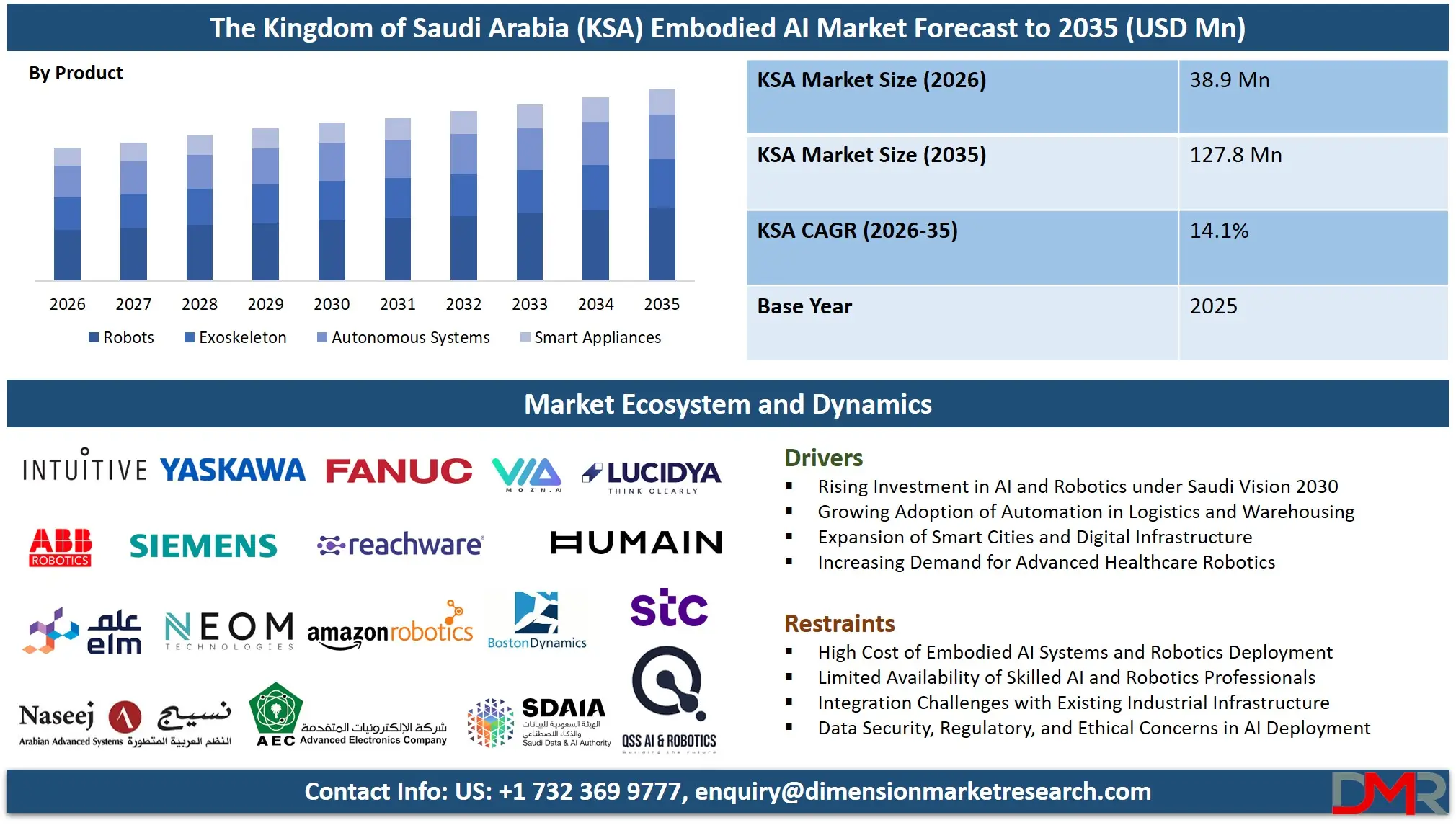
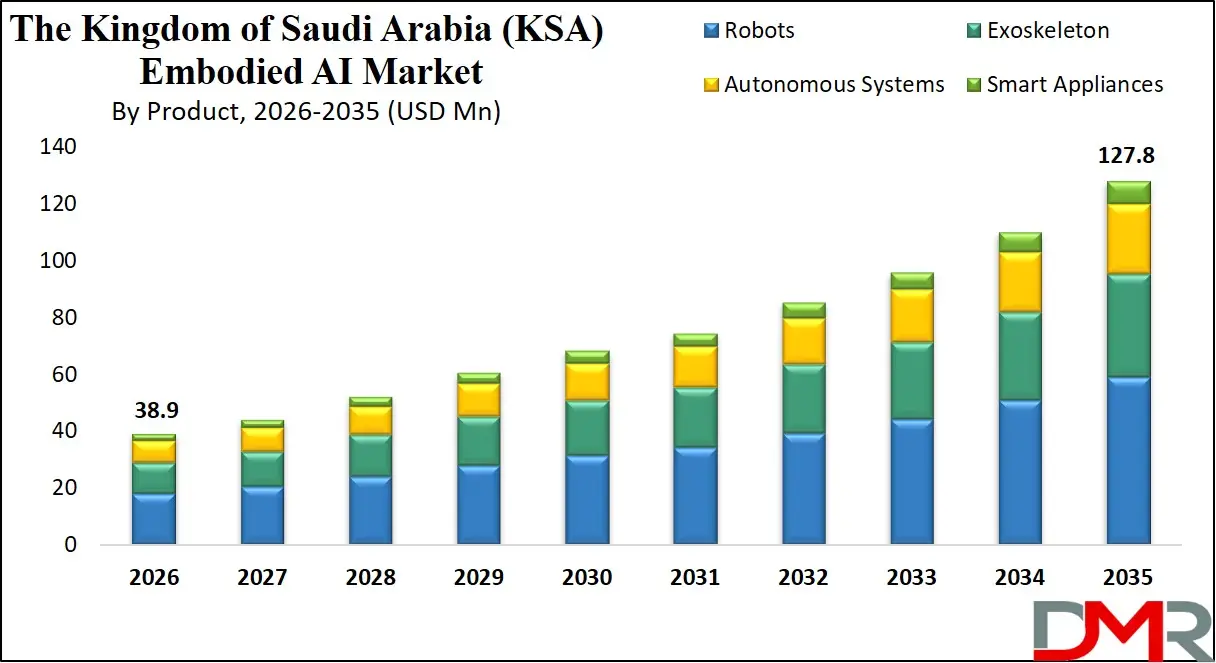
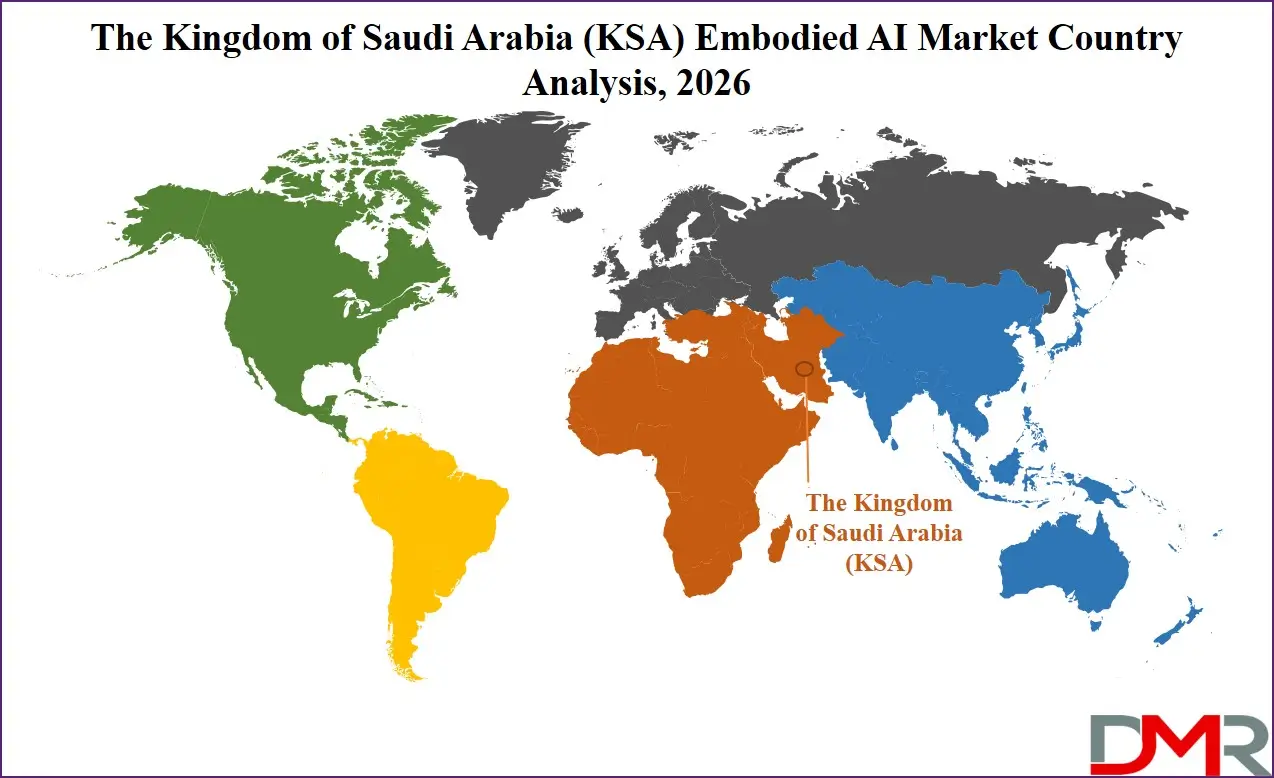
Saudi Arabia Embodied AI market size is expected to reach a value of USD 38.9 million in 2026, and it is further anticipated to reach a market value of USD 127.8 million by 2035 at a CAGR of 14.1%.
ℹ
To learn more about this report –
Download Your Free Sample Report Here
The embodied AI market is an important part of the economic development of the Kingdom of Saudi Arabia, led by the highly ambitious Vision 2030. Strategically located at the crossroads between Asia, Africa, and Europe, Saudi Arabia occupies a privileged position in its emergence as a key global hub for technological innovation and advanced robotics. The sector covers a wide range of autonomous systems, from humanoid robots and collaborative cobots to exoskeletons and smart appliances, which are important in facilitating industrial automation and supporting the growth of strategic sectors such as healthcare, defense, automotive, and logistics. The government's commitment to diversifying the economy from oil dependency has resulted in substantial investment in AI infrastructure and robotics technology, significantly transforming the embodied AI landscape.
Over the last few years, the embodied AI market of Saudi Arabia has witnessed a strategic transition in adopting advanced autonomous systems integrating technologies like machine learning, computer vision, and natural language processing. These technologies are making robotic operations more effective, developing real-time environmental interaction, facilitating easier human-robot collaboration, and further helping in the optimization of complex tasks across industries. Also, with the rapid growth of smart city projects like NEOM, the need for intelligent autonomous systems has accelerated the demand to scale up companies' robotics capabilities. All these evolutions of technology and the market are likely to drive the sector's growth, signifying a good future outlook for the market.
Key trends currently evident within the embodied AI arena in Saudi Arabia are digital transitions taking hold of physical operations by moving from traditional mechanization to agile-oriented, AI-driven robotic ecosystems. Aside from this, further integration of computer vision and sensor fusion brings predictive maintenance and real-time decision-making with cost reductions along the value chain for better outputs of efficiency. Furthermore, with the augmenting emphasis on sustainability in line with Vision 2030, adaptation to energy-efficient robotic systems, such as autonomous surveillance drones and collaborative robots for green manufacturing, is on the rise. Similarly, the rise in healthcare automation has changed strategies for patient care as hospitals try to meet expectations for precise and reliable robotic assistance.
ℹ
To learn more about this report –
Download Your Free Sample Report Here
The market is consequently witnessing huge opportunities on the back of high investments by the Saudi government in technological infrastructure development. Initiatives such as the construction of robotics hubs, AI research centers, and test zones for autonomous vehicles are creating a robust innovation backbone to support regional and international technological leadership. Megaprojects like NEOM City and the Red Sea Project illustrate the strategic importance of embodied AI in enabling Saudi Arabia's ambitious economic goals. The geographical position of the nation enhances its potential to become a global robotics hub, offering unparalleled access to key markets across three continents. Further, the focus on smart technologies like collaborative robots, exoskeletons, and autonomous systems provides companies with opportunities to gain a competitive edge by improving productivity and reducing operational costs.
Still, some significant challenges may impede the market. Geopolitical instability in this region creates a threat to cross-border technology trade and the continuity of robotics supply chains, thereby threatening to put uncertainty into business. On the other hand, an emerging skill gap is appearing in the embodied AI sector amidst a growing shortage of skilled engineers with advanced knowledge of robotics and AI systems. This factor may hamper the adoption of modern robotic solutions. Other regulatory challenges include complex certification procedures and bureaucratic obstacles that make other difficulties worse and, hence, may discourage foreign investment in this market.
The Kingdom of Saudi Arabia (KSA) Embodied AI Market: Key Takeaways
- Market Size Insights: The Kingdom of Saudi Arabia (KSA) Embodied AI Market is estimated at USD 38.9 million in 2026 and is projected to reach USD 127.8 million by 2035, reflecting the country's increasing investments in artificial intelligence, robotics, and smart automation technologies.
- Market Growth Rate: The market is expected to grow at a CAGR of 14.1% from 2026 to 2035, driven by rapid digital transformation initiatives, automation adoption, and the integration of AI-enabled robotics across multiple industries.
- Key Players: Major participants in the KSA Embodied AI Market include Fanuc Corporation, Yaskawa Electric Corporation, SoftBank Robotics, Kawasaki Heavy Industries Robotics, Honda Robotics, Cyberdyne Inc., Toyota Research Institute, Sony Robotics, Panasonic Robotics, and Mitsubishi Electric, alongside emerging regional technology companies and AI startups.
- Robots as the Core Growth Driver: Robots are expected to dominate the KSA embodied AI market as industries increasingly deploy industrial robots, service robots, and autonomous systems to improve operational efficiency and reduce reliance on manual labor.
- Automation as a Leading End User: Industrial automation, logistics automation, and smart infrastructure projects are key end-user segments. Sectors such as oil and gas, logistics, manufacturing, and smart cities are adopting embodied AI technologies to enhance operational productivity and safety.
- Government Policy as a Catalyst: National initiatives including Saudi Vision 2030, the National Strategy for Data and AI (NSDAI), and smart city projects such as NEOM are accelerating the development and adoption of robotics and embodied AI technologies across the country.
Impact of the Iran Conflict on The Kingdom of Saudi Arabia (KSA) Embodied AI Market
- Potential Disruptions in Robotics Component Supply Chains: Embodied AI technologies rely on semiconductors, sensors, and advanced electronic components used in robotics systems. Regional geopolitical tensions may affect global supply chains for these components, potentially slowing the deployment of AI-enabled robotic technologies.
- Energy Market Volatility Influencing Technology Investments: Fluctuations in global energy markets may influence industrial investment decisions and operational costs related to robotics and AI infrastructure development within Saudi Arabia.
- Trade and Logistics Challenges in the Gulf Region: The Persian Gulf serves as a critical international trade route. Instability in the region may disrupt shipping and logistics networks, affecting the import of robotics hardware and AI technology components required for embodied AI systems.
- Growing Demand for Defense and Security Robotics: Regional security concerns may increase investments in autonomous surveillance systems, AI-powered drones, and robotic monitoring technologies, which can accelerate the adoption of embodied AI solutions in defense and security sectors.
The Kingdom of Saudi Arabia (KSA) Embodied AI Market: Use Cases
- Healthcare Robotics and Medical Automation: Saudi Arabia is expanding the use of robotic surgery systems, rehabilitation robots, and AI-enabled healthcare assistance platforms to enhance medical services and improve hospital operational efficiency.
- Logistics and Supply Chain Automation: The rapid growth of e-commerce and logistics infrastructure is encouraging the adoption of autonomous mobile robots and AI-driven warehouse management systems to streamline inventory operations and goods movement.
- Industrial Automation and Smart Manufacturing: Embodied AI technologies are being integrated into manufacturing facilities and industrial plants, enabling predictive maintenance, automated assembly lines, and AI-powered quality inspection systems.
- Infrastructure Monitoring and Emergency Response: Robotics platforms equipped with embodied AI are increasingly used for infrastructure inspection, environmental monitoring, and emergency response operations, particularly in large industrial and construction projects.
- Education, Hospitality, and Service Robotics: Embodied AI robots are also being deployed in universities, research institutes, airports, hotels, and shopping malls, where they assist with education, customer service, and smart city applications.
The Kingdom of Saudi Arabia (KSA) Embodied AI Market: Stats & Facts
Saudi Ministry of Commerce
- Robotics companies registered in Saudi Arabia reached 2,344 in 2023.
- The number of robotics-related firms increased from 1,537 companies in 2022.
Saudi Data and Artificial Intelligence Authority (SDAIA)
- Over 1 million Saudis have been trained in artificial intelligence and data skills through SDAIA programs.
- More than 50 AI companies in the Kingdom have received accreditation certificates from SDAIA.
- SDAIA has launched multiple national initiatives to develop AI talent and innovation ecosystems.
Global AI Index
- Saudi Arabia ranks 5th globally in artificial intelligence growth.
- The Kingdom ranks 1st in the Arab region for AI development and adoption.
Stanford AI Index
- Saudi Arabia ranks among the top global countries for AI-related job growth.
- The country has experienced significant increases in AI hiring activity in recent years.
Saudi Vision 2030 Program
- Saudi Vision 2030 includes approximately USD 4.0 billion allocated for agricultural modernization projects, including robotics and automation technologies.
- Around USD 2.13 billion has been allocated for retail automation and digital transformation initiatives in Saudi Arabia.
- Vision 2030 identifies AI and robotics as strategic technologies for economic diversification.
Saudi Ministry of Industry and Mineral Resources
- The manufacturing sector contributes around 12% to Saudi Arabia's GDP.
- Saudi Arabia aims to establish thousands of new advanced manufacturing facilities under its National Industrial Strategy.
- Industry 4.0 technologies such as AI, robotics, and automation are being integrated into industrial development plans.
International Federation of Robotics (IFR)
- Robotics adoption in the Middle East is growing rapidly in manufacturing and logistics sectors.
- Saudi Arabia is emerging as a key robotics adopter in the regional industrial automation ecosystem.
International Telecommunication Union (ITU)
- Saudi Arabia ranks among the leading countries globally in digital government development.
- The Kingdom has one of the most advanced digital infrastructure ecosystems in the Middle East.
The Kingdom of Saudi Arabia (KSA) Embodied AI Market: Market Dynamics
Driving Factors in the Kingdom of Saudi Arabia (KSA) Embodied AI Market
Digital Transformation of Physical Operations
The embodied AI sector in Saudi Arabia is also becoming a hub of digital transformation due to the initiatives laid down by Vision 2030 for integrating AI across all physical operations. Companies are leveraging technologies such as computer vision, sensor fusion, and edge AI for real-time environmental perception, predictive maintenance, and extended autonomous functionality. For example, AI-enabled sensors provide timely insights into robotic performance, hence reducing any inefficiencies. Cloud robotics enhances data sharing across complex operations, building trust among stakeholders. This trend significantly improves operational efficiencies, besides being in tune with global smart automation practices, and cements the Kingdom's status as a regional robotics hub.
Healthcare Automation Expansion Boosting Robotics Demand
This rapid growth in healthcare modernization has produced high demand in Saudi Arabia for the sector to implement robotic surgery and patient care solutions. Hospitals such as King Faisal Specialist Hospital have partnered with leading robotics providers to try to meet today's demanding expectations around precision and recovery times. The number of robotic-assisted surgeries has been on the rise; there is an increasing level of rehabilitation robotics innovation, including the implementation of AI-powered exoskeletons. As advanced healthcare is increasingly integral to patient outcomes, this trend is producing real investment in the hard infrastructure of medical robotics but also increasingly in training platforms that then tie the operation together in one seamless interface for surgeons and patients alike.
Restraints in The Kingdom of Saudi Arabia (KSA) Embodied AI Market
High Initial Investment Costs
Advanced embodied AI technologies and robotics infrastructure development require huge capital investment, although governments are very supportive. Smaller enterprises can hardly afford AI-enabled robots, sensor systems, or autonomous platforms. This may impede market growth and further widen the gap between large corporations and SMEs in access to advanced robotics solutions.
Limited Skilled Workforce
The embodied AI industry will have a shortage of professionals who may manage modern robotics like AI or autonomous systems. While workforce development is included in Vision 2030, the pace of its digital adoption outpaces supplies of trained talent. Normally, companies rely on hiring expatriates, greatly increasing operational costs. Getting over this restraint will involve considerable investments in education and training programs meant to build a local pool of talent in robotics engineering.
Opportunities in The Kingdom of Saudi Arabia (KSA) Embodied AI Market
Integration of Emerging Technologies
The adoption of technologies such as edge AI, 5G connectivity, and digital twins presents an excellent opportunity for embodied AI optimization. Collaborative robots and predictive analytics cut down operational costs, while AI-powered exoskeletons enhance human capabilities. Startups and established firms alike are testing such integrations, which offers an excellent opportunity for technology providers and investors to reach the Saudi embodied AI market.
Expansion of Defense and Security Robotics
With growing demand for autonomous surveillance and combat systems, this defense robotics segment is developing at a very fast pace. There is also more inflow of investments into autonomous drones and unmanned ground vehicles. Additionally, security modernization in Saudi Arabia and changing threat patterns will further contribute to this segment and open doors for value-added service providers through innovative solution design.
Tendencies in the Kingdom of Saudi Arabia (KSA) Embodied AI Market
Vision 2030 Economic Diversification Initiatives
Saudi Arabia's Vision 2030 underlines diversification away from dependence on oil and makes the embodied AI and robotics industry one of the mainstays of the economy. Huge investments in infrastructure projects like NEOM and the Red Sea Global have been driving growth. In addition, it also comprises technology-friendly policies like establishing Special Economic Zones for robotics and reducing import barriers for AI components, which also attract foreign and local investments. This helps strengthen the nation's standing as a leading robotics hub in the Middle East.
Increasing Healthcare Modernization
Saudi Arabia is also developing healthcare actively with its participation in initiatives such as the Health Sector Transformation Program, increasing the adoption of robotic systems, which in turn are raising demand for more sophisticated embodied AI solutions. The upgrading of hospitals, expansion of robotic surgery centers, and the development of better rehabilitation facilities are easing the way to smoother healthcare automation. All these growth drivers increase the global competitiveness of the Kingdom in medical technology and ensure the prosperity of the embodied AI sector in the globalized world economy.
The Kingdom of Saudi Arabia (KSA) Embodied AI Market: Research Scope and Analysis
By Product
Robots are projected to dominate the product segment in this market as they will hold 46.0% of market share in 2026. The dominance of robots in the product segment of the KSA Embodied AI Market is owing to rapid industrialization and technological growth in the country. Businesses in KSA are hugely investing in manufacturing hubs, healthcare facilities, and logistics centers; hence, advanced robotic solutions are being used to smoothen operations, ranging from industrial robots for assembly lines to service robots for customer interaction and mobile robots for material handling. Saudi Arabia's Vision 2030 underlines the emphasis on integrating AI for the smooth operation of automated systems. It therefore raises demand for collaborative robots, humanoid robots, and autonomous mobile robots that help in performing complex tasks with precision and adaptability-critical to maintaining operational efficiency in this highly competitive market. Such huge industrial projects spur demand for high-class robotic systems, including cobots for safe human-robot collaboration.
It will help in the complete interconnectivity of physical and digital components within an automated environment, thus making its future in the market indispensable. AI, IoT, and cloud computing completely depend on this basic robotic hardware for gathering and synchronizing data within their systems. Growth in the e-commerce industry also adds to the contribution of autonomous mobile robots that optimize the processes of fulfillment. Government-backed technology zones and initiatives advocate the use of the latest available robotic equipment to reduce operational bottlenecks, thus supporting the market of robots. Hence, robots remain an integral factor as they provide the actual physical intelligence for modern embodied AI applications in KSA.
By End User
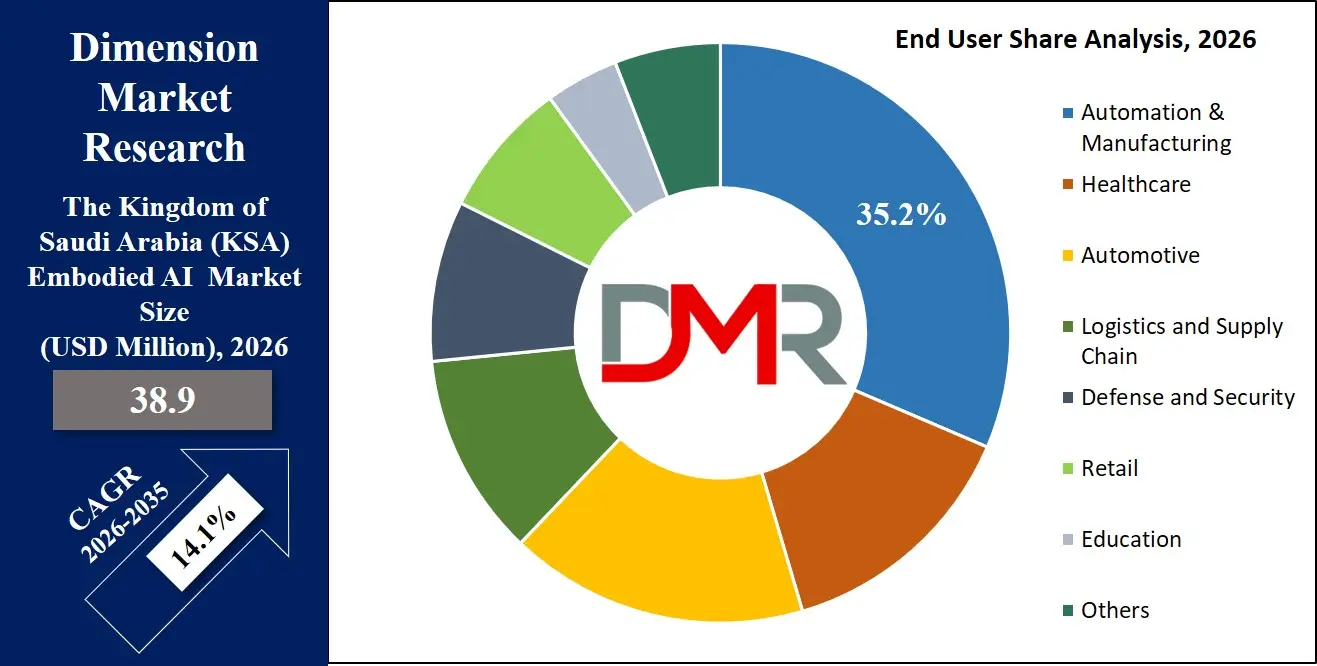
Automation & Manufacturing is expected to dominate the share in the end-user segment of the embodied AI market in KSA, owing to the strategic reliance on industrial automation of the country for economic diversification. Saudi Arabia has vast industrial cities with manufacturing clusters connecting important economic regions for easier production of goods to regions such as Riyadh, Jeddah, and Dammam. Industrial robots offer precision and efficiency no other mode of production can provide. Factory automation and quality control, being very essential, do happen with automotive and electronics industries. There is an unparalleled growth in the number of manufacturing activities as, with a growing demand for consumer goods, manifold times the same producers would want to expect speedy or precise production.
ℹ
To learn more about this report –
Download Your Free Sample Report Here
The industrial infrastructure investments involve the expansion of industrial cities, adding robotics hubs along major manufacturing zones, and furthering automation efficiency. This development also aligns with Vision 2030 in positioning Saudi Arabia as a global industrial hub. The proximity of manufacturing clusters to industrial zones further cements their position as the main end-user for robotic solutions. Among many factors, productivity improvement comes forward. Compared with either manual labor or traditional machinery, it has industrial robots at lesser costs for high-volume production, thus making them perfectly fit for large-scale manufacturing operations. The increased use of technologies for robotic control, like AI and machine vision, improves the operational efficiency-cum-situation more in enhancing automation dominance.
The Kingdom of Saudi Arabia (KSA) Embodied AI Market Report is segmented on the basis of the following:
By Product
- Robots
- Humanoid Robots
- Mobile Robots
- Industrial Robots
- Service Robots
- Cobots (Collaborative Robots)
- Exoskeleton
- Autonomous Systems
- Smart Appliances
By End User
- Automation & Manufacturing
- Factory Automation
- Quality Control and Inspection
- Healthcare
- Robotic Surgery and Assistance
- Patient Care and Rehabilitation
- Medical Imaging and Diagnostics
- Automotive
- Autonomous Vehicles
- Driver Assistance Systems (ADAS)
- Logistics and Supply Chain
- Autonomous Delivery Systems
- Warehouse Automation
- Defense and Security
- Autonomous surveillance drones
- Search and Rescue Operations
- Autonomous Combat Systems
- Retail
- Customer Service Robots
- In-Store Robotics for Inventory Management
- Personalized Shopping Assistants
- Education
- Teaching Robots
- Interactive Learning Systems
- AI Tutors
- Others
The Kingdom of Saudi Arabia (KSA) Embodied AI Market: Competitive Landscape
The competitive landscape is fueled by participation, both domestic and international, in the Kingdom of Saudi Arabia Embodied AI Market, with dissimilar capabilities across robotics, AI technologies, and infrastructure. Major companies, therefore, strategize to develop advanced technologies such as AI, computer vision, and sensor fusion to enhance embodied AI operations to better competitiveness. The leading players are Aramex, DHL Supply Chain, Bahri, and Saudi Post in logistics robotics, while in healthcare robotics, the leading players include Siemens Healthineers, Intuitive Surgical, and local distributors. These companies leverage Saudi Arabia's Vision 2030 initiatives by aligning their offerings with government priorities meant to attract investments and improve automation. It addresses both rising healthcare and defense sectors where these focus more on niche capabilities: surgical robotics and autonomous surveillance, while third-party robotics integrators have emerged, providing end-to-end solutions in industrial and logistics automation.
ℹ
To learn more about this report –
Download Your Free Sample Report Here
Mergers and partnerships are common strategies that allow companies to expand service portfolios and reach. For instance, technology companies partnering with healthcare providers enhance data-driven decision-making and operational agility. While the leading companies are competitive, innovation in the fields of collaborative robots, autonomous systems, and predictive analytics separates the leaders. These opportunities are likely to come along with an intense competitive landscape for both established players and new entrants, with strong governmental support for developing robotics zones.
Some of the prominent players in The Kingdom of Saudi Arabia (KSA) Embodied AI Market are:
- Humain
- Saudi Data and Artificial Intelligence Authority (SDAIA)
- Neom Tech & Digital Company
- Advanced Electronics Company (AEC)
- STC Solutions
- Elm Company
- Aramco AI Solutions
- Mozn
- Lucidya
- Reachware
- Naseej
- Saudi Robotix
- QSS AI & Robotics
- ABB Robotics
- Fanuc Corporation
- Yaskawa Electric Corporation
- Boston Dynamics
- Amazon Robotics
- Siemens
- Intuitive Surgical
- Other Key Players
Recent Developments in the Kingdom of Saudi Arabia (KSA) Embodied AI Market
- November 2025: Siemens Healthineers launched an AI-powered surgical robot to enhance precision and outcomes in robotic surgery for Saudi hospitals. The solution facilitates seamless collaboration across surgical teams, ensuring the accuracy of procedures, reducing recovery times, and enhancing regulatory compliance.
- July 2025: Intuitive Surgical unveiled cloud-connected robotic surgery innovations aimed at improving decision-making in operating rooms. These solutions leverage big data to forecast surgical outcomes, optimize instrument control, and streamline training processes, empowering hospitals to adapt to healthcare dynamics.
- April 2025: Bahri, a leader in maritime logistics, expanded its fleet of autonomous inspection drones, increasing capacity for monitoring vessel operations and cargo handling. This move supports the growing trade demand and strengthens Saudi Arabia's position in global maritime automation.
Report Details
| Report Characteristics |
| Market Size (2026) |
USD 38.9 Mn |
| Forecast Value (2035) |
USD 127.8 Mn |
| CAGR (2026–2035) |
14.1% |
| Historical Data |
2021 – 2025 |
| Forecast Data |
2027 – 2035 |
| Base Year |
2025 |
| Estimate Year |
2026 |
| Report Coverage |
Market Revenue Estimation, Market Dynamics, Competitive Landscape, Growth Factors and etc. |
| Segments Covered |
By Product (Robots, Exoskeleton, Autonomous Systems, and Smart Appliances), By End User (Automation & Manufacturing, Healthcare, Automotive, Logistics and Supply Chain, Defense and Security, Retail, Education, and Others) |
| Country Coverage |
The Kingdom of Saudi Arabia (KSA) |
| Prominent Players |
Humain, Saudi Data and Artificial Intelligence Authority (SDAIA), Neom Tech & Digital Company, Advanced Electronics Company (AEC), STC Solutions, Elm Company, Aramco AI Solutions, Mozn, Lucidya, Reachware, Naseej, Saudi Robotix, QSS AI & Robotics, ABB Robotics, Fanuc Corporation, Yaskawa Electric Corporation, Boston Dynamics, Amazon Robotics, Siemens, and Intuitive Surgical, and Other Key Players |
| Purchase Options |
We have three licenses to opt for: Single User License (Limited to 1 user), Multi-User License (Up to 5 Users), and Corporate Use License (Unlimited User) along with free report customization equivalent to 0 analyst working days, 3 analysts working days and 5 analysts working days respectively. |
Frequently Asked Questions
How big is the Kingdom of Saudi Arabia's Embodied AI Market?
▾ The Kingdom of Saudi Arabia Embodied AI Market size is estimated to have a value of USD 38.9 million in 2026 and is expected to reach USD 127.8 million by the end of 2035.
Who are the key players in the Kingdom of Saudi Arabia Embodied AI Market?
▾ Some of the major key players in the Kingdom of Saudi Arabia Embodied AI Market are Humain, Saudi Data and Artificial Intelligence Authority (SDAIA), Neom Tech & Digital Company, Advanced Electronics Company (AEC), STC Solutions, and many others.
What is the growth rate in the Kingdom of Saudi Arabia Embodied AI Market?
▾ The market is growing at a CAGR of 14.1 percent over the forecasted period.