Market Overview
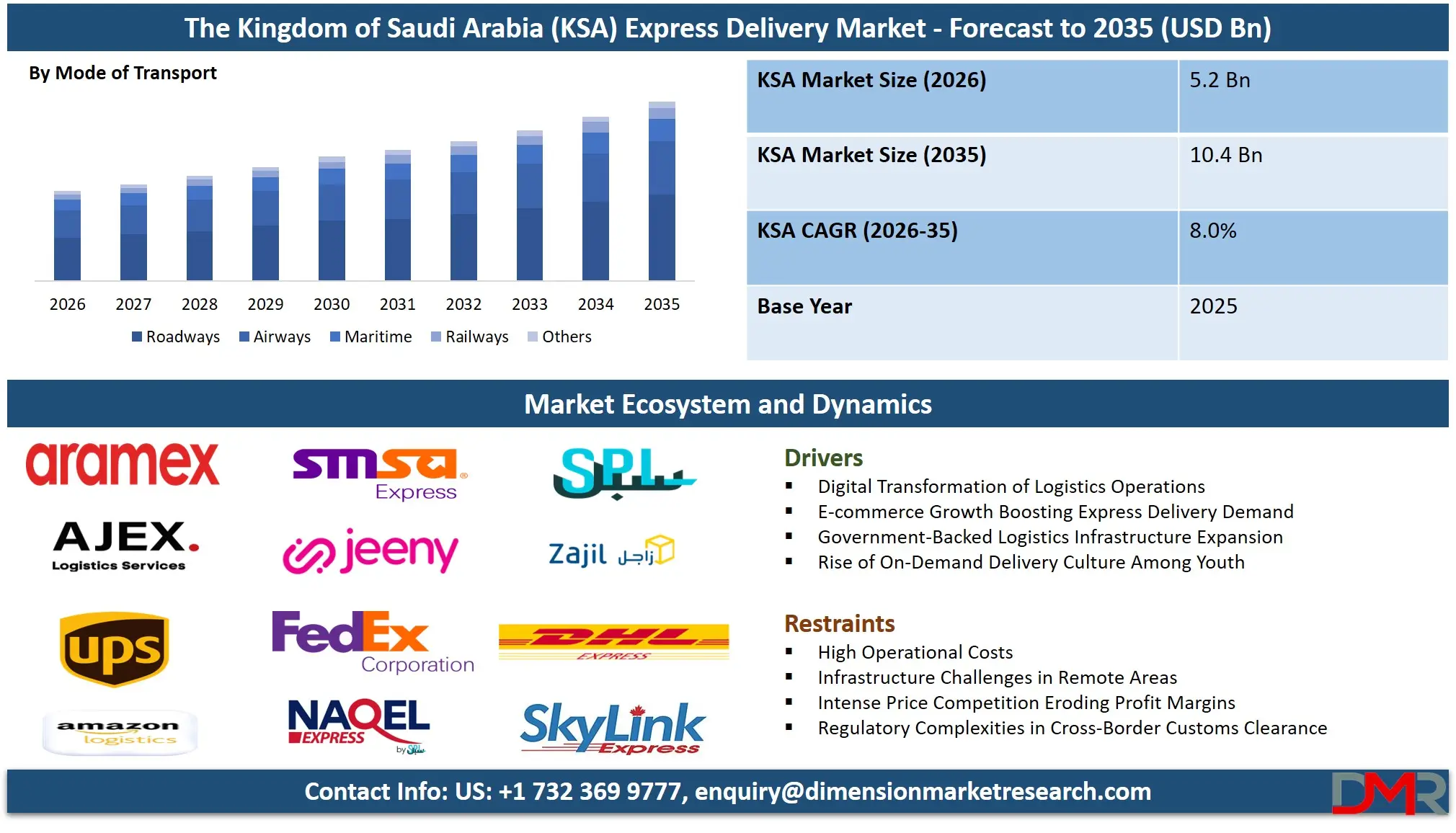
Saudi Arabia Express Delivery Market size is expected to reach a value of USD 5.2 billion in 2026, and it is further anticipated to reach a market value of USD 10.4 billion by 2035 at a CAGR of 8.0%.
ℹ
To learn more about this report –
Download Your Free Sample Report Here
The express delivery market is an important part of the economic development of the Kingdom of Saudi Arabia, led by the highly ambitious Vision 2030. Strategically located at the crossroads between Asia, Africa, and Europe, Saudi Arabia occupies a privileged position in its emergence as a key global hub for logistics and trade. The sector covers a wide range of services, from business-to-business freight and e-commerce last-mile delivery to time-definite and same-day courier solutions, which are important in facilitating commerce and supporting the growth of strategic sectors such as retail, healthcare, and manufacturing. The government's commitment to diversifying the economy from oil dependency has resulted in substantial investment in logistics infrastructure and digital platforms, significantly transforming the express delivery landscape.
Over the last few years, the express delivery market of Saudi Arabia has witnessed a strategic transition in adopting advanced logistics technologies integrating systems like AI-powered route optimization, real-time tracking, and automated sorting facilities. These technologies are making delivery operations more effective, improving real-time shipment visibility, facilitating easier customer communication, and further helping in the optimization of complex supply chain networks across industries. Also, with the rapid growth of e-commerce and giga-projects like NEOM, the need for intelligent and rapid delivery systems has accelerated the demand to scale up companies' logistics capabilities. All these evolutions of technology and the market are likely to drive the sector's growth, signifying a good future outlook for the market.
Key trends currently evident within the express delivery arena in Saudi Arabia are digital transitions taking hold of physical operations by moving from traditional logistics to agile-oriented, data-driven delivery ecosystems. Aside from this, further integration of AI and telematics brings predictive logistics and real-time decision-making with cost reductions along the value chain for better outputs of efficiency. Furthermore, with the augmenting emphasis on sustainability in line with Vision 2030, adaptation to eco-friendly delivery methods, such as electric vehicle fleets and optimized route planning to reduce carbon emissions, is on the rise. Similarly, the rise in on-demand delivery services has changed consumer expectations as individuals and businesses seek faster and more reliable shipping options.
ℹ
To learn more about this report –
Download Your Free Sample Report Here
The market is consequently witnessing huge opportunities on the back of high investments by the Saudi government in logistics infrastructure development. Initiatives such as the construction of integrated logistics zones, expansion of airport cargo capacities, and development of advanced warehousing facilities are creating a robust logistics backbone to support regional and international trade leadership. Megaprojects like NEOM City and the Red Sea Project illustrate the strategic importance of express delivery in enabling Saudi Arabia's ambitious economic goals. The geographical position of the nation enhances its potential to become a global logistics hub, offering unparalleled access to key markets across three continents. Further, the focus on specialized delivery services for sectors like healthcare and e-commerce provides companies with opportunities to gain a competitive edge by improving customer satisfaction and reducing delivery times.
Still, some significant challenges may impede the market. Geopolitical instability in this region creates a threat to cross-border trade and the continuity of transport networks, thereby threatening to put uncertainty into business. On the other hand, an emerging infrastructure gap is appearing in the express delivery sector amidst a growing need for advanced cold chain logistics and last-mile delivery capabilities in remote areas. This factor may hamper the adoption of specialized delivery solutions. Other regulatory challenges include complex customs procedures and bureaucratic obstacles that make other difficulties worse and, hence, may discourage foreign investment in this market.
The Kingdom of Saudi Arabia (KSA) Express Delivery Market: Key Takeaways
- Market Size Insights: The Kingdom of Saudi Arabia (KSA) Express Delivery Market is estimated at USD 5.2 billion in 2026 and is projected to reach USD 10.4 billion by 2035, reflecting the country's increasing investments in logistics infrastructure, e-commerce growth, and digital transformation.
- Market Growth Rate: The market is expected to grow at a CAGR of 8.0% from 2026 to 2035, driven by rapid e-commerce adoption, the expansion of the retail sector, and the integration of technology-enabled logistics solutions across multiple industries.
- Key Players: Major participants in the KSA Express Delivery Market include Saudi Post (SPL), Saudi Post, Aramex International, SMSA Express, DHL Express, FedEx, United Parcel Service, Naqel Express, Zajil Express, and TNT Express, alongside emerging regional logistics startups and technology companies.
- Domestic Delivery as the Core Growth Driver: Domestic deliveries are expected to dominate the KSA express delivery market as the growing e-commerce sector and urbanization increase demand for fast, reliable last-mile delivery services across the Kingdom's major cities.
- E-commerce as a Leading End User: The retail and e-commerce sector is a key end-user segment. The rapid growth of online shopping and omnichannel retail in the Kingdom is driving demand for specialized delivery services such as same-day, next-day, and instant delivery.
- Government Policy as a Catalyst: National initiatives including Saudi Vision 2030, the National Industrial Development and Logistics Program (NIDLP), and the expansion of logistics zones are accelerating the development and adoption of modern express delivery technologies across the country.
Impact of the Iran Conflict on The Kingdom of Saudi Arabia (KSA) Express Delivery Market
- Potential Disruptions in Transport and Supply Chains: Express delivery services rely on stable transport networks, including air and sea freight. Regional geopolitical tensions may disrupt key shipping routes in the Persian Gulf, potentially causing delays in international shipments and increasing freight costs.
- Energy Market Volatility Influencing Logistics Investments: Fluctuations in global energy markets may influence operational costs for logistics companies, particularly fuel expenses for road transport and air freight, impacting pricing and investment decisions.
- Trade and Logistics Challenges in the Gulf Region: The Persian Gulf serves as a critical international trade route. Instability in the region may disrupt shipping and logistics networks, affecting the import and export of goods and delaying cross-border express deliveries.
- Growing Demand for Secure and Resilient Logistics: Regional security concerns may increase investments in secure supply chain solutions, including track-and-trace technologies, bonded warehousing, and risk-managed logistics services, which can accelerate the adoption of advanced tracking and security features in express delivery.
The Kingdom of Saudi Arabia (KSA) Express Delivery Market: Use Cases
- E-commerce Last-Mile Delivery: The rapid growth of online shopping platforms is driving demand for efficient last-mile delivery solutions, including same-day, next-day, and instant delivery to residential and commercial customers.
- Healthcare and Pharmaceutical Logistics: The expansion of healthcare services requires specialized express delivery for temperature-sensitive pharmaceuticals, medical devices, and lab samples, leveraging cold chain capabilities and time-definite services.
- Industrial and Manufacturing Supply Chain: The manufacturing sector relies on express delivery for just-in-time inventory management, spare parts delivery, and time-critical component shipments to maintain production schedules.
- Document and Parcel Courier Services: Traditional courier services for legal documents, contracts, and small parcels remain essential for BFSI, government, and professional services sectors requiring secure and time-definite delivery.
- Cross-Border Trade Facilitation: International express delivery services are critical for businesses engaged in global trade, enabling fast and reliable movement of samples, documents, and commercial goods across borders.
The Kingdom of Saudi Arabia (KSA) Express Delivery Market: Stats & Facts
Saudi Ministry of Commerce
- Logistics and delivery companies registered in Saudi Arabia reached over 3,500 in 2023.
- The number of e-commerce related delivery firms has increased significantly, reflecting the growth of online retail.
Saudi Ministry of Transport and Logistics Services
- The Kingdom aims to rank among the top 10 countries globally in the Logistics Performance Index (LPI) by 2030.
- Over 200 billion SAR has been invested in the transport and logistics sector as part of the National Strategy for Transport and Logistics.
General Authority of Civil Aviation (GACA)
- Saudi Arabia's air cargo capacity has expanded significantly with the establishment of new logistics hubs at major international airports.
- The Kingdom aims to become a leading global air cargo hub, connecting three continents.
Saudi Postal Company (SPL)
- SPL handles millions of parcels annually, with a significant year-on-year growth rate driven by e-commerce.
- The company has expanded its last-mile delivery network to cover all regions of the Kingdom, including remote areas.
Saudi Vision 2030 Program
- The National Industrial Development and Logistics Program (NIDLP) aims to transform Saudi Arabia into a leading global industrial and logistics hub.
- Vision 2030 identifies logistics and digital infrastructure as strategic enablers for economic diversification.
Saudi E-commerce Council
- E-commerce revenues in Saudi Arabia have experienced double-digit annual growth, directly fueling demand for express delivery services.
- The percentage of SMEs engaged in e-commerce has increased substantially in recent years.
McKinsey & Company
- The Middle East logistics market is one of the fastest-growing globally, with Saudi Arabia leading regional growth.
- Last-mile delivery in the Kingdom's major cities is evolving rapidly with the adoption of technology and new business models.
International Telecommunication Union (ITU)
- Saudi Arabia ranks among the leading countries globally in digital government development.
- The Kingdom has one of the most advanced digital infrastructure ecosystems in the Middle East, supporting e-commerce and logistics digitization.
The Kingdom of Saudi Arabia (KSA) Express Delivery Market: Market Dynamics
Driving Factors in the Kingdom of Saudi Arabia (KSA) Express Delivery Market
Digital Transformation of Logistics Operations
The express delivery sector in Saudi Arabia is also becoming a hub of digital transformation due to the initiatives laid down by Vision 2030 for integrating digital technologies across all logistics operations. Companies are leveraging technologies such as AI-powered route optimization, real-time tracking platforms, and automated sorting systems for enhanced operational efficiency and extended delivery capabilities. For example, AI-enabled route planning provides timely insights into fleet performance, hence reducing any inefficiencies. Cloud-based logistics platforms enhance data sharing across complex supply chains, building trust among stakeholders. This trend significantly improves operational efficiencies, besides being in tune with global smart logistics practices, and cements the Kingdom's status as a regional logistics hub.
E-commerce Growth Boosting Express Delivery Demand
This rapid growth in e-commerce has produced high demand in Saudi Arabia for the sector to implement faster and more reliable delivery solutions. Online retailers and marketplaces have partnered with leading logistics providers to try to meet today's demanding expectations around delivery speed and transparency. The volume of parcels handled by express delivery companies has been on the rise; there is an increasing level of specialized delivery innovation, including the implementation of instant and same-day delivery services. As e-commerce is increasingly integral to retail, this trend is producing real investment in the hard infrastructure of automated sortation centers but also increasingly in last-mile delivery networks that then tie the operation together in one seamless interface for merchants and consumers alike.
Restraints in The Kingdom of Saudi Arabia (KSA) Express Delivery Market
High Operational Costs
Advanced express delivery infrastructure development and fleet modernization require huge capital investment, although the market is growing. Smaller logistics enterprises can hardly afford investments in temperature-controlled vehicles, real-time tracking systems, or automated sorting facilities. This may impede market growth and further widen the gap between large corporations and SMEs in access to advanced logistics capabilities.
Infrastructure Challenges in Remote Areas
The express delivery industry will have limitations in reaching remote and rural areas efficiently due to underdeveloped transport infrastructure in some regions. While infrastructure development is included in Vision 2030, the pace of logistics expansion sometimes outpaces the availability of last-mile delivery networks in these areas. Normally, companies face higher operational costs for deliveries to remote locations. Getting over this restraint will involve considerable investments in transport infrastructure and innovative delivery models meant to build comprehensive coverage across the Kingdom.
Opportunities in The Kingdom of Saudi Arabia (KSA) Express Delivery Market
Integration of Emerging Technologies
The adoption of technologies such as autonomous delivery vehicles, drone delivery systems, and blockchain for supply chain visibility presents an excellent opportunity for express delivery optimization. Predictive analytics cut down operational costs, while AI-powered tracking enhances customer experience. Startups and established firms alike are testing such integrations, which offers an excellent opportunity for technology providers and investors to reach the Saudi express delivery market.
Expansion of Specialized Logistics Services
With growing demand for cold chain logistics, pharmaceutical delivery, and oversized freight services, this specialized logistics segment is developing at a very fast pace. There is also more inflow of investments into temperature-controlled warehousing and specialized transport fleets. Additionally, healthcare modernization in Saudi Arabia and changing consumer expectations will further contribute to this segment and open doors for value-added service providers through innovative solution design.
Trends in The Kingdom of Saudi Arabia (KSA) Express Delivery Market
Vision 2030 Economic Diversification Initiatives
Saudi Arabia's Vision 2030 underlines diversification away from dependence on oil and makes the logistics and express delivery industry one of the mainstays of the economy. Huge investments in infrastructure projects like King Salman International Airport logistics zone and the Landbridge rail project have been driving growth. In addition, it also comprises technology-friendly policies like establishing Special Integrated Logistics Zones and simplifying customs procedures, which also attract foreign and local investments. This helps strengthen the nation's standing as a leading logistics hub in the Middle East.
Increasing E-commerce Penetration
Saudi Arabia is also developing e-commerce actively with its participation in initiatives such as the E-commerce Council, increasing the adoption of online shopping, which in turn is raising demand for more sophisticated express delivery solutions. The expansion of digital payment systems, the growth of online marketplaces, and the development of better consumer protection frameworks are easing the way to smoother e-commerce logistics. All these growth drivers increase the global competitiveness of the Kingdom in digital trade and ensure the prosperity of the express delivery sector in the globalized world economy.
The Kingdom of Saudi Arabia (KSA) Express Delivery Market: Research Scope and Analysis
By Destination Analysis
Domestic deliveries are projected to dominate the destination segment in this market as they will hold approximately 70.0% of market share in 2026. The dominance of domestic deliveries in the destination segment of the KSA Express Delivery Market is owing to rapid urbanization and the exponential growth of e-commerce within the Kingdom's major city centers like Riyadh, Jeddah, and Dammam. Retailers and logistics providers in Saudi Arabia are heavily investing in optimizing last-mile networks; hence, advanced solutions are being used to smooth delivery operations, ranging from local sorting centers and urban micro-fulfillment depots to real-time tracking platforms integrated with Arabic-language interfaces. Saudi Arabia's Vision 2030 underlines the emphasis on logistics efficiency for national shipments, therefore raising demand for robust ground transport and agile delivery networks that help in reaching consumers quickly with proactive updates, building service reliability critical to maintaining performance in this rapidly evolving market. Such huge volumes of B2C parcels from the burgeoning e-commerce sector spur demand for high-class domestic express services.
It will help in the complete interconnectivity of e-commerce platforms and logistics functions within the Kingdom, thus making its future in the market indispensable. Omnichannel retail and consumer convenience, particularly in a market with growing disposable incomes, completely depend on this basic domestic infrastructure for fulfilling and synchronizing orders within the nation's borders. Growth in the sustainability agenda, aligned with the Saudi Green Initiative, also adds to the contribution of electric delivery vehicles and optimized route-planning algorithms integrated into domestic fleets that optimize urban delivery processes in congested cities. Government-backed e-commerce and logistics programs, such as those from the Ministry of Transport and Logistics Services, advocate the use of the latest available technology to reduce delivery times, thus supporting the market of domestic express services. Hence, domestic deliveries remain an integral factor as they provide the foundational logistics skeleton for modern e-commerce and retail in Saudi Arabia.
By Business Model Analysis
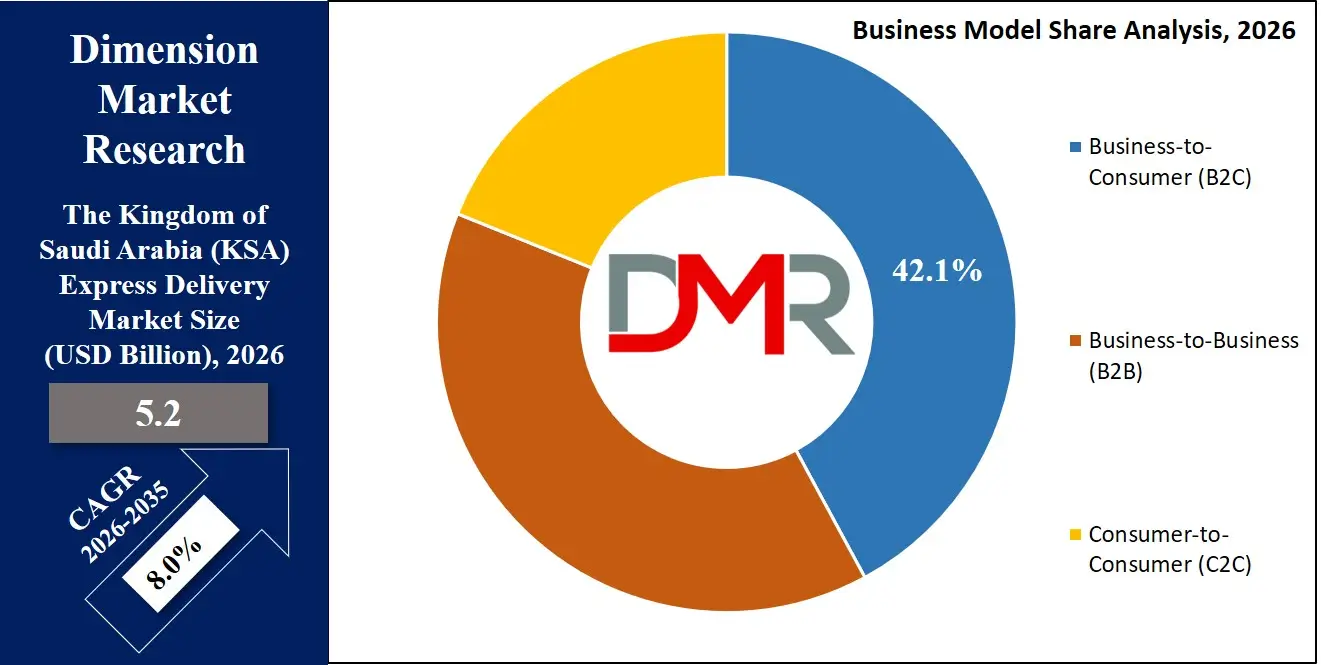
Business-to-Consumer (B2C) services, driven by e-commerce, are anticipated to dominate the share in the business model segment of the express delivery market in KSA, owing to the strategic reliance on high-volume, tech-enabled delivery networks for mass-market retail applications serving a young, tech-savvy population. Saudi Arabia has vast and growing e-commerce activity with a supply chain connecting important consumer regions for easier distribution of parcels to households across the Kingdom. B2C offers a proven balance of volume and efficiency that no other business model can match for functions like next-day and same-day delivery, which are becoming the standard expectation. First-generation e-commerce functions, being very essential, do happen with online retail and omnichannel applications as major international and local brands expand their digital presence. There is an unparalleled growth in the number of online shoppers, as with a growing demand for delivery convenience, retailers would want to expect reliable service under all conditions, including during peak seasons.
ℹ
To learn more about this report –
Download Your Free Sample Report Here
The logistics technology investments involve the expansion of delivery capacity for automated sorting and route optimization, adding distribution facilities along major population hubs, and furthering last-mile algorithms that account for the unique urban layouts of Saudi cities. This development also aligns with the Saudi Vision 2030 in positioning the Kingdom as a leader in digital commerce and a hub for innovation. The proximity of e-commerce demand centers to newly established logistics zones further cements B2C’s position as the main business model enabler for express delivery. Among many factors, volume comes forward. Compared with B2B, which is more stable, or C2C, which is fragmented, it has B2C at a higher and faster-growing volume for mass-market applications, thus making it perfectly fit for meeting the soaring consumer expectations across delivery segments. The increased use of technologies for route optimization, like AI-based logistics platforms developed by local tech startups, improves the operational efficiency-cum-situation more in enhancing B2C model dominance.
By Mode of Transport Analysis
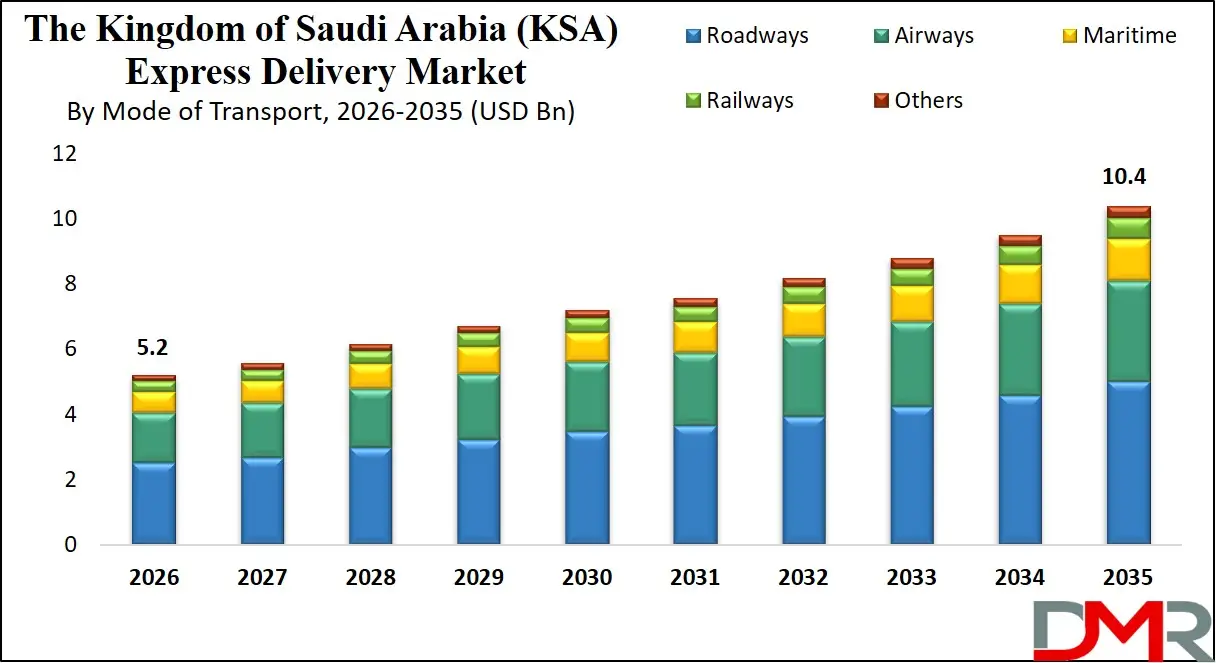
The mode of transport segment in the KSA Express Delivery Market is projected to be dominated by roadways, having become essential for last-mile connectivity, flexible scheduling, and the comprehensive geographic coverage required to connect the Kingdom's sprawling urban centers. Due to the increased adoption of e-commerce and just-in-time delivery by retailers and manufacturers in KSA, road transport solutions offer flexible routing and robust infrastructure support for complex delivery operations across the country’s modern highway network. This is also aligned with the aim of the National Transport and Logistics Strategy toward ensuring service reliability and embracing logistical rigor. Road transport makes the deliveries available on time to make better schedule adherence and meet delivery windows without the modal transfer delays associated with air or rail handoffs. This becomes even more important in a region like KSA, where dense urban areas like Riyadh and Jeddah, alongside long-haul routes connecting them, require flexible and resilient routing. Moreover, road transport reduces transshipment risks associated with intermodal transfers, such as damage and delays at transfer points. The operational flexibility appeal appeals to businesses of all sizes, especially last-mile providers like SMSA and Aramex, who are a growth segment in KSA's logistics ecosystem.
Not to say that the capability for door-to-door service of the expanding road networks stands in their favor, too. Coverage, high-integrity tracking enabled by Saudi Arabia's advanced 5G infrastructure, and real-time communication integrated with these road transport systems further enable businesses in delivery operations relevant to achieving high service levels. This dream is partly driven by initiatives from the Ministry of Transport aimed at improving road infrastructure and partnering with major logistics providers. This will enable them to support dynamic delivery demands and ensure operational integrity, hence remaining the dominant mode of transport within the express delivery market.
By Shipment Weight Analysis
The lightweight segment (typically under 5kg) is poised to dominate the KSA express delivery market due to several reasons, such as high e-commerce parcel volumes driven by fashion and electronics, favorable and often subsidized pricing models, and ease of handling in automated sortation facilities. Lightweight parcels are at the forefront of express delivery adoption, driven by their dominance in online retail shipments of clothing, accessories, small electronics, and consumer goods sold on platforms like Amazon.sa and Noon. Saudi Arabia's e-commerce boom places a strong emphasis on the delivery of small, high-value parcels, a factor that retailers across Riyadh, Jeddah, and the Eastern Province are eyeing with great interest. These retailers could be operating very extensive online catalogs for which they need efficient sorting and delivery systems to enable functions like next-day delivery and pickup from smart lockers. E-commerce companies also boast scale for the adoption of innovative technologies like automated sorting and drone delivery trials, paving the way to enhance delivery speed and complete transparency in operations. The reason e-commerce companies can negotiate better with logistics providers and deploy integrated delivery solutions is because of their overall scale and the high volume of lightweight shipments.
Retailers have benefited from such initiatives funded by the Saudi government, examples of which are the digital logistics programs under the Saudi Exports Development Authority to provide different types of funding and infrastructure to extend the delivery capabilities of their shipments. In summary, this dominant position has also been enabled by driving the wheel of KSA's e-commerce economy. At the forefront in the implementation of state-of-the-art logistics best practices, leading retailers like Jarir Bookstore and Namshi continue to help set new thresholds in terms of delivery speed and innovative applications across the industry, therefore continuing their top market performance by focusing on the efficient movement of lightweight goods.
By Service Type Analysis
Next-Day Delivery is projected to lead in the KSA Express Delivery Market due to its highly transformative effect in achieving immediate consumer satisfaction and its widespread availability as a standard offering across major e-commerce platforms. This service type powers rapid order fulfillment and, most importantly, provides stepping stones toward faster delivery expectations in solving the complexity brought along by modern consumer habits in a fast-paced society. Saudi Arabia's e-commerce focus is on meeting consumer demand for speed, with next-day delivery now often seen as the baseline for customer satisfaction. All these objectives also align with next-day delivery applications focused on improved customer experience and retailer competitiveness in a crowded online marketplace. Firms utilize next-day delivery technologies, including AI-driven route planning and localized inventory, to meet consumer expectations, reduce cart abandonment, and create better customer value.
E-commerce adoption has gained significant momentum in Saudi Arabia, thus increasing the need for next-day solutions. For example, next-day delivery improves online shopping convenience, and real-time tracking via Arabic apps prevents uncertainty. Next-day delivery functions enhance the end-user experience, which is an important factor in the competitive market where customer loyalty is hard-won. Government-backed e-commerce mandates and partnerships with global logistics leaders like DHL and FedEx further fuel next-day adoption. These are increasingly being integrated into omnichannel retail models, packaging what is to be expected in the future for Saudi consumers. Having already proven their potential through improvement in convenience, satisfaction, and scalability, next-day delivery remains among the major service types that will still dominate in the Saudi express delivery sector.
By End-User Industry Analysis
The Retail & E-commerce sector is projected to dominate the end-user industry segment in the KSA express delivery market because this sector has the highest volume of parcels shipped and the most stringent reliance on efficient delivery networks and consumer satisfaction in a rapidly digitizing economy. E-commerce sales are showing explosive growth in Saudi Arabia, driven by a young, digitally native, and convenience-oriented consumer base, with seamless delivery integration driving this segment to dominate. Saudi Arabia's e-commerce boom emphasizes delivery improvements across all online retail, with a key focus on the Retail & E-commerce sector. Further, this segment would need the implementation of high-tech express delivery solutions to guarantee speed and reliability—impacting carrier selection, service level choices, and returns management, since consumer expectations evolve day by day. Heavy investments have been made in fulfillment capacity and last-mile partnerships not only by leading global retailers like Amazon but also by local giants like Alhokair and local logistics providers, making the market competitive in reality. Delivery options for online and in-app purchases, such as those offered by food delivery platforms like Jahez and Mrsool, are increasingly being offered by retailers, further raising the requirement for sophisticated on-demand and express delivery services.
The Saudi government's support in enhancing digital infrastructure, thereby establishing innovation hubs and logistics zones, improves the supply chain for e-commerce companies. Because this industry is considered a major contributor to the national GDP and non-oil economic activity, it is considered one of the most dominant end-user industries. The Retail & E-commerce sector continues to lead with the latest technologies and comprehensive delivery networks in shaping the region's express logistics ecosystem, directly fueling the growth of service types like same-day and instant delivery.
The Kingdom of Saudi Arabia (KSA) Express Delivery Market Report is segmented on the basis of the following:
By Destination
By Business Model
- Business-to-Business (B2B)
- Business-to-Consumer (B2C)
- Consumer-to-Consumer (C2C)
By Mode of Transport
- Roadways
- Airways
- Railways
- Maritime
- Others
By Shipment Weight
- Lightweight
- Medium Weight
- Heavyweight
By Service Type
- Time-Definite Delivery (Express)
- Deferred Delivery (Standard)
- Same-Day Delivery
- Next-Day Delivery
- Instant Delivery (On-Demand)
- Freight Express
By End-User Industry
- Retail & E-commerce
- Healthcare & Pharmaceuticals
- Automotive & Industrial
- Banking, Financial Services & Insurance (BFSI)
- Technology & Electronics
- Manufacturing
- Construction
- Others
The Kingdom of Saudi Arabia (KSA) Express Delivery Market: Competitive Landscape
The competitive landscape is fueled by participation, both domestic and international, in the Kingdom of Saudi Arabia Express Delivery Market, with dissimilar capabilities across logistics operations, technology integration, and infrastructure. Major companies, therefore, strategize to develop advanced technologies such as AI, real-time tracking, and automated sorting to enhance express delivery operations to better competitiveness. The leading players are Saudi Post (SPL), Aramex, DHL Express, FedEx Express, and UPS in integrated logistics, while in specialized delivery, the leading players include SMSA Express, Naqel Express, and Fetchr. These companies leverage Saudi Arabia's Vision 2030 initiatives by aligning their offerings with government priorities meant to attract investments and improve logistics efficiency. It addresses both growing e-commerce and healthcare sectors where these focus more on niche capabilities: cold chain logistics and last-mile delivery, while third-party logistics integrators have emerged, providing end-to-end solutions in warehousing and distribution.
ℹ
To learn more about this report –
Download Your Free Sample Report Here
Mergers and partnerships are common strategies that allow companies to expand service portfolios and reach. For instance, technology companies partnering with logistics providers enhance data-driven decision-making and operational agility. While the leading companies are competitive, innovation in the fields of autonomous delivery, drone technology, and predictive analytics separates the leaders. These opportunities are likely to come along with an intense competitive landscape for both established players and new entrants, with strong governmental support for developing logistics zones.
Some of the prominent players in The Kingdom of Saudi Arabia (KSA) Express Delivery Market are:
- Saudi Post
- Aramex International
- SMSA Express
- DHL Express
- FedEx
- United Parcel Service
- Naqel Express
- Zajil Express
- AJEX Logistics Services
- Fetchr
- Jeeny Delivery
- Careem NOW
- Amazon Logistics
- Noon Express
- Skylinks Express
- MRSOOL
- TNT Express
- Hellmann Worldwide Logistics
- Speedex
- NAS Express
- Other Key Players
Recent Developments in the Kingdom of Saudi Arabia (KSA) Express Delivery Market
- November 2025: DHL Supply Chain announced an investment of approximately USD 150.1 million to establish a new regional logistics and distribution hub in Riyadh, aimed at enhancing warehousing capacity, improving supply chain efficiency, and strengthening last-mile delivery capabilities in Saudi Arabia.
- October 2025: Saudi Post (SPL) signed a strategic agreement with SAL Logistics Services to enhance mail handling and shipment transfer operations, focusing on improving logistics integration, increasing operational efficiency, and strengthening the Kingdom’s postal and delivery infrastructure.
- August 2025: DHL eCommerce finalized its minority stake acquisition in AJEX Logistics Services, strengthening last-mile delivery capabilities and enhancing cross-border parcel networks in Saudi Arabia to support the Kingdom’s rapidly growing e-commerce sector.
- June 2025: DHL Group announced an investment of over USD 577.3 million across Middle East markets, including Saudi Arabia, to expand logistics infrastructure, enhance aviation capacity, and strengthen delivery networks in response to increasing regional trade and e-commerce demand.
- February 2025: DHL eCommerce entered into an agreement to acquire a minority stake in AJEX Logistics Services, marking its expansion into the Saudi Arabian parcel logistics market and strengthening its presence in the region’s fast-growing e-commerce sector.
Report Details
| Report Characteristics |
| Market Size (2026) |
USD 5.2 Bn |
| Forecast Value (2035) |
USD 10.4 Bn |
| CAGR (2026–2035) |
8.0% |
| Historical Data |
2021 – 2025 |
| Forecast Data |
2027 – 2035 |
| Base Year |
2025 |
| Estimate Year |
2026 |
| Report Coverage |
Market Revenue Estimation, Market Dynamics, Competitive Landscape, Growth Factors and etc. |
| Segments Covered |
By Destination (Domestic and International), By Business Model (Business-to-Business (B2B), Business-to-Consumer (B2C) and Consumer-to-Consumer (C2C)), By Mode of Transport (Roadways, Airways, Railways, Maritime and Others), By Shipment Weight (Lightweight, Medium Weight and Heavyweight), By Service Type (Time-Definite Delivery (Express), Deferred Delivery (Standard), Same-Day Delivery, Next-Day Delivery, Instant Delivery (On-Demand) and Freight Express), By End-User Industry (Retail & E-commerce, Healthcare & Pharmaceuticals, Automotive & Industrial, Banking, Financial Services & Insurance (BFSI), Technology & Electronics, Manufacturing, Construction and Others) |
| Country Coverage |
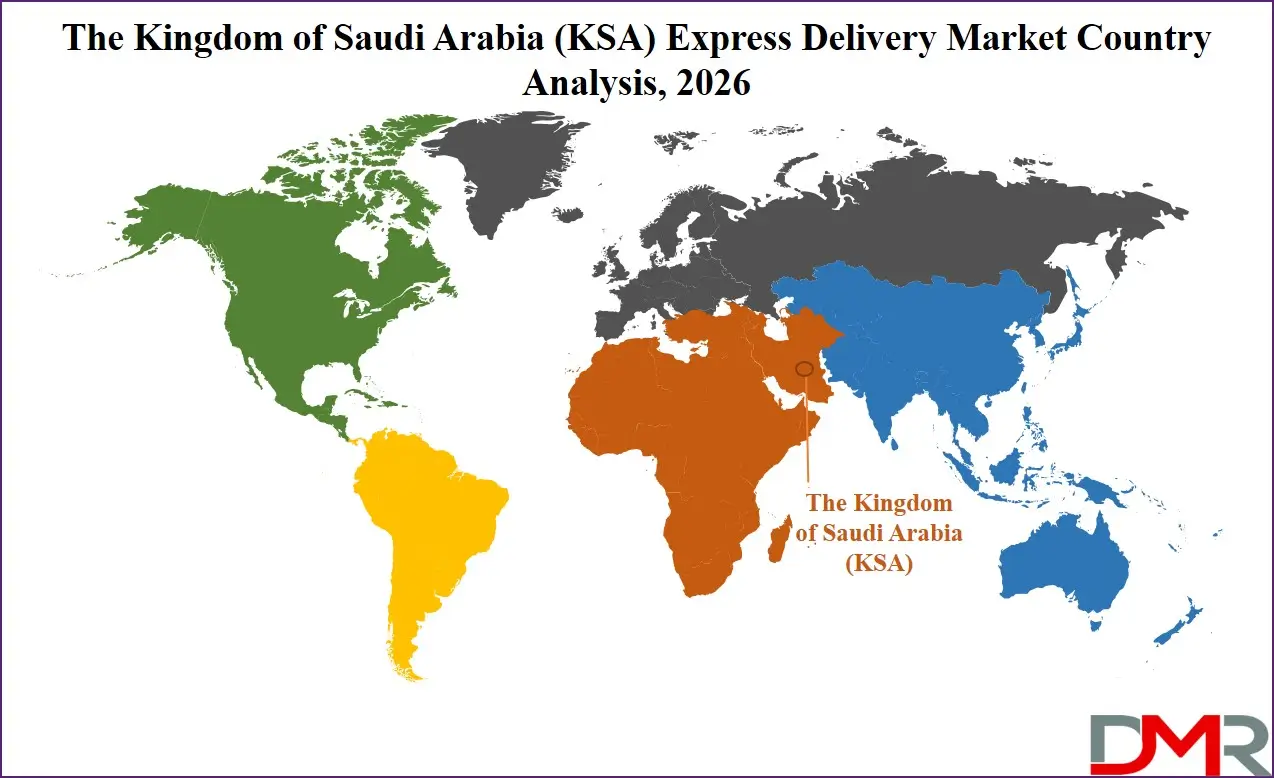
The Kingdom of Saudi Arabia (KSA) |
| Prominent Players |
Saudi Post, Aramex International, SMSA Express, DHL Express, FedEx, UPS, Naqel Express, Zajil Express, AJEX Logistics Services, Fetchr, Jeeny Delivery, Careem NOW, Amazon Logistics, Noon Express, Skylinks Express, MRSOOL, TNT Express, Hellmann Worldwide Logistics, Speedex, NAS Express, and Other Key Players |
| Purchase Options |
We have three licenses to opt for: Single User License (Limited to 1 user), Multi-User License (Up to 5 Users), and Corporate Use License (Unlimited User) along with free report customization equivalent to 0 analyst working days, 3 analysts working days and 5 analysts working days respectively. |
Frequently Asked Questions
How big is the Kingdom of Saudi Arabia's Express Delivery Market?
▾ The Kingdom of Saudi Arabia Express Delivery Market size is estimated to have a value of USD 5.2 billion in 2026 and is expected to reach USD 10.4 billion by the end of 2035.
Who are the key players in the Kingdom of Saudi Arabia Express Delivery Market?
▾ Some of the major key players in the Kingdom of Saudi Arabia Express Delivery Market are Saudi Post, Aramex International, SMSA Express, DHL Express, FedEx, United Parcel Service, Naqel Express, and many others.
What is the growth rate in the Kingdom of Saudi Arabia Express Delivery Market?
▾ The market is growing at a CAGR of 8.0% over the forecasted period.