Saudi Arabia Food Packaging Market Snapshot
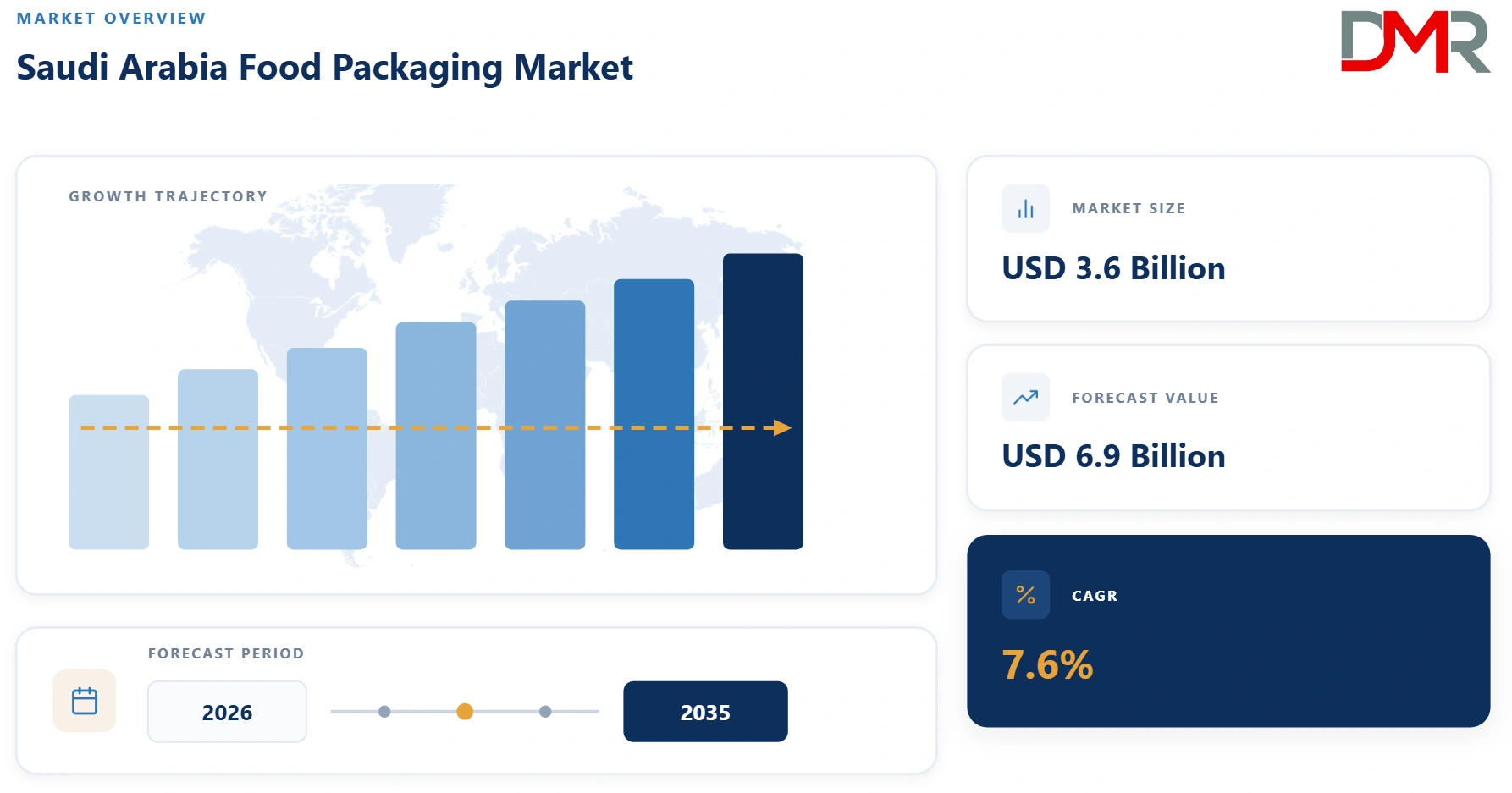
- Saudi Arabia Food Packaging Market Size in 2026: USD 3.6 Billion
- Saudi Arabia Food Packaging Market Size in 2035: USD 6.9 Billion
- Saudi Arabia CAGR from 2026 to 2035: 7.6%
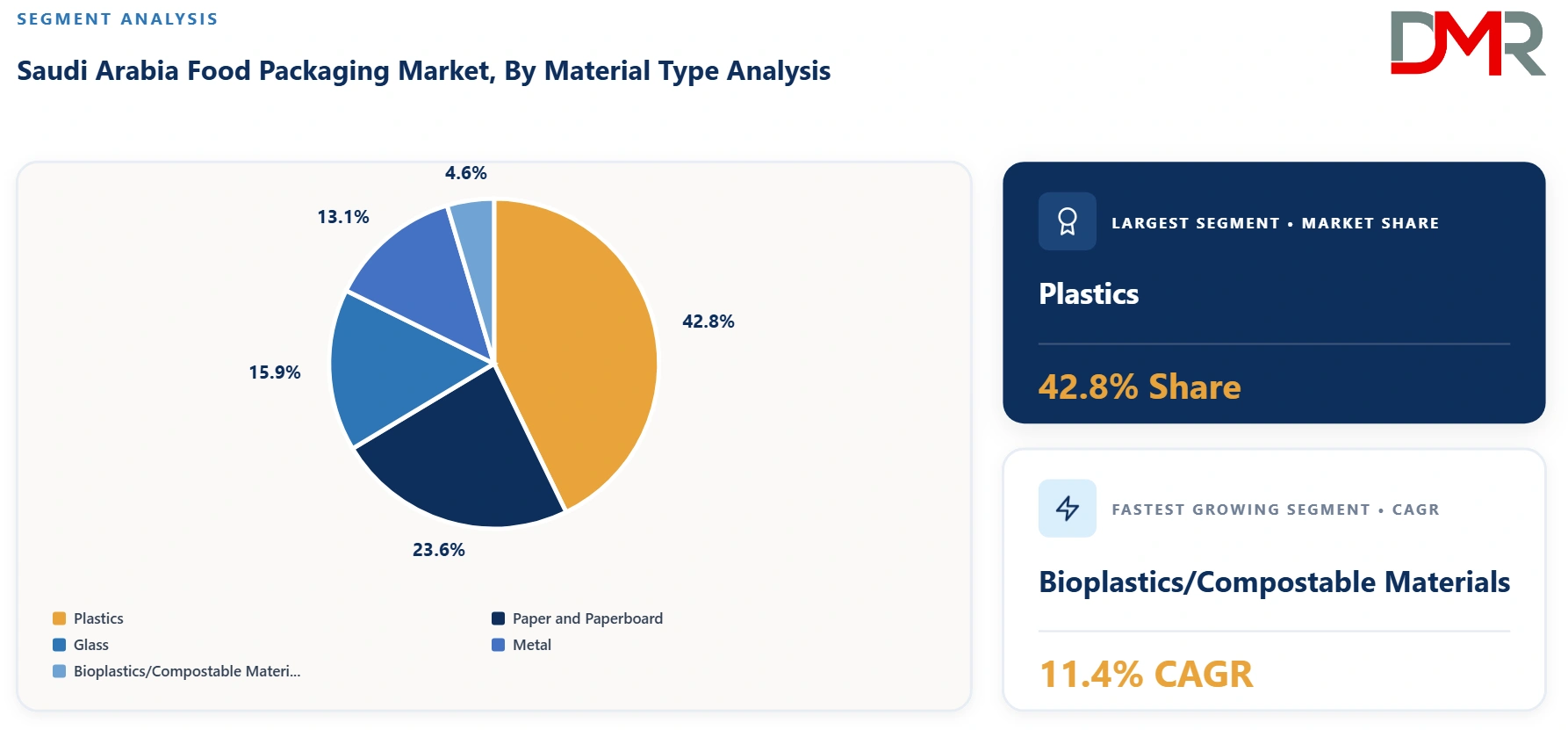
- Plastics is the leading material type segment in 2026: 42.8%
- Flexible Packaging is the leading packaging type segment in 2026: 46.1%
- Modified Atmosphere Packaging is the leading technology segment in 2026: 22.4%
- Dairy Products is the leading application segment in 2026: 25.3%
- Food and Beverage Manufacturers is the leading end user segment in 2026: 71.6%
What is the Saudi Arabia Food Packaging Market and its Market Size?
The Saudi Arabia Food Packaging Market is projected to be valued at USD 3.6 Billion in 2026 and is projected to reach USD 6.9 Billion by 2035, expanding at a CAGR of 7.6% during the forecast period.
ℹ
To learn more about this report –
Download Your Free Sample Report Here
Growth is being propelled by Saudi Arabia's Vision 2030 food security strategy driving expanded domestic food processing and packaging capacity, sustained population growth and rising demand for packaged convenience and ready-to-eat foods, and the Kingdom's extreme climate conditions that require robust, protective packaging to preserve product quality and safety across extended distribution networks. The maturing of packaging technologies suited to the Kingdom's demanding climate and logistics environment, growing government and retailer emphasis on plastic waste reduction under Saudi Arabia's national environmental strategy, and continued expansion of domestic food manufacturing capacity generating substantial new packaging demand are reshaping the market from a historically import-dependent packaging supply pattern into a more domestically anchored, increasingly sustainability-conscious industry. Investment is accelerating as Saudi packaging manufacturers expand production capacity to serve growing domestic food manufacturing while beginning to navigate emerging national plastics reduction and sustainability policy.
Use Cases
- Climate-Resilient Packaging for Dairy and Perishable Food Distribution: Saudi dairy and perishable food manufacturers rely on robust, protective packaging formats capable of maintaining product quality and safety across extended distribution networks spanning the Kingdom's vast geography and demanding desert climate conditions.
- Flexible Packaging for Growing Snack and Convenience Food Categories: Saudi food manufacturers use flexible pouch and film packaging formats to meet rising consumer demand for convenient, on-the-go snack and convenience food products, reflecting evolving Saudi consumer lifestyle patterns, particularly among younger, urban populations.
- Packaging Capacity Expansion Supporting Domestic Food Manufacturing Growth: Packaging manufacturers expand production capacity to serve the substantial new food processing capacity being developed under Vision 2030 food security initiatives, supplying packaging for dairy, poultry, bakery, and beverage products increasingly manufactured domestically rather than imported.
- Sustainable Packaging Redesign for National Environmental Compliance: Food and beverage manufacturers reformulate packaging to reduce plastic content and improve recyclability in response to Saudi Arabia's emerging national environmental strategy and Vision 2030 sustainability commitments, including initiatives targeting single-use plastic reduction.
Key Takeaways
- Market Size: The Saudi Arabia Food Packaging Market is anticipated to be valued at USD 3.6 Billion in 2026 and is forecast to reach USD 6.9 Billion by 2035, expanding at a CAGR of 7.6%.
- Growth Outlook: Market expansion is sustained by Vision 2030-driven domestic food processing capacity growth, sustained population growth and rising packaged food consumption, and emerging national sustainability policy encouraging packaging reformulation.
- Primary Growth Drivers: National Vision 2030 food security strategy driving domestic food manufacturing and associated packaging demand, sustained population growth and rising demand for convenience and packaged foods, the Kingdom's demanding climate requiring robust protective packaging, and emerging national plastics reduction policy are accelerating market growth and innovation.
- By Material Type Analysis: Plastics is projected to lead the material type segment with a 42.8% share in 2026, reflecting its continued cost-effectiveness and protective performance suited to the Kingdom's climate and logistics requirements. Bioplastics/Compostable Materials is the fastest-growing material type segment at 11.4% CAGR, driven by early-stage but accelerating adoption in response to national sustainability policy development.
- By Packaging Type Analysis: Flexible Packaging is expected to dominate with a 46.1% share in 2026, supported by widespread use across snack, bakery, and dairy categories. Flexible Packaging is also among the fastest-growing packaging type segments given the rapid growth of Saudi Arabia's convenience food category.
- By Technology Analysis: Modified Atmosphere Packaging is poised to lead with a 22.4% share in 2026, reflecting its important role extending shelf life for fresh and perishable products distributed across the Kingdom's extensive and demanding climate logistics network. Active and Intelligent Packaging is the fastest-growing technology segment at 10.3% CAGR, driven by rising demand for shelf-life extension technology suited to extreme heat distribution conditions.
- By Application Analysis: Dairy Products is expected to command a 25.3% share in 2026, underpinned by substantial national investment in dairy production capacity expansion. Ready-to-Eat and Frozen Foods is the fastest-growing application segment at 9.8% CAGR, fuelled by sustained consumer demand for convenience-oriented meal formats.
- By End User Analysis: Food and Beverage Manufacturers are projected to dominate with a 71.6% share in 2026, reflecting their position as the primary purchasers of packaging materials supporting Vision 2030-driven domestic production expansion. Retailers and Grocery Chains is the fastest-growing end user segment at 9.4% CAGR, driven by expanding private label packaging initiatives.
Key Drivers in the Saudi Arabia Food Packaging Market
Vision 2030 Food Security Strategy Driving Domestic Manufacturing and Packaging Demand
Saudi Arabia's Vision 2030 economic diversification and food security strategy is driving substantial expansion of domestic food processing and manufacturing capacity across dairy, poultry, bakery, and beverage categories, generating significant corresponding demand for domestic packaging supply. As food products increasingly shift from imported to domestically manufactured sources under this national strategic priority, packaging demand growth is closely tied to and reinforced by the broader food manufacturing capacity expansion occurring across the Kingdom, creating a mutually reinforcing growth dynamic between food processing and packaging sector investment.
Extreme Climate Conditions Requiring Robust Protective Packaging
Saudi Arabia's extreme heat and demanding desert climate conditions create sustained requirements for robust, protective packaging capable of maintaining food product quality and safety across extended distribution networks spanning the Kingdom's vast geography. Packaging must provide superior barrier protection against heat, humidity variation, and extended transit times relative to packaging requirements in more temperate climate markets, creating structural demand for higher-performance packaging materials and technologies, including modified atmosphere and active packaging solutions specifically suited to these challenging environmental conditions.
Restraints in the Saudi Arabia Food Packaging Market
Import Dependency for Advanced Packaging Materials and Technology
Despite growing domestic packaging manufacturing capacity, Saudi Arabia continues to rely significantly on imports for certain advanced packaging materials, specialized barrier films, and sophisticated packaging technology not yet widely manufactured domestically. This import dependency exposes Saudi food and beverage manufacturers to international supply chain risk, currency exchange rate fluctuations, and extended lead times for specialized packaging inputs, representing a meaningful restraint on the market's ability to fully domesticate packaging supply chains in line with broader Vision 2030 localization objectives.
Growth Opportunities in the Saudi Arabia Food Packaging Market
Domestic Manufacturing Capacity Expansion for Advanced Packaging Materials
Growing Vision 2030 localization priorities present a substantial opportunity for packaging manufacturers to establish or expand domestic production of advanced barrier films, specialized flexible packaging materials, and sustainable packaging alternatives currently reliant on imports. Companies investing in Saudi-based manufacturing capacity for these higher-value packaging categories can capture growing domestic demand while benefiting from government incentives supporting industrial localization under the Kingdom's broader economic diversification strategy.
Climate-Optimized Sustainable Packaging Innovation
Growing Saudi national environmental policy attention presents an opportunity for packaging manufacturers to develop sustainable packaging solutions specifically engineered to maintain the protective performance required for the Kingdom's demanding climate conditions while meeting emerging recyclability and plastic reduction expectations. Manufacturers achieving this dual objective, rather than importing sustainable packaging solutions designed for more temperate climate markets, can differentiate through demonstrated performance reliability suited to Saudi Arabia's specific environmental and logistics requirements.
Trends in the Saudi Arabia Food Packaging Market
Growing Government and Retailer Focus on Plastic Waste Reduction
Saudi Arabia is increasingly developing national environmental policy initiatives addressing plastic waste reduction, aligned with the Kingdom's broader Vision 2030 environmental sustainability commitments and Saudi Green Initiative. Major Saudi grocery retailers are beginning to implement voluntary packaging reduction and recyclability initiatives, creating early but accelerating market pressure toward more sustainable packaging formats even ahead of comprehensive binding regulatory requirements, positioning early-moving packaging manufacturers favorably as this policy area continues to develop.
Expansion of Domestic Packaging Manufacturing Capacity Aligned with Localization Policy
Saudi Arabia's broader industrial localization policy priorities under Vision 2030 are encouraging both domestic and international packaging companies to establish or expand local manufacturing capacity within the Kingdom, reducing historical reliance on imported packaging materials. This trend is supported by government incentive programs and industrial zone development specifically targeting manufacturing localization, reinforcing the broader national economic diversification strategy while building more resilient, domestically anchored packaging supply chains for the growing Saudi food manufacturing sector.
Research Scope and Analysis
The Saudi Arabia Food Packaging Market is segmented by material type, packaging type, technology, application, and end user, covering plastics, paper and paperboard, glass, metal, bioplastics, flexible and rigid packaging, modified atmosphere and active packaging technologies, and manufacturer, foodservice, and retail end users.
ℹ
To learn more about this report –
Download Your Free Sample Report Here
By Material Type Analysis
Plastics is projected to dominate the Saudi Arabia Food Packaging Market with 42.8% share in 2026, reflecting continued cost-effectiveness and protective performance advantages suited to the Kingdom's demanding climate and extended distribution logistics requirements. Bioplastics/Compostable Materials is expected to register the highest CAGR of 11.4% during 2026-2035, driven by early-stage but accelerating adoption in response to Saudi Arabia's developing national environmental policy and Saudi Green Initiative sustainability commitments.
By Packaging Type Analysis
Flexible Packaging is anticipated to dominate the Saudi Arabia Food Packaging Market by packaging type, accounting for 46.1% share in 2026, supported by widespread use across the Kingdom's rapidly growing snack, bakery, and dairy product categories requiring lightweight, cost-effective barrier protection. Continued growth in Saudi Arabia's convenience food consumption is expected to support sustained strong growth in this packaging category throughout the forecast period.
By Technology Analysis
Modified Atmosphere Packaging is projected to lead the Saudi Arabia Food Packaging Market by technology, accounting for 22.4% share in 2026, reflecting its important role extending shelf life for fresh and perishable products distributed across the Kingdom's extensive and climate-challenging logistics network. Active and Intelligent Packaging is expected to register the fastest CAGR of 10.3% between 2026 and 2035, driven by rising manufacturer interest in advanced shelf-life extension technologies specifically suited to extreme heat distribution and storage conditions.
By Application Analysis
Dairy Products is expected to lead the Saudi Arabia Food Packaging Market by application, accounting for 25.3% share in 2026, underpinned by substantial national investment in dairy production capacity expansion under Vision 2030 food security programs. Ready-to-Eat and Frozen Foods is projected to achieve the fastest CAGR of 9.8% during 2026-2035, driven by sustained consumer demand for convenience-oriented meal formats among the Kingdom's growing urban population.
By End User Analysis
Food and Beverage Manufacturers are projected to dominate the Saudi Arabia Food Packaging Market with 71.6% share in 2026, reflecting their position as the primary purchasers of packaging materials supporting Vision 2030-driven domestic food production expansion. Retailers and Grocery Chains are expected to register the fastest CAGR of 9.4% through 2035, driven by expanding private label packaging initiatives and growing retailer emphasis on sustainable packaging positioning.
The Saudi Arabia Food Packaging Market Report is segmented based on the following:
By Material Type
- Plastics
- Paper and Paperboard
- Glass
- Metal
- Bioplastics/Compostable Materials
By Packaging Type
- Flexible Packaging
- Rigid Packaging
By Technology
- Modified Atmosphere Packaging
- Vacuum Packaging
- Aseptic Packaging
- Active and Intelligent Packaging
- Conventional Packaging
By Application
- Dairy Products
- Bakery and Confectionery
- Beverages
- Meat, Poultry and Seafood
- Snacks and Convenience Foods
- Ready-to-Eat and Frozen Foods
- Others
By End User
- Food and Beverage Manufacturers
- Foodservice Operators
- Retailers and Grocery Chains
Technology Analysis
Technology development is increasingly shaping competitiveness in the Saudi Arabia Food Packaging Market as manufacturers invest in climate-resilient barrier materials, active packaging technologies suited to extreme heat conditions, and domestic production capability for previously imported advanced packaging materials. Growing use of intelligent packaging sensors capable of monitoring product condition across extended, climate-challenging distribution routes is helping manufacturers and retailers reduce spoilage-related losses. Opportunities are expanding for manufacturers investing in sustainable packaging solutions specifically engineered for Gulf region climate performance, as well as domestic production technology for specialized barrier films and flexible packaging materials currently reliant on imports. However, achieving both climate-appropriate protective performance and emerging sustainability expectations simultaneously remains a distinctive technical challenge for manufacturers serving this market.
Investment and White Space Analysis
Investment opportunities in the Saudi Arabia Food Packaging Market are expanding alongside Vision 2030-driven domestic food manufacturing capacity growth, sustained population and consumption growth, and emerging national environmental sustainability policy development. Significant white space exists in domestic manufacturing capacity for advanced barrier films and specialized flexible packaging materials, climate-optimized sustainable packaging innovation, and packaging solutions supporting the Kingdom's broader industrial localization objectives. Manufacturers with strong domestic production capability, climate-adapted technical expertise, and established relationships with major Saudi food and beverage manufacturers are positioned to capture premium, longer-duration contracts. However, continued import dependency for certain advanced materials, extreme climate-related product performance requirements, and the early stage of national sustainability regulation can create both uncertainty and opportunity for manufacturers navigating this evolving market.
Competitive Landscape
The Saudi Arabia Food Packaging Market is moderately consolidated and increasingly competitive, comprising large diversified global and regional packaging companies with Saudi operations, growing domestic Saudi packaging manufacturers benefiting from localization policy support, and international suppliers serving the Kingdom's substantial and expanding food manufacturing sector. Competition centers on climate-adapted protective performance, domestic manufacturing capacity aligned with localization priorities, established relationships with major Saudi food processors and government development entities, and emerging sustainability credentials. Large diversified packaging companies benefit from established international technology and broad product portfolios, while growing domestic Saudi manufacturers compete on localization policy alignment and proximity to the Kingdom's rapidly expanding food processing sector. Companies increasingly differentiate through domestic production capability, climate-adapted technical performance, and early sustainability positioning rather than material cost alone.
Some of the prominent players in the Saudi Arabia Food Packaging Market are:
- Napco National
- Obeikan Investment Group
- Saudi Printing & Packaging Company (SPPC)
- Saudi Arabian Packaging Industry (SAPIN)
- Gulf Packaging Industries
- Printopack
- Packaging Products Company (PPC)
- Tetra Pak Arabia
- Huhtamaki Saudi Arabia
- Arabian Packaging Company
- Zamil Plastic Industries
- Saudi Plastic Factory Company
- Arabian Plastic Industrial Company (APICO)
- Takween Advanced Industries
- NPF Advanced Plastic Solutions
- Integrated Plastics Packaging
- Arabian Flexible Packaging
- Al Bayader International
- Al Jawad Flexi
- Express Flexi Pack
- Takamul Industries
- Saudi Can Manufacturing Company
- National Company for Glass Industries (Zoujaj)
- Akram K. Bader & Partner Co.
- Al-Shams Printing, Packaging & Trading Company
- PACFORT
- ASPCO
- Crown Packages
- KSA Packaging
- ALPLA Group
- Amcor
- Sealed Air
- Sonoco Products Company
- Mondi
- Constantia Flexibles
- UFlex
- Greif
- Mauser Packaging Solutions
- International Paper
- ENPI Group
- Other Key Players
Recent Developments
- January 2026: SIG & Sawani introduced its first camel milk in aseptic carton packaging with Sawani’s NOUG Camel UHT Milk, produced and co-packed in Saudi Arabia.
- July 2025: Al Jawad Carton commissioned a Koenig & Bauer offset printer and BOBST NOVACUT die-cutting machine to expand folding-carton packaging capacity for food and beverages.
- May 2025: Sidel signed an MoU with Saudi Arabia’s National Industrial Development Center to assess localization of advanced food and beverage packaging capabilities in the Kingdom.
- March 2025: Tetra Pak launched a three-year project to modernize and digitize Al Rabie’s Saudi production facilities, including processing and carton-packaging operations.
Report Details
| Report Characteristics |
| Market Size (2026) |
USD 3.6 Bn |
| Forecast Value (2035) |
USD 6.9 Bn |
| CAGR (2026–2035) |
7.6% |
| Historical Data |
2021 – 2025 |
| Forecast Data |
2026 – 2035 |
| Base Year |
2025 |
| Segments Covered |
By Material Type, By Packaging Type, By Application, and By End User |
| Country Coverage |
Saudi Arabia |
Frequently Asked Questions
How big is the Saudi Arabia Food Packaging Market?
▾ The Saudi Arabia Food Packaging Market is poised to be valued at USD 3.6 Billion in 2026 and is projected to reach USD 6.9 Billion by 2035, reflecting sustained growth in domestic food manufacturing capacity and packaged food consumption supporting Vision 2030 food security objectives.
What is the CAGR of the Saudi Arabia Food Packaging Market from 2026 to 2035?
▾ The market is projected to expand at a compound annual growth rate (CAGR) of 7.6% between 2026 and 2035, supported by national food security investment priorities, sustained population growth, and emerging national sustainability policy development.
What factors are driving the growth of the Saudi Arabia Food Packaging Market?
▾ Growth is driven by national Vision 2030 food security strategy driving domestic food manufacturing and associated packaging demand, sustained population growth and rising demand for convenience and packaged foods, the Kingdom's demanding climate requiring robust protective packaging, and emerging national plastics reduction policy.
What are the major trends in the Saudi Arabia Food Packaging Market?
▾ Major trends include growing government and retailer focus on plastic waste reduction, expansion of domestic packaging manufacturing capacity aligned with localization policy, and rising adoption of active and intelligent packaging suited to extreme climate conditions.
Who are the key players in the Saudi Arabia Food Packaging Market?
▾ Key market participants include SABIC Packaging, Obeikan Investment Group, National Plastic Company (NAPCO), Middle East Packaging Company, and Saudi Printing and Packaging Company, among other domestic and international packaging manufacturers.
How is the Saudi Arabia Food Packaging Market segmented?
▾ The market is segmented by material type, packaging type, technology, application, and end user, with demand analysis concentrated across Riyadh, Jeddah, the Eastern Province, and the Kingdom's dedicated industrial and food processing zones.