Market Overview
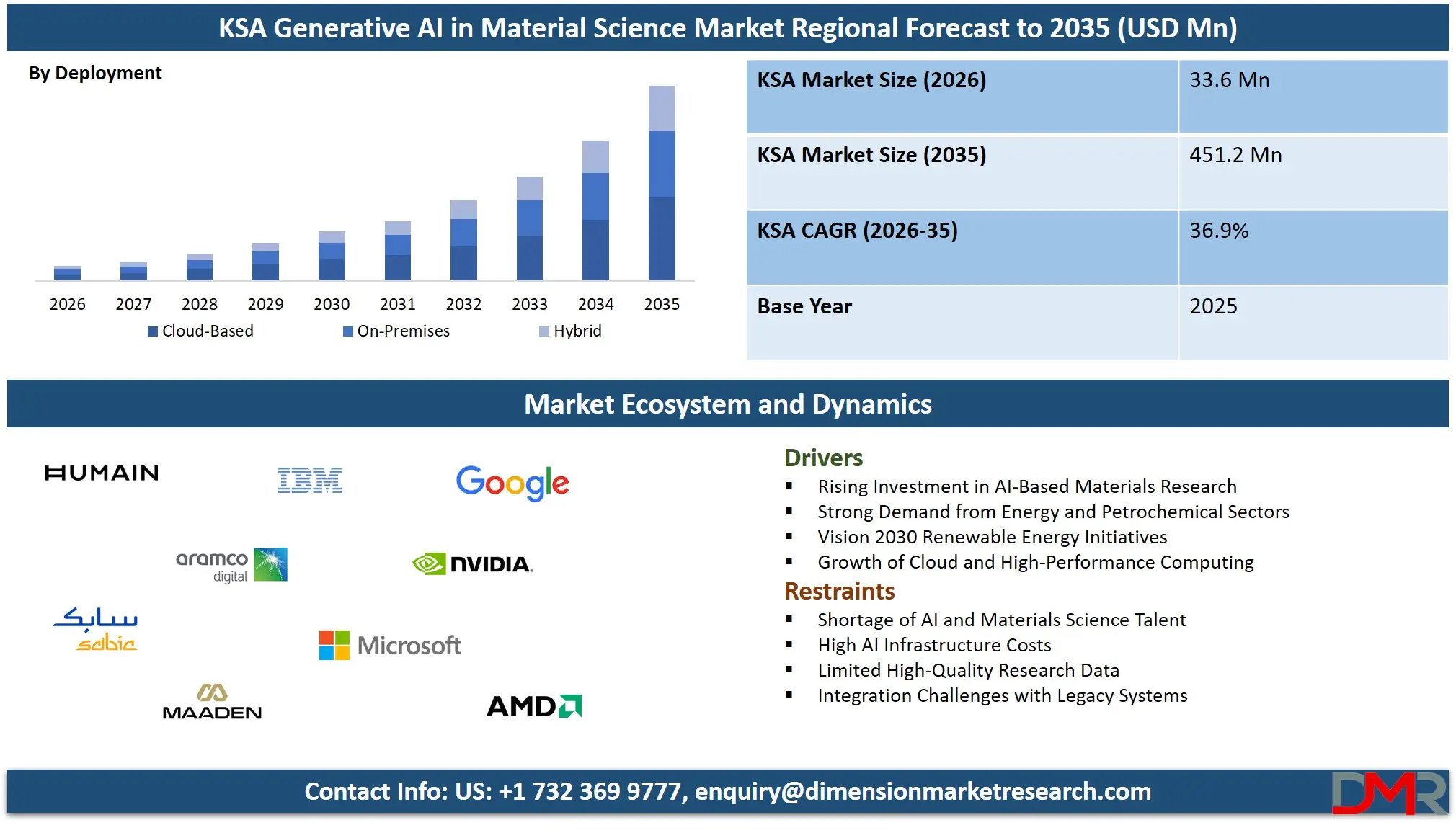
The KSA generative AI in material science market is anticipated to reach at USD 33.6 million in 2026 and is expected to grow at a CAGR of 36.9% from 2026 to 2035, reaching approximately USD 451.2 million by 2035, driven by increasing adoption of AI driven materials discovery, predictive simulation technologies, and advanced research platforms across energy, petrochemical, and industrial manufacturing sectors.
ℹ
To learn more about this report –
Download Your Free Sample Report Here
Generative AI in material science refers to the use of advanced artificial intelligence models to design discover and optimize new materials by learning patterns from large scientific datasets. These models analyze chemical structures molecular interactions and physical properties to generate new material compositions with targeted characteristics such as improved strength conductivity durability or thermal stability. By combining machine learning algorithms deep neural networks and simulation tools researchers can significantly accelerate the process of material discovery compared to traditional laboratory experimentation. Generative AI enables scientists to predict material behavior simulate performance under different conditions and identify optimal formulations for various industrial applications. As a result this technology is increasingly used in areas such as drug development semiconductor design battery materials and advanced manufacturing to reduce research timelines and improve innovation efficiency.
The KSA generative AI in material science market is emerging as an important component of the country’s digital transformation and advanced technology strategy. Saudi Arabia is investing in artificial intelligence research high performance computing and data driven scientific innovation to strengthen its industrial and technological capabilities. The integration of generative AI with materials engineering is helping research institutions energy companies and chemical manufacturers accelerate the development of advanced materials used in petrochemicals energy storage polymers and specialty chemicals. Collaboration between universities research centers and technology companies is also supporting the adoption of AI powered material discovery platforms across the country.
ℹ
To learn more about this report –
Download Your Free Sample Report Here
Growth in the KSA generative AI in material science market is further supported by large scale infrastructure development renewable energy initiatives and expansion of the petrochemical industry. Advanced AI models are increasingly being used to develop materials for hydrogen production battery technologies lightweight industrial components and sustainable construction materials. The adoption of cloud computing digital laboratories and predictive simulation tools is enabling organizations to improve research productivity and reduce experimental costs. As Saudi Arabia continues to focus on innovation driven economic diversification the role of generative AI in accelerating material research and industrial product development is expected to expand significantly.
KSA Generative AI in Material Science Market: Key Takeaways
- Strong Market Growth Outlook: The market is projected to expand from USD 33.6 million in 2026 to USD 451.2 million by 2035, reflecting rapid adoption of AI driven material discovery and research technologies.
- High Growth Rate: The industry is expected to grow at a CAGR of 36.9% during 2026–2035, supported by rising investments in artificial intelligence and advanced scientific computing.
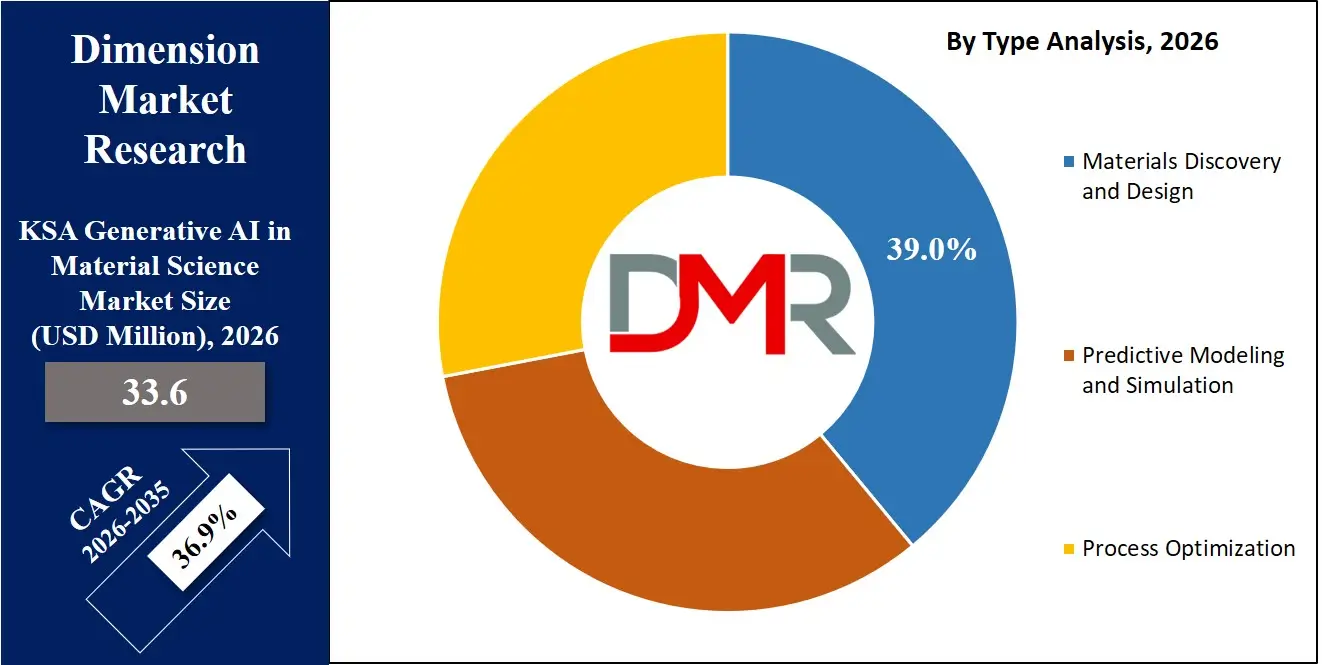
- Materials Discovery Leading Type Segment: Materials discovery and design accounts for 39.0% market share in 2026, driven by increasing use of generative AI for molecular and chemical material innovation.
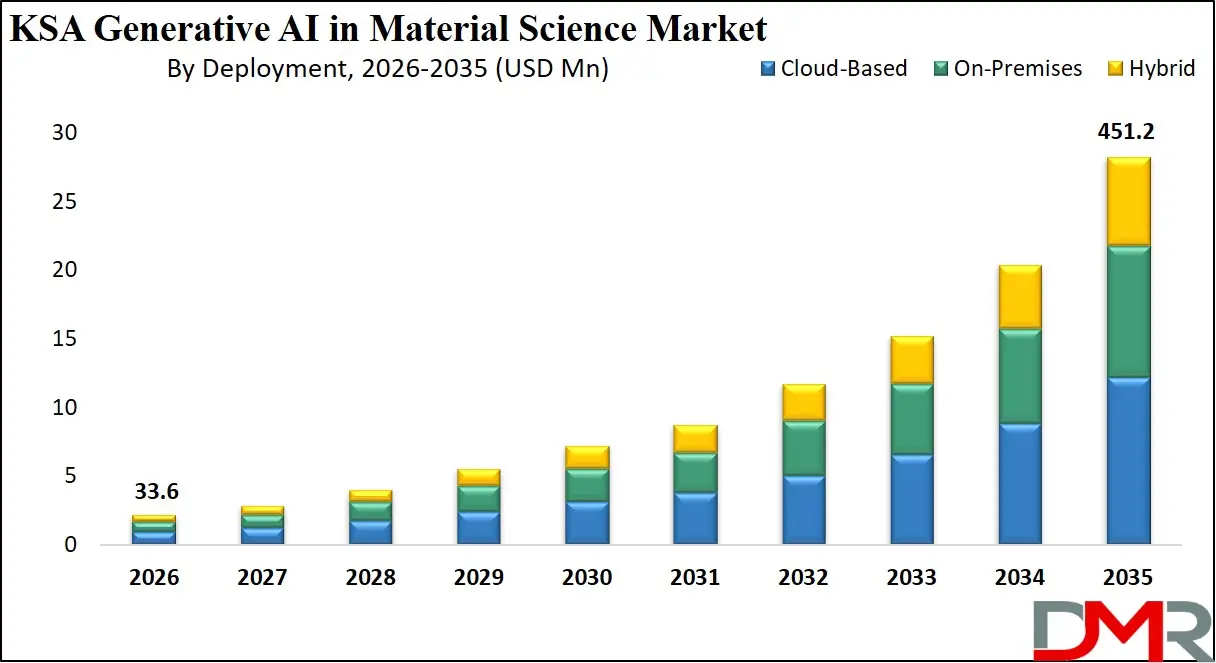
- Cloud Deployment Dominance: Cloud based solutions hold 43.0% share in 2026, as organizations adopt scalable computing platforms for AI driven material simulations.
- Pharmaceuticals and Chemicals Leading Applications: The pharmaceuticals and chemicals segment captures 22.0% share in 2026, supported by growing demand for AI based molecular modeling and compound discovery.
KSA Generative AI in Material Science Market: Use Cases
- Energy Storage Material Development: Generative AI is used to discover advanced materials for batteries hydrogen storage and renewable energy systems. AI driven simulation and predictive modeling help researchers identify high performance catalysts electrolytes and electrode materials, accelerating energy technology innovation in Saudi Arabia.
- Petrochemical and Polymer Innovation: AI powered material discovery tools help design new polymers specialty chemicals and industrial materials. Machine learning models analyze molecular structures and optimize chemical formulations used in petrochemical production and advanced manufacturing.
- Smart Construction Materials: Generative AI supports the development of durable and sustainable construction materials. Predictive material simulation helps create stronger cement composites coatings and insulation materials for large infrastructure and smart city projects in Saudi Arabia.
- Advanced Industrial Manufacturing: Manufacturers use generative AI to design lightweight and high strength materials for industrial equipment and components. AI driven material optimization improves product performance reduces production costs and enhances manufacturing efficiency.
KSA Generative AI in Material Science Market: Stats & Facts
- Digital Government Authority (Saudi Arabia)
- Saudi Arabia’s digital economy accounted for 14% of the national GDP in 2025.
- The Kingdom’s ICT sector reached SAR 166 billion (about USD 44.3 billion) in 2023.
- Nearly 50% of Saudi businesses adopted cloud computing services by 2025.
- Internet penetration in Saudi Arabia reached 99% in 2023.
- Mobile service subscriptions reached 198% of the population in 2023.
- Average mobile internet speed reached 215 Mbps in 2023.
- Saudi Data and Artificial Intelligence Authority (SDAIA)
- Saudi Arabia operated 22 colocation data centers in 2023.
- An additional 40 data centers were under development in 2023.
- The Kingdom had 10 supercomputers in 2024.
- Eight Saudi supercomputers ranked among the world’s top 500 in 2024.
- In 2024 the National Data Lake integrated 320 government systems.
- The National Data Lake stored over 100 terabytes of government data in 2024.
- More than 60 government entities contributed data to the National Data Lake in 2024.
- SDAIA’s Open Data Platform hosted over 8,700 datasets in 2024.
- These datasets were contributed by more than 230 government and private organizations in 2024.
KSA Generative AI in Material Science Market: Market Dynamic
Driving Factors in the KSA Generative AI in Material Science Market
Growing Investment in AI Driven Scientific Research
Saudi Arabia is increasing investments in artificial intelligence, digital laboratories, and high performance computing to accelerate scientific innovation. Research institutions and industrial companies are adopting generative AI platforms to support materials discovery, molecular modeling, and predictive simulation. These technologies allow researchers to analyze large chemical datasets and identify new material compositions with improved performance characteristics. The integration of machine learning algorithms with material engineering tools is enabling faster experimentation cycles, which supports innovation across petrochemicals, energy materials, and advanced manufacturing sectors.
Strong Demand from Energy and Petrochemical Industries
The country’s strong petrochemical and energy sector is creating significant demand for advanced materials research. Generative AI tools help scientists design catalysts, polymers, and specialty chemicals with optimized thermal stability and chemical resistance. By using AI driven modeling and computational material science techniques, companies can reduce research timelines and improve industrial product development. This demand is particularly strong in applications related to hydrogen production, energy storage technologies, and high performance industrial materials.
Restraints in the KSA Generative AI in Material Science Market
Limited Availability of Skilled AI and Material Science Talent
One of the key challenges in the KSA generative AI in material science market is the shortage of professionals with expertise in artificial intelligence, machine learning, and computational material science. Developing advanced generative models requires specialized knowledge in data science, chemistry, and material engineering. The limited talent pool can slow down technology adoption and restrict the ability of organizations to fully implement AI driven research platforms.
High Cost of AI Infrastructure and Computational Resources
Generative AI models used for material discovery require significant computing power, large scientific datasets, and advanced simulation software. Establishing high performance computing infrastructure and AI research platforms involves substantial investment. Small research labs and emerging technology firms may face financial barriers when deploying these systems, which can limit widespread adoption across the market.
Opportunities in the KSA Generative AI in Material Science Market
Expansion of Renewable Energy and Hydrogen Projects
Saudi Arabia’s focus on renewable energy and hydrogen production is creating strong opportunities for generative AI in materials research. AI based modeling can accelerate the discovery of advanced catalysts, battery materials, and hydrogen storage compounds. These innovations are essential for improving energy efficiency and supporting sustainable energy technologies. As renewable energy investments increase, the demand for AI powered material design and predictive simulation tools is expected to grow significantly.
Growth of Smart Manufacturing and Industrial Digitalization
The adoption of smart manufacturing and digital transformation strategies in Saudi Arabia is opening new opportunities for generative AI applications. Industrial companies are integrating AI based material optimization tools with automated production systems to improve product quality and manufacturing efficiency. Generative design models can identify optimal material compositions for industrial equipment, lightweight components, and high strength alloys, supporting innovation in industrial production processes.
Trends in the KSA Generative AI in Material Science Market
Rising Use of Cloud Based AI Research Platforms
Cloud based AI platforms are becoming increasingly popular in material science research due to their scalability and access to powerful computing resources. These platforms allow researchers to run large scale simulations, train machine learning models, and collaborate with global research networks. Cloud infrastructure also enables organizations to manage complex scientific datasets more efficiently and accelerate AI driven material discovery processes.
Increasing Adoption of Predictive Simulation and Digital Material Design
Predictive simulation and digital material design are becoming key trends in modern material science research. Generative AI models can simulate how materials behave under different environmental and mechanical conditions before physical testing begins. This approach improves research accuracy, reduces laboratory costs, and shortens product development cycles. As companies continue to adopt computational chemistry tools and advanced data analytics, AI driven simulation is expected to play a major role in future material innovation.
KSA Generative AI in Material Science Market: Research Scope and Analysis
By Type Analysis
Materials discovery and design is expected to remain the leading segment within the type category of the KSA generative AI in material science market, accounting for approximately 39.0% of the market share in 2026. This dominance is primarily driven by the increasing use of generative AI models to accelerate the identification and creation of new materials with targeted properties. Traditional material discovery processes often require extensive laboratory experimentation and long research timelines, whereas AI driven material discovery platforms can analyze large chemical and structural datasets to generate potential material compositions in a much shorter time. In Saudi Arabia, research institutions and industrial companies are leveraging machine learning algorithms, deep learning models, and computational chemistry tools to design advanced materials for applications such as petrochemicals, renewable energy systems, industrial coatings, and high performance polymers. The ability of generative AI to predict molecular structures and optimize material characteristics such as durability, conductivity, and thermal stability is significantly improving research productivity and innovation efficiency. Additionally, the growing focus on sustainable materials, energy efficient technologies, and advanced industrial manufacturing is encouraging companies to adopt AI powered material design solutions, further strengthening the position of this segment in the market.
ℹ
To learn more about this report –
Download Your Free Sample Report Here
Predictive modeling and simulation also represent an important segment within the generative AI in material science market in Saudi Arabia. This segment focuses on the use of artificial intelligence and advanced data analytics to simulate the physical and chemical behavior of materials under different conditions before they are produced or tested in laboratories. By applying machine learning algorithms and computational modeling techniques, researchers can evaluate how materials respond to temperature changes, pressure variations, and chemical reactions. This approach allows scientists to assess material performance and reliability while reducing the need for repeated experimental trials. In the Saudi industrial landscape, predictive modeling is increasingly used in energy materials research, petrochemical processing, and industrial manufacturing to optimize production processes and enhance material performance. The integration of AI based simulation tools with digital laboratories and high performance computing systems is enabling organizations to test thousands of potential material combinations virtually, which significantly reduces development costs and accelerates innovation. As research institutions and industrial companies continue to adopt advanced simulation technologies, predictive modeling and simulation are expected to play a critical role in improving material development efficiency and supporting the broader growth of the market.
By Deployment Analysis
Cloud based deployment is expected to lead the deployment segment of the KSA generative AI in material science market, accounting for around 43.0% of the market share in 2026. The growing preference for cloud infrastructure is mainly driven by the increasing demand for scalable computing resources required to train complex generative AI models and run large scale material simulations. Cloud platforms allow research institutions, universities, and industrial companies to access advanced AI tools, high performance computing environments, and large scientific databases without investing heavily in physical infrastructure. This capability is particularly valuable for material science applications where large datasets related to molecular structures, chemical reactions, and material properties need to be processed efficiently. In Saudi Arabia, organizations involved in petrochemicals, renewable energy research, and advanced manufacturing are increasingly adopting cloud based AI research platforms to accelerate material discovery and predictive simulation processes. Cloud deployment also supports collaboration among global research teams, enabling scientists to share experimental data, AI models, and computational resources more effectively. As the country continues to expand its digital infrastructure and cloud ecosystem, the adoption of cloud based generative AI platforms in material science research is expected to increase further.
On premises deployment remains an important segment in the KSA generative AI in material science market, particularly among organizations that handle highly sensitive industrial or research data. In this model, generative AI platforms and computational systems are installed and operated within the organization’s own data centers, providing greater control over data security, system performance, and intellectual property protection. Companies operating in sectors such as petrochemicals, energy production, and advanced industrial manufacturing often prefer on premises infrastructure to ensure that proprietary research data and material formulations remain confidential. On premises deployment also allows organizations to customize AI models, integrate them with internal research systems, and manage computational workloads according to their specific operational requirements. Although this approach requires significant investment in hardware, software, and maintenance, it provides a high level of reliability and control for organizations conducting critical materials research. As Saudi Arabia continues to strengthen its industrial research capabilities, on premises AI systems are expected to remain relevant for companies that prioritize data sovereignty and secure research environments.
By Application Analysis
Pharmaceuticals and chemicals are expected to lead the application segment of the KSA generative AI in material science market, accounting for approximately 22.0% of the market share in 2026. The growing importance of this segment is driven by the increasing use of generative AI models to accelerate molecular discovery, chemical compound design, and advanced material formulation. In pharmaceutical and chemical research, AI driven algorithms analyze complex chemical datasets, molecular structures, and reaction patterns to generate new compounds with targeted properties. This approach significantly shortens the research cycle compared to conventional laboratory methods. In Saudi Arabia, companies and research institutions are increasingly applying AI powered material science tools to develop specialty chemicals, catalysts, polymers, and high performance industrial compounds. Generative AI also supports predictive chemistry modeling and virtual screening of molecular structures, enabling scientists to identify optimal chemical formulations with improved stability, efficiency, and performance. As the country continues to expand its chemical manufacturing and research capabilities, the adoption of AI driven material discovery technologies is expected to strengthen the role of pharmaceuticals and chemicals in the market.
Electronics and semiconductors represent another important application segment in the KSA generative AI in material science market, particularly as the country increases its focus on advanced technology development and digital infrastructure. Generative AI tools are increasingly used to design new semiconductor materials, conductive compounds, and nanomaterials that support improved electronic performance. Through machine learning based simulation and computational material modeling, researchers can analyze how different material structures influence electrical conductivity, heat resistance, and energy efficiency. This allows scientists to optimize materials used in electronic components, sensors, and microchips before physical production begins. In Saudi Arabia, the growing demand for high performance electronics, smart devices, and advanced communication technologies is encouraging research organizations to explore AI assisted semiconductor material design. The use of generative AI in this area helps accelerate innovation by enabling faster evaluation of potential materials and reducing the cost associated with experimental testing. As the Kingdom continues to develop its digital economy and technology ecosystem, the use of AI driven material research in electronics and semiconductor applications is expected to gradually expand.
The KSA Generative AI in Material Science Market Report is segmented on the basis of the following:
By Type
- Materials Discovery and Design
- Predictive Modeling and Simulation
- Process Optimization
By Deployment
- Cloud-Based
- On-Premises
- Hybrid
By Application
- Pharmaceuticals and Chemicals
- Electronics and Semiconductors
- Energy Storage and Conversion
- Automotive and Aerospace
- Construction and Infrastructure
- Consumer Goods
- Others
KSA Generative AI in Material Science Market: Competitive Landscape
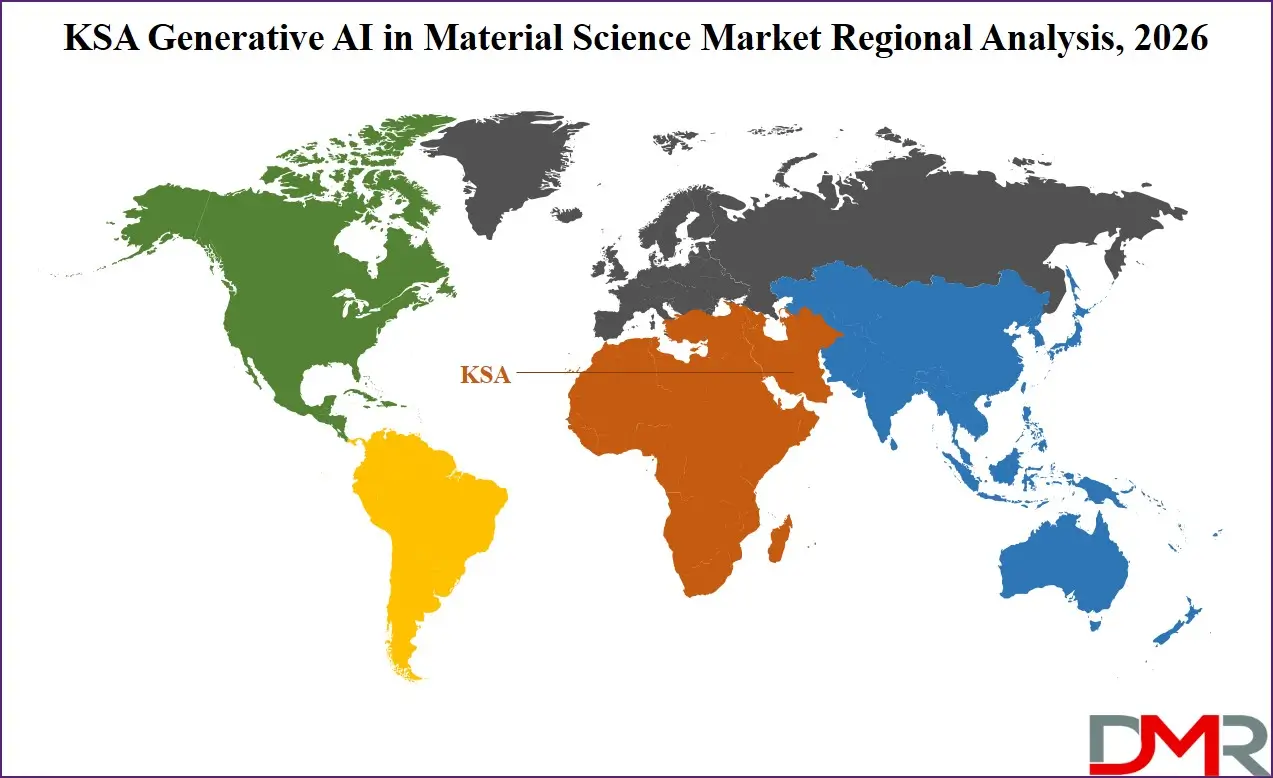
The competitive landscape of the KSA generative AI in material science market is characterized by a mix of global technology providers, regional artificial intelligence developers, and research driven institutions that are actively investing in AI powered scientific innovation. Large international technology firms provide advanced AI infrastructure, cloud computing platforms, high performance processors, and machine learning frameworks that enable generative models and predictive simulation tools used in material discovery.
ℹ
To learn more about this report –
Download Your Free Sample Report Here
At the same time, regional technology companies and research organizations are increasingly developing localized AI platforms, analytics tools, and data driven research capabilities tailored to industrial applications within the Kingdom. The market is also supported by collaborations between technology providers, universities, and government backed innovation programs that aim to strengthen AI research and digital transformation initiatives under national development strategies. Saudi Arabia has been actively expanding its generative AI ecosystem through investments in research centers, cloud data infrastructure, and industry partnerships, positioning AI as a key pillar of technological innovation and economic diversification.
Some of the prominent players in the KSA Generative AI in Material Science Market are:
- Humain
- Aramco Digital
- SABIC
- Maaden
- IBM
- Microsoft
- Google
- NVIDIA
- AMD
- Qualcomm
- Cisco
- Intel
- Schrödinger
- Citrine Informatics
- SandboxAQ
- Exscientia
- DeepMind
- Mozn
- Verofax
- Other Key Players
Recent Developments in the KSA Generative AI in Material Science Market
- January 2026: Schrödinger introduced an AI powered conversational interface within its Maestro computational platform, enabling researchers to use natural language commands to analyze molecular structures and accelerate AI driven materials and drug discovery workflows.
- January 2026: Schrödinger entered a strategic collaboration agreement with Manas AI to integrate physics based modeling and generative AI algorithms for faster scientific discovery and predictive simulation.
- December 2025: Novyte Materials secured a pre seed funding round led by Theia Ventures to develop AI driven materials discovery technologies focused on energy transition and advanced materials innovation.
Report Details
| Report Characteristics |
| Market Size (2026) |
USD 33.6 Mn |
| Forecast Value (2035) |
USD 451.2 Mn |
| CAGR (2026–2035) |
36.9% |
| Historical Data |
2021 – 2025 |
| Forecast Data |
2027 – 2035 |
| Base Year |
2025 |
| Estimate Year |
2026 |
| Report Coverage |
Market Revenue Estimation, Market Dynamics, Competitive Landscape, Growth Factors and etc. |
| Segments Covered |
By Type (Materials Discovery and Design, Predictive Modeling and Simulation, and Process Optimization), By Deployment (Cloud-Based, On-Premises, and Hybrid), By Application (Pharmaceuticals and Chemicals, Electronics and Semiconductors, Energy Storage and Conversion, Automotive and Aerospace, Construction and Infrastructure, Consumer Goods, and Others) |
| Country Coverage |
KSA |
| Prominent Players |
Humain, Aramco Digital, Saudi Aramco, SABIC, Maaden, IBM, Microsoft, Google, NVIDIA, AMD, Qualcomm, Cisco, Intel, Schrödinger, Citrine Informatics, SandboxAQ, Exscientia, DeepMind, Mozn, Verofax, and Other Key Players |
| Purchase Options |
We have three licenses to opt for: Single User License (Limited to 1 user), Multi-User License (Up to 5 Users) and Corporate Use License (Unlimited User) along with free report customization equivalent to 0 analyst working days, 3 analysts working days and 5 analysts working days respectively. |
Frequently Asked Questions
How big is the KSA Generative AI in Material Science Market?
▾ The KSA Generative AI in Material Science Market size is estimated to have a value of USD 33.6 million in 2026 and is expected to reach USD 451.2 million by the end of 2035.
What is the growth rate in the KSA Generative AI in Material Science Market in 2026?
▾ The market is growing at a CAGR of 36.9% over the forecasted period of 2026.
Who are the key players in the KSA Generative AI in Material Science Market?
▾ Some of the major key players in the KSA Generative AI in Material Science Market are Humain, Aramco Digital, SABIC, Maaden, IBM, Microsoft, Google, NVIDIA, AMD, Qualcomm, Cisco, Intel, Schrödinger, Citrine Informatics, and many others.