Market Snapshot
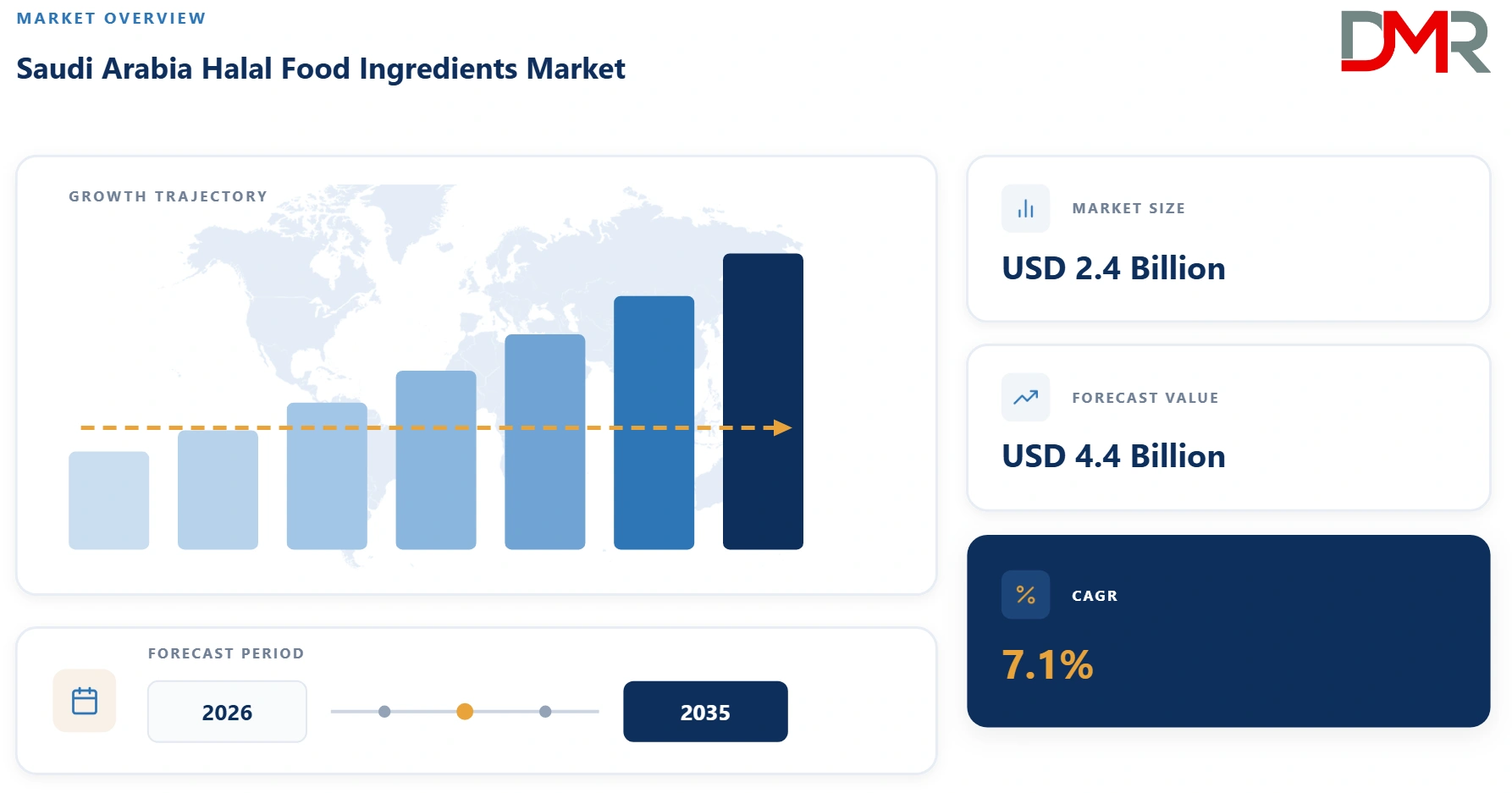
- Market Size (2026): USD 2.4 Bn
- Forecast Value (2035): USD 4.4 Bn
- CAGR (2026-2035): 7.1%
- Leading Ingredient Type (2026): Proteins and Amino Acids, approximately 27.8%
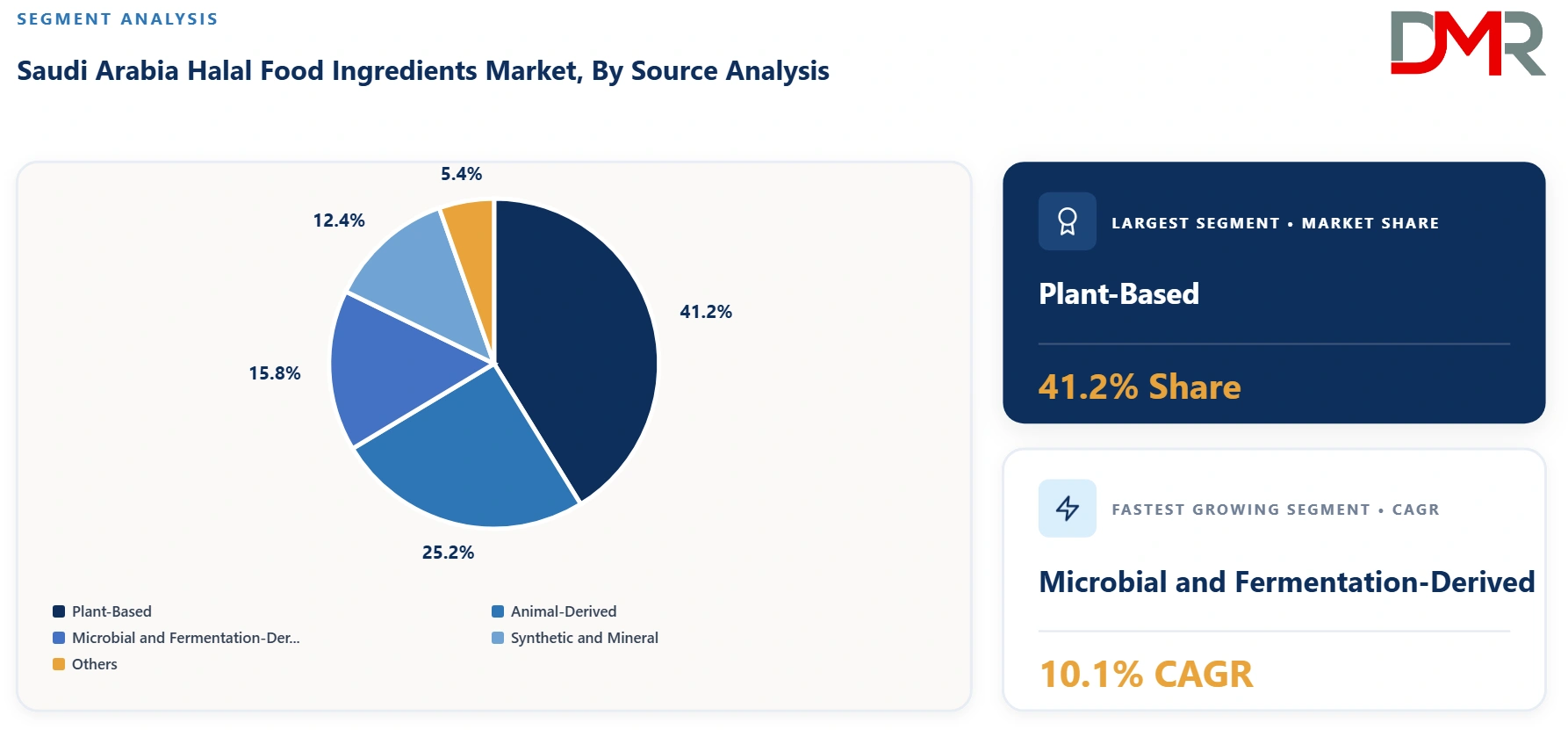
- Leading Source (2026): Plant-Based, around 41.2%
- Key Players: Cargill, Incorporated, Archer Daniels Midland Company, Kerry Group plc and others
What is Saudi Arabia Halal Food Ingredients Market and its Market Size?
The Saudi Arabia Halal Food Ingredients Market size is estimated to reach USD 2.4 Bn in 2026 and is further anticipated to reach USD 4.4 Bn by 2035, at a CAGR of 7.1%. Halal food ingredients are formulation inputs, processing aids and functional materials whose source, manufacturing route, handling and documentation meet applicable halal requirements for food production. The category includes certified proteins, amino acids, flavors, colors, emulsifiers, stabilizers, enzymes, vitamins, minerals, starches, sweeteners and related specialty ingredients.
ℹ
To learn more about this report –
Download Your Free Sample Report Here
The sizing covers demand generated inside Saudi Arabia rather than worldwide revenue of Saudi-headquartered companies. It captures ingredients purchased by food and beverage manufacturers, meat and poultry processors, bakeries, confectionery producers, dairy companies, beverage plants, convenience food manufacturers and foodservice-oriented processors. Final packaged halal foods, certification services, pharmaceuticals, cosmetics and non-food applications are outside the market boundary.
Saudi demand is structurally different from generic ingredient consumption because manufacturers must consider raw-material origin, processing media, cross-contamination controls, documentation and approved certification routes. Animal-derived gelatin, enzymes, emulsifiers, flavor carriers and certain processing aids can require particularly detailed verification. This makes traceability and technical documentation commercially important alongside price, functionality and supply reliability.
Growth is also tied to localization of food manufacturing, expansion of processed foods and rising demand for nutrition, convenience and clean-label formulations. Manufacturers are shifting from simple commodity procurement toward ingredients that solve texture, shelf life, taste, fortification and process-efficiency problems. Suppliers that combine halal-compliant sourcing with local warehousing, application support and regulatory documentation are therefore positioned to gain a larger role in formulation decisions.
Use Cases
- Meat and Poultry Processing: Processors use halal-certified proteins, phosphates, seasonings, antioxidants and functional binders to manage texture, yield and flavor while maintaining documented compliance. A verified ingredient system reduces reformulation risk and helps factories standardize recipes across chilled, frozen and further-processed product lines.
- Industrial Bakery Production: Large bakeries deploy enzymes, emulsifiers, improvers, fillings and flavors to control dough handling, crumb structure, softness and shelf stability. Technical ingredient packages reduce batch variation and allow production teams to scale buns, cakes, flatbreads and pastries across high-volume automated lines.
- Dairy and Beverage Formulation: Dairy and beverage producers use stabilizers, cultures, flavors, vitamins and sweetening systems to improve mouthfeel, suspension, nutritional positioning and sensory consistency. Halal documentation becomes especially important when formulations combine imported cultures, flavors, emulsifiers or processing aids from multiple origins.
- Convenience Food Manufacturing: Ready-meal and snack producers combine seasonings, hydrocolloids, proteins, preservatives and texture systems to deliver consistent reheating performance and longer distribution life. Flexible ingredient systems help manufacturers launch new regional flavors while using common processing infrastructure across several product formats.
Key Takeaways
- Market Size & Share: Emulsifiers and Stabilizers are expected to account for approximately 16.4% of 2026 revenue as processed foods require repeatable texture, dispersion and shelf-life performance.
- Ingredient Type Analysis: Proteins and Amino Acids are projected to lead with around 27.8% of 2026 market share, supported by meat processing, dairy nutrition and fortified food applications.
- Demand Concentration: Meat and Poultry is expected to represent close to 29.6% of 2026 application demand because certified functional proteins, binders, seasonings and processing aids are widely used in value-added products.
- Source Shift: Microbial and Fermentation-Derived ingredients are forecast to grow at a CAGR of 10.1% from 2026-2035 as producers seek traceable alternatives to selected animal-derived inputs.
- Functional Growth: Nutritional Enhancement ingredients are projected to expand at a CAGR of 9.0% from 2026-2035 with fortification and health-positioned foods gaining attention.
- Channel Evolution: Online and Digital B2B Channels are expected to rise at a CAGR of 11.3% from 2026-2035 for standardized, documented and repeat-purchase ingredients.
How AI/Gen AI is Transforming the Saudi Arabia Halal Food Ingredients Market?
AI is most useful in this industry where formulation, traceability and compliance intersect. Machine learning can compare ingredient specifications, certificate histories, supplier performance and batch data to identify inconsistencies before material enters production. Computer vision can support label, packaging and warehouse checks, while predictive models can improve demand planning for imported specialty ingredients with long replenishment cycles.
Generative AI adds value around technical documentation and formulation workflows rather than replacing food scientists. LLM document processing can organize halal certificates, specifications, allergen statements and supplier declarations, while formulation tools can narrow candidate ingredient combinations before bench trials begin. Digital twins can also model process behavior for mixing, heating or stabilization when manufacturers scale a recipe from pilot to industrial production.
- Certificate Document Screening: LLM-based tools can extract supplier, facility, certificate and expiry data from document sets, helping quality teams identify missing or inconsistent information faster.
- Formulation Assistance: AI models can rank candidate stabilizers, sweeteners or flavor systems against cost, sensory and processing constraints before physical trials.
- Demand Forecasting: Predictive analytics can connect sales patterns, seasonality and production plans with ingredient inventory to reduce emergency imports and excess safety stock.
- Process Optimization: Digital twins can simulate temperature, shear and dosing conditions so manufacturers reduce trial-and-error during scale-up of new halal-compliant formulations.
Key Drivers in the Saudi Arabia Halal Food Ingredients Market
Demand is being pulled by food-manufacturing localization and by stricter commercial expectations around traceable halal inputs. These drivers expand both ingredient volume and the value of technical support attached to each formulation.
Localization of Processed Food Manufacturing
Direct Sales are expected to account for approximately 46.5% of 2026 distribution revenue because larger processors increasingly source technical ingredients through direct supplier relationships. New and expanded domestic food plants create recurring demand for flavors, proteins, enzymes, stabilizers and fortification systems rather than only finished imported foods. Local production also requires ingredient adaptation to Saudi taste profiles, climate, shelf-life requirements and processing conditions. As manufacturers increase local value addition, they need suppliers that can support trials, specifications and production troubleshooting. This mechanism raises demand for both imported specialty ingredients and locally stocked formulation systems.
Halal Traceability and Compliance Requirements
Animal-Derived ingredients are projected to represent around 28.7% of 2026 source demand, making origin verification commercially significant for gelatin, collagen, selected enzymes and emulsifier feedstocks. Manufacturers must establish that raw materials, processing aids and handling practices align with halal requirements, particularly where supply chains cross several countries. This favors suppliers with recognized certification, segregated handling and complete documentation. The effect is not simply regulatory. Better traceability reduces the risk of rejected materials, reformulation delays and market-access problems, encouraging buyers to favor documented ingredient systems over less transparent low-cost alternatives.
Restraints in the Saudi Arabia Halal Food Ingredients Market
Growth is moderated by import dependence for specialty inputs and by the cost of maintaining compliant, segregated supply chains. These burdens are greatest for smaller processors and highly specialized ingredients.
Import Dependence for High-Specification Ingredients
Specialty Distributors are expected to hold close to 38.2% of 2026 distribution revenue because many manufacturers depend on imported flavors, cultures, enzymes, hydrocolloids and micronutrient systems. Long lead times, freight volatility, minimum order quantities and supplier qualification requirements can make inventory planning difficult. A formulation may also rely on a specific approved grade that cannot be substituted quickly without new trials or documentation review. Import exposure therefore increases working-capital requirements and encourages manufacturers to hold safety stock. Smaller buyers face the greatest constraint because they lack the scale to negotiate direct contracts or reserve production slots with major international ingredient suppliers.
Certification and Reformulation Complexity
Enzymes and Processing Aids are expected to account for roughly 13.6% of 2026 ingredient-type demand, but they can require detailed review because their production organisms, nutrient media, carriers or processing origins are not always obvious from the final ingredient name. A supplier change can therefore trigger documentation review, plant-quality approval and sometimes reformulation work. Similar issues apply to flavor systems and emulsifiers with complex carriers or derivatives. This raises the cost of switching suppliers and can slow adoption of novel ingredients even when they provide better functionality. Manufacturers may retain familiar formulations simply to avoid qualification risk.
Growth Opportunities in the Saudi Arabia Halal Food Ingredients Market
White space is strongest in locally supported specialty ingredients, fermentation-derived alternatives and health-oriented formulations. These areas can reduce import friction while giving manufacturers more technical flexibility.
Local Production of Halal Specialty Ingredients
Enzymes and Processing Aids are forecast to expand at a CAGR of 9.6% from 2026-2035, creating an opportunity for local blending, application laboratories and eventually production of selected specialty inputs. Saudi manufacturers often import these materials in finished form, so domestic capability could shorten lead times and simplify technical support. Local production is most realistic first in blends, seasonings, premixes, stabilizer systems and application-specific solutions rather than complex upstream molecules. Suppliers that combine imported core inputs with local customization can improve responsiveness while preserving certification controls and product consistency.
Fortification and Better-for-You Formulations
Nutritional Enhancement is forecast to grow at a CAGR of 9.0% from 2026-2035 as manufacturers add proteins, fibers, vitamins, minerals and lower-sugar systems to mainstream foods and beverages. The opportunity extends beyond premium wellness products as mainstream brands use fortification to differentiate established categories. Halal-compliant nutrient premixes and functional systems that remain stable during heat treatment are particularly attractive. Suppliers can strengthen their position by providing dosage guidance, sensory masking, stability data and documentation in one package, reducing the number of technical interfaces the manufacturer must manage.
Trends in the Saudi Arabia Halal Food Ingredients Market
Ingredient procurement is moving toward clean-label systems, fermentation-derived inputs and digitally managed documentation. Buyers increasingly evaluate the full formulation and compliance package rather than a single functional claim.
Shift Toward Plant and Fermentation-Derived Inputs
Plant-Based sources are expected to hold approximately 41.2% of 2026 revenue because starches, fibers, plant proteins, gums, colors and botanical extracts fit a wide range of food applications with relatively straightforward source narratives. At the same time, Microbial and Fermentation-Derived ingredients are growing faster because they can replace certain animal-derived enzymes, cultures and functional compounds while offering consistency at industrial scale. This shift does not eliminate animal-based ingredients, especially in gelatin and dairy systems, but it broadens the formulation toolkit. Suppliers are responding with clearer source declarations and more detailed processing information so manufacturers can evaluate compliance earlier in product development.
Clean Label with Functional Performance
Flavor and Taste Enhancement is projected to represent close to 24.8% of 2026 functional demand as manufacturers balance recognizable ingredient lists with strong sensory performance. Natural flavors, spice extracts, yeast-based taste systems and multifunctional ingredients are gaining interest where they can reduce dependence on several separate additives. The trend is not simply toward fewer ingredients. Manufacturers still require shelf stability, texture and process tolerance, so suppliers must prove that cleaner-label alternatives can survive local distribution conditions and industrial processing. Application testing is becoming more important because a replacement that works in one bakery, dairy or meat matrix may behave differently in another.
Research Scope and Analysis
Segment performance is assessed across ingredient type, source, application, function and distribution channel. Each axis identifies where 2026 revenue is concentrated and which sub-segment expands fastest through 2035, linking demand to formulation needs, compliance requirements, local processing and procurement structure.
ℹ
To learn more about this report –
Download Your Free Sample Report Here
By Ingredient Type
Proteins and Amino Acids are projected to hold the largest ingredient-type share in 2026 at approximately 27.8%, supported by meat processing, dairy nutrition, sports-oriented foods and fortified products. Their value contribution is also higher than many commodity additives because functionality depends on purity, source and application performance. Growth, however, is concentrated in Enzymes and Processing Aids, expanding at a CAGR of 9.6% from 2026-2035. Bakers use enzymes for dough performance and freshness, dairy processors rely on cultures and enzyme systems, and manufacturers use processing aids to improve yield or consistency. Microbial production routes and better documentation are widening the halal-compliant supply base, while technical support helps processors adopt specialized enzyme systems without destabilizing established production lines.
By Source
Plant-Based ingredients are expected to lead source demand in 2026 with around 41.2% of revenue because starches, fibers, vegetable proteins, botanical extracts, gums and many colors can serve multiple food categories. Their broad functionality and relatively transparent sourcing support continued use in bakery, beverages, dairy alternatives and processed foods. The steeper trajectory sits with Microbial and Fermentation-Derived ingredients, forecast to grow at a CAGR of 10.1% from 2026-2035. Fermentation allows producers to manufacture enzymes, cultures, flavors and selected functional compounds with consistent specifications and reduced reliance on animal tissues. Adoption is supported by demand for scalable, traceable ingredients, although buyers still review culture media, processing aids and downstream handling when evaluating halal compliance.
By Application
Meat and Poultry is projected to account for the largest application share in 2026 at close to 29.6%, driven by Saudi Arabia's large consumption base and the extensive use of seasonings, proteins, binders, antioxidants and texture systems in further-processed products. Processors also value ingredients that improve yield and freeze-thaw performance. Growth, however, is concentrated in Convenience Foods, which are forecast to expand at a CAGR of 9.2% from 2026-2035. Ready meals, prepared snacks and heat-and-eat products require integrated flavor, texture, preservation and processing solutions that can tolerate extended distribution. Urban lifestyles and a growing prepared-food manufacturing base support this demand, while halal-compliant premixes allow producers to launch new recipes without qualifying every functional component separately.
By Function
Flavor and Taste Enhancement is expected to hold the largest functional share in 2026 at approximately 24.8% because manufacturers must adapt products to local taste expectations while maintaining consistency across industrial batches. Seasonings, natural flavors, extracts and taste modulators are used across meat, snacks, dairy, bakery and beverages. Growth is stronger in Nutritional Enhancement, projected at a CAGR of 9.0% from 2026-2035. Protein enrichment, fiber addition, vitamin and mineral fortification and sugar-reduction systems are moving into mainstream categories rather than remaining limited to specialist nutrition brands. The opportunity favors suppliers that can combine halal documentation with stability data and sensory support, since nutrient additions often affect taste, texture or process behavior and therefore require formulation adjustment.
By Distribution Channel
Direct Sales are projected to represent the largest distribution share in 2026 at around 46.5% because large processors prefer technical relationships with ingredient producers for high-volume or customized formulations. Direct engagement supports trials, specifications, quality agreements and supply planning across multinational and large domestic food manufacturers. The fastest growth is expected in Online and Digital B2B Channels, with a CAGR of 11.3% from 2026-2035. Digital ordering is most suitable for standardized ingredients, repeat purchases, documentation requests and smaller lot sizes rather than complex new formulations. As supplier portals improve certificate access, stock visibility and reorder workflows, manufacturers can shift routine purchasing online while continuing to use technical sales teams for product development and major contract negotiations.
The Saudi Arabia Halal Food Ingredients Market Report is Segmented Based on the Following
By Ingredient Type
- Proteins and Amino Acids
- Flavors and Colors
- Emulsifiers and Stabilizers
- Enzymes and Processing Aids
- Vitamins and Minerals
- Starches and Sweeteners
- Others
By Source
- Plant-Based
- Animal-Derived
- Microbial and Fermentation-Derived
- Synthetic and Mineral
- Others
By Application
- Meat and Poultry
- Bakery and Confectionery
- Dairy and Frozen Desserts
- Beverages
- Convenience Foods
- Sauces and Condiments
- Others
By Function
- Flavor and Taste Enhancement
- Texture and Stability
- Nutritional Enhancement
- Preservation
- Processing Efficiency
- Color Enhancement
- Others
By Distribution Channel
- Direct Sales
- Specialty Distributors
- Online and Digital B2B Channels
- Others
Competitive Landscape
Competition combines multinational ingredient producers with specialized distributors and Saudi trading companies. Large suppliers compete through halal-certified portfolios, technical formulation support, global sourcing and consistency across production sites. Local distributors differentiate through stock availability, Arabic and English documentation support, smaller order quantities and relationships with domestic processors. Market power varies by ingredient: commodity starches and sweeteners are price-sensitive, while flavors, cultures, enzymes, hydrocolloids and nutrient systems depend more heavily on application expertise and qualification history. Strategic advantage increasingly comes from combining recognized certification with local warehousing, fast sample delivery, regulatory support and application laboratories, allowing suppliers to reduce development time for Saudi manufacturers.
Some of the Prominent Players in the Saudi Arabia Halal Food Ingredients Market Are
- Cargill, Incorporated
- Archer Daniels Midland Company
- Kerry Group plc
- Ingredion Incorporated
- Tate & Lyle PLC
- dsm-firmenich
- Givaudan SA
- International Flavors & Fragrances Inc.
- Symrise AG
- BASF SE
- Corbion N.V.
- Palsgaard A/S
- Roquette Frères
- Lesaffre
- Puratos Group
- BENEO GmbH
- Döhler GmbH
- Sensient Technologies Corporation
- Jungbunzlauer Suisse AG
- Ajinomoto Co., Inc.
- Angel Yeast Co., Ltd.
- Kemin Industries, Inc.
- Glanbia plc
- Darling Ingredients Inc.
- Griffith Foods
- AAK AB
- Sahaa Ingredients
- Hendami Trading Company
- Transarq Trading Company
- Food & Nuts Company
- FoodNation
- Tala Al-Joud Holding Company
- Mawasim Taibah Trading Est.
- MATERA Chem
- Resource Food Company
- Pan Gulf Foods Company Ltd.
- Al Babtain Food
- Ahmad Abdulwahab Abed Trading Co. Ltd.
- Al Rasheed Trading
- Al Eid Est.
- Other Key Players
Recent Developments
- In February 2026, the Saudi Food and Drug Authority and Indonesia's halal authority expanded cooperation on digital certification, mutual recognition and QR-based verification, strengthening the infrastructure used to validate imported halal products and ingredient documentation.
- In February 2026, the Saudi Food and Drug Authority signed a cooperation agreement with Thailand's Central Islamic Council during the Makkah Halal Forum, supporting closer alignment in certification and market access for halal supply chains.
- In January 2026, Saudi industry officials reviewed JBS's expanded Jeddah production facility following a substantial local investment, reinforcing the Kingdom's strategy to build domestic halal food processing capacity and regional export capability.
- In November 2025, the Saudi Food and Drug Authority and Türkiye's Halal Accreditation Agency signed a cooperation agreement covering research, training and coordination, widening Saudi Arabia's international halal institutional network.
- In March 2025, Tanmiah Food Company and Griffith Foods agreed to evaluate a Saudi joint venture, local halal ingredient production, an R&D center and a manufacturing facility, directly targeting local formulation capability and GCC supply.
| Report Characteristics |
| Market Size (2026) |
USD 2.4 Bn |
| Forecast Value (2035) |
USD 4.4 Bn |
| CAGR (2026-2035) |
7.1% |
| Historical Data |
2021 - 2025 |
| Forecast Data |
2026 - 2035 |
| Base Year |
2025 |
| Segments Covered |
By Ingredient Type, By Source, By Application, By Function and By Distribution Channel |
| Regional Coverage |
Saudi Arabia |
Frequently Asked Questions
How big is the Saudi Arabia Halal Food Ingredients Market?
▾ The Saudi Arabia Halal Food Ingredients Market is estimated at USD 2.4 Bn in 2026. It includes certified formulation ingredients and processing aids used by food and beverage manufacturers, including proteins, flavors, emulsifiers, enzymes, vitamins, minerals, starches and sweeteners.
What is the growth rate of the Saudi Arabia Halal Food Ingredients Market?
▾ The industry is forecast to expand at a CAGR of 7.1% from 2026-2035. Growth is supported by food-manufacturing localization, processed-food demand, stronger traceability requirements, clean-label reformulation and wider use of specialty functional ingredients in domestic production.
What is driving demand in the Saudi Arabia Halal Food Ingredients Market?
▾ Demand is being driven by local food-processing investment and the need for documented halal-compliant inputs. Direct Sales are expected to account for approximately 46.5% of 2026 distribution revenue as large processors deepen technical sourcing relationships with ingredient producers.
Who are the key players in the Saudi Arabia Halal Food Ingredients Market?
▾ Key participants include Cargill, Incorporated, Archer Daniels Midland Company, Kerry Group plc, Ingredion Incorporated, Tate & Lyle PLC, dsm-firmenich and Givaudan SA. Competition centers on certified sourcing, application support, specification consistency, documentation and local availability.
Which ingredient type holds the largest share?
▾ Proteins and Amino Acids are expected to hold the leading 2026 share at approximately 27.8%. Demand comes from meat processing, dairy nutrition, fortified foods and protein-enriched formulations where source, functional performance and documentation strongly influence purchasing decisions.
Which source category is growing fastest?
▾ Microbial and Fermentation-Derived ingredients are forecast to grow at a CAGR of 10.1% from 2026-2035. These production routes support enzymes, cultures, flavors and other functional ingredients while offering manufacturers scalable alternatives to selected animal-derived inputs.
How is formulation changing the Saudi Arabia Halal Food Ingredients Market?
▾ Manufacturers are moving toward multifunctional ingredients, cleaner labels, nutritional enhancement and stronger digital traceability. The Saudi Arabia Halal Food Ingredients Market increasingly rewards suppliers that combine verified halal sourcing with technical application support, stable supply and complete documentation.