Market Overview
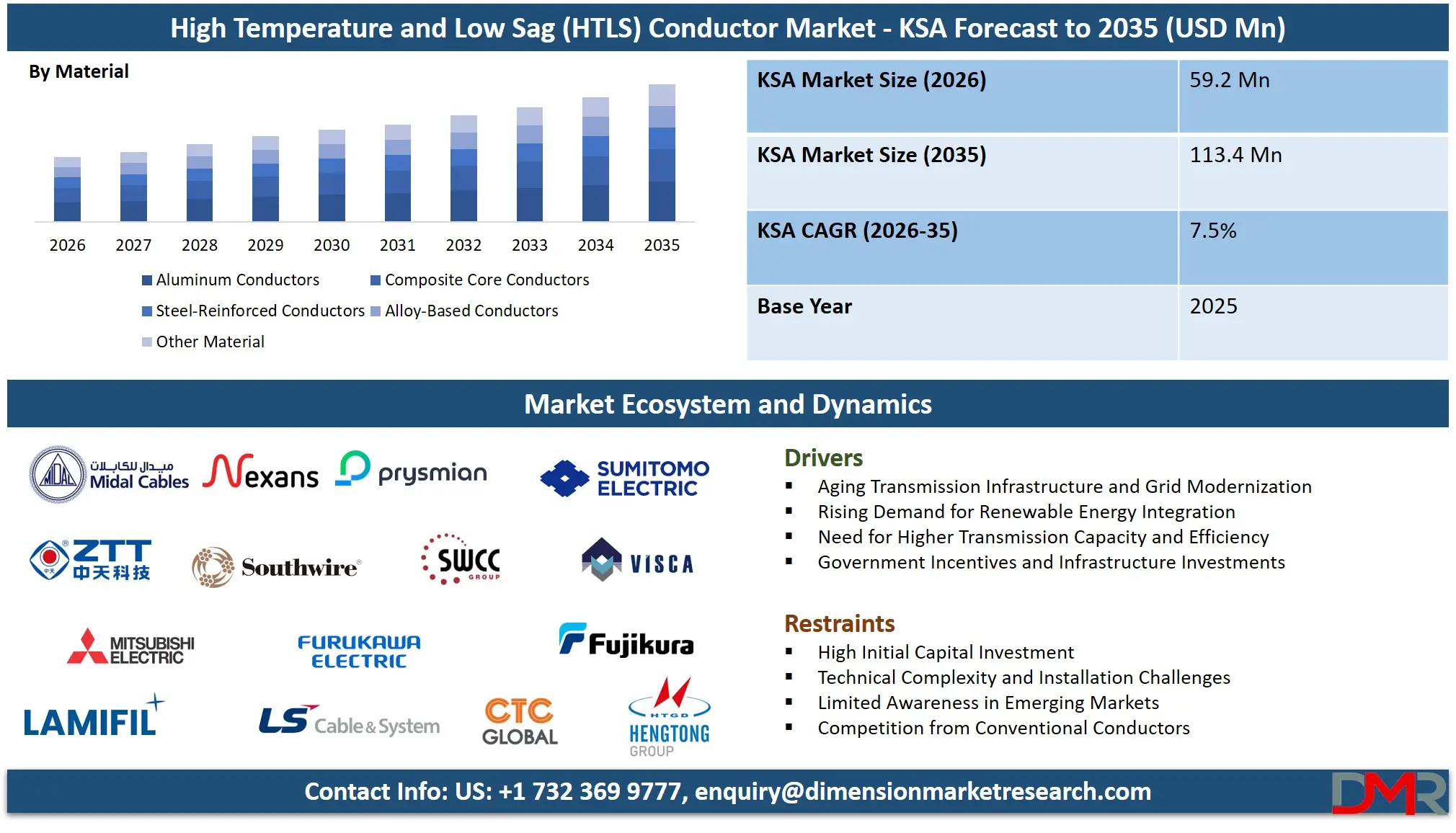
The Saudi Arabia High Temperature and Low Sag (HTLS) Conductor Market is anticipated to be valued at approximately USD 59.2 million in 2026 and is expected to reach around USD 113.4 million by 2035, expanding at a CAGR of about 7.5% during the forecast period.
ℹ
To learn more about this report –
Download Your Free Sample Report Here
The growth of the HTLS conductor market in Saudi Arabia is primarily driven by rapid electricity demand growth, large-scale renewable energy projects, and the modernization of the national transmission infrastructure under the Saudi Vision 2030 strategy. As the Kingdom continues to diversify its energy mix and expand industrial capacity, strengthening the transmission network has become a critical priority.
Saudi Arabia's electricity demand has increased steadily due to population growth, urban development, large industrial zones, and energy-intensive sectors such as petrochemicals, mining, and desalination plants. This demand requires substantial expansion of transmission capacity to ensure reliable electricity delivery across the Kingdom's vast geographic area.
Unlike many mature power markets where infrastructure is aging, Saudi Arabia faces the challenge of rapidly scaling transmission networks to connect newly developed energy generation projects, particularly large renewable power plants located in desert regions far from major load centers such as Riyadh, Jeddah, and Dammam. HTLS conductors provide an effective solution for utilities to increase line capacity without requiring major structural changes to existing towers.
Saudi Arabia is also undergoing a major transformation in its energy sector. The government has set ambitious targets to deploy large solar and wind energy projects under the National Renewable Energy Program (NREP). Many of these projects are located in remote regions such as Al-Jouf, Tabuk, and the Red Sea region, requiring long-distance transmission lines to transport electricity to urban and industrial demand centers.
The Saudi Electricity Company (SEC), the primary electricity transmission operator, is investing heavily in grid modernization, high-voltage transmission expansion, and smart grid infrastructure. These investments are creating strong demand for advanced conductor technologies capable of carrying higher current loads while maintaining mechanical stability under high ambient temperatures.
HTLS conductors are particularly well-suited for Saudi Arabia's climate conditions, where high temperatures can reduce the efficiency and capacity of conventional conductors. Their ability to operate at higher temperatures while maintaining low sag makes them an attractive option for upgrading transmission corridors across desert regions.
Government initiatives supporting energy diversification, economic development projects such as NEOM, and the expansion of energy-intensive industries are further accelerating demand for advanced transmission infrastructure. These developments are expected to play a key role in expanding the HTLS conductor market across the Kingdom.
ℹ
To learn more about this report –
Download Your Free Sample Report Here
Despite strong growth potential, the market faces several challenges, including higher upfront installation costs compared with conventional conductors, complex project logistics in desert environments, and strict technical standards required for high-voltage transmission systems.
Nevertheless, continued advancements in composite core materials, heat-resistant aluminum alloys, and smart monitoring technologies are expected to strengthen the role of HTLS conductors in supporting Saudi Arabia's long-term energy transition and grid expansion.
Impact of Iran War on the Kingdom of Saudi Arabia (KSA) High Temperature and Low Sag (HTLS) Conductor Market
- Increased Raw Material Procurement Costs: Regional geopolitical tensions in the Middle East can affect global commodity markets, particularly aluminum and specialized materials used in conductor manufacturing. Any disruption to global supply chains or fluctuations in commodity prices can increase production costs for HTLS conductors supplied to the Saudi market.
- Supply Chain Disruptions in the Gulf Region: Conflicts affecting shipping routes in the Persian Gulf or the Strait of Hormuz can disrupt maritime logistics and increase freight costs. Saudi Arabia imports a portion of specialized materials used in conductor production, including carbon fiber and alloy materials, making supply chain stability critical for transmission infrastructure projects.
- Energy Price Volatility and Infrastructure Spending: Regional conflicts can cause significant fluctuations in global oil prices. While higher oil prices may increase national revenue for Saudi Arabia, they can also influence infrastructure project budgets and supply chain costs. This volatility may impact the cost structures of large grid expansion projects.
- Strengthened Focus on Energy Infrastructure Security: Geopolitical tensions often encourage governments to strengthen domestic energy infrastructure and ensure a reliable electricity supply. For Saudi Arabia, this may translate into accelerated investment in transmission networks, which can increase long-term demand for advanced conductor technologies such as HTLS.
The Kingdom of Saudi Arabia (KSA) High Temperature and Low Sag (HTLS) Conductor Market: Key Takeaways
- Steady Market Growth: The Saudi Arabia HTLS Conductor Market, valued at USD 59.2 million in 2026, is projected to reach USD 113.4 million by 2035, reflecting consistent growth supported by large infrastructure projects and renewable energy integration.
- Stable CAGR: The market is expected to expand at a CAGR of approximately 7.5% from 2026 to 2035, driven by rising electricity demand, industrial expansion, and renewable energy development.
- ACCC Conductors to Gain Strong Adoption: Aluminum Conductor Composite Core (ACCC) technology is expected to gain strong adoption due to its high ampacity, lightweight design, and ability to increase capacity on existing transmission towers.
- Grid Expansion as Key Application: Large-scale grid expansion projects to support renewable energy plants and industrial developments will remain the primary application segment.
- Electric Utilities as Primary End-Users: The Saudi Electricity Company (SEC) and regional power utilities represent the primary buyers of HTLS conductors as they expand high-voltage transmission networks.
- Renewable Energy Projects Driving Demand: Major renewable energy developments under Saudi Arabia's energy transition strategy are creating strong demand for high-capacity transmission infrastructure.
The Kingdom of Saudi Arabia (KSA) High Temperature and Low Sag (HTLS) Conductor Market: Use Cases
- Long-Distance Renewable Energy Transmission: Saudi Arabia is rapidly developing large-scale renewable energy projects, particularly solar and wind farms located in remote desert regions such as Al Jouf, Tabuk, and the northern areas of the Kingdom.
- Industrial Power Corridor Expansion: Saudi Arabia's industrial growth, driven by economic diversification initiatives under Vision 2030, has significantly increased the demand for reliable and high-capacity electricity transmission infrastructure. Major industrial zones, including in regions such as Jubail, Yanbu, and Ras Al Khair, require robust power supply systems capable of supporting energy-intensive operations.
- Urban Grid Reinforcement: Rapid urbanization and population growth in Saudi Arabia's major cities, including Riyadh, Jeddah, and Dammam, have created increasing pressure on existing electricity transmission infrastructure. Growing residential developments, commercial facilities, and smart city initiatives require greater electricity supply and more reliable grid performance.
- Desert Climate Transmission Reliability: Saudi Arabia's extreme environmental conditions present unique challenges for electricity transmission systems. High ambient temperatures, intense solar radiation, sandstorms, and corrosive desert environments can reduce the performance and lifespan of traditional conductors.
- Mega Project Energy Supply: Saudi Arabia is undertaking several mega infrastructure developments that require massive and reliable electricity supply systems. Projects such as NEOM, Qiddiya, the Red Sea Project, and other large-scale tourism and economic development zones demand advanced transmission infrastructure capable of delivering substantial amounts of power from generation facilities to project sites.
The Kingdom of Saudi Arabia (KSA) High Temperature and Low Sag (HTLS) Conductor Market: Stats & Facts
Saudi Electricity Company (SEC)
- Saudi Arabia's national electricity grid spans approximately 95,132 circuit kilometers of transmission lines.
- The national grid operates 1,233 transmission substations across the country.
- The electricity transmission system includes 3,940 power transformers.
- The grid transmits about 355,982 gigawatt-hours (GWh) of electricity annually.
- Saudi Arabia recorded a peak electricity demand of 70.66 GW in 2023.
- The national grid communication infrastructure includes 87,794 km of fiber-optic cable used for grid monitoring and control.
- Saudi Electricity Company plans to invest around SAR 500 billion in electricity infrastructure expansion by 2030.
National Grid SA
- Saudi Arabia's electricity transmission network previously covered around 84,000 km of high-voltage transmission lines.
- The grid supplies electricity to more than 13,000 cities, towns, and villages.
- The national grid includes over 1,093 conversion substations.
- The transmission system operates more than 3,465 transformers with a total capacity exceeding 424,000 MVA.
Global Transmission Report
- Saudi Arabia operates about 68% of the total GCC electricity transmission network.
- The Kingdom accounts for over 54% of the GCC's total substation capacity.
- Saudi Arabia's substation capacity reached approximately 474,263 MVA in 2022.
- The total GCC transmission network length reached around 120,785 km by 2022, with Saudi Arabia representing the largest share.
Renewable Watch (Power Transmission Analysis)
- Saudi Arabia's transmission network reached about 92,999 circuit kilometers in 2022 at voltage levels between 132 kV and 380 kV.
- Between 2018 and 2022, the transmission network expanded at around 2.7% CAGR.
- The network added approximately 9,317 circuit kilometers of new transmission lines during 2018–2022.
- High-voltage transmission lines operating at 230 kV and 380 kV increased from 37,783 km in 2018 to 49,649 km in 2022.
- Transformer capacity increased from 417,203 MVA in 2018 to about 474,262 MVA in 2022.
Ministry of Energy – Saudi Arabia
- Saudi Arabia's electricity consumption is projected to increase from 292,771 GWh in 2022 to approximately 365,400 GWh by 2030.
- The country plans to add about 5,000 MW of additional conventional power generation capacity by 2030.
- Saudi Arabia is also planning around 2,800 MW of nuclear power capacity by 2030.
National Grid Expansion Programs
- Saudi Arabia plans to expand its transmission network to around 160,000 km by 2030.
- This expansion represents approximately 60% growth compared with the current grid network.
- The national grid currently operates around 1,260 transmission substations.
- Total substation capacity has reached approximately 497,902 MVA.
- Saudi Arabia plans to develop nine new high-voltage direct current (HVDC) interconnection lines.
Power Infrastructure Development
- Saudi Arabia completed a 380 kV overhead transmission line measuring about 420 km, one of the longest in the Kingdom.
- The line strengthens power transmission between the central and western regions of Saudi Arabia.
Power Transmission Infrastructure Statistics
- Saudi Arabia had about 95,564 circuit kilometers of transmission lines in 2023.
- The country operates 1,248 substations in the 72–172 kV voltage range.
- There are 246 substations operating above 172 kV voltage levels.
- The national transmission network is projected to reach about 100,360 circuit kilometers by 2028.
The Kingdom of Saudi Arabia (KSA) High Temperature and Low Sag (HTLS) Conductor Market: Market Dynamic
Driving Factors in the Kingdom of Saudi Arabia (KSA) High Temperature and Low Sag (HTLS) Conductor Market
Rapid Expansion of Electricity Demand
Saudi Arabia continues to experience strong growth in electricity demand due to population expansion, economic development, and increasing industrial activity. The government's Vision 2030 initiative has accelerated infrastructure development, industrial diversification, and urban expansion, all of which contribute to rising power consumption. As new residential communities, commercial complexes, and industrial facilities are established, transmission networks must evolve to accommodate higher electricity loads. HTLS conductors offer an effective solution by enabling existing transmission lines to carry significantly more current without requiring new towers or rights-of-way. Their ability to operate safely at higher temperatures while maintaining low sag allows utilities to expand grid capacity efficiently. This capability makes HTLS conductors a valuable technology for meeting the Kingdom's growing electricity demand while optimizing existing transmission infrastructure.
Renewable Energy Integration
Saudi Arabia's commitment to expanding renewable energy capacity is a major driver of transmission infrastructure investment. Large solar and wind projects are being developed across the country, particularly in regions with strong natural resources. Integrating these generation sources into the national grid requires high-capacity transmission corridors capable of transporting electricity over long distances. HTLS conductors provide utilities with the ability to increase transmission capacity without constructing entirely new lines, reducing both project costs and development timelines. Their high ampacity and superior thermal performance allow renewable energy producers to deliver electricity efficiently to urban and industrial markets. As renewable deployment accelerates, HTLS technology is expected to play an increasingly important role in enabling the smooth integration of clean energy into Saudi Arabia's electricity system.
Restraints in the Kingdom of Saudi Arabia (KSA) High Temperature and Low Sag (HTLS) Conductor Market
High Installation Costs
Despite their technical advantages, HTLS conductors typically involve higher upfront costs compared to traditional conductor technologies. These costs include advanced materials, specialized manufacturing processes, and more complex installation procedures. For utilities operating within strict budget constraints, the higher initial investment can pose challenges, particularly in projects where immediate capacity expansion is not essential. Although HTLS conductors often provide long-term economic benefits through increased efficiency and reduced infrastructure requirements, the initial financial barrier can slow adoption in certain projects. Utilities must carefully evaluate the cost-benefit balance when deciding whether to implement HTLS solutions for transmission upgrades.
Harsh Environmental Conditions
Saudi Arabia's desert climate presents engineering challenges for transmission infrastructure development and maintenance. Extreme heat, dust accumulation, sandstorms, and long transmission distances can place significant stress on electrical conductors and supporting structures. These environmental factors may increase maintenance requirements and create operational complexities for utilities. Installing and maintaining transmission lines across remote desert regions also requires specialized equipment and logistical planning. While HTLS conductors are designed to perform well under high temperatures, the challenging environmental conditions can still increase project complexity and operational costs.
Opportunities in the Kingdom of Saudi Arabia (KSA) High Temperature and Low Sag (HTLS) Conductor Market
Renewable Energy Grid Development
The rapid expansion of renewable energy projects across Saudi Arabia represents one of the most significant growth opportunities for the HTLS conductor market. Large solar parks and wind farms require extensive transmission networks capable of handling high power flows over long distances. HTLS technology enables utilities to develop efficient transmission systems that support renewable energy integration without extensive new infrastructure development. As renewable generation capacity continues to expand, demand for high-capacity conductors capable of handling increased electricity flows is expected to grow substantially.
Mega Infrastructure Projects
Saudi Arabia is investing heavily in mega infrastructure developments designed to diversify its economy and attract global investment. Projects such as NEOM, Qiddiya, and the Red Sea Project require reliable electricity infrastructure capable of supporting advanced urban environments, tourism facilities, and industrial activities. HTLS conductors provide the high-capacity transmission capabilities required to power these large-scale developments. As these projects progress, significant opportunities will emerge for HTLS deployment within new transmission networks and grid reinforcement initiatives.
Trends in the Kingdom of Saudi Arabia (KSA) High Temperature and Low Sag (HTLS) Conductor Market
Adoption of Composite Core Conductors
Composite core conductors are gaining increasing attention within the Saudi transmission sector due to their exceptional strength-to-weight ratio and superior thermal performance. These conductors incorporate advanced materials such as carbon fiber cores, which significantly reduce sag and allow higher operating temperatures. Utilities are exploring composite core technologies as a means of upgrading existing transmission lines while maintaining structural stability and safety clearances. As awareness of their long-term performance advantages grows, composite core HTLS conductors are expected to see increased adoption in high-capacity transmission projects.
Expansion of Extra-High Voltage Networks
Saudi Arabia continues to expand its extra-high voltage transmission network, particularly the 380 kV grid that forms the backbone of the national electricity system. These high-capacity transmission lines connect major generation facilities with population centers and industrial regions across the Kingdom. The expansion of this network is essential for supporting future electricity demand and enabling the integration of large renewable energy projects. HTLS conductors are increasingly being considered for these high-voltage applications because they allow greater power transfer capacity without requiring additional transmission corridors. As the national grid continues to evolve, the demand for advanced conductor technologies is expected to rise accordingly.
The Kingdom of Saudi Arabia (KSA) High Temperature and Low Sag (HTLS) Conductor Market: Research Scope and Analysis
By Conductor Type Analysis
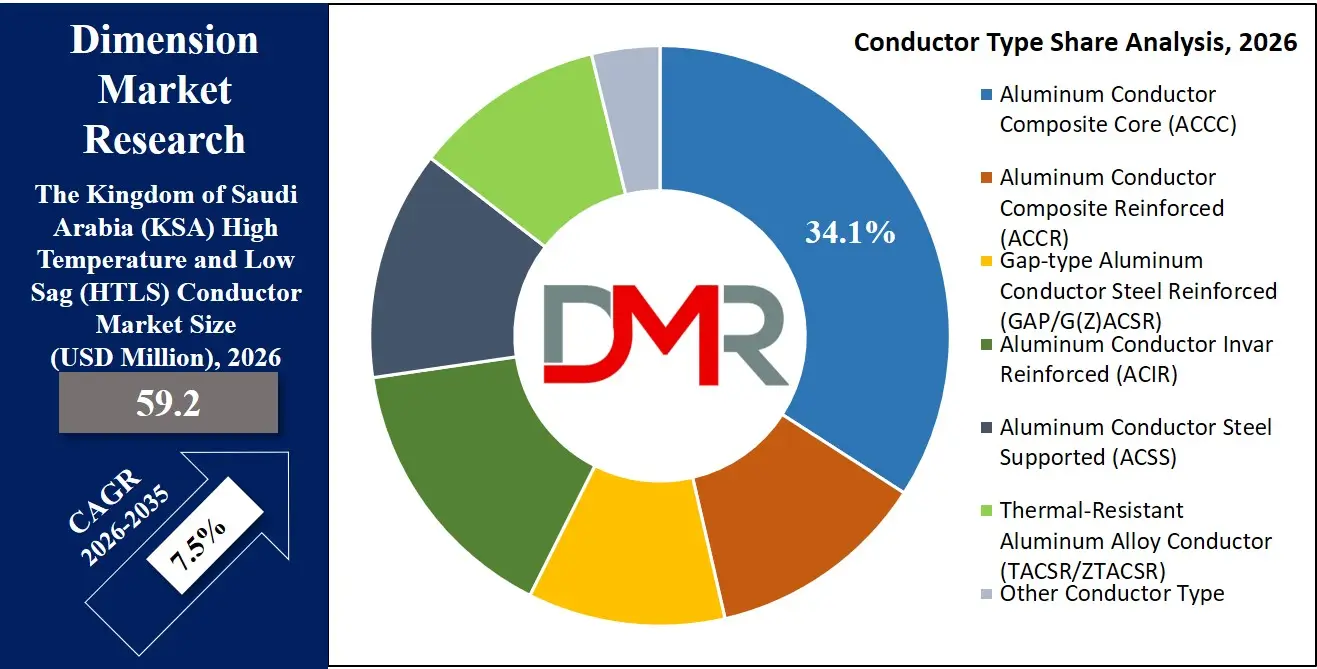
The Aluminum Conductor Composite Core (ACCC) segment is projected to lead the Kingdom of Saudi Arabia (KSA) HTLS Conductor Market, capturing a significant share in 2026. This leadership is primarily driven by the country's increasing demand for high-capacity transmission infrastructure to support long-distance electricity transmission from renewable energy generation sites to major urban and industrial load centers. Saudi Arabia is rapidly expanding solar and wind energy projects in remote desert regions such as Tabuk, Al Jouf, and the northern parts of the Kingdom. These locations require advanced transmission solutions capable of delivering large volumes of electricity across vast distances while maintaining high efficiency and reliability. ACCC conductors provide a major capacity improvement compared with conventional conductors, often enabling utilities to double transmission capacity while maintaining minimal sag due to their lightweight composite core structure.
ℹ
To learn more about this report –
Download Your Free Sample Report Here
The superior high-temperature performance of ACCC conductors, capable of operating at temperatures up to approximately 180°C without significant sagging, makes them particularly suitable for Saudi Arabia's extreme desert climate. Transmission lines in the Kingdom frequently operate under high ambient temperatures, and conventional conductors often experience limitations in such conditions. ACCC technology allows utilities to maintain required ground clearance even during peak load conditions, ensuring safe and reliable grid operations. Additionally, the lightweight nature of composite cores reduces mechanical stress on existing transmission towers, enabling utilities to upgrade existing infrastructure without extensive structural reinforcement.
Saudi Arabia's growing emphasis on renewable energy integration, supported by national initiatives such as the National Renewable Energy Program, aligns strongly with the capabilities of ACCC conductors. Large renewable generation projects require efficient long-distance transmission corridors to deliver electricity to high-demand regions such as Riyadh, Jeddah, and the Eastern Province. Transmission planners are increasingly specifying composite core conductors because they provide high power transfer capability while minimizing energy losses over long distances. These characteristics make ACCC technology particularly suitable for connecting large solar parks and wind farms with the national grid.
By Material Analysis
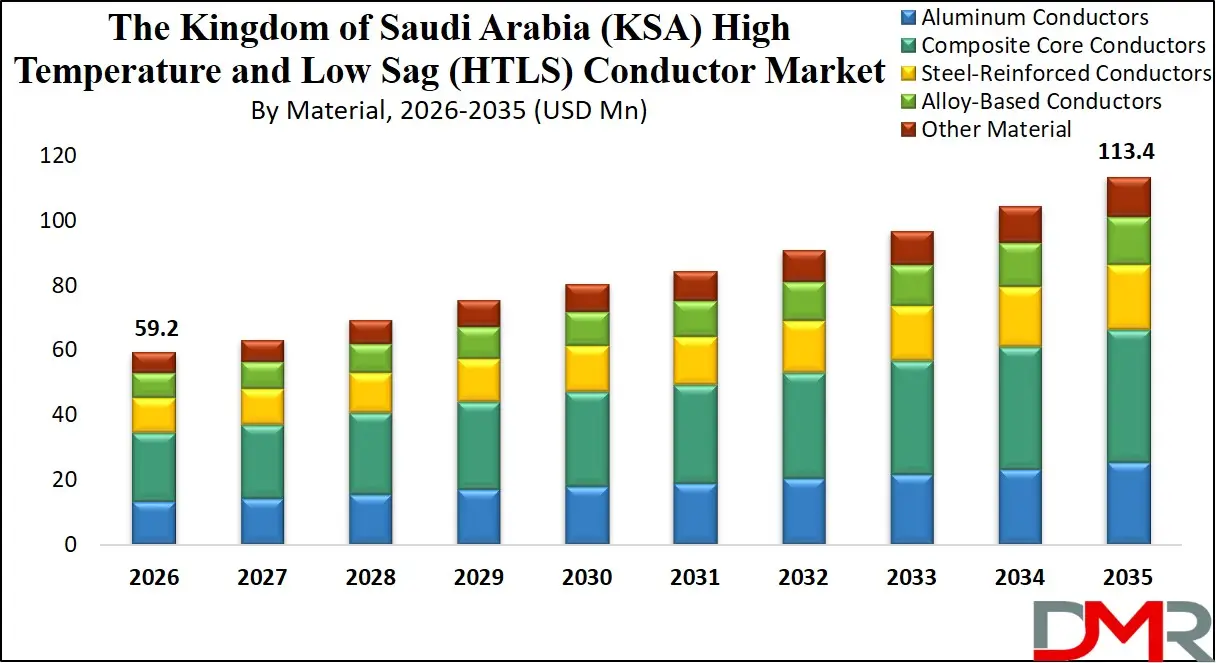
Composite core materials are expected to dominate the material segment in the Kingdom of Saudi Arabia's HTLS conductor market. These materials offer a superior strength-to-weight ratio and exceptional thermal stability compared with conventional steel-reinforced conductors. In Saudi Arabia, where transmission networks often span long distances across desert landscapes, the ability to maximize transmission capacity without increasing structural loads on towers is a key requirement. Composite core conductors provide a practical solution by enabling higher current-carrying capacity while maintaining low sag even under high operating temperatures.
The lightweight structure of composite cores simplifies installation and reduces mechanical stress on transmission towers, which is particularly beneficial for upgrading existing transmission infrastructure. Saudi Arabia's rapidly expanding grid requires frequent upgrades to accommodate rising electricity demand and new renewable energy projects. By replacing traditional conductors with composite core HTLS conductors, utilities can significantly increase transmission capacity without constructing entirely new lines. This reconductoring approach reduces both project costs and development timelines while improving the efficiency of existing infrastructure.
Composite conductors also offer excellent resistance to environmental degradation, which is an important consideration in Saudi Arabia's desert environment. Transmission lines are frequently exposed to extreme heat, sandstorms, and dust accumulation, all of which can accelerate wear and reduce the operational lifespan of traditional conductors. Composite materials provide improved durability and corrosion resistance, making them well-suited for long-term operation in harsh climatic conditions. These properties enhance the reliability of transmission systems and reduce maintenance requirements for utilities.
While steel-reinforced conductors and specialized alloy-based conductors such as Aluminum Conductor Invar Reinforced (ACIR) remain relevant for specific applications, their performance under extremely high temperatures is generally lower compared with composite core conductors. As Saudi Arabia continues to expand its transmission network to support economic diversification and renewable energy development, utilities are expected to increasingly adopt composite core technologies. The combination of high thermal tolerance, reduced sag, and enhanced durability positions composite materials as a key component of the Kingdom's future transmission infrastructure.
By Voltage Level Analysis
High Voltage (HV) and Extra High Voltage (EHV) transmission applications are expected to dominate the voltage level segment in the Kingdom of Saudi Arabia's HTLS conductor market. These voltage levels form the backbone of the national transmission system, connecting large power generation facilities with major demand centers across the country. Saudi Arabia operates an extensive high-capacity transmission network that includes 132 kV, 230 kV, and particularly 380 kV extra-high-voltage lines, which serve as the primary arteries of the national electricity grid.
The increasing scale of renewable energy projects and industrial developments requires transmission systems capable of delivering electricity across vast distances with minimal energy loss. HTLS conductors are particularly valuable for high-voltage and extra-high-voltage applications because they allow transmission lines to carry significantly higher current loads without requiring new infrastructure. Upgrading existing HV and EHV lines with HTLS conductors enables utilities to enhance bulk power transfer capacity and relieve congestion on critical transmission corridors.
These upgrades are particularly important for connecting remote renewable energy generation sites with major consumption centers such as Riyadh, Jeddah, Dammam, and emerging economic zones. Many of Saudi Arabia's solar and wind projects are located in sparsely populated regions where transmission infrastructure must span hundreds of kilometers to reach the main grid. HTLS technology allows utilities to maximize the efficiency of these long-distance transmission corridors while maintaining safe operating conditions even under extreme temperatures.
By Application Analysis
Grid reconductoring and capacity upgrade applications are expected to dominate the application segment of the Kingdom of Saudi Arabia's HTLS conductor market. This dominance reflects the country's growing need to increase transmission capacity while optimizing existing infrastructure. As electricity demand continues to rise due to population growth, industrial expansion, and renewable energy integration, utilities must find efficient ways to expand the capacity of the national grid. Reconducting existing transmission lines with HTLS technology offers a practical and cost-effective solution for achieving this objective.
By replacing conventional conductors with HTLS conductors on existing towers, utilities can significantly increase the power-carrying capacity of transmission lines without constructing new transmission corridors. This approach reduces project costs, minimizes environmental impact, and accelerates project implementation timelines. In Saudi Arabia, where large transmission distances and challenging desert conditions make new infrastructure development complex, reconductoring existing lines provides a highly attractive alternative.
Grid reconductoring also supports the integration of large renewable energy projects being developed under national energy programs. Many solar and wind projects require upgraded transmission infrastructure to deliver electricity to the main grid. HTLS conductors enable utilities to increase the capacity of existing transmission lines, allowing them to accommodate higher power flows from renewable generation sources.
While new power transmission projects continue to be developed to support major infrastructure initiatives and economic zones, many of these developments rely on upgrades to existing transmission networks. As Saudi Arabia continues to modernize and expand its electricity grid, reconductoring and capacity enhancement using HTLS technology will remain one of the most important strategies for improving transmission efficiency and reliability.
By End-Use Industry Analysis
The electric utilities sector is expected to dominate the end-use segment of the Kingdom of Saudi Arabia's HTLS conductor market. Utilities are responsible for owning, operating, and expanding the national electricity transmission infrastructure, making them the primary purchasers of advanced conductor technologies. In Saudi Arabia, the Saudi Electricity Company (SEC) plays a central role in managing the country's power generation, transmission, and distribution systems, while also coordinating with government agencies and energy authorities to implement national energy strategies.
The procurement of HTLS conductors by utilities is driven by several important factors, including the need to integrate renewable energy projects, improve grid reliability, and increase transmission capacity to support economic development. Saudi Arabia's long-term energy strategy emphasizes both renewable energy deployment and industrial expansion, both of which require significant upgrades to the national transmission network. Utilities, therefore, play a critical role in implementing grid modernization initiatives that support these national objectives.
As the Kingdom expands its electricity infrastructure to support mega projects, industrial zones, and new urban developments, utilities will continue investing in advanced transmission technologies. HTLS conductors provide a practical solution for enhancing grid performance while minimizing the need for entirely new transmission infrastructure. Their ability to increase current carrying capacity while maintaining structural stability makes them particularly valuable for large-scale transmission projects.
The Kingdom of Saudi Arabia (KSA) High Temperature and Low Sag (HTLS) Conductor Market Report is segmented on the basis of the following:
By Conductor Type
- Aluminum Conductor Composite Core (ACCC)
- Aluminum Conductor Composite Reinforced (ACCR)
- Gap-type Aluminum Conductor Steel Reinforced (GAP/G(Z)ACSR)
- Aluminum Conductor Invar Reinforced (ACIR)
- Aluminum Conductor Steel Supported (ACSS)
- Thermal-Resistant Aluminum Alloy Conductor (TACSR/ZTACSR)
- Other Conductor Type
By Material
- Aluminum Conductors
- Composite Core Conductors
- Steel-Reinforced Conductors
- Alloy-Based Conductors
- Other Material
By Voltage Level
- Low Voltage (LV)
- Medium Voltage (MV)
- High Voltage (HV)
- Extra High Voltage (EHV)
By Application
- Power Transmission
- Power Distribution
- Renewable Energy Grid Integration
- Grid Reconductoring / Capacity Upgrade
- Other Application
By End-Use Industry
- Electric Utilities
- Renewable Energy Integration
- Oil & Gas
- Mining & Metal Processing
- Railways & Transportation
- Other End-Use Industry
Impact of Artificial Intelligence on the Kingdom of Saudi Arabia (KSA)'s High Temperature and Low Sag (HTLS) Conductor Market
- AI-Driven Composite Core Design Optimization: Artificial intelligence improves the engineering of composite cores used in HTLS conductors. AI-based simulations optimize carbon-fiber structures that deliver high strength and minimal thermal expansion, enabling Saudi utilities to increase transmission capacity on existing towers while maintaining low sag under extreme desert temperatures.
- AI-Supported Development of High-Temperature Alloy Materials: AI-driven metallurgy research helps identify advanced aluminum alloys such as aluminum-zirconium capable of operating at 150°C–210°C. These materials support reliable HTLS conductor performance in Saudi Arabia's high-temperature environments while improving conductivity, strength, durability, and overall transmission efficiency.
- Advanced Gap-Type Conductor Engineering: AI-supported simulations help optimize gap-type conductor designs where aluminum strands are separated from the steel core. This configuration enables controlled thermal expansion, minimizes sag during high-temperature operation, and supports safe, efficient upgrades of Saudi Arabia's long-distance high-voltage transmission corridors.
- Smart Protective Coating Development: Artificial intelligence assists in developing advanced protective coatings that improve HTLS conductor durability. These coatings resist corrosion, sand abrasion, and extreme temperatures common in Saudi Arabia, extending conductor lifespan, lowering maintenance requirements, and ensuring reliable grid performance across diverse environments.
- AI-Based Simulation and Performance Modeling: AI-powered modeling tools simulate electrical, thermal, and mechanical stresses on HTLS conductors before deployment. These simulations help engineers optimize designs for Saudi Arabia's long-distance transmission networks, improving reliability, predicting maintenance needs, and ensuring stable performance under extreme operating conditions.
The Kingdom of Saudi Arabia (KSA) High Temperature and Low Sag (HTLS) Conductor Market: Competitive Landscape
The Kingdom of Saudi Arabia HTLS Conductor Market features a competitive environment consisting of global cable manufacturers, regional suppliers, and technology providers specializing in advanced transmission solutions. Increasing demand for high-capacity transmission infrastructure, driven by renewable energy integration and large-scale industrial expansion, has attracted several international companies to the Saudi market.
Global cable manufacturers such as Prysmian, Nexans, and CTC Global provide advanced HTLS technologies, including composite core conductors and heat-resistant alloy conductors. These companies often collaborate with regional engineering firms and utilities to supply transmission infrastructure for large energy projects across the Kingdom.
ℹ
To learn more about this report –
Download Your Free Sample Report Here
Regional manufacturers and infrastructure suppliers also play an important role in the market. Companies such as Midal Cables, APAR Industries, and Sterlite Power offer conductor technologies designed specifically for high-temperature environments and long-distance transmission applications typical in the Middle East.
In addition, materials suppliers and advanced metallurgy companies contribute to the development of HTLS conductors by providing specialized alloys, composite fibers, and protective coatings. As Saudi Arabia continues to expand its electricity grid and renewable energy infrastructure under national development programs, competition among global and regional players is expected to intensify, leading to further innovation in conductor technologies.
Some of the prominent players in the Kingdom of Saudi Arabia (KSA) High Temperature and Low Sag (HTLS) Conductor Market are:
- Prysmian S.p.A.
- Nexans S.A.
- CTC Global Corporation
- LS Cable & System Ltd.
- Southwire Company, LLC
- Lamifil N.V.
- Hengtong Group
- ZTT International Limited
- Midal Cables Ltd.
- APAR Industries Limited
- Sterlite Power
- Sumitomo Electric Industries, Ltd.
- Furukawa Electric Co., Ltd.
- Fujikura Ltd.
- SWCC Showa Holdings Co., Ltd.
- Mitsubishi Cable Industries, Ltd.
- VISCAS Corporation
- Other Key Players
Recent Developments in the Kingdom of Saudi Arabia (KSA) High Temperature and Low Sag (HTLS) Conductor Market
- April 2025: Skipper Limited secured a contract from Saudi Electricity Company (SEC) for the supply, manufacturing, and testing of 500 kV HVDC overhead transmission line towers for an interconnection project in Saudi Arabia, supporting high-capacity transmission infrastructure expansion.
- December 2024: Saudi Electricity Company continued large-scale grid modernization programs focused on strengthening high-voltage transmission corridors to support renewable energy integration and long-distance power transfer across the Kingdom.
- October 2024: Saudi Arabia accelerated the Egypt–Saudi Arabia HVDC interconnection project, with approximately 95% of construction completed and commissioning expected by the end of 2025, strengthening cross-border electricity transmission infrastructure.
- July 2024: Transmission equipment manufacturers and EPC contractors participated in Saudi infrastructure energy forums and power transmission conferences, focusing on advanced conductor technologies, including HTLS conductors for improving grid capacity.
- May 2024: Saudi Electricity Company and international engineering contractors expanded cooperation on high-voltage transmission corridor projects designed to support renewable energy projects under Saudi Vision 2030.
- March 2024: Saudi Electricity Company updated its list of qualified global manufacturers and suppliers for grid equipment and transmission materials, allowing several international cable and conductor manufacturers to participate in upcoming transmission projects.
- January 2024: Saudi power authorities initiated new transmission infrastructure tenders aimed at expanding high-capacity power corridors linking major renewable energy zones and industrial regions.
Report Details
| Report Characteristics |
| Market Size (2026) |
USD 59.2 Mn |
| Forecast Value (2035) |
USD 113.4 Mn |
| CAGR (2026–2035) |
7.5% |
| Historical Data |
2021 – 2025 |
| Forecast Data |
2027 – 2035 |
| Base Year |
2025 |
| Estimate Year |
2026 |
| Report Coverage |
Market Revenue Estimation, Market Dynamics, Competitive Landscape, Growth Factors and etc. |
| Segments Covered |
By Conductor Type (Aluminum Conductor Composite Core (ACCC), Aluminum Conductor Composite Reinforced (ACCR), Gap-type Aluminum Conductor Steel Reinforced (GAP/G(Z)ACSR), Aluminum Conductor Invar Reinforced (ACIR), Aluminum Conductor Steel Supported (ACSS), Thermal-Resistant Aluminum Alloy Conductor (TACSR/ZTACSR), Other Conductor Type), By Material (Aluminum Conductors, Composite Core Conductors, Steel-Reinforced Conductors, Alloy-Based Conductors, Other Material), By Voltage Level (Low Voltage (LV), Medium Voltage (MV), High Voltage (HV), Extra High Voltage (EHV)), By Application (Power Transmission, Power Distribution, Renewable Energy Grid Integration, Grid Reconductoring / Capacity Upgrade, Other Application), and By End-Use Industry (Electric Utilities, Renewable Energy Integration, Oil & Gas, Mining & Metal Processing, Railways & Transportation, Other End-Use Industry). |
| Country Coverage |
The Kingdom of Saudi Arabia (KSA) |
| Prominent Players |
Prysmian S.p.A., Nexans S.A., CTC Global Corporation, LS Cable & System Ltd., Southwire Company, LLC, Lamifil N.V., Hengtong Group, ZTT International Limited, Midal Cables Ltd., APAR Industries Limited, Sterlite Power, Sumitomo Electric Industries, Ltd., Furukawa Electric Co., Ltd., Fujikura Ltd., SWCC Showa Holdings Co., Ltd., Mitsubishi Cable Industries, Ltd., VISCAS Corporation, and Other Key Players |
| Purchase Options |
We have three licenses to opt for: Single User License (Limited to 1 user), Multi-User License (Up to 5 Users) and Corporate Use License (Unlimited User) along with free report customization equivalent to 0 analyst working days, 3 analysts working days and 5 analysts working days respectively. |
Frequently Asked Questions
What is the market size of the Kingdom of Saudi Arabia HTLS Conductor Market?
▾ The Kingdom of Saudi Arabia HTLS Conductor Market is estimated to reach approximately USD 59.2 million in 2026 and is projected to grow to USD 113.4 million by 2035.
What is the expected growth rate of the Saudi Arabia HTLS Conductor Market?
▾ The market is projected to grow at a compound annual growth rate (CAGR) of around 7.5% during the forecast period from 2026 to 2035.
Who are the major companies operating in the Saudi Arabia HTLS Conductor Market?
▾ Major market participants include CTC Global Corporation, LS Cable & System, Southwire Company, Midal Cables, APAR Industries, Sterlite Power, Sumitomo Electric Industries, Furukawa Electric, and Fujikura Ltd.